
Power reserve numbers on AP super clone listings can easily be misunderstood. A claimed 60 or 70 hours may point to a certain movement route or newer model style, but it does not prove that the watch will deliver that result in normal ownership. Real reserve depends on the condition of the movement, winding efficiency, lubrication, mainspring strength, AP replica rotor noise, rotor behavior, and batch consistency. It also matters whether the number comes from a controlled full-wind test or from ordinary wrist wear.
This article helps buyers judge those claims more practically. Instead of choosing the highest advertised reserve, the better approach is to confirm the movement type, test the watch from a proper full wind, and watch for repeatable behavior over several days. Smooth crown feel, clean date change, stable running, and reliable overnight performance usually matter more than a headline number that cannot be verified.
| Buyer Check | What It Really Tells You | Practical Judgment |
|---|---|---|
| Advertised 60–70 hour reserve | Often reflects the claimed movement route or model generation | Treat it as a reference, not a guaranteed result |
| Controlled full-wind test | Shows the movement’s reserve under clearer conditions | More useful than judging from light daily wear alone |
| Clone 3120 route | Common for time-and-date AP-style builds | Sensible if behavior is smooth and consistent |
| Clone 4302 route | Often linked to 15500-style builds and longer reserve claims | Verify with testing instead of trusting the listed number |
| Miyota 9015 option | Usually easier to service but less AP-like in layout and feel | Practical for reliability-focused buyers who accept the trade-off |
| Repeated early stopping | May indicate winding, lubrication, mainspring, or batch issues | More concerning than a small shortfall from the advertised reserve |
Quick Questions Before You Read
Q: Should I trust a listed 70-hour power reserve?
Use it only as a starting point. The real test is repeatable performance after a proper full wind.
Q: Is a shorter-than-advertised reserve always a defect?
No. A small shortfall can be acceptable if winding, timekeeping, date change, and overnight running are stable.
Q: Which matters more, movement name or actual behavior?
Actual behavior matters more. A familiar clone name does not guarantee good lubrication, winding efficiency, or batch quality.
Q: What warning sign should buyers take seriously?
Repeated early stopping after a controlled full wind, especially with rough winding or weak date change, deserves caution.
Editorial Perspective: For AP super clone buyers, power reserve should be treated as a movement-behavior question, not a factory-name contest. A factory label, seller description, or caseback photo can help identify the likely movement route, but it does not prove lubrication quality, mainspring strength, winding efficiency, or current-batch consistency. At cleanvsfactory.com, this kind of claim is best judged by model, movement, and intended use: a watch that looks convincing in photos may still be a poor daily-wear choice if it winds weakly, stops overnight, or gives inconsistent full-wind results.
Evidence Boundary: This article discusses buyer-side evaluation of imitation AP-style watches, not authorized Audemars Piguet products. In this market, many movement names, factory names, and power-reserve figures come through seller descriptions or community shorthand rather than public manufacturer documentation. For that reason, the safest reading is conservative: a claimed movement route can guide questions, but only the behavior of the individual watch can support confidence in its actual reserve, winding efficiency, and daily reliability.
Brand and Reference Boundary: Audemars Piguet and Royal Oak references are used here to identify the genuine reference designs being discussed. AP super clone watches and other replica-market watches are not genuine Audemars Piguet watches, are not produced or authorized by Audemars Piguet, and should not be represented, resold, or used as authentic watches. The purpose of movement and factory discussion is buyer education and risk awareness, not authentication avoidance or misrepresentation.
Why AP Super Clone Power Reserve Claims Deserve Careful Reading
The short answer is this: an AP super clone power reserve claim is worth reading, but it should not be treated as a guaranteed result. A listing that says “60 hours” or “70 hours” may be describing the movement route, the intended specification, or the number the factory wants buyers to associate with that watch. It does not mean every individual Royal Oak super clone will run that exact length after every normal wearing day.
This is where many buyers misread replica AP movement claims. Power reserve is a real mechanical measurement, not a meaningless sales phrase. But in the replica watch market, the number is often simplified before it reaches the buyer. Movement cleanliness, lubrication, mainspring condition, winding efficiency, rotor behavior, and batch quality can all change the real-world running time. Two watches advertised with the same movement name can behave differently on the wrist.
The Short Answer for Buyers
Buyers should treat advertised power reserve as a reference range, not a fixed promise. A 60-hour claim tells you the watch is being positioned as a longer-reserve AP-style movement. A 70-hour claim often signals a newer-style movement route associated with later Royal Oak references. Neither claim proves that the exact watch in front of you will deliver that number consistently.
The better question is not “does the description say 70 hours?” The better question is “does this movement wind smoothly, hold power consistently, change date cleanly, and behave the same way over more than one cycle?” That is the practical difference between a spec sheet claim and movement reliability in daily ownership.
A small shortfall from the advertised number is not automatically a disaster. A watch that runs meaningfully less than claimed after one casual day of desk wear may simply be under-wound. But repeated early stopping after a controlled full wind is a different issue. That pattern matters more than whether the listing used an impressive hour count.
Why AP Buyers Notice This More Than Some Other Replica Buyers
AP buyers tend to notice power reserve claims because Royal Oak-style super clone watches are movement-sensitive in a way that many simpler replica watches are not. The display caseback invites buyers to compare decoration, bridge layout, rotor engraving, balance position, and movement naming. Once a seller mentions clone 3120, clone 4302, Miyota-based construction, or a chronograph movement, buyers naturally start expecting the performance to match the language.
This is especially true with Royal Oak super clone models because the movement is tied to more than running time. It affects case thickness, caseback appearance, winding feel, date behavior, and sometimes rotor noise. A movement can look convincing through the back and still deliver disappointing daily performance if the automatic winding is weak or the movement is dry from assembly.
At Clean VS Factory, we usually separate the visual movement claim from the ownership behavior. A decorated bridge or AP-style rotor may help the watch look closer to the intended reference, but it does not automatically prove strong power delivery. For daily wear, the more useful judgment is whether the movement behaves predictably, not whether the listing uses the most prestigious caliber name.
Factory names and movement-route names in the replica watch market are useful buyer-facing references, but they should not be treated as official luxury-brand affiliations or automatic proof of quality across every AP-style model. A factory may execute one Royal Oak reference well while showing weaker consistency on another because case profile, bracelet construction, dial finishing, movement layout, and current-batch assembly are separate variables. For power reserve specifically, the factory label should lead to better questions, not replace testing of the individual watch.
When a Power Reserve Claim Is Still Useful
A power reserve claim is not useless. It can help identify what movement route is being advertised. If one AP replica is described around a shorter reserve and another around a longer-reserve clone movement, that difference may point to different architecture, different case construction, or a different generation of factory development. The number gives buyers a starting point for questions.
The mistake is stopping there. A claimed 70-hour reserve should lead to verification, not blind confidence. Buyers should still consider whether the movement route is clearly named, whether the factory version is current, whether the watch has a history of consistent behavior, and whether the seller is describing a full-wind reserve or ordinary real wearing performance.
The most sensible way to read these claims is to treat them as a filter. They help you understand what the watch is supposed to be. They do not replace observation. In AP super clone movements, consistency over several days is more valuable than a large headline number that only appears in a product description.

What Power Reserve Actually Means in a Mechanical AP-Style Watch
Mechanical watch power reserve means the amount of time a fully wound watch can keep running before it stops. Inside the movement, energy is stored in the mainspring, which sits inside the barrel. As the mainspring unwinds, it releases energy through the gear train to keep the watch running. In simple terms, the power reserve number describes how long that stored energy should last from a full wind.
That definition sounds clean, but ownership is messier. Most people do not wear an automatic watch from a perfectly full-wind condition every day. They wear it to work, sit at a desk, drive, type, take it off at night, and expect it to keep running. That daily routine may not charge the mainspring anywhere near its full capacity, especially if the automatic winding system is not very efficient.
Practical Evidence Note: A buyer does not need laboratory tools to separate a weak claim from a useful one. The most persuasive evidence is repeatable behavior: a clearly wound watch, a recorded start time, a recorded stop time, and similar results over more than one cycle. Seller wording, factory labels, and caseback decoration can support the story of the movement, but they are weaker than a controlled observation of the actual watch.
Full-Wind Reserve Versus Daily-Wear Reserve
A full-wind reserve is a controlled measurement. The watch is wound to its maximum safe operating point, then left to run until it stops. If an AP clone movement power reserve claim says 60 hours or 70 hours, that number normally refers to this kind of ideal starting condition, not the reserve remaining after a few casual hours on the wrist.
Daily-wear reserve is different. A buyer may wear an AP-style automatic watch for eight or ten hours and assume it should now be fully charged. That is not always true. If the buyer spends most of the day at a computer and wears the bracelet loosely, the rotor may not move enough to replenish much energy. The watch may stop overnight even though the movement could run longer from a proper full wind.
This distinction prevents a common misdiagnosis. A watch that stops after light wear is not automatically defective. It may be under-wound. But if the same watch performs poorly after a controlled full-wind test, then the concern shifts from wearing habits to movement performance.
Why Automatic Winding Efficiency Matters
An automatic watch depends on wrist motion. The rotor turns as the wrist moves, and the winding system transfers that motion into stored mainspring energy. If the rotor is too light, the winding gears are inefficient, or the movement has friction from poor lubrication, the watch may struggle to maintain its charge during normal use.
This is one reason a long advertised power reserve can be misleading. A movement may have a theoretical barrel capacity that supports a longer running duration, but the owner may rarely reach that state through everyday wear. In practice, automatic winding efficiency can matter more than the headline reserve number for someone who wears the watch lightly.
AP-style watches also create a specific buyer expectation because they often feel substantial on the wrist. A heavy bracelet and large case can make the watch feel mechanically serious, but weight alone does not charge the mainspring. The rotor, winding path, and movement condition do that work. If those parts are not efficient, the watch can look impressive and still behave like a partial-wind watch most of the time.
What Power Reserve Does Not Prove
Power reserve does not prove overall movement quality by itself. A watch can run for many hours and still have rough winding, noisy rotor action, weak date change behavior, or poor long-term service prospects. The number only tells you one part of the energy story.
It also does not prove water resistance, case accuracy, bracelet finishing, dial quality, or whether the movement is close to the original AP architecture. Buyers sometimes treat a 70-hour claim as if it upgrades the whole watch. That is the wrong reading. A strong reserve is useful, but it is not a substitute for checking the complete movement behavior and the physical execution of the watch.
Water resistance should not be assumed from a model name, Royal Oak-style appearance, or seller photos. Buyers should confirm whether the specific watch has been tested and what the seller’s policy actually covers before exposing any replica watch to water; even then, replica-market watches should be treated more cautiously than genuine watches serviced through official brand channels.
The most practical judgment is this: power reserve matters, but it matters as part of a pattern. Smooth winding, stable running, clean date change, reasonable rotor behavior, and repeatable performance are all more meaningful than one isolated number.
Why Genuine AP Power Reserve Is a Performance Feature, Not Just a Number
In a genuine Audemars Piguet watch, power reserve is not simply a marketing line. It is part of the movement’s engineering. The stated reserve is connected to barrel design, gear train efficiency, winding system behavior, tolerances, finishing, lubrication standards, and long-term quality control. That broader system is what buyers are really responding to when they see genuine AP power reserve discussed as a premium feature.
This context matters because replica listings often borrow the same language. A product description may reference AP caliber 3120, AP caliber 4302, or a Royal Oak movement style to suggest closeness to the original watch. But a replica movement is not an official Audemars Piguet caliber, and it should not be judged as if it carries the same development, finishing, or consistency standard. The number may be similar; the control behind the number is not the same.
How Genuine Movement Design Shapes Buyer Expectations
Authentic Audemars Piguet movement performance is designed as a complete package. A genuine AP caliber is not only built to store energy for a certain number of hours. It is also designed to wind efficiently, deliver energy predictably, operate within specified tolerances, and maintain stable behavior across many years with proper service.
That is why genuine AP power reserve figures influence expectations in the replica market. If a buyer knows a certain Royal Oak generation is associated with a longer-running movement, they naturally expect the super clone version to advertise a similar number. The issue is not that buyers care about power reserve. They should. The issue is assuming the replica-market claim carries the same meaning as the genuine specification.
For a buyer, the decision-changing point is simple: do not compare only the printed reserve number. Compare how the movement route supports the watch in real use. If a clone movement gives the correct case thickness, acceptable visual layout, and stable daily behavior, it may be a more rational choice than a watch that advertises a higher number but behaves inconsistently.
Why Replica Listings Borrow Genuine-Sounding Language
Replica listings often use genuine-sounding caliber names because they help buyers understand which model generation the watch is trying to represent. A clone 3120-style movement usually signals one kind of Royal Oak expectation. A clone 4302-style movement suggests another. These names can be useful shorthand, but they can also make the claim feel more precise than the actual watch may be.
The danger is that buyers may treat the movement name as proof instead of as a starting point. A decorated movement, engraved rotor, or familiar caliber reference can support visual accuracy, but it does not automatically confirm power reserve, lubrication quality, winding efficiency, or batch consistency. This is where many AP super clone buyers overpay for a description instead of evaluating behavior.
A more careful reading is to ask what the listing is really claiming. Is it naming the movement route clearly? Is the power reserve described as a full-wind maximum or as daily-wear performance? Is the version current? Are there known differences between batches? If those details are vague, a precise 60-hour or 70-hour claim should be treated cautiously.
Specification Details to Verify
When genuine AP specifications are used for comparison, the exact reserve figures should be checked against current Audemars Piguet documentation for the relevant caliber and reference. AP model families change over time, and the same Royal Oak name can cover different movement generations. It is better to verify the official figure than repeat a forum number as fact.
For replica buyers, the more important verification is practical: confirm the advertised movement route, confirm whether the claim refers to a full-wind reserve, and avoid assuming that a clone movement is endorsed by or equivalent to an authentic AP caliber. The replica compared with genuine AP should be understood as an expectation-management exercise, not a claim of official parity.
The responsible buyer’s rule is to use genuine AP movement performance as context, not as a promise. It explains why power reserve matters. It does not guarantee that an AP-style super clone will deliver the same consistency, service life, or real wearing performance.
Movement Transparency Note: Movement references in this article describe replica-market movement routes, configurations, and buyer-facing shorthand. They should not be read as official Audemars Piguet calibers, official brand authorization, or proof that a replica movement will match the consistency, finishing, or service expectations of an authorized AP product.
Movement trust in the replica market depends on understanding what the movement claim actually describes: architecture, decoration, layout, reliability expectation, or simply a market name used by sellers. A clone 3120-style or clone 4302-style description may be useful for identifying the intended build route, but it does not prove the movement is a genuine brand-manufactured caliber, nor does it prove long-term serviceability. Buyers should separate appearance through the caseback from the hidden mechanical factors that determine power reserve.
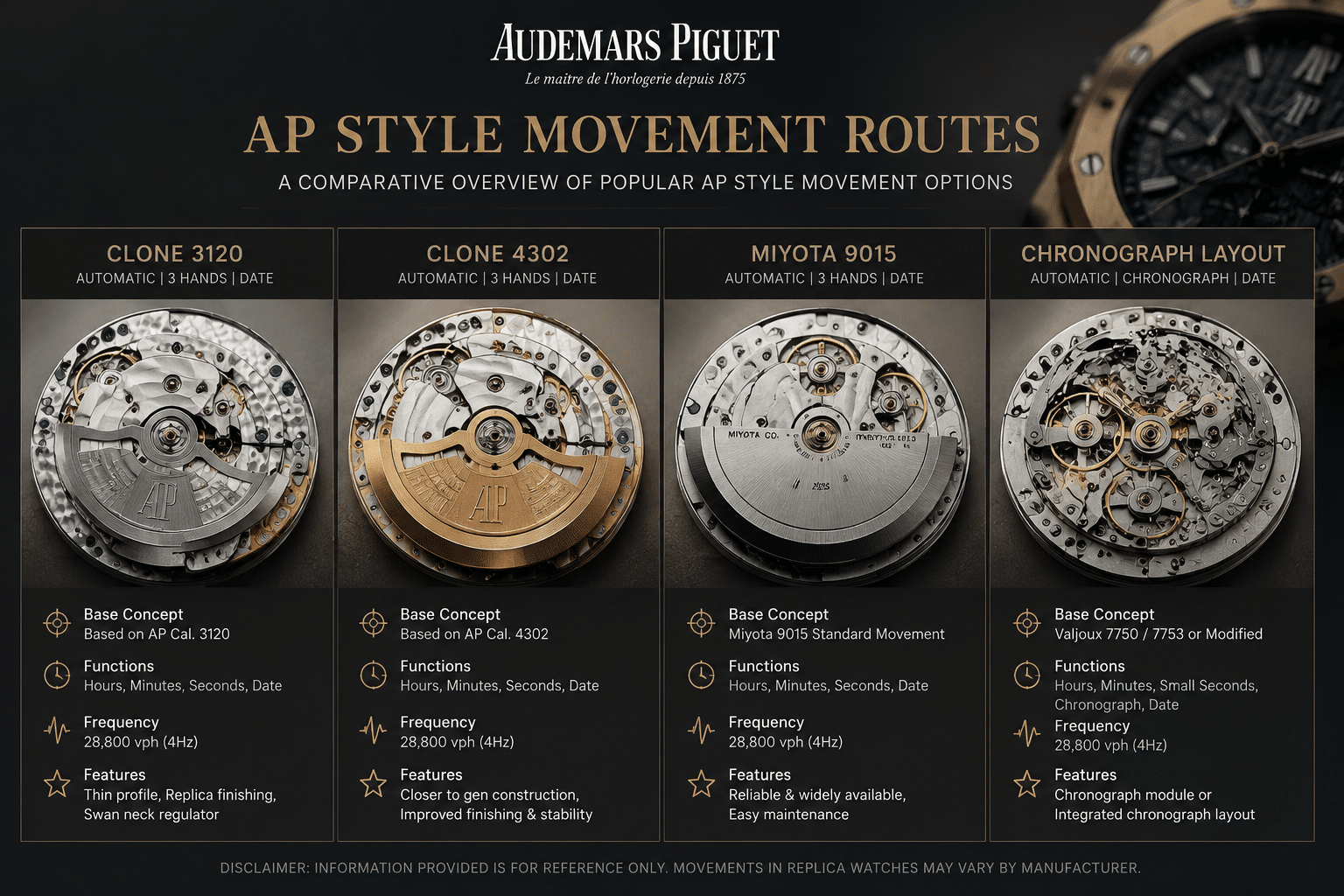
Clone 3120, Clone 4302, Miyota 9015, and Chronograph Routes: Different Expectations
The useful way to compare AP super clone movements is not to ask which name sounds closest to Audemars Piguet. The better question is: what behavior should this movement route realistically produce in daily use? A clone 3120 movement, a clone 4302 movement, a Miyota 9015 AP clone, and an AP chronograph replica movement can all look impressive in a listing, but they do not create the same power reserve expectation, winding feel, rotor noise profile, or ownership risk.
This is where buyers often get misled. A movement name can describe a design direction, but it does not guarantee that every unit is assembled, lubricated, and adjusted to the same standard. In practice, the safer movement is not always the one with the biggest claimed reserve. It is the one whose behavior is predictable enough for the watch you plan to wear.
How to Read Replica-Market Movement Names
Movement descriptions in the replica watch market should be checked carefully because they may refer to layout, decoration, clone architecture, or seller terminology rather than an official brand-manufactured caliber. A “3120-style” or “4302-style” label can be helpful for understanding what the watch is trying to represent, but it should not be treated as proof of genuine AP movement origin, official service compatibility, or guaranteed long-term accuracy.
The safer comparison is version-specific. Buyers should ask how the movement route affects case thickness, date position, rotor behavior, winding feel, visible decoration, serviceability, and repeatable power reserve on the actual watch being supplied. This keeps the focus on observable ownership behavior instead of relying on a movement name alone.
Clone 3120: Familiar Route With Batch-Dependent Behavior
The clone 3120 movement is most often associated with 15400-style AP Royal Oak super clone builds and related time-and-date models. Its appeal is straightforward: it was developed to correct some of the older Miyota-decorated compromises, especially case thickness and movement layout. For buyers who care about a Royal Oak that sits closer to the intended profile, the clone 3120 route usually makes more sense than an older plate-modified movement.
From a power reserve perspective, the clone 3120 is usually the more familiar and less dramatic route. It is not the movement family where buyers should obsess over the highest advertised hour count. The more important question is whether the watch winds smoothly, runs consistently overnight, and repeats similar results after a controlled full wind. A clone 3120 that gives stable, repeatable behavior is more desirable than one advertised with an optimistic reserve but showing uneven winding or early stopping.
The main caution is batch condition. Two watches both described as clone 3120 can behave differently if one movement is clean and properly lubricated while another is dry, dirty, or poorly adjusted. This is why a buyer should not treat “clone 3120” as an automatic pass. It is a good route for many AP time-only buyers, but the individual watch still matters.
Clone 4302: Longer-Reserve Claims Need Real Testing
The clone 4302 movement is where power reserve marketing becomes more tempting, and the broader AP 15202 clone movement problem helps explain why factory comparison should look beyond reserve labels. Because genuine AP 15500-style references are associated with longer reserve language, replica listings often use the clone 4302 power reserve claim as a selling point. Buyers see numbers that sound precise and assume the movement will behave that way every time. That assumption is risky.
A clone 4302-style movement can be the more attractive route for a 15500-style AP super clone because it supports the correct movement concept better than a decorated generic base. It may also help the watch achieve a more convincing case profile and caseback impression. But longer-reserve claims need to be tested under controlled conditions. A watch that is advertised around a high reserve figure may still deliver less in real use if the rotor is inefficient, the mainspring is weak, or the movement loses energy through friction.
The buyer’s judgment should be simple: treat the clone 4302 movement as a potentially strong route, not a guaranteed 70-hour experience. If the watch runs consistently after a full wind and does not show weak date-change behavior, the movement claim becomes more credible. If it stops early after repeated full-wind tests, the printed number in the listing is not doing much for you.
Miyota 9015-Based Builds: Practical but Not the Same Ownership Feel
A Miyota 9015 AP clone is often more practical than enthusiasts like to admit, but it is not the same ownership experience as a purpose-built clone route. The Miyota 9015 is widely known, relatively thin as a base movement, and easier for many repair people to understand than obscure clone calibers. For a buyer who values basic service familiarity over caseback accuracy, that can be a rational compromise.
The compromise is that AP design exposes movement expectations more than many other watches. Royal Oak-style watches often have display backs, thin case profiles, and buyers who pay close attention to balance position, rotor engraving, and bridge layout. A decorated movement can look acceptable at a glance, but decorative plates do not automatically improve winding efficiency, reserve, or reliability. They mostly improve the visual story.
Rotor noise is the other point buyers should not ignore. Miyota 9015-based builds can produce a more noticeable rotor sound because of the movement’s winding behavior. Some owners tolerate it easily; others find it cheapens the watch, especially in a Royal Oak case that already feels very mechanical on the wrist. This does not mean every Miyota route is bad. It means the buyer should understand that the tradeoff is not only visual accuracy. It is also sound, feel, and the way the watch behaves during normal wear.
For many buyers asking which AP clone movement is safer, the honest answer depends on the priority. If you want the most AP-correct presentation, a clone 3120 or clone 4302 route is usually more convincing. If you prefer a simpler, known base and can accept rotor noise and movement-layout compromises, a Miyota-based build may be more practical than its lower status suggests.
Chronograph Movements: More Functions, More Variables
AP chronograph replica movements need a different standard. A time-and-date Royal Oak and an Offshore-style chronograph should not be judged by the same power reserve expectations. A chronograph movement has more going on: extra gearing, subdial operation, reset behavior, pusher feel, and in some versions, architecture that may require compromises in thickness or layout.
This is why chronograph movement risk is higher even when the watch looks better in photos. The buyer is not only asking whether the watch can run through the night. The buyer is also accepting more mechanical load, more adjustment points, and more chances for inconsistent behavior. A chronograph that advertises a strong power reserve but has rough pusher action, unstable reset, or visible thickness compromises may not be a better daily-wear choice than a simpler time-and-date AP clone.
The practical judgment is clear: complicated AP replicas are better for buyers who already understand movement compromise. If this is a first AP super clone and daily reliability matters more than functions, a proven time-only route is usually the safer decision. A chronograph can be worthwhile, but the buyer should not buy it only because the specification sheet sounds more advanced.
At Clean VS Factory, we usually separate movement prestige from ownership behavior. A movement route that looks closer to AP architecture can still be frustrating if it winds poorly or performs inconsistently, while a less glamorous route may be acceptable if the buyer understands the visual and tactile tradeoff before purchase.
Model Difficulty Changes the Movement Decision
Not every AP-style replica creates the same risk for a beginner. A simpler Royal Oak time-and-date model is usually more forgiving because the buyer can focus on case profile, dial alignment, bracelet feel, date window, and basic movement behavior. The movement still matters, but there are fewer functions that can fail or feel inconsistent during ownership.
More complicated AP-style models narrow the margin for error. Chronographs, openworked-style dials, extra-thin concepts, and heavily decorated display-back builds can look attractive in seller photos, but they also give the buyer more details to verify. A watch can be visually impressive in a macro photo while still being less suitable for daily wear if the movement is harder to service, the case is thicker than expected, or the automatic winding system struggles to keep the watch charged.
This is why “best factory” claims should be narrowed to the specific AP model and use case. A factory that performs well on one Royal Oak reference does not automatically perform equally well on a chronograph, skeleton-style dial, or newer-generation movement route. For a first purchase, a stable movement and forgiving design often matter more than choosing the most ambitious-looking version.
Why the Same Claimed Movement Can Produce Different Power Reserve Results
One of the most frustrating buyer experiences is seeing two watches advertised with the same movement while owners report completely different power reserve results. One buyer says the watch runs well into the next day. Another asks why my AP clone stops overnight. Both reports can be true because AP clone movement variation is not only about the movement name. It is about the actual condition of the individual movement inside the watch.
This is the part many listings hide behind neat specifications. “Clone 4302” or “clone 3120” may describe the route, but it does not describe cleanliness, lubrication, mainspring quality, rotor efficiency, or how carefully that specific unit was assembled. Replica watch power reserve inconsistency often comes from these less visible details.
Cleanliness and Lubrication Affect Energy Loss
A mechanical movement is an energy management system. The mainspring stores energy, and the gear train delivers that energy through a series of tiny contact points. If the movement is clean and lubricated correctly, less energy is wasted. If it is dry, contaminated, or assembled with excess friction, the same movement architecture can lose effective running time.
This is why a movement can be theoretically capable of a strong reserve but perform weakly in practice. A small amount of debris, uneven lubrication, or friction in the winding and gear train can reduce efficiency enough for the owner to notice. The watch may still run, and it may even look fine in a short QC video, but the reserve can fall short when tested over a full cycle.
Buyers should not diagnose this like watchmakers, but they can observe symptoms. Rough manual winding, inconsistent running after a full wind, or a watch that repeatedly stops much earlier than expected suggests that the issue may be more than ordinary variation.
Mainspring and Barrel Quality Can Limit the Real Reserve
The barrel and mainspring decide how much energy the watch can store. In a perfect comparison, two movements using the same design would store and release energy similarly. In the replica market, that assumption is too clean. Mainspring strength, barrel condition, and assembly quality can vary enough to change the practical reserve.
This matters especially with long-reserve claims. A listing may borrow the language of a 60-hour or 70-hour movement, but the actual energy storage parts in an individual unit may not deliver that number. The buyer does not need to know the metallurgy of the mainspring. The useful point is simpler: a power reserve claim is only believable if the watch repeats it with reasonable consistency.
A one-time short run can come from incomplete winding. Repeated short runs after a controlled full wind are more meaningful. That pattern suggests the movement is not storing or delivering energy as advertised, regardless of what the movement route is called.
Rotor Weight and Winding Efficiency Change Daily Wear Results
Automatic winding is where many AP super clone buyers misread the problem. They wear the watch for a full day and assume it must be fully wound. That is not always true. Rotor weight, winding gear efficiency, case fit, bracelet fit, and wrist activity all affect how much energy returns to the mainspring during wear.
A rotor that is too light, inefficient, or restricted by friction may not wind the movement strongly enough during normal use. The watch can pass a full-wind power reserve test but still stop overnight after a quiet day at a desk. That does not automatically prove the movement is defective, but it does show that daily-wear reserve and full-wind reserve are not the same thing.
This is especially relevant for buyers comparing AP-style watches with display casebacks. A rotor may be visually decorated to look more convincing, but decoration does not prove winding performance. Rotor shape, weight, bearing condition, and winding system efficiency matter more for whether the watch stays charged in ordinary use.
Batch Variation Is a Real Buyer Variable
Batch difference is not forum drama; it is a real buyer variable. Replica movement batches can change over time due to parts supply, assembly teams, revisions, and factory adjustments. A review from last year may describe a strong movement batch, while a current unit with the same advertised name may behave differently. The opposite can also happen: a later batch may improve a weak point.
This is why older owner reports are useful but not final proof. They help identify patterns, but they cannot guarantee the behavior of the watch in front of you. For AP clone movement variation, current version language and individual behavior matter more than a single historic reputation.
The clear judgment is this: do not buy a movement label; evaluate the movement’s behavior. A same movement different power reserve situation is not unusual in this market. Small differences are normal. Repeated early stopping, rough winding, or inconsistent performance across several cycles is the concern.
How Wearing Habits Change the Power Reserve You Actually Experience
Not every short reserve result is a movement failure. Automatic watch wearing habits can change the AP replica daily power reserve more than buyers expect, especially with Royal Oak-style bracelets and heavier cases. A watch may perform respectably in a full-wind test but still stop overnight if it was never charged enough during the day.
Consider a common example: a buyer wears an AP Royal Oak super clone for eight hours at an office, mostly typing, driving, and sitting in meetings. The watch looks like it has had a full day of wear, so the buyer expects something close to the advertised reserve. Mechanically, that may be wrong. Low wrist movement may have only partially wound the mainspring.
The Desk-Work Problem
Automatic movements need motion, not just wrist time. Desk work creates a misleading situation because the watch is technically being worn, but the rotor may not be moving enough to restore meaningful energy. If the wearer’s arm stays flat on a desk for most of the day, the automatic winding system may add only a partial charge.
This is why “how long should it run after wearing?” is not always a simple question. A highly active wearer may finish the day with a stronger charge than someone who wore the same watch for the same number of hours while barely moving. For AP-style automatic watches, daily wear reliability depends on both the movement and the wearer’s motion pattern.
If a watch stops overnight after a quiet day, the first question should be whether it was actually wound enough. If it also stops early after a controlled full wind, then the concern shifts more toward movement condition or winding efficiency.
Loose Bracelet Fit and Rotor Activity
Bracelet fit can also affect rotor activity. A Royal Oak-style integrated bracelet worn very loose may slide around the wrist instead of transferring motion efficiently into the case. Some movement still reaches the rotor, but the watch may not receive the same winding input as it would with a more stable fit.
This does not mean the bracelet should be uncomfortable or tight. It means the buyer should not ignore fit when judging automatic winding. A loose, heavy AP case that rolls on the wrist can feel relaxed, but it may also produce less consistent winding during low-activity days.
The non-obvious point is that wrist presence and winding behavior are connected. A watch that feels impressive because of its weight and bracelet structure may still need more deliberate winding support if the owner’s daily movement is limited.
Manual Winding Before Testing
Before blaming the movement, start from a known full-wind condition. Manual winding before testing gives the buyer a cleaner baseline. Without that baseline, a stopped watch only proves that the movement ran out of energy; it does not prove why.
For most buyers, the useful method is not complicated. Wind the watch carefully, avoid forcing the crown, record the start time, and let the watch run normally. If the result is much stronger than the casual-wear result, the issue may be under-winding during daily use. If the result is still repeatedly weak, the movement claim deserves more caution.
Manual winding is not a magic fix. It will not correct poor lubrication, a weak mainspring, or inefficient automatic winding. It simply removes one major uncertainty from the evaluation.
What This Means for Daily Wear
Buyers should judge power reserve across several days, not from one isolated stop. A single overnight failure after a quiet desk day may be ordinary under-winding. A repeated pattern after proper winding is more meaningful. This distinction prevents two common mistakes: rejecting a healthy watch too quickly, or excusing a weak movement because the listing promised a large reserve number.
The practical rule is to separate maximum reserve from lived reserve. The advertised number describes an ideal or claimed capacity; daily wear depends on how much energy the owner actually puts back into the movement. For AP super clone buyers, consistency over several normal days is more useful than chasing one perfect advertised hour figure.
How Factory Labels, QC Photos, and Seller Descriptions Should Be Read
Factory names and QC photos are useful, but they are not final proof of power reserve. A known factory may have a strong reputation on a specific AP model, yet that reputation can still vary by movement route, version, and batch. A factory that produces a convincing 15400-style case and bracelet does not automatically prove that every 15500-style clone 4302 movement will deliver the same reserve behavior.
QC photos are stronger for visible issues than for movement endurance. They can show dial alignment, date window position, caseback decoration, rotor engraving, bracelet finishing, and sometimes the movement route. They cannot show whether the movement is clean inside, whether the mainspring is strong, or whether the automatic winding system will keep the watch charged after a quiet day of wear.
A short QC video can help more than still photos, but it still has limits. A running seconds hand proves the watch is alive at that moment; it does not prove a 60-hour or 70-hour reserve. A date-change clip can confirm basic calendar action, and a rotor clip may reveal obvious scraping or severe noise, but a real reserve judgment still requires time-based testing. Buyers should treat these materials as signals to support a decision, not as complete evidence.
The more practical way to read a seller description is to separate what is verifiable from what is promotional. “Clone 4302 route,” “current batch,” “display caseback,” and “full-wind reserve claim” are details that can be checked or tested. Phrases like “same as genuine,” “perfect movement,” or “guaranteed 70 hours” should carry less weight unless the individual watch shows consistent behavior after proper testing.
Evidence Hierarchy for Movement Claims
When a seller makes a power-reserve claim, rank the supporting information by how close it is to the individual watch. The strongest buyer-level evidence is a repeatable full-wind result from the actual watch being purchased. Next comes a useful QC video showing basic winding, running, rotor movement, and date action. Below that are clear movement photos that help identify the advertised route. The weakest evidence is generic listing language that repeats a large hour figure without showing how it was measured.
This hierarchy prevents overconfidence. A factory name may help buyers understand the market category, but it is not a test result. A caseback photo may help identify a decorated movement, but it is not proof of lubrication quality or barrel strength. A seller may describe a movement as “new version” or “upgraded,” but unless that claim connects to observable behavior, it should be treated as background information rather than proof.
QC photos reduce uncertainty, but they do not remove every risk. For AP-style super clone watches, buyers should review real watch photos where available, including dial printing, marker alignment, datewheel centering, case thickness, bracelet fit, clasp engraving, caseback finishing, and movement-route photos when relevant. Stock photos and factory labels alone are not enough to judge the exact watch being supplied.
Verification Note: When possible, buyers should review real watch photos, movement-route information, crown-winding behavior, rotor action, date alignment, and any available QC video before relying on a power-reserve claim. Stock images, factory labels, and large hour figures alone are not enough to judge the actual watch’s daily reliability.
Seller Policy and QC Boundaries
QC photos can reduce uncertainty, but they do not guarantee perfection or prove a long reserve. They are most useful for visible details such as dial printing, marker alignment, datewheel centering, bezel finishing, bracelet fit, clasp engraving, caseback decoration, and movement-route clues. Hidden factors such as lubrication, barrel strength, rotor efficiency, and long-cycle running behavior still require testing of the specific watch.
Before ordering, buyers should confirm return terms, repair options, water-resistance testing, shipping expectations, and after-sales support directly with the seller. Unless those policies are clearly stated by the seller, they should not be assumed from a factory label, a QC photo set, or a power-reserve claim.
Warning Signs That a Power Reserve Claim May Be Mostly Marketing
A power reserve number becomes less useful when it is separated from the movement route. If an AP replica movement marketing description says “60 hours” or “70 hours” but does not clearly explain what caliber style is inside, which version is being sold, or whether the claim refers to a fully wound movement, the number should be treated as a sales claim rather than a reliable ownership expectation.
The most important power reserve claim red flags are not always dramatic. They are usually small gaps in the description: a confident hour rating with no movement details, a movement photo that only shows decoration, or a version claim that sounds current but is not tied to a specific batch. A buyer asking “is 70 hours real?” should first ask a better question: “Which movement route is this claim based on, and has this current version shown consistent behavior?”
Exact Hour Claims Without Movement Details
A listing that gives an exact hour number but vague movement wording deserves caution. “Clone AP movement, 70-hour reserve” sounds precise, but it may not tell you whether the watch uses a clone 4302-style movement, a modified base movement, a Miyota-based build with decoration, or a chronograph movement with a different energy demand. Those are not minor differences. They change winding efficiency, rotor behavior, service expectations, and how realistic the advertised hours are.
The weaker the movement description, the less weight the hour claim should carry. A serious description should at least make the movement route understandable. It does not have to read like a watchmaker’s parts manual, but it should be more specific than “same as genuine” or “original quality movement.” Those phrases are especially poor evidence because they borrow the language of genuine AP movement performance without proving that the replica watch will deliver the same reserve in daily wear.
The practical judgment is simple: a slightly lower advertised reserve from a clearly identified, predictable movement is often more useful than a bigger number attached to vague movement language. Buyers get into trouble when they chase the highest claimed reserve and ignore whether the movement route itself makes sense for that AP model.
Decorated Movement Photos Can Distract From Performance
Display casebacks make AP super clone watches easy to market. A gold-tone rotor, engraved bridge, or AP-style decoration can look convincing in photos, especially on a Royal Oak-style watch where the movement view is part of the appeal. But decoration does not wind the mainspring. It does not prove clean lubrication, strong barrel performance, efficient automatic winding, or consistent power delivery.
This is one of the more common misunderstandings with AP super clone movement claims. With Audemars Piguet replica movements, buyers see a decorated rotor and assume the movement must be mechanically superior. Sometimes the decorated movement is part of a stronger integrated clone route; sometimes it is mainly a visual treatment over a more basic architecture. The photo can help identify the movement family, but it cannot confirm the real running duration by itself.
A decorated movement can even hide the more important question. If the rotor is too light, poorly fitted, or inefficient during normal wrist motion, the watch may never reach its theoretical reserve through ordinary wear. If the movement is dry or dirty, energy loss can shorten the actual running time even if the layout looks close. For power reserve, behavior matters more than bridge engraving.
Old Forum Reviews May Not Match Current Batches
Forum reports are useful, but they are not permanent specifications. An owner review from two years ago may describe a strong batch, a freshly serviced movement, or a version that is no longer being shipped. Another review may describe one bad sample rather than the whole movement route. AP clone movement batches can change quietly, and the same factory name does not guarantee that the current watch behaves exactly like an older reviewed piece.
This matters most with movements advertised under familiar names. A seller may use the same claimed caliber wording while the actual source, assembly quality, lubrication condition, or rotor setup has shifted. That does not mean every newer batch is worse. It means old performance reports should be used as background, not as proof that today’s watch will hit the same advertised hours.
The best way to read older reviews is to look for patterns rather than single success stories. If multiple current owners report similar winding behavior, similar overnight reliability, and similar reserve results after a full wind, that is more useful than one old post claiming an unusually long run. In the AP super clone market, current batch behavior is more valuable than reputation alone.
Version Details to Confirm
Before giving too much credit to a power reserve number, confirm three things. First, identify the movement route being advertised: clone 3120-style, clone 4302-style, Miyota 9015-based, chronograph-based, or another route. Second, understand the version language: factory version, current batch, and whether the watch has changed from the batch discussed in older reviews. Third, ask whether the advertised hours refer to a full-wind bench-style reserve or ordinary daily wear.
That last point is where many buyers misread the claim. A 60-hour or 70-hour figure, even when mechanically plausible, usually describes what the movement might do from a full wind under controlled conditions. It does not mean the watch will always run that long after a light day at a desk, a loose bracelet fit, or limited wrist movement. If the claim does not separate full-wind reserve from daily-wear reserve, treat it as incomplete.
How Power Reserve Connects With Date Change, Winding Feel, and Rotor Noise
A long running time is only one part of movement behavior. An AP super clone can run for many hours and still show warning signs through rough crown winding, inconsistent rotor action, weak date change, or unstable timekeeping across several cycles. Buyers who judge only the total number of hours may miss the clues that explain whether the movement is actually healthy for daily use.
This is why AP clone winding feel and replica watch rotor noise deserve attention. They are not perfect diagnostic tools, and they do not replace professional servicing, but they tell the owner how the movement feels under normal interaction. A movement that winds smoothly, changes date cleanly, and behaves consistently is usually more reassuring than one that posts an impressive single reserve number but feels rough or unpredictable.
Winding Feel as a Practical Signal
Manual winding should feel controlled and reasonably even. It should not feel gritty, jumpy, or unusually resistant from the first few turns. Some resistance is normal as the mainspring gains tension, and different movement routes feel different at the crown. The concern is not that one AP replica feels exactly like another. The concern is inconsistency: scraping, sudden tight spots, slipping sensation, or a crown that feels like it is fighting the movement.
For buyers, winding feel is useful because it connects directly to how energy enters the movement. If the crown winding feels harsh, it may point to poor lubrication, rough gear engagement, or assembly issues. It does not automatically mean the watch will fail, but it should reduce confidence in a bold power reserve claim. A movement advertised with a long reserve still needs to accept energy cleanly.
At Clean VS Factory, we tend to treat winding feel as part of ownership practicality, not just a technical detail. A watch that looks strong in QC photos can become frustrating if every manual wind feels rough or uncertain. For AP-style watches with display backs and premium movement claims, the tactile behavior should support the advertised specification, not contradict it.
Rotor Noise and Winding Efficiency
Rotor noise needs careful interpretation. A quiet rotor does not guarantee a strong movement, and a noticeable rotor does not automatically mean a bad one. Some movement routes, especially Miyota 9015-based builds, are known for more audible rotor behavior because of their winding design. A soft whir or occasional spin can be normal depending on the movement.
The noises that deserve more caution are harsher: scraping, metallic rubbing, uneven spinning, or a rotor sound that seems to come with poor winding results. If the watch is worn for a normal day and still stops quickly overnight, rotor efficiency becomes a real question. The movement may have a long theoretical reserve, but if the automatic system does not refill the mainspring effectively during wear, the owner will experience a short daily reserve.
This is where marketing photos are weak. A rotor can look correct and still wind inefficiently. Rotor weight, bearing condition, winding gear friction, and caseback clearance all affect behavior. For a daily-wear AP super clone, a slightly noisier but predictable rotor may be less concerning than a beautifully decorated rotor that does not keep the movement charged.
Date Change Behavior Near Midnight
Date change behavior is another useful movement signal. A healthy automatic date movement should approach the date change with enough energy to complete the action cleanly. The exact timing can vary by movement and adjustment, so buyers should not panic if the change does not occur at the exact minute of midnight. The more important concern is weakness or inconsistency: the date hanging halfway, changing irregularly, or behaving differently from one cycle to the next.
A weak date change can point to adjustment problems, low power at the time of change, or friction inside the calendar system. It can also reveal that the watch was not wound enough before observation. That is why date behavior should be read together with winding feel and running consistency rather than judged alone.
If a watch repeatedly struggles around the date change even after a proper wind, the advertised power reserve number becomes less persuasive. Stored energy is only useful if the movement delivers it reliably through the gear train and calendar mechanism. For AP super clone buyers, clean date behavior is often a better real-world confidence signal than a headline “70 hours” claim.
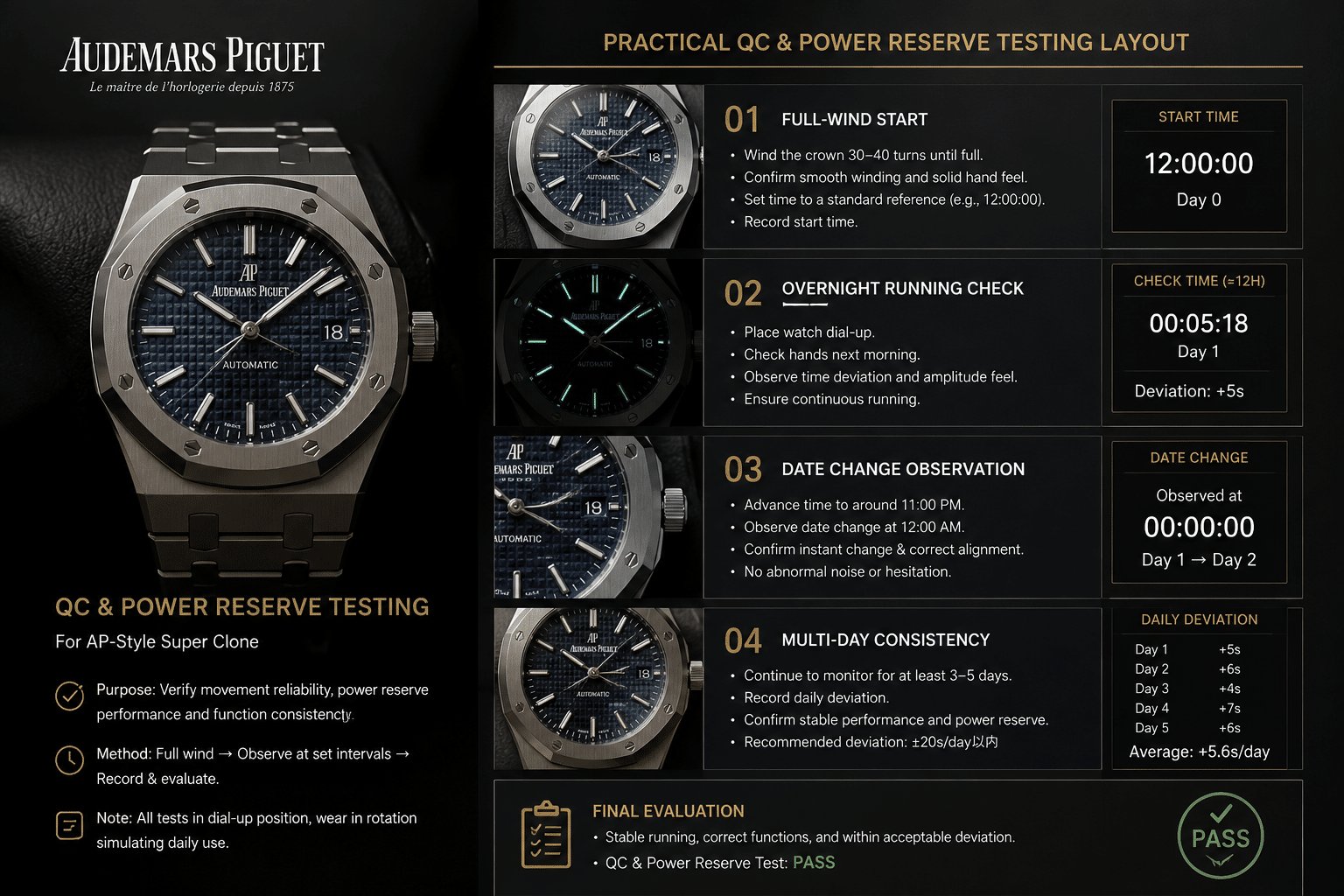
A Practical Power Reserve Test for AP Super Clone Buyers
The most useful AP clone power reserve test is not complicated. It starts from a known full wind, tracks running time, checks overnight performance, observes the date change, and repeats the process. The goal is not to prove that a replica watch matches a genuine AP specification. The goal is to understand whether this individual watch behaves consistently enough for the buyer’s expectations.
A replica watch full-wind test is more reliable than guessing from casual wear because it removes one major variable: whether the watch was actually charged. Many owners think they tested the reserve after wearing the watch, but a light wearing day may leave the mainspring only partially wound. A controlled test gives a cleaner starting point.
Step One: Start With a Controlled Full Wind
Begin by manually winding the watch from a stopped or low-power state. Use a steady, gentle motion and pay attention to the feel at the crown. The exact number of turns can vary by movement route, so the buyer should not treat any single number as universal. The point is to bring the mainspring close to full power without forcing the crown or continuing aggressively once resistance becomes obvious.
After winding, set the watch down in a safe position and record the start time. Let it run without wearing it, shaking it, or placing it on a winder. When it stops, record the stop time. This gives a basic full-wind running time. It may not match the advertised hours exactly, but it is far more useful than relying on a listing claim.
One short result is not always final. The watch may not have been fully wound, or the first test may have been affected by handling. But repeated short results after controlled full winding are meaningful. If a watch advertised around a long-reserve movement repeatedly stops much earlier than expected, that is no longer just normal variation.
Step Two: Check Overnight Running After Normal Wear
Overnight running is a daily-use check, not a full reserve test. Wear the watch during a normal day, then leave it dial-up or in a consistent safe position overnight. If it is still running the next morning, the automatic winding system is probably keeping enough energy for ordinary use. If it stops repeatedly overnight after what you consider a normal wearing day, look at your wearing pattern before blaming the movement.
This is especially important for AP-style watches on integrated bracelets. A loose fit and low wrist motion can reduce rotor activity. Desk-heavy wear may not wind the movement as much as buyers expect. If the watch passes a full-wind test but fails after light daily wear, the issue may be winding efficiency or owner activity rather than the barrel’s theoretical capacity.
The practical decision is not whether the watch reaches the largest advertised number every time. The question is whether it can survive the owner’s real routine. A buyer who sits at a desk all day may need a more predictable winding route than someone who is moving constantly.
Step Three: Watch the Date Change Window
During testing, observe the date change around midnight. Do not focus only on whether it changes at exactly 12:00. Focus on whether the action is clean and repeatable. A date that snaps over cleanly on multiple cycles is a better sign than one that hesitates, stalls, or lands misaligned after the change.
This check is useful because the date mechanism places extra demand on the movement. A watch may run acceptably during the day but reveal weakness when the calendar engages. If the date change is inconsistent after the watch has been fully wound, that deserves more attention than a small difference from the advertised reserve number.
Do not quickset the date during the danger period around midnight unless you understand the movement’s safe operating window. For this buyer-level test, simple observation is enough. The goal is to notice behavior, not to perform a watchmaker’s adjustment.
Step Four: Repeat the Test Over Several Days
Repeatability matters more than one impressive result. A single long run may look good, but consistent results across several cycles are more useful for judging movement stability. This is especially true with AP super clone movements, where batch condition, lubrication, rotor setup, and assembly quality can create unit-to-unit variation.
Track the results simply: full-wind start time, stop time, overnight performance after wear, date-change behavior, and any unusual winding or rotor symptoms. If the results cluster in a reasonable range and the watch behaves predictably, the movement claim is more believable. If the results swing sharply from one cycle to the next, the headline reserve number should carry less weight.
The strongest buyer judgment is consistency over maximum. A slightly shorter but repeatable reserve is usually easier to live with than a movement that occasionally runs long but randomly stops early. For daily wear, predictability is the feature that matters.
QC Photos and Video Clips That Help
QC media cannot prove a full power reserve, but it can help reduce uncertainty. Useful clips include a short video of the watch running, a brief crown-winding clip if available, a rotor movement clip for obvious scraping or abnormal noise, and a date-change confirmation when practical. Clear movement-route photos can also help confirm whether the claimed caliber matches the advertised version.
Photos alone are weaker for power reserve than they are for dial alignment or case finishing. A still image cannot show winding smoothness, date-change strength, or rotor behavior. If the power reserve claim is a major reason for choosing the watch, prioritize evidence of movement behavior over beauty shots of the caseback decoration.
Traceable Testing Record Buyers Can Keep
A simple written record makes the power reserve judgment more traceable. Note the movement route claimed by the seller, the version or factory label used in the description, the date of the test, whether the watch started from a stopped condition, the approximate manual-wind method, the start time, the stop time, and any symptoms such as rough winding, rotor scraping, weak date change, or sudden early stopping. This does not turn the test into a professional inspection, but it prevents vague impressions from replacing observable behavior.
This record is also useful when comparing two AP-style super clone options. If one watch has a slightly lower advertised reserve but shows repeatable results, clean date action, and normal winding feel, it may be more sensible than a higher-claim version with inconsistent behavior. CleanVSFactory’s editorial approach is to make replica watch decisions more traceable by connecting factory claims to visible details, movement behavior, version differences, and practical QC checks rather than relying on headline specifications alone.
How Price Should Influence a Power Reserve Decision
A higher AP super clone price does not automatically mean a stronger power reserve. Price can reflect the factory label, movement route, case and bracelet finishing, dial execution, availability, current-batch demand, seller margin, and after-sale risk. Some of those factors may improve the ownership experience, but they do not all prove that the movement will run longer or wind more efficiently.
For movement-focused buyers, the useful price question is specific: what is the extra money buying? If the higher price is tied to a better case profile, more accurate display-back layout, cleaner bracelet finishing, and a more appropriate movement route, the premium may make sense. If the extra cost is mostly attached to a bold “70-hour” line with vague movement details, the buyer should be more cautious.
There is also a difference between paying for visual accuracy and paying for daily reliability. A more AP-correct clone movement can improve caseback appearance and reference accuracy, but it may be harder to service than a simpler base movement. A Miyota-based route may be less visually correct and noisier, yet easier for some repairers to understand. The better value depends on whether the buyer wants a photo-focused watch, a daily-wear watch, or a model-correct display-back experience.
When comparing two prices, do not reduce the choice to “more expensive equals better factory.” Compare movement route, known batch behavior, power reserve testing, crown feel, rotor behavior, date change, case thickness, and after-sale handling if the watch shows repeated early stopping. Those details explain the real ownership risk more clearly than price alone.
Prices can change by factory label, version, movement, seller channel, availability, finishing quality, and after-sales support, so exact comparisons should be verified at the time of purchase. A price difference is most useful when it is tied to specific, checkable details rather than a broad promise of superior quality or a universal factory ranking.
Questions Worth Asking Before You Pay More
Before paying a premium for a longer-reserve AP super clone, ask the seller questions that can be answered without exaggeration. Ask which movement route is being advertised, whether the reserve figure refers to a full-wind condition, whether the current batch has changed from earlier batches, and whether QC media can show basic movement behavior rather than only still photos. If the answer is only “best version” or “same as genuine,” the claim is not specific enough to justify much confidence.
It is also reasonable to ask what happens if the watch repeatedly stops early after a proper full-wind test. A seller who treats every issue as user error may be difficult to work with if the movement is genuinely weak. A seller who explains the testing method, wearing-habit variables, and realistic after-sale options is giving more useful information than one who only repeats the advertised hour figure.
How to Judge an AP Super Clone Movement Claim Without Overreacting
After testing an AP super clone movement, the right question is not “did it hit the advertised number exactly?” The better question is whether the movement behaves consistently, winds normally, holds enough reserve for your wearing pattern, and avoids repeated signs of poor energy delivery. A small gap between a listing claim and your real-world result is not automatically a defect. Repeated short reserve after a controlled full wind is different.
This is where many buyers misread AP super clone movement reliability. They see a 60-hour or 70-hour claim and treat it like a contract. In the replica watch market, that number is better viewed as a movement-route claim or an expectation range, not a guaranteed result for every individual watch. Batch quality, assembly condition, lubrication, rotor efficiency, and how the watch is worn can all change the final experience.
The clearest judgment is simple: consistency matters more than the biggest advertised power reserve number. A watch that runs predictably, winds smoothly, changes date cleanly, and gives stable results over several cycles is usually a better daily-wear candidate than a watch with a dramatic claim but erratic behavior.
Acceptable Difference Versus Repeated Underperformance
An acceptable power reserve difference is usually a pattern that still makes sense mechanically. If a watch falls somewhat short of the advertised maximum but repeats similar results across multiple full-wind tests, that is less concerning than a watch that gives one long result, one very short result, then stops overnight for no clear reason. Predictability is the signal buyers should care about.
For example, a Royal Oak-style super clone advertised with a longer reserve may not deliver that full number in ordinary daily wear, especially if it was never fully wound. That alone does not prove the movement is bad. But if the same watch is fully wound, left untouched, and repeatedly stops far earlier than expected, the buyer should treat the claim with caution. One imperfect test can be noise; repeated underperformance is information.
The same logic applies to related behavior. A shorter-than-claimed reserve is more concerning when it comes with rough winding, a weak date change, inconsistent timekeeping, or rotor behavior that suggests inefficient winding. A single issue may be tolerable. Several symptoms together point to higher daily wear risk.
Why the Highest Claimed Reserve Is Not Always the Best Choice
Buyers often assume the movement with the longest advertised reserve is automatically the more advanced or safer option. That is not always true. A longer claim can be attractive on paper, but ownership depends on how efficiently the movement winds, how cleanly it delivers power, and whether the movement route has predictable behavior in current batches.
A more modest claimed reserve with stable winding and easier service familiarity can be more rational than a higher-claim movement that varies heavily from unit to unit. This matters especially in AP-style replicas because many watches are bought for daily wear, not just display-case photography. If the watch stops at the desk, struggles overnight, or needs constant manual correction, the headline number did not solve the buyer’s real problem.
Serviceability also matters. A complicated or highly decorated replica movement can look more convincing through a display caseback, but visual decoration does not guarantee better power reserve. In practice, a movement that a competent watch repairer can understand and regulate may be less frustrating than a more ambitious clone route with limited parts access or inconsistent batch quality.
At Clean VS Factory, we usually encourage buyers to separate the specification claim from the ownership result. A strong AP super clone is not just the one with the largest number in the listing; it is the one where the movement route, case design, winding behavior, and buyer expectations make sense together.
The Buyer’s Final Rule of Thumb
The safest power reserve buyer judgment is to trust observed behavior more than marketing language. Clear movement-route information is useful. Advertised hours are useful as a reference. But repeated full-wind behavior, stable overnight performance, normal winding feel, reliable date change, and consistent results across several days are more important than whether the listing says 60 hours or 70 hours.
If the watch runs slightly below the advertised maximum but behaves consistently, it may still be normal for that movement, that batch, and your wearing habits. If it repeatedly stops early after a proper full wind, feels rough at the crown, struggles with the date change, or gives unpredictable results from one cycle to the next, the concern is no longer the number. The concern is movement condition and daily-use reliability.
For most buyers, the smarter choice is not to chase the most impressive AP clone power reserve claim. It is to choose the movement route with the most predictable real-world behavior for the model you actually want to wear. In replica AP buying, a realistic, repeatable result is worth more than an advertised maximum that only sounds better on paper.
Disclosure: This article is for general educational and comparison purposes only. Replica watches are not genuine products from the original luxury brands, and brand names are used only to identify reference designs or comparison topics. Factory names, movement descriptions, prices, availability, QC details, seller policies, and version information can change, so readers should verify important details with the seller before making a purchase decision. Replica watches should not be represented, resold, or used as genuine watches.