
Rotor noise in AP-style replicas is easy to misjudge because the sound does not always mean the movement is damaged. Royal Oak-style cases are thin, angular, and connected to integrated metal bracelets, so normal rotor vibration can travel through the watch more clearly than on many other designs, and display caseback movements can make ordinary rotor behavior appear more dramatic during close inspection. A brief, smooth whir may be normal, especially with a Miyota 9015, while scraping, grinding, sudden rattling, or power reserve changes deserve more attention.
This article helps separate normal automatic movement behavior from warning signs that should be inspected. It also explains why two watches with the same listed movement can sound different because of rotor bearings, lubrication, case resonance, bracelet fit, and assembly tolerance. The practical question is not whether an AP replica is completely silent, but whether the sound is consistent, mechanically smooth, and acceptable for daily wear.
Editorial Perspective: For AP replicas, rotor noise should be judged as a model-specific ownership issue, not as a simple “good factory versus bad factory” problem. A factory label, seller description, or still QC photo can help identify the movement route, but it cannot prove how the rotor feels on the wrist. The useful comparison is whether the movement architecture, case thickness, rotor clearance, bracelet fit, and expected daily use match the buyer’s tolerance for sound. A watch that looks strong in photos may still be the wrong choice for a noise-sensitive buyer, while a louder Miyota-based build may be mechanically normal if the sound is smooth and performance remains stable.
Evidence Boundary: This guide discusses imitation AP-style watches and common buyer-observed behavior, not authorized Audemars Piguet products. Official brand specifications can describe genuine Royal Oak models, but they do not prove the construction, water resistance, movement quality, or finishing of a replica. For replica watches, the most defensible judgment usually comes from the specific watch in hand: QC video, caseback view where available, seller description, running behavior, and inspection by a competent watch technician.
Replica and Brand Boundary: Audemars Piguet and Royal Oak names are used here only to identify the genuine reference design being discussed. AP-style replica watches are replica-market products, not genuine Audemars Piguet watches, and factory names or movement labels in the replica market do not imply authorization, endorsement, official production, or service compatibility with the original luxury brand.
| What You Hear or Feel | Likely Meaning | Buyer or Owner Judgment |
|---|---|---|
| Smooth, brief rotor whir | Often normal automatic rotor activity | Acceptable if timekeeping and power reserve stay stable |
| Fast free-spinning sound | Common with Miyota 9015 unidirectional winding | Usable for many owners, but not ideal for noise-sensitive buyers |
| Quieter, heavier rotor feel | Often associated with clone 3120 or 4302-style replica-market builds | More model-correct feel, but still depends on assembly quality |
| Clicking or tapping near bracelet | May come from bracelet links or clasp, not the movement | Isolate the case and bracelet before blaming the rotor |
| Scraping, grinding, sudden rattling | Possible rotor contact, bearing issue, or poor clearance | Stop aggressive wear and arrange inspection |
| Noise plus reduced power reserve | Sound may be linked to mechanical performance | Treat as a warning sign, not normal ownership noise |
Quick Questions Before You Read
Q: Is rotor noise always a defect in an AP replica?
No. A smooth and consistent whir can be normal, especially in thin Royal Oak-style cases that transmit sound easily.
Q: Why are Miyota 9015 AP replicas often louder?
The Miyota 9015 uses unidirectional winding, so the rotor can free-spin more noticeably on the wrist.
Q: Are clone 3120 or 4302 movements automatically safer?
Not automatically. They may feel quieter and more model-correct, but lubrication, clearance, and assembly still matter.
Q: What sound should make me stop wearing the watch?
Scraping, grinding, sudden loud rattling, rough winding, stopping, or reduced power reserve should be checked promptly.
Why AP Replicas Can Sound Loud Even When Nothing Is Broken
If your Royal Oak replica sounds loud when moved on the wrist, the first point is simple: some AP replica rotor noise is normal. An automatic watch has a winding rotor inside the case, and that rotor is designed to swing as your wrist moves. It is not a sealed, silent electronic part. It is a moving mechanical component with a bearing, a winding system, and a metal mass rotating close to the caseback.
The mistake many buyers make is expecting the mechanical experience to match the visual impression. A well-finished AP-style replica can look sharp from the dial side, with a clean octagonal bezel, brushed case, and integrated bracelet, yet still have an automatic watch rotor sound that feels more obvious than expected. That does not automatically mean the movement is failing. It means the watch is mechanical, and the case design gives that movement sound fewer places to hide.
Automatic Rotors Are Moving Parts, Not Silent Components
The rotor’s job is to wind the mainspring as it swings. When the wearer moves the wrist, the rotor turns around its central bearing. Depending on the movement design, the sound may come from the rotor spinning, the bearing rotating, the winding gears engaging, or the case vibrating slightly as the mass moves.
A healthy rotor sound is usually smooth, brief, and repeatable. You may hear a soft whir, a light spin, or a faint mechanical sweep when the watch changes position. That kind of movement sound is different from scraping, grinding, or irregular metallic rattling. The buyer’s first job is not to ask, “Can I hear anything?” but “What kind of sound is it, and has it changed?”
This distinction matters because quiet does not always mean better, and audible does not always mean defective. Some automatic movements are naturally more noticeable because of their winding architecture. Some quieter movements can still have assembly or lubrication problems. Judging an AP replica only by how silent it feels on day one is too simple, especially with Royal Oak-style cases.
Why AP-Style Watches Make the Sound Easier to Notice
The Royal Oak design is part of the reason owners notice rotor noise. A Royal Oak replica is usually built around a flat metal case, a relatively thin caseback, and an integrated bracelet that connects directly into the case body. That structure can carry vibration more clearly than a thicker diver-style watch on a rubber strap or leather strap.
On the wrist, the caseback sits close to the skin, and the bracelet wraps the sound path around the wrist. A small internal vibration can feel more present because the watch is not isolated from the wearer. This is why some owners say the watch sounds louder during daily wear than it does when they hold it loosely in the hand. The wrist fit, bracelet tension, and case material all change how the sound is perceived.
Royal Oak Offshore replicas can also be audible, but the reason may feel slightly different. The larger case, thicker construction, and strap or bracelet setup can change the way vibration travels. The core point remains the same: AP-style construction often makes internal movement sound more noticeable than buyers expect from a watch that looks visually premium.
At Clean VS Factory, we usually separate visual accuracy from ownership feel for this exact reason. A replica watch can photograph well and still have a sound profile that bothers a noise-sensitive buyer. Rotor noise is not just a technical detail; it affects whether the watch feels comfortable as a daily piece.
Factory and movement names in the replica watch market should be treated as buyer-facing reference points, not as official Audemars Piguet affiliations or proof of a specific individual watch’s condition. A factory label may help narrow the likely movement route, case construction, or version family, but rotor sound still depends on the exact watch, its assembly tolerance, lubrication state, bracelet fit, and how it behaves during real movement.
The practical judgment is this: basic rotor audibility is not enough reason to assume the watch is bad. Smooth, consistent sound is usually less concerning than sudden, harsh, or irregular noise. The rest of the diagnosis depends on the movement route, case construction, bracelet behavior, and whether the sound has changed over time.
The Miyota 9015 Factor: Why Many AP Replicas Have a Faster, Louder Rotor Sound
The Miyota 9015 is one of the main reasons rotor noise became such a common complaint in AP replicas. It is a practical, slim, high-beat automatic movement used in many mid-tier and older AP-style builds, especially where factories added decorative plates to create the look of an AP movement. It can be a usable movement, but its sound profile is not especially refined in a thin Royal Oak-style case.
Miyota 9015 rotor noise is often described as a fast whir, buzz, or spinning sensation. Owners sometimes notice it most when the wrist makes a quick motion, such as reaching for a door handle, turning the steering wheel, or shaking water off the hand. The sound can feel out of place because the watch looks like a high-end integrated-bracelet sports watch, but the rotor behavior reminds the wearer that the movement architecture is more basic.
Movement Claim Caution: A seller’s movement label should be treated as a starting point rather than final proof. A listing may say Miyota 9015, clone 3120, clone 4302, or another AP-style movement route, but the actual watch should be evaluated through the specific listing, QC material, visible movement layout where possible, and running behavior. Movement architecture helps explain why certain sounds are expected, but it does not prove the exact condition, lubrication, rotor clearance, or service quality of an individual replica.
Movement Transparency Note: Movement references in this article describe replica-market movement types or configurations used in AP-style replica watches, not official Audemars Piguet calibers unless verifiable evidence is available. Buyers should judge each movement route by visible layout, expected winding behavior, service practicality, rotor clearance, and real running performance rather than by a movement name alone.
Unidirectional Winding and the Free-Spin Effect
The key mechanical point is unidirectional winding. The Miyota 9015 winds the mainspring efficiently in one rotor direction. In the opposite direction, the rotor can spin more freely. That free-spinning side is what many owners notice. It can feel like the rotor suddenly accelerates, creating a short burst of sound and motion inside the case.
This does not automatically mean the movement is defective. A Miyota AP replica movement can run well while still making this sound. The problem is expectation. Buyers often assume a better-looking replica should also feel mechanically quiet, but the Miyota route was chosen largely because it is thin enough, available, and generally serviceable. It was not chosen because it gives the quietest Royal Oak wrist experience.
The non-obvious issue is that the free-spin effect can be more annoying in an AP replica than in another watch using the same movement. Put the same movement in a different case with more acoustic damping, a different caseback, or a strap that does not transmit vibration, and it may bother the wearer less. In a metal Royal Oak-style case with an integrated bracelet, the sound becomes harder to ignore.
Why the Sound Can Feel Like a Buzz or Whir
When owners say their Miyota 9015 sounds loud, they are usually describing rotor speed rather than a slow mechanical tick. The rotor can move quickly in the free direction, and that fast motion creates a light buzzing or whirring character. The bearing, winding system, and case acoustics all contribute to how sharp or smooth that sound feels.
A light rotor can make the effect feel faster. A flat metal case can make it sound brighter. A bracelet can carry the vibration into the wrist. These small factors combine into the daily-wear impression: the watch may not sound broken, but it may sound less expensive than it looks.
This is why “Miyota versus clone 3120” is not only a visual movement debate. For many owners, the bigger issue is not what the caseback looks like under a photo, but whether the automatic winding sound becomes irritating after a week of normal wear. If a buyer is sensitive to mechanical noise, the Miyota 9015 route is a tradeoff that should be considered before choosing the watch, not after receiving it.
What Is Usually Normal With a Miyota 9015
Normal Miyota rotor noise is usually smooth, brief, and consistent. A short free spin after wrist movement can be normal. A repeatable whir that sounds the same every day is usually less concerning than a new scrape, grind, or loose metallic rattle.
The sound should not feel like metal dragging against the caseback. It should not suddenly become much louder after a knock. It should not be paired with obvious performance problems such as very poor power reserve, rough hand-winding, or the feeling that something is loose inside the watch head. Those symptoms deserve more caution, but the ordinary Miyota free-spin sound by itself is not a reason to panic.
The fair judgment is that the Miyota 9015 remains a sensible movement in some AP replica builds if the buyer values availability, familiar architecture, and basic serviceability. It is less sensible for someone who expects a quiet AP replica movement and dislikes feeling the rotor on the wrist. In that case, the movement may be functioning normally and still be the wrong match for the buyer.
Clone 3120 and Clone 4302 Movements: Why They Often Feel Quieter but Are Not Automatically Better
Clone 3120 and clone 4302-style movements are often chosen because they create a more model-correct AP replica experience. In many Royal Oak discussions, the clone 3120 route is associated with 15400-style builds, while clone 4302 movement sound is usually discussed around newer 15500-style replicas. These movement routes can feel more refined than a Miyota-based build because they are designed to better match the movement layout, case thickness, and display-back impression of the genuine reference being copied.
From a rotor-noise perspective, many owners find these clone movements smoother and less obviously free-spinning. The winding behavior can feel more controlled, and the sound may be lower, softer, or less “buzz-like” than a Miyota 9015. That is one reason buyers looking for a more refined daily-wear impression often move away from Miyota-based AP replicas.
But this is where buyers need to be careful: quieter is not the same as automatically safer. A clone movement can have better visual consistency and a more convincing caseback layout while still being sensitive to assembly quality, lubrication condition, rotor clearance, and batch variation. The movement route improves the starting point, but it does not remove mechanical risk.
Important Movement Boundary: Terms such as “clone 3120” and “clone 4302” in replica-market discussion should not be read as claims that the watch contains an authentic Audemars Piguet-manufactured caliber. These labels usually describe a replica-market movement layout, decoration style, or architecture inspired by the genuine reference. The actual movement should still be judged by the supplied version, visible construction, winding behavior, service access, and condition of the individual watch.
Clone 3120 Sound Behavior in Royal Oak Replicas
In a Royal Oak 15400-style replica, a clone 3120 route often feels more aligned with the watch than a plate-modified Miyota build. The movement architecture can support a more convincing case thickness and a more appropriate display-back appearance. That can also change the sound profile because the rotor behavior is not dominated by the same obvious Miyota free-spin character.
Clone 3120 rotor noise is usually judged less by raw loudness and more by smoothness. A mild rotor sound is not surprising, but it should feel controlled rather than frantic. If the movement is assembled cleanly and the rotor has proper clearance, the watch can feel more coherent on the wrist: the visual quality, case proportions, and winding feel are working in the same direction.
The buyer’s tradeoff is that the clone route is more specialized. It may be more satisfying in the correct AP reference, but it is not as simple as saying it is always better for every owner. Parts access, servicing comfort, and the specific version matter. A poorly assembled clone 3120 can be more frustrating than a healthy Miyota 9015, even if the clone looks better through the caseback.
Clone 4302 Sound Behavior in Newer Royal Oak Replicas
For AP 15500 replica buyers, the clone 4302 route is often part of the appeal because the genuine reference itself uses the newer 4302 architecture. A well-executed clone 4302 can give the watch a more integrated feel: correct-style layout, improved visual consistency, and a rotor sound that may seem calmer in normal wrist movement.
Still, clone 4302 movement sound can vary. Some examples are smooth and relatively quiet. Others may have noticeable rotor noise because of dry lubrication, light rotor mass, uneven assembly, or case resonance. A larger or newer Royal Oak-style case does not eliminate sound; it only changes how that sound is transmitted.
This is why the movement label alone is not enough. A buyer asking “which AP replica movement is quieter” is asking the right question, but the answer must include version and condition. A clone 4302-style watch from a strong batch may feel more refined than a Miyota build, while a poorly adjusted example can still produce an annoying rotor sound.
Why Quieter Does Not Always Mean Safer
The most useful rule is not “buy the quietest movement.” The better rule is “understand what kind of sound is normal for that movement, then watch for changes.” A louder Miyota-based AP replica, when evaluated alongside AP power reserve claims in buyer discussions, may be operating normally within its architecture. A quieter clone 3120 or clone 4302 may still have a hidden issue if the rotor is dry, loose, or rubbing.
For daily wear, the safest choice depends on the buyer’s tolerance. If rotor sound bothers you easily, a Miyota-based Royal Oak replica may disappoint even when it keeps time well. If you want a more refined ownership feel and more model-correct movement presentation, a clone 3120 or clone 4302 route is usually more satisfying, provided the version is mature and the individual watch is cleanly assembled.
The judgment is conditional but clear: clone AP movements often create a quieter and more coherent wrist experience than Miyota-based builds, especially in 15400 and 15500-style replicas. They are not a guarantee of silence, reliability, or perfect refinement. Movement choice lowers some compromises and introduces others, so the buyer should treat rotor sound as part of the ownership decision rather than a minor afterthought.
Why Factory Reputation Should Be Narrowed to the Exact AP Reference
Factory reputation can be useful, but it should not be applied too broadly to AP replicas. A factory that performs well on one Royal Oak reference may not deliver the same balance of case thickness, bracelet feel, dial texture, and movement behavior on another. Rotor noise makes this especially clear because the sound is affected by the movement route and case construction, not just the logo in the seller’s listing.
For example, a buyer comparing a 15400-style replica and a 15500-style replica should not only ask which factory is “best for AP.” The better question is whether the specific version uses Miyota 9015, clone 3120, or clone 4302 architecture, and whether that movement fits the buyer’s use case. A photo-focused buyer may prioritize dial texture and case finishing, while a daily-wear buyer may care more about rotor smoothness, crown feel, bracelet comfort, and service risk.
This is also why seller descriptions should be treated as useful signals, not final proof. A listing may say “latest version,” “upgraded movement,” or “quiet rotor,” but those claims still need to be checked against available QC video, movement photos, case thickness, and known batch behavior. At cleanvsfactory.com, this kind of comparison is usually treated as a model-specific buying question rather than a simple factory ranking.
A traceable AP replica comparison should connect the factory-market name to the exact reference, version, movement configuration, and visible execution details. For rotor noise specifically, that means asking whether the case is 15400-style or 15500-style, whether the movement is Miyota-based or clone-style, whether the bracelet is tightly assembled, and whether any QC video shows movement behavior rather than only dial appearance. This model-by-model approach is more reliable than treating one factory reputation as a universal answer.
Rotor Bearing, Lubrication, and Rotor Weight: The Small Mechanical Details That Change the Sound
Two AP replicas can use the same movement route and still sound different on the wrist. That is where buyers often misjudge the problem. The movement name tells you the basic architecture, but rotor bearing noise, dry rotor lubrication, rotor weight, and assembly tolerance decide whether the sound feels smooth, hollow, sharp, or rough in daily wear.
This matters because a loud automatic rotor is not automatically a bad movement. A smooth spinning sound may simply be the normal character of the winding system. A dry movement sound, however, can feel thinner and harsher, almost like the rotor is running without enough cushioning. The practical judgment is simple: sound level alone is less important than sound quality. Smooth and repeatable is usually less concerning than rough, raspy, uneven, or newly changed.
Bearing Sound Versus Rotor Spin Sound
A rotor spin sound is the basic noise of the winding rotor moving around its axis. In many AP replicas, especially in a thin Royal Oak-style case, that can come through as a quick circular whir. It may be audible when the wrist changes direction quickly, then disappear once the rotor loses speed. This type of loud automatic rotor can be annoying, but if it is smooth and consistent, it does not by itself prove that the movement is failing.
Rotor bearing noise is different. The automatic rotor bearing is the small mechanical interface that lets the rotor rotate freely. If the bearing surface is rough, dry, dirty, or poorly assembled, the sound can become sharper and more textured. Instead of a clean spin, the owner may hear a faint rasp, chatter, or friction sound. That is why one replica can feel acceptable while another with the same movement feels cheaper or more mechanical on the wrist.
The non-obvious point is that bearing character can affect perceived quality more than actual timekeeping. A watch may keep decent time while still sounding dry or unrefined. For a buyer comparing AP replica options, this is one reason movement choice should not be judged only by beat rate, decoration, or claimed power reserve. Daily-wear feel includes sound.
How Dry Lubrication Changes the Character of the Noise
Dry rotor lubrication does not always announce itself as a dramatic failure. More often, it changes the texture of the sound. The rotor may still spin, but it feels less fluid. The noise can become sharper, raspier, or more metallic, especially when the watch is moved quickly. Some owners describe this as a dry movement sound or say the rotor feels rough, even though they cannot see anything wrong from the outside.
In replica AP movements, lubrication condition can vary from one unit to another. Assembly cleanliness, storage time, and factory handling all matter. A clone 3120 or clone 4302-style movement may be expected to feel more refined than a Miyota-based build, but poor lubrication can erase some of that advantage. Conversely, a well-assembled Miyota route can sound more acceptable than a poorly lubricated clone movement.
This is where buyers should avoid overconfidence. You cannot diagnose lubrication with certainty from sound alone. A rougher sound may suggest dry or insufficient lubrication, but it can also come from bearing quality, rotor clearance, case resonance, or bracelet noise. The sensible response is not to open the watch at home or start adding oil. If the sound is harsh, worsening, or paired with performance issues, it is worth having the movement checked by someone competent.
Rotor Weight and Winding Feel
Rotor weight changes both winding efficiency and the physical sensation of the watch. A lighter rotor can accelerate quickly, so it may create a faster, more “spinning” impression. A heavier rotor often feels more damped, but it can also produce a deeper movement sound if the case transmits vibration strongly. Neither design is automatically better. The question is whether the rotor weight matches the movement and case well enough to feel controlled.
In some AP replicas, decorative rotors are used to imitate the visual layout of the genuine AP movement. That decoration may change mass distribution. If the rotor is too light, poorly balanced, or not secured with ideal tolerance, the sound can become more noticeable than the buyer expects from a watch that looks visually premium. This is one of the quiet frustrations of AP replicas: the case and dial may look strong in photos, while the winding feel reveals the movement’s practical compromise.
At Clean VS Factory, we usually treat rotor feel as part of ownership quality, not just a technical footnote. A movement that looks correct through the caseback can still disappoint a noise-sensitive buyer if the rotor feels fast, hollow, or dry during normal wrist movement. For daily wear, a slightly less impressive movement visually may be more acceptable if its rotor behavior is smoother and more predictable.
Case Resonance in Royal Oak Replicas: Why the Case and Bracelet Can Amplify Movement Noise
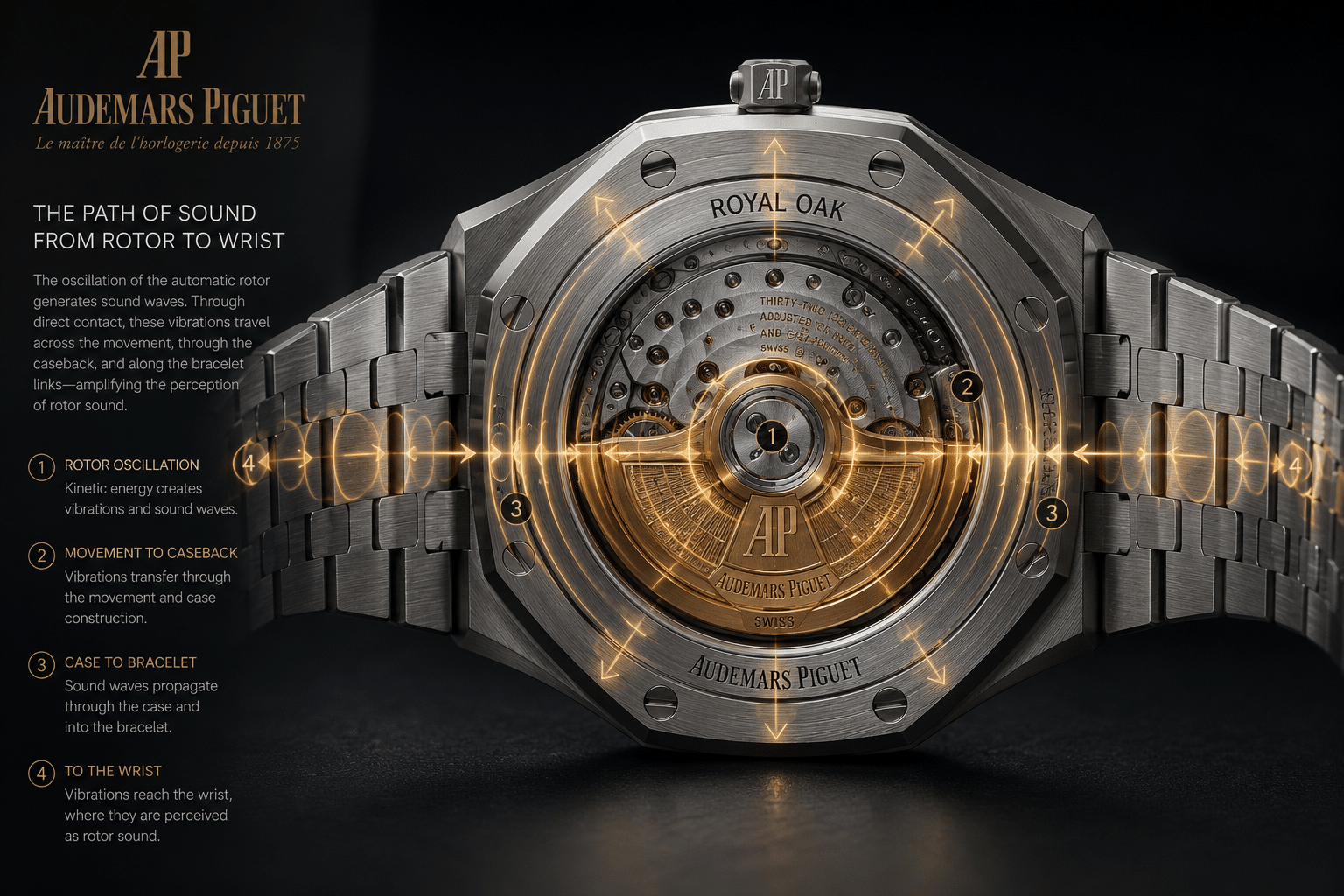
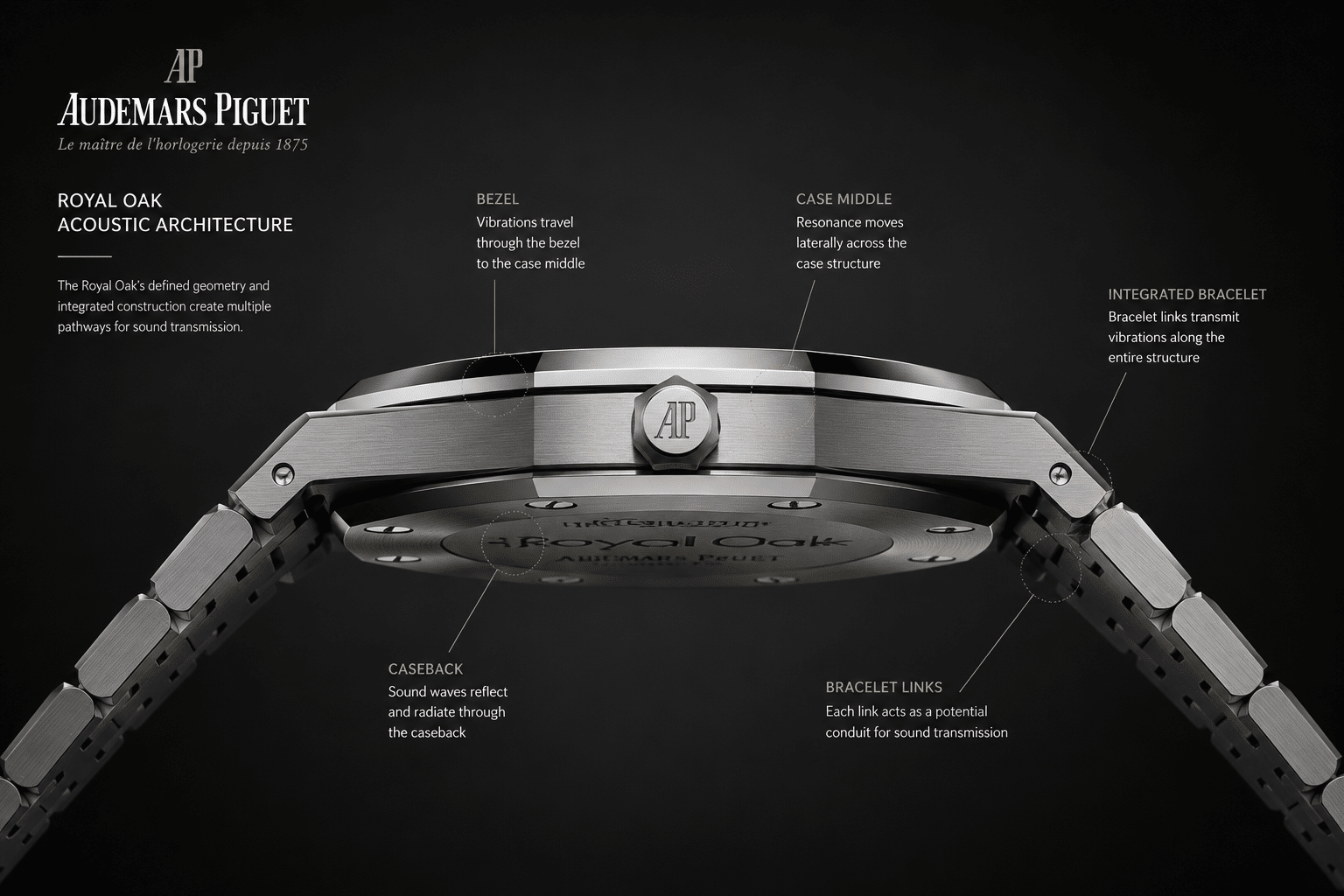
Royal Oak case resonance is one of the main reasons an AP replica can sound louder on wrist than the same movement might sound in another watch. The Royal Oak-style design is not acoustically neutral. Its flat metal caseback, angular case, thin case profile, and integrated bracelet can transmit vibration efficiently. That does not mean the design is flawed. It means the watch can act like a small metal sound path.
This is why some owners are surprised after wearing the watch for a full day. In the hand, the rotor may sound acceptable. On the wrist, the sound travels through the caseback, into the bracelet links, and across the wrist. The result can feel closer and louder than expected. A thick diver case or a watch on a leather strap often dampens this same kind of movement sound more effectively.
The Integrated Bracelet as a Sound Path
The integrated bracelet is a major part of the Royal Oak’s visual identity, but it also changes how sound moves. Each metal link can carry small vibrations from the watch head. When the rotor spins, the vibration does not stay inside the movement. It can pass into the case, through the first bracelet links, and into the clasp. This is one reason AP replica bracelet noise and rotor noise often get confused.
Bracelet construction adds another layer. If the bracelet links have extra play, if screws are not seated cleanly, or if the clasp tolerance is slightly loose, the bracelet can create its own clicking or rattling. To the wearer, that noise may feel internal because it happens at the same moment the wrist moves. The better judgment is to separate “circular rotor sound” from “metal link chatter.” They are different problems, even if they happen together.
A well-fitted bracelet can make a loud rotor seem more controlled. A loose bracelet can make a normal rotor seem worse than it is. That is a practical detail buyers often miss when comparing factory versions only by dial texture or case thickness.
Caseback, Wrist Fit, and Tabletop Tests
The caseback changes how sound is perceived. A metal caseback pressed close to the wrist can transmit vibration directly into the skin and bone. If the bracelet is sized tightly, the watch may feel louder because there is less space for vibration to dissipate. If the watch is worn loose, the head may knock slightly or shift during movement, adding another sound that is not purely rotor-related.
Tabletop tests can also mislead. Place a Royal Oak-style replica near a hard surface and the surface may amplify the sound. Hold the watch in the air and it may seem quieter. Wear it on the wrist and the bracelet may carry the vibration differently again. These differences explain why one owner says the movement is loud while another says the same movement is acceptable. They may be testing in different acoustic conditions.
The most useful comparison is not “silent versus loud.” It is whether the sound remains smooth, repeatable, and proportional to wrist movement across different positions. If the case makes rotor noise louder but the character stays clean, that is different from a harsh scrape or loose internal rattle.
Water and Durability Caution: Rotor noise should not be confused with water-resistance confidence. A replica watch that sounds mechanically smooth is not automatically safe for swimming, showering, or sports use. Unless the individual watch has been pressure-tested after purchase, water resistance should be treated as unverified. Moisture, impact, and aggressive shaking can make a borderline rotor, bearing, or movement-holder issue worse, so daily-wear confidence should be based on actual condition rather than a factory-style specification claim.
Simple Listening Check Without Opening the Watch
A safe listening check starts with observation, not tools. Wear the watch normally and notice whether the sound happens during natural wrist motion or only when the watch is deliberately shaken. Then hold the watch head gently in the hand and move it without letting the bracelet swing freely. If the sound drops noticeably when the bracelet is controlled, part of the noise may be coming from the integrated bracelet or clasp rather than the movement.
Next, compare the sound in three situations: on the wrist, held in the hand, and near a hard surface. A louder sound near a table or on the wrist can point toward resonance and vibration transfer. A rough, scraping, or irregular metallic sound in every position deserves more caution. This check does not diagnose the movement completely, but it helps prevent the common mistake of blaming every wrist noise on the rotor.
Loose Rotor Screws and Clearance Problems: When Loud Becomes a Warning Sign
There is a clear line between normal automatic rotor sound and a mechanical warning sign. A consistent whir, even if audible, is not the same as sudden rattling, grinding, scraping, or irregular metallic contact. A loud AP replica should not be judged only by volume. The more important question is whether the sound feels controlled or whether something seems loose, dragging, or hitting inside the case.
A loose rotor screw, poor rotor clearance, rotor wobble, or caseback rubbing can create sounds that should not be treated as ordinary winding noise. These issues cannot be confirmed with certainty by ear alone, but certain symptoms are strong enough to justify stopping regular wear and getting the watch checked. Continuing to wear a watch with real contact inside the case can turn a small assembly issue into movement damage.
Loose Rotor Screw Symptoms
A loose rotor screw may create a rattling sound that feels different from normal rotor spin. Instead of a smooth circular whir, the owner may hear a wobble-like knock, a shifting metallic tick, or a sudden increase in noise after the watch was previously stable. If an AP replica is rattling inside and the sound appeared suddenly, that is more concerning than a rotor that has always had the same smooth character from day one.
The key signal is change. A Miyota-based AP replica may always have a noticeable rotor. A clone-movement AP may still make some automatic winding sound. But if the sound becomes louder overnight, starts to feel loose, or develops a metallic knock during normal wrist movement, a loose rotor screw or rotor attachment issue becomes a realistic possibility.
Buyers sometimes make the mistake of assuming a more refined movement route rules this out. It does not. Clone 3120 and clone 4302-style movements can still have assembly variation. A quieter architecture does not protect against a poorly secured rotor.
Rotor Scraping Against the Caseback or Movement Plate
A rotor scraping sound is more serious than ordinary rotor bearing noise. Scraping or grinding can suggest that the rotor is touching the caseback, movement plate, decorative bridge, or another surface it should clear. This may happen because of rotor wobble, incorrect spacing, caseback pressure, a shifted movement ring, or assembly tolerance that is too tight.
The sound is usually different from a normal whir. It may feel like metal dragging, brushing, or grinding during movement. Some owners describe it as a watch makes grinding noise or the rotor sounds like scraping. That kind of sound should not be normalized as “just an automatic movement.” A smooth rotor spins; it should not sound like it is contacting a surface.
This is especially relevant in AP replicas because case thickness is a major visual target. Factories want the Royal Oak-style case to look thin and correct. When tolerances are tight, small assembly differences can matter. A watch that looks better dimensionally may have less room for error if the rotor, movement holder, or caseback fit is not right.
Red Flags Before Continued Wear
Certain symptoms deserve caution before the watch is worn further:
- A new grinding or metal-on-metal scraping sound during normal wrist movement.
- An irregular internal rattle that was not present before.
- A rotor noise that suddenly becomes much louder without a clear external reason.
- Reduced power reserve after the noise begins, especially if the watch stops sooner than usual.
- Rough manual winding or a crown feel that changes at the same time as the rotor noise.
- Visible rotor wobble or uneven rotor movement if the caseback is already safely viewable through a display back.
The practical takeaway is not to panic over every audible rotor. It is to respect changes in sound character. Smooth, repeatable spinning is one category. Scraping, grinding, and loose metallic rattling are another. If the sound suggests contact or a loose part, the safer choice is to pause daily wear and have the movement inspected by a competent service source rather than trying to diagnose it by shaking the watch harder.
Bracelet and Clasp Noise That Buyers Mistake for Rotor Noise
Not every sound from an AP replica comes from the movement. This is especially true with Royal Oak-style watches because the integrated bracelet is not just a strap attached to a case; it is a metal structure with many small contact points, screws, links, shoulders, and clasp surfaces. A small amount of link play can create a click or rattle that feels internal once the watch is on the wrist.
This is where many owners misdiagnose the problem. They hear a noise when shaking the wrist and assume the rotor is loose. Sometimes it is. But an AP replica bracelet rattle can travel through the case and sound like it is coming from the movement cavity. The practical difference is character: bracelet noise is usually more clicky, tappy, or metal-on-metal, while rotor noise is usually more circular, spinning, or whirring.
How Bracelet Link Play Creates a False Rotor Problem
The Royal Oak bracelet has many short links with exposed edges and visible screw construction. On a good example, the links should articulate smoothly without feeling floppy. On a weaker or loosely assembled example, tiny gaps between links can create a repeated tapping sound during wrist motion. Because the bracelet is integrated into the case, that sound can feel closer to the watch head than it really is.
A useful non-invasive check is simple: hold the bracelet links gently between your fingers and move only the watch head. Then do the opposite: hold the case more stable and move the bracelet slightly. If the sound changes dramatically when the bracelet is restrained, the issue may not be the rotor at all. This is one of the easiest ways to answer the common owner question: is it rotor noise or bracelet noise?
Loose or unevenly seated bracelet screws can also add noise. This does not always mean a serious movement problem, but it does matter for wearing comfort and security. A replica bracelet that “clicks” at the first link, feels uneven around the wrist, or shifts with a hollow metallic sound may need bracelet attention before anyone blames the movement.
Clasp Fit and Wrist Movement
Royal Oak clasp noise is another common source of false diagnosis. The butterfly-style clasp on many AP replicas has several metal surfaces that must close with consistent tension. If the clasp tolerance is loose, the watch can make a small rattle every time the wrist flexes, especially if the bracelet is sized slightly loose.
This sound often appears only while wearing the watch. In the hand, the watch may seem quiet. On the wrist, the clasp shifts against the underside of the bracelet, the links move against skin pressure, and the integrated structure carries the vibration into the case. That is why a noise when shaking the wrist is not automatically a movement warning.
The clear judgment here: before assuming a defective movement, isolate the bracelet and clasp. If the sound is sharp, external, and changes when the bracelet is held still, the likely problem is fit or tolerance outside the movement. If the sound remains circular and comes from the caseback area even with the bracelet stabilized, then rotor behavior becomes the more relevant suspect.
How to Classify the Sound: Normal Whir, Free Spin, Scrape, or Rattle
Rotor noise should be judged by its pattern, not just its volume, and an Audemars Piguet movement guide can help frame that assessment. A loud watch is not automatically damaged, and a quiet watch is not automatically healthy. The better question is: does the sound behave like a normal moving rotor, or does it suggest contact, looseness, or a sudden mechanical change?
This framework is not a guaranteed remote diagnosis. It is a practical daily-wear diagnosis method for deciding whether the sound is probably normal, worth monitoring, or serious enough to stop wearing the watch and have it inspected.
Smooth Whirring or Brief Spinning
A smooth, brief whir after wrist movement is usually the least concerning type of sound. It often appears as a soft spinning noise from the caseback area, especially when the watch is moved quickly and then held still. If the sound is repeatable, short, and not paired with timekeeping problems, it often falls within normal automatic behavior.
This type of normal rotor sound may still be more noticeable in an AP replica than in a thicker watch because the case and bracelet transmit vibration efficiently. The important point is smoothness. A clean whir is different from scraping. A brief spin is different from a loose metallic rattle.
Fast Free-Spinning After Wrist Movement
A fast free-spinning rotor can surprise buyers because it may feel louder than the watch looks. In some movement routes, especially those with unidirectional winding behavior, the rotor can spin more freely in one direction. The result may be a quick buzz, whoosh, or “helicopter” sensation after a sharp wrist motion.
This can be acceptable when the sound is smooth, brief, and consistent from day one. It becomes more suspicious if the free-spin suddenly becomes harsher, longer, or accompanied by a new rattle. The buyer mistake is treating all fast rotor sound as damage. The better judgment is to compare the sound against consistency, performance, and whether the character has changed.
Scraping, Grinding, or Metallic Contact
Scraping noise in an AP replica deserves more caution. A scrape sounds flatter and more abrasive than a normal whir, as if one part is lightly dragging against another. Grinding is more serious still, especially if it happens during ordinary wrist movement rather than only during aggressive shaking.
These sounds may point to rotor clearance, lubrication condition, or contact inside the case. They are not the same as a normal rotor spinning freely. If the watch makes a repeated scraping or grinding sound, the safer choice is to stop wearing it heavily and arrange a competent inspection rather than hoping the noise will “wear in.”
Irregular Rattle or Sudden Change in Sound
An irregular rattle is different from both bracelet clicking and rotor whirring. It may sound like a small loose part moving inside the case, or like the rotor is shifting rather than spinning. This is one of the clearer AP replica service warning signs, especially if the noise appears suddenly after the watch was previously stable.
The tricky part is that rattling can come from more than one place. It may be a loose rotor screw, a rotor wobble, a bracelet screw, clasp play, or another assembly issue. The decision signal is change. A sound that has always been present and behaves the same way is less alarming than a new rattle paired with reduced power reserve, rough winding, or unstable timekeeping.
| Sound Type | Common Character | Usually Less Concerning When | More Concerning When |
|---|---|---|---|
| Smooth whir | Soft circular spinning | Brief, consistent, no performance issues | Becomes harsher or much louder suddenly |
| Free spin | Fast buzz or whoosh after wrist motion | Smooth and expected for the movement route | Paired with rattling, scraping, or power loss |
| Scrape | Dragging or abrasive contact | Rarely something to ignore | Repeated during normal wear |
| Grinding | Rough metallic friction | Not a normal daily-wear sound | Any repeated occurrence |
| Irregular rattle | Loose, uneven, metallic movement | May be bracelet or clasp if isolated externally | Sounds internal or appears suddenly |
The strongest practical rule is simple: smooth and consistent is usually less worrying; harsh, irregular, or newly changed is where caution begins.
What to Check Before Assuming the Movement Is Bad
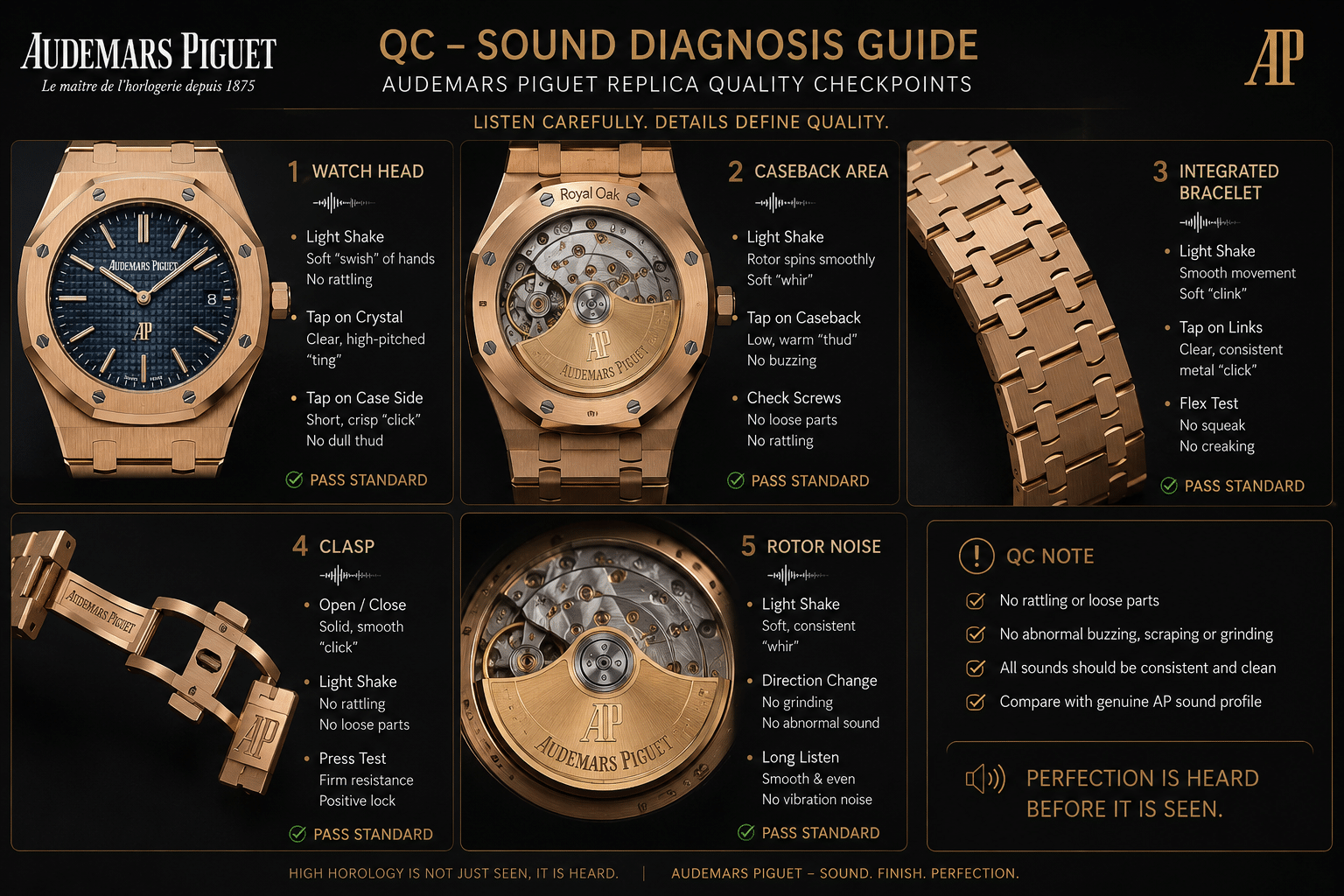
A noisy AP replica does not automatically have a bad movement. Before treating the watch as defective, run a calm external rotor noise checklist. The goal is not to repair the watch yourself. The goal is to separate normal behavior, bracelet noise, and genuine service concerns before making the wrong conclusion.
Sound alone is incomplete evidence. A watch can be loud but stable, or quiet but poorly adjusted. The useful judgment comes from combining the sound with when it happens, whether it changed, how the watch performs, and which movement route the watch uses.
Check When the Sound Happens
Start by identifying the condition that produces the noise. Does it happen during normal walking, only when you shake the watch, when you wind the crown, or when the watch is close to your ear? A noise that appears only during exaggerated shaking may not matter much for daily wear. A noise that appears during ordinary wrist movement deserves closer attention.
Also compare the watch on the wrist versus in the hand. If the sound is louder on the wrist, the bracelet, clasp, and caseback may be transmitting vibration. If the sound is equally strong when the bracelet is held still and the caseback is near your ear, the movement area becomes more relevant.
Separate Bracelet Noise From Rotor Noise
For a safe external check, hold the bracelet links gently so they cannot move freely, then move the watch head lightly. Do not shake aggressively. Listen for whether the clicking or rattling reduces. If it does, the problem may be link play, clasp tolerance, or integrated bracelet fit rather than internal rotor trouble.
Then hold the case more stable and flex the bracelet slightly. If the sound returns as a click, tap, or metallic chatter, you have likely found an external source. This matters because bracelet noise can be annoying but is a different problem from a rotor scraping the caseback.
Watch for Performance Clues
The most useful AP replica movement check is not only listening. Watch how the piece behaves. Does it hold power through a normal day? Does it stop much sooner than expected after being worn? Does the crown feel rough when winding? Has timekeeping become unstable? These clues carry more weight than rotor audibility alone.
A smooth rotor sound with stable running is usually less urgent. A new scraping sound plus reduced power reserve is a different situation. Rough winding, sudden stopping, grinding, or a rattle that was not present before should move the watch from “monitor it” to “have it checked.”
What QC Photos and Short Videos Can Actually Tell You
QC photos are useful for checking visible details such as dial alignment, bezel screws, case finishing, bracelet fit, date position, and whether the listed movement route appears plausible. They are much weaker for judging rotor noise. A still photo cannot show bearing texture, free-spin behavior, bracelet resonance, or whether the rotor makes contact under movement.
A short QC video can help more, but it should still be read carefully. If the video only shows the dial, date change, and timegrapher reading, it may not reveal the daily-wear sound profile. A useful video would include gentle wrist-like movement, a view of the caseback if applicable, crown winding feel, and ideally a moment where the bracelet is controlled so bracelet rattle is not confused with rotor noise. Even then, phone microphones and room acoustics can exaggerate or hide certain sounds.
Seller wording such as “silent movement” or “upgraded rotor” should not be treated as final proof. The more buyer-verifiable questions are: which movement route is inside, has this version been known for loud free-spin behavior, does the QC video show smooth rotor movement, and are there any signs of rough winding or unstable timekeeping? This is where cleanvsfactory.com generally separates marketing claims from practical inspection points.
Inspection Standard: The most reliable evidence is not a seller phrase such as “quiet,” “upgraded,” or “best version,” but a consistent pattern across several checks. If the watch has smooth rotor motion in video, stable timekeeping, normal crown feel, no visible rotor wobble through a display back, and no new sound after normal wear, the noise is easier to classify as expected behavior. If the sound is harsh, changing, or linked to stopping and reduced reserve, the evidence points away from normal rotor character and toward a service question.
Before making a decision, buyers should review real QC photos and short videos where available, including dial printing, bezel screw alignment, datewheel position, bracelet fit, clasp tolerance, case thickness, crown operation, visible caseback details, and any movement behavior shown on video. QC material reduces uncertainty, but it cannot guarantee rotor smoothness, lubrication quality, water resistance, or long-term reliability.
Verification Note: When possible, buyers should review real watch photos, short QC videos, caseback details where available, bracelet fit, crown operation, date alignment, timegrapher behavior, and any visible rotor movement before making a decision. Stock images, factory labels, and simple claims such as “quiet rotor” are not enough to judge the actual sound profile or service risk of a specific AP replica.
Version Details to Confirm
Expected sound differs by movement route, so confirm what is actually inside the watch if that information is available from QC photos, a QC video, or the original version description. A Miyota 9015-based AP replica may have a more noticeable free-spinning character. Clone 3120 and clone 4302 routes may feel smoother in many examples, but they are not immune to noise from assembly, lubrication, or clearance issues.
This is why a factory name alone is not enough. At Clean VS Factory, we usually treat movement route and daily-wear behavior as part of the same decision. A watch that looks strong in photos can still disappoint a noise-sensitive buyer if its normal sound profile does not match what the buyer expects.
Buyers should also confirm practical terms before ordering, including return, repair, shipping, and after-sales conditions, because those details can vary by seller and are separate from the movement description itself. Rotor noise is a good example of why this matters: a listing may identify the movement correctly, but the individual watch may still need evaluation for assembly quality, bracelet tolerance, or service-warning sounds.
The final call should be practical: if the sound is smooth, consistent, and the watch performs normally, it may simply be part of the movement and case experience. If the sound is scraping, grinding, newly irregular, or paired with performance changes, do not keep testing it by shaking harder. That is the point where inspection makes more sense than guessing.
Practical Buyer Takeaway: Choose the Movement Route With the Sound Profile You Can Live With
Rotor noise should not be treated as a side detail in an AP replica. It is part of the ownership experience, especially with Royal Oak-style watches where the case, bracelet, and movement all sit close to the wrist. A watch can look convincing in photos and still annoy the owner every time the rotor spins during normal arm movement.
The practical judgment is simple: if you are sensitive to sound, a Miyota 9015-based AP replica may not be the right match, even if the movement is otherwise functional and serviceable. The Miyota 9015 tradeoff is that it can be widely understood, but its unidirectional winding character often gives a faster, more obvious rotor sensation. For some buyers, that is acceptable. For others, it breaks the feeling of refinement they expected from an AP-style watch.
The clone 3120 route and clone 4302 route are often more satisfying for buyers who want a quieter AP replica movement and a more model-correct daily-wear feel. They usually reduce the sharp free-spin impression associated with Miyota builds, and they can make a Royal Oak replica feel more coherent as a complete watch. But quieter does not mean risk-free. Version quality, assembly condition, lubrication, rotor clearance, and bracelet construction still matter. A clone movement with poor assembly can create its own problems, while a louder Miyota can be normal within its architecture.
At Clean VS Factory, we usually encourage buyers to separate visual accuracy from ownership expectation. Rotor sound is a good example: it does not always show up in QC photos, and it is rarely captured honestly in factory descriptions. The better question is not only “which movement should I choose,” but “which sound profile can I tolerate in real AP replica daily wear?”
A realistic ownership expectation is important for any super clone or high-grade AP-style replica. Even a strong version may still differ from the genuine reference in movement architecture, finishing under close inspection, water resistance, long-term stability, service convenience, and the way the case and bracelet transmit sound. The purpose of comparing movement routes and QC evidence is to understand these limits before purchase, not to treat a replica watch as equivalent to an authorized retail product.
How Price Differences Should Be Read for Noisy AP Replicas
A higher price does not automatically mean a quieter AP replica. Price may reflect the factory, movement route, decorative finishing, case and bracelet work, current availability, seller margin, or after-sale risk. A clone 4302 build may cost more than a Miyota-based build because it aims for a more model-correct movement presentation and case structure, but the individual watch can still have rotor noise if assembly or lubrication is not clean.
For this topic, the useful price question is not “which one is more expensive,” but “what compromise is the price buying down?” If the extra cost mainly improves dial texture and case finishing, it may not solve a buyer’s concern about daily rotor sound. If it buys a more suitable movement route with a mature version history, better bracelet construction, and more consistent assembly, then the price difference may be easier to justify for a daily wearer. Prices can change by factory label, version, movement, seller channel, availability, and after-sales support, so exact comparisons should be verified at the time of purchase.
Beginners should be especially cautious with complicated or highly modified AP-style replicas if they are sensitive to ownership problems. More decorative movement work, tighter case tolerances, or more complex caseback presentation can improve visual appeal, but it can also leave less room for error. A simpler, stable version with a known sound profile may be a better first AP replica than a more ambitious version that looks impressive in seller photos but carries more mechanical uncertainty.
For Noise-Sensitive Buyers
If rotor noise bothers you easily, do not assume you will “get used to it” just because the watch looks strong. A Royal Oak replica is not a thick diver on a rubber strap; the integrated bracelet and metal case can make movement sound feel more present. In this case, paying attention to the movement route before purchase is more important than chasing the cheapest good-looking version.
A clone 3120 or clone 4302-based build is usually the more sensible direction for buyers who want smoother perceived refinement. It will not guarantee silence, and it should not be judged as identical to a genuine AP movement, but it is generally a better fit if loud free-spinning rotor behavior would irritate you. For noise-sensitive owners, the lowest-priced acceptable-looking AP replica can become the wrong watch if the rotor character ruins daily use.
For Daily-Wear Buyers
For buyers who care more about practicality than mechanical refinement, some audible rotor behavior is not automatically a deal breaker. A smooth, consistent whir that has been present from the start is usually less concerning than a new metallic scrape or irregular rattle. If timekeeping is stable, power reserve is reasonable, winding feels normal, and the sound is repeatable rather than chaotic, the watch may simply be behaving like its movement architecture suggests.
This is where “quiet versus reliable” needs a careful answer. A suitable AP replica movement for daily wear is not always the quietest one on paper. A familiar Miyota-based setup may be easier to understand and service, while a clone movement may feel more refined but still depends heavily on batch quality and condition. The smarter choice is the one that matches your tolerance: smoother feel if refinement matters most, practical simplicity if you can accept the rotor sound.
The Most Important Warning Sign
Basic rotor audibility matters less than change. A watch that has always made a brief whir is different from one that suddenly begins scraping, grinding, or rattling as if something is loose inside the case. Sudden changes deserve attention because they may point to a loose rotor screw, clearance issue, dry bearing, or another assembly problem that can worsen if the watch continues to be worn.
If the sound is smooth and consistent, observe it. If it becomes sharp, metallic, irregular, or paired with reduced power reserve or rough winding, stop treating it as normal rotor noise and have the watch checked by a competent service source. That distinction is the real takeaway: rotor noise alone is not always a defect, but abnormal contact sounds should not be ignored.
Responsible Use of Factory and Movement Information
Factory labels, movement names, and QC observations are most useful when they help a buyer understand practical risk: expected rotor behavior, case resonance, bracelet fit, service complexity, and whether a specific watch shows warning signs. They should not be used to imply that an AP-style replica is a genuine Audemars Piguet watch, that it has official brand approval, or that it can be represented as authentic.
CleanVSFactory’s buyer-facing approach is to make replica watch comparison clearer by connecting factory names, movement claims, visible QC details, version differences, and realistic ownership limits. For rotor-noise topics, that means treating “quiet,” “upgraded,” “clone,” and “latest version” as claims to verify, not conclusions to accept automatically. A careful buyer should compare the exact reference, version, movement configuration, QC video, bracelet construction, seller terms, and personal tolerance for mechanical sound before making a decision.
The safest use of this information is to avoid misunderstanding quality, overpaying for unsupported claims, or choosing a watch whose daily-wear sound profile does not match the owner’s expectations. It is not intended to help anyone hide replica status, pass a replica watch as genuine, or use factory and movement language as proof of authenticity.
Disclosure: This article is for general educational and comparison purposes only. Replica watches are not genuine products from the original luxury brands, and brand names are used only to identify reference designs or comparison topics. Factory names, movement descriptions, prices, availability, QC details, seller policies, and version information can change, so readers should verify important details with the seller before making a purchase decision. Replica watches should not be represented, resold, or used as genuine watches.