
AP chronograph replicas are tempting because they add a sportier dial, pushers, subdials, and a more technical wrist presence than a simple Royal Oak three-hand model. The trade-off is that every extra chronograph function adds another place where QC, alignment, sealing, movement stability, and future servicing can become more complicated, especially when broader Royal Oak issues like the AP 15202 movement problem show how difficult thin-case architecture and reliable movement adaptation can be. A watch may look acceptable in still photos while hiding reset issues, sticky pusher action, crooked subdial hands, or layout compromises caused by the movement route.
This article focuses on the practical ownership decision: whether the added look of an AP chronograph is worth the higher inspection burden and reliability uncertainty. It compares simple Royal Oak models, Royal Oak Chronographs, and Offshore Chronographs through the lens of daily wear, movement risk, case thickness, pusher feel, water-entry concerns, and the details buyers should verify before choosing.
| Buyer Decision | What to Check | Practical Takeaway |
|---|---|---|
| Simple Royal Oak three-hand | Basic timekeeping, date alignment, bracelet fit | Lower-stress choice for daily wear and beginners |
| Royal Oak Chronograph | Start, stop, reset-to-zero, subdial hand alignment | Choose only with video QC, not photos alone |
| Offshore Chronograph | Case thickness, strap fit, pusher feel, wrist comfort | Better suited to buyers who accept bulk and added risk |
| 7750-based or modified movement | Subdial spacing, case profile, power reserve, service access | Functional, but often involves visible or mechanical trade-offs |
| Water resistance claims | Pusher openings, crown sealing, pressure testing | Avoid relying on claims without independent testing |
| Chronograph QC approval | Hands returning cleanly to zero after repeated use | Small reset errors can become daily ownership frustrations |
Quick Questions Before You Read
Q: Is an AP chronograph replica a bad choice for everyone?
No. It can make sense if you specifically want the chronograph design and accept more QC and servicing uncertainty.
Q: Why is a three-hand Royal Oak usually safer?
It avoids pushers, reset systems, subdial alignment, and extra chronograph parts that create more failure points.
Q: Are photos enough to approve an AP chronograph?
No. Video is important because reset behavior, pusher feel, and chronograph hand movement cannot be judged well from still images.
Q: Should water-resistance claims be trusted on chronograph replicas?
Be cautious. Pushers add extra case openings, so pressure testing matters more than seller claims.
The Short Answer: AP Chronograph Replicas Add More Things That Can Go Wrong
AP chronograph replica movements are usually riskier than a three-hand AP replica because they are asked to do more work inside the same style of watch case. A simple Royal Oak replica needs to keep time, wind, set the hands, and sometimes change the date. A chronograph replica also has to start, stop, measure elapsed time, reset the chronograph hand, coordinate subdials, and respond cleanly to pushers on the case. That is a meaningful jump in mechanical complexity.
This does not mean every AP chronograph replica is a bad choice. Some are attractive, usable, and impressive on the wrist when the buyer understands the compromise. The problem is expectation. A chronograph function adds extra parts, extra controls, and extra alignment demands. Each of those areas can affect movement reliability, QC sensitivity, and long-term reliability risk in a way that a simpler Royal Oak replica usually avoids.
The practical judgment is straightforward: if you want the lower-stress AP replica for daily wear, the simple three-hand model is usually the safer daily watch. If you want the sportier look of a Royal Oak Chronograph or Offshore Chronograph, you should accept that the watch is harder to own and needs more careful expectations before purchase.
Editorial Perspective: For AP chronograph replicas, the useful comparison is not simply “which factory is best” or “which version costs more.” The better question is whether the movement route, case thickness, pusher system, reset behavior, and service expectations fit the buyer’s intended use. At cleanvsfactory.com, this type of model is treated as a higher-inspection purchase: factory name, seller photos, and QC labels are useful signals, but they do not prove that the chronograph will reset cleanly, feel consistent at the pushers, or remain easy to service over time.
Evidence Boundary Note: This guide discusses imitation watches and buyer-side inspection logic, not authorized Audemars Piguet products. Official brand information can help a buyer understand the general design family being imitated, but it cannot prove the execution, movement construction, water resistance, durability, or service quality of a replica watch. For that reason, factory labels, movement descriptions, and seller claims should be treated as purchase signals to verify through QC evidence rather than as conclusive proof.
Brand and Reference Boundary: Audemars Piguet and Royal Oak names are used here to identify the genuine reference design family being discussed. AP replica watches and AP super clone watches are replica-market products, not genuine Audemars Piguet watches, and they should not be represented, resold, or used as authentic brand-manufactured watches. A genuine reference may be useful for visual comparison, but it does not verify the quality, origin, or movement construction of a replica-market version.
Why the Risk Difference Matters Before You Choose a Model
Many buyers compare AP replicas by dial color, case size, bracelet finishing, and factory reputation first. Those things matter, but they do not answer the most important ownership question: how much mechanical risk are you willing to accept for the look you want? A chronograph-style AP can look more exciting in photos, yet the movement and case system behind that look are more demanding.
A buyer choosing between an AP chronograph replica and a simple Royal Oak replica is not only choosing between two designs. They are choosing between different levels of movement stress, QC attention, and service difficulty. A three-hand AP replica can still have issues with rotor noise, date alignment, dial printing, or bracelet feel, but the basic movement job is more limited. A chronograph adds more points where tolerance, lubrication, hand alignment, and user operation can become relevant.
This is where many buyers misjudge the category. They assume the more complicated watch is automatically the higher-end choice because it looks more expensive and has more functions. In replica ownership, complexity can be a cost, not just a feature. The better watch is the one that matches the buyer’s tolerance, not necessarily the one with the busiest dial.
The Core Tradeoff: Wrist Presence Versus Simpler Ownership
AP chronograph replicas have a real appeal. The subdials, pushers, sportier dial balance, and thicker visual presence make them feel more aggressive than a standard Royal Oak. For some buyers, that is the whole point. A Royal Oak Chronograph or Offshore Chronograph replica often has more wrist presence than a clean three-hand model.
The tradeoff is that stronger wrist presence usually comes with more to inspect and more to maintain. The central chronograph hand has to sit correctly. The subdial hands have to align. The reset action should return cleanly. The pushers need to feel even and functional. The movement should not only keep time, but also handle the chronograph function without obvious strain. None of this makes the watch unusable, but it makes the buying decision less forgiving.
At Clean VS Factory, we usually separate visual accuracy from ownership experience when comparing complicated super clone watches. A chronograph AP replica can be visually convincing enough for many buyers, but that does not make it as simple to live with as a three-hand AP replica. If reliability simplicity matters more than the chronograph look, the simpler model is usually the smarter choice.
Visual accuracy should also be judged through specific details rather than broad listing language. For an AP chronograph replica, the most useful comparison points are case thickness, lug and bracelet transition, dial texture, subdial spacing, hand length, bezel screw finishing, pusher fit, and clasp execution. A watch can look strong from one front-facing photo while still showing meaningful differences in side profile, bracelet articulation, or chronograph reset behavior under closer review.
Three-Hand AP Replicas Are Mechanically Simpler by Design
A simple Royal Oak replica has an advantage that is easy to overlook: it does less. That sounds modest, but in replica watch ownership it matters. An AP three-hand replica movement normally focuses on basic timekeeping, automatic winding, hand setting, and sometimes a date wheel. There is no chronograph train to engage, no reset hammer to control, no pusher system to coordinate, and fewer tiny hands competing for perfect alignment.
This is why a simple Royal Oak replica often makes more sense as an easier daily wear option. The movement has fewer mechanical events to manage, so there are fewer functional checks after delivery and fewer ways for the watch to disappoint a buyer who mainly wants to wear it without thinking about the mechanism. Simple does not mean perfect, but it usually means lower movement stress.
The buyer still needs realistic standards. A three-hand AP replica can have rotor noise, uneven winding feel, date wheel misalignment, limited power reserve, or movement decoration that does not satisfy close inspection. The difference is that those concerns sit around a simpler operating system. Compared with a chronograph layout, serviceability is usually more straightforward because the movement has fewer complication-specific parts and fewer interactions to diagnose.
What a Simple Three-Hand Movement Has to Do
The basic job of an AP three-hand replica movement is to keep the hour, minute, and seconds hands moving at a stable rate. If the model has a date, the movement also needs to advance the date wheel cleanly and keep the date centered in the window. Automatic winding adds another layer, because the rotor must wind the mainspring efficiently without becoming excessively noisy or rough.
For buyers, these are easier things to understand and check. Does the watch start after winding? Does the crown feel acceptable when setting the time? Does the date change properly? Is the rotor noise tolerable? Is the power reserve reasonable for the movement route being sold? These questions still matter, but they are less complicated than evaluating whether a chronograph starts, stops, records elapsed time, and resets cleanly across multiple hands.
This is also why a simple AP replica is often more beginner-friendly. The watch may still require QC review, but the buyer is not trying to judge a multi-part timing system from a few photos and a short video. The fewer the functions, the less the buyer has to trust unseen mechanical behavior.
Why Fewer Functions Usually Mean Fewer Failure Points
Mechanical watches fail or frustrate owners most often at points of interaction. The crown, date change, rotor, hands, and setting works all create opportunities for rough feel or inconsistent behavior. A chronograph adds another layer of interaction on top of that. It is not just another hand on the dial. It is a separate timing system that has to engage and disengage correctly.
A three-hand movement avoids much of that additional load. There are no chronograph pushers pressing into the movement. There is no reset system forcing hands back to zero. There are no subdial counters that need to stay aligned after repeated operation. Fewer functions do not guarantee better reliability, but they reduce the number of areas where a small tolerance issue can become visible to the owner.
That is the main reason simple AP replicas often age with less drama. If a basic automatic movement keeps decent time and the date works properly, the watch can remain satisfying even if it is not technically perfect. A chronograph replica has to satisfy more conditions before the owner feels confident using it regularly.
What This Means for Daily Wear
For daily wear, a simpler AP replica is usually the calmer choice. It has fewer moving complications, fewer QC concerns, and less need for the owner to wonder whether using a function will create a reset or alignment issue. This matters most for buyers who want a watch they can put on in the morning without treating the movement like a fragile experiment.
The three-hand Royal Oak path is especially sensible for first-time AP replica buyers, buyers who prioritize bracelet feel and case proportions over functions, and anyone who dislikes maintenance uncertainty. The chronograph may be more dramatic, but the simple model usually creates fewer ownership surprises. That is not a glamorous advantage, but it is often the one that matters after the first week of wearing the watch.
Chronograph Movements Add Gears, Levers, Clutches, and Reset Systems
A chronograph replica movement is more complicated because it has to run two jobs at once. It must keep normal time like any automatic movement, while also operating a separate timing system controlled by pushers. The AP chronograph mechanism has to start the chronograph seconds hand, stop it without disturbing the main timekeeping, and reset the hand or hands back to zero in a controlled way.
That extra function brings extra mechanical load. Depending on the movement route, a chronograph replica movement may use additional gears, levers, a clutch system, a reset hammer, and a subdial train. The buyer does not need to memorize every component, but the ownership lesson is important: each added part requires acceptable tolerance, lubrication, alignment, and assembly quality. If one area is weak, the watch may still tell time but fail as a chronograph.
This is one of the least obvious risks for new buyers. A watch can appear healthy because the hour and minute hands move normally. The problem may only show when the chronograph is engaged, stopped, reset, or used repeatedly. That is why chronograph reliability should be judged separately from basic timekeeping reliability.
Movement Claim Caution: Movement names in replica listings should be read carefully. A seller may describe a movement as 7750-based, 7750-style, modified, decorated, cloned, or upgraded, but those terms do not automatically explain serviceability, exact architecture, long-term reliability, or whether the movement inside the individual watch matches the description. Unless the buyer has clear movement photos, current version details, and a credible inspection basis, the safest approach is to judge the watch by visible function: winding feel, crown behavior, chronograph start, stop, reset, subdial response, and realistic service expectations.
Movement Transparency Note: Movement references in this article describe replica-market movement routes, configurations, and listing language, not official Audemars Piguet calibers unless supported by verifiable evidence. Buyers should judge the specific watch by visible operation, movement photos where available, and realistic service expectations rather than assuming that a movement label proves long-term reliability.
Start, Stop, and Reset Are Separate Mechanical Jobs
Starting a chronograph is not simply turning on one extra hand. The movement has to engage the chronograph system so the central chronograph seconds hand begins moving. Stopping it requires the system to hold that reading without dragging or jumping. Resetting it requires a controlled return-to-zero action, usually involving a reset mechanism that forces the chronograph hand and counters back into position.
Each step can create a different symptom. A weak start may show as hesitation or a jump in the chronograph seconds hand. A poor stop can feel vague or inconsistent at the pusher. A reset problem may leave the central hand slightly left or right of zero, or leave a subdial hand crooked. These are not the same as the watch running fast or slow. They are chronograph-specific issues.
This distinction matters because a buyer may receive a watch that keeps time acceptably but still has a chronograph not resetting correctly. For a simple three-hand watch, there are fewer separate behaviors to test. For an AP chronograph replica, the function itself becomes part of the QC burden.
Why Chronograph Problems May Not Show Up Immediately
Chronograph problems often hide during basic inspection. A straight dial photo can show that the watch looks attractive, but it may not prove the chronograph starts smoothly, stops cleanly, or resets to zero. Even a short video may only show one operation cycle. Some issues appear after repeated use, after the movement has been sitting, or when the reset alignment is checked carefully from a straight-on angle.
This is why an AP chronograph replica needs more careful expectations than a simple Royal Oak replica. The watch may pass the first impression test and still carry a higher long-term reliability risk. It may also work well if the chronograph is rarely used, but become frustrating for a buyer who expects the function to behave like a thoroughly serviced genuine chronograph.
The responsible view is not to avoid every chronograph replica. It is to understand what the complication demands. If the chronograph function matters to you, it should be tested and judged as a real mechanical feature. If you mainly want the AP look with fewer ownership concerns, the simpler three-hand route remains the more rational starting point.
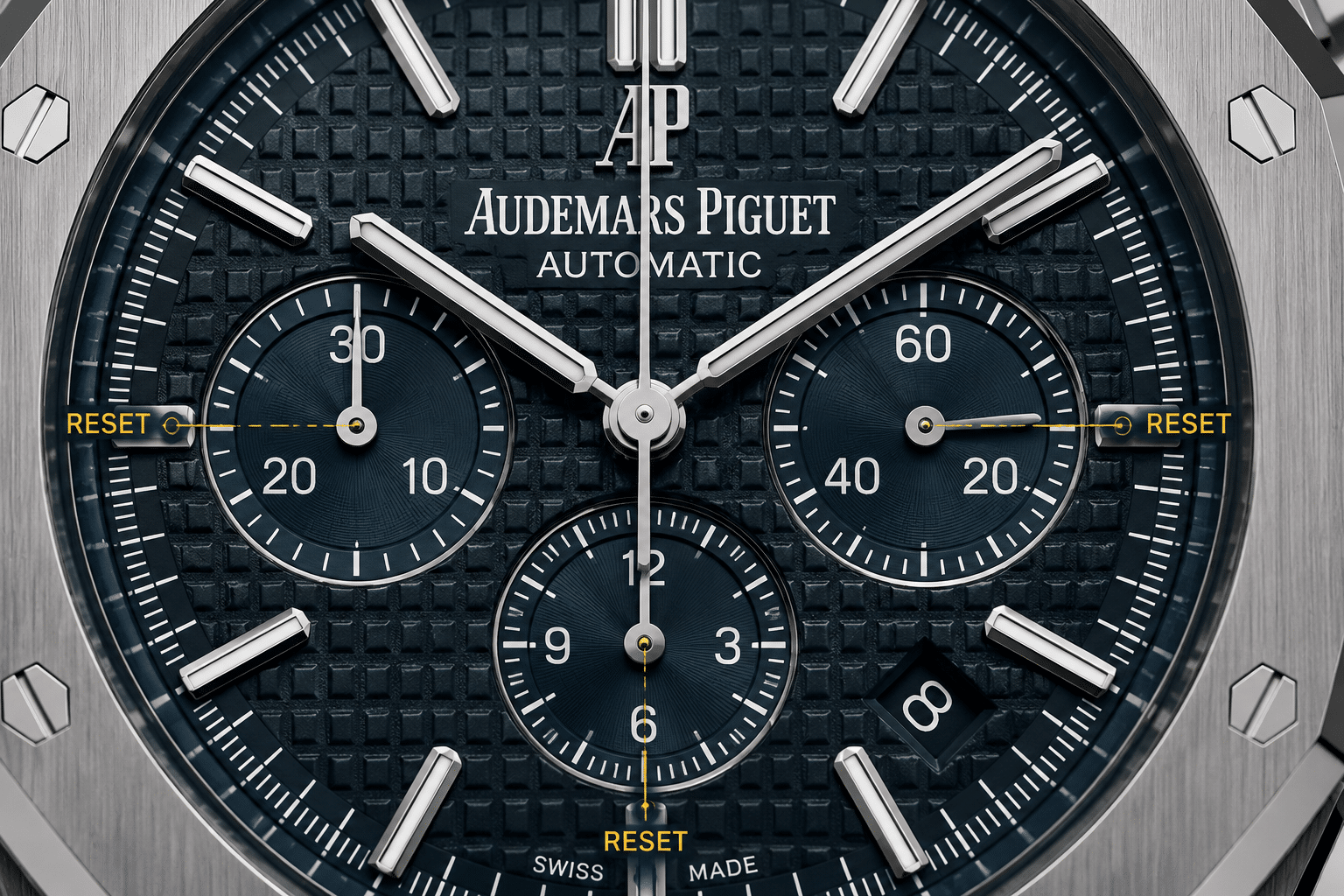
Pushers Create Extra Case and Sealing Challenges
AP chronograph pushers are easy to underestimate because they look like simple exterior buttons. On a replica watch, they are not decorative trim. They are moving controls that must pass through the case, reach the chronograph mechanism, and the APS 26240 movement guide helps explain why clean actuation matters, then actuate it cleanly, and return to position without binding. That creates a different ownership profile from a simple Royal Oak-style case where the crown is the main point of interaction.
The practical issue is not that every pusher system will fail. The issue is that AP chronograph replicas have more physical interfaces that can feel inconsistent, age poorly, or introduce water exposure risk if the sealing and fit are weak. A watch can keep normal time perfectly while still having a sticky pusher, uneven pusher action, or a chronograph button that does not click cleanly. For daily ownership, that kind of flaw is more annoying than many buyers expect because it affects how the watch feels every time the chronograph is used.
Why Extra Case Openings Matter
A simple three-hand AP replica usually depends on a crown tube, crown gasket, caseback gasket, crystal fit, and basic case construction. A chronograph adds two additional controls on the case flank. Each pusher needs a channel through the case, a spring or return system, sealing components, and proper alignment with the movement inside. That means the case is not just thicker or sportier; it is mechanically busier.
This matters most on Royal Oak and Royal Oak Offshore-style cases because the side profile is highly visible. The case flank is broad, angular, and integrated into the bracelet or strap line. If a pusher sits slightly proud, angles unevenly, or feels loosely installed, the flaw is not hidden the way it might be on a rounder sports chronograph. AP case geometry makes small control-area issues more noticeable.
Sealing expectations also need to be realistic. Extra pushers mean extra places where moisture can enter if gaskets are poorly fitted, dry, damaged, or simply not tested. No replica watch should be treated as guaranteed waterproof based on factory claims alone, and chronograph pushers add another reason for caution. Even if the watch is described as water resistant, pressing pushers around water is a bad assumption unless the watch has been properly tested by someone competent.
Water-Resistance Boundary: Genuine watch specifications, factory listing language, or seller confidence should not be used as proof that a replica chronograph is safe for swimming, showering, diving, or repeated water exposure. The only practical way to treat water resistance as more than a claim is to have the individual watch pressure-tested after purchase and to avoid operating chronograph pushers around moisture unless a competent tester has confirmed the case condition. This is especially important for chronographs because the pushers add sealing points beyond the crown and caseback.
Pusher Feel Is a Real Ownership Signal
Pusher feel tells you more than most catalog photos ever will. A clean chronograph pusher should have a reasonably consistent press, a defined actuation point, and a clear return. It does not need to feel like a genuine AP chronograph, but it should not feel vague, crunchy, delayed, or different from one pusher to the other without explanation.
The warning signs are practical: one pusher is much stiffer than the other, the start button feels mushy, the reset button sticks after being pressed, or the chronograph only responds if the pusher is pressed at a certain angle. These are not just tactile imperfections. They can point to poor pusher alignment, rough case machining, weak return springs, or a movement-control mismatch inside the case.
Factory, batch, and movement route all affect this. Two AP chronograph replicas with similar dial photos can feel very different in hand because the pusher system depends on both case construction and the movement underneath. This is why we treat pusher behavior as part of the movement-risk conversation, not as a separate cosmetic detail. If the chronograph controls feel wrong, the impressive dial layout matters less.
Red Flags Before Buying
- No pusher operation shown in QC video: Static photos are not enough for a chronograph. A short start, stop, and reset demonstration is more useful than another angled glamour shot.
- Uneven pusher position: If one pusher appears tilted, sits deeper, or protrudes differently from the other, ask whether it is camera angle or actual alignment.
- Seller avoids discussing chronograph function: If the answer stays vague, that is a warning sign. The chronograph does not need to be used constantly, but it should be shown working before approval.
- Reset behavior looks inconsistent: A pusher problem and a reset problem can overlap. If the reset button feels stiff or the hand does not return cleanly, both the external control and internal mechanism deserve scrutiny.
- Water resistance is oversold: Claims of strong waterproofing should not override common sense. Chronograph pushers create more sealing variables than a simple crown-only case.
The safest judgment is simple: if you want an AP chronograph replica mainly for the look, you can accept that the pushers may be used lightly. If you expect to operate the chronograph often and treat the watch like a robust sports instrument, you should be much more selective about pusher feel, reset behavior, and realistic water exposure limits.
Before making a decision, buyers should review real QC photos and videos where available, including dial printing, hand alignment, bezel screw position, datewheel centering, side-profile thickness, bracelet or strap fit, clasp engraving, pusher operation, and chronograph reset behavior. Factory labels and stock photos alone are not enough for a reliable judgment on an AP chronograph replica.
QC Evidence Boundary: QC photos and videos can reduce uncertainty, but they do not guarantee perfection or future reliability. They are a practical way to check visible details at one moment in time, including reset position, hand alignment, case profile, and pusher response. Buyers should still confirm seller terms, service expectations, water-resistance testing options, and what happens if a functional issue appears after delivery before treating a chronograph replica as a comfortable purchase.
Subdial Layout and Reset Alignment Make AP Chronograph QC Harder
A simple AP replica asks you to judge the dial, hands, markers, date if present, and overall case impression. An AP chronograph replica adds more hands, more subdials, more printing relationships, and more reset points. That is why AP chronograph subdial alignment can become a real buyer issue even when the watch looks attractive in seller photos.
The non-obvious problem is that there are two separate kinds of dial-side risk. One is cosmetic: whether the subdial spacing, dial printing, and visual balance look right. The other is functional: whether the chronograph reset alignment returns correctly after use. A watch can have decent-looking subdial placement but poor reset behavior, or it can reset well while still having a layout that feels off because the movement architecture does not naturally match the reference.
More Hands Mean More Alignment Checks
Chronograph reset alignment begins with the central chronograph seconds hand. After the chronograph is started, stopped, and reset, that hand should return cleanly to 12. If it lands slightly left or right of the marker, the flaw is immediately visible because the long central hand crosses the entire dial. On an AP chronograph, where the dial is already busy with tapisserie texture, applied markers, and subdials, a misaligned central chrono hand can make the whole front view feel careless.
The subdial hands also need attention. Depending on the model and movement route, the subdials may include a running seconds display, minute counter, or hour counter. A crooked subdial hand may look minor in a compressed photo, but in daily wear it can become one of those flaws your eye keeps finding. This is especially true when the hand is supposed to rest at zero and instead sits slightly off-center.
Buyers often ask, “does the chronograph reset to zero?” That is the right question, but it should be checked more than once if possible. A single reset in a short clip is better than nothing, but repeated start-stop-reset behavior is more revealing. Some chronograph issues do not show up while the watch is just sitting in a lightbox.
Subdial Spacing Can Reveal Movement Compromises
Subdial spacing is a different issue from reset accuracy. Reset alignment asks whether the hands return properly. Subdial spacing asks whether the dial layout itself makes sense for the reference being copied. On AP chronograph replicas, the movement route can affect where the subdials sit, how far they are from the center, and whether the dial feels balanced.
This is where buyers sometimes get distracted by the wrong detail. A sharp tapisserie dial and polished bezel screws may look impressive, but if the subdials sit too close together, too far apart, or slightly wrong for the model family, the watch can feel less convincing even before the movement is discussed. Royal Oak Chronograph dials are relatively clean for a sports chronograph, so spacing errors are easier to notice than on some busier designs.
Offshore chronographs are more forgiving visually because the cases are larger, the dials are bolder, and the overall design accepts more aggression. But “more forgiving” does not mean risk-free. A large Offshore case can hide some layout compromise, while still amplifying thickness, pusher, and movement-route issues elsewhere. The dial may be less delicate, but the ownership risk is not automatically lower.
QC Photos and Video Angles to Review
- Straight-on front dial photo: This is the most useful basic image for checking central chronograph seconds hand position, subdial centering, marker alignment, and dial printing balance.
- Close-up subdial photos: Look for crooked hands, uneven resting positions, and whether the subdial printing sits cleanly around the hand pinions.
- Reset-to-zero video: The video should show the chronograph starting, stopping, and resetting. The key moment is where the central hand and counter hands land after reset.
- Pusher operation video: This helps connect dial behavior with tactile function. A hand that resets poorly may be related to the movement, the pusher system, or both.
- Side profile image: Not strictly a dial check, but important because the movement route that affects subdial layout may also affect case thickness.
The practical judgment is that AP chronograph QC needs motion, not just photos. A beautiful static dial shot can hide a misaligned reset, and a short video can reveal problems that no macro photo will show. If a buyer is not willing to review chronograph behavior carefully, a simple three-hand AP replica is usually the calmer choice.
A Traceable QC Sequence for AP Chronograph Replicas
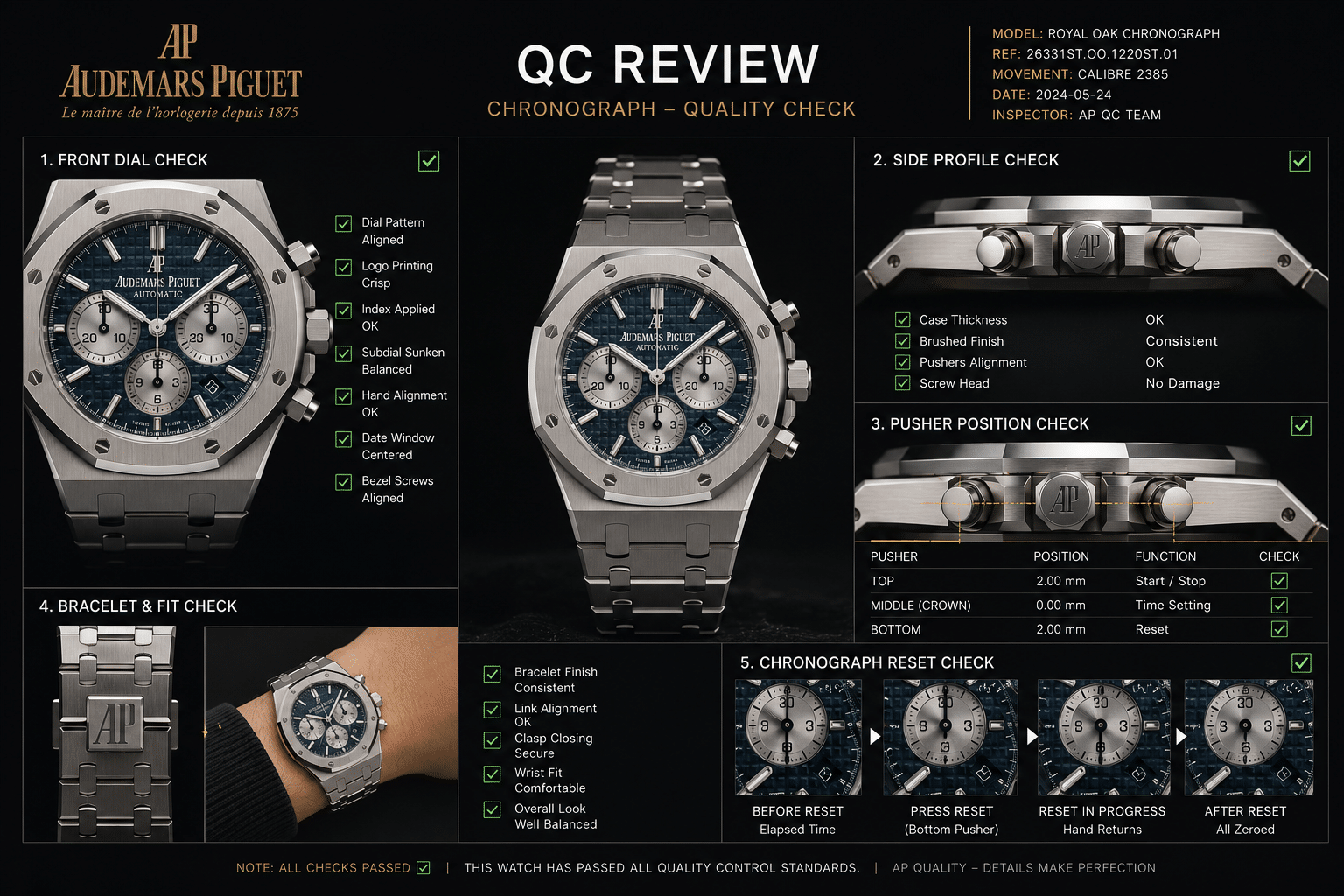
A more traceable QC review should follow the same order every time so the buyer is not distracted by attractive dial color or polished case angles. Start with the watch at rest and check whether the central chronograph hand and subdial hands sit where they should. Then review a start sequence, a stop sequence, and at least one reset sequence from a straight-on angle. After that, compare the side profile, pusher seating, crown position, bracelet or strap fit, and clasp finishing. This sequence does not guarantee that the watch will be problem-free, but it reduces the chance of approving a chronograph only because the first photo looked impressive.
It is also useful to separate “acceptable cosmetic variation” from “functional warning sign.” A slightly different dial shade or minor brushing difference may be tolerable for some buyers, while a chronograph hand that repeatedly fails to return to zero is a more direct ownership concern. CleanVSFactory’s editorial approach is to make replica watch decisions more traceable by connecting factory claims to visible details, movement behavior, version differences, and practical QC checks rather than treating a listing name as the whole answer.
7750-Based Routes Can Create Thickness, Layout, and Service Tradeoffs
Many chronograph replicas have historically relied on 7750-based or 7750-style movement routes because the architecture is widely available, familiar to many factories, and capable of supporting real chronograph functions. That does not make the route automatically bad. It does mean the buyer should understand what is being traded away, especially in a 7750 AP chronograph replica where the original watch may use a different movement architecture.
The main tradeoff is not just a spec-sheet issue. Chronograph movement thickness affects the case profile. Movement layout affects subdial placement. Movement modification affects servicing predictability. A 7750-based route can be practical, but it often asks the case and dial to adapt around the movement rather than allowing the movement to naturally match the AP design.
Why Thickness Is More Noticeable on Royal Oak and Offshore Cases
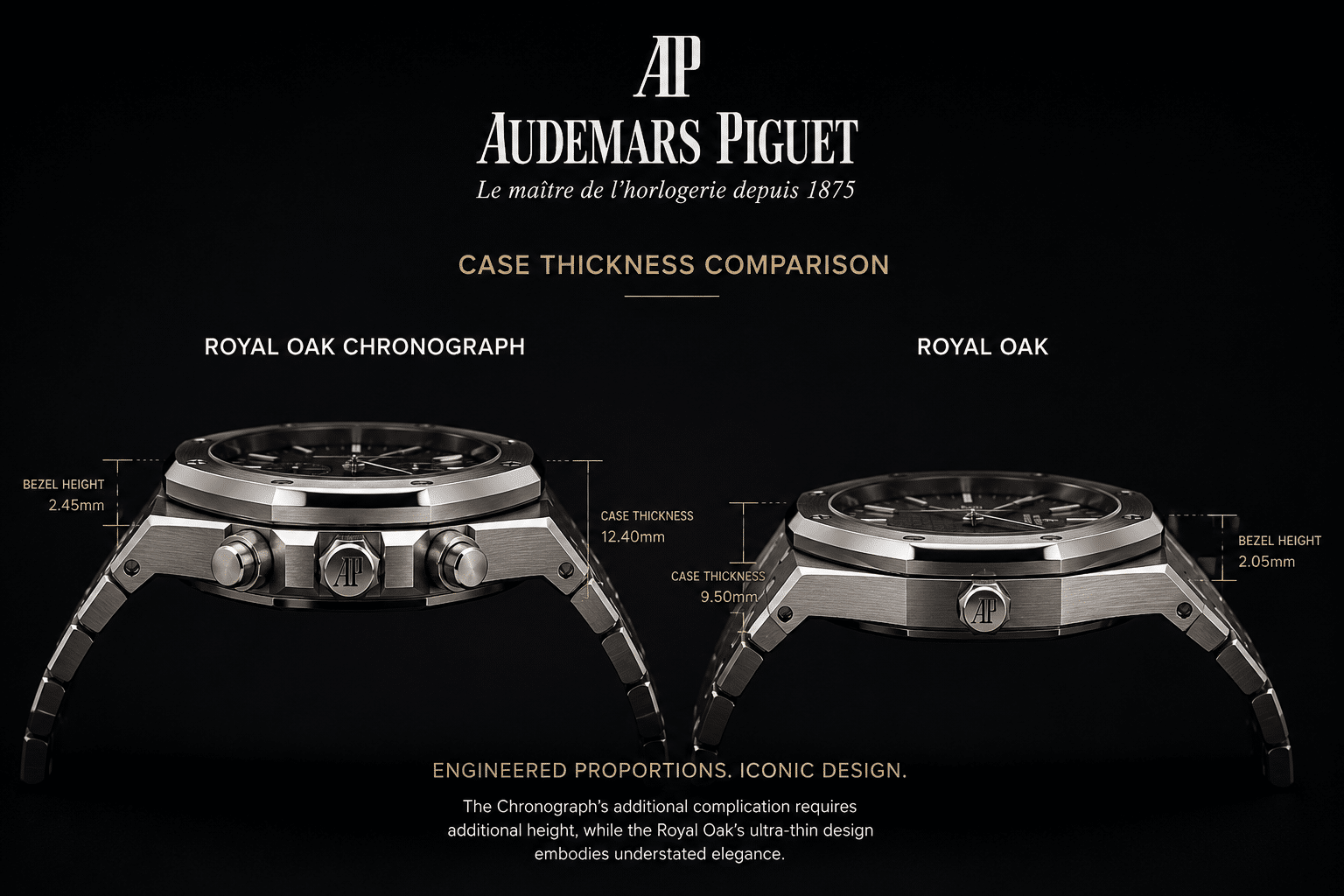
Chronograph movement thickness matters more on AP cases than buyers expect because the Royal Oak design does not hide height gracefully. The case has flat planes, a strong midcase wall, a defined bezel stack, and an integrated bracelet transition. If the case becomes too tall, the watch can look top-heavy from the side even if the dial looks strong from above.
On a round sports chronograph, extra thickness can sometimes disappear into curved lugs, a domed back, or a broader case shape. A Royal Oak-style case is less forgiving. The bracelet or strap flows directly from the case, so an overly thick midcase interrupts the whole silhouette. This is why chronograph movement thickness is not only a technical complaint. It changes wrist presence.
Royal Oak Offshore models are naturally larger and thicker, so they can absorb more height than a standard Royal Oak Chronograph. But there is a limit. A bulky Offshore replica may still look acceptable in photos because the model is supposed to be aggressive, while feeling awkward on the wrist if the case height, pusher guards, and strap integration are not well balanced.
Modified Chronograph Layouts Can Add Risk
A modified chronograph movement can solve one problem while creating another. If a factory modifies a movement to place subdials closer to the correct AP layout, the dial may look better. But the more a movement is altered, the more buyers should care about reset behavior, hand drag, pusher feel, power reserve expectations, and future service complexity.
This is the part many buyers miss: a more accurate-looking layout does not always mean a lower-risk movement. Sometimes the visual improvement comes from added intermediate parts or layout changes that make the system more sensitive. If the chronograph is rarely used, that risk may be acceptable. If the buyer expects frequent timing use, the same movement route becomes less comfortable.
Rotor noise and winding feel can also vary by route and execution. A chronograph movement has more mass, more parts, and more case constraints than a simple automatic movement. If the watch arrives with noisy winding, rough crown feel, weak power reserve, or inconsistent pusher action, those are not isolated annoyances. They may indicate that the movement and case package is less refined than the dial photos suggested.
Movement Route to Verify
- Confirm the claimed movement route: Ask whether the watch uses a 7750-based, 7750-style, integrated clone, or other chronograph movement route. Treat broad claims cautiously unless they are supported by current version information.
- Check whether the chronograph is fully functional: Some buyers care only about appearance, but if the chronograph is advertised as functional, start, stop, and reset should be shown clearly.
- Ask about known thickness compromises: Case thickness is especially important on Royal Oak and Royal Oak Chronograph-style models because the side profile exposes extra height quickly.
- Review subdial layout against the model: Incorrect subdial spacing may reveal that the movement architecture is being forced into a dial design it does not naturally support.
- Set realistic service expectations: Modified chronograph movements are usually harder to diagnose and repair than simple three-hand movements. Parts and labor can be less predictable.
- Do not treat power reserve claims as guarantees: If a seller mentions a power reserve number, view it as an expectation to verify, not a promise of long-term performance.
The strongest buying rule is to judge the movement route by how it affects the whole watch. If the route creates a case that is too thick on the wrist, a dial with compromised subdial spacing, and a chronograph that is harder to service, the technical label alone does not save it. A good AP chronograph replica is not just one with a working chronograph; it is one where the movement, case thickness, dial layout, and expected ownership risk make sense together.
How to Read Movement Labels Without Overtrusting Them
Movement trust in the replica market depends on understanding what the movement claim actually describes. A label may refer to general architecture, a decorated appearance, an Asian movement base, a modified chronograph configuration, or simply a market name used by sellers. It should not be read as an official Audemars Piguet caliber claim unless there is clear, verifiable evidence. For a buyer, the more useful question is whether the movement route explains the watch’s thickness, subdial layout, pusher response, power reserve expectation, and likely service difficulty.
This matters because two watches described with similar movement language can behave differently if the version, batch, assembly quality, or modification path is different. A movement photo can help, but it should still be matched with functional evidence. The most practical traceability is not a single technical term; it is the combination of movement description, case construction, dial layout, chronograph video, and realistic ownership expectations.
Factory Reputation Does Not Remove Chronograph-Specific Risk
Factory reputation is useful as a starting filter, but it does not apply equally to every AP model. A factory that performs well on a simple Royal Oak three-hand version may not automatically deliver the same ownership experience on a Royal Oak Chronograph or Offshore Chronograph. The chronograph version requires different movement packaging, pusher fit, reset control, dial layout, and case thickness management. Those are model-specific problems, not just factory-name problems.
This is why “best factory for AP” is too broad for this category. A more useful claim would be narrower: best for a specific reference, in a specific version, with a specific movement route, for a specific buyer priority. One buyer may value dial accuracy and wrist presence more than frequent chronograph use. Another buyer may prefer a less dramatic three-hand model because it is easier to wear daily and easier to service. Those two buyers should not be pushed toward the same answer just because one factory name is currently popular.
Factory labels and seller descriptions should also be treated as signals rather than final proof. A label can help identify the likely production source, but it does not prove the individual watch has a clean reset, even pushers, acceptable power reserve, or good case sealing. For AP chronographs, the individual QC evidence matters more than the confidence of the listing language. A strong factory name cannot compensate for a visible reset error or a case profile that looks too thick for the model.
How to Read Factory Comparisons: Factory names in the replica market are often discussed by buyers, sellers, and communities, but many reputation claims are informal and version-specific. A factory may be commonly compared for a certain Royal Oak case, dial, or bracelet execution, while still having a different risk profile on a chronograph model. The more careful comparison is not “which factory is universally best,” but “which current version shows the cleanest QC evidence for this exact model path, movement route, pusher system, and case profile.”
Factory Name Clarification: Factory names in the replica watch market are buyer-facing reference labels and should not be treated as official Audemars Piguet affiliations, audited manufacturer identities, or guarantees of identical quality across every model. For AP chronographs, the factory label is only useful when it is checked against the specific version, movement route, pusher construction, case thickness, and real QC evidence for the individual watch.
Version-Specific Judgment Matters More Than a Universal Factory Ranking
In super clone watch comparisons, the safer judgment is usually version-specific. A factory may be strong on one AP case shape and weaker on another because bracelet finishing, tapisserie dial execution, bezel screw finishing, pusher construction, movement thickness, and subdial layout are not equally difficult across every reference. This is especially important for chronographs because the factory is not only copying a visual design; it is packaging a more complicated movement system into a case shape that leaves little room to hide compromises.
A practical factory comparison should therefore move from general to specific: identify the claimed factory name, confirm the model reference or design family, check the current version or batch if available, understand the movement route, and then review real QC evidence. Claims such as “top factory,” “new version,” or “fully upgraded” should be treated with caution until they are tied to visible improvements or functional evidence on the actual watch being considered.
Royal Oak Chronograph, Offshore Chronograph, and Simple Royal Oak Replicas Carry Different Risk Profiles
Not every AP replica carries the same ownership risk. A simple Royal Oak replica, a Royal Oak Chronograph replica, and a Royal Oak Offshore Chronograph replica may all sit under the same Audemars Piguet design language, but they are very different buying decisions. The mistake is treating them as one category and asking only, “Which AP replica looks best?” The better question is, “Which AP replica is easier to own for the way I actually wear watches?”
For most buyers, the simple Royal Oak replica is the calmer path. It still has AP-specific challenges such as bracelet finishing, tapisserie texture, bezel screw appearance, case profile, and rotor feel, but the movement is not being asked to run a separate timing system. A chronograph adds visual energy, but it also adds more points of failure. An Offshore chronograph adds even more wrist presence, but usually with greater tolerance required for thickness, pusher feel, strap fit, and long-term service uncertainty.
This is why a factory name alone does not settle the decision. One version may look excellent in photos, but if the model family itself requires a more complicated movement route, more pusher interaction, and more alignment checks, the ownership profile changes. At Clean VS Factory, we usually separate “visual attraction” from “daily-wear risk” for this exact reason. The watch that looks more impressive on a listing page is not always the better first AP replica.
| Model Path | Main Appeal | Main Ownership Risk | Better Fit For |
|---|---|---|---|
| Simple Royal Oak replica | Clean AP case and bracelet identity with fewer movement demands | Bracelet feel, case finishing, date alignment, rotor noise, dial texture | Daily wearers, first AP buyers, risk-sensitive buyers |
| Royal Oak Chronograph replica | Sportier dial balance and stronger visual detail | Chronograph reset, subdial alignment, pusher function, movement stress | Buyers who want chronograph styling and accept extra QC checks |
| Royal Oak Offshore Chronograph replica | Maximum wrist presence, larger case, aggressive AP personality | Thickness, pusher feel, strap integration, service complexity, movement route | Experienced buyers who prioritize impact over simplicity |
Simple Royal Oak Replicas: Lower Stress and Cleaner Daily Use
A simple Royal Oak replica is usually the lower-risk AP choice because it keeps the ownership problem narrower. In practical terms, Audemars Piguet replica movements discussions often separate basic time-and-date layouts from added complications. The movement has to keep time, wind, set hands, and sometimes change the date. That does not make it perfect, but it removes the chronograph layer that creates reset, pusher, and subdial-function concerns.
For a buyer asking which AP replica is easier to own, the simple Royal Oak usually wins. References in the 15400, 15500, or similar three-hand family are attractive because the AP identity comes from the case architecture, integrated bracelet, octagonal bezel, and tapisserie dial rather than a complicated function. If the factory version has a mature movement route and acceptable case thickness, the watch can be relatively straightforward to live with compared with a chronograph.
The non-obvious advantage is not only reliability. QC is simpler. You are checking dial alignment, date centering, bezel screws, bracelet fit, clasp action, case finishing, and movement sound. Those are still meaningful checks, but you are not also asking whether a central chronograph hand returns exactly to zero, whether the minute counter advances correctly, whether a pusher sticks, or whether a modified chronograph layout creates future service problems.
This makes the simple Royal Oak replica the more sensible daily-wear AP for many buyers. It is not the most dramatic option, but it is usually the cleaner ownership experience. If someone wants a safer first AP replica and does not specifically need chronograph styling, choosing the simpler model is often the more rational decision.
Royal Oak Chronograph Replicas: Balanced Style With More QC Demands
The Royal Oak Chronograph replica sits in the middle. It is usually more visually interesting than a three-hand Royal Oak but less physically aggressive than an Offshore. For many buyers, that balance is the attraction. The subdials fill the dial, the pushers make the case feel sportier, and the watch carries more wrist presence without becoming as large or loud as a Royal Oak Offshore Chronograph replica.
The tradeoff is that an AP ROC replica is less forgiving. The dial has more hands to align, the movement has more jobs to perform, and the case must support pusher operation cleanly. A watch can look good in a static front photo and still have a weak chronograph experience. The central chronograph seconds hand may not reset perfectly, a subdial hand may sit slightly off, or the pusher action may feel uneven. These are not cosmetic details only; they affect how confident the watch feels during ownership.
Subdial layout also matters more on a Royal Oak Chronograph than many buyers expect. On a simple three-hand AP, the eye is drawn to the tapisserie, markers, date window, and bracelet integration. On a chronograph, the subdials create a grid of visual references. If spacing, hand length, or reset position feels wrong, the flaw becomes easier to notice because the dial is asking the viewer to read symmetry.
A Royal Oak Chronograph replica can still be a reasonable choice, especially for buyers who value the look more than frequent chronograph use. The smarter expectation is to treat it as a sportier, more complex replica watch that needs better QC evidence before approval. If the seller cannot show reset behavior and pusher operation clearly, the buyer is accepting more uncertainty than the model already requires.
Royal Oak Offshore Chronograph Replicas: Maximum Presence, Maximum Tolerance Required
The Royal Oak Offshore Chronograph replica is the boldest option and usually the least forgiving. Offshore models are supposed to feel larger, thicker, and more aggressive than standard Royal Oak models, so some extra mass is part of the design language. That helps hide certain compromises compared with a thin dressier Royal Oak, but it does not remove the ownership risk. In fact, the Offshore often concentrates several risks into one watch: a large case, rubber or hornback-style strap integration, chronograph pushers, visible subdials, and a movement route that may be harder to service.
The main appeal is obvious. An AP ROO replica has strong wrist presence. It looks substantial, sporty, and more casual than a standard Royal Oak. Buyers who want impact often prefer it because the watch does not try to be subtle. But the same presence that makes it exciting also makes physical compromises harder to ignore. If the case sits too tall, the pusher guards feel crude, or the strap does not curve naturally from the lugs, the watch can feel bulky rather than convincing.
The Offshore chronograph is also where buyer tolerance matters most. A small reset imperfection on a watch you rarely operate may not bother some owners. A slightly thick case may feel acceptable if the whole model is already oversized. But if you expect smooth pusher action, clean reset behavior, comfortable daily fit, and easy servicing, the Offshore is a demanding choice. It is not automatically a poor option; it is simply not the best answer for a buyer who wants the lowest-stress AP replica.
The practical judgment is simple: choose the Offshore chronograph because you specifically want the Offshore personality, not because you assume a bigger watch is safer or easier to replicate. Size gives factories more room, but it also gives the buyer more components to judge. For daily wear, the simple Royal Oak remains easier. For visual impact, the ROO can be rewarding, but only if the buyer accepts the extra mechanical and ergonomic tradeoffs.
Servicing Chronograph AP Replicas Is Usually More Difficult Than Servicing Simple Models
The real chronograph replica service risk is not limited to whether the watch works on arrival. Many AP chronograph replicas can pass basic QC, run acceptably, and look strong in early wrist shots. The harder question is what happens after months of wear, repeated pusher use, or a reset issue that slowly becomes more obvious. Chronographs have more parts, more interactions, and more possible causes behind a problem, which makes AP replica servicing less predictable than with a simple three-hand model.
A simple automatic movement problem is usually easier to narrow down. Poor timekeeping may point toward regulation, magnetization, lubrication, shock damage, or general movement condition. Date issues are usually contained to the calendar side. Rotor noise may be annoying but often has a clearer source. With a chronograph, the symptom can be less direct. A watch may keep time normally but fail to reset cleanly. A pusher may click but not engage consistently. A subdial may advance incorrectly. The base timekeeping and the chronograph layer can behave like two different problems inside the same watch.
This is where buyers often underestimate the cost of complexity. A chronograph AP replica is not just “a normal AP replica with extra hands.” It may involve a modified movement route, extra levers, reset hammers, coupling systems, and case pushers that must all work together. If one part is slightly out of adjustment, dirty, under-lubricated, or poorly aligned, the issue may not be solved by simple regulation.
Why Diagnosis Takes Longer on Chronograph Problems
Chronograph diagnosis takes longer because the symptom does not always reveal the source. If the central chronograph hand does not reset exactly to zero, the issue might involve hand fitting, reset hammer contact, heart cam position, chronograph train friction, or shock during shipping. If the pusher feels stiff, the problem could be inside the case pusher, the movement lever, the alignment between the two, or simply inconsistent finishing around the pusher assembly.
This is very different from judging a three-hand Royal Oak replica. On a simple model, if the watch winds, sets, changes date properly, and keeps reasonable time, the movement side is usually easier to evaluate. On a chronograph, “it runs” is only part of the answer. The chronograph function must start, stop, and reset repeatedly without creating obvious alignment or engagement issues.
Another complication is that chronograph problems may be intermittent. A reset may look correct once and slightly off after the next use. A pusher may feel acceptable when pressed gently but sticky when operated at an angle on the wrist. A subdial hand may appear aligned in a photo but reveal drag or delayed movement during actual timing. This is why a QC video matters more for an AP chronograph replica than for a simple Royal Oak replica.
Parts and Labor Are Less Predictable
Parts availability is one of the biggest reasons chronograph replica service risk is harder to price. With many simple three-hand movements, a watchmaker may be able to regulate, clean, lubricate, or in some cases replace the movement more straightforwardly. With a chronograph replica movement, especially a modified route, the repair may depend on specific chronograph components that are not easily sourced outside the replica supply chain.
Labor is also less predictable. Chronograph work requires more time because the watchmaker has to preserve normal timekeeping while correcting the timing function. Adjusting one part of the chronograph system can affect reset feel, hand alignment, or engagement. This is why some local watchmakers are reluctant to work on complicated replica chronographs even if they are comfortable with simpler automatic movements.
Movement replacement is not always a clean solution either. Case thickness, stem height, subdial layout, date position, and pusher alignment may be tied to the specific movement route used in that model. Replacing a simple automatic movement can be inconvenient, but replacing or repairing a chronograph system can become a compatibility problem. The more modified the movement is to imitate a particular AP dial layout, the more careful the buyer should be about long-term expectations.
What to Consider Before Long-Term Ownership
Before choosing an AP chronograph replica, be honest about how you plan to use it. If you mainly want the chronograph look and will rarely operate the timing function, the risk may be acceptable as long as QC is strong and the movement route is reasonable. If you expect to use the pushers frequently, reset the chronograph often, and treat the watch like a robust sports timer, your expectations should be much more cautious.
Also consider your tolerance for inconvenience. Some buyers are comfortable with occasional adjustment, service cost risk, or the possibility that a chronograph function may need attention while the watch still keeps time. Others want a replica watch they can wear without thinking about the movement. Those buyers are usually better served by a simple three-hand AP replica.
The sharper decision is not whether chronographs are good or bad. It is whether the added function is worth the added uncertainty. If long-term ownership simplicity matters more than the look of pushers and subdials, a simple Royal Oak replica is the safer choice.
Price, Photos, and Seller Claims Can Mislead Chronograph Buyers
AP chronograph replicas often cost more than simple three-hand versions, but that price difference should be read carefully. A higher price may reflect a more complicated movement, a harder-to-source version, added dial and case finishing work, seller margin, lower availability, or the risk of after-sale support. It does not automatically mean the individual watch is more reliable, easier to service, or better suited for daily wear.
Seller photos can also overemphasize the strongest part of the watch. A front-facing dial photo may show attractive tapisserie texture, polished bezel screws, and strong subdial contrast, while hiding the case height, pusher feel, reset behavior, rotor noise, and strap comfort. For a chronograph AP replica, photos are useful for checking visual alignment, but they are not enough to judge the ownership experience. The watch has to be evaluated as a moving mechanical object, not only as a still image.
The most useful pre-purchase evidence is specific: a straight-on dial shot after reset, a video showing start-stop-reset, a side profile image that reveals thickness, and a clear explanation of the movement route. If a seller only repeats broad claims such as “best version,” “top factory,” or “fully functional,” the buyer still needs verifiable details. A complicated replica can look strong in a listing and still be the wrong choice for a buyer who wants low-maintenance daily wear.
Price Claim Caution: Exact price differences, market trends, and version premiums can change by seller channel, availability, movement route, shipping method, and after-sales support. A buyer should not treat a higher price as proof of better chronograph reliability unless the individual watch also shows stronger QC evidence. For complicated AP replicas, price is best understood as one factor in the decision, not as a substitute for checking reset alignment, pusher function, case thickness, and realistic service expectations.
Seller Policy and Claim Boundary: Before ordering, buyers should confirm return terms, repair options, shipping expectations, water-resistance testing, and after-sales support directly with the seller. Broad listing phrases such as “factory direct,” “fully upgraded,” “perfect,” or “waterproof” should not replace specific evidence from the individual watch and clear written terms from the seller. The safest use of price, factory, and movement information is to avoid misunderstanding quality and risk, not to assume guaranteed performance.
How to Set Realistic Expectations Before Choosing an AP Chronograph Replica
To choose an AP chronograph replica sensibly, start with expectations instead of popularity. The model that photographs best may not be the model that causes the fewest ownership headaches. Chronograph AP replicas can be attractive, wearable, and satisfying for the right buyer, but they are not the lowest-risk AP path. The extra visual drama comes with extra QC requirements, more moving parts, and less predictable service outcomes.
A realistic buyer separates three questions. First, do you want the chronograph design enough to accept the complexity? Second, will you actually use the chronograph function, or is it mainly for the look? Third, are you comfortable reviewing reset behavior, pusher function, movement route, and case thickness before approving the watch? If those questions feel annoying rather than useful, a simple Royal Oak replica is probably the better fit.
This is also where price can mislead buyers. Paying more for a chronograph replica does not automatically mean you are buying a more relaxed ownership experience. Often, the higher price is paying for a more complicated dial, a more complex movement route, and more difficult assembly. That can be worthwhile if the model is what you truly want, but it should not be confused with lower risk.
Choose a Chronograph for Design and Wrist Presence
An AP chronograph replica makes sense when the design is the point. If you love the busier dial, the sportier case presence, the pushers, and the more technical feel, the added risk may be an acceptable tradeoff. This is especially true for buyers who already understand replica movement limitations and do not expect a chronograph to behave like a low-maintenance three-hand watch.
The important condition is that the chronograph function should be checked, not assumed. A proper QC review should show a straight-on dial view, visible reset-to-zero behavior, pusher operation, and enough side profile detail to judge thickness. A brief glamour photo is not enough evidence for a complicated replica movement. If the chronograph matters to the buying decision, the function needs to be visible before approval.
The best buyer for this route is design-focused and realistic. They want the Royal Oak Chronograph or Offshore Chronograph look, understand that service may be more complicated, and accept that the watch is less forgiving than a simple AP. For that buyer, a chronograph can be worth it. For a buyer who wants zero anxiety, it is usually the wrong first choice.
Choose a Three-Hand Royal Oak for Lower Ownership Stress
A three-hand Royal Oak replica is usually the better answer for daily wear, first AP ownership, and buyers who dislike mechanical uncertainty. It delivers the core AP visual identity without forcing the movement to manage a chronograph system. That does not remove every risk, but it narrows the risk to a more manageable set of checks.
This path is especially sensible if you care more about bracelet feel, case shape, dial texture, and overall wrist comfort than about extra subdials. The Royal Oak design is strong enough that it does not need a chronograph to feel distinctive. In fact, the cleaner dial can make flaws easier to avoid because there are fewer active components competing for attention.
For many U.S. buyers comparing AP replica buying expectations, the three-hand model is the lower-risk AP replica because it is easier to evaluate and easier to live with. It may not feel as dramatic in photos, but daily ownership is often where the simpler watch wins.
The Practical Decision Rule
If the chronograph function is part of why you want the watch, inspect it carefully. Ask for evidence of reset behavior, pusher operation, dial alignment, and side profile. Treat the movement route as a serious part of the purchase, not a technical footnote. A chronograph that looks good but resets poorly will bother many owners more than a small cosmetic flaw on a simple three-hand model.
If reliability simplicity matters more than visual complexity, choose the simpler movement path. A simple Royal Oak replica is usually the smarter choice for daily wear, lower maintenance anxiety, and a first AP-style watch. A Royal Oak Chronograph replica or Royal Oak Offshore Chronograph replica is better for buyers who knowingly accept more complexity in exchange for stronger wrist presence.
The cleanest rule is this: buy the chronograph because you specifically want the chronograph, not because it looks like the “higher-end” choice. In AP replicas, more functions often mean more ownership responsibility. The right choice is the one that matches your tolerance, not the one with the busiest dial.
Final Buyer Traceability Checklist
Before approving an AP chronograph replica, the buyer should be able to connect each major claim to something visible or testable. The factory name should connect to the exact model and version. The movement description should connect to the case thickness, subdial layout, and chronograph behavior. The QC photos should connect to dial printing, hand alignment, bezel screws, side profile, bracelet or strap fit, and clasp finishing. The QC video should connect to start, stop, reset, and pusher response. If any of those links are missing, the decision becomes more dependent on trust in broad claims rather than evidence from the specific watch.
A replica watch should also be evaluated with realistic ownership expectations. Even a strong super clone can have limits in water resistance, long-term movement stability, servicing convenience, close inspection, and parts availability compared with a genuine reference. The safest purpose of factory and movement information is to avoid misunderstanding quality and risk, not to represent a replica as a genuine Audemars Piguet product or as a substitute for authorized retail.
Disclosure: This article is for general educational and comparison purposes only. Replica watches are not genuine products from the original luxury brands, and brand names are used only to identify reference designs or comparison topics. Factory names, movement descriptions, prices, availability, QC details, seller policies, and version information can change, so readers should verify important details with the seller before making a purchase decision. Replica watches should not be represented, resold, or used as genuine watches.