
The main issue with AP Royal Oak 26240 replicas is not only whether the dial looks close in front-facing photos. Because this model uses an exhibition caseback and a modern flyback chronograph layout, AP chronograph movement risks affect the whole watch: thickness, caseback shape, side profile, bracelet slope, rotor appearance, and how believable the chronograph architecture feels. Older 7750-based routes could function, but they often created compromises that were difficult to hide on this specific reference.
This article looks at why the APS clone 4401 matters as a more model-specific solution, while keeping expectations realistic. The movement can improve visual coherence and technical credibility, especially from the back and side, but it also adds complexity, QC demands, and possible service risk. The practical question is whether those gains justify the added attention required before buying.
| What to Check | Why It Matters on the 26240 | Practical Buyer Judgment |
|---|---|---|
| Movement layout through caseback | The open back exposes rotor, bridges, and chronograph architecture. | Ask for clear caseback photos, not only dial shots. |
| Case thickness and side profile | A bulky movement can distort the Royal Oak Chronograph wrist profile. | Check side-view photos before accepting the watch. |
| Chronograph reset behavior | Flyback complexity is less useful if hands do not reset cleanly. | Request reset photos and preferably a short function video. |
| Bracelet integration | Case height affects how the bracelet slopes from the case. | Look for a natural transition, not a raised or awkward caseback feel. |
| Reliability expectations | A clone flyback chronograph has more parts and service uncertainty. | Better for careful use than low-maintenance daily abuse. |
| Price justification | The value is in model-specific coherence, not just decoration. | Pay more only if movement, profile, and QC evidence support it. |
Quick Questions Before You Read
Q: Is the APS clone 4401 the same as a genuine AP Cal. 4401?
No. It is a replica movement solution intended to better match the 26240 concept, but it should not be treated as a genuine AP movement.
Q: Why does the movement matter so much on this model?
The 26240 has a display back, so movement layout, rotor position, depth, and caseback shape are visible parts of the watch’s credibility.
Q: Is the flyback function the most important thing to test?
Not by itself. Clean start, stop, reset, hand alignment, and consistent pusher feel are more important for practical use.
Q: Who should avoid this type of chronograph replica?
Buyers who want the simplest, lowest-maintenance daily watch may be better served by a less complex automatic model.
Editorial Perspective: For this AP 26240 topic, the useful judgment is not simply whether APS is a “better factory” or whether the watch has the newest movement name. A careful buyer should treat the clone 4401 claim as one signal among several: case thickness, movement-side architecture, flyback and reset behavior, side-profile control, bracelet integration, and the seller’s ability to show clear QC evidence. On cleanvsfactory.com, this type of chronograph is evaluated as a model-specific buying decision because a movement that improves visual credibility through the caseback may still bring more ownership risk than a simpler daily-wear replica.
Reference Boundary: Audemars Piguet and Royal Oak names are used here to identify the genuine reference design being compared. The AP 26240 replica watches discussed in this article are replica-market products, not genuine Audemars Piguet watches, and no factory label or movement name should be read as authorization, endorsement, or affiliation with the original luxury brand.
Buyer-Use Boundary: The purpose of factory, movement, and QC discussion is to help readers understand quality differences, risk, and version claims within the replica watch market. It should not be used to represent, sell, or present a replica watch as a genuine Audemars Piguet product.
The Core Reason the Clone 4401 Matters for AP 26240 Replicas
The AP clone 4401 matters because it changes the foundation of the Royal Oak 26240 replica. This is not just a rotor engraving update or a decorative bridge added to make the movement look busier. For this model, the movement route affects the whole watch: the case thickness, the side profile, the subdial logic, the display caseback, and the way a buyer judges whether the replica is technically coherent.
That is why the APS 26240 deserves separate evaluation from older AP chronograph replicas. A Royal Oak Chronograph can look impressive in a straight dial photo and still be weak as a model replica if the case is too tall, the movement layout looks unrelated to the watch, or the caseback gives away that the construction was adapted from a generic chronograph base. The clone 4401 does not make the watch perfect, but it does address the right problem. It moves the discussion from surface finishing toward a more model-specific clone movement.
The clear judgment is this: for the AP Royal Oak 26240 replica, the clone 4401 is one of the more meaningful technical steps in the current AP replica market because it improves the areas older chronograph builds struggled to hide. It is more convincing because the movement route is better aligned with the watch’s design, not because every mechanical detail should be assumed identical to the genuine AP Cal. 4401.
Evidence boundary: Because replica-factory movement claims are usually difficult for a buyer to verify independently, this article treats “clone 4401” as a practical seller-and-QC claim rather than an official specification. The safe way to read the term is that the movement is being presented as a 4401-style replica solution for the 26240 concept. It should not be read as proof of authentic Audemars Piguet manufacture, identical engineering, identical materials, or guaranteed long-term serviceability.
Factory names such as APS are useful replica-market references, but they should not be treated as official luxury-brand affiliations or automatic proof of quality across every AP model. The more traceable way to evaluate this watch is to connect the factory name to the exact reference, current version, movement configuration, visible caseback execution, and individual QC evidence.
Movement Transparency Note: Movement references in this article describe the replica-market movement type or configuration, not an official Audemars Piguet-manufactured caliber unless explicitly supported by verifiable evidence. Buyers should judge the APS clone 4401 claim through visible caseback architecture, thickness control, chronograph behavior, and version-specific QC details rather than treating the movement name as proof of genuine-brand engineering.
Why “Best Factory” Is Too Broad for This Watch
Factory reputation helps narrow the shortlist, but it does not settle the AP 26240 decision by itself. A factory can be strong on one Royal Oak reference and less convincing on another because each model stresses different details. A simple three-hand Royal Oak mainly tests case shape, dial texture, bracelet quality, and date placement. The 26240 adds chronograph layout, movement thickness, pusher feel, flyback behavior, and exhibition-back credibility. That means a broad claim such as “APS is best for AP” is less useful than asking whether this specific APS clone 4401 build solves the problems that matter on the 26240.
Price should be judged with the same caution. A higher price may reflect a more complicated movement, better case construction, limited availability, seller margin, or added after-sale risk. It does not automatically prove better finishing or a cleaner individual unit. For this model, the more useful comparison is whether the watch shown in QC photos supports the movement claim: the side profile should look controlled, the caseback should match the advertised architecture, and the chronograph should reset cleanly. If those points are weak, the factory label and price premium should not carry the decision alone.
A factory comparison is most useful when it is tied to the specific reference, version, movement, and visible execution details rather than treated as a universal ranking. For the AP 26240, that means comparing not only APS against older 7750-based builds, but also checking whether the particular batch shown has the correct movement-side presentation, controlled case height, balanced bracelet transition, and clean chronograph behavior.
Why Movement Route Is the Real Story Behind the 26240 Replica
With many simple time-only replica watches, buyers can focus mostly on dial color, case shape, bracelet feel, and date alignment. The movement still matters, but it is often hidden behind a closed caseback or used only for basic timekeeping. The Royal Oak 26240 is different. It is a modern chronograph with an exhibition back, so the movement becomes part of the watch’s visual identity.
This is where many buyers misjudge the model. They compare front-facing photos and ask whether the dial texture, AP logo, subdial spacing, and bezel screws look acceptable. Those details matter, but they do not tell the full story. On the 26240, the movement route also influences how thick the watch has to be, how believable the caseback looks, and whether the chronograph architecture feels purpose-built or improvised.
At Clean VS Factory, we usually treat movement choice as part of the buying decision rather than a hidden specification. A visually strong replica can still become the wrong purchase if the movement forces the case into the wrong proportions or creates ownership expectations the buyer did not understand.
For the Royal Oak Chronograph, that point is especially important. The Royal Oak case is not forgiving. Its flat planes, angular bezel, integrated bracelet, and slim mid-case transitions leave very little room for excess thickness. A movement that works mechanically but requires a bulky case changes the character of the watch immediately.
The Upgrade Is Technical, Visual, and Practical
The clone 4401 upgrade matters in three connected ways. First, it is a technical upgrade because the movement is closer in concept to what the 26240 is supposed to be: a modern integrated-style flyback chronograph rather than a basic movement solution disguised under decoration. That does not mean every internal component should be treated as equivalent to the genuine movement, but the architecture is more relevant to this specific replica.
Second, it is a visual upgrade because the Royal Oak 26240 has a display caseback. Buyers are no longer judging only the tapisserie dial and bracelet finishing. They can see the rotor, bridge layout, visible movement depth, and general chronograph complexity. A more credible caseback does not turn a replica into a genuine watch, but it does reduce one of the most obvious weaknesses that older AP chronograph replicas had.
Third, it is practical because better movement fit can support better case proportion. On a Royal Oak, thickness is not just a number on a spec sheet. It changes how the watch sits on the wrist, how the bracelet slopes from the case, and whether the side profile still has the sharp, low, architectural feel that makes the design work.
The buyer should still stay realistic. A more advanced clone movement also means more parts, more chronograph complexity, and more reason to be cautious about long-term reliability compared with a simple three-hand replica. The clone 4401 is a real upgrade, but it is not a low-risk shortcut.
The Old 7750-Based Chronograph Problem
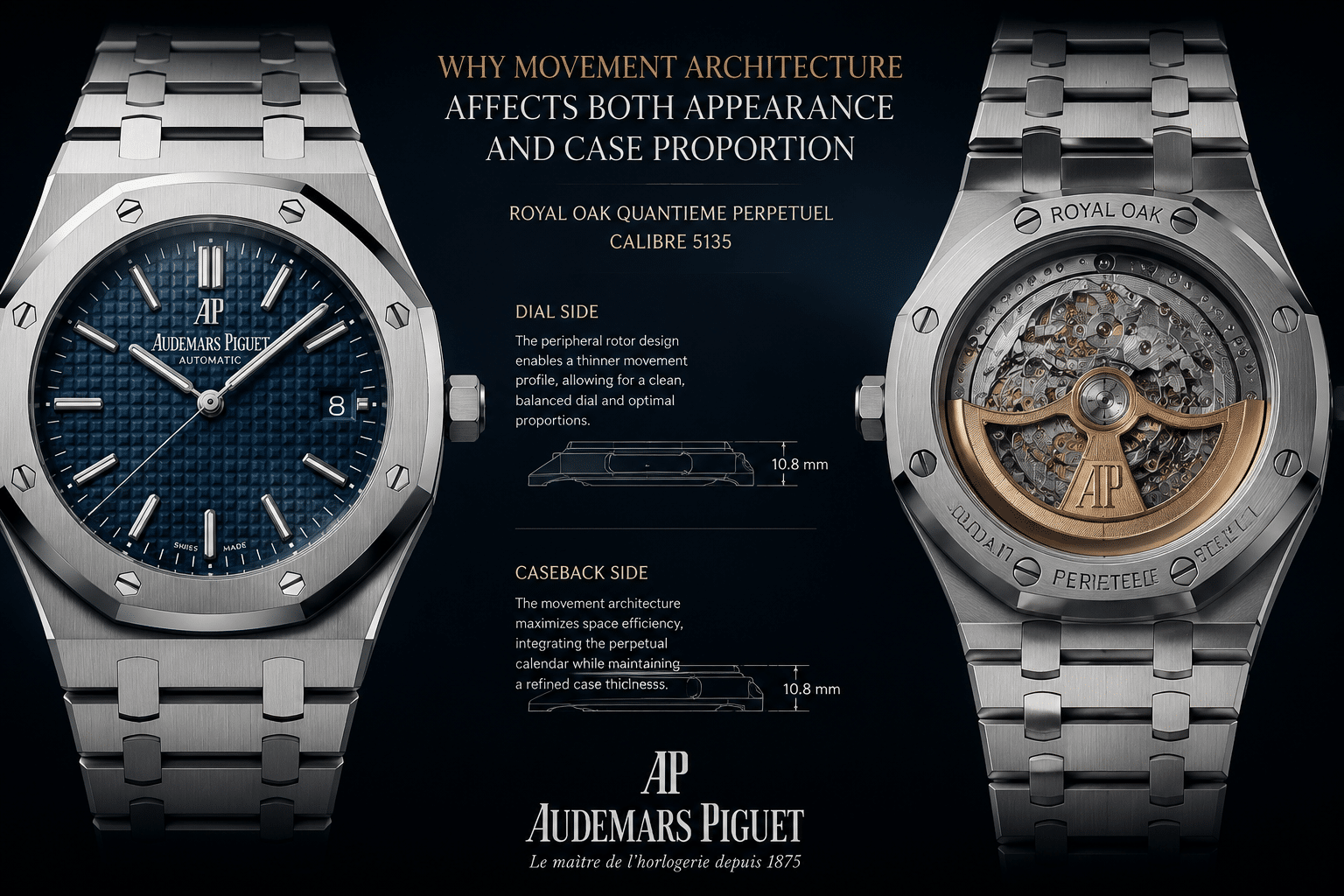
The older 7750 AP chronograph replica route was useful because it gave factories a functional chronograph movement that was widely available, familiar, and relatively practical to build around. The problem was not that every 7750-style movement is automatically bad. The problem was fit. A 7750-based Royal Oak Chronograph was trying to force a generic chronograph architecture into a watch whose case design and display-back expectations demand something more specific.
That mismatch created visible consequences. Older 7750-based Royal Oak Chronograph builds could look acceptable from the dial side, especially in seller photos taken straight on. But once buyers looked at the side profile or caseback, the compromise became harder to ignore. The case often needed more height, the movement view did not fully match the expected layout, and decorative changes could only do so much to hide the underlying architecture.
This is the old limitation many buyers misunderstood. The flaw was not only “the movement is different.” The real issue was that the movement route pushed the entire watch away from the Royal Oak Chronograph’s intended proportions and visual logic. For a design as exposed as the Royal Oak, that is a serious compromise.
Thickness Was the First Visible Compromise
Excessive case thickness was the easiest problem to notice, even for buyers who were not movement experts. A Royal Oak Chronograph is already a more substantial watch than a simple Royal Oak, but it still needs the case to feel controlled. When an older 7750-based Royal Oak Chronograph became too thick, the watch lost some of the flat, integrated character that defines the model.
The side profile is where this shows up. A thicker mid-case makes the bezel appear less planted, the caseback can look more bulbous, and the bracelet may appear to drop away from the case instead of flowing naturally from it. On the wrist, that can make the watch feel taller and more top-heavy than the dial photo suggested.
This is why thickness is not a minor spec-sheet argument. A difference that sounds small on paper can change the entire wrist impression of a Royal Oak. Buyers who only evaluate front photos often miss this until the watch is in hand.
The Caseback Could Not Fully Match the Genuine Layout
The display caseback made the old 7750 solution even more difficult. If the caseback were closed, factories could focus on external shape and function. But the Royal Oak 26240-style expectation includes a visible movement, and a visible movement needs to look structurally believable.
Older builds often relied on decorated rotors, surface plates, or engraving changes to make a generic chronograph base look more AP-like. Those changes could improve the first impression, but they could not fully solve the deeper issue: the bridge layout, movement depth, chronograph works, and overall architecture did not naturally belong to the 26240 concept.
This is the difference between decoration and architecture. A decorated rotor can improve the view, but it cannot make the movement look purpose-built if the underlying layout is wrong. For buyers who care about the caseback, that difference is decisive.
Why Dial-Side Accuracy Was Not Enough
Some older AP chronograph replicas had respectable dial execution. The subdials could look reasonably placed, the tapisserie pattern could be acceptable for daily wear, and the bracelet might feel solid enough. But on this model, a good dial does not rescue a weak movement route.
The Royal Oak is unusually sensitive to total design coherence. The dial, bezel, case, bracelet, and movement view all work together. If the front looks convincing but the case is too tall and the back reveals an unrelated chronograph architecture, the watch feels like a strong surface replica built on a compromised technical base.
For casual wearers who never look at the caseback and do not mind a heavier profile, an older 7750-based chronograph might have seemed acceptable. For buyers comparing the AP 26240 as a serious super clone watch, the limitations were harder to ignore. The clone 4401 matters because it addresses those structural problems rather than only polishing around them.
What the Genuine AP Cal. 4401 Represents in the 26240
The genuine AP Cal. 4401 matters because it is not just a hidden engine inside the Royal Oak 26240. It is part of the model’s identity. The 26240 is a modern Royal Oak Chronograph with an open caseback, so the movement architecture, visible depth, rotor style, and chronograph layout are part of what the wearer sees and what an informed buyer expects.
For replica evaluation, this changes the standard. A Royal Oak 26240 movement cannot be judged only by whether the hands move and the chronograph starts. The more important question is whether the movement route makes sense for the watch. Does the case thickness remain controlled? Does the display caseback look like a serious attempt to echo the AP Cal. 4401 concept? Does the chronograph behavior support the story the watch is trying to tell?
The clone 4401 is important because it tries to answer those questions more directly than older movement routes. It should still be judged with restraint. Visual and architectural closeness does not prove identical engineering, finishing quality, material quality, or long-term reliability. But for a model with a visible chronograph movement, being closer in concept matters much more than it would on a closed-back watch.
How authentic-watch facts should be used here: Official Audemars Piguet information can help a reader understand what the authentic Royal Oak Chronograph is intended to be, but it should not be used as proof that a replica has the same movement construction, finishing, tolerance, water resistance, warranty, or service support. In replica evaluation, the authentic model is a comparison reference for design logic; the actual replica still needs its own QC photos and function checks.
Integrated Chronograph Architecture as a Design Signal
An integrated chronograph feels more correct for the Royal Oak 26240 because the movement is supposed to look like it belongs to the watch from the beginning. In plain terms, the chronograph mechanism is not meant to feel like an afterthought stacked onto a generic base for convenience. The layout should have visual depth, organized bridge shapes, and a sense that the chronograph works are part of the movement’s main design.
This is why movement architecture becomes a design signal. Buyers may not be able to identify every lever or wheel through the caseback, but they can often sense when the movement looks dense, purposeful, and properly matched to the case. A generic base covered with decoration can look flatter or less convincing, especially once compared with photos of the genuine Cal. 4401 layout.
The practical takeaway is simple: for this model, a more appropriate clone movement is not just a technical bragging point. It supports the visual logic of the entire replica.
Why the Display Caseback Raises the Standard
The display caseback is what makes the Royal Oak 26240 more demanding than many older AP replicas. A closed-back watch can hide a lot. An exhibition-back chronograph cannot. The buyer can see the rotor shape, bridge design, screw placement, engraving style, jewel positions, and the overall depth of the movement.
This does not mean every buyer needs to become a watchmaker. It means the caseback must pass a broader credibility test. Does the movement look purpose-built or patched together? Does the rotor appear appropriate for the model? Does the bridge layout look close in spirit to the AP Cal. 4401, or does it clearly reveal a different movement route beneath decoration?
This is where the clone 4401 gains importance. It gives the replica a stronger back-side presentation, which older chronograph builds often lacked. The point is not that the caseback becomes indistinguishable from the genuine watch under close inspection. The point is that the movement view no longer feels like a separate weakness the buyer has to ignore.
The Flyback Function in Buyer-Friendly Terms
A flyback chronograph allows the chronograph to be reset and restarted quickly without going through the normal stop, reset, and start sequence. In practical terms, it is a more advanced chronograph concept than a basic start-stop-reset setup. For the Royal Oak 26240, the flyback idea is part of why the movement feels modern and technically ambitious.
For a replica buyer, the flyback function should be understood carefully. It is interesting because it shows that the clone movement is trying to reflect the correct functional concept, not only the correct appearance. But buyers should avoid assuming that every claimed clone 4401 version behaves with the same refinement, durability, or exact internal execution as the genuine AP movement.
The sensible view is this: flyback behavior adds credibility if it works cleanly, but it also adds complexity, much like the tradeoffs discussed in Miyota 9015 AP replicas when reliability claims meet visible compromises. The more advanced the chronograph function, the more important it becomes to check reset alignment, pusher feel, and basic chronograph behavior before treating the movement claim as meaningful.
Movement Details to Verify
Before judging any AP clone 4401 version, buyers should confirm the claimed movement route through actual photos, not only factory descriptions. The most useful checks are the caseback view, rotor appearance, bridge layout, movement depth, and whether the chronograph behavior matches what is being claimed for that batch.
A short function video can be more useful than another polished dial photo. At minimum, the buyer should want to see the chronograph start, stop, reset, and return cleanly to zero. If a seller or listing claims a clone 4401 flyback chronograph but cannot show the movement side clearly, that is a reason to slow down. On this model, the movement is not a footnote. It is the main reason the replica deserves attention in the first place.
Verification limit: Even strong photos cannot prove lubrication quality, internal finishing, part hardness, regulation stability, or future parts availability. They can only help confirm whether the visible movement layout and basic chronograph behavior support the advertised version. That is why a careful buyer should treat movement photos and videos as risk-reduction tools, not as guarantees.
What Movement Names Do Not Prove
Movement descriptions in the replica market should be checked carefully because they may refer to layout, decoration, clone architecture, or seller terminology rather than an official brand-manufactured caliber. A term such as “4401-style clone” can be useful for comparing versions, but it does not by itself prove genuine Audemars Piguet origin, identical materials, identical engineering tolerances, or full service compatibility with the authentic movement.
For this reason, buyers should separate three different questions. First, does the visible architecture support the claimed movement route? Second, does the individual watch show clean chronograph behavior in QC evidence? Third, are the seller’s service, return, water-resistance, and after-sales terms clearly confirmed before ordering? A strong answer to one question does not automatically answer the others.
Before making a decision, buyers should review real QC photos where available, including dial printing, hand alignment, bezel position, datewheel centering, bracelet fit, clasp engraving, case thickness, caseback finishing, and visible movement layout. Factory labels, movement names, and stock photos alone are not enough for a reliable judgment on a complicated AP 26240 clone 4401 build.
How the APS Clone 4401 Changes the Replica Conversation
The APS clone 4401 changes the AP 26240 replica discussion because it moves the watch away from a generic chronograph solution and toward a movement route built around the identity of the Royal Oak Chronograph itself. That is the real upgrade. It is not just a nicer rotor, a different engraving, or a factory label added to a familiar build.
For the AP Royal Oak 26240 replica, the movement is part of the watch’s visible architecture. The 26240 has a display caseback, a modern integrated chronograph layout, and a case profile that does not tolerate excessive movement height well. A movement that only works from the dial side is not enough here. The APS 26240 movement matters because it supports the whole replica package: case thickness, caseback credibility, rotor design, bridge layout, and chronograph behavior all become more aligned with what buyers expect from this reference.
This does not mean every APS AP model should automatically be treated as superior. The judgment is narrower and more useful: for this specific Royal Oak Chronograph, the APS clone 4401 is meaningful because the 26240 exposes the weaknesses of older movement routes more aggressively than many three-hand Royal Oak replicas do. A time-only Royal Oak can hide more behind the dial. A modern chronograph with an exhibition back cannot.
A More Model-Specific Movement Route
The main difference is that the clone 4401 flyback chronograph is trying to solve a model-specific problem rather than simply powering the hands. Older chronograph bases could be made functional, but the movement architecture did not naturally belong to the 26240 concept. The result was often a watch that looked acceptable in straight dial photos but felt technically improvised once you checked the side profile or caseback.
The APS clone 4401 gives the AP 26240 super clone a stronger foundation because the movement bridge layout, rotor position, and visible chronograph structure are designed to resemble the 4401-style concept more closely. That matters because the Royal Oak Chronograph is not a closed-back sports watch where the movement is mostly irrelevant to the visual experience. The owner sees the movement. The buyer compares caseback photos. The movement route becomes part of the judgment.
The non-obvious point is that this upgrade is not only for buyers who stare at movements. A more appropriate movement route can also affect how the case is built around it. If the movement thickness and architecture are better suited to the model, the factory has more room to keep the case proportion under control. That is why serious buyers care about this movement even before discussing decoration quality.
Why the Upgrade Matters Even Before Wearing the Watch
A strong APS 26240 movement version can change a buyer’s evaluation before the watch is ever handled in person. In QC photos, three angles become more important than the usual front-facing dial shot: the caseback, the side profile, and the pusher-side view. These angles reveal whether the watch is built around a credible movement route or merely dressed to look acceptable from the front.
The caseback should show a movement that appears purpose-built for the reference, not a flat decorative layer trying to disguise an unrelated chronograph base. The side profile should not make the mid-case look inflated. The rotor design should sit naturally within the movement view rather than looking like an aftermarket badge placed on top of the wrong architecture.
At Clean VS Factory, we usually treat this kind of upgrade as a version-level decision, not a blanket factory endorsement. The useful question is not simply “is APS 26240 better?” The better question is whether this specific clone 4401 route makes the 26240 more coherent as a replica watch. In this case, the answer is yes, with the usual caution that movement complexity still needs realistic ownership expectations.
For a buyer comparing older AP chronograph replicas against the APS clone 4401, the decision changes in a practical way. The older route may still function as a chronograph, but the APS route is more convincing as a 26240 build. That distinction matters more on this model than on many simpler watches.
Thickness Control and Royal Oak Case Proportion
AP 26240 case thickness is not a small specification detail. On a Royal Oak Chronograph, thickness controls how the watch wears, how the bracelet leaves the case, and whether the angular design still feels sharp. A replica can have a clean dial and still look wrong if the mid-case is too tall or the caseback pushes the watch upward on the wrist.
The Royal Oak design depends on flat planes and controlled transitions. The bezel, mid-case, caseback, and integrated bracelet need to feel like one continuous structure. When a movement forces the case too high, that structure becomes stacked rather than integrated. The watch starts to look like a thick chronograph placed inside a Royal Oak shell instead of a Royal Oak Chronograph designed as a complete object.
This is where the clone 4401 route becomes important in daily-wear terms. Better movement thickness control gives the factory a better chance of keeping the Royal Oak Chronograph thickness visually balanced. Exact measurements should always be checked by version and batch, but the direction of the improvement is clear: a movement better suited to the 26240 helps reduce the bulky profile that made many older AP chronograph replicas less convincing.
Why a Thick Royal Oak Chronograph Looks Less Convincing
A thick Royal Oak Chronograph does not just wear larger. It changes the design language. The Royal Oak is supposed to look broad, flat, and architectural. If the case becomes too tall, the bezel can look perched on top of a heavy mid-case, the pushers can appear more protruding, and the bracelet transition can lose its natural slope from the case to the wrist.
This matters more on the Royal Oak than on many round chronographs. A round sports chronograph can sometimes absorb extra height because the case shape is already more traditional. The Royal Oak cannot hide it as well. Its case side is exposed, its bracelet is integrated, and the first links immediately reveal whether the watch sits naturally or rides high.
For buyers asking whether the replica looks too thick, the answer should not come from the number alone. A slightly thicker watch with a well-shaped mid-case can look better than a thinner watch with poor transitions. But once the case height starts making the bracelet drop sharply or the caseback look swollen, the watch loses a major part of its Royal Oak character.
Side Profile Is Often More Revealing Than Dial Photos
Front-facing photos are forgiving. They can show the tapisserie dial, subdial spacing, hands, logo, and bezel shape while hiding the physical mass of the watch. The side profile is less forgiving because it shows how the movement route affects the whole case stack.
For the APS 26240 movement, side-view photos are especially useful because they tell you whether the technical upgrade is translating into better proportion. Look at the mid-case height, the thickness of the caseback, the way the bezel sits on the case, and how the pushers align with the case flank. If those elements look heavy or inflated, the movement upgrade is not delivering its full practical value.
The strongest AP 26240 replica is not the one that only photographs well from the dial side. It is the one that keeps the Royal Oak geometry believable from multiple angles. That is why side profile should be treated as a primary QC view for this model, not an optional extra.
Case and Bracelet Checks
- Side profile: Check whether the case looks balanced from bezel to caseback. A bulky mid-case is more damaging than a minor dial printing difference.
- Caseback protrusion: A display back should not make the watch look like it is floating above the wrist. Excessive caseback height changes comfort and visual proportion.
- Bracelet slope: The first links should leave the case naturally. If they angle downward too sharply, the watch may wear taller than photos suggest.
- Lug transition: On a Royal Oak, the case-to-bracelet connection is part of the design. Gaps, stiffness, or awkward first-link posture weaken the whole impression.
- Pusher-side balance: The chronograph pushers should not make the case side feel crowded or overly thick. This angle often reveals whether the case geometry is controlled.
The practical judgment is simple: if the side profile looks wrong, a beautiful dial will not fully rescue the watch. For the Royal Oak Chronograph, proportion is not decoration. It is the core of the design.
Caseback Credibility: Where the Clone 4401 Gains the Most
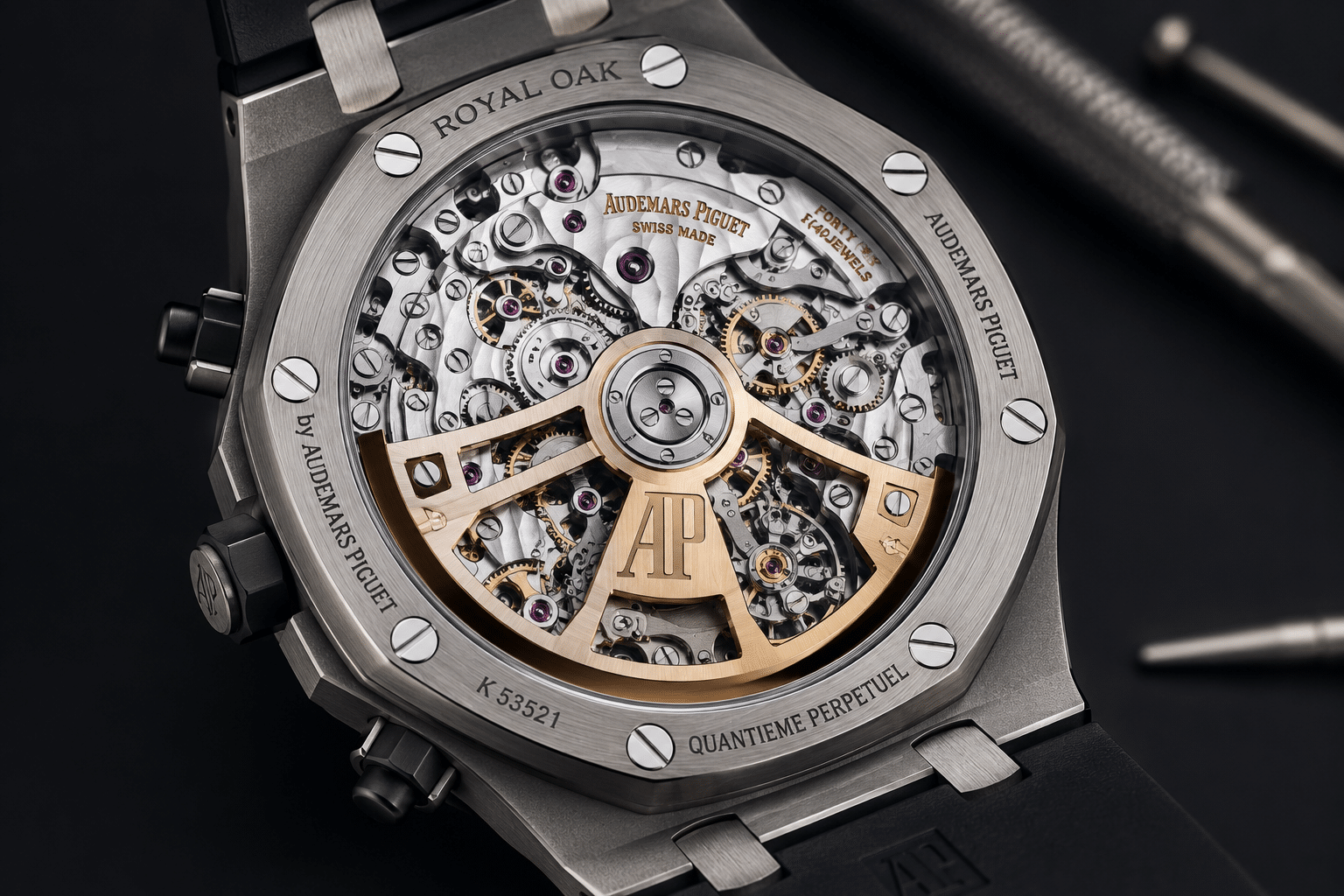
The AP 26240 caseback is where the clone 4401 gains its most obvious advantage. Older AP chronograph replicas often looked strongest from the front and weakest from the back. The dial could be convincing enough, the bracelet could look refined, and the bezel could pass a casual glance, but the display caseback exposed the limits of an adapted movement route.
The clone 4401 caseback improves that conversation because it gives the buyer something closer to the correct visual logic of a modern AP chronograph movement. The point is not that the movement is identical to the genuine AP Cal. 4401. It is not useful or responsible to frame it that way. The point is that the bridge layout, rotor design, visible movement density, and chronograph works can look more coherent under the exhibition back.
For this reference, caseback credibility is not a collector-only concern. The open back is part of the model’s appeal. If the movement view looks obviously improvised, the whole replica feels less convincing even if the dial side is strong. That is why buyers care about this movement: it addresses a weakness that could not be fixed with better dial printing alone.
Why Decorative Covers Were Not Enough
Decorative covers can make a movement look more expensive, but they cannot fully correct the wrong architecture. A rotor with AP-style engraving may help at a glance, but if the underlying bridge shapes, depth, and chronograph layout do not make sense for the model, the display back still feels compromised.
This is especially true on a chronograph. A simple automatic movement can hide behind a decorated rotor more easily because the visual expectations are lower. A flyback chronograph creates a different standard. Buyers expect visible complexity, layered components, and a layout that appears to belong to the watch. Flat decoration over a generic base rarely creates that impression.
The clone 4401 route matters because it reduces the need for visual pretending. Instead of relying mainly on surface decoration, it gives the AP 26240 replica a movement view that is more aligned with the concept of the reference. That is a more meaningful improvement than a slightly sharper engraving on the wrong movement.
What a More Convincing Caseback Should Show
A more convincing AP 26240 caseback should show depth first. The movement should not look like a flat printed layer under glass. There should be visible structure, with bridges, screws, rotor shape, and chronograph-related components creating a sense of mechanical layering.
Bridge layout is also important. The shapes should look intentional rather than generic. Buyers should look for whether the movement fills the caseback space naturally, whether the rotor design sits proportionally within the movement, and whether the visible engraving and finishing are consistent enough to avoid a cheap decorative appearance.
Rotor appearance deserves separate attention because it is one of the easiest caseback details to notice. A rotor that looks poorly shaped, poorly colored, or visually disconnected from the rest of the movement can weaken the entire back-side impression. The same applies to screw placement and movement density. A credible clone 4401 caseback should look purpose-built, not assembled from unrelated visual cues.
What Caseback Photos Can and Cannot Prove
Caseback photos are useful, but they are not final proof of movement quality. They can show whether the visible architecture broadly matches the advertised clone 4401 route, whether the rotor and bridge layout look appropriate, and whether the movement view appears too flat or obviously decorative. They cannot show lubrication quality, tolerance control, long-term wear behavior, or whether the flyback mechanism has been adjusted correctly. That is why a strong caseback photo should be paired with basic function evidence instead of treated as a complete answer.
Lighting and angle can also make a movement look better or worse than it is. A polished rotor can hide rougher finishing under glare, while a dark caseback photo may obscure bridge shapes and screw quality. For this model, buyers should ask for clear, direct caseback photos because the movement is part of the buying reason. If the only available images are front-facing glamour shots and one blurred caseback, the seller description should be treated as an unverified claim rather than buyer-verifiable evidence.
Where Buyers Should Still Stay Realistic
Visual credibility does not prove identical engineering. A better-looking clone 4401 caseback does not guarantee the same finishing quality, material quality, tolerances, power reserve, serviceability, or long-term durability as the genuine movement. Buyers should separate appearance accuracy from ownership confidence.
This is the main trap with impressive caseback photos. A movement can look far more convincing than an older 7750-based build and still remain a complex replica chronograph that should be treated carefully. The chronograph works, flyback behavior, pusher feel, reset alignment, and long-term stability all deserve more caution than a simple three-hand automatic.
The right judgment is balanced: the APS clone 4401 is a major step forward for AP 26240 caseback credibility, but it should not be treated as a risk-free movement. It is more convincing because it solves a real visual and architectural problem. It is also more complex, which means buyers should pay closer attention to QC photos, function checks, and realistic daily-use expectations.
Flyback Function and Chronograph Behavior in Practical Terms
The flyback feature is the part of the clone 4401 flyback chronograph that sounds most exotic, but buyers should keep it in proportion. It matters because it shows a more ambitious movement route than a basic chronograph clone, not because most owners will use it every day. The practical question is not only “does the flyback work?” It is whether the chronograph starts, stops, resets, and returns cleanly without sloppy hand alignment or rough pusher behavior.
A normal chronograph usually follows a start, stop, reset sequence. A flyback chronograph is designed to let the running chronograph reset and restart in one action, without stopping first. On an AP flyback chronograph replica, this function is interesting because it brings the watch closer to the concept of the 26240 movement, but it also gives buyers one more behavior to verify carefully. A claimed flyback is not enough; the exact watch and batch still need to be checked.
Flyback Explained Without Overcomplication
In simple terms, flyback means the chronograph hand can snap back to zero and immediately begin timing again while the chronograph is already running. Instead of pressing stop, then reset, then start, the flyback action compresses that into a faster reset-and-restart operation. This is useful in aviation and interval timing, but for most replica watch buyers it is mainly a sign of movement complexity and model-specific ambition.
The non-obvious point is that the flyback function should not be overvalued if the basic chronograph behavior is poor. A watch that technically performs a flyback but has a central seconds hand that lands half a marker off, a minute counter that does not advance correctly, or pushers that feel gritty is not a better ownership experience just because the function exists. For this movement, clean behavior matters more than dramatic terminology.
Buyers should also be realistic about usage. Many owners of complicated replica chronographs rarely run the chronograph for long periods. That is not necessarily a problem. In fact, with a complex clone movement, conservative use is often the smarter ownership habit. The flyback feature can make the AP 26240 replica more technically credible, but it does not turn it into a low-risk tool chronograph.
Chronograph Alignment Is Still a QC Priority
Chronograph alignment is where a technically impressive movement can still disappoint. The first thing to check is the central chronograph seconds hand at rest. It should sit cleanly at 12, not slightly left or right of the marker. A tiny camera-angle distortion can exaggerate this, so the best judgment comes from a straight-on photo, but a visibly crooked reset position is still a red flag.
The subdial hands deserve the same attention. On a Royal Oak Chronograph layout, a buyer should look at the minute counter, running seconds, and any resettable chronograph register with the same suspicion given to the main chronograph hand. If the minute counter does not advance after the chronograph has been running long enough, or if a subdial hand resets inconsistently, the movement may be poorly adjusted even if the case and dial look strong.
Pusher feel is harder to judge from photos, but it matters in real use. A proper start, stop, and reset sequence should not feel vague, crunchy, or uneven. Replica chronograph pushers rarely duplicate the tactile refinement of the genuine watch, so the goal is not perfection. The goal is consistency: the pusher should engage predictably, the hand should start without hesitation, and the reset should be firm rather than lazy.
The most important judgment here is simple: do not let the presence of a clone 4401 movement distract from basic chronograph QC. A movement can be more advanced in architecture and still have an individual unit with poor reset alignment. For this type of AP chronograph replica, alignment is not a minor cosmetic issue; it is one of the few visible signs of whether the complication has been assembled and adjusted with care.
Chronograph Checks to Request
A front-facing photo with the chronograph fully reset is the minimum. The central chronograph seconds hand should be checked against the 12 o’clock marker, and the subdial hands should be inspected for clean resting positions. If the photo is taken at an angle, ask for a straighter view before making a judgment, because AP’s dial texture and crystal reflections can make small alignment issues look worse or better than they are.
Where available, a short function video is more useful than another glamour photo. The video should show start, stop, reset, and, if the version claims flyback behavior, the reset-and-restart action while the chronograph is running. The buyer is not looking for a laboratory test. The useful signs are clean hand snapback, no obvious stutter, no failure to reset, and no register hand wandering away from its expected position.
It is also worth checking the chronograph after it has run for a few minutes, not only after a one-second demonstration. A minute counter that looks fine in a quick clip may show problems only after the chronograph runs long enough to advance. This is one reason serious buyers treat chronograph QC differently from a simple three-hand replica. There are more functions, and more chances for a small problem to become noticeable.
Why the Clone 4401 Attracts More Serious AP Replica Buyers
The AP 26240 super clone movement attracts serious buyers because it changes what can be evaluated. A casual buyer may look at the dial, bracelet, and bezel and decide whether the watch looks close enough. A more movement-aware buyer looks at the side profile, display-back layout, chronograph behavior, and whether the movement route makes sense for this specific reference. The clone 4401 matters most to the second group.
This is not about saying every buyer needs the most complicated version. Some do not. The real point is that the APS Royal Oak Chronograph with a clone 4401-style movement gives advanced AP replica buyers fewer obvious compromises in the areas that used to weaken chronograph builds: case thickness, movement credibility, and back-side presentation. That does not make it risk-free, but it does make the watch more coherent as a 26240 replica.
The Buyer Who Only Looks at the Dial May Miss the Point
Front-facing photos can make many AP chronograph replicas look persuasive. The tapisserie dial, applied markers, subdial rings, bezel shape, and integrated bracelet do most of the immediate visual work, while Audemars Piguet replica movements remain a less obvious basis for judging the clone 4401 architecture beneath the caseback. If the buyer only judges from a straight-on dial shot, the clone 4401 upgrade may not seem dramatic. That is exactly why some buyers underestimate it.
The biggest improvements are often outside the first photo. A better movement route can support a more reasonable case profile. A more model-specific chronograph architecture can make the exhibition caseback look less improvised. A cleaner chronograph mechanism can make the watch feel more credible when the pushers are actually used. These are not always obvious in a listing-style dial image, but they affect how the watch is judged by someone who understands the 26240.
The clear judgment is this: if a buyer only wants an AP-looking chronograph from the front, the clone 4401 may be more movement than they need. If the buyer cares about whether the replica makes sense as a Royal Oak Chronograph 26240, the movement becomes one of the main reasons to consider the version seriously.
The Movement-Aware Buyer Gets More Value From This Upgrade
The movement-aware buyer is not necessarily obsessed with macro-level perfection. More often, this buyer wants the watch to be technically consistent. The case should not look inflated. The caseback should not reveal a movement layout that clearly belongs to another platform. The chronograph should behave in a way that matches the model’s identity. This is where the AP 26240 super clone movement becomes meaningful.
For this buyer, the value is not only that the movement is visible through the back. It is that the visible movement no longer feels like an afterthought hidden behind decoration. Bridge layout, rotor appearance, movement depth, and chronograph works all contribute to the impression that the watch was built around the 26240 concept rather than adapted from a generic chronograph base.
At Clean VS Factory, we tend to separate visual accuracy from ownership experience when evaluating complicated replica watches. The clone 4401 is attractive because it improves model credibility, but it still needs to be judged as a complex chronograph movement, not as a simple automatic with extra decoration. That distinction is where many buyer expectations become either realistic or unrealistic.
When the Upgrade May Be Less Important
The clone 4401 is less important for buyers who prioritize simplicity above all else. If the main goal is low-maintenance daily wear, minimal movement concern, and fewer functions to worry about, a three-hand Royal Oak-style replica may be a more rational choice. It may be less technically exciting, but it has fewer moving parts and fewer chronograph-specific QC points.
It may also be less important for buyers who never look at the caseback and do not care about side-profile accuracy. If the watch will be worn casually and judged mostly as a design object, dial quality, bracelet comfort, and exterior finishing may matter more than flyback behavior or movement architecture. There is nothing wrong with that preference, but it changes the buying logic.
The mistake is buying the clone 4401 version only because it sounds like the highest specification. Advanced movements are not automatically better for every owner. They are better for buyers who understand why the movement matters and accept the extra complexity that comes with it.
Reliability Caution: Impressive Does Not Mean Simple
The clone 4401 reliability discussion needs balance. The movement is a meaningful step for AP chronograph replica reliability in the sense that it moves beyond older, poorly matched chronograph solutions. But it is still a complicated clone chronograph. Buyers should not evaluate it the same way they would evaluate a proven three-hand automatic movement in a simpler replica watch.
Chronographs add levers, wheels, reset hammers, coupling systems, pushers, and more adjustment points. A flyback chronograph adds another layer of functional expectation. That does not mean the watch should be avoided by everyone. It means the buyer should understand that technical ambition and low-maintenance ownership are not the same thing.
A replica watch should be evaluated with realistic ownership expectations. Even a strong super clone can have limits in water resistance, long-term movement stability, servicing convenience, and close inspection compared with a genuine reference. Buyers should confirm repair, water-resistance testing, shipping, and after-sales terms before ordering rather than assuming these details from a factory name or movement label.
More Parts Usually Means More Ownership Risk
A simple automatic movement has fewer things to coordinate. It winds, stores power, drives the hands, and often changes the date. A chronograph movement has to do all of that while also starting, stopping, measuring elapsed time, advancing registers, and resetting hands cleanly to zero. Every additional system creates another place where poor lubrication, adjustment error, impact, or wear can create problems.
This is why AP chronograph replica reliability should be judged with more caution than time-only replica reliability. A watch can keep acceptable time while the chronograph reset is slightly off. It can wind normally while the pusher action feels uneven. It can look excellent through the caseback while long-term parts support remains uncertain. These are different risk categories, and buyers should not compress them into one vague idea of “good movement.”
Rotor noise, winding feel, pusher feel, power reserve, and reset consistency are all practical signals. None of them alone proves long-term durability, but together they tell the buyer whether the movement feels well adjusted or marginal. The wrong approach is to assume that because the clone 4401 is more impressive than an older 7750 route, it must also be as trouble-free as a basic automatic. That is not how complicated replica movements should be judged.
Daily Wear Versus Occasional Wear Expectations
For regular office wear, with the chronograph used only occasionally, the clone 4401 route can make sense for a buyer who values the 26240’s technical identity. The watch is being worn mostly as a Royal Oak Chronograph, not as a stopwatch used constantly throughout the day. In that use case, the owner benefits from the improved architecture and caseback credibility while limiting unnecessary stress on the chronograph works.
Heavy chronograph use is a different expectation. If a buyer plans to run the chronograph frequently, reset it often, or use the flyback function as a daily timing tool, the risk profile rises. Complex clone chronographs are not the safest category for that kind of use. Even if the movement performs well at first, repeated engagement of the chronograph system can increase wear compared with leaving it idle most of the time.
Serviceability is the hidden concern. A simple movement is usually easier for an independent watchmaker to understand, regulate, clean, or replace. A clone flyback chronograph is more specialized. Parts access, correct adjustment, and long-term maintenance may be less straightforward. Buyers should not assume that every local watch repair shop will be comfortable servicing one.
Why Three-Hand Replicas Still Have a Reliability Advantage
Three-hand replicas remain the safer choice for buyers who want the least complicated ownership experience. A good three-hand Royal Oak, Datejust-style watch, Submariner-style watch, or similar simple automatic has fewer functions to test and fewer failure points to manage. It may be less exciting mechanically, but it is often more forgiving as a daily wearer.
This does not make the clone 4401 a poor movement route. It makes it a more specialized one. The buyer gets stronger model credibility for the AP 26240 replica, better functional ambition, and a more convincing chronograph presentation. The tradeoff is that the watch should be treated with more care, inspected more carefully, and judged with more conservative reliability expectations.
The best fit is a buyer who understands that impressive and simple are different virtues. If the goal is the most coherent AP Royal Oak Chronograph replica experience, the clone 4401 deserves attention. If the goal is the lowest possible maintenance concern, a simpler movement still wins.
Water Resistance and Durability Expectations
Water resistance should not be assumed from the Royal Oak Chronograph design, the factory label, or the fact that the genuine reference is built as a luxury sports watch. A replica watch may have gaskets, a screw-down crown, or a case construction that appears similar in photos, but those visible details do not prove pressure testing, sealing consistency, or long-term protection against water exposure.
Buyers who plan to wear an AP 26240 clone 4401 regularly should confirm whether the specific watch has been tested and what the seller’s policy actually covers. Even then, a complicated replica chronograph should be treated cautiously around water because pushers, caseback seals, crown seals, and servicing history can all affect real-world durability. The safer assumption is that water exposure adds avoidable risk unless the individual unit has been checked and the terms are clearly understood.
QC Focus for an AP 26240 Clone 4401 Build
An AP 26240 QC review should not become a generic “does the watch look nice” check. The clone 4401 movement gives this Royal Oak Chronograph replica a better technical foundation, but it also adds more places where a specific unit can go wrong. For this model, the most useful QC photos are not only the clean front dial shot. You need the dial, chronograph hands, side profile, caseback, bracelet fit, and preferably a short function video if available.
The main judgment is simple: do not approve an AP 26240 clone 4401 build based only on dial-side beauty. A sharp tapisserie dial and polished bezel can hide a poor chronograph reset, an awkward caseback protrusion, or a movement view that does not match the claimed route. The better the movement claim, the more important the supporting photos become.
Buyer evidence standard: For this model, evidence should be visual and behavior-based. A useful QC set should connect each important claim to something observable: side shots for thickness, caseback photos for movement architecture, reset photos for chronograph alignment, and a short video for start-stop-reset or flyback behavior. If a claim cannot be tied to an image or function demonstration, it should be treated as marketing language rather than confirmed fact.
Front Dial and Chronograph Hand Alignment
Start with a straight, front-facing dial photo. Angled photos can make subdials look uneven or hide a slightly crooked logo. On the AP 26240, the tapisserie pattern is a major visual anchor, so check whether the grid appears centered against the hour markers and subdials. Minor lighting differences across the squares are normal; a visibly tilted dial texture, uneven marker placement, or distorted logo position is not something to ignore.
The chronograph hands deserve more attention than they get in many AP 26240 QC discussions. The central chronograph seconds hand should rest cleanly at zero. The subdial hands should also return consistently after reset. A tiny photographic angle issue can make a hand look slightly off, but if the central hand clearly sits left or right of 12 in multiple straight photos, that is a functional and visual concern. On a chronograph replica, reset alignment is not a decorative detail. It tells you something about how carefully the movement and hands were assembled.
Date alignment is another practical check. The date should sit reasonably centered in the window, without being pushed too high, too low, or clipped at the edge. A small variation between numbers can happen, but a datewheel that looks badly sunken, tilted, or consistently off-center will bother most buyers more in daily wear than a microscopic dial-printing difference. For this reference, a clean date window and resettable chronograph hands matter more than chasing every macro-level texture flaw.
Side Profile and Caseback Photos
The side profile is one of the most important AP 26240 QC angles because it shows whether the movement upgrade is actually supporting the case shape. Ask for a true side shot, not only a glamour angle from above. The mid-case should not look bloated, the caseback should not protrude awkwardly, and the bracelet should flow out of the case rather than drop sharply like an afterthought.
Camera angle can exaggerate thickness, so do not reject a watch from one poor side photo alone. Compare several views if possible: crown side, non-crown side, and a slight wrist-style angle. What you are looking for is proportion, not a laboratory measurement. A Royal Oak Chronograph can be substantial, but it should still preserve the flat, angular character of the Royal Oak case. If the case looks like a thick slab from the side, the dial accuracy will not fully save the watch.
The caseback photo is where the clone 4401 QC claim should be supported. The movement view should look consistent with the advertised clone 4401 route: appropriate bridge layout, rotor style, visible depth, and chronograph complexity rather than a generic decorated base that appears visually unrelated to the 26240 concept. This is not about proving equivalence to the genuine AP movement. It is about confirming that the watch being shown matches the version being described.
Bracelet, Bezel, and Finishing Consistency
The Royal Oak bracelet can make a technically strong replica feel either convincing or disappointing. In QC photos, check the first links where the bracelet meets the case. The gap should be even, and the first links should articulate naturally instead of sitting stiffly or flaring outward. A slightly tight bracelet can loosen with wear, but obvious uneven fit at the case junction is a poor sign because it affects the entire wrist presence of the watch.
Bezel screw placement should also be reviewed with realistic expectations. Replica Royal Oak bezel screws are rarely perfect under macro inspection, but they should look evenly seated and consistent with each other. A screw that appears raised, twisted, badly misaligned, or differently finished from the others can stand out immediately because the octagonal bezel is one of the most visible design elements on the watch.
Finishing consistency matters more than maximum sharpness. The Royal Oak depends on the contrast between brushed flats and polished bevels, so look for clean transitions on the bezel, case edges, bracelet links, and clasp. Overly rounded edges make the watch feel soft; excessively harsh edges can make it uncomfortable. In practice, the best QC outcome is not the most aggressive-looking finishing in photos, but a balanced case and bracelet that look coherent from every angle.
Seller Descriptions Should Support, Not Replace, QC Evidence
Seller wording can be useful when it identifies the factory, version, movement route, and batch, but it should not replace visual confirmation. Phrases such as “latest version,” “clone 4401,” or “best AP chronograph” are only meaningful if the watch shown actually supports those claims. For the 26240, that means caseback photos, side-profile shots, chronograph reset views, and preferably a short function video. Without those, the buyer is being asked to accept marketing language instead of verifiable evidence.
This matters because factory labels and movement names can be used loosely in listings. A buyer does not need to assume bad faith, but should recognize that descriptions can simplify a complicated version landscape. The safer approach is to match each claim to something visible: if the movement is the selling point, the caseback should be clear; if flyback behavior is claimed, a function demonstration is more useful than another dial photo; if thickness is presented as improved, side shots should show the case and bracelet transition. That is how a buyer turns a seller claim into a practical decision.
Claims such as “perfect,” “same as genuine,” or “guaranteed to pass inspection” should be treated with caution. A more reliable comparison looks at the actual model version, movement configuration, finishing details, and available QC evidence. The safest use of factory and movement information is to avoid confusion or overpayment, not to represent a replica watch as a genuine Audemars Piguet product.
Policy and Pricing Claims to Confirm Separately
QC photos can reduce uncertainty, but they do not confirm every buying risk. Before ordering, buyers should separately confirm the seller’s actual terms for returns, exchanges, repairs, water-resistance testing, shipping expectations, customs-related risk, and after-sales communication. These points should not be assumed from a factory name, movement label, listing title, or polished product photo.
Pricing also needs careful comparison. Replica watch prices can vary by factory label, version, movement configuration, finishing quality, seller channel, availability, and after-sales support. A higher price may be reasonable for a more complicated clone 4401 build, but it should still be supported by version-specific evidence such as movement-side photos, side-profile control, chronograph behavior, and clear seller communication rather than treated as proof of superior quality by itself.
Verification Note: When possible, buyers should review real watch photos, caseback details, side-profile views, chronograph reset alignment, clasp finishing, bracelet fit, date position, and movement information before making a decision. Stock images, factory labels, and movement names alone are not enough for a reliable judgment on a complicated AP 26240 clone 4401 build.
Red Flags Before You Decide
- Chronograph hands that fail to reset cleanly: If the central chronograph seconds hand or subdial hands return off-zero after repeated resets, treat it as more than a cosmetic issue.
- Very uneven date placement: A slightly imperfect date is common, but a visibly clipped, tilted, or badly low date will remain noticeable in normal use.
- Poor side-profile proportion: If the mid-case looks swollen or the caseback protrudes heavily, the watch may lose the Royal Oak profile that the clone 4401 route is supposed to improve.
- Mismatched caseback movement: If the caseback photo does not support the claimed clone 4401 movement route, the factory label or seller description should not carry the decision by itself.
- Loose or uneven bracelet fit: Large gaps at the first links, uneven bracelet slope, or a weak clasp fit can make the watch feel lower grade even if the dial is attractive.
- Claims without photos: For an AP 26240 QC decision, unsupported claims about movement, flyback behavior, thickness, or factory version should carry little weight.
At Clean VS Factory, we usually treat AP 26240 QC as a version confirmation exercise, not just a cosmetic inspection. The watch has to make sense as a complete build: dial, movement behavior, side profile, caseback view, and bracelet integration should all support the same story. If one of those areas is seriously wrong, the movement upgrade alone does not make the unit a safe choice.
Final Buyer Judgment: A Major Upgrade With Realistic Limits
The AP clone 4401 verdict is positive, but it should be positive for the right reason. This movement matters because it changes the foundation of the AP 26240 replica movement discussion. It addresses the areas where older chronograph builds were weakest: architecture, case thickness, caseback credibility, and chronograph concept. For buyers who understand the Royal Oak Chronograph beyond the front dial, that is a meaningful step forward.
It is not, however, a reason to suspend judgment. A more advanced movement can make a replica more convincing, but it can also make ownership less simple. The best way to think about the clone 4401 is not “perfect upgrade” or “risky gimmick.” It is a serious technical improvement with a more demanding QC and ownership profile.
The Strongest Case for the Clone 4401
The strongest argument for the clone 4401 is coherence. The movement route fits the AP 26240 better than older 7750-based solutions because it supports a more believable case profile and gives the display back a more credible visual structure. On a watch with an exhibition caseback, that matters. The movement is not hidden deep inside a closed case where only the dial tells the story.
Thickness control is another major point. A Royal Oak Chronograph that becomes too bulky loses some of the design discipline that makes the Royal Oak recognizable. The clone 4401 route helps the replica stay closer to the intended visual character of the 26240. That improvement is visible from the side, on the wrist, and in how the bracelet flows from the case.
The flyback chronograph concept also gives the watch more technical credibility than a basic chronograph layout with decorative treatment. Most buyers will not use the flyback function daily, but its presence changes how the movement should be evaluated. It shows that the replica is trying to follow the model’s technical identity rather than simply filling the case with a convenient chronograph base.
The Main Reason to Stay Cautious
The caution is complexity. A clone flyback chronograph has more parts, more interactions, and more potential adjustment issues than a simple automatic three-hand movement. A buyer who wants the lowest-maintenance daily-wear replica may still be better served by a simpler Royal Oak reference or another proven time-only model. Technical ambition is valuable only if the buyer accepts the additional ownership risk.
Serviceability is also less predictable. With a simple movement, parts access and repair paths are usually easier. With a specialized clone chronograph, long-term support depends more on the exact movement, batch, and available watchmaker experience. That does not make the clone 4401 a bad choice, but it does mean buyers should avoid treating it like a low-risk movement just because it looks impressive through the caseback.
The final caution is QC. The movement upgrade solves important design problems, but it does not automatically guarantee a clean individual watch. Chronograph reset, date alignment, side profile, bracelet fit, and caseback consistency still need to be checked. For this model, a weak unit from a strong movement route is still a weak unit.
The Best-Fit Reader for This Movement
The clone 4401 is best suited to the buyer who cares about AP model credibility beyond the dial. If you compare case thickness, movement layout, display-back appearance, chronograph behavior, and bracelet integration, this upgrade is worth understanding. It gives the AP 26240 replica a more complete technical argument than older chronograph builds could offer.
It is less ideal for the buyer who mainly wants a simple, quiet, low-maintenance daily watch. In that case, the visual drama of a Royal Oak Chronograph may not compensate for the additional movement complexity. The smartest buyer is the one who separates visual accuracy from ownership experience and decides which side matters more.
For a movement-aware AP replica buyer, the clone 4401 is one of the most important developments in the Royal Oak Chronograph space. The realistic judgment is not that it removes every limitation. It makes the AP 26240 replica more technically convincing than before, while still requiring careful QC, restrained reliability expectations, and a clear understanding of the tradeoff.
CleanVSFactory’s editorial approach is to make replica watch decisions more traceable by connecting factory claims to visible details, movement behavior, version differences, and practical QC checks. For the AP 26240 clone 4401, the decision should remain model-specific: verify the watch being offered, understand what the movement claim does and does not prove, and keep the boundary clear between a replica-market comparison and an authentic Audemars Piguet watch.
Disclosure: This article is for general educational and comparison purposes only. Replica watches are not genuine products from the original luxury brands, and brand names are used only to identify reference designs or comparison topics. Factory names, movement descriptions, prices, availability, QC details, seller policies, and version information can change, so readers should verify important details with the seller before making a purchase decision. Replica watches should not be represented, resold, or used as genuine watches.