
The Miyota 9015 is often discussed as if the choice is simply “reliable or not,” but AP replicas make the issue more complicated. This movement can be a practical, serviceable option in a lower-cost Royal Oak or Offshore-style build, especially when the watch has a closed back and the price reflects the compromise, while the APS 26240 movement comparison highlights why architecture, chronograph layout, and case compatibility matter in higher-tier AP-style projects. The problem is that reliability alone does not make it visually or architecturally suitable for every AP-style case.
This article looks at where the Miyota 9015 makes sense and where it starts to expose itself through case thickness, crown position, caseback depth, rotor feel, bracelet integration, and display-back presentation. The useful question is not whether Miyota is “good” in isolation, but whether the specific AP replica uses it honestly, assembles it cleanly, and avoids overselling it as a modern high-tier clone movement.
Replica watches should be clearly understood as replica-market products, not genuine watches from the original luxury brands. Brand names are used for reference and comparison only; they do not imply authorization, endorsement, or affiliation with the original luxury watch brands.
| Buyer Concern | Miyota 9015 Can Work When | Be Careful When |
|---|---|---|
| Case profile | Side photos show controlled thickness and clean bracelet transition | Thin Royal Oak cases show bulging casebacks or crown misalignment |
| Caseback type | Closed-back builds hide the movement architecture | Display backs expose plates, bridge layout, and movement depth |
| Daily wear | Reliability, parts availability, and serviceability matter most | Rotor whirr, vibration, or rough winding affects perceived refinement |
| Model choice | Offshore or thicker cases tolerate the movement more easily | Thin Royal Oak references demand stricter profile and crown checks |
| Price judgment | The watch is priced as a practical lower-cost option | It is sold with vague “top clone” claims despite Miyota limitations |
| QC priority | Seller provides side, caseback, crown, bracelet, and clasp photos | Only front dial photos are shown, hiding the main compromises |
Quick Questions Before You Read
Q: Is the Miyota 9015 a bad movement for an AP replica?
No. It can be reliable and easy to service, but it is not architecturally correct for many Royal Oak-style builds.
Q: What is the first thing to check in QC photos?
Check the side profile, caseback depth, crown position, and bracelet transition before focusing only on the dial.
Q: Does a decorated rotor make a Miyota look like a true AP-style clone movement?
Not really. Decoration can improve photos, but it does not change the movement layout, balance position, or depth.
Q: Who should consider a Miyota-based AP replica?
Buyers who want a lower-cost, serviceable daily watch and can accept movement and profile compromises.
Editorial Perspective: For this topic, the movement name is only the starting point. A Miyota 9015-based AP replica should be judged by how the movement affects the specific case, caseback, crown height, bracelet transition, rotor behavior, and price tier. At cleanvsfactory.com, this kind of comparison is treated as a model-specific buying question rather than a simple “good movement” or “bad movement” label. The Miyota 9015 can be practical for daily wear, but it should not be described as a hidden substitute for a purpose-built AP-style clone movement in thin open-back Royal Oak builds.
Evidence Boundary Note: This article discusses replica watches and factory-style terminology used in buyer communities. Because no official brand source can verify the construction quality of a replica watch, statements about Miyota-based AP replicas should be read as practical buyer guidance rather than proof of factory origin, official compatibility, or authentic equivalence. Official movement specifications can explain what the Miyota 9015 is as a base caliber, but they cannot prove what is inside a specific replica unless the individual watch is inspected and documented.
How to read movement claims: A seller description, decorated rotor, or engraved plate should not be treated as conclusive evidence of movement architecture. The more defensible approach is to compare the movement claim against visible QC evidence: caseback layout, balance-wheel location, rotor behavior, case thickness, crown alignment, and whether the price tier matches the stated route. If those details are missing, the safest position is not to assume the watch is a higher-tier AP-style clone movement.
The Short Answer: Miyota 9015 Is Reliable, But Not AP-Accurate
A Miyota 9015 AP replica is not automatically a bad buy. The movement itself is a known, practical automatic caliber with a generally serviceable reputation and easier service options than many obscure modified movements used in replica watches. If the question is simply, “Can this AP replica movement keep time and survive normal daily wear?” the answer can be yes, assuming the watch is assembled properly.
The problem is that an Audemars Piguet replica, especially a Royal Oak replica, does not judge movement choice only by timekeeping. Royal Oak-style watches are thin, sharply shaped, and often fitted with a display caseback. The movement route affects more than the seconds hand. It can affect case thickness, caseback depth, crown height, dial stack, and the visual impression through the back of the watch. That is where the Miyota 9015 becomes a compromise rather than just a reliable movement.
The cleanest way to think about it is this: Miyota 9015 is mechanically sensible, but it is rarely architecturally convincing for a modern AP super clone watch. Buyers who confuse those two ideas often make the wrong decision. A movement can be dependable and still be visibly wrong for the watch it is inside.
Reliable Does Not Mean Architecturally Correct
The Miyota 9015 has earned its reputation because it is commonly available, relatively thin for a general automatic movement, and familiar to many repairers. Those are real advantages. In a closed-back replica watch where the case design does not depend heavily on an exact movement layout, that kind of practical movement can be a rational choice.
An AP replica is less forgiving. The Royal Oak was designed around a specific visual language: thin case, flat profile, integrated bracelet, and movement architecture that should look intentional through the display back. A Miyota base does not naturally create that AP-style architecture. It may be decorated or adapted, but the underlying layout is still not the same as a true AP-style clone movement route.
This matters because buyers often ask the wrong question. “Is Miyota 9015 acceptable?” is too broad. The better question is: acceptable for which AP model, at what price, with what caseback, and for what expectation? If the buyer wants a simple daily-wear AP-style watch and understands the movement compromise, Miyota can make sense. If the buyer expects a highly convincing Royal Oak build with accurate movement presentation, it becomes harder to justify.
Do Not Let the Factory Name Replace the Movement Check
One practical mistake is assuming that a factory’s general reputation settles the decision. Factory reputation may help narrow the shortlist, but it does not apply equally to every AP model, every production version, or every movement route. A factory can make a strong Royal Oak with one movement solution and a less convincing version with another. The same factory label on a listing does not prove the case profile, display-back layout, or rotor behavior will meet the buyer’s expectation.
For Miyota-based AP replicas, the buyer should verify the actual movement route instead of relying only on seller descriptions such as “latest version,” “upgraded movement,” or “AP decorated automatic.” Those phrases can be useful signals, but they are not final proof. The useful evidence is more concrete: side-profile QC, crown alignment, caseback depth, whether the movement is openly stated as Miyota 9015-based, and whether the price reflects that compromise.
Factory names in the replica watch market should be treated as buyer-facing references, not official luxury-brand affiliations or automatic proof of quality. A factory label may help identify the claimed source or version family, but it cannot prove movement architecture, case dimensions, regulation quality, or the condition of the individual watch. For a Miyota-based AP replica, the movement route and visible execution matter more than the name attached to the listing.
A more traceable comparison connects the claimed factory, model reference, version, movement route, and visible QC evidence together. If those points do not support each other, the buyer should slow down. For example, a listing that claims a high-tier Royal Oak experience but shows a thick caseback, vague movement wording, and only front-facing photos is giving weaker evidence than a listing that clearly states the Miyota route and shows the side profile, crown height, bracelet transition, and caseback layout.
When Miyota 9015 Still Makes Sense
Miyota 9015 still has a place for buyers who prioritize practicality over movement-correct architecture. A budget-conscious buyer may prefer a lower-cost AP replica that is easier to maintain rather than paying more for a clone movement with less familiar long-term service behavior. For someone who wants a casual Royal Oak-style daily watch and does not spend much time looking through the caseback, the Miyota route can be a reasonable compromise.
It also makes more sense in older AP replica builds, closed-back versions, or watches where the movement is not part of the main visual appeal. In those cases, the buyer is mostly judging the dial, bezel, case shape, bracelet feel, and general wearing experience. If those areas are acceptable and the price reflects the movement route honestly, a Miyota-based AP replica does not need to be dismissed automatically.
At Clean VS Factory, we usually separate movement reliability from model suitability. Miyota 9015 may be a reliable workhorse, but that does not mean it belongs equally well in every AP-style case. The more the watch depends on thinness and open-back movement presentation, the more visible the compromise becomes.
When It Becomes the Wrong Choice
Miyota 9015 becomes the wrong choice when the buyer expects a modern AP Royal Oak super clone experience. Open casebacks raise the standard immediately because the movement is no longer hidden. Thin Royal Oak references raise it again because even small changes in case height or caseback shape can disturb the whole profile. A watch that looks fine from the front can feel wrong once viewed from the side or handled on the wrist.
It is also a poor fit for buyers who care about movement layout accuracy. If you are comparing newer AP-style clone movement versions, the Miyota route will usually feel dated because the compromise is not just cosmetic. It sits at the center of the watch’s structure. The case may need to accommodate it, the back may need to hide it, and the decoration may need to explain it away.
The buyer who should avoid Miyota 9015 is not necessarily the buyer who hates practical movements. It is the buyer who wants the AP replica to succeed as an AP-style object, not only as a watch that runs. For that buyer, paying more for a better movement route may be less about luxury and more about reducing the specific flaws that Miyota exposes in a Royal Oak-style build.

Why Factories Used Miyota 9015 in AP Replicas for Years
Factories used the Miyota 9015 movement in AP replicas for practical reasons. It was not simply a lazy choice or a sign that every Miyota-based watch was low quality. For years, it offered the combination factories needed: broad availability, predictable cost, a relatively slim automatic base, and a serviceable platform that could be adapted across many replica watch models.
That production logic matters because replica factories do not choose movements only by what looks most accurate under a display caseback. They also choose based on supply stability, assembly consistency, price tier, failure rate, and whether the movement can fit the case without making the watch unwearable. Before stronger AP-style clone movement routes became more common, Miyota 9015 gave factories a workable base for building older AP replicas at scale.
The mistake is treating “factory-friendly” as the same thing as “AP-correct.” Miyota 9015 solved many manufacturing problems, but it did not solve the architectural problem of the Royal Oak. It helped factories produce watches that were usable and commercially viable, but not always watches that matched the movement character of the original AP design.
Availability and Cost Made It Factory-Friendly
Movement availability is one of the least glamorous but most important reasons Miyota 9015 became common. A factory can design a watch around a movement only if that movement can be sourced consistently and installed repeatedly without constant redesign. The Miyota 9015 movement gave replica producers a stable base that was easier to plan around than rare, fragile, or heavily modified alternatives.
Cost also mattered. A movement route that keeps the watch within a reachable price tier allows factories to offer AP-style replicas to buyers who are not shopping at the highest super clone level. This does not make the movement “bad.” It means the watch was built around a different value equation: reliable operation and lower production risk instead of full AP-style movement accuracy.
For a buyer, this explains why some older or lower-priced AP replicas can still be mechanically sensible. The factory may have chosen Miyota not because it was trying to make the most accurate Royal Oak possible, but because it was trying to make a watch that could be produced, sold, worn, and repaired with fewer surprises.
The Slim Base Helped Older Royal Oak Builds
The Miyota 9015 is often treated by buyers as a relatively slim general-purpose automatic base, which made it attractive for Royal Oak-style cases. That point is often missed. Factories were not choosing between Miyota and a perfect AP clone movement in many older builds. They were choosing between available automatic movements, many of which would have forced a thicker, clumsier case.
In that context, Miyota 9015 was useful. It allowed some older Royal Oak replicas to remain more wearable than they might have been with bulkier alternatives. A thinner base movement gave factories more room to manage dial height, caseback construction, and bracelet integration, even if the final result still did not match true AP architecture.
The compromise is that a slim base movement is not the same as a correct integrated movement. Once decorative layers, adapters, or display-back treatments are added, the benefit can shrink. Buyers should understand that Miyota’s thinness helped older production, but it did not automatically produce a properly thin or correctly structured AP replica.
Serviceability Was a Real Advantage
Serviceability is one of Miyota 9015’s strongest practical arguments. Many watchmakers are more comfortable dealing with a known Miyota platform than an unusual modified movement with uncertain parts access. For a daily-wear replica watch, that can matter more than a buyer expects. A visually impressive movement route is less appealing if it becomes difficult to regulate, repair, or replace when problems appear.
Miyota-based AP replicas can also be easier to diagnose. If the issue is timekeeping, winding, or basic automatic function, the movement is not a mystery. That does not guarantee trouble-free ownership, and it does not erase assembly-related problems, but it gives the buyer a more familiar mechanical foundation.
This is why calling Miyota 9015 “cheap” without context is too simple. It is affordable, but it is also practical. The weakness is not that it cannot function. The weakness is that the AP Royal Oak format asks for more than basic function.
What This Means for Older Builds
An older Miyota-based AP replica can still be usable if the buyer evaluates it honestly. If the price is fair, the case is not excessively thick, the dial and bracelet are acceptable, and the movement is not being presented as a modern AP-style clone route, it may be a sensible lower-risk daily watch.
The wrong expectation is believing that an older Miyota build can compete directly with newer AP-style clone movement versions on architecture, display-back credibility, and case integration. That is usually where disappointment starts. For older builds, the Miyota route should be judged as a practical compromise, not as a hidden bargain that somehow delivers the same AP movement experience for less money.
The Royal Oak Problem: AP Case Design Exposes the Movement Route
The AP Royal Oak replica is where Miyota 9015 faces its hardest test. In many replica watches, the movement sits behind a closed back and mostly needs to keep time. In a Royal Oak-style watch, the movement route can shape the whole object. The case is thin, the bracelet is integrated, the side profile is exposed, and many versions use a display caseback. There is less room to hide an internal compromise.
This is why the Royal Oak replica movement matters more than it would in many thicker sports watches. The Royal Oak does not wear like a generic round diver. Its case, bezel, bracelet, and caseback are meant to flow as one flat, angular structure. If the movement forces extra height, an awkward back, or an unnatural dial stack, the watch may still look decent from the front but lose the Royal Oak feel on the wrist.
Miyota 9015 starts to look like a compromise at the point where the case has to adapt to the movement instead of the movement supporting the case design. That distinction is central. A movement that is practical in isolation can become visually disruptive inside a watch whose identity depends on proportion.
Thin Cases Leave Less Room to Hide Compromises
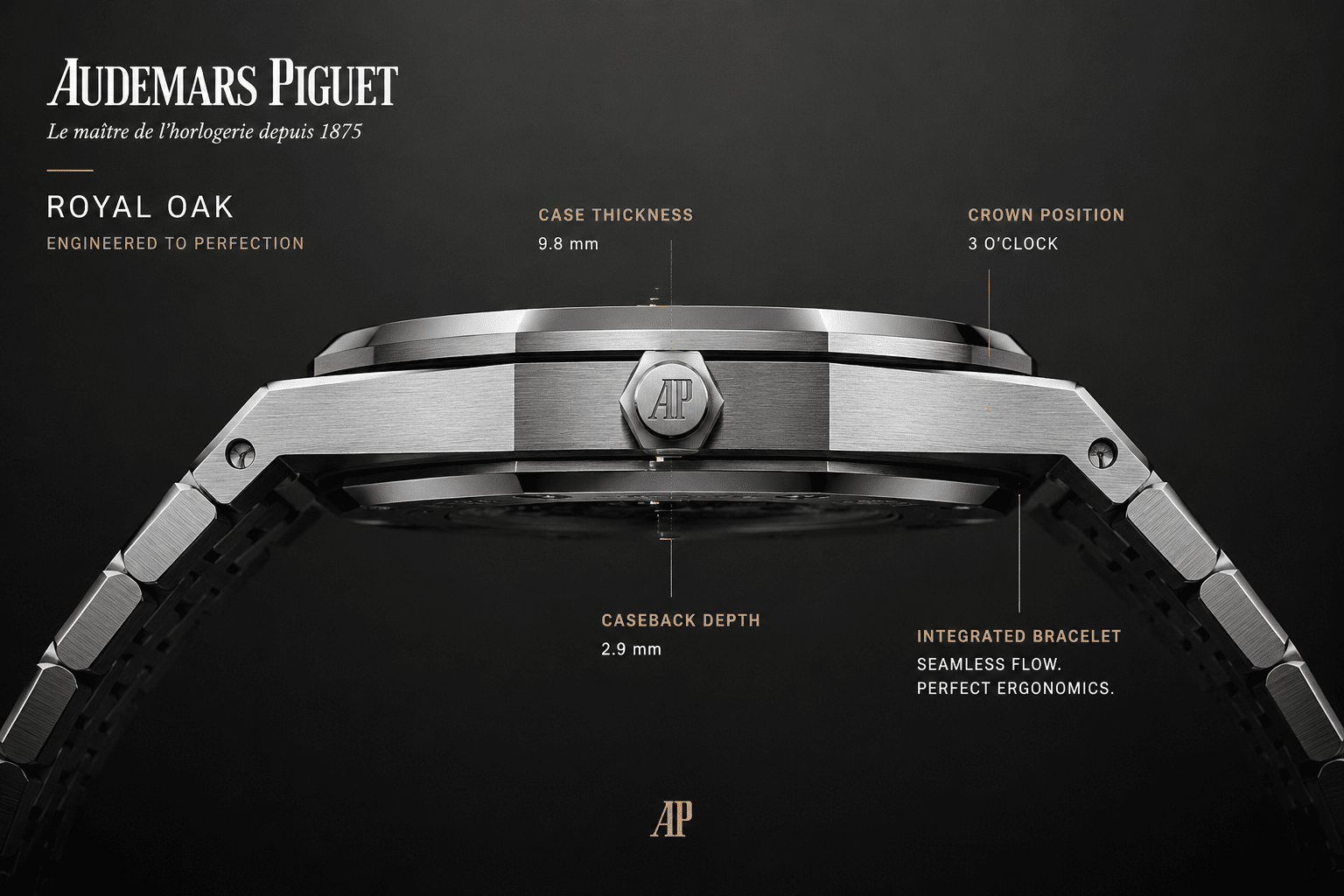
Royal Oak-style cases are unforgiving because the side profile is part of the design. A little extra height can be more noticeable here than on a thicker watch, because the original design language depends on flatness and tension. The octagonal bezel, mid-case, and caseback should feel layered but controlled. If the caseback looks too deep or the mid-case looks swollen, the whole watch reads differently.
Front photos often hide this. A Royal Oak replica can show a convincing dial, bezel, and bracelet from above while still looking too tall from the side. This is one reason buyers should not judge a Miyota-based AP Royal Oak replica only from dial shots. The movement route may reveal itself through the case structure before it reveals itself through any technical movement detail.
The important judgment is not whether every Miyota Royal Oak is too thick. Some builds manage the compromise better than others. The point is that thin AP-style cases give factories less margin for error, so the buyer should treat side-profile accuracy as a primary check, not a minor detail.
Integrated Bracelets Make Proportions More Noticeable
The Royal Oak bracelet is not just attached to the watch; visually, it is part of the case. That makes proportion problems easier to see. If the caseback protrudes too much or the case sits too high above the bracelet, the transition from case to first link can feel less natural. The watch may still look like a Royal Oak in photos, but it will not have the same flat, integrated wrist presence.
This is where many buyers underestimate the impact of movement choice. They focus on the dial pattern or bezel screws and miss the way the watch sits. A Royal Oak replica with a decent front view but poor case-to-bracelet flow can feel less convincing than a less dramatic model with better proportions.
For daily wear, this matters more than a macro-level movement engraving flaw. You see and feel the case height every time the watch is on the wrist. A display-caseback detail might bother advanced buyers, but a bulky profile affects almost everyone.
Crown Position and Dial Height Can Give Away the Movement Route
The movement also influences the internal stack of the watch. If the movement, dial, hands, and case are not engineered cleanly together, external details can start to look slightly off. Crown position is one of the easier areas to notice in side-profile photos. If the crown appears too high or too low relative to the case band, it can suggest that the internal movement arrangement is not sitting as naturally as it should.
Dial height can create a similar effect. A dial that sits too deep, too high, or with an awkward relationship to the rehaut and crystal can weaken the whole build. This does not require expert authentication knowledge. It is a buyer-facing proportion issue: does the watch look like its components belong together, or does it look like the case was forced to accommodate the engine?
For Miyota-based AP Royal Oak replicas, side views and crown-side photos are more useful than many buyers realize. They show whether the movement route has been integrated cleanly or merely fitted inside the case. That difference often separates a practical daily-wear compromise from a watch that feels visibly off.
Before making a decision, buyers should review real QC photos where available, including side profile, crown height, caseback depth, bracelet transition, dial alignment, datewheel centering, clasp finishing, and display-back presentation. Stock photos and factory labels alone are not enough to judge whether a Miyota-based AP replica has controlled the main compromises.
Rotor Noise and Winding Feel: The Most Common Miyota 9015 Complaint
The most common ownership complaint with a Miyota 9015 AP replica is not usually poor timekeeping. It is sound and feel. A Miyota 9015 can keep acceptable time and still remind the wearer that it is a practical base movement every time the rotor spins freely on the wrist.
This is where buyers often judge the movement too simplistically. Miyota 9015 rotor noise does not automatically mean the movement is defective, and a quiet sample is not automatically a better-built AP replica overall. The real question is whether the sound and tactile feedback match your tolerance for daily wear. Some buyers barely notice it. Others find it difficult to ignore, especially in a watch styled after a refined integrated sports model.
Why the Rotor Can Sound More Noticeable
The Miyota 9015 is commonly described as using a unidirectional automatic winding system. In plain terms, the rotor winds the mainspring in one direction and can spin more freely in the other. That free spin can create a light whirring or spinning sound, sometimes felt as a small vibration through the case. This is one reason the Miyota movement sound gets discussed so often in replica watch ownership threads.
On a desk, the sound may seem minor. On the wrist, it can become more noticeable because the AP-style case and bracelet transmit small vibrations differently from a thick rubber-strapped diver or a closed, heavy sports case. The bracelet can act almost like a sound path. A quick wrist movement may create a brief rotor spin that feels sharper than the same movement would inside a less rigid watch design.
The practical judgment is simple: if you are sensitive to mechanical noise, do not treat Miyota 9015 winding feel as a small detail. It may not affect accuracy, but it can affect whether the watch feels satisfying. For some buyers, that matters more than a macro-level dial flaw they will never notice during the day.
Normal Sound Versus a Real Warning Sign
A normal Miyota 9015 rotor sound is usually a short, light spin or whirr after wrist movement. It may be more obvious in a quiet room, and it may vary from watch to watch depending on case construction, rotor lubrication, assembly, and how tightly the movement is secured. That type of sound is common enough that it should not surprise a buyer considering a Miyota-based AP replica.
What should raise concern is a different category of noise: scraping, grinding, clunking, loose rattling, or an irregular sound that appears with very light movement. If the rotor sounds like it is contacting the caseback, if the watch makes a metallic knock when tilted, or if hand-winding feels rough and inconsistent, that is no longer just ordinary automatic rotor sound. It may indicate poor assembly, a loose rotor screw, caseback contact, or a movement that needs inspection.
Miyota 9015 winding feel is also worth separating from rotor noise. Hand-winding should feel reasonably smooth with some mechanical resistance. It will not feel like a finely finished high-end Swiss movement, but it should not feel sandy, sticky, or uneven. A buyer should be more cautious about rough winding than about a brief free-spinning rotor noise, because rough winding can point toward a functional problem rather than a personality trait of the movement.
Why Noise Feels Worse in an AP-Style Watch
A noisy AP replica movement feels more disappointing than the same sound in a cheaper-looking watch because the Royal Oak design creates a higher expectation, especially when an SH4302 vs DD4302 movement discussion centers on rotor behavior and long-term refinement. The sharp case lines, integrated bracelet, tapisserie-style dial, and display-caseback presentation all suggest precision and refinement. When the rotor suddenly spins audibly, the ownership experience can feel mismatched even if the watch is running fine.
This is the non-obvious problem with the Miyota route: the movement may be mechanically sensible, but the sound profile does not always support the visual message of the watch. In a budget daily wearer, a little rotor noise may be acceptable. In an AP-style replica that is trying to look thin, architectural, and premium, the same sound can make the watch feel less convincing on the wrist.
At Clean VS Factory, we usually encourage buyers to separate running reliability from perceived quality. A Miyota-based AP can be a usable daily watch, but if the buyer expects the quiet, dense, refined feel associated with a high-end integrated sports watch, rotor behavior becomes part of the decision, not a small afterthought.
What to Listen for During Early Wear
During the first few days, listen for pattern rather than obsessing over one sound. A brief rotor spin after a quick wrist motion is generally less concerning than a repeated scraping or knocking noise. Hand-wind the watch gently and feel whether the crown action is smooth, even, and controlled. Avoid forcing the crown if resistance feels abnormal.
Also pay attention to whether the noise changes. Some samples feel slightly sharper when new and settle a little with wear, while others remain consistently audible. If the sound becomes louder, rougher, or paired with poor power reserve, stopping, or unstable timekeeping, it is no longer just a Miyota 9015 rotor noise concern. It becomes a movement condition issue.
The buyer decision is not whether a Miyota 9015 should be perfectly silent. It should not be expected to behave like that. The better question is whether the specific sound and winding feel are acceptable for the way you plan to wear the AP replica. If the noise will bother you every time you move your wrist, a more AP-style clone movement route may be worth considering for ownership comfort alone.
Movement Transparency Note: Movement references in this article describe replica-market movement types, base calibers, decorations, or AP-style clone configurations. They should not be read as claims of an official Audemars Piguet caliber, brand-authorized construction, or verified manufacturer equivalence unless the individual watch has separate, verifiable evidence supporting that claim.
Decorative Plates and Display Casebacks: Where Miyota 9015 Looks Least Convincing
The AP replica display caseback is where the Miyota 9015 route becomes hardest to defend visually. Decorative plates can make the movement look more complete in seller photos, but they do not turn a Miyota base into true AP-style movement architecture. They improve the surface impression. They do not fully correct the layout underneath.
This distinction matters because many buyers first see a Miyota 9015 decorated movement through polished, angled photos. The rotor may carry AP-style engraving, the plates may mimic bridge shapes, and the color tone may look attractive. But once the caseback is viewed directly, the limits become clearer: bridge depth, wheel placement, jewel layout, rotor relationship, and movement proportions often do not behave like a purpose-built AP-style caliber.
Decorative Plates Can Improve Photos, Not Architecture
Decorative plates are surface solutions. They cover parts of the base movement and create the impression of a larger, more elaborate caliber. In casual photos, this can be effective enough to make the watch look less empty through the caseback. For buyers who rarely look at the back of the watch, that may be acceptable at the right price.
The compromise is that plates cannot easily change where the real components sit. The movement still has its own original architecture. If the bridges appear too flat, if the visible depth feels layered rather than integrated, or if the proportions seem like a cover sitting over a smaller engine, the display back starts to look decorative rather than convincing.
This is why a Miyota 9015 decorated movement should be judged as a compromise, not as a failed movement. Mechanically, it may run well. Visually, it is trying to represent something it was not designed to be. Buyers who understand that difference make better decisions than buyers who only ask whether the rotor has the right logo style.
Rotor Shape and Engraving Are Only Part of the Story
An AP-style rotor helps the first impression, but it is not enough. A rotor can be shaped, colored, and engraved to look closer to the intended design while the rest of the movement still gives away the route. Bridge geometry, visible screws, jewel placement, and the apparent depth of the caliber often matter more than the rotor alone.
This is a common buyer trap. A seller photo may focus on the rotor because that is the most recognizable visual element. The buyer sees engraving and assumes the movement presentation is accurate. But the better check is the full caseback view: Does the movement fill the space naturally? Do the plates look like part of the caliber, or like a decorative shell? Does the rotor sit over a believable layout, or does it distract from a movement that looks too generic underneath?
For a closed-back or lower-cost AP replica, this may not matter much. For an open-back Royal Oak-style build priced near newer clone-movement options, it matters a lot. At that point, the buyer is no longer paying only for timekeeping. The price is supposed to buy a more coherent movement presentation.
Low-Angle Photos Can Hide the Weakness
Low-angle display caseback photos can make a decorated Miyota look better than it appears in hand. Angled lighting creates shine across the rotor and plates, while compression hides the flatness and spacing issues. A slightly blurred photo can make finishing look smoother than it is. This is why buyers should be careful about judging a display back AP replica from one attractive image.
Direct, evenly lit caseback photos are more useful. They show whether the movement sits naturally in the case, whether the decorative plates align cleanly, and whether the bridge layout has believable depth. If every photo is tilted, dark, or focused only on the rotor, assume there may be something the angle is helping to soften.
The clear judgment here is that a Miyota-based open caseback is acceptable only if the buyer is comfortable with decorative approximation. If the movement view is a major reason you want the watch, a plate-decorated Miyota is usually the wrong place to save money.
Balance-Wheel Position and Movement Architecture: The Detail Advanced Buyers Notice
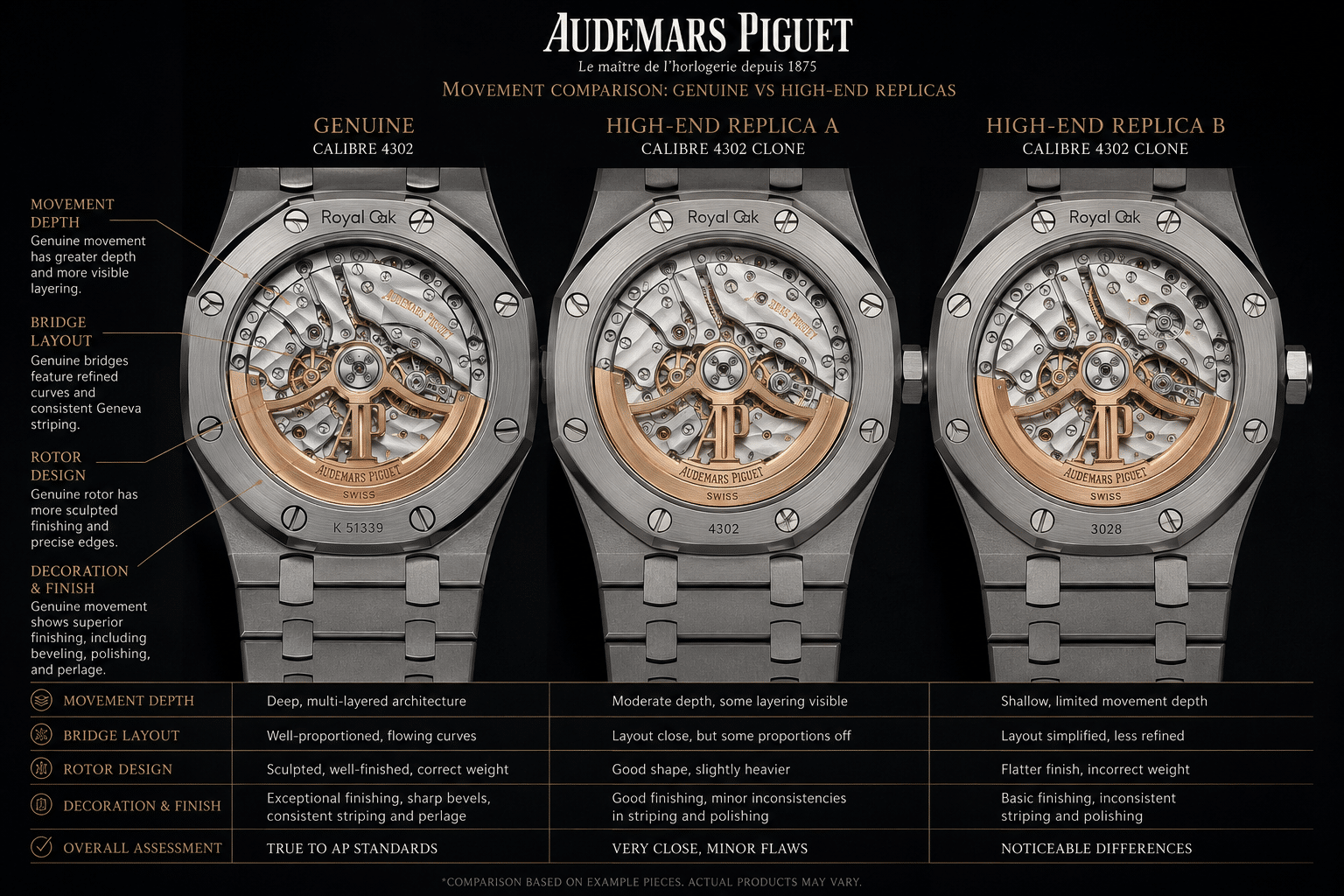
Once buyers move beyond the dial and bracelet, AP replica movement architecture becomes one of the clearest differences between a Miyota-based build and a more AP-style clone movement route. The issue is not whether the Miyota 9015 balance wheel works. It does. The issue is whether the visible movement layout belongs in the watch it is trying to represent.
This is where experienced buyers become less forgiving. A decorated movement can look attractive at first glance, but the balance position, bridge layout, and component arrangement may still reveal that the watch is built around a practical base caliber rather than a movement designed to match AP-style architecture. On an open-back model, that difference is not buried inside the case. It is part of the watch’s presentation.
Balance Position Is Hard to Fake Convincingly
The balance wheel is one of the few moving parts visible enough for buyers to notice through a display caseback. Its position gives structure to the whole movement view. If it sits in the wrong area compared with the expected AP-style caliber layout, decorative plates cannot fully disguise it. The eye may not immediately know why the movement looks wrong, but the overall arrangement feels off.
This is not a criticism of the Miyota 9015 as a mechanical product. It is a criticism of the fit between the movement route and the AP-style display caseback. The Miyota was not created to visually imitate AP’s integrated movement language. Factories can decorate around it, but they cannot cheaply relocate the core architecture without moving into a different movement solution altogether.
For buyers who never inspect the caseback, this may be a low-priority flaw. For buyers who want an AP replica because of the movement view, it is a serious compromise. The balance position is one of those details that matters little in daily timing performance and a lot in visual credibility.
Bridge Layout Tells More Than Rotor Decoration
Bridge layout is usually a stronger signal than rotor decoration. A rotor can be redesigned or engraved relatively easily. Bridge shapes, component spacing, and movement depth are harder to fake convincingly because they depend on the underlying caliber. If the bridges look like covers rather than structural parts, the movement may look dressed up rather than purpose-built.
This is one reason buyers should not overvalue phrases like “decorated AP movement” without asking what movement route is underneath. A Miyota 9015 with plates and an AP-style rotor is still a Miyota-based solution. A more accurate AP clone movement route may offer a more convincing layout, but even then quality depends on the specific version, assembly, and finishing. The word “clone” alone is not a guarantee.
The non-obvious buying point is that movement architecture can change how expensive the whole watch feels. Two AP replicas may look similar from the front, but through the back one can feel like a watch built around its caliber while the other feels like a case designed to hide a compromise. That difference is easy to miss in casual product listings and hard to ignore once you know what to look for.
Why This Matters More to Experienced Buyers
Beginners usually judge an AP replica from the front: dial texture, bezel shape, bracelet fit, logo placement, and general wrist presence. That is reasonable. Those details affect daily wear more immediately. Advanced buyers, however, often start asking whether the movement route supports the watch’s identity. For an open-back Royal Oak-style model, the caseback is no longer a secondary detail.
This is why Miyota-based AP replicas can create divided opinions. A practical buyer may say the watch runs well and looks good enough on the wrist. A more experienced buyer may reject the same watch because the visible movement architecture does not match the model’s expectations. Both reactions can be rational. They are using different standards.
The mistake is buying at one expectation level while paying for another. If you want a reliable, lower-cost daily-wear AP-style replica and the caseback is not important to you, the Miyota route may still be tolerable. If you are comparing higher-tier super clone watch options and care about open caseback accuracy, the movement layout becomes a central part of the decision.
Movement Route to Verify
Before comparing prices, confirm the stated movement route as clearly as possible from the product description and QC communication. Look for whether the watch is described as Miyota 9015-based, plate-decorated, or using a more AP-style clone movement. Vague wording such as “AP decorated automatic movement” is not enough to understand what you are buying.
Also match the movement route to the watch type. On a closed-back AP replica, the movement architecture may be less important than reliability, thickness, and winding behavior. On an open-back Royal Oak-style model, the visible caliber layout carries more weight. The smarter comparison is not “Miyota versus clone” in the abstract. It is whether the movement route makes sense for that specific caseback, price tier, and buyer expectation.
Practical evidence hierarchy for movement verification: The most useful evidence is not a marketing phrase but a consistent set of watch-specific details. A clear caseback photo can show whether the movement is plate-decorated or more structurally integrated. A side-profile photo can show whether the movement route has forced a deeper caseback. A crown-side photo can reveal whether the stem height looks natural. A short winding or rotor-noise video, when available, can help the buyer judge tactile comfort, although it still cannot prove long-term reliability.
What evidence cannot prove: QC photos cannot confirm lubrication quality, hidden wear, exact long-term accuracy, water resistance, or whether every internal component matches a seller’s description. Even a genuine-looking rotor engraving is only a visual clue, not proof of AP-style architecture. For that reason, movement confidence should come from the total pattern of evidence, not from one attractive photo or one confident listing sentence.
Case Thickness, Wrist Profile, and the “Too Tall” AP Replica Problem
The most practical AP replica case thickness problem is not the number on a spec sheet. It is how the watch sits from the side. A Miyota 9015 is not an unusually thick automatic movement by itself, but in a Royal Oak-style case the full stack matters: movement holder, dial height, hands, crystal, caseback, gasket structure, and bracelet transition. If those parts are not engineered tightly, the watch can look correct from the front and still wear too tall on the wrist.
This is where buyers often misjudge Miyota-based AP replicas. They look at a straight dial photo, see a clean tapisserie pattern and aligned markers, then assume the watch is safe. The Royal Oak is less forgiving than a conventional sports watch because the case is supposed to feel flat, angular, and integrated into the bracelet. Extra height does not hide under a rounded case flank. It changes the whole silhouette.
Side Profile Matters More Than Front Photos
Front photos are the easiest way for a Royal Oak replica to look good. The octagonal bezel, dial color, hands, and bracelet center links dominate the image. Side profile photos are less flattering, but they tell you more about whether the build is properly balanced. If the mid-case looks tall, the caseback drops too far below the lugs, or the crystal stack appears raised to compensate for internal clearance, the watch may have the familiar “too tall” AP replica feel.
This matters more on Royal Oak-style designs than on thicker dive watches or chronographs. A Submariner-style case can absorb extra height because the bezel, case flank, and caseback are visually heavy already. A Royal Oak-style case does not have that luxury. The design depends on a thin case body flowing into a wide bracelet. Even a small increase in height can make the watch look slabby instead of sharp.
The better judgment is simple: if you are considering a Miyota-based AP replica, do not approve it from dial photos alone. Ask yourself whether the side profile still looks like an integrated luxury sports watch, or whether it looks like a flat dial and bezel sitting on top of a thick mechanical container.
Caseback Bulge Can Break the Royal Oak Shape
A caseback bulge is one of the fastest ways for a Royal Oak replica thickness issue to become visible in real wear. The watch may measure acceptably from the top, but if the underside protrudes sharply, the case no longer sits flat against the wrist. Instead of the bracelet flowing out from the case, the center of the watch lifts and the first links drop away at a steeper angle.
This creates two problems. Visually, the watch loses the low, architectural profile that makes the Royal Oak design work. Physically, the AP replica wrist feel becomes less natural because the caseback becomes the main contact point. On smaller or flatter wrists, that raised back can make the watch rock slightly, especially if the bracelet is sized tightly.
A Miyota 9015 build is not automatically guilty here. Some older or budget AP replicas manage the case stack reasonably well. The red flag is not the movement name alone; it is the engineering response around it. If the factory solves the movement fit by adding a thick caseback rather than preserving the case flow, the compromise becomes part of the watch’s daily presence.
Crown Position Can Reveal the Internal Stack
Crown alignment is an underrated check because it shows how the movement sits inside the case. If the movement is positioned too low or too high relative to the dial and case wall, the crown may look slightly awkward from the side. On a Royal Oak-style case, where the crown is framed by sharp geometry and a relatively thin case band, this is easier to notice than buyers expect.
A crown that sits too low can suggest the movement is riding deeper in the case, often paired with a thicker caseback. A crown that appears high against the case flank can make the dial stack feel elevated. Neither detail proves poor function, but both can weaken the impression that the watch was designed as one integrated object.
This is why we usually treat crown-side photos as more useful than another close-up of the dial. A clean dial can be ruined by a clumsy internal stack. For a Miyota-based Royal Oak replica, the crown-side view often tells you whether the case was built around the movement thoughtfully or simply made tall enough to contain it.
QC Photos to Request
For side profile QC, the useful photos are not complicated. Request a straight crown-side photo, a non-crown-side photo, a caseback angle that shows how far the back protrudes below the lugs, and a wrist-shot angle if available. The wrist shot is not about styling; it shows whether the case sits flat or floats above the wrist.
- Crown-side profile: Check crown height, case flank thickness, crystal height, and whether the case looks balanced from top to bottom.
- Caseback angle: Look for a deep protruding back that makes the watch sit on a central bump rather than across the full case.
- Bracelet transition: Confirm that the first links leave the case naturally instead of dropping sharply because the caseback is too tall.
- Wrist angle: Judge whether the watch wears flat or appears raised, especially on smaller wrists.
If a seller or listing only provides front-facing glamour shots, the safest assumption is that the side profile has not been proven. For AP replica case thickness, absence of a side view is not a minor omission. It is the missing angle that often decides whether the watch will feel convincing in daily wear.
Model-Specific Limitations: Where Miyota 9015 Is More or Less Acceptable
Miyota 9015 is not equally wrong or equally acceptable across all AP replicas. The movement route depends heavily on the model family. A Miyota 9015 Royal Oak replica in a thin, open-back, high-expectation build is a much harder sell than a closed-back, older budget AP replica where the buyer mainly wants stable daily wear and reasonable external appearance.
The common mistake is asking, “Is Miyota 9015 acceptable?” as if there is one answer. The better question is, “Which AP replica movement is acceptable for this case style, caseback type, price tier, and expectation level?” Royal Oak versus Offshore replica choices do not expose the same flaws in the same way.
Thin Royal Oak References Are Less Forgiving
Thin Royal Oak references are where Miyota-based compromises become hardest to ignore. The Royal Oak’s appeal comes from a flat case, angular bezel, integrated bracelet, and compact side profile. If the movement route forces extra case height, a thicker caseback, or awkward crown placement, the whole design starts to feel less precise.
This is especially true for buyers comparing modern super clone watch options. Once you have seen a better AP-style clone movement build with a more convincing case profile, an older Miyota-based Royal Oak can feel dated even if the dial and bracelet still look respectable. The issue is not that the Miyota cannot keep time. The issue is that the thin Royal Oak case gives the movement route very little room to hide.
For a buyer who cares about Royal Oak replica thickness, slim case flow, and open-back credibility, a Miyota route is usually the weaker choice. It may be cheaper and easier to service, but it is rarely the most convincing answer for a thin Royal Oak-style build today.
Royal Oak Offshore Builds May Be More Tolerant
Royal Oak Offshore replicas are generally more forgiving because the original design language is already thicker, sportier, and more aggressive. A larger case, rubber strap or heavier bracelet, bigger pushers, and deeper case architecture can hide some of the movement-height compromises that look obvious on a thinner Royal Oak.
This does not mean Miyota 9015 is automatically ideal for Offshore-style AP replicas. It only means the case gives the factory more visual cover. A thicker sports-style watch can absorb a practical movement route without looking as immediately wrong from the side. If the model has a closed back and the external finishing is decent, the movement may become a lower-priority compromise for a budget-conscious buyer.
The judgment changes if the Offshore-style build has an open caseback or claims a highly accurate movement presentation. In that case, the movement route becomes more exposed again. Thickness may be easier to tolerate, but movement layout and caseback execution still matter.
Closed-Back AP Replicas Reduce the Visual Risk
A closed caseback makes Miyota 9015 easier to accept because it removes the most obvious visual movement problem from daily view. The buyer can focus on the front of the watch, the case shape, the bracelet, the dial execution, and the wrist profile. If those areas are strong, the movement becomes more of an ownership and serviceability question than a constant visual compromise.
This is where a Miyota-based AP replica can still make practical sense. A closed-back build with acceptable Royal Oak replica thickness, clean dial alignment, and a comfortable bracelet may be a rational lower-cost choice. It will not satisfy someone looking for AP-style integrated movement architecture, but it may satisfy someone who wants a wearable AP-style watch without chasing the highest movement tier.
The closed back does not excuse poor case engineering. If the watch still wears too tall, the crown sits awkwardly, or the bracelet transition looks clumsy, the hidden movement does not save the build. Closed-back tolerance only works when the external proportions remain convincing.
Older Budget Builds Need Different Expectations
Older Miyota-based AP replicas should be judged by what they were trying to be, not by the standards of the newest AP clone movement releases. Many were built before more convincing AP-style clone movement routes became common. In that context, Miyota 9015 offered a practical mix of availability, decent reliability, and easier serviceability.
An older budget AP replica can still be worth considering if the price reflects the compromise and the buyer understands the limits. It is more suitable for someone who values simple daily wear over open-back accuracy, ultra-thin case construction, or advanced movement architecture. It is less suitable for a buyer who has already studied current high-tier Royal Oak replicas and expects modern case proportions.
The worst purchase is not necessarily a Miyota-based AP replica. The worst purchase is a Miyota-based AP replica priced or described as if it belongs in the same category as a better-engineered AP-style clone movement version. Different expectations make the same movement route either sensible or disappointing.
Miyota 9015 Versus AP-Style Clone Movements: What Actually Changes
The Miyota 9015 versus clone movement question is not a simple upgrade ladder. An AP clone movement can improve the areas that make a Royal Oak replica more convincing, especially caseback impression, movement layout, and sometimes case thickness. But it can also introduce different risks: more specialized parts, more version dependence, and less predictable serviceability compared with a familiar Miyota base.
For a buyer, the real decision is not “cheap movement versus good movement.” It is reliable versus accurate movement in a specific AP replica movement choice. Miyota 9015 is mechanically practical but architecturally generic. AP-style clone movements are usually more visually appropriate, but their quality depends heavily on the exact model, version, assembly, and batch.
What Clone Movements Usually Improve
A stronger AP clone movement route usually improves the watch where Royal Oak buyers care most: the relationship between movement architecture and case design. The movement may support a more accurate caseback shape, a more believable internal layout, and a better overall impression when the watch is viewed from the side or back.
This is not just about decoration. A clone movement can place visible components in a more appropriate arrangement, reduce the need for crude spacer solutions, and, in the context of Audemars Piguet replica movements, help the case stay closer to the intended profile. On open-back AP replicas, that can change the watch from “good front, weak back” to a more coherent object.
Clone movements may also make the watch feel more current in the super clone watch market. Many buyers today are not comparing a Miyota AP only against old budget pieces. They are comparing it against newer Royal Oak-style builds where the movement route was developed specifically to reduce the old thickness and layout problems. In that comparison, the Miyota route often looks like a practical older solution rather than the premium choice.
What Miyota 9015 May Still Do Better
Miyota 9015 still has real advantages. It is familiar, widely understood, relatively easy to service compared with obscure modified movements, and generally sensible for basic daily use when assembled properly. For a buyer who does not care about display-caseback accuracy, those strengths should not be dismissed.
The cost advantage also matters. If a Miyota-based AP replica is honestly positioned as a lower-cost or older-style build, the buyer may be paying less for a movement that is easier to live with, not more for a movement that looks perfect. That can be a fair trade if the model is closed-back, the case thickness is acceptable, and the buyer is not chasing AP-style movement architecture.
This is where some buyers overcorrect. They hear “clone movement” and assume Miyota 9015 is automatically bad. That is not the right conclusion. Miyota is a compromise in AP accuracy, not necessarily a poor practical movement. If your priority is simple ownership rather than caseback realism, Miyota may still be the more rational route in a lower price tier.
Why “Clone Movement” Is Not Automatically Better
The phrase “AP clone movement” sounds reassuring, but it is not a guarantee. Clone movement quality depends on execution. A poorly assembled clone, a weak batch, or a version with limited parts support can become more frustrating than a plain Miyota 9015. More accurate architecture does not automatically mean easier ownership.
Buyers should also separate movement decoration from movement route. A watch can be advertised with AP-style language while still using a base movement with plates. Another watch may use a more integrated clone architecture but still have issues with regulation, lubrication, date behavior, or noisy winding. The label alone does not answer the ownership question.
At Clean VS Factory, we usually treat movement choice as a tradeoff between visual credibility, case engineering, serviceability, and price positioning. A better-looking movement route is valuable only if it solves a specific problem the buyer actually cares about. Paying more makes sense when it reduces a visible or practical risk, not simply because the description sounds more advanced.
Why Version and Batch Details Change the Answer
In super clone watch comparisons, the safer judgment is usually version-specific. A factory or movement route may be strong on one Royal Oak reference and weaker on another because case thickness, dial height, bracelet construction, caseback layout, and movement integration are not equally difficult across every AP-style model. A buyer should not assume that one successful reference proves the same result across the entire catalog.
Version language also needs careful reading. “Latest version” can mean a genuine improvement, but it can also be a loose seller phrase. The improvement should be visible or explainable: thinner profile, cleaner caseback layout, better date position, improved bracelet finishing, more stable movement route, or more consistent QC presentation. If the version claim does not connect to a visible or practical improvement, it should not carry much weight in the decision.
For CleanVSFactory, the goal is to make replica watch comparison easier to understand by connecting factory names, movement claims, visible QC details, and realistic ownership limits. A Miyota 9015 AP replica should therefore be compared as a complete version, not just as a movement name. The question is whether that particular version controls the known Miyota compromises well enough for the buyer’s use case.
Movement Route to Confirm Before Comparing Prices
Before comparing prices, confirm what movement route the watch actually uses. Do not compare two AP replicas by model name alone. A Royal Oak-style watch with a Miyota 9015, a decorated plate movement, and a more integrated AP-style clone movement may all be sold under similar model descriptions, but they are not offering the same compromise.
- Confirm the stated movement: Ask whether it is Miyota 9015-based, plate-decorated, or an AP-style clone movement route.
- Match the movement to the case: A thin Royal Oak-style case benefits more from an accurate movement route than a thicker closed-back sports build.
- Check whether the price reflects the route: A Miyota build can be fair value, but not if it is priced close to a more advanced clone movement version without matching improvements.
- Judge the full watch, not the movement name: Case profile, bracelet fit, dial execution, crown alignment, and QC consistency still decide whether the watch works as a whole.
The sensible upgrade is the one that improves the weakness you would actually notice. If your main concern is Royal Oak side profile and open-back accuracy, a better AP-style clone movement may be worth the premium. If your priority is a lower-cost daily wearer with easier service potential, Miyota 9015 can still be acceptable as long as the watch is not pretending to be something more advanced.
QC Checks for Miyota-Based AP Replicas
AP replica QC is not only about whether the dial looks straight in a front photo. With a Miyota-based AP replica, the bigger question is whether the movement route has forced compromises into the case shape, caseback, crown position, and bracelet flow. QC photos cannot prove long-term reliability, and they will not tell you whether the movement was serviced properly. They can, however, show whether the watch is already carrying visible compromises that you may not want to live with.
The most common mistake is approving a Miyota AP replica from attractive front-facing photos only. A Royal Oak-style watch can look convincing from above while being too thick from the side, awkward at the caseback, or poorly integrated at the first bracelet link. For this movement route, the side profile and caseback are not optional photos. They are the photos that decide whether the compromise is controlled or obvious.
Front Dial Photos Still Matter
Start with the dial because it is still the part you will see most often. On a Royal Oak-style build, check whether the hour markers are evenly applied, whether the hands sit cleanly, whether the date is centered in the window, and whether the dial sits naturally inside the case. If the dial appears sunken, tilted, or crowded against the rehaut, that may point to a case-and-movement stack that was not engineered cleanly.
For tapisserie dials, do not expect genuine-level depth from a Miyota-based AP replica, especially in lower price tiers. The useful QC question is more practical: does the pattern look evenly stamped, is the color consistent, and do the printed minute track and logo sit straight? A slightly less refined tapisserie texture may be acceptable in a budget build. Crooked markers, uneven printing, or a datewheel sitting too high or low are less forgivable because they affect the daily-wear impression immediately.
Dial QC also helps expose overpromising. If a seller describes the watch as a higher-tier AP-style build but the dial printing, date alignment, and marker placement look average, the movement compromise is probably not the only shortcut. A Miyota 9015 can be acceptable in an honestly positioned watch, but it should not be paired with sloppy basic assembly at a premium price.
Side Profile Photos Are Essential
The side profile is where many Miyota AP replica QC decisions are won or lost. Ask for a clean crown-side photo and a caseback-side angle that shows the full case thickness, not a tilted glamour shot. A Royal Oak-style case should feel flat, angular, and integrated. If the midcase looks thin but the caseback drops down like a separate pod, the watch may wear taller than the front photo suggests.
Crown position is another useful clue. If the crown appears unusually low or high relative to the case flank, the internal movement and dial stack may not be sitting naturally. This does not automatically mean the watch is unusable, but it does mean the build is asking the case design to work around the movement rather than the other way around. On an AP-style watch, that matters more than it would on a thicker sports replica.
Also study how the bracelet meets the case. The first link should not look like an afterthought attached to a thick caseback. Extra height at this transition makes the entire watch feel less integrated on the wrist. If you are choosing a Miyota-based Royal Oak replica, a balanced side profile is more important than a decorated rotor photo.
Caseback Photos Reveal the Movement Compromise
For display caseback models, the caseback photo should show the movement clearly enough to judge the decorative approach. Look at the rotor shape, bridge layout, engraving quality, and whether decorative plates appear flat, shallow, or poorly aligned. A decorated Miyota 9015 may look acceptable at a glance, but it often loses credibility when the plates look like surface covers rather than a coherent AP-style movement architecture.
The buyer’s judgment should be tied to price tier and expectations. If the watch is clearly sold as a practical Miyota-based AP replica, a decorated movement that looks clean and stable may be enough. If it is priced or described near more advanced AP-style clone movement versions, the caseback needs to do more than show an engraved rotor. It should reduce a real visual weakness, not merely hide it from low-resolution photos.
Movement photos have limits. They can show layout, decoration, rotor position, and obvious assembly issues, but they cannot confirm long-term accuracy, lubrication condition, or service history. Do not treat a clean caseback image as proof of mechanical health. Treat it as evidence of whether the movement route matches the watch’s visual promise.
Bracelet and Clasp Fit Should Not Be Ignored
An AP-style replica can have an acceptable movement and still feel wrong if the bracelet is poor. The Royal Oak design depends on the case and bracelet reading as one continuous object. Gaps at the first link, stiff articulation, uneven brushing, rough edges, or a weak clasp action can make the watch feel cheaper than the movement specification suggests.
In QC photos, check the end-link fit, the spacing between links, the brushing direction, and the clasp engraving. The bracelet should not flare awkwardly from the case, and the clasp should sit cleanly when closed. If the bracelet looks loose in some places and tight in others, expect the wearing experience to feel inconsistent. This is especially important because a Miyota route is often chosen for value; poor bracelet execution removes much of that value.
At Clean VS Factory, we usually treat AP bracelet fit as part of movement-route evaluation, not a separate cosmetic issue. If a Miyota build is already accepting a visible movement compromise, the case and bracelet need to be solid enough to justify the tradeoff. Otherwise the buyer is accepting both mechanical inaccuracy and weak wearing quality.
How to Compare Two QC Sets Without Being Misled
When comparing two Miyota-based AP replicas, use the same angles and the same checklist for both watches. A sharper front photo on one watch can make it look better even if its side profile is weaker. Likewise, a darker caseback photo can hide decorative-plate flatness or rotor finishing issues. The comparison is more useful when each watch is judged through front dial, crown-side, non-crown-side, caseback, bracelet transition, clasp, and wrist-profile evidence.
It is also worth separating fixed design compromises from individual QC flaws. A Miyota-based movement route may explain certain architecture limits, but it does not excuse crooked markers, uneven datewheel centering, poor hand alignment, rough brushing, or a visibly loose bracelet. Those are watch-specific problems, not unavoidable Miyota traits. A fair comparison identifies which issues come from the movement route and which come from assembly quality.
QC photos reduce uncertainty, but they do not remove every risk. They help buyers judge visible execution before shipment, especially when factory names or stock photos do not show the exact watch being supplied. Hidden movement condition, lubrication, pressure resistance, and long-term stability still depend on the individual watch and should not be assumed from photos alone.
Red Flags Before You Decide
- Thick caseback protrusion: A raised or bulky caseback is one of the clearest signs that the movement route is affecting the AP case shape.
- Poor or missing side-profile photos: If every image is front-facing or heavily angled, the most important proportion issue may be hidden.
- Unclear movement claims: Phrases like “AP movement,” “custom movement,” or “upgraded automatic” are not enough. The actual movement route should be stated clearly.
- Obvious decorative-plate mismatch: Plates that look flat, misaligned, or disconnected from the movement layout weaken display-caseback credibility.
- Rough rotor sound reports: Some Miyota 9015 rotor noise is common, but scraping, grinding, or rattling should not be dismissed as normal.
- Weak bracelet integration: Large gaps, stiff first links, uneven brushing, or poor clasp fit can make the watch feel wrong even if the movement runs well.
- Datewheel or marker alignment issues: These are basic QC failures and should not be excused simply because the watch uses a lower-cost movement route.
The practical QC standard is simple: decide whether the Miyota compromise is controlled. If the watch has a clean dial, balanced side profile, acceptable caseback presentation, and strong bracelet fit, the movement route may be reasonable for the right buyer. If several of those areas are weak at once, the problem is not only Miyota 9015; it is the whole build.
Verification Note: When possible, buyers should review real QC photos rather than relying only on stock images, factory labels, or movement descriptions. For Miyota-based AP replicas, the most useful checks include side profile, crown height, caseback depth, bracelet transition, clasp finishing, date alignment, rotor presentation, and any available information about the stated movement route.
Price and Value: When the Miyota Route Is Fair and When It Is Overpriced
Miyota 9015 AP replica value depends less on the movement name alone and more on whether the watch is priced honestly for what it is. A Miyota-based build can be fair if it is clearly positioned as a practical, lower-cost option with acceptable case and bracelet execution. It becomes questionable when it is priced close to AP-style clone movement versions while still carrying the same visible caseback, thickness, and architecture compromises.
The buyer should not ask only, “Is Miyota 9015 good?” The better question is, “What am I paying for besides the Miyota 9015?” If the answer is a better dial, cleaner case finishing, stronger bracelet, tighter QC, and a reasonable case profile, the movement compromise may be acceptable. If the answer is vague decoration and marketing language, the price is probably doing more work than the watch.
Fair Value Depends on Honest Positioning
A Miyota-based AP replica can make sense in a lower price tier when the expectations are clear. The movement is known, serviceable, relatively thin as a base caliber, and generally practical for daily wear. For a buyer who wants the Royal Oak look, does not care much about open-back movement architecture, and understands the possibility of rotor sound, this route can be rational.
Fair value requires the rest of the watch to hold up. The dial should be aligned, the case should not look bloated, the bracelet should articulate reasonably, and the caseback should not pretend to deliver more than it can. A lower price is not an excuse for poor assembly. It is only acceptable when the compromise is specific, visible, and priced accordingly.
Closed-back or thicker AP-style builds can make the Miyota route easier to justify because the weakest part of the movement route is less exposed. In that scenario, the buyer is paying for usable daily wear and acceptable external appearance, not AP-style movement architecture. That is a fair trade only if the description does not oversell the watch as a top-tier super clone.
Overpricing Happens When Movement Route Is Hidden
The danger zone is vague movement language. Terms like “decorated AP movement,” “custom automatic,” or “high-grade movement” may sound reassuring, but they do not answer the core question. Is it a Miyota 9015 with plates, or is it an AP-style clone movement route? Without that distinction, the buyer cannot judge whether the AP replica price makes sense.
Overpricing often appears when a Miyota-based watch borrows the language of higher-tier versions. The listing may emphasize the dial, bracelet, or “latest version” while avoiding the movement route. This matters because movement architecture affects more than the caseback photo. It can influence case thickness, crown position, rotor sound, and the overall wearing impression.
A Miyota AP replica is not automatically overpriced because it uses Miyota. It is overpriced when the seller asks the buyer to pay clone-movement money for a build that still carries Miyota-based compromises. The unfair part is not the movement itself; it is the mismatch between price, description, and visible execution.
Paying More Should Reduce a Specific Risk
A higher AP replica price should reduce a specific risk. It should not simply buy a more confident description. If the premium version offers a thinner case profile, a more credible display caseback, better bracelet construction, cleaner dial finishing, or more consistent QC, the price increase has a practical reason. If none of those areas improve, paying more may only reduce your anxiety, not your actual risk.
This is where buyers need to separate movement prestige from ownership value. An AP-style clone movement may improve architecture and caseback credibility, but it is not automatically the better ownership choice for every buyer. A Miyota 9015 may be easier to service and cheaper to replace. The upgrade is worth considering when it solves the specific problem you care about, such as open-back accuracy, case thickness, or movement layout.
For value judgment, compare the whole watch rather than the movement label. A cheaper Miyota build with honest specs and strong external execution can be more sensible than a poorly executed “upgraded” version. A more expensive clone-movement build is justified only when the movement route, case engineering, finishing, and QC consistency all move in the same direction.
Why Two Miyota-Based AP Replicas Can Be Priced Differently
Not every Miyota 9015 AP replica should cost the same. Price can reflect more than the base movement: case machining, dial quality, bracelet finishing, clasp feel, decorative plate work, version availability, batch consistency, seller margin, and seller communication can all affect the final number. A higher price is not automatically unfair, but it should be tied to visible or practical improvements that the buyer can check.
The useful comparison is whether the extra money reduces a weakness that matters for this model. If the more expensive Miyota build has a noticeably cleaner case profile, better bracelet articulation, better date alignment, and clearer movement disclosure, the price difference may have a practical basis. If both watches share the same thick caseback, vague movement description, and average bracelet, the higher price may simply be a listing premium rather than a better watch.
Price evidence should be treated carefully: Exact replica-watch prices can change by seller channel, factory version, movement route, shipping method, QC communication, and availability. Without current, verifiable pricing data for the specific watch, it is safer to compare value by evidence of execution rather than by fixed numbers. A watch described as Miyota-based should be evaluated against its visible case profile, bracelet quality, movement presentation, and seller transparency before deciding whether the price is fair.
A fair price is not only the lowest price: A lower number can still be poor value if the watch has a thick caseback, weak bracelet fit, vague movement description, or no meaningful QC evidence. Likewise, a higher price is not automatically justified unless it corresponds to visible improvements. For Miyota-based AP replicas, the buyer should ask what the extra money actually improves: movement route clarity, profile control, dial alignment, caseback execution, or communication clarity before ordering.
Final Buyer Decision: Who Should Accept Miyota 9015 and Who Should Move On
So, is Miyota 9015 good for an AP replica? The honest answer is yes for some buyers and no for others. It is a reliable workhorse movement route, not a true AP-style integrated clone movement. If your priority is daily wear, lower cost, and easier service, it can still make sense. If your priority is Royal Oak accuracy, open-back credibility, thin case architecture, and correct movement layout, it is usually the wrong place to compromise.
The decision should not be emotional. Miyota 9015 is not junk, and clone movement does not automatically mean trouble-free. The issue is fit. AP watches, especially Royal Oak-style designs, expose movement choices more than many other replicas. A movement that works well mechanically can still weaken the watch visually and structurally if the model depends on thinness, display-caseback accuracy, and integrated proportions.
Accept It If Reliability and Cost Matter Most
Choose a Miyota-based AP replica if you are a practical buyer who understands the compromise before paying for it. This route is most sensible when the watch is priced honestly, the caseback is closed or not important to you, the side profile looks acceptable, and you are not expecting modern AP-style clone movement architecture.
It is also reasonable if you value serviceability. Miyota 9015 is familiar to many watchmakers, and replacement or servicing is usually less mysterious than with some heavily modified or less common replica movements. That does not guarantee trouble-free ownership, but it does make the movement route easier to understand and manage.
The buyer who should accept Miyota 9015 is not chasing the most technically convincing Royal Oak super clone. This buyer wants a wearable AP-style replica, accepts possible rotor sound, checks the QC carefully, and does not overpay for movement decoration. In that context, Miyota can be a sensible compromise rather than a mistake.
Avoid It If Architecture Accuracy Matters
Avoid the Miyota route if you are buying an open-back Royal Oak-style model and expect the movement to look architecturally convincing. Decorative plates and engraved rotors may improve the first impression, but they do not fully solve bridge layout, balance position, movement depth, or caseback credibility. If those details matter to you, the compromise will probably bother you after the initial excitement fades.
You should also move on if you are sensitive to case thickness. Royal Oak-style watches rely on a flat, integrated profile. If a Miyota-based build creates a thicker caseback, awkward crown position, or bulky wrist profile, the entire watch loses the design language that made the model desirable in the first place.
Advanced buyers comparing higher-tier AP replica movement choice will usually be better served by a stronger AP-style clone movement route, assuming the specific version is executed well. The key qualification is important: do not buy the phrase “clone movement” blindly. Buy the version that actually improves the case, caseback, and wearing profile.
The Best Answer Depends on the Watch, Not the Movement Name Alone
The final judgment is model-specific. A Miyota 9015 inside a lower-cost, closed-back, thicker AP-style replica may be acceptable. The same movement inside a thin, open-back Royal Oak-style build may feel like an obvious compromise. The movement name matters, but the case design decides how visible that movement becomes.
Before deciding, check four things together: the model type, the caseback style, the side-profile QC, and the price positioning. If those four points support the Miyota route, the watch may be a fair daily-wear choice. If they fight against it, the buyer is likely paying for a watch that looks promising in photos but feels less convincing in use.
The safest conclusion is this: Miyota 9015 is acceptable when reliability and cost are the priority, but it is not the movement route for buyers who want the most convincing AP Royal Oak-style architecture. Treat it as a practical engine with visible limits, not as a hidden shortcut to a top-tier AP super clone.
Final Traceability Checklist Before Ordering
Before committing to a Miyota-based AP replica, buyers should make the decision traceable rather than impression-based. Confirm the stated movement route, then compare that claim against the watch’s visible construction. The most useful checks are case thickness, crown position, caseback depth, display-back layout, rotor behavior, dial alignment, datewheel centering, bracelet transition, clasp finishing, and whether the price tier matches the compromise being offered.
Buyers should also confirm return, repair, shipping, and after-sales terms before ordering because those terms can vary by seller and model. This does not replace QC review. It simply helps the buyer understand what is being accepted before the watch is approved. A transparent decision is not based on a single factory name or a confident listing phrase; it is based on movement disclosure, version-specific evidence, visible QC details, and realistic ownership expectations.
A replica watch should be evaluated with realistic ownership expectations. Even a strong super clone can have limits in water resistance, long-term movement stability, servicing convenience, finishing consistency, and close inspection compared with a genuine reference. The safest use of factory and movement information is to avoid overpaying or misunderstanding quality, not to represent a replica watch as genuine.
Disclosure and comparison clarity: This article discusses imitation watches and buyer evaluation logic. It does not describe authorized Audemars Piguet products, factory-authorized alternatives, or watches endorsed by the original brand. Comparisons to Royal Oak-style design language are used to explain why certain replica movement routes are more or less convincing; they should not be read as claims of authenticity, official equivalence, or brand approval.
Water resistance and durability caution: Buyers should not assume that a Miyota-based AP replica, or any replica watch, has the same water resistance or durability as the authentic model it imitates. Water resistance should be treated as unverified unless the individual watch has been pressure-tested after purchase by a competent watchmaker. Movement reliability also depends on assembly, regulation, lubrication, shipping condition, and handling, not only on the movement name printed in a listing.
Disclosure: This article is for general educational and comparison purposes only. Replica watches are not genuine products from the original luxury brands, and brand names are used only to identify reference designs or comparison topics. Factory names, movement descriptions, prices, availability, QC details, seller policies, and version information can change, so readers should verify important details with the seller before making a purchase decision. Replica watches should not be represented, resold, or used as genuine watches.