
Choosing between SH4302 and DD4302 for an AP 15500 clone is not just a question of which movement looks closer through the display caseback, because Miyota 9015 AP replicas show how reliability, rotor noise, and thickness can reshape the ownership trade-off. The 15500’s thin case, visible rotor, integrated bracelet feel, winding action, date setting, and power reserve all make the movement a major part of daily ownership. A “4302-style” description can sound reassuring, but it does not prove batch consistency, assembly quality, or long-term reliability.
This article focuses on the practical risk difference between the more established SH4302 route and the newer DD4302 option. SH4302 currently has the stronger record because it has wider use, more owner feedback, and more known service behavior. DD4302 may become competitive, but it should be judged by current QC evidence and real batch feedback rather than novelty. The main decision is whether you want lower uncertainty or are willing to accept more risk for a newer movement claim.
Evidence note: This comparison is written from a buyer-risk perspective, not as an official movement certification. SH4302, DD4302, APSF, VS-related, and similar labels in the replica market are seller and buyer-community terms rather than statements from Audemars Piguet. Because no public factory documentation is available here to verify every batch, the safer approach is to treat movement names as claims that must be checked against the actual QC photos, caseback layout, operation video, and recent owner feedback.
Replica watches should be clearly understood as replica-market products, not genuine watches from the original luxury brands. Brand names are used for reference and comparison only; they do not imply authorization, endorsement, or affiliation with the original luxury watch brands.
| Decision Point | SH4302 | DD4302 |
|---|---|---|
| Track record | Longer market use and broader owner feedback | Promising but less proven over time |
| Daily wear risk | Lower uncertainty if QC checks are clean | Depends heavily on current batch evidence |
| Caseback judgment | Known layout helps verify claims more easily | Needs clear photos to confirm movement details |
| Mechanical checks | Check rotor noise, winding feel, date alignment, reserve | Check the same points, with extra caution on consistency |
| Better fit for | Cautious buyers prioritizing proven behavior | Buyers willing to accept newer-movement uncertainty |
Quick Questions Before You Read
Q: Is SH4302 automatically the better AP 15500 movement?
Not automatically, but it is currently the safer choice because it has more market history and owner feedback.
Q: Should DD4302 be avoided?
No, but it should be chosen only when the specific watch has strong QC proof, credible movement confirmation, and recent positive feedback.
Q: Does a nicer-looking caseback mean the movement is more reliable?
No. Caseback appearance helps verification, but winding feel, rotor behavior, date action, reserve, and service feedback matter more.
Q: What should be checked before buying either version?
Request clear caseback photos, rotor close-ups, crown and date operation video, dial and bracelet checks, and timegrapher evidence.
Editorial Perspective: For an AP 15500 replica, the movement decision should be treated as a model-specific ownership question, not a simple factory-name contest. SH4302 and DD4302 labels are useful signals, but they do not replace checking the actual watch: case thickness, caseback layout, winding feel, rotor behavior, date action, power reserve consistency, and recent batch feedback. At cleanvsfactory.com, the safer recommendation is usually the one with clearer evidence for the buyer’s intended use, not the one with the newest or most marketable movement description.
Why the AP 15500 Movement Route Matters More Than Buyers Expect
Yes, the movement matters in an AP 15500 super clone, and it matters more than it would in many simpler replica watches. The reason is not that a movement name alone guarantees quality. The reason is that the Royal Oak 15500 replica is built around a display-back, integrated-bracelet, thin-case design where the movement affects more than timekeeping. It influences case thickness, rotor feel, winding behavior, power reserve expectations, date operation, and how convincing the watch feels after the first week of ownership.
This is where many buyers misread the AP 15500 market. They look at the dial texture, bezel screws, bracelet brushing, and caseback decoration, then treat the AP 15500 super clone movement as a hidden technical detail. That works poorly for this model. A weak or immature 4302 clone movement can force compromises in case architecture, create rough crown feel, produce distracting rotor behavior, or give the buyer a watch that looks strong in QC photos but feels less stable in daily wear.
The 15500 is also less forgiving because buyers expect the modern Royal Oak profile to be relatively slim and balanced. If the movement route does not support the correct layout and case construction, the watch can become too thick, visually heavy, or awkward through the display caseback. This is not the same problem as a closed-caseback diver where the movement is mostly judged by reliability. On the AP 15500, the movement is part of the presentation.
A careful comparison should also separate the authentic Royal Oak reference from the replica execution. Official model architecture may explain why a display-back movement layout matters, but it does not prove that any imitation watch has the same engineering, finishing tolerance, water resistance, or service behavior. For a buyer, that distinction is important: the replica should be judged as the specific unit offered by the seller, not as an authorized product and not as a guaranteed mechanical equivalent.
The 15500 Is Not Just a Dial-and-Bracelet Clone
The Royal Oak is famous for its bracelet and tapisserie dial, but on the 15500 platform the movement sits much closer to the center of the buying decision. The watch has a display caseback, so the movement layout, rotor shape, bridge decoration, and visible finishing all become part of the overall impression. Even if the front side looks convincing, an awkward movement view can make the whole build feel less mature.
More importantly, the movement affects physical construction. A proper 4302-style route helps support the expected case thickness and balance of the AP Royal Oak 15500 replica. If the movement is too generic, too heavily modified, or poorly matched to the case, the result may still photograph well from the dial side, but it can wear taller or feel less natural on the wrist. For this model, case thickness is not a small spec-sheet number. It changes the way the integrated bracelet flows from the case.
Rotor behavior is another practical signal. A buyer may accept some mechanical sound from a replica movement, but a loud, rough, or unstable rotor quickly damages daily wear confidence. The same applies to winding. A crown that feels gritty, catches unevenly, or gives inconsistent resistance makes the watch feel cheaper than its photos suggest. These are not always visible in QC images, which is why the movement route should be taken seriously before choosing a safer AP 15500 version.
At Clean VS Factory, we tend to separate visual accuracy from ownership feel on watches like this. A Royal Oak clone can look impressive in still photos, but if the winding behavior, rotor feel, date action, or reserve consistency is weak, the buyer experiences that problem every time the watch is handled.
Why “4302-Style” Does Not Automatically Mean Equal Quality
The phrase “4302 clone movement” is useful, but it can also mislead buyers. It tells you the movement is intended to follow the modern 15500 architecture, but it does not tell you how mature the movement is, how cleanly it was assembled, how well it winds, or how consistently it performs across batches. Two movements can target the same basic design idea and still feel very different in ownership.
This is especially important in replica watch listings, where movement names often become shorthand for quality. A listing may mention a 4302-style movement, decorated rotor, claimed long power reserve, or updated factory version. Those details matter, but they are not proof by themselves. A newer movement can have attractive decoration and still lack long-term owner feedback. An older movement can have known quirks but still be easier to judge because more buyers have already worn it, serviced it, and reported its behavior.
The buyer mistake is assuming that architectural similarity means equal confidence. It does not. Maturity matters because movement weaknesses often appear after real use: inconsistent date change, rough crown engagement, rotor noise, reserve drop-off, or timekeeping that looks acceptable at QC but becomes less stable after wear. A movement route earns confidence through repeated examples, not through a label alone.
Movement Transparency Note: Movement references such as SH4302 and DD4302 describe replica-market movement routes or configurations used in AP 15500 super clone discussions. They should not be read as official Audemars Piguet calibres, factory-authorized parts, or verified Swiss-manufactured movements unless separate verifiable evidence is provided for the specific watch being examined.
A more traceable movement comparison asks what the movement name is actually describing. In some listings, the name may refer to architecture, bridge layout, rotor decoration, calendar position, or a market-recognized supply route rather than a fully documented movement identity. Buyers should compare the written claim with visible caseback details, crown operation, date behavior, timegrapher data where available, and recent feedback from the same model version. This makes the decision more grounded than relying on a single movement label.
What This Means for the Buyer
The practical rule is simple: judge the AP 15500 movement route by track record, version maturity, and QC evidence, not by the most impressive wording in the listing. The safer choice is usually the movement route with more real-world feedback, clearer factory usage history, and better evidence from the actual watch being offered.
This does not mean a newer 4302-style movement should be dismissed automatically. It means the burden of proof is higher. Before treating any newer AP 15500 movement as an upgrade, buyers should ask whether the movement has enough owner feedback, whether the caseback view matches the claim, whether the crown and date operation appear stable, and whether the power reserve claim is realistic rather than just repeated from marketing copy.
SH4302 as the More Established APS-Style Movement Route
The SH4302 movement is generally viewed as the more established route for AP 15500 super clones because it has had more time in the market, more version history, and a longer feedback trail through APS-style builds. That does not make it perfect. It does make it easier to judge. In replica movements, that difference matters because the most expensive problems rarely reveal themselves in launch photos.
For buyers comparing an APSF AP 15500 or another AP Royal Oak clone using this Shanghai-style 4302 route, the main advantage is not simply decoration or the promise of a long power reserve. The advantage is familiarity. More examples have circulated, more buyers have reported ownership behavior, and more sellers and repair contacts have seen how these movements tend to behave. That gives cautious buyers a better basis for risk assessment.
This is why SH4302 is often described as the more proven movement route. “Proven” should not be read as risk-free. It means the market has had more time to identify the usual strengths and weak spots. A movement with known behavior is easier to buy intelligently than a movement that looks exciting but has limited long-term evidence.
Why Market Time Matters for Replica Movement Confidence
Market time is valuable because replica movement quality is not fully measurable from a spec sheet. A factory can claim the right beat rate, a long reserve, improved decoration, or a better movement layout, but those claims do not answer the questions that matter after purchase. Does the watch wind smoothly? Does the date change reliably? Does the rotor sound acceptable? Does the movement remain stable after weeks or months of use?
The SH4302 route benefits from having more real-world feedback around those questions. Buyers have had time to report normal variation, problem patterns, and batch differences. That information is not glamorous, but it is exactly what helps reduce uncertainty. A more established AP clone movement gives the buyer fewer unknowns, even if it still requires careful QC.
There is another practical point: repeated production usually exposes weak details. If a movement route has been used across multiple runs, factories and assemblers have more opportunity to adjust small issues, improve fitting, and refine case integration. Early versions of any replica movement can look impressive because they are judged mainly by photos. Mature versions are judged by whether owners still trust them after wearing them.
For a buyer who wants a safer daily wear choice, that history matters more than novelty. A slightly less exciting but better-understood movement route can be more rational than a newer option with stronger marketing language but less ownership evidence.
Where SH4302 Still Needs Careful QC
The biggest mistake with SH4302 is overconfidence. More established does not mean flawless, and it does not remove the need to inspect the actual watch. Buyers should still look at timekeeping information when provided, listen for comments about rotor sound if a short video is available, and check whether the date sits cleanly in the window. A mature movement route can still arrive poorly regulated, dry, noisy, or assembled with visible dust or finishing inconsistencies.
Power reserve claims also need caution. Some examples may perform close to the advertised expectation, while others can fall meaningfully short depending on condition, lubrication, batch, or use pattern. The important point is not to chase the largest number in a listing. The better question is whether the movement behaves consistently enough for the way the buyer will wear the watch.
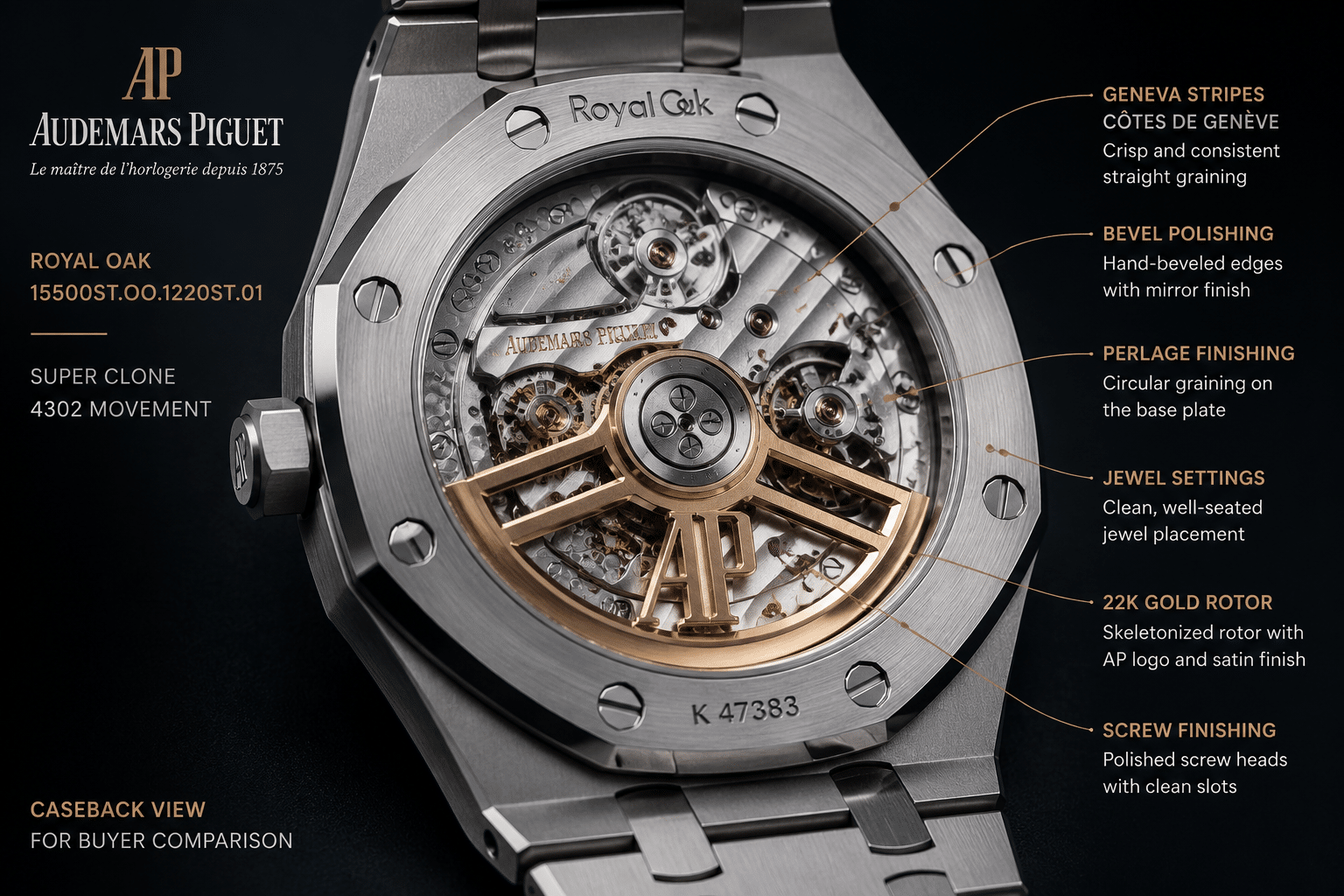
The display caseback should also be reviewed carefully. On an AP 15500, the movement is visible, so obvious rotor marks, uneven finishing, strange engraving quality, debris, or a movement view that does not match the claimed route should raise questions. These details do not prove long-term reliability, but they can catch mismatches and careless assembly before the buyer approves the watch.
The fair judgment is this: SH4302 currently carries the stronger established-route argument, but it still needs buyer discipline. Treat it as a more known quantity, not as a guarantee.
DD4302 as the Newer Dandong-Style Competitor
The DD4302 movement enters the AP 15500 conversation as the newer Dandong-style competitor, and it is easy to understand why buyers notice it. Dandong movement names carry weight in other parts of the replica watch market, especially where buyers associate them with stronger clone movement development. That reputation creates immediate interest when a Dandong 4302 movement appears in a VS-related AP 15500 or similar listing.
The buyer should be careful here. Reputation in one model family does not automatically transfer to another. A Dandong-style movement may be promising, but the AP 15500 has its own requirements: correct movement layout, compatible case thickness, stable winding, acceptable rotor behavior, realistic reserve performance, and clean display-back presentation. Confidence has to be earned inside this specific watch, not borrowed from a factory name or movement maker reputation elsewhere.
This is the main tension behind DD4302. It may look like the more modern choice because it is newer, and some buyers naturally read “newer” as “upgraded.” In replica movements, newer often means less proven. That does not make it bad. It means the buyer has less historical evidence to lean on.
Why DD4302 Gets Attention
DD4302 gets attention because it suggests competition in a model category that had already become relatively mature. Competition can be good for buyers. It may push factories to improve decoration, refine movement architecture, improve winding behavior, or offer a more convincing caseback view. In a market where factory claims often move faster than long-term feedback, a new competitor can create real excitement.
The appeal also comes from the broader perception of Dandong-style clone movements. Many buyers have seen Dandong-associated routes discussed positively in other replica categories, so they expect similar progress here. That expectation is understandable, but it needs to be narrowed. The question is not “Is Dandong good?” The question is “Is this DD4302 version, in this AP 15500 build, mature enough to trust?”
A VS-related AP 15500 with DD4302 may be attractive to a buyer who likes being early to a new movement route, especially if the caseback execution is strong and the actual QC evidence looks clean. But early adoption always carries a different risk profile. The buyer is not only buying the watch; they are also accepting more uncertainty around stability, parts familiarity, and how the movement behaves after repeated daily use.
The Risk of Treating Newer as Automatically Better
The most common DD4302 mistake is assuming that a newer AP 15500 movement must be the safer choice. In practice, a newer movement can improve certain details while still lacking the feedback trail needed for confident ownership. Launch batches often show what a movement is trying to become. Longer market exposure shows what it actually does across many examples.
This matters because movement problems are not always dramatic at first. A watch can pass basic QC, show an attractive caseback, and run acceptably during a short test, yet still leave unanswered questions about reserve consistency, rotor wear, crown feel, date reliability, and service familiarity. Those are the areas where long-term feedback becomes valuable.
DD4302 should therefore be judged as a serious competitor, not an automatic upgrade. If the specific watch has clear movement-route evidence, good caseback photos, acceptable operation feedback, and growing positive ownership reports, AP clone 3120 movement context can help frame the Royal Oak 15400 comparison more cautiously. If the main argument is only that it is newer or Dandong-style, that is not enough for a cautious buyer.
The responsible position is not to dismiss DD4302, but to slow down the hype. A newer movement may become more convincing over time. Until then, buyers should separate potential from proof.
Market History and Factory Usage: Which Movement Has the Stronger Track Record?
For buyers asking which movement is more proven in an AP 15500 super clone, the cleaner answer is not “the newest one” or “the factory with the louder reputation.” The stronger track-record argument currently sits with the SH4302 because it has had more market exposure, more repeated use in APSF-style AP 15500 builds, and more owner feedback around how it behaves across real batches. DD4302 may become more convincing as more VS-related AP 15500 versions circulate, but at this stage it has less public history behind it.
This is the key difference in a serious SH4302 vs DD4302 discussion: SH4302 is being judged from a longer feedback trail, while DD4302 is still being judged partly on expectation. That does not make DD4302 bad. It means buyers should treat it as a newer competitor that needs evidence, not as an automatic upgrade because the name sounds more modern or because Dandong-style movement labels have a strong reputation in other replica watch categories.
Factory usage matters because replica movement confidence is built through repetition. A movement that appears in more AP 15500 batches gives the market more chances to find patterns: whether early examples had issues, whether later examples improved, whether sellers understand the route clearly, and whether buyers report stable ownership after the excitement of first photos has passed. A movement with limited circulation can look promising, but it has not yet been stress-tested by enough normal owners.
Track Record Is Different From Factory Reputation
A common buyer mistake is to transfer a factory’s reputation from one model family to another. If a factory or supply route is respected for Rolex, Omega, or another movement platform, that does not automatically prove it has solved the AP Royal Oak 15500. The 15500 has its own case architecture, display caseback expectations, movement layout requirements, and batch behavior. The specific movement inside the specific AP 15500 version still needs its own history.
This is why an AP 15500 movement comparison should separate three things: the factory name, the movement route, and the version being sold right now. APSF’s use of the SH4302 route gives buyers a longer practical reference point. A VS-related version using DD4302 may attract attention because of the movement label, but the buyer still needs to ask how many current examples are in the market, what feedback exists beyond launch photos, and whether the exact watch in QC matches the claimed specification.
At Clean VS Factory, we usually treat factory reputation as a starting point, not a verdict. A respected name can still release an early version that needs time to mature, while an older route may remain the safer version choice simply because its behavior is better understood. For this particular AP 15500 movement decision, the stronger evidence still favors the more established SH4302 route.
Why Version Maturity Helps Reduce Buyer Uncertainty
Version maturity matters because replica movements rarely reveal their full story at launch. First-batch photos can show a good bridge layout, attractive rotor decoration, and a convincing caseback, but they do not tell buyers whether the movement performs consistently after weeks or months of use. Repeated production creates more feedback around assembly consistency, regulation variation, date behavior, rotor character, and whether factories quietly correct small issues over time.
This is where SH4302 has the practical advantage. It has been discussed and used long enough that buyers are not relying only on launch claims. Even when criticism exists, known criticism is useful. A known pattern gives buyers something to check. An emerging movement may have fewer complaints simply because fewer owners have reported long-term use, not because the route is already safer.
DD4302 should be judged with a different standard for now. It may be promising, and competition is healthy for the AP replica market, but a newer movement route needs batch feedback before it can claim the same confidence level. The buyer should not ask, “Is DD4302 newer?” The better question is, “Has this exact DD4302 version shown enough stable owner reports to reduce my risk?”
How Price Should Be Read in a Movement Comparison
Price can add context, but it should not be treated as final proof that one AP 15500 movement route is better. A DD4302 version may cost more because it is newer, less available, or being positioned as a fresh upgrade. A SH4302 version may cost less or similar because supply is more settled, not because the movement is necessarily inferior. In this category, price can reflect movement route, factory finishing, batch scarcity, seller margin, replacement risk, and after-sale handling.
For a buyer, the useful question is whether the extra cost reduces a real ownership risk. Paying more makes sense only if the specific watch provides stronger evidence: clearer caseback confirmation, cleaner assembly, better operation video, more stable timegrapher data, or credible recent owner feedback. Paying more only because a listing says “new DD4302” is weaker logic, especially if the watch has not yet built enough long-term service and daily-wear history.
Prices can change by factory label, version, movement, seller channel, availability, and after-sales support, so exact comparisons should be verified at the time of purchase. A movement comparison is most useful when the buyer compares like-for-like examples rather than assuming a higher price automatically means a safer movement or a lower price automatically means weaker execution.
Version Details to Confirm
Before choosing either route, confirm the details with the actual watch being offered. Listing language is not enough because factory usage can shift, batches can change, and sellers may use old descriptions for new stock. For an AP 15500 super clone, the buyer should request or review evidence that supports the movement claim rather than accepting “SH4302” or “DD4302” as a text label.
- Movement route: confirm whether the watch is being represented as SH4302 or DD4302, and check that the caseback appearance matches that claim.
- Factory version: ask which current AP 15500 version or batch is being supplied, especially if the listing references APSF, a VS-related version, or another factory label.
- Caseback evidence: review a clear caseback photo, not only front dial images. A movement decision cannot be made from the dial side alone.
- Recent batch identity: make sure the seller is not describing an older batch while showing a different current unit.
- QC consistency: compare the claimed movement, rotor view, case profile, and overall watch specification as one package.
The judgment here is simple: if a buyer wants the movement with more feedback and lower uncertainty today, SH4302 has the stronger track-record case. DD4302 deserves attention, but it should earn buyer confidence through version maturity and QC evidence, not through novelty.
Factory Name Clarification: Factory names and route labels such as APSF, VS-related, SH4302, and DD4302 are practical buyer-facing references in the replica watch market. They are not official Audemars Piguet affiliations, audited manufacturer identities, or guarantees of identical quality across every batch, so buyers should judge the current watch model by model and confirm the claimed version through visible QC details.
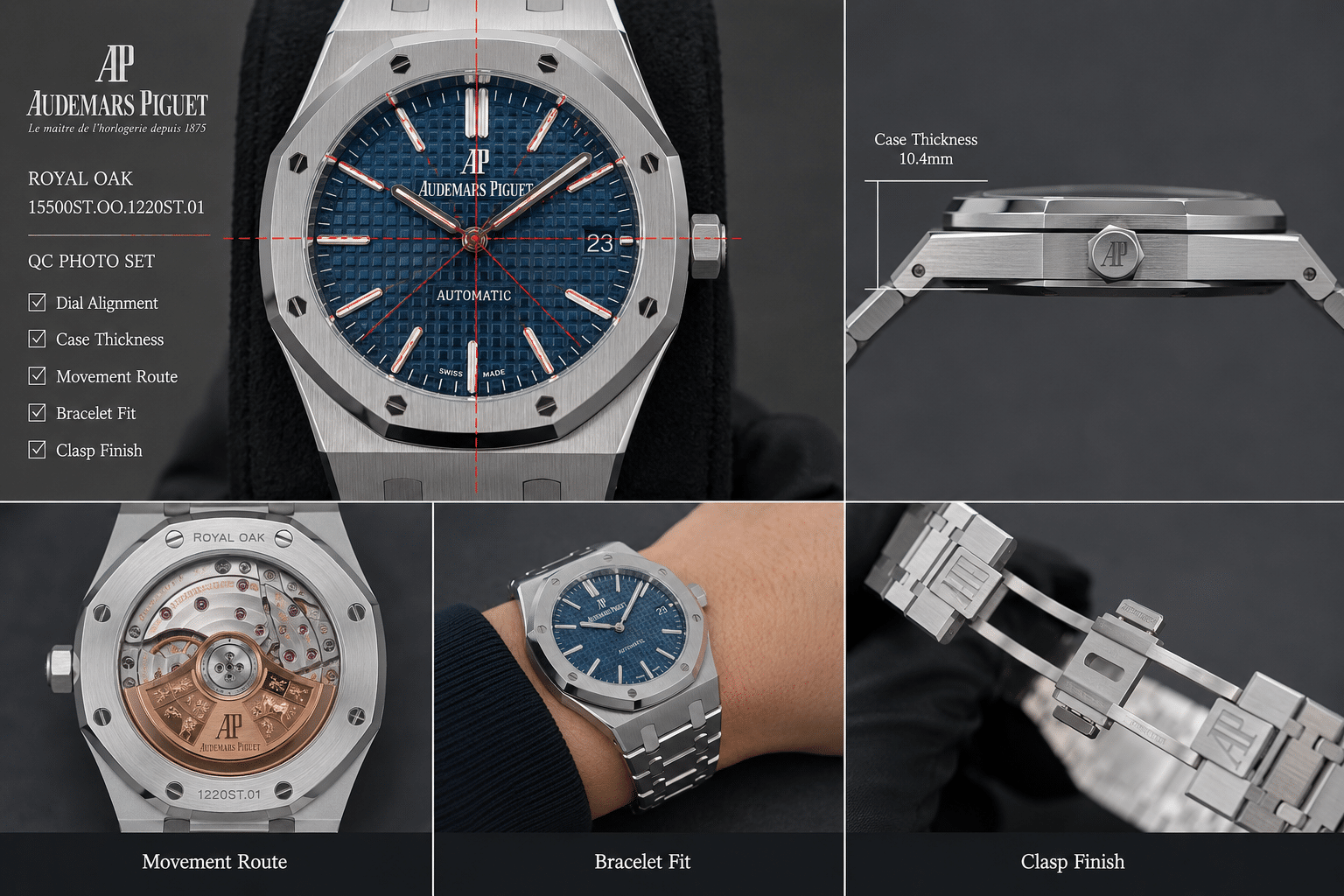
Before making a movement-based decision, buyers should review real QC photos where available, including dial alignment, case thickness, caseback layout, rotor finishing, datewheel position, bracelet fit, clasp engraving, and any short operation video. Factory labels, movement names, and stock photos alone are not enough to confirm the specific AP 15500 unit being supplied.
Evidence Limits in SH4302 vs DD4302 Discussions
One reason this topic becomes confusing is that movement evidence in the replica market is uneven. A seller may use confident wording, a buyer may post a good early impression, and a factory label may become popular quickly, but none of those alone proves long-term stability. For SH4302 and DD4302, the most useful evidence is cumulative: repeated QC examples, consistent caseback appearance, similar operation feedback across different buyers, and fewer reports of recurring problems over time.
Buyers should also be careful with single-example conclusions. One excellent DD4302 unit does not prove that all DD4302 batches are mature, and one noisy SH4302 unit does not prove that the whole route is weak. The point of comparing movement routes is to reduce uncertainty, not to guarantee a perfect result. The more consistent the evidence becomes across different watches and sellers, the more confidence a buyer can reasonably place in that route.
This is also why this article avoids treating factory names as official proof. Factory reputation can be useful context, but the actual watch still needs to show the claimed movement, acceptable assembly, and stable operation. In a replica AP 15500 purchase, evidence should move from general to specific: broad market feedback first, current batch feedback second, and the individual QC set last. If those three levels do not agree, the buyer should slow down.
How to Build a Traceable Comparison Before Ordering
A practical way to compare SH4302 and DD4302 is to create a simple traceability chain rather than relying on one impressive claim. Start with the model reference being offered, then identify the factory-market label, the stated movement route, the current version or batch, and the actual QC evidence. If the seller’s description says one thing but the caseback photo, rotor design, or case profile suggests another, the buyer should ask for clarification before accepting the watch.
The most useful comparison file includes the listing description, the exact QC photos, any caseback close-up, a short winding or rotor video when available, and notes about recent owner feedback for the same route. This does not remove every risk, but it helps buyers avoid a common problem: paying for a movement name without confirming that the individual watch supports the claim. CleanVSFactory’s editorial approach is to make replica watch decisions more traceable by connecting factory claims to visible details, movement behavior, version differences, and practical QC checks.
Winding Feel, Rotor Behavior, and Daily Ownership Signals
Movement confidence is not only what the caseback looks like in photos. After the watch arrives, the buyer interacts with the movement through the crown, rotor, date setting, and general feel on the wrist. This is where a visually impressive AP 15500 replica can either feel reassuring or start to feel questionable.
For both SH4302 and DD4302, the buyer should expect some replica movement variation. These are not official AP movements, and they should not be judged as if every example will have identical refinement. A slightly audible rotor, a crown that feels more mechanical than buttery, or minor variation in winding resistance can exist without meaning the watch is unusable. The red flags are harsher: grinding, slipping, inconsistent crown engagement, a rotor that sounds loose, or a date mechanism that feels unstable during setting.
This is why AP 15500 winding feel matters in a practical way. The Royal Oak 15500 is an integrated-bracelet watch with a display back and a high-expectation design language. If the movement feels crude every time the owner winds or sets it, the watch may remain visually strong but become less satisfying as a daily-wear piece.
Why Rotor Sound Can Shape Buyer Confidence
4302 rotor noise is a difficult topic because buyers often overreact to sound clips while also ignoring obvious warning signs. A rotor that is faintly audible in a quiet room does not automatically prove a defect. Many replica automatic movements have more rotor presence than buyers expect, and the AP case construction can transmit sound differently depending on bracelet fit, caseback assembly, and movement condition.
The issue is not whether the rotor is perfectly silent. The issue is whether the rotor sounds controlled. A normal sound is usually a light, smooth rotation or a muted mechanical presence. A concerning sound is sharp scraping, loose rattling, heavy wobbling, or a sudden grinding sensation when the watch is moved. Those are the signals that should push a buyer to ask for clarification, request another example if still in QC, or consider service if the watch is already in hand.
Rotor noise also affects perceived quality more than many buyers admit. A Royal Oak 15500 super clone can look convincing from the front, but if the rotor is distractingly loud during normal wrist motion, the ownership experience feels cheaper. This does not decide SH4302 vs DD4302 by itself, but it should influence whether a specific unit is acceptable.
Crown and Date Behavior as Practical Warning Signs
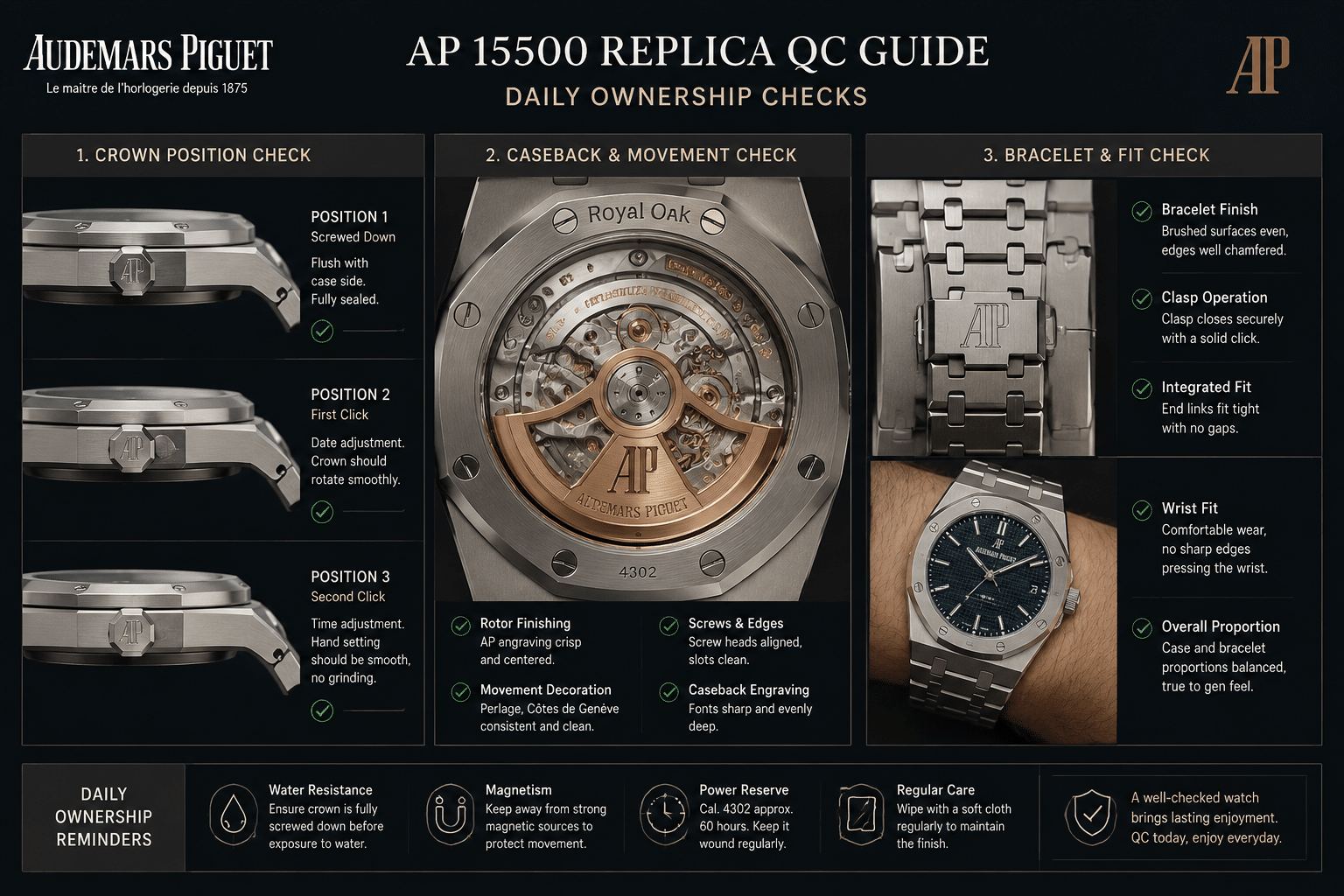
The crown tells the buyer a lot about movement condition. Winding should feel engaged and reasonably consistent. It does not need to feel like a genuine AP, but it should not feel sandy, sticky, or as if the gears are fighting the crown. If the crown resists sharply, slips between positions, or feels unstable when pulled, that is not just a luxury-feel complaint. It can be a sign of poor adjustment, rough assembly, or a movement that needs attention.
Date behavior deserves the same caution. The AP 15500 design makes buyers expect a clean, confident calendar function. During setting, the date should advance predictably without half-clicks, hesitation, or a feeling that the mechanism is binding. A datewheel that looks centered in photos but behaves poorly during operation is still a problem. Daily ownership exposes issues that QC photos may not show.
The useful buyer rule is to separate acceptable variation from operational red flags. Slightly firmer winding than expected is not automatically a reason to reject a watch. Harsh grinding, loose crown engagement, unstable date setting, or an obviously noisy rotor should be treated as a QC concern before approval. If the seller can provide a short winding or rotor video, it may reveal more about the actual movement than another polished caseback photo.
Power Reserve Claims and What Buyers Should Treat Cautiously
Power reserve is one of the easiest numbers to market and one of the easiest numbers for buyers to misunderstand. A listing may present an impressive reserve for SH4302 or DD4302, but the better question is not only how long the movement can run in ideal conditions. The better question is whether real examples run consistently enough for normal ownership.
For a replica AP 15500, SH4302 power reserve and DD4302 power reserve claims should be treated as confidence signals, not guarantees. A movement may be designed around a long-reserve target, but actual running time can vary by batch, lubrication condition, assembly quality, regulation, and how fully the watch was wound before testing. This is especially important with newer movement routes, where the market may not yet have enough examples to separate a strong claim from stable real-world behavior.
The most rational buyer does not choose a movement only because one description lists a higher number. A slightly less glamorous but consistently reported reserve is more useful than an ambitious claim that varies widely across units. In daily wear, predictability matters more than winning a specification chart.
Why Claimed Reserve Is Not the Same as Consistent Reserve
A claimed power reserve usually describes what the movement is supposed to achieve under favorable conditions. Consistent reserve describes what normal buyers repeatedly experience across actual watches. Those are not the same thing. A movement can produce an impressive result after careful setup or service, while ordinary factory-delivered examples may run shorter because of lubrication, adjustment, or batch inconsistency.
This is why power reserve should not be used as a simple winner-takes-all statistic in the SH4302 vs DD4302 debate. SH4302 benefits from more feedback because buyers have had more time to observe whether claims match typical ownership. DD4302 may eventually build the same kind of evidence, but a newer route should be judged by repeated reports, not by the most optimistic number attached to a listing.
Buyers should also be careful with informal testing. If a watch was not fully wound, if it sat unused for a long period, or if the wearer assumed automatic wrist motion fully charged it, the result may not reflect the movement’s real capacity. Poor testing can make a good unit look weak, while selective marketing can make an average unit look better than it is.
How Power Reserve Affects Daily Wear
Power reserve matters most for buyers who rotate watches. If the AP 15500 is worn every day, even a moderate reserve may feel acceptable as long as the automatic winding system keeps up with normal activity. If the owner switches between watches and leaves the Royal Oak off for a day or two, inconsistent reserve becomes more annoying. The watch may stop unexpectedly, forcing more frequent resetting and increasing interaction with the crown and date mechanism.
For daily wear, the safest expectation is practical rather than idealized. Do not assume every 4302-style clone will deliver the advertised maximum. Look for owner reports, ask whether the seller has observed stable running behavior, and avoid paying a premium only for a headline reserve claim unless the specific version has enough feedback to support it.
The buyer judgment is straightforward: power reserve should support the movement decision, not dominate it. If SH4302 has a longer feedback trail and more predictable owner reports, that carries more weight than a newer DD4302 claim that has not yet been proven across enough examples. If a DD4302 unit comes with strong QC evidence and growing positive batch feedback, it becomes more interesting, but the claim still needs to be treated as a claim until real-world consistency catches up.
Movement Decoration and Caseback Accuracy Without Overvaluing Looks
The AP 15500 is not a closed-back watch, so movement appearance matters more here than it would on a simple Rolex-style replica. A buyer will see the rotor, bridge layout, engraved text, screw heads, and general finishing every time the watch is turned over. That makes AP 15500 caseback accuracy a real comparison point between SH4302 and DD4302, but it should not become the whole decision.
The common mistake is treating a more attractive caseback photo as proof of a better movement. It is not. A 4302 movement decoration can look convincing in a still image while the actual movement route has less real-world feedback, weaker consistency, or less service familiarity. Caseback presentation is part of the ownership experience, but it is not the same as movement confidence.
For most buyers, the smarter standard is this: use the display caseback to check whether the movement is plausibly the claimed route and whether the visible assembly looks clean. Do not use it as the only reason to choose one movement over another. If SH4302 has a longer feedback trail in a specific AP 15500 version, a slightly more dramatic DD4302 rotor finish should not automatically override that advantage.
What Caseback Photos Can Actually Tell You
Caseback photos are useful because they reveal details that listing language can hide. You can compare the rotor decoration, bridge shape, engraving weight, jewel positions, visible screws, and general movement layout. If a seller claims SH4302 or DD4302 but the shown caseback does not match the expected route, that is a serious warning sign.
Good caseback photos can also show whether the movement finishing is clean enough for the price tier. Look for obvious dust under the crystal, scratched rotor plating, sloppy engraving, stained screws, loose-looking parts, or careless assembly marks. These are not always movement-failure signs, but they suggest poor handling or weak QC discipline.
What caseback photos cannot prove is long-term AP 15500 movement reliability. A polished rotor and clean bridge decoration do not tell you whether the movement will hold stable performance after months of wear. They also do not confirm lubrication quality, calendar durability, or future repair confidence. The caseback helps you reject obvious mismatches; it does not certify the movement as risk-free.
When Visual Accuracy Should Take Second Place
Visual accuracy should take second place when the buyer plans to wear the watch regularly. A display caseback is inspected occasionally; the movement has to function every day, so Audemars Piguet replica movements should be judged by stronger owner feedback, more predictable batch behavior, and better known quirks, since that practical confidence usually matters more than a prettier engraved rotor.
This is especially important with DD4302 because newer movement routes often arrive with stronger marketing energy. A newer Dandong-style label may sound attractive, and the caseback may photograph well, but buyers should separate decoration versus reliability. The question is not only which movement looks closer. The better question is which movement has enough version maturity to make the buyer comfortable beyond the first week.
SH4302’s caseback decoration is not perfect, and no 4302-style replica movement should be confused with an official AP calibre. Still, if the buyer values lower uncertainty, a more established movement route with acceptable caseback accuracy is often the more rational choice than a newer option that wins mainly in photo appeal.
Caseback Details to Review in QC
- Rotor finish: Check whether the engraved rotor looks clean, centered, and free from obvious scratches or plating marks. A messy rotor is not just cosmetic; it can suggest careless handling.
- Bridge layout: Compare the visible bridge structure with the claimed SH4302 or DD4302 route. The goal is not authentication; the goal is confirming that the watch shown matches the seller’s movement claim.
- Engraving quality: Look for overly thick, uneven, or poorly spaced text. Minor decoration flaws are common, but crude engraving weakens the caseback impression on a Royal Oak 15500 replica.
- Screw placement appearance: Screws should look seated and consistent. Damaged screw heads or irregular marks may indicate previous opening or poor assembly work.
- Bridge cleanliness: Dust, fingerprints, cloudy marks, or visible debris under the caseback crystal should be treated as QC concerns, especially on a watch sold as a higher-tier AP 15500 super clone.
- Movement-route consistency: The shown caseback should support the claimed movement route. If the listing says DD4302 but the caseback looks like a different 4302-style build, ask for clarification before approving.
Water Resistance, Daily Wear, and What Not to Assume
Movement choice should not be confused with water-resistance confidence. A better-looking caseback, a newer movement route, or a higher-tier factory label does not prove that the individual AP 15500 replica is safe for swimming, showering, or heavy exposure to moisture. Unless the exact watch has been pressure-tested after purchase by someone competent to do so, water resistance should be treated as unverified.
This matters because the AP 15500 design includes a display back, crown assembly, case gasket surfaces, and bracelet-case integration that all depend on assembly quality. Even if a listing uses confident language, the buyer should not assume the replica has the same water-resistance behavior as the authentic watch. For practical ownership, avoid water exposure unless the individual watch has been tested, and treat any moisture-related claim as separate from the SH4302 versus DD4302 movement decision.
Daily ownership expectations should also include servicing limits. A strong AP 15500 super clone may be enjoyable to wear, but it is still an imitation watch with movement, gasket, finishing, and parts-access uncertainty. Buyers should confirm return, repair, shipping, and after-sales terms before ordering, and should not assume that a local watchmaker will accept or have parts for a clone movement. This is another reason why a more documented movement route can be easier to own than a newer route with limited long-term handling history.
Service Confidence and Long-Term Risk
AP 15500 movement reliability is not only about whether the watch runs during QC. The more important question is what happens after months of winding, wearing, setting, and occasional inactivity. This is where service confidence becomes part of the SH4302 versus DD4302 decision.
A movement with more market time usually gives buyers more information. Owners report patterns. Sellers learn which issues appear repeatedly. Repair contacts become more familiar with how the movement is built and what typically goes wrong. That does not make SH4302 risk-free, but it does make the risk easier to understand. With a newer DD4302 route, the uncertainty is not necessarily that it is worse; the uncertainty is that fewer long-term patterns may be visible yet.
For a buyer who plans to keep the watch, known behavior matters more than a clean launch claim. Replica movement serviceability is never something to treat as guaranteed. Parts access can vary, repair willingness can vary, and not every local watchmaker wants to work on clone movements. But a more proven clone movement route usually gives the owner a better chance of knowing what kind of risk they are accepting.
Why Known Weaknesses Can Be Better Than Unknown Ones
A documented weakness sounds negative, but it can actually help the buyer make a better decision. If an established movement route has known quirks, those quirks can be checked, discussed, and priced into expectations. A buyer can ask about date behavior, visible cleanliness, rotor condition, and recent batch feedback before approving the watch.
Unknown weaknesses are harder. A newer movement may look strong in early photos and may perform well in initial examples, but early buyers carry more of the discovery risk. Some issues only appear after repeated production, shipping stress, owner use, and real service attempts. That is why “newer” is not automatically safer in the AP 15500 movement comparison.
The better judgment is not that every older movement is good and every newer one is risky. The real point is that maturity creates information. In the replica watch market, information is valuable because factory descriptions often move faster than long-term evidence.
How Service Familiarity Changes Buyer Risk
Service familiarity does not mean every repair will be easy. It means the movement route has been seen often enough that its construction, common symptoms, and likely weak points are less mysterious. That can matter if the watch develops date issues, winding roughness, rotor problems, or inconsistent running after ownership begins.
With SH4302, the stronger argument is that more examples have circulated through AP 15500 super clone builds, giving buyers and repair contacts more practical reference points. With DD4302, the appeal may be real, but confidence should grow through observed stability rather than assumed superiority from the Dandong name.
At Clean VS Factory, we tend to treat service confidence as a risk-reduction factor, not a promise. A movement route with broader feedback is usually easier to trust for daily wear than a newer route that still depends heavily on factory claims and a small sample of early owner impressions.
The practical buyer rule is simple: if you are choosing the watch for regular wear, prefer the movement with clearer known behavior unless the newer route has strong QC evidence and enough current feedback to justify the extra uncertainty.
Beginner Risk: Why the AP 15500 Is Not the Easiest First Movement Choice
For first-time replica watch buyers, the AP 15500 is less forgiving than many simpler models. The visible movement, slim case profile, integrated bracelet, and high attention to finishing mean small compromises can feel more noticeable in daily use. A beginner may focus on the dial color or bracelet brushing, but the movement route can affect how often the watch needs setting, whether winding feels reassuring, and whether a future repair is realistic.
This does not mean beginners must avoid the AP 15500, but it does mean they should choose the lower-uncertainty path. If the buyer is not comfortable reading caseback differences or evaluating movement claims, a more established SH4302 example with clean QC is usually easier to justify than an early DD4302 example sold mainly on novelty. Complicated or newer routes can be interesting for experienced buyers who accept discovery risk; they are less ideal for someone who wants a first daily-wear Royal Oak clone with fewer unknowns.
QC Evidence That Matters Before Choosing SH4302 or DD4302
The safest SH4302 versus DD4302 comparison is not theoretical. It is the actual AP 15500 shown in QC. A movement route can have a good reputation, but the watch in front of you still needs to support the claim with photos, video, and basic operation evidence.
AP 15500 QC photos should do more than show a nice blue dial and polished bracelet. For this movement decision, the buyer needs movement route confirmation, a clean caseback view, crown-side evidence, and enough operation clues to avoid approving a mismatched or poorly handled example. QC cannot guarantee long-term reliability, but it can catch obvious inconsistency before the watch ships.
This matters because listings may use movement labels loosely. A seller may describe a watch as SH4302, DD4302, APS-style, VS-related, or 4302 clone movement without showing enough proof. The buyer should not approve based only on the written claim. The shown watch must match the description.
QC photos can reduce uncertainty, but they do not guarantee perfection. Buyers should still review visible details, ask how the movement route was confirmed, and clarify seller policies before ordering. The purpose of factory and movement information is to help readers understand quality and risk, not to represent a replica watch as genuine.
Photos That Support the Movement Claim
The most important photo is a clear display-caseback shot. It should show the rotor, bridge layout, visible engraving, and enough movement detail to compare against the claimed route. A blurry caseback photo is not enough for a movement-route decision, especially when the price depends on whether the watch uses SH4302 or DD4302.
A rotor close-up helps because the rotor is the easiest visible area for sellers to highlight and for buyers to compare. Look for decoration consistency, engraving clarity, and whether the rotor design appears to match the claimed movement family. This is not about proving anything as genuine; it is about confirming the replica watch is the version being advertised.
Version identifiers also matter. If the watch is described as a recent APSF AP 15500 or a VS-related AP 15500, the QC set should align with that claim through caseback appearance, case profile, dial execution, and bracelet details. A movement claim that conflicts with the rest of the watch should make the buyer slow down.
Operation Clues to Ask About Carefully
Photos alone cannot show how the movement behaves. When possible, ask for a short rotor video or winding video. You are not looking for perfection; you are looking for obvious red flags such as harsh scraping, unstable rotor movement, rough crown engagement, or a seller avoiding basic operation questions.
Crown operation matters because a poor crown feel can turn a visually strong AP 15500 into a frustrating daily watch. Ask whether the crown winds cleanly, pulls to the expected positions, and allows the time and date to be set without unusual resistance. A slightly different feel from a genuine AP is expected. Grinding, slipping, or inconsistent engagement is not something to ignore.
Date setting is another practical clue. The QC stage may not reveal every calendar issue, but the seller should at least be able to confirm that the date advances properly during setting. If the watch shows misaligned date printing, a stuck date, or unclear operation, the movement route label becomes less important than the specific example’s risk.
A timegrapher reading can be useful, but it should not be treated as a complete health certificate. It gives a snapshot of rate, amplitude, and beat error under limited conditions. A clean reading supports confidence; it does not prove future movement stability.
QC Photos to Request
- Front dial photo: Confirms basic dial alignment, marker placement, date position, and whether the watch shown is the correct AP 15500 version.
- Side profile photo: Helps judge case thickness and whether the movement route supports a convincing case architecture.
- Clear caseback photo: The key evidence for movement route confirmation, rotor decoration, bridge layout, and visible assembly cleanliness.
- Rotor close-up: Useful for checking engraved rotor quality, finish condition, and whether the visible movement matches the claimed SH4302 or DD4302 route.
- Crown-side case view: Shows crown fit, case finishing, and gives context for crown operation questions.
- Clasp and bracelet fit photos: Not movement-specific, but they confirm the overall factory execution of the watch being offered.
- Short winding or rotor video: Helps identify obvious operation concerns that still photos cannot reveal.
- Timegrapher photo or video: Supports basic running confidence, while still leaving room for normal movement variation.
The final QC judgment should be practical: approve the watch only if the movement route, visible construction, and basic operation evidence agree with the seller’s claim. If the photos are vague, the caseback is hidden, or the movement label keeps changing, the safer move is to pause rather than trust the newest or most impressive wording.
Seller Claims, Policy Questions, and Misrepresentation Boundaries
Movement comparison should also include the way a seller presents the watch. Cautious buyers should be skeptical of listings that rely on phrases such as “perfect,” “same as genuine,” “official movement,” or “guaranteed inspection pass.” A strong replica-market AP 15500 may look convincing in normal wear, but close inspection can still reveal differences in finishing, movement architecture, case proportions, bracelet feel, dial details, or service compatibility.
Before ordering, buyers should confirm the practical terms that affect ownership: whether QC photos are provided, what happens if the watch shown does not match the stated movement route, whether any water-resistance testing has been performed on the specific unit, and what repair or return options are actually available. Unless a seller clearly states and supports those policies, they should not be assumed from the factory label, price level, or movement name.
The safest use of SH4302 and DD4302 information is to avoid overpaying or misunderstanding risk. It should not be used to help represent a replica watch as an authentic Audemars Piguet watch, to support resale as genuine, or to imply that the watch will pass professional authentication. A buyer who understands the movement route clearly is better equipped to make a realistic ownership decision without confusing replica-market quality with genuine brand manufacture.
The Buyer Rule: Choose Proven Evidence Over the Newest Movement Claim
The safer AP 15500 buyer rule is simple: choose the movement route with the stronger evidence trail, not the newest name in the listing. For now, that gives the SH4302 the stronger proven-history argument in most AP 15500 super clone discussions. It has more market exposure, more repeated factory use, and more buyer feedback around the ownership behaviors that matter after the watch leaves the QC table.
That does not make SH4302 perfect, and it does not make DD4302 a bad movement by default. The real distinction is confidence. SH4302 is easier to judge because more of its strengths and weaknesses have already surfaced through real use. DD4302 may become more convincing as batches mature, but a newer movement should earn confidence through version maturity, QC evidence, and owner feedback rather than through the Dandong name alone.
If a buyer asks for the most practical AP 15500 movement choice, the answer is not simply “SH4302 or DD4302” as a permanent winner. The better answer is: pick the specific watch whose movement route, batch, caseback, operation, and seller-provided evidence create the lowest daily wear risk for your expectations. In today’s market, that usually favors the more established SH4302 route unless the DD4302 example is supported by unusually strong current evidence.
For a Conservative Buyer
A conservative buyer should usually start with SH4302. Not because older automatically means better, but because a longer movement track record reduces unknowns. In replica movements, known quirks are often easier to live with than unknown ones. If buyers already have feedback around winding feel, rotor behavior, date operation, power reserve variance, and service experience, they can make a more informed decision instead of becoming part of the first feedback wave.
This matters especially for a Royal Oak 15500 replica intended for regular wear. The watch is thin enough, exposed enough through the display caseback, and expensive enough within the replica watch market that movement frustration can spoil the whole ownership experience. A slightly less exciting but better-documented movement route is often the more rational choice for someone who wants to wear the watch, not just compare launch photos.
For beginners, the same logic applies even more strongly. A first-time buyer should not pay extra mental tax for uncertainty unless there is a clear reason to do so. If two AP 15500 super clone options look similarly convincing in normal QC photos, the one with stronger movement history and more predictable feedback is usually the safer movement choice.
For a Buyer Tempted by the Newer Route
DD4302 is worth considering if the buyer understands what they are accepting: less historical certainty in exchange for the possibility of a newer competing route. That can be reasonable for buyers who follow batch changes closely, compare caseback photos carefully, and are comfortable waiting for more feedback before declaring a movement route superior.
The mistake is treating “newer” as the same thing as “upgraded.” A newer AP 15500 movement may have attractive claims, cleaner-looking decoration, or a stronger factory story, but those points do not replace ownership evidence. Before choosing DD4302, the buyer should want more than a listing label. The specific example should show consistent QC, credible movement-route confirmation, acceptable winding and rotor behavior, and enough current feedback to suggest the version is settling into production rather than still being tested by early buyers.
A caseback-focused buyer may also find DD4302 interesting if the visible movement presentation is appealing. That is a valid preference, but it should be ranked correctly. Caseback appearance can improve enjoyment, while instability affects usability. If the prettier-looking option carries more uncertainty, the buyer should be honest about that tradeoff before choosing it.
The Final Decision Standard
The final standard is not factory excitement, movement naming, or the newest claim. It is evidence. Version maturity, QC proof, and real-world feedback should carry more weight than any single marketing label. That is the cleanest way to compare SH4302 or DD4302 without turning the decision into factory fan loyalty.
For most cautious buyers today, SH4302 remains the more proven AP 15500 movement route. DD4302 should be watched seriously, but judged patiently. If later batches build a stronger feedback trail, the recommendation can shift. Replica watch decisions are not permanent laws; they are version-specific risk judgments.
At Clean VS Factory, we treat this kind of movement comparison as a buyer-confidence question rather than a winner-takes-all ranking. A good AP 15500 super clone is not only the one that looks impressive in photos. It is the one whose movement route, factory implementation, and QC evidence make sense together for the way the buyer actually plans to wear the watch.
The practical AP 15500 buyer rule is this: if you want lower uncertainty, favor the more proven route. If you want to try the newer route, demand stronger proof. Do not let a fresh movement claim outrank a mature track record unless the specific watch in front of you gives you a clear reason to accept that risk.
Disclosure: This article is for general educational and comparison purposes only. Replica watches are not genuine products from the original luxury brands, and brand names are used only to identify reference designs or comparison topics. Factory names, movement descriptions, prices, availability, QC details, seller policies, and version information can change, so readers should verify important details with the seller before making a purchase decision. Replica watches should not be represented, resold, or used as genuine watches.