
The Royal Oak 15400 replica is not a model where the movement can be treated as a hidden detail. Because the watch has a thin integrated case, a display caseback, and a very specific case-to-bracelet flow, the movement architecture affects how convincing the whole watch feels, especially when viewed through an SH4302 vs DD4302 comparison focused on AP 15500 movement credibility. Older Miyota 9015-based builds may offer solid reliability and a lower price, but decorative plates cannot fully correct balance-wheel position, case thickness, rotor layout, or caseback depth.
This article explains why the AP clone 3120-style movement changed buyer expectations for 15400 replicas. The useful question is not whether a seller uses the “clone 3120” label, but whether the watch shows the right side profile, movement placement, date alignment, caseback layout, and QC evidence. The goal is to help buyers decide when the premium is justified and when a cheaper Miyota-based version may still be acceptable.
Replica watches should be clearly understood as replica-market products, not genuine watches from the original luxury brands. Audemars Piguet and Royal Oak references in this guide are used to identify the genuine reference design being compared, not to imply authorization, endorsement, service compatibility, or any official production relationship.
| Buyer Check | What Matters on the 15400 | Practical Judgment |
|---|---|---|
| Movement route | Clone 3120-style architecture versus decorated Miyota base | Choose based on caseback credibility, not the label alone |
| Side profile | Bezel, mid-case, caseback height, and bracelet transition | A swollen caseback weakens the Royal Oak look quickly |
| Caseback view | Rotor shape, bridge layout, balance position, depth, spacing | Clear caseback QC photos are essential before paying more |
| Date alignment | Window position and date centering on the dial | Small errors are visible because the 15400 dial is clean |
| Daily wear risk | Rotor noise, winding feel, date change, unit consistency | Clone 3120-style builds can be better, but still need QC |
| Price premium | Thinner case, better movement placement, stronger open-back realism | Worth considering only when evidence supports the upgrade |
Quick Questions Before You Read
Q: Is a clone 3120-style movement always the better choice for a 15400 replica?
Not always. It makes the most sense if you care about side profile, display-caseback realism, and movement placement.
Q: Can a Miyota-based 15400 still be a reasonable buy?
Yes, for buyers who mainly want the front-facing Royal Oak look and accept a thicker, less credible caseback.
Q: What should be checked first in QC photos?
Start with clear caseback and crown-side profile photos, then check date alignment, dial fit, bracelet flow, and clasp finish.
Q: Does a higher price prove the watch has the better movement?
No. Confirm the exact version, balance-wheel position, rotor layout, caseback height, and real QC images before paying the premium.
Editorial Perspective: For the Royal Oak 15400, the movement discussion should stay model-specific. A factory name, a “clone 3120” label, or a higher price can be useful signals, but none of them proves the finished watch is the better buy. The practical comparison is whether the movement architecture supports the correct case thickness, balance-wheel position, display-caseback layout, date placement, and daily-wear expectations. At cleanvsfactory.com, this type of AP comparison is treated as a buyer decision about use case and evidence, not a simple ranking of factories or movement names.
Evidence Boundary: This guide discusses imitation watches and buyer-side evaluation logic, not authorized Audemars Piguet products. Official brand specifications can help a buyer understand the authentic design target, but they should not be used as proof that a replica has the same finishing, movement quality, materials, water resistance, serviceability, or legal status. In the replica market, the strongest usable evidence is usually the actual watch offered: clear QC photos, consistent version description, visible movement layout, side-profile images, and honest disclosure of uncertainty.
How to Read Movement Claims: Terms such as “clone 3120,” “AP-style movement,” or “super clone” are seller and buyer-community descriptions rather than factory-audited certification labels. They should be treated as claims to verify, not conclusions to accept. A credible claim should be supported by visible architecture: balance-wheel location, rotor position, bridge layout, movement depth, date placement, and case thickness. If those details are missing or contradictory, the safer assumption is that the listing has not provided enough evidence.
Use Comparison Ethically: The purpose of factory, movement, and QC information is to help readers understand quality differences, avoid unclear listings, and set realistic expectations. It should not be used to represent a replica watch as a genuine Audemars Piguet watch, to support resale misrepresentation, or to suggest that a replica can pass official or professional authentication.
Why the Clone 3120 Became a Turning Point for Royal Oak 15400 Replicas
The AP clone 3120 movement changed the Royal Oak 15400 replica market because it attacked the problem at the level that mattered most: movement architecture. Older Royal Oak 15400 replica builds could improve the dial, bracelet, bezel brushing, and case finishing, but many were still built around a Miyota 9015 with decorative plates. That route could look acceptable from the front. It could not fully solve the side profile, the display caseback view, the balance wheel location, or the way the movement sat inside the case.
This is why the clone 3120 matters. The 15400 is not a forgiving closed-back sports watch where the movement can stay hidden. It has a display caseback, a thin case expectation, and an integrated bracelet that makes extra case height more obvious on the wrist. A movement that is not designed around the same basic layout forces compromises elsewhere. Decoration can cover a movement. It cannot turn a mismatched movement into the correct architecture.
The clone 3120 did not make every AP 15400 super clone watch perfect. That would be the wrong conclusion. It did, however, move the category away from “good front view, compromised back and side” toward a more complete package. For buyers who care about more than a dial photo, that is a meaningful shift.
The Short Answer: Decoration Was Not Enough
Decorative plates were the old workaround. Factories used a reliable, available automatic movement underneath, then added plates and rotor decoration to make the caseback look more AP-like. On a basic level, this made sense. A decorated Miyota could run, keep time, and give the buyer a visible movement instead of a plain generic caliber.
The limit was structural. A plate can imitate bridge shapes from a distance, but it cannot relocate the real balance wheel, change the gear train layout, or erase the height added by adaptation parts and caseback design. If the underlying movement was not built to match the Royal Oak 15400 movement layout, the illusion started to break down as soon as the buyer looked at the watch from the side or through the caseback.
This is the key buyer judgment: a decorated Miyota versus clone movement comparison is not just about prettier engraving. It is about whether the movement route allows the watch to keep the correct proportions and credible caseback layout. On the 15400, that difference is too important to treat as a small technical footnote.
Why the 15400 Exposes Movement Shortcuts
The Royal Oak 15400 exposes shortcuts because its design is built around flatness and integration. The bezel, mid-case, caseback, and bracelet are supposed to flow as one sharp, low-profile object. If the case is made thicker to accommodate the wrong movement route, the watch may still look impressive in a straight-on photo, but the side profile starts to feel heavier and less refined.
The display caseback makes the problem more direct. A Rolex Submariner-style replica with a closed back can hide a lot of movement compromises. The 15400 cannot. The rotor, bridge layout, open areas, and balance wheel position are all part of the visible experience. Buyers who only compare dial texture or bracelet brushing miss the most important reason some older 15400 replicas never felt fully convincing.
There is also a wrist-wear issue. The Royal Oak bracelet drops from the case in a way that exaggerates case thickness. A slightly bulky caseback or awkward movement spacer does not remain a hidden technical compromise; it changes how the watch sits and how the case transitions into the bracelet. That is why movement architecture matters more here than it does on many other replica watch models.
The Buyer Mistake This Article Should Prevent
The common mistake is treating “clone movement” as a marketing phrase instead of a claim that needs to match visible evidence. A seller can describe a Royal Oak 15400 replica as a clone 3120 version, but the buyer still needs to understand what that should change: balance wheel position, case profile, rotor behavior, and the overall caseback layout.
At Clean VS Factory, we usually separate the movement name from the movement result. If a watch is advertised with a better movement route but still has an overly thick side profile, unclear caseback photos, or a layout that looks like a decorated base movement, the name alone is not enough. The smarter question is not “Does the listing say clone 3120?” but “Do the visible traits support that claim?”
The clone 3120 became a turning point because it reduced the biggest built-in tells of older 15400 builds. It should not be treated as a guarantee of perfect finishing, silent operation, or genuine-level durability. It is best understood as a technical upgrade that gives the Royal Oak 15400 replica a better foundation, especially for buyers who care about the watch from the side and back, not only from the front.
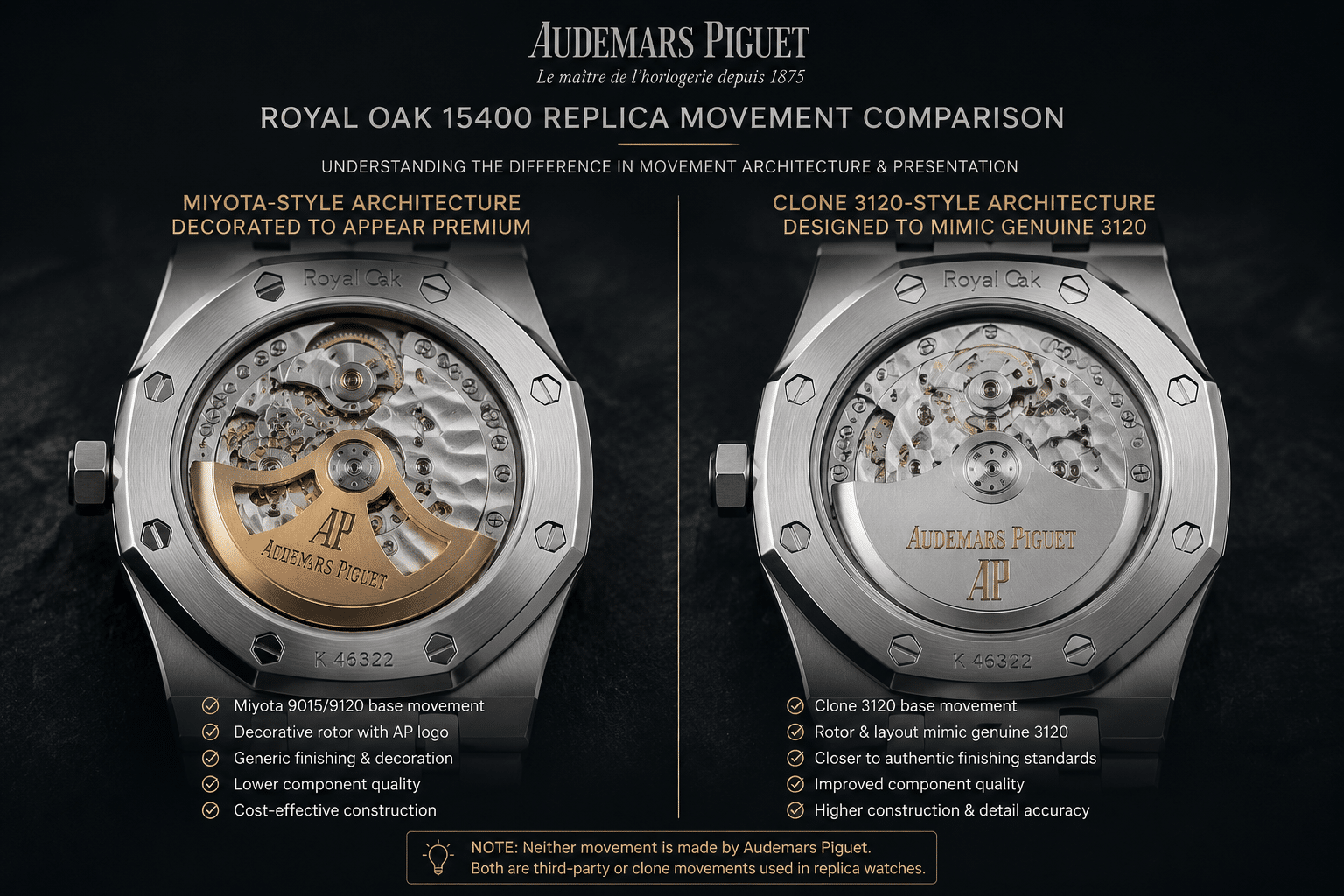
How the Genuine AP Caliber 3120 Shapes the Royal Oak 15400 Design
The genuine AP Caliber 3120 matters to replica buyers because it is not just the engine inside the Royal Oak 15400. It helps define the watch’s proportions, caseback view, date position, and visual balance. A convincing Royal Oak 15400 movement route has to approximate the logic of that architecture, not simply decorate a different movement and hope the buyer only looks at the dial.
For a replica comparison, the useful question is not whether a clone movement equals a genuine AP movement. It does not. The genuine caliber carries AP’s own finishing standards, engineering, service expectations, and long-term quality control. The practical question is narrower: does the replica movement route support a case, caseback, and layout that look believable for the 15400?
Movement Architecture as the Hidden Design Constraint
Movement architecture is the hidden constraint behind many details buyers mistakenly judge as separate flaws. Case thickness, dial-side spacing, datewheel placement, caseback depth, and rotor position all depend on what is sitting inside the watch. If the movement is wrong for the case, the factory has to compensate with spacers, thicker casebacks, altered internal mounting, or surface decoration.
That is why the Royal Oak 15400 is a poor model for lazy movement adaptation. Its thin case profile leaves less room for compromise. The dial is broad and clean, the date window is easy to inspect, and the display caseback exposes the movement as part of the design. A mismatch underneath can show up in several places at once.
This is also why buyers should be careful with front-only comparisons. A 15400 can have a strong tapisserie dial, good logo placement, and attractive brushing while still being compromised by the movement route. For this model, the movement is not a separate hidden specification. It is part of the external accuracy.
Balance-Wheel Position and Caseback Credibility
The balance wheel is one of the easiest architectural clues to understand because it is visible and active. It is the small oscillating part that moves back and forth while the watch runs. On a display-back Royal Oak 15400 replica, its position tells the buyer whether the movement layout is closer to the reference architecture or simply covered with AP-style decoration.
Older decorated movement builds commonly struggled here because the base movement dictated where the real balance wheel sat. A decorative plate could hide part of the movement, but it could not truly move the escapement. This created a caseback view that might look busy or impressive at a glance, yet still feel wrong to anyone comparing the layout carefully.
A better clone 3120-style route improves this because the visible movement layout is built around the 15400’s expected architecture. Again, that does not mean the finishing is identical to genuine AP work. The gain is credibility of placement and proportion. For this reference, that is more important than slightly sharper engraving on the wrong layout.
Rotor Shape, Bridge Layout, and the Display-Back Problem
The Royal Oak 15400 display caseback turns the rotor and bridges into visible design elements. Buyers often focus too much on rotor text, but engraving is only the surface layer. The more important questions are whether the rotor occupies the caseback space naturally, whether the bridges have the right general layout, and whether the movement appears properly fitted inside the case rather than buried under decorative parts.
This is where closed-back replica logic fails. On many closed-caseback watches, the buyer can prioritize dial, bezel, bracelet, and crown feel because the movement view is irrelevant in daily use. The 15400 is different. The caseback is part of the watch’s appeal, and a mismatched movement route can make the back look like an adapted product rather than a purpose-built one.
The stronger clone 3120-style builds are more convincing because they address layout before decoration. Surface finishing still has limits under close inspection, and buyers should not expect genuine AP-level beveling, Geneva stripes, or engraving depth. But if the architecture is wrong, improved decoration only makes the wrong structure look more polished.
Reference Points Worth Knowing Before Comparing Replicas
Before judging any Royal Oak 15400 movement claim, the buyer should understand five reference points. First, the caseback layout should make architectural sense, not just show AP-style text. Second, the balance-wheel position should support the claimed movement route. Third, the case thickness should preserve the Royal Oak’s flat, integrated profile. Fourth, the rotor should sit naturally in the display-back view rather than looking like a cover over a generic movement. Fifth, the date behavior and alignment should not be ignored just because the movement name sounds upgraded.
These points help keep the comparison practical. The genuine 3120 movement layout gives the replica market a target, but the buyer’s job is not to perform a full watchmaker’s teardown. The job is to avoid paying clone 3120 money for a watch that still carries old movement-route compromises.
Movement Transparency Note: Movement references in this article describe replica-market movement routes, architecture clues, and buyer-facing version claims. A “clone 3120-style” description should not be read as an official Audemars Piguet caliber, brand-certified movement, or proof of genuine-level finishing, servicing, regulation, or long-term durability.
What Authentic-Model Knowledge Can and Cannot Prove
Authentic-model knowledge is useful because it gives the buyer a design target: a Royal Oak 15400-style watch should feel thin, integrated, open-backed, and architecturally coherent. However, that knowledge should be used with restraint. It can help identify what the replica is trying to imitate, but it cannot prove that any particular replica has the same materials, tolerances, finishing quality, water resistance, movement performance, or service life as an authorized Audemars Piguet watch.
This distinction matters when sellers use phrases such as “same as genuine,” “1:1,” or “genuine spec.” Those phrases should be treated as sales language unless the actual watch evidence supports a narrower claim. A photo may support a visible layout judgment; it does not prove metallurgy. A movement view may support a clone-3120-style architecture judgment; it does not prove genuine-level regulation, finishing, or durability. A side-profile image may show a better case shape; it does not prove official case construction or factory testing.
For buyers, the defensible method is to separate observable facts from assumptions. Observable facts include the position of visible movement parts, caseback depth, date alignment, bracelet transition, and whether QC photos match the version description. Assumptions include claims about exact material grade, pressure resistance, long-term accuracy, factory supply chain, or official equivalence. The more expensive the watch, the more important this separation becomes.
The Miyota 9015 Decorative-Plate Era and Its Built-In Limits
The Miyota 9015 Royal Oak 15400 era should be judged fairly. The movement itself is not the villain. The Miyota 9015 is a thin, widely used automatic movement with practical reliability and broad service familiarity. In many replica watch categories, it has been a sensible choice because it is available, relatively affordable, and easy for factories to build around.
The problem is that the decorated Miyota 9015 was never architecturally matched to the Royal Oak 15400. It could power the watch, and it could be dressed up through the caseback, but it could not fully reproduce the 15400’s movement layout, caseback proportions, balance position, or overall case profile. That distinction matters. A movement can be functional and still be wrong for a specific model.
Why Factories Used the Miyota 9015 Route
Factories used the Miyota 9015 route because it solved several production problems at once. It was available in quantity, reasonably thin for a general automatic movement, and familiar to assemblers and repairers. For earlier AP replicas, that mattered. Developing a purpose-built clone movement requires more investment, more technical risk, and more version control. Using a known base movement was the faster and safer manufacturing path.
It also allowed factories to focus on the visible front of the watch. During that period, many buyers were still comparing dial color, tapisserie pattern, bezel shape, bracelet finishing, and logo placement more than movement architecture. A decorated caseback gave the watch a more complete presentation without requiring the factory to redesign the movement from the ground up.
For buyers looking at older stock or used pieces, this explains why Miyota-based 15400 replicas can still appear attractive in photos. They were not always cheap-looking watches. Some had decent external finishing. The weakness was deeper: the movement route limited how far the watch could go as a true 15400-style super clone watch.
Where Decorative Plates Helped and Where They Failed
Decorative plates helped with first impressions. They could create a more AP-like caseback view, cover a plain base movement, and support a rotor design that looked more appropriate than a completely undecorated caliber. For a buyer who rarely looked through the caseback, this was enough to make the watch feel more complete than a low-tier replica.
Where they failed was architecture. A decorative plate movement cannot change the true location of the balance wheel. It cannot remove the need for adaptation space if the movement does not fit the case design properly. It cannot make the rotor behavior feel like a different winding system. It cannot fully correct a thicker case profile created by movement fitment and caseback construction.
This is the non-obvious point many buyers miss: decoration can make a wrong movement look less wrong in still photos, but it often makes the ownership compromise more frustrating because the watch appears upgraded without actually solving the core issue. On the Royal Oak 15400, that difference becomes visible from the back, from the side, and sometimes even in daily handling.
Rotor Noise and Winding Feel as Ownership Clues
Miyota-based builds often gave themselves away not only visually, but also through sound and feel. The Miyota 9015 is often discussed by buyers as having a more noticeable rotor character than some other automatic movements, especially in thin metal cases that transmit sound easily. Some units are quieter than others, and lubrication, assembly quality, and case construction all affect the result. Still, rotor noise became one of the common ownership complaints around decorated Miyota AP builds.
Winding feel can also tell the buyer something about the movement route. A generic automatic movement adapted into an AP-style case may feel different at the crown from a more purpose-built clone route. This does not mean every Miyota-based 15400 is unreliable, and it does not mean every clone 3120 build feels refined. The point is more practical: sound and winding feel are part of the ownership experience, not just technical trivia.
If a buyer asks, “Is Miyota 9015 good enough?” the honest answer is model-specific. As a movement, it can be good enough for many uses. As the foundation for a display-back Royal Oak 15400 that depends on correct case thickness, balance position, and caseback credibility, it is a compromise. A cheaper Miyota-based 15400 can make sense only if the buyer accepts those limits instead of expecting it to perform like a modern clone 3120 version.
Case Thickness and Side Profile: The Flaw Buyers Could See Without Opening the Watch
The Royal Oak 15400 is not a watch that forgives extra height. Its design depends on a flat case, a thin mid-case, a clean bezel stack, and a bracelet that flows out of the case rather than looking attached to a bulky head. That is why Royal Oak 15400 case thickness became one of the most practical ways to separate older or compromised builds from more convincing modern versions.
This is also where the movement route stops being an internal technical detail and becomes visible on the wrist. If the movement architecture requires extra spacing, a deeper caseback, or a thicker internal assembly, the watch may still photograph well from the dial side. But from the side, the illusion weakens quickly. On the 15400, a thick case does not just mean “slightly bigger.” It changes the entire character of the watch.
A buyer comparing an AP 15400 replica side profile should treat thickness as a higher-priority check than many small dial details. Slight printing differences or minor brushing variation may be hard to notice in daily wear. A tall caseback and heavy mid-case, however, change the way the watch sits, reflects light, and connects to the integrated bracelet every time it is on the wrist.
Why Front Photos Can Hide a Thick 15400
Straight-on dial photos are the most flattering angle for almost every Royal Oak replica. The octagonal bezel, Grande Tapisserie dial, hands, markers, and date window dominate the view. From this angle, even an older 15400 build can look surprisingly persuasive if the dial color is decent and the bezel screws are reasonably aligned.
The problem is that front photos flatten the watch. They do not show whether the caseback protrudes, whether the mid-case is too deep, or whether the bezel-to-case ratio looks compressed. A thick 15400 often reveals itself only when the camera drops to wrist level or when the watch is photographed from the crown side.
This is why a front-only photo set is not enough for this reference. A seller can show a clean dial and still leave the most important proportion question unanswered. For the 15400, the side profile is not a secondary cosmetic detail. It is part of the model’s identity.
The strongest judgment here is simple: if a Royal Oak 15400 replica cannot show a convincing side profile, the movement claim matters less. A “clone-style” label is not useful if the finished watch still wears like an older thick-case build.
Caseback Height and the Movement Spacer Problem
Extra thickness often comes from the way a movement is fitted inside the case. When a movement does not naturally match the case architecture, factories may use movement spacers, deeper casebacks, or adjusted internal mounting to make everything fit. The watch works, but the proportions suffer.
On the Royal Oak 15400, the caseback is especially important because it sits within a design that is supposed to feel broad and low. If the caseback rises too much, the watch can look as if it is standing on a platform. This affects more than the view through the display back. It changes the side silhouette and makes the mid-case appear heavier than it should.
Buyers often ask how thick should a 15400 replica look. The more useful question is whether the thickness looks evenly controlled. A slightly imperfect measurement may be less damaging than a caseback that bulges unnaturally or a mid-case that looks swollen compared with the bezel. The Royal Oak’s geometry is about balance, not just one number.
A good side-profile check should look at three relationships together: the bezel height, the mid-case thickness, and the caseback depth. Viewed through clone movement service reality, if one part looks inflated to accommodate the movement, the watch loses the flat architectural feel that makes the 15400 attractive in the first place.
How Thickness Changes the Wearing Experience
Case thickness affects comfort, but on the 15400 it also affects posture. A thinner, better-proportioned case tends to sit flatter across the wrist, allowing the integrated bracelet to fall away naturally from the case. A thicker case raises the center of gravity and can make the bracelet feel like it is dropping from a block rather than flowing from the watch head.
This is one of the non-obvious reasons some replicas look better in a tray than on a wrist. In a front-facing product photo, the watch head carries the image. On the wrist, the transition from case to bracelet becomes obvious. If the case is too tall, the first links can appear visually lower than the case, breaking the smooth Genta-style line.
For daily wear, that matters more than many buyers expect. The Royal Oak is already a sharp-edged, angular watch. If the case is also too thick, the watch can feel more aggressive and less refined. It may still look expensive from across a room, but it no longer has the low, precise presence that defines the 15400.
At Clean VS Factory, we usually treat side profile as one of the first practical filters on Royal Oak-style replicas. A watch can survive small macro-level flaws, but a bulky case changes the entire wearing impression before anyone looks closely at the dial.
Side-Profile Photos to Review
For a serious review, ask for a neutral side photo rather than only a dramatic angled shot. The camera should be level with the case, not tilted downward to hide caseback height. The crown side is useful because it shows the full case stack, including bezel, mid-case, caseback, and crown position.
A second useful image is a three-quarter caseback angle. This shows whether the display back sits naturally within the case or protrudes more than expected. It also helps reveal whether the movement appears properly seated or visually buried inside a thick rear assembly.
The bracelet transition deserves a quick look in the same photo set. This is not a full bracelet QC inspection, but the first links should not look as if they are dropping sharply from an oversized watch head. On a convincing AP 15400 replica side profile, the case and bracelet should read as one continuous design.
Red flags include missing side photos, only front-facing dial shots, a visibly tall caseback, a thick slab-like mid-case, or a bezel that looks too thin relative to the rest of the case. Those signs usually matter more in real use than a small dial printing flaw that only appears under macro lighting.
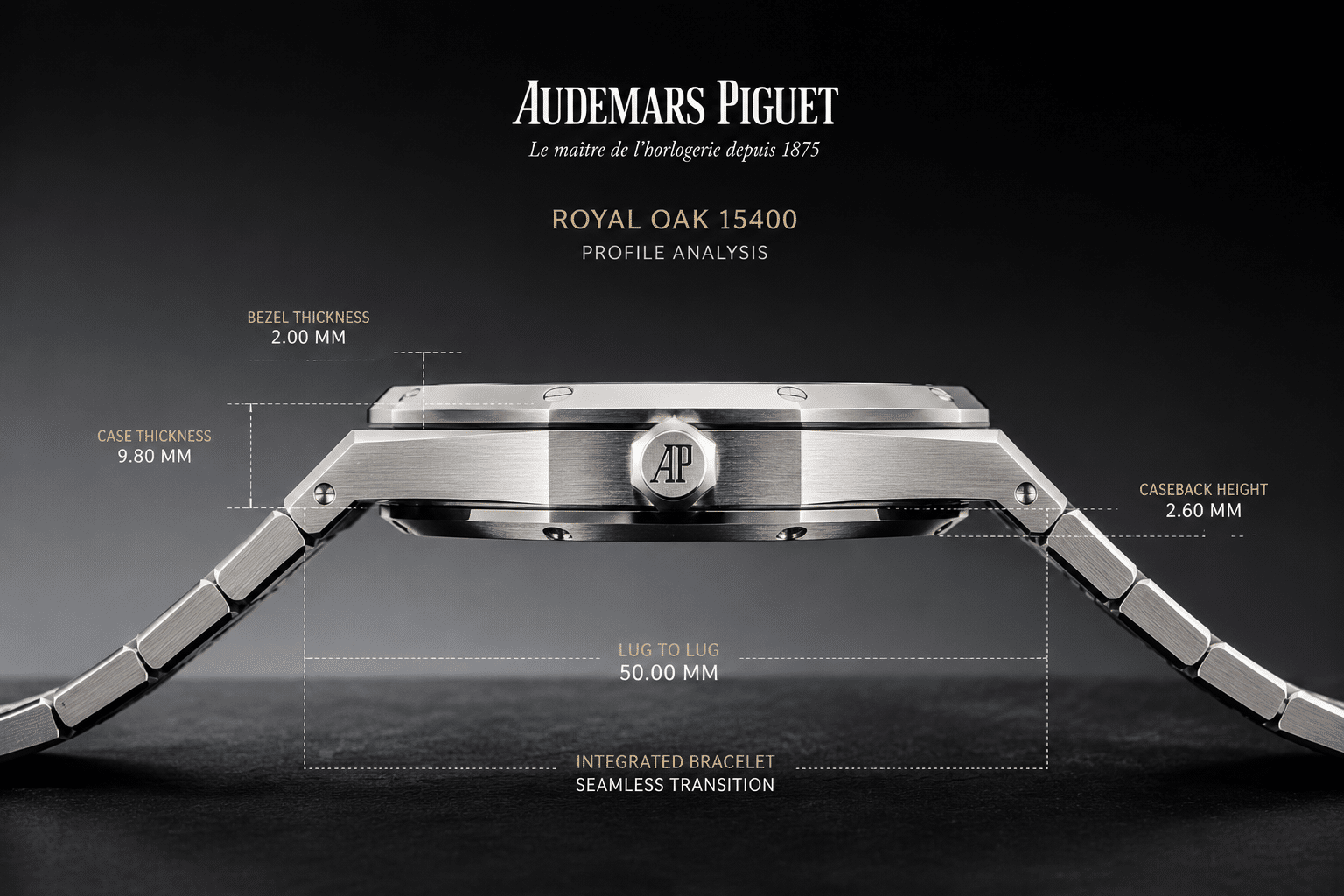
Balance-Wheel Position: The Small Detail That Exposed Older 15400 Builds
The balance wheel is a small oscillating component, but on a display-back Royal Oak 15400 replica it carries outsized importance. It tells the buyer whether the watch is built around a movement architecture that better resembles the 15400 layout, or whether a different movement has simply been covered with a decorative layer.
This is why 15400 balance wheel position became such a common point in movement discussions. Most casual buyers first notice the rotor or bridge engraving. More experienced buyers look for the escapement location because decoration can imitate the surface, but it cannot easily relocate the operating heart of the movement.
The practical value of this detail is not about turning buyers into authenticators. It is about version verification. If a watch is being described as using an AP clone 3120 balance wheel layout, the caseback should support that claim visually. If the visible oscillating balance sits in the wrong area, the buyer should pause before accepting the movement description.
Why Decorative Plates Could Not Move the Balance Wheel
A decorative plate can change what the top of a movement looks like. It can add bridge shapes, engraving, color, and a rotor that resembles the style of an AP caliber. What it cannot do is rewrite the underlying mechanical architecture.
The balance wheel is tied to the escapement and gear train. Its position is not a sticker, a rotor design, or a surface plate. If the base movement places the escapement in one area, a decorative plate may hide parts of the movement, but it does not truly move the balance to the correct reference position.
This is where older decorative-plate builds were structurally limited. From the front, the watch could look clean. From the back, the wrong balance position made the movement route obvious to anyone who knew what to look for. Even if the engraving looked attractive, the layout did not make mechanical sense for a convincing 15400-style presentation.
The key buyer lesson is that movement decoration and movement architecture are not the same thing. A better-looking plate can improve the first impression, but it cannot fully solve a wrong escapement location.
What a Better Clone 3120 Layout Improves
A better clone 3120-style layout improves the caseback because the visible parts are arranged in a way that better matches the design logic of the Royal Oak 15400. The balance position is closer to where buyers expect it to be, the movement fills the caseback more naturally, and the overall view looks less like a generic automatic movement wearing an AP costume.
This does not mean the movement is equal to a genuine AP caliber in finishing, tolerances, service network, or long-term durability. The improvement is narrower and more practical: the caseback becomes more credible as part of the watch’s architecture. For a model with an open back, that matters.
The best way to judge this improvement is not to stare only at engraving. Look at the whole caseback layout. Does the balance appear in the expected area? Does the rotor sit naturally over the bridges? Does the movement look centered and properly scaled for the case? These clues are more meaningful than bold claims printed in a sales description.
A clone 3120 route is most valuable for buyers who care about the Royal Oak as a complete object, not just a dial-side impression. If the buyer never looks at the caseback and only wants a front-facing style piece, this detail may feel less important. But for a 15400 super clone watch, balance-wheel position is one of the few details that directly exposes the movement route.
Photo Angles That Make This Detail Easier to Judge
Caseback photos should be clear, level, and taken under neutral lighting. Strong reflections can hide the balance wheel, and angled shots can make the layout harder to read. A single blurry caseback photo is not enough to confirm or reject a movement claim with confidence.
The most useful photo shows the entire caseback straight on, with the rotor not completely blocking the area where the balance should be visible. If the rotor covers the view, another image with the rotor in a different position can help. This is normal buyer-side verification, not a professional authentication process.
A close-up can also help, but only after the full layout is visible. Macro shots sometimes make engraving look impressive while hiding the broader architecture. For the 15400, the buyer should first understand where the balance wheel sits in the movement view, then judge decoration and finishing afterward.
Be cautious with photos taken at extreme angles, through glare, or with the rotor parked over key components. Those images may not prove anything either way. The sensible response is to request a clearer caseback view rather than assume the best from an incomplete photo set.
APSF, ZF, and the Clone 3120 Improvement: What Actually Changed
The modern APSF and ZF discussion around the Royal Oak 15400 is often reduced to factory preference, but that misses the real shift. The important change was not simply that one factory label became more popular. The change was that the clone 3120-style route gave the 15400 a movement architecture better suited to the watch’s case, display back, and proportions.
For the APSF 15400 clone 3120 and many current ZF Royal Oak 15400 movement discussions, the buyer should focus on what the movement route actually improves: side profile, balance-wheel position, caseback layout, and the way the movement fits the case. Those are model-specific improvements. They do not automatically make every AP replica from the same factory equally strong.
The practical verdict is that the clone 3120 era made the AP 15400 super clone category more credible, but it did not remove the need for version checking. Factory names are useful shorthand. They are not proof by themselves.
Factory names such as APSF, ZF, and other replica-market labels should be understood as buyer-facing references, not official Audemars Piguet affiliations or automatic proof of quality. They can help buyers narrow the search, but the actual judgment still depends on the specific reference, production version, movement configuration, case execution, bracelet finishing, and photos of the watch being considered. A factory comparison is most useful when it explains visible execution differences rather than treating the name as a universal ranking.
What the Clone 3120 Route Improved First
The first improvement was architectural. A better movement route allowed factories to reduce the compromises that came from fitting a non-matching movement into a Royal Oak 15400-style case. That affected the caseback view, the visible balance position, and the ability to keep the case profile closer to the reference shape.
This matters because the 15400 is not only judged from the dial. The open caseback and thin sports-luxury profile expose shortcuts. A movement that better fits the design lets the caseback look less improvised, the case sit flatter, and the overall package feel more coherent.
The second improvement was buyer confidence in the movement claim. With older decorated builds, the caseback often asked the buyer to ignore the underlying architecture. With a stronger clone 3120-style execution, the movement route and the watch design work more closely together. That does not make the watch perfect, but it removes some of the most obvious structural mismatches.
The third improvement is ownership feel, though this varies by unit. A movement that fits the case more naturally can reduce the sense that the watch is mechanically adapted rather than designed as a complete package. Rotor behavior, winding feel, and date operation can still differ between examples, but the starting point is more appropriate for this model.
Why Factory Name Alone Is Not Enough
APSF versus ZF 15400 comparisons are useful only if the exact version and movement route are known. A buyer should not assume that every watch carrying a factory name uses the newest or most desirable configuration. The replica market is version-driven, and batches can overlap in circulation longer than buyers expect.
A factory can be strong in one AP reference and less consistent in another. It can also update one part of a watch while leaving another area less refined. For the 15400, the correct question is not simply “APSF or ZF?” The better question is: which specific 15400 version, using which movement route, with what case profile and what caseback evidence?
This is where many buyers make the wrong decision. They pay for a name instead of confirming the watch. A label may suggest a better build, but QC photos should still support the claim. If the side profile looks thick, the caseback is unclear, or the balance position cannot be seen, the factory name has not done enough work.
From a technical perspective, the most useful review method is to check whether the movement layout, case thickness, and caseback shape agree with each other. If those three details conflict, the watch may be described as a higher version but still feel compromised in the areas that matter most for the 15400.
Where Modern Clone 3120 Builds Can Still Vary
Even among modern clone 3120-style builds, variation remains. Movement architecture may be improved, but finishing consistency, rotor sound, date alignment, dial fit, and bracelet execution can still differ from watch to watch. A good movement route is the foundation, not the entire building.
Rotor behavior is a good example. A better architecture does not guarantee a silent or refined rotor on every unit. Assembly quality, lubrication, rotor fit, and case acoustics can all affect how the watch sounds in daily wear. If a buyer expects genuine-level smoothness from the label alone, disappointment is possible.
Date behavior is another area to check. The movement claim may be correct while the date sits slightly high, low, or off-center in the window. On the 15400, the date window is close enough to the dial’s grid and markers that poor alignment can stand out. This is a separate QC issue from the movement route itself.
Case and bracelet finishing also remain batch-sensitive. The Royal Oak design depends on sharp brushing, polished bevels, and controlled transitions. A clone 3120 movement does not automatically produce clean case bevels or a well-articulated bracelet. Buyers should avoid treating the movement upgrade as a blanket guarantee across the whole watch.
Visual Accuracy Versus Daily Reliability
One important buyer distinction is visual accuracy versus daily reliability. The clone 3120-style route mainly improves the visual and structural logic of the 15400: the caseback layout, movement placement, balance position, and side profile can all become more convincing. That does not automatically mean the watch will be the lowest-risk daily wearer. A simpler closed-back replica with a common, easily serviced movement may be less visually impressive but easier to live with for some buyers.
This matters because Royal Oak replicas are often bought for the complete design experience, while daily wear exposes practical weaknesses. A watch that looks strong in caseback photos can still need careful handling if the rotor is noisy, the date change feels uneven, or the bracelet has sharp edges. For first-time buyers, the more useful question is not only “Which factory has the best 15400?” but “Do I care more about open-back accuracy, wrist comfort, serviceability, or low-maintenance daily use?” Different answers can lead to different sensible choices.
Version Details to Confirm
Before accepting a clone 3120 version claim, confirm the movement route in plain terms. The description should not rely only on vague language such as “AP movement” or “best version.” It should specify the clone 3120-style route clearly enough that the caseback photos can be compared against the claim.
The next details to confirm are side profile and case thickness. Exact numbers can vary by source and should be checked against current reliable references, but the visual test remains straightforward: the watch should not show an obviously raised caseback, swollen mid-case, or heavy side silhouette.
Caseback photos should show the movement layout, rotor position, bridge arrangement, and balance-wheel area. If the seller cannot provide a clear caseback view, the buyer is being asked to accept the movement claim without the most relevant evidence.
Date alignment should be reviewed after the movement route is confirmed. A stronger movement architecture does not excuse a visibly poor date position. The same applies to dial centering, marker alignment, bracelet transition, and clasp finishing. These are not the main subject of the clone 3120 discussion, but they still affect whether the final watch is worth choosing.
The safest approach is to treat APSF, ZF, or any other factory name as the beginning of the comparison, not the conclusion. For the Royal Oak 15400, the decision should be based on factory, version, movement route, case profile, and actual photos working together.
Display Caseback Realism: Why the 15400 Is Less Forgiving Than Many Replicas
The Royal Oak 15400 display caseback changes the standard for a replica watch because the movement is not hidden. On many closed-back Rolex-style replicas, the buyer can judge the watch mostly by case shape, dial, bezel, bracelet, and date alignment. The AP 15400 is different. The movement view is part of the watch’s character, so a weak movement route does not stay inside the case. It shows itself through the rotor, bridge layout, balance position, decoration depth, and how naturally the movement fills the back of the case.
This is why the AP 15400 movement view became such a serious issue in the replica market. A decorated Miyota-based build could look acceptable from the front, especially in seller photos, but the display back often revealed that the movement was being adapted to the watch rather than designed around it. A clone 3120-style route does not make the watch perfect, but it addresses the bigger visual problem: the caseback no longer looks like a generic automatic movement wearing AP-style decoration.
Rotor and Bridge Layout Matter More Than Engraving Alone
One of the most common buyer mistakes is focusing too much on rotor engraving. Clean text on the rotor can make a caseback photo look more convincing at first glance, but engraving is the easiest part to imitate. The harder part is whether the rotor shape, bridge layout, and visible movement architecture make sense as a complete AP 15400 movement view.
On older decorative-plate builds, the plates could cover parts of the base movement and create an AP-like surface pattern, but they could not fully change the mechanical geography underneath. The bridge layout could look flat or artificial, the rotor could sit over a movement that did not visually belong in the case, and the balance area could expose the wrong architecture. This is the difference between decoration and structure. Decoration can improve the photo; structure improves the watch’s believability as a Royal Oak 15400 super clone watch.
A stronger clone 3120 layout should be judged by the whole caseback composition, not one attractive detail. The rotor should not look like a stickered afterthought. The bridges should have coherent spacing. The balance-wheel area should support the movement claim. The finishing still will not equal a genuine AP caliber under close inspection, but the layout should at least feel purpose-built for the 15400 rather than patched together.
Depth, Layering, and Empty Space Around the Movement
Caseback realism is also about depth. Many buyers look for sharp text and gold-tone rotor color, but the more revealing question is whether the movement has believable layering. A convincing open caseback replica should show bridges, rotor, screws, and plates sitting with some visual depth, not as a single flat decorative cover.
This is where poorly matched movement architecture often looks strange even if the parts are neatly finished. If the movement sits too low, too small, or too visually isolated inside the case, the watch can develop an unnatural “movement in a display window” look. The empty space around the movement, the height of the rotor, and the way the bridges occupy the caseback all affect the impression. Buyers who only compare dial photos often miss this, but once seen, it is hard to ignore.
The caseback gasket and inner case ring also matter because they frame the movement. If the surrounding structure looks thick, crude, or disproportionate, it can make the entire AP 15400 movement view less convincing. This does not mean every buyer needs to obsess over macro finishing. The practical point is simpler: layout and fit matter more than a pretty rotor inscription.
What Caseback Photos Can and Cannot Prove
A clear caseback photo is useful, but it is not a complete judgment of the watch. It can help confirm whether the movement claim is plausible, whether the balance-wheel position appears consistent with a clone 3120-style route, and whether the bridge and rotor layout look appropriate for a Royal Oak 15400 display caseback. It can also expose obvious decorative-plate shortcuts or a movement that looks poorly fitted inside the case.
What a caseback photo cannot prove is equally important. It cannot tell you whether the rotor will be quiet on the wrist, whether the winding feel will be smooth, whether the date change will behave consistently, or whether the movement will remain stable over long-term daily wear. Photos can show visible architecture; they cannot guarantee mechanical health.
For buyers, the right judgment is to treat the caseback photo as a filter, not a final guarantee. If the layout looks wrong, the movement claim deserves skepticism. If the layout looks right, the watch still needs the usual checks for date alignment, dial fit, side profile, bracelet feel, and realistic ownership expectations. The display back solves one question only: does the visible movement route match what is being claimed?
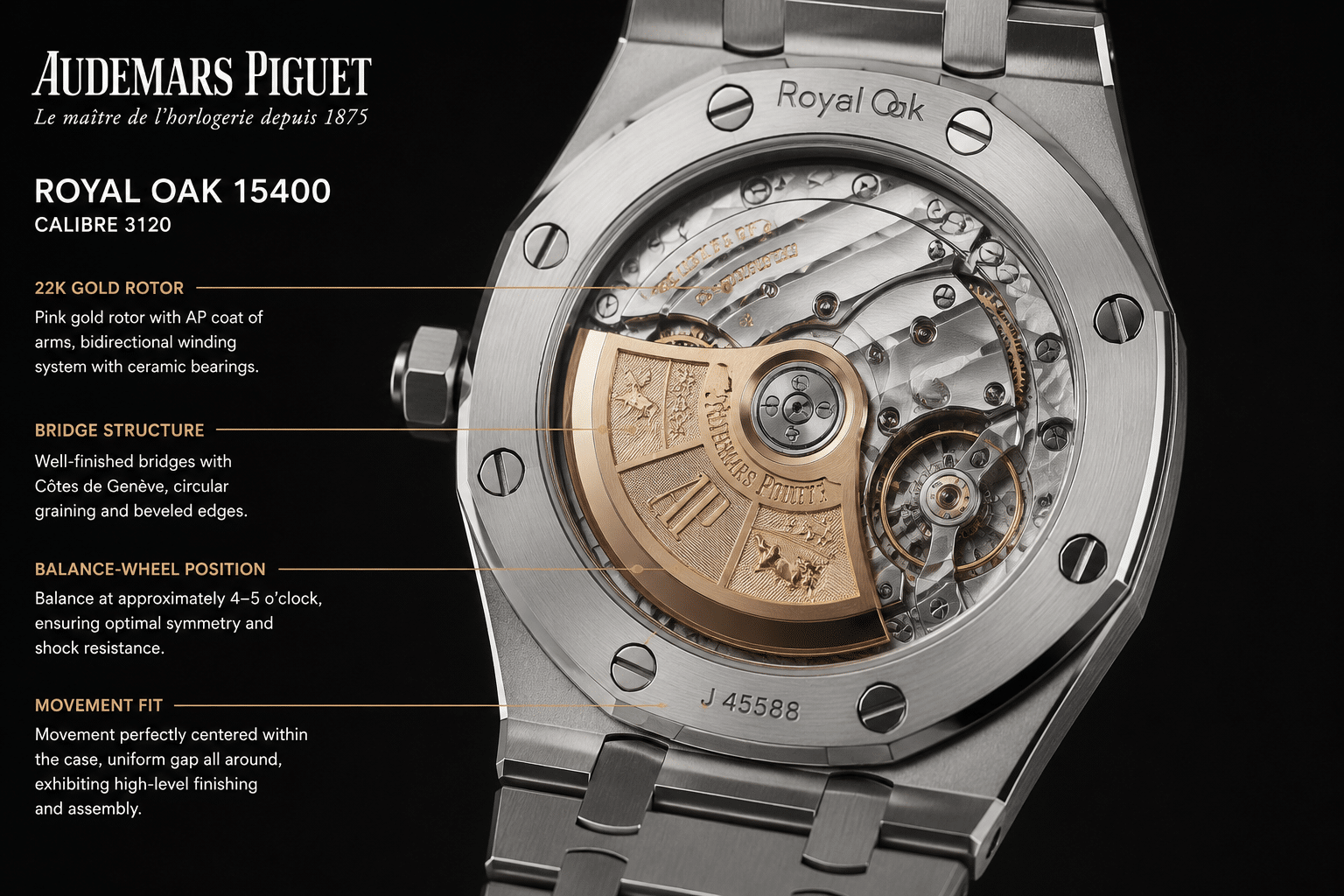
Rotor Sound, Date Behavior, and Daily-Wear Feel After the Movement Shift
The movement shift from decorated Miyota-style builds to clone 3120-style builds did not only change how the watch looked through the back. It also changed what buyers expected in daily use. A Royal Oak 15400 replica can photograph well and still feel less refined if the rotor is loud, the crown action feels rough, or the date behavior feels inconsistent. This is where movement route becomes an ownership issue, not just a visual accuracy issue.
The best way to think about clone 3120 daily wear is risk reduction, not perfection. A better-matched movement route can make the watch feel more integrated, but it does not remove the variability that comes with replica movements. Assembly, lubrication, case construction, and individual unit condition still matter.
Ownership expectations should stay realistic even when the visible architecture is strong. A replica watch can offer a more convincing Royal Oak-style presentation while still having limits in water resistance, long-term movement stability, servicing convenience, regulation consistency, and resistance to close inspection. The clone 3120-style route improves the model fit, but it should not be treated as evidence that the watch has the same durability, maintenance pathway, or factory testing standards as an authorized Audemars Piguet watch.
Why Miyota-Based Builds Often Felt Different
The Miyota 9015 is not a bad movement in a general sense. It is slim, widely used, relatively familiar to many repairers, and practical in many replica watch builds. The issue is that it was never architecturally ideal for the Royal Oak 15400. In use, many Miyota-based 15400 replicas were easy to identify not only by the caseback layout, but also by rotor behavior.
The common complaint was rotor noise. Because of the Miyota’s winding design and the way it behaves when the rotor spins freely, some units produced a noticeable whirring or spinning sound on the wrist. Not every watch was equally loud, and lubrication or assembly quality could change the experience, but the pattern was common enough that experienced buyers learned to associate noisy rotor behavior with older Miyota-based AP builds.
Winding feel could also be a clue. Some decorative-plate builds felt slightly disconnected: the crown action, rotor movement, and visible caseback all seemed like they came from different design priorities. The watch might look clean from the front, but in hand it could feel more like a generic automatic movement installed inside a Royal Oak-shaped case.
What Clone 3120 Builds May Improve in Use
A clone 3120-style build can improve the daily-wear impression because the movement is better matched to the 15400’s concept. Viewed through an Audemars Piguet replica movement guide, the movement sits more naturally in the case, the visible architecture is more coherent, and the watch generally feels less like a decorated adaptation. For buyers who care about the Royal Oak as a whole object, that matters.
Rotor sound may be better controlled on some clone 3120 builds, but this should not be treated as a guaranteed silent experience. Rotor noise can still vary by unit. A slightly dry movement, loose rotor bearing, rough assembly, or case resonance can make one example sound different from another example with the same broad movement claim.
Date behavior is another area where buyers should pay attention. A better movement route may support a more convincing overall package, but the date still needs to be checked for alignment, clean switching, and proper seating in the date window. A clone 3120 label does not automatically mean the datewheel is centered or that the date mechanism has been adjusted well.
Where Buyers Still Need Realistic Expectations
The practical judgment is this: the clone 3120 route is a meaningful upgrade for the AP 15400 replica, but it is still a replica movement. It should not be evaluated as if it carries the finishing standard, service network, or long-term quality control of a genuine AP caliber. The movement can be visually and structurally more appropriate without being risk-free.
Power reserve claims should also be treated carefully. Some versions may advertise figures close to the genuine movement’s behavior, but real-world performance can vary by batch and by individual watch. If daily reliability matters more to the buyer than display-back accuracy, then the movement claim should be paired with realistic expectations about servicing, careful use, and avoiding unnecessary abuse.
At Clean VS Factory, we usually separate appearance accuracy from ownership feel when discussing super clone watches. The 15400 is a good example: the clone 3120 route improves the watch’s technical credibility, but the buyer still needs to care about sound, crown feel, date operation, and the condition of the actual unit being offered.
Water Resistance and Durability Should Not Be Assumed
Movement-route improvements should not be confused with water-resistance proof. A Royal Oak 15400 replica may look better built, use a more convincing caseback layout, and still have unverified sealing. Display casebacks, crown gaskets, caseback gaskets, and case assembly quality all matter, and a seller’s model description does not replace pressure testing of the individual watch.
The safest buyer expectation is to treat water resistance as unknown unless the exact watch has been pressure-tested after purchase by someone competent to test it. Do not use authentic Royal Oak specifications as evidence for a replica’s water resistance, and do not assume that a clone 3120-style build is safer around water than a Miyota-based build. The movement route can improve visual architecture, but it does not prove gasket condition, case sealing, or pressure performance.
How to Judge a Royal Oak 15400 Clone 3120 Claim From QC Photos
A Royal Oak clone 3120 verification should begin with evidence, not the product title. Many listings use movement language loosely, and “clone 3120” can become a marketing shortcut if the buyer does not ask for the right photos. Good 15400 QC photos will not prove everything, but they can prevent one of the most common mistakes: paying for a modern movement-route claim while receiving an older or misdescribed build.
The review order matters. Start with the caseback and balance-wheel position, then move to the side profile, then review the dial, date, bracelet, and clasp. If the movement claim fails at the caseback stage, the rest of the watch may still be wearable, but it should not be priced or understood as a proper clone 3120-style Royal Oak 15400 replica.
QC photos reduce uncertainty, but they do not remove every risk. Buyers should review real photos of the actual watch where available, including dial printing, hand alignment, caseback layout, balance-wheel area, crown-side profile, datewheel centering, bracelet fit, clasp engraving, case thickness, and overall finishing. Factory labels, stock images, and movement names alone are not enough for a reliable judgment.
Start With the Caseback and Balance-Wheel Position
The first photo to request or review is a clear caseback photo under neutral lighting. It should show the rotor, bridge layout, balance-wheel area, and how the movement sits inside the case. A blurry caseback photo is not enough because glare and angle can hide the exact areas that matter most.
The balance-wheel position deserves early attention because it is one of the strongest architecture clues. Decorative plates can imitate surface details, but they cannot fully change the base movement’s mechanical layout. If the balance-wheel area does not match the clone 3120-style claim, the buyer should be cautious, even if the rotor engraving looks attractive.
This is not about using QC photos to pass a watch as something it is not. It is about making sure the replica watch being offered matches the version description. A buyer comparing APSF, ZF, or another AP 15400 super clone option should not accept the factory name alone as proof of the movement route.
Use Side Photos to Confirm the Case Profile
After the caseback, the side profile is the next practical check. A front-facing dial shot can make many 15400 replicas look convincing because it hides the caseback height, mid-case balance, and overall thickness. A neutral side photo reveals much more about how the movement has been integrated.
Look at the relationship between bezel, mid-case, caseback, and bracelet transition. The Royal Oak 15400 depends on a flat, architectural profile. If the watch looks too slab-sided or the caseback appears overly proud, the movement route or case construction may be less convincing than the listing suggests.
A side profile photo does not need to be artistic. In fact, straight, plain QC shots are usually more useful than dramatic angled photos. The goal is to see the watch honestly: how tall it looks, how the caseback sits, and whether the integrated bracelet flows naturally from the case.
Check Date Alignment and Dial Fit After the Movement Claim
Once the movement claim looks plausible, do not stop there. A better movement route does not automatically give you a clean date window or a well-fitted dial. The date should sit centered in the aperture, not high, low, or visibly tilted. Some slight variation exists across batches, but poor date alignment is easy to notice in daily wear because the date window is viewed constantly.
Dial fit also matters on the 15400 because the dial is large, open, and structured. Check whether the markers appear evenly placed, whether the logo and text are straight, and whether the tapisserie pattern sits cleanly relative to the chapter ring and date opening. A watch can have a credible clone 3120 movement and still disappoint if the dial execution is careless.
This is the point where buyers should avoid overvaluing one specification. The movement route is the centerpiece of this article, but it is not the only part of the watch. A strong movement claim with weak date alignment is still a compromised purchase.
Do Not Ignore Bracelet and Clasp Execution
The Royal Oak bracelet is not a minor accessory. It is part of the case design. Even when the movement claim is correct, poor bracelet finishing can make the watch feel cheaper than expected. Check the first-link transition, link articulation, brushing direction, polished bevels, clasp engraving, and whether the bracelet sits evenly against the case.
On the wrist, bracelet feel often matters more than small movement decoration flaws. A slightly imperfect bridge engraving may only bother a buyer during caseback inspection, but a stiff bracelet, sharp link edge, loose clasp, or uneven transition will be noticed every time the watch is worn. For daily wear, this is where some buyers misjudge value: they pay attention to the movement name and ignore the part that touches the wrist all day.
The clasp should close securely and feel reasonably clean in action. It does not need to feel identical to a genuine AP clasp, but it should not feel rough, vague, or poorly machined. The integrated bracelet is one of the reasons the Royal Oak is difficult to replicate well, so it deserves a final check before deciding.
Seller Language That Should Make Buyers Slow Down
Some listings rely on aggressive claims instead of useful evidence. Phrases such as “impossible to tell,” “passes inspection,” “same as genuine,” or “official factory version” should be treated carefully because they shift attention away from the actual watch. A strong replica-market version should be able to stand on specific details: movement route, caseback layout, balance-wheel position, side profile, date alignment, bracelet finishing, and real QC photos.
Buyers should also be cautious when a seller uses factory names as if they were official luxury-brand sources. APSF, ZF, and similar names are replica-market references, not Audemars Piguet-authorized production sources. The safer question is whether the claimed factory version matches the visible evidence. If the seller avoids caseback photos, changes the movement description, refuses to clarify the version, or relies only on stock images, the buyer does not have enough information to judge the claim confidently.
The safest use of movement and factory knowledge is to avoid overpaying or misunderstanding quality, not to create a story that the watch is genuine. A replica watch should remain clearly described as a replica watch in any personal, sale, or collection context.
Red Flags Before You Decide
- Missing or deliberately unclear caseback photos when the listing claims a clone 3120 movement.
- Caseback shots that show attractive rotor text but do not clearly show the bridge layout or balance-wheel area.
- Inconsistent factory or version descriptions, especially when the seller changes the movement wording during conversation.
- A visibly wrong balance-wheel position for the claimed movement route.
- A side profile that looks too thick, with an overly raised caseback or awkward mid-case proportion.
- Poor date alignment, especially if the date is obviously high, low, tilted, or crowded in the window.
- Dial markers, logo, or printed text that appear off-center despite an otherwise strong movement claim.
- Bracelet gaps, stiff articulation, rough finishing, or a clasp that looks poorly engraved or loosely fitted.
- Claims such as “perfect,” “same as genuine,” or “impossible to tell,” which usually signal sales pressure rather than careful version description.
The safest decision path is not to chase the most aggressive claim. It is to match the movement description with visible evidence: caseback layout first, balance-wheel position second, side profile third, then date, dial, bracelet, and clasp. If those photos support each other, the clone 3120 claim becomes more credible. If they conflict, the buyer should slow down before paying a premium for a name on a listing.
Verification Note: When possible, buyers should review real QC photos of the actual Royal Oak 15400 being offered, including the caseback, balance-wheel area, crown-side profile, date window, bracelet transition, clasp finishing, and movement description. Stock images, factory labels, and movement names alone are not enough for a careful judgment.
Price and Value Logic: When the Clone 3120 Premium Makes Sense
The AP 15400 replica price difference is not just a question of paying more for a more expensive movement name. The real question is whether the watch has moved from a movement adapted to fit the Royal Oak 15400 toward a movement route designed to support the 15400’s proportions, caseback view, and daily-wear behavior more convincingly. That is where clone 3120 value becomes meaningful.
For this model, the premium makes the most sense when the buyer cares about the whole watch, not only the dial photo. A cheaper 15400 replica can still look attractive straight on, especially if the dial color, bezel brushing, and bracelet shape are reasonably done. The problem is that the Royal Oak is not a flat-front watch in real use. The thin side profile, display caseback, and integrated bracelet flow all expose whether the movement route underneath is correct enough for the case design.
This is why a clone 3120-style premium should be judged as risk reduction, not perfection. You are usually paying for a more suitable architecture, better case fit, a more credible caseback layout, and a version update that addresses known Miyota-based limitations. You are not paying for a replica movement that equals AP’s genuine Caliber 3120 in finishing, factory service standards, or long-term durability assurance.
What the Premium Is Really Paying For
The most defensible reason to pay more for a clone 3120-style Royal Oak 15400 replica is architectural fit. Older Miyota 9015 decorative-plate builds often used a reliable and practical base movement, but it was still an adapted movement. Decoration could improve the surface impression, but it could not fully correct the underlying layout, the visual depth of the caseback, or the way the movement forced the case to be built around it.
With a better clone 3120 route, the value is tied to how the movement supports the watch around it. The side profile can be closer, the display-back layout can look less improvised, and the balance-wheel position is usually more credible for this reference. Those improvements matter more on the 15400 than they would on a closed-caseback replica watch, because the open caseback makes the movement part of the visual experience.
The non-obvious value point is that the premium is often paying for the case as much as the movement. If the movement allows the factory to build a thinner, better-proportioned mid-case and a cleaner caseback profile, the watch wears more like a Royal Oak and less like a generic automatic watch inside a Royal Oak-shaped shell. That affects wrist presence immediately, even for buyers who rarely study the movement through the back.
At Clean VS Factory, we usually treat this as a movement-route decision rather than a simple movement-upgrade decision. A clone 3120 label has value only if it results in better case accuracy, better movement placement, and better version consistency. If those supporting details are weak, the extra price is much harder to justify.
What Price May Reflect Besides the Movement
Price differences in AP 15400 replicas can reflect several things at once. A higher price may be connected to a more complex movement route, better case machining, improved bracelet finishing, smaller batch availability, seller margin, or the after-sale risk the seller is willing to absorb. It may also reflect market hype around a factory name or a “latest version” phrase. The buyer should not assume that every extra dollar is going directly into the movement.
The cleaner comparison is to match the price increase with buyer-verifiable evidence. If the seller asks clone 3120 money, the photos should show the reasons: the caseback layout should be clear, the side profile should look controlled, the balance-wheel position should support the claim, and the date and bracelet should not show avoidable QC problems. If those checks are missing, the price premium is difficult to evaluate, even if the listing sounds technically impressive.
Buyers should also separate price from seller policy assumptions. A higher price does not automatically prove better return terms, repair support, shipping handling, water-resistance testing, or after-sales help. Those terms should be confirmed separately before ordering, because they can vary by seller and by specific watch. The technical value of a clone 3120-style movement should be judged from the watch evidence, while service and transaction terms should be clarified directly rather than assumed from the model name or price level.
Prices can change by factory label, version, movement, seller channel, availability, and support terms, so exact comparisons should be verified at the time of purchase. A value judgment is strongest when it compares like-for-like details: the same reference, same factory version, same movement route, similar QC evidence, and clearly stated seller terms.
When a Cheaper Miyota-Based 15400 May Still Be Acceptable
A cheaper Miyota-based 15400 can still make sense for a narrow type of buyer: someone who mainly wants the Royal Oak look from the front, wears the watch casually, does not care much about the display caseback, and accepts that the movement architecture will not be reference-correct. That buyer is not necessarily making a bad decision; they are choosing a different tradeoff.
The mistake is buying a lower-priced Miyota decorative-plate version while expecting clone 3120-level caseback credibility and case profile. Those are different categories. If the seller presents an older movement route as equivalent to a modern clone 3120 build, the buyer is not getting a bargain; they are getting a misdescribed product.
A budget-focused buyer should be especially honest about how the watch will be used. If the caseback will never be shown, the buyer is not sensitive to rotor sound, and the side profile does not bother them, then saving money can be rational. But if the buyer already knows they will compare movement photos, case thickness, balance position, and version claims, the cheaper route will likely feel compromised after the first few days.
The safe way to think about it is simple: Miyota-based 15400 replicas are more defensible as front-facing style pieces. Clone 3120-style builds are more defensible for buyers who want the 15400 package to make sense from the front, side, and back.
Why Higher Price Still Needs QC Evidence
A higher price does not prove a clone 3120 movement route. It does not prove the exact factory batch, the case thickness, the date alignment, or the quality of bracelet finishing. In the replica watch market, price can reflect real technical development, but it can also reflect seller language, scarcity claims, old stock being relabeled, or a vague “latest version” description with no useful evidence behind it.
The minimum evidence should match the reason for the premium. If the premium is based on clone 3120 value, the buyer should see a clear caseback photo, a readable movement layout, a side-profile shot, and enough detail to judge whether the claimed version is consistent with the watch being offered. Without that, the price difference is just a claim.
QC consistency also matters because two watches described with the same factory and movement language can still differ in execution. One may have a cleaner date window, better bracelet transition, less obvious caseback height, or more controlled rotor behavior. Another may carry the right label but show sloppy alignment or poor finishing. The movement route raises the ceiling, but it does not automatically make every unit equally good.
The buyer should reject the idea that “more expensive” means “safer” by itself. The better logic is: higher price is justified when the version claim, movement layout, side profile, and visible finishing all support the premium. If those pieces do not line up, the cheaper watch may be more honest, or the better decision may be to wait for clearer QC evidence.
Evidence-Based Value Questions Before Paying More
Before paying a clone 3120 premium, reduce the decision to a few evidence-based questions. What visible problem is the premium solving? Does the caseback prove a more convincing layout, or does it simply show nicer decoration? Does the side profile look meaningfully better than the cheaper version? Does the date sit correctly? Does the seller provide enough photos to compare the actual unit, not only a sample watch?
This approach prevents two opposite mistakes. The first mistake is dismissing the clone 3120 route as “just marketing” when the movement architecture genuinely improves the caseback and side profile. The second mistake is believing the movement label without evidence. The better buyer position is in the middle: respect the technical advantage, but demand visible support from the watch being purchased.
The Practical Buyer Verdict on Clone 3120 Royal Oak 15400 Replicas
The clone 3120 buyer verdict is clear: for a Royal Oak 15400 replica buyer who cares about more than the front dial view, the clone 3120 route is a meaningful upgrade. It addresses the model’s most important movement-related weaknesses: incorrect architecture, less convincing caseback layout, compromised case thickness, and the visual mismatch created by decorative-plate movement builds.
That does not mean every clone 3120 Royal Oak 15400 is automatically the best Royal Oak 15400 replica movement choice for every buyer. It means the movement route is technically better suited to this reference. The final decision still depends on the factory version, QC review, case profile, date alignment, bracelet execution, and realistic ownership expectations.
The hierarchy matters. First, confirm the movement architecture. Second, judge the side profile and caseback height. Third, evaluate whether the caseback layout supports the clone 3120 claim. After that, look at daily-wear behavior and QC consistency. Buyers often reverse this order by focusing first on dial color or factory name, but on the 15400, the movement route is too central to treat as an afterthought.
Who Should Prioritize the Clone 3120 Route
The clone 3120 route should be prioritized by buyers who want a more complete 15400 replica experience. If caseback realism matters to you, if you care about the balance-wheel position, if you notice whether the case sits too thick on the wrist, or if you compare the watch from side angles rather than only straight-on photos, then the upgrade is not cosmetic. It changes the structure of the watch.
This route is also more sensible for buyers who expect the Royal Oak to feel like an integrated design. The 15400 is not forgiving when the case, bracelet, and movement feel disconnected. A better movement layout helps the case stay closer to the intended profile, which helps the bracelet transition look more natural. That is one reason modern clone 3120-style builds feel more mature than older decorative-plate versions, even before discussing small dial details.
Buyers who keep watches for daily use should also take the movement route seriously, but with restraint. Clone 3120 builds may offer a better ownership feel than many older Miyota-based versions, especially around movement fit and display-back credibility. Still, they remain replica movements with unit-to-unit variation, so they should not be judged as equivalent to genuine AP engineering or service support.
Who May Not Need to Pay for the Upgrade
Not every buyer needs to pay for the clone 3120 premium. If the watch will be worn mainly for the front-facing Royal Oak look, and the buyer is comfortable with a less accurate caseback and movement architecture, a cheaper Miyota-based version can be an understandable compromise. The key is knowing what is being sacrificed.
This buyer should not expect the watch to satisfy collection-level scrutiny. The display back will usually be the weakest area, the side profile may be less convincing, and rotor behavior may be more noticeable depending on the unit. Those tradeoffs are acceptable only if they are accepted upfront.
The worst purchase is not necessarily the cheaper version. The worst purchase is the buyer who pays a premium without checking evidence, or the buyer who buys a budget version while expecting modern super clone watch standards. Both mistakes come from the same misunderstanding: treating “Royal Oak 15400 replica” as one category when the movement route actually separates very different ownership experiences.
The Final Movement Claim Checklist
Before deciding whether a clone 3120 Royal Oak 15400 claim is worth paying for, use a simple movement claim checklist. The goal is not to overanalyze every screw under magnification. The goal is to confirm that the watch being offered supports the price and version description.
- Caseback layout: The movement view should look like a movement built for the 15400 layout, not a generic automatic movement hidden under decorative plates.
- Balance-wheel position: The visible balance location should be consistent with the claimed clone 3120-style architecture. A poor or unclear caseback photo is not enough evidence.
- Side thickness: Review a neutral side-profile photo. A 15400 that looks too tall from the side loses one of the main benefits of the better movement route.
- Caseback height: Look for whether the back appears naturally integrated or raised to accommodate an adapted movement and spacer arrangement.
- Rotor behavior: Photos cannot prove sound or winding feel, but movement route and assembly quality can affect daily-wear refinement. Do not assume silence or long-term smoothness.
- Date alignment: A better movement claim does not excuse a poor date window. Check centering, font impression, and whether the date sits naturally in the aperture.
- Version consistency: Factory name, movement claim, caseback view, and case profile should all tell the same story. If the description is vague or contradictory, treat the premium cautiously.
The practical verdict is that clone 3120 matters because the Royal Oak 15400 exposes movement shortcuts more than many replica watches. If you want the 15400 to be convincing as a complete object, not just as a dial photo, the clone 3120 route is the more rational choice. If you only want the basic front-facing style and accept the known compromises, a cheaper Miyota-based version can still serve that narrower purpose. The important decision is not simply whether the watch is expensive or inexpensive; it is whether the movement route matches your expectations for case accuracy, caseback realism, and daily wear.
CleanVSFactory’s Practical Boundary for This Topic
CleanVSFactory’s buyer-facing approach is to make replica watch comparison clearer by connecting factory names, movement claims, visible QC details, version differences, and realistic ownership limits. That means a clone 3120 discussion should remain technical and evidence-based: it can explain why architecture matters, but it should not turn a replica-market movement label into an official certification, a guarantee of long-term performance, or a claim of genuine Audemars Piguet equivalence.
For the Royal Oak 15400 specifically, the most useful buyer education is not about finding language that sounds impressive. It is about checking whether the claimed movement route produces visible improvements in the actual watch: a more credible caseback layout, a better balance-wheel position, a controlled side profile, and fewer obvious signs of a decorated base movement. If those details are not visible, the responsible conclusion is uncertainty, not automatic trust.
Brand names and reference numbers in this article are used for identification and comparison only. Replica watches are not genuine products from the original luxury brands and should not be represented, resold, or used as authentic watches. Factory names are useful market references, but they do not guarantee identical quality across every model or version.
Disclosure: This article is for general educational and comparison purposes only. Replica watches are not genuine products from the original luxury brands, and brand names are used only to identify reference designs or comparison topics. Factory names, movement descriptions, prices, availability, QC details, seller policies, and version information can change, so readers should verify important details with the seller before making a purchase decision. Replica watches should not be represented, resold, or used as genuine watches.