
An AP clone movement can look fine from the outside and still be a poor service candidate. This article focuses on the practical question many buyers face in an AP clone 3120 movement assessment after receiving or wearing an AP replica: should the movement be monitored, serviced, or avoided before more money is spent? The key issue is not whether the watch is currently running, but whether its behavior shows a stable baseline or deeper mechanical risk.
Because AP-style replicas often use thin cases, display backs, decorative plates, and added complications, small assembly problems can become more serious than they would in simpler watches. The article helps separate normal watch-to-watch variation from warning signs such as scraping, repeated stopping, rough quickset action, unstable power reserve, or unreliable chronograph behavior. The goal is to judge when cleaning, lubrication, and regulation are reasonable—and when repair may become unpredictable or uneconomical.
Replica watches should be clearly understood as replica-market products, not genuine watches from the original luxury brands. In this article, Audemars Piguet and AP references are used to identify the genuine reference designs that replica-market watches attempt to visually interpret; they do not imply authorization, endorsement, official production, or service compatibility with the original luxury brand.
| Movement Behavior | Likely Judgment | Buyer Action |
|---|---|---|
| Starts easily, winds smoothly, runs overnight | Stable baseline | Monitor first before paying for service |
| Consistent time gain or loss | Possible regulation issue | Service may be worthwhile if other signs are healthy |
| Dry feel, mild rotor noise, minor winding inefficiency | Potential lubrication or cleanliness issue | Consider cleaning and lubrication if symptoms persist |
| Scraping, grinding, rough quickset, loose rotor | Mechanical red flag | Avoid assuming simple service will solve it |
| Stops after full wind or has unstable power reserve | Unreliable running condition | Inspect carefully before spending on repairs |
| Chronograph reset failure, hand creep, stiff pushers | Higher servicing risk | Be cautious; repair may not be economical |
Quick Questions Before You Read
Q: If an AP clone movement is running, does that mean it is healthy?
No. A running movement still needs to be judged by winding feel, power reserve, timing consistency, rotor behavior, and complication function.
Q: When is servicing usually worth considering?
Service is more reasonable when the movement has a stable baseline and shows fixable issues such as dryness, dirt, weak lubrication, or poor regulation.
Q: What signs suggest the watch should be avoided or returned instead?
Repeated stopping, scraping, grinding, severe date problems, loose rotor behavior, or visible interference are stronger warning signs.
Q: Are AP chronograph clone movements riskier to repair?
Often yes. Reset failure, stiff pushers, hand creep, or unstable subdials can make servicing less predictable and less cost-effective.
The Real Question: Is the AP Clone Movement Healthy, Serviceable, or Not Worth Chasing?
The useful question is not simply, “Does the watch run?” A weak AP clone movement can tick on the table and still be a poor long-term ownership bet. The better question is whether the movement is healthy enough to monitor, flawed but serviceable, or showing signs that make further spending hard to justify.
AP clone movement service makes sense when the basic movement architecture is sound but the execution is imperfect: light misregulation, dry lubrication, minor dirt from assembly, or a winding system that needs attention. Service becomes questionable when the problem points to deeper instability, such as repeated failures, severe interference, erratic stopping, or a complication that does not behave predictably. A watchmaker can improve a decent movement. They cannot always turn a bad movement route into a dependable daily watch.
This is where replica AP movement reliability is often misunderstood. Buyers see a Royal Oak-style case with sharp brushing, a good dial, and a decorated caseback, then assume the movement must be on the same level as the exterior. That is not always true. With AP replicas, especially models built around slim profiles or display backs, the movement can be the hidden risk that only appears after days or weeks of wear.
Editorial Perspective: For AP replicas, cleanvsfactory.com treats movement evaluation as a model-specific ownership question rather than a simple factory ranking. A respected factory label, attractive QC photos, or a higher price can help narrow the shortlist, but none of those proves that the exact unit has a stable movement. The more useful check is whether the movement route fits the case thickness, whether the rotor and calendar work without interference, whether the watch behaves consistently after winding and wearing, and whether the buyer wants a photo-focused piece or a daily-wear watch. This distinction matters because visual accuracy, decorative movement plates, and real mechanical serviceability are related signals, not the same proof.
Factory names in the replica watch market are useful buyer-facing references, but they should not be treated as official luxury-brand affiliations or automatic guarantees of quality across every model. For an AP-style replica, the factory label can help identify a general production route, but the more traceable judgment comes from the specific reference, version, movement configuration, visible finishing, and behavior of the exact unit being offered.
For a careful buyer, the decision also depends on intended use. A watch that will be worn occasionally for appearance may tolerate mild rotor sound or less-than-perfect regulation better than a watch expected to be a daily office or travel piece. A first-time buyer should usually be more cautious with thin AP cases, open backs, and chronograph layouts because these designs leave fewer places for a factory to hide compromises. A more experienced buyer may accept a known tradeoff if the model’s exterior execution is unusually strong, but that should still be a conscious choice rather than a reaction to seller photos or a factory name.
Running Is Not the Same as Reliable
A movement that starts after a few winds has only passed the most basic test. “Runs” means the balance is moving and the gear train is alive. “Runs accurately” means the watch keeps time within a predictable range. “Runs reliably” means it starts, winds, sets, changes functions properly, holds power in a stable way, and does not produce signs of friction or interference.
Those are different standards. A clone movement can run while having dry pivots, weak amplitude, poor regulation, debris under the dial side, or a winding system that is not transferring energy efficiently. None of those issues may be obvious in a short QC video. They become ownership problems when the watch loses power too quickly, drifts unpredictably, feels rough at the crown, or starts behaving differently from one day to the next.
The mistake is treating every running movement as healthy. The opposite mistake is servicing every AP replica immediately out of fear. Neither approach is sensible. If the movement winds smoothly, sets cleanly, keeps stable time, and shows no worsening symptoms, monitoring it first can be more rational than opening the watch right away.
A useful buyer test is to separate a momentary proof from a pattern. A short video can show the second hand moving, the date changing, or the chronograph starting, but it rarely proves power reserve, rotor efficiency, positional stability, or repeated reset behavior. Those ownership patterns only appear after the watch has been wound, worn, left overnight, and operated several times under ordinary conditions. This is why QC material should be treated as a starting signal, not a final mechanical verdict.
The Three Ownership Categories
For practical ownership, most AP clone movements fall into three categories.
- Normal behavior to monitor: The watch runs consistently, winds without harsh resistance, sets correctly, and shows only mild variation or ordinary automatic movement sound. This does not automatically require service.
- Serviceable movement problems: The movement works, but signs suggest poor factory preparation: dryness, dirt, weak regulation, reduced but predictable power reserve, or light winding inefficiency. These are the situations where service may improve the ownership experience.
- Red flag movement problems: The watch shows severe or repeating symptoms, such as erratic stopping, obvious mechanical interference, a complication that will not reset or operate correctly, or behavior that changes unpredictably. In this category, the real question is not “should I service my AP replica?” but “is this movement worth fixing at all?”
This classification matters because service money is not the same as purchase money. Once a buyer starts chasing a bad movement, the emotional logic changes. The watch already looks good, so it feels tempting to keep investing. But if the movement has a poor baseline, each repair attempt may only delay the same issue rather than solve it.
The same categories also help compare models from different factories without turning the discussion into a vague “best factory” argument. One factory may have a stronger case and bracelet on a particular AP model, while another may use a movement route that is easier to live with. A buyer who values wrist appearance for occasional wear may rank those tradeoffs differently from a buyer who wants predictable daily reliability. The category of the exact movement in the exact watch should guide the decision more than the broad reputation of the name printed in a listing.
The Practical First Rule
Service can protect and improve a decent AP clone movement, especially if the issue is lubrication, cleanliness, or regulation. It cannot reliably rescue a badly assembled movement, a weak complication layout, or a movement route that was never a good match for the watch. Before spending more, decide which category the movement belongs to. That decision is more important than the factory name on the listing.
Why AP Replica Movements Are More Complicated Than They Look
AP replica movement ownership is more sensitive than many buyers expect because the Royal Oak design does not give factories much room to hide mechanical compromise. A simple three-hand Rolex-style replica can often use a proven movement in a relatively forgiving case. An Audemars Piguet clone movement has to support a thin case profile, a display back, decorative finishing, correct hand height, date placement, and sometimes complications. That combination raises the service risk.
The outside of an AP replica can be very convincing in photos. The inside may be a different story. Some watches use a more integrated clone caliber designed to fit the model more naturally. Others use a base movement with decorative plates or modified layouts to imitate the appearance of an AP movement. Some complicated models add even more mechanical stress through chronograph functions or module-style construction. Those choices affect thickness, reliability, serviceability, and how much a watchmaker can realistically improve.
At CleanVSFactory, we tend to separate visual satisfaction from ownership risk when evaluating AP-style replicas. A strong case and bracelet do not automatically mean the movement is low-risk. The movement route has to make sense for the case design, or the watch can look impressive but become frustrating in daily use.
This separation is especially important because AP watches are design-sensitive. Case thickness, bracelet integration, bezel geometry, and dial texture create much of the appeal. A factory can improve those visible details while still using a movement that is noisier, less efficient, harder to service, or less consistent between batches. The result can be a replica that photographs well but asks more from the owner in daily wear than a simpler model would.
Visual Accuracy Can Hide Mechanical Risk
A clean tapisserie dial, aligned bezel screws, and a well-finished bracelet tell you something about external execution. They do not prove movement health. The movement may still be dry, dirty, poorly regulated, or assembled with tolerances that only show problems under real wear.
This is one reason AP clones can disappoint buyers who judge only from front-facing QC photos. The Royal Oak is a visual watch, so it is easy to focus on bezel brushing, dial color, and bracelet fit. Those matter, but they do not answer whether the rotor clears properly, whether the winding system is efficient, whether the date mechanism is clean, or whether the movement is stable after being worn for a full day.
The non-obvious point is that some of the prettiest AP replicas carry more hidden movement risk than plainer models. Open backs and decorated bridges can create confidence, but decoration is not the same as mechanical preparation. A polished rotor and AP-style bridge engraving do not tell you whether the pivots are properly lubricated.
Seller photos can also hide the difference between a movement that looks appropriate and a movement that behaves appropriately. A display back photo may show decorative plates, rotor engraving, jewel color, and bridge layout, but it will not show whether the automatic works are dragging or whether the calendar has clean engagement under the dial. A buyer should treat movement decoration as a visual feature first. Mechanical condition still has to be inferred from behavior, inspection, and known model history.
Thin Cases and Complications Reduce the Margin for Error
AP design language depends heavily on proportion. A Royal Oak that is too thick loses part of the look, so factories often push movement construction to fit a slim case profile. That makes assembly quality more important. Rotor clearance, dial-side height, hand stack, datewheel position, and caseback spacing all have less margin for error.
Complications make the situation stricter. A simple time-and-date movement has fewer interacting parts. A chronograph-style AP clone adds pushers, levers, reset behavior, subdial hands, and more points where friction or poor adjustment can appear. Even if the watch runs as a timekeeper, the complication may not be stable enough to deserve expensive troubleshooting.
This is why an AP clone watch service risk should be judged by the whole architecture, not just the symptom. A dry time-and-date movement may be a sensible service candidate. A thick chronograph with stiff pushers and unreliable reset behavior may be a poor candidate even if it technically still runs.
For beginners, this is one of the strongest reasons to avoid making a complicated AP clone the first serious purchase unless the specific model has a known stable track record. A simpler three-hand or time-and-date model gives the buyer fewer moving systems to evaluate and fewer failure points to fund later. That does not make simple models flawless, but it makes their problems easier to classify and often easier to correct.
Movement Route Matters More Than the Factory Name Alone
Factory reputation helps, but it is not the whole decision. The same factory can release a strong-looking AP case with a movement route that varies by model, version, or batch. A buyer asking about Royal Oak clone reliability should ask a more specific question: what movement is inside this exact watch, how is it adapted to the case, and what symptoms is it showing?
In plain terms, there are several routes. A watch may use a relatively standard base movement, a base movement with decorative plates, a more integrated clone caliber, or a complication layout that is harder to service. Each route changes the ownership calculation. Base movements may be easier to replace or regulate, but they can create thickness or rotor-noise compromises. Integrated clones may look and fit better, but parts availability and assembly consistency can still vary. Complicated movements can be visually exciting, but they deserve a stricter standard before service money is spent.
The practical judgment is simple: do not approve or service an AP replica based only on the factory label. Judge the actual movement route and the behavior of the specific unit. A serviceable movement is one with a stable baseline. A red flag movement is one where the architecture or assembly keeps fighting the watch.
Movement Transparency Note: Movement references in this article describe replica-market movement routes, decorations, adaptations, and service behavior. They should not be read as claims of an official Audemars Piguet caliber, authorized brand service standard, or guaranteed long-term reliability. Buyers should judge the exact watch by visible QC details, running behavior, movement configuration, and realistic parts availability.
Movement trust in the replica market depends on understanding what the movement claim actually describes: architecture, decoration, layout, reliability, or simply a market name used by sellers. A clone movement, a decorated base movement, and a modified movement can look similar through a display back while having different parts access, different winding behavior, and different service risk. That distinction matters more than whether the listing uses an impressive movement name.
Price should be interpreted in the same careful way. A higher price may reflect a better movement, a more difficult case, stronger bracelet finishing, limited availability, seller margin, after-sale risk, or current hype around a factory version. It does not automatically prove that the movement inside the watch is better prepared. When two AP replicas differ in price, the useful comparison is not just “which one costs more,” but whether the added cost buys a more suitable movement route, a better case profile, cleaner dial-side execution, or simply a more popular factory label.
How to Read AP-Style Caliber Claims in the Replica Market
AP-style replica listings may use movement names that sound close to genuine Audemars Piguet calibers, but those names should be read as replica-market descriptions rather than proof of an official brand-manufactured movement. In many cases, the name may refer to a clone architecture, a decorated movement, a modified Asian movement, a rotor design, a bridge layout, or seller terminology. It should not be interpreted as an authentic AP caliber, a brand-approved component, or a movement that can be serviced through official Audemars Piguet channels.
A safer way to evaluate the claim is to ask what the movement actually does for this specific watch. Does it keep the case thin enough? Does the date sit correctly in the window? Does the rotor clear the caseback? Are the hands at a stable height? Is the crown action clean? Is the chronograph module, if present, repeatable? These practical questions are more useful than relying on a movement label alone. The purpose of movement information is to understand serviceability and ownership risk, not to suggest that a replica watch is genuine or equivalent to the original luxury watch.

Normal AP Clone Movement Behavior That Does Not Always Require Service
Not every imperfection means an AP clone movement needs service. A replica movement does not become defective simply because it is not silent, not regulated to luxury-watch standards, or not as refined as the genuine Audemars Piguet movement. The important test is stability. If the behavior is mild, predictable, and not getting worse, monitoring is often smarter than rushing into service.
This is especially true during the first few days of AP replica daily wear. A mechanical watch may settle slightly as the mainspring cycles, the rotor winds through normal wrist motion, and the owner learns how the crown, date, and power reserve behave. The goal is not to pretend every clone movement is perfect. The goal is to avoid spending service money on behavior that is normal for the movement route and not affecting actual use.
Normal behavior should still be documented. A buyer can note the starting time after a full wind, whether the watch survives overnight, how the crown feels, and whether rotor sound changes during ordinary wear. These notes do not need to be complicated, but they help separate a real change from anxiety after reading too many forum comments. A stable watch with mild quirks is a different ownership case from a watch whose symptoms become worse each day.
Mild Rotor Noise Without Scraping
Some rotor sound is normal clone movement behavior, especially in movements known for freer rotor spin or less refined winding feel. A light whir, soft spin, or occasional audible rotor movement does not automatically mean the movement is damaged. Many buyers overreact because they compare the sound to a genuine AP or to a quieter replica with a different movement architecture.
The distinction is sound quality. A mild rotor noise is usually smooth and rotational. It may be noticeable in a quiet room but does not feel like parts are touching the caseback. Scraping or grinding is different. That suggests interference, poor clearance, loose hardware, or metal-on-metal contact. Mild sound can be monitored. Contact noise should not be normalized.
A practical test is consistency. If the rotor sounds the same over several days and the watch winds, runs, and holds power normally, visual checks of display caseback movements should remain secondary to functional behavior, so it is usually a monitor-first situation. If the noise becomes sharper, rougher, or appears with reduced power reserve, the category changes.
It is also worth comparing rotor sound to the movement type rather than to an unrelated watch. Some base movements are naturally louder than others, and thin AP-style cases can transmit sound more clearly through the caseback and bracelet. The concern is not whether the rotor can be heard at all. The concern is whether the sound suggests rubbing, looseness, or an efficiency problem that affects winding and reserve.
Small Timekeeping Variation That Stays Consistent
Acceptable timekeeping for a clone movement depends on the movement route, condition, and wearing pattern, so fixed numbers can be misleading. A watch that gains or loses a modest amount every day in the same direction may simply need regulation if the owner wants tighter performance. That is not the same as a movement that gains one day, loses heavily the next, then stops overnight.
Stable deviation is easier to understand. It means the movement has a predictable rhythm, even if it is not ideally regulated. Unstable timing can point toward weak amplitude, friction, poor lubrication, magnetism, impact damage, or inconsistent winding. The first may be a minor ownership annoyance. The second deserves more caution.
For most owners, the key question is whether the watch behaves the same way under similar use. If it runs all day, survives overnight, and shows repeatable timing behavior, monitoring is reasonable before paying for AP clone movement service.
When comparing timing, the wearing pattern matters. A desk-heavy day may wind the watch less than an active day, and a watch left dial-up overnight may behave differently from one left crown-up or crown-down. A buyer does not need professional timing equipment to notice whether the watch is broadly consistent. The useful question is whether the timing error follows a pattern that can be explained, not whether the watch matches a luxury chronometer standard.
Light Winding Resistance Versus Rough Winding
A mechanical crown should not feel like a quartz watch button. Some resistance is normal because the crown is engaging gears and tensioning the mainspring. On AP-style replicas with screw-down crowns or compact case construction, the tactile feel can also be less silky than buyers expect from photos.
Light resistance is acceptable when it feels even and controlled. The crown should turn without slipping, crunching, or sudden hard spots. A slightly firm wind that remains consistent is usually not a service emergency. A gritty, grinding, or uneven wind is different because it can indicate dirt, poor gear engagement, crown-stem issues, or excessive friction in the winding train.
The buyer mistake is describing all resistance as “rough.” The better judgment is whether the resistance is mechanical or unhealthy. Mechanical resistance feels smooth under load. Unhealthy resistance feels abrasive, inconsistent, or worsening.
Crown feel also has to be judged without forcing the mechanism. If a screw-down crown is not aligned cleanly, the owner may mistake thread engagement for movement resistance. If the stem position is not fully seated, the owner may mistake a keyless works issue for normal winding load. Slow, gentle operation gives better information than repeated force. A replica AP movement should not be treated roughly in an attempt to “break it in.”
What to Monitor for the First Week
For the first week, treat the watch like a baseline test rather than a finished verdict. Check whether it starts normally after winding, whether the crown action remains smooth, whether it runs through the night, whether the power reserve feels consistent, and whether any sound becomes sharper or more frequent. If the watch has a date, observe whether the date changes cleanly under normal use without forcing anything.
If the movement remains stable, immediate service may not be necessary. If the behavior worsens or new symptoms appear, the question changes from “does my AP replica need service?” to “is this a predictable serviceable issue or an early warning sign?” That separation prevents both over-servicing a normal watch and ignoring a movement that is beginning to fail.
A simple first-week routine can be more useful than a single dramatic test. Fully wind the watch once, wear it normally, note whether it runs through the night, and avoid operating the date during the danger period around the date change. If it is a chronograph, test the start, stop, and reset sparingly and consistently rather than pressing the pushers repeatedly. The aim is to learn the baseline without adding unnecessary stress.
Serviceable Problems: When a Movement Cleaning, Lubrication, or Regulation May Help
The most sensible reason to service an AP clone movement is not panic. It is a watch that basically works but shows signs that the factory preparation was not clean, lubricated, or adjusted well enough for comfortable ownership. This is the middle category many buyers misunderstand. The movement is not healthy enough to ignore, but it is not obviously ruined either.
A useful clone movement service can address friction, dirt, dry pivots, weak regulation, and sometimes inefficient winding. It cannot rewrite the movement architecture. If the base design is sound and the symptoms are predictable, service may turn a frustrating AP replica into a much more stable daily watch. If the movement route is inherently compromised, or the fault pattern is chaotic, service becomes less attractive.
This is where buyers need to separate “the watch runs” from “the movement is worth improving.” A dry movement may still tick. A dirty movement may still pass a quick QC video. A poorly regulated movement may look fine in photos. The question is whether the fault points to poor preparation or deeper mechanical weakness. Cleaning and lubrication help the first problem much more than the second.
Before approving service, it is useful to ask what the service is supposed to solve. “Make it better” is too vague. “Clean and lubricate because winding feels dry and reserve is predictably weak” is a clearer reason. “Regulate after confirming the movement is otherwise stable” is also a clearer reason. The more specific the problem, the easier it is to decide whether service is sensible or whether the buyer is simply trying to rescue a watch that should have been rejected earlier.
Dry or Dirty Movement From the Factory
Some AP replica movements leave the factory with too little lubrication, excess assembly debris, or inconsistent cleanliness around the gear train, winding system, or automatic works. This is not unique to AP, but AP-style replicas make the problem more expensive to ignore because many models use decorated bridges, tighter case clearances, and movement layouts designed partly around appearance.
A dry movement often feels slightly strained rather than dramatically broken. The watch may wind with more resistance than expected, show weaker amplitude, lose stability across positions, or run acceptably for a short period before the power reserve starts to disappoint. A dirty movement can create similar symptoms because microscopic debris increases drag. The movement is working, but it is working harder than it should.
This is one of the few situations where AP clone movement service can be genuinely rational. A proper cleaning and lubrication may reduce friction, smooth out the winding feel, improve amplitude, and make regulation more meaningful. The key word is may. Some clone movements have parts tolerances that limit how much a watchmaker can improve them. Service is a way to improve a decent movement, not a guarantee that the watch becomes genuine-grade in durability or feel.
At CleanVSFactory, we usually treat a dry-but-stable movement differently from a movement that is already showing severe failure signs. Dryness is a condition. Grinding, repeated stoppage, and damaged parts are risk categories. Buyers lose money when they treat those two situations as the same.
A careful buyer should also consider whether the movement is commonly serviceable in the local market. Some watchmakers are comfortable cleaning and regulating familiar base movements but may refuse decorated clone calibers, thin modified layouts, or complicated chronograph systems. If parts are difficult to source, even a simple damaged wheel or setting component can turn a normal service into a longer repair. Serviceability is not only about whether a movement can be opened; it is about whether the fault can be corrected without creating a parts hunt.
Weak but Predictable Power Reserve
A poor power reserve AP clone does not always mean the movement is dying. If the watch runs reliably but stops earlier than expected after a full wind or a normal day of wear, the issue may be winding efficiency, friction, lubrication, or mainspring performance. The important word is predictable. A movement that consistently runs short but behaves the same way every time is easier to evaluate than one that stops randomly at different intervals.
For example, if an AP replica movement is advertised with a long reserve but regularly performs much lower in real use, the owner should not immediately assume fraud or catastrophic failure. Clone movements often vary from unit to unit, and advertised reserve claims can be optimistic. What matters for service logic is whether the watch winds normally, starts easily, runs overnight, and shows a consistent pattern.
Cleaning and lubrication may help if friction is draining the reserve or if the automatic winding system is not transferring energy efficiently. Inspection of the rotor, reversing wheels, winding gears, and mainspring barrel can reveal whether the movement is simply inefficient or whether parts are worn, loose, or poorly fitted. The former is a serviceable problem. The latter can become a parts-availability problem.
The mistake is paying for service because the number on paper disappointed you. Service makes more sense when the watch’s actual behavior suggests mechanical drag or weak winding, not merely because the reserve does not match a seller’s claim. A clone movement with a stable, usable reserve may be better left alone than opened unnecessarily.
Power reserve claims in listings should be treated as approximate, not as a promise of identical performance from every unit. A listed reserve may be based on the movement family, a factory claim, or a best-case measurement under ideal conditions. Real wrist use depends on rotor efficiency, wearer activity, lubrication, and how fully the watch was wound at the start. A buyer should judge the watch against usable ownership needs first: does it survive normal wear and overnight rest in a repeatable way?
Timekeeping That Is Poor but Stable
AP replica movement regulation is most useful when the timing error is consistent. A watch that gains or loses time in a predictable way may simply need adjustment after cleaning, lubrication, or basic regulation. This is different from a movement that gains heavily one day, loses heavily the next, stops overnight, and changes behavior depending on nothing obvious. Stable inaccuracy is often more serviceable than unstable accuracy.
A poorly regulated movement can still be mechanically sound. Factory regulation is not always careful, especially on replica watches where appearance, batch output, and assembly speed may receive more attention than long-term timing performance. If the watch winds smoothly, changes date correctly, maintains a usable reserve, and shows a repeatable timing pattern, regulation may be a reasonable investment.
Buyers should be careful with timegrapher numbers, though. A single reading can show rate, amplitude, and beat error at one moment and one position, but it does not prove long-term movement health. A movement that looks acceptable on a timegrapher but loses reserve quickly may still need cleaning. A movement that looks poor on one reading but behaves consistently on the wrist may be easier to improve than the numbers first suggest.
The practical judgment is simple: poor but stable timing is often worth discussing with a watchmaker; random timing behavior is a warning that regulation alone may not solve the problem. Do not pay for “just regulation” if the underlying movement is dry, dirty, or mechanically inconsistent. Regulation works best after the movement is physically healthy enough to be regulated.
It is also worth remembering that a timegrapher result can be presented selectively in seller communication. One position, one brief reading, and one healthy-looking amplitude number do not cover every ownership condition. A buyer should not ignore timegrapher data, but should place it beside winding feel, power reserve, rotor behavior, and date or chronograph function. The most convincing evidence is a consistent pattern across several checks, not one impressive screenshot.
Service Makes Sense When the Baseline Is Stable
The best candidates for clone movement service are not the worst-running watches. They are the watches with a stable baseline: they start normally, wind without harsh grinding, run overnight, show a repeatable power reserve, and have a fault pattern that can be described clearly. Dryness, dirt, weak amplitude, moderate winding inefficiency, and poor but consistent timing are all problems that may justify cleaning, lubrication, and regulation.
The weaker the baseline, the less rational service becomes. If the movement behaves unpredictably before service, the owner should assume the repair outcome will also be less predictable. A stable problem gives a watchmaker something to improve. A chaotic problem asks the owner to gamble.
Service is most rational when three conditions line up: the watch is otherwise worth keeping, the movement route is known enough to be serviceable, and the symptom points to friction or adjustment rather than structural failure. If those conditions are not present, the buyer should pause before turning a movement problem into a long-term spending project.
The buyer’s goal should also influence the decision. If the watch has excellent external execution and the owner wants to keep it for frequent wear, service on a stable movement may be easier to justify. If the watch already has visual compromises, uncertain movement architecture, and weak seller support, adding service cost may not improve the overall value enough. A replica watch is still a tradeoff purchase, and movement service should fit the whole ownership plan rather than the hope that one repair will make every compromise disappear.

Red-Flag Symptoms That May Not Be Worth Servicing
Some AP clone movement problems should not be softened into “it probably just needs service.” That phrase can become expensive. A movement that scrapes, grinds, stops after a full wind, repeatedly fails the date change, or shows visible internal damage may still be repairable in theory, but repairable is not the same as worth chasing.
The difference is investment quality. A serviceable movement has a predictable fault on a basically sound platform. A red-flag movement raises doubts about assembly, clearance, parts condition, or complication reliability. Once those doubts appear, the owner is no longer deciding whether to improve the watch. The owner is deciding whether to fund an uncertain recovery.
For AP clone movement problems, the risk is sharper than it is on many simpler replica watches because case thickness, rotor clearance, decorated movement layouts, and complication modules can leave less room for sloppy assembly. A small problem in a simple three-hand movement may be manageable. The same level of roughness in a thin AP-style case or chronograph layout can become recurring trouble.
Red flags should also be weighed against timing in the purchase process. If a problem appears before approval or during the first inspection window, the buyer usually has more leverage to reject, exchange, or pause. If the owner waits, continues wearing the watch, and then seeks service after more symptoms appear, the path becomes more expensive and harder to prove. Early red flags deserve early decisions, not weeks of hopeful testing.
Scraping, Grinding, or Metal-on-Metal Sounds
Rotor sound by itself is not automatically a disaster. Some automatic clone movements, especially those based on common workhorse architectures, can produce audible rotor noise during normal wear. Scraping is different. Grinding is different. A metallic drag that seems to happen when the watch is moved suggests contact, interference, or loose components, not ordinary automatic winding behavior.
A scraping rotor may point to poor rotor clearance, a loose rotor screw, caseback contact, bridge interference, or incorrect assembly height. In an AP replica, this matters because the case profile is part of the whole visual proportion and the movement is often fitted into a tight space. If the rotor is touching something, continued wear can create metal debris, worsen friction, and damage nearby parts.
This is a clear red flag before spending more. A watchmaker may be able to tighten, correct, or adjust the problem if it is simple. But if the scraping comes from poor movement fitment or insufficient clearance in the case, the repair can become temporary. A movement that is physically fighting the case is not a good candidate for casual service.
Visible rub marks should be treated seriously even if the watch still runs. Metal dust or circular wear marks near the rotor path suggest that contact has already occurred. In a thin AP-style watch, a tiny clearance issue can become a repeating problem because the caseback, rotor, and movement height are all part of the same fitment stack. If the underlying dimensions are wrong, tightening one screw may not be enough.
Date Sticking, Date Failure, or Dangerous Quickset Behavior
Date issues deserve more caution than many owners give them. A slightly off-center datewheel is often a visual QC problem. A date that sticks, fails to advance, partially changes, or feels dangerous during quickset is a movement problem. Repeated date failure can involve the date jumper, driving wheel, calendar works, keyless works, or hand-setting relationship, depending on the movement route.
The risky part is recurrence. A watchmaker may correct a sticky date once, but if the calendar system has poor tolerances or weak parts, the symptom can return. This is especially frustrating on AP replicas because the owner may have bought the watch for strong external finishing, only to find that the daily interaction at the crown feels fragile.
Quickset behavior should never feel like forcing a stuck door. If the crown position feels vague, the date snaps unpredictably, or the mechanism resists sharply, stop using the quickset until the issue is inspected. Continuing to force it can turn a serviceable calendar issue into broken teeth, bent levers, or a keyless works problem.
The date system is also one area where seller descriptions can oversimplify the issue. A listing may say “date works” because the date changed once in a video, but that does not prove smooth quickset action, safe midnight transition, or correct datewheel alignment under the dial. For AP replicas with tight date windows, even small dial-side errors can be noticeable and mechanically relevant. A clean date change should be judged by feel, repeatability, and alignment, not only by whether the number eventually moves.
Sudden Stopping After Full Wind
Sudden stopping after a full wind is more serious than a short power reserve. A short reserve means the watch runs for less time than expected. Sudden stopping means the movement may be losing power delivery, binding, slipping, or encountering intermittent friction. If it happens repeatedly, the owner should treat it as a replica watch movement red flag.
A movement that stops after being fully wound may have problems in the gear train, escapement, mainspring barrel, automatic works, or assembly alignment. It may also be suffering from debris moving through the movement and causing intermittent drag. The exact cause requires inspection, but the ownership conclusion is already clear: this is not a “monitor for a few weeks” symptom if it repeats.
The most misleading version is a watch that runs fine for a short test, then stops unpredictably during normal wear. Sellers and buyers often focus on whether the watch is ticking in a video; for Audemars Piguet replica movements, that does not prove reliability. A movement that starts, runs briefly, and stops after full wind may be worse than a movement with poor but stable timing, because the fault pattern suggests loss of mechanical control rather than simple regulation.
If the stopping appears only after certain actions, that clue matters. A watch that stops after date setting, after chronograph operation, after a knock, or after being placed in one position may point to a more specific area of trouble. The owner should not keep repeating the same action to confirm the failure dozens of times. Once the pattern is clear, further forcing may add damage while giving little extra useful information.
Loose Rotor, Visible Damage, or Parts Interference
Visible movement irregularities should change the service decision immediately. A loose rotor, damaged screw heads, displaced components, rubbing marks, metal dust, or bridge interference can make repair unpredictable. These are not cosmetic concerns inside the caseback. They are evidence that something may already be wearing incorrectly.
Display-caseback AP replicas can create false confidence because decorated bridges and rotors look impressive in photos. The useful inspection is less romantic: is the rotor sitting level, are screws damaged or missing, is there any sign of rubbing, and does anything look shifted or misaligned? A beautiful rotor engraving does not matter if the rotor is wobbling.
If damage is visible in QC or service photos, the buyer should be very careful about approving more work without understanding parts availability. Replacement is not always simple. Dial feet, hand sizes, case clamps, rotor height, and movement thickness can make “just swap the movement” less straightforward than it sounds. When the visible problem suggests poor fit or parts interference, service can become a chain of small corrections with no clean finish line.
Movement replacement is often discussed too casually in replica watch conversations. A nominally similar movement may not accept the same hands, dial feet, spacer, datewheel, rotor, or stem height without modification. On AP-style cases, the bracelet and case can be excellent while the movement fitment remains very specific. Before assuming replacement is cheap or easy, the buyer should ask whether the exact movement route is known, whether parts exist, and whether the case construction allows a clean swap.
Red Flags Before Spending More
Pause before paying for service if the watch has scraping, grinding, repeated stopping, a non-functional complication, severe date failure, rough winding with resistance, a loose rotor, or visible movement damage. These symptoms do not automatically mean the watch is impossible to repair, but they do mean the owner should stop assuming service will be a clean reset.
The strongest judgment here is that not every movement is worth saving. If the fault suggests damaged parts, poor assembly geometry, or an unstable complication, the smarter decision may be to avoid servicing this movement beyond basic diagnosis. Liking the case, dial, or bracelet is not enough reason to keep funding a movement that has already shown it may not be a reliable ownership platform.
A practical way to think about red flags is to compare repair confidence with replacement confidence. If diagnosis is clear, parts are available, and the movement route is known, a repair may still make sense. If every answer is uncertain and the symptoms point to interference or instability, the buyer is not making a repair decision; the buyer is accepting an open-ended project. That may be acceptable for a hobbyist, but it is a poor fit for someone who simply wanted a reliable daily-wear AP replica.
Chronograph AP Clones: Why Reset, Subdial, and Thickness Issues Change the Service Decision
AP chronograph clones need a stricter standard than time-and-date models. A dry simple movement may be a reasonable service candidate because the watchmaker is trying to reduce friction and regulate a relatively straightforward system. A chronograph with reset failure, stiff pushers, hand creep, or poor subdial behavior involves more interacting parts and a higher chance that the problem is not just lubrication.
This is why AP chronograph replica reliability should be judged differently from basic Royal Oak-style ownership. The chronograph system adds levers, wheels, cams or column-wheel-style components depending on the movement route, extra hands, more friction points, and tighter tolerance demands. Each additional function creates another way for the watch to disappoint the owner after the visual excitement fades.
Some buyers choose AP chronograph replicas mainly for the look. That is a valid preference if expectations are conservative. The mistake is treating the chronograph function as casually as the stopwatch on a quartz sports watch. Frequent use can increase wear, expose weak adjustment, and reveal whether the movement was assembled as a reliable mechanism or merely as a visually convincing package.
Chronograph buyers should be especially careful about the difference between dial layout accuracy and mechanical confidence. A factory may improve subdial spacing, case shape, or bezel finishing while still using a movement route that is thick, harder to service, or sensitive to pusher operation. For a buyer who rarely uses the chronograph, that tradeoff may be acceptable. For a buyer who wants to operate the function regularly, the same watch may be a weaker choice even if it looks better in photos.
Reset Problems Are More Serious Than Small Timing Deviation
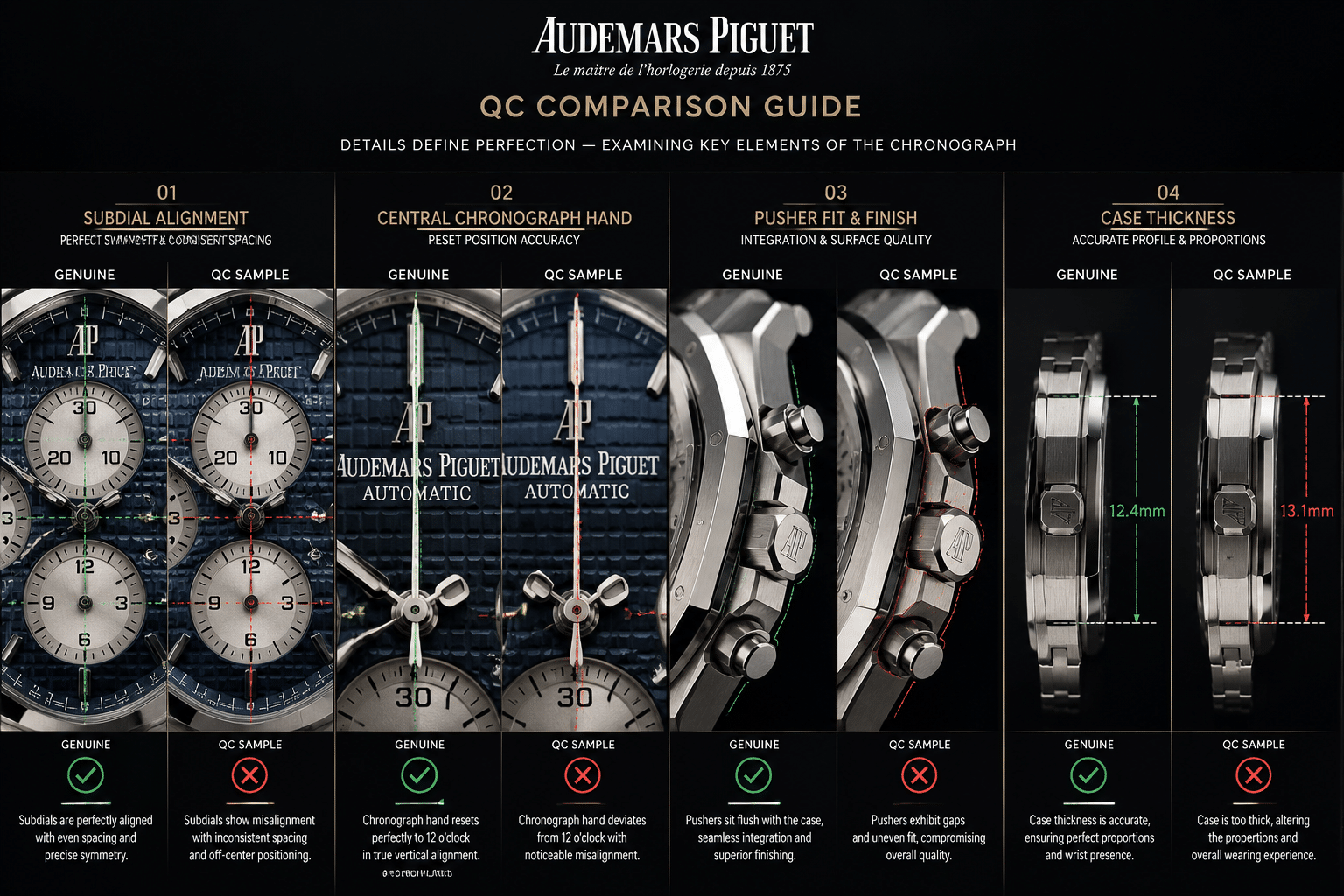
A replica chronograph reset issue is not in the same category as a watch gaining ten or fifteen seconds per day. If the central chronograph hand does not reset to zero, lands slightly different each time, or snaps back inconsistently, the issue may involve hand fitment, reset hammer adjustment, friction, or deeper module behavior. Some of those can be adjusted. Others can become recurring.
The reason this matters is that reset behavior tests the mechanical coordination of the chronograph system. The movement is not just running; it is engaging, stopping, and returning extra hands under mechanical force. A reset problem tells you something about how cleanly that system is interacting. Poor reset should make the buyer more cautious than poor basic timekeeping.
A small fixed offset may sometimes be corrected if it is a hand alignment issue. Inconsistent reset is more concerning because it suggests instability rather than simple positioning. If the hand resets differently each time, service becomes less predictable and the owner should not assume one adjustment will solve the problem permanently.
The buyer should also distinguish between a hand that is installed slightly off zero and a chronograph system that cannot return consistently. The first may be a hand-setting issue. The second points to the mechanism doing something different each time it is used. In a replica chronograph, that difference matters because repeated reset force can expose weak friction surfaces, poor lever adjustment, or hand fitment that loosens over time.
Stiff Pushers and Hand Creep
Pusher feel is one of the most useful ownership clues on an AP chronograph clone movement. A pusher should not feel dangerously stiff, gritty, sticky, or uneven. It does not need to feel like a genuine AP chronograph, but it should engage and release with a controlled mechanical action. If pressing the pusher feels like forcing the movement, that is not a harmless personality trait.
Hand creep is another warning sign. If a chronograph hand or subdial hand moves when it should remain still, the system may have friction, weak tension, poor adjustment, or imperfect coupling. This is especially important on replicas where subdial layout may already be a compromise. A watch can have visually acceptable subdial spacing but still behave poorly when the chronograph is operated.
Buyers often focus on whether the subdials are in the correct places, but operation matters more for ownership. Correct-looking subdial spacing does not prove the movement is stable. A chronograph that looks right but creeps, sticks, or resists at the pushers can become more frustrating than a simpler AP clone with less visual drama and fewer mechanical demands.
Chronograph operation should be tested deliberately but not abused. Start, stop, and reset should be checked enough to confirm repeatability, especially during QC or early ownership, but repeated rapid pressing is not a useful stress test for a fragile movement route. If the pusher feel changes during a few normal operations, or if reset accuracy worsens as the function is used, the movement deserves caution before any service money is committed.
When Chronograph Service Becomes a Poor Investment
Chronograph service becomes a poor investment when the complication is unstable from the start. A watch that fails to reset, shows hand creep, has harsh pusher action, and runs with questionable power delivery is not just asking for cleaning and regulation. It is asking the owner to trust a complicated system that has already failed several basic ownership tests.
This does not mean every AP chronograph clone should be avoided. Some newer or better-executed movement routes are more impressive than older thick chronograph builds, and some owners are satisfied when they use the chronograph rarely. The point is that the service threshold should be higher. A chronograph needs to pass more functional checks before it deserves more money.
Case thickness also changes the decision. Older chronograph routes often used thick base movements or modules that forced the case profile away from the intended AP proportions. If a chronograph is already compromised in thickness and also has unstable function, servicing the movement may not improve the overall ownership value enough. You may end up paying to preserve a watch that remains mechanically risky and visually less convincing from the side.
The practical answer to “should I avoid replica chronograph service?” depends on the fault pattern. If the issue is minor, fixed, and the movement otherwise behaves well, inspection may be worthwhile. If reset failure, stiff pushers, hand creep, and stopping appear together, the better move is usually to stop spending. A complicated AP clone can be enjoyable, but it should not be treated as a low-risk daily watch just because the dial layout looks convincing.
For many buyers, the cleanest chronograph decision is made before purchase rather than after failure. If the priority is wrist presence and occasional use, a visually strong chronograph with known limitations may be acceptable. If the priority is daily reliability, a simpler AP-style model with fewer complications may be the more sensible choice even if it has less dial drama. The “best” option is therefore not the most complicated or most expensive one; it is the model whose movement risk matches the buyer’s actual use.
How to Build a Defensible Service Decision Before Opening the Watch
A service decision is stronger when it is based on repeatable observations rather than one nervous impression. Before asking a watchmaker to open an AP clone movement, the buyer should collect a simple ownership record: how many winds were given, when the watch started, whether it survived overnight, whether it stopped in a specific position, how the crown felt, whether the rotor noise changed, and whether the date or chronograph function behaved the same way each time. This does not prove the exact fault, but it gives the watchmaker a clearer pattern to inspect.
The most useful evidence is usually behavioral, not promotional. A seller’s listing may describe a movement route, a factory version, or a claimed reserve, but those claims should not override what the actual watch does on the wrist. A buyer who can say “the watch stops only after the chronograph is reset,” “the rotor scrapes when the watch is tilted,” or “the date quickset feels rough at the same point every time” gives a much better diagnostic starting point than a buyer who only says “the movement is bad.” Specific symptoms reduce guesswork.
Photos and videos can help when used carefully. A short video of crown winding sound, rotor scraping, chronograph reset, date quickset behavior, or a repeated stopping pattern can be more useful than a single still image of a decorated movement. However, visual material should not be treated as proof that a movement is healthy. It is a communication tool. The final judgment still depends on inspection, parts condition, movement architecture, and whether the problem can be corrected without creating new fitment issues.
Verification Note: When possible, buyers should review real watch photos and short function videos before approval, including dial alignment, caseback structure, rotor position, crown operation, date change, chronograph reset, and any movement information available. Stock images, factory labels, and a brief ticking video alone are not enough to judge whether an AP clone movement has a stable baseline.
QC photos reduce uncertainty, but they do not remove every risk. They help buyers judge visible execution before approval, especially when factory names or stock photos do not show the exact watch being supplied. For AP replicas, useful checks include dial printing, marker alignment, bezel screw position, bracelet fit, clasp engraving, case thickness, caseback finishing, rotor position, datewheel centering, crown operation, and chronograph reset behavior where relevant.
QC photos should also be used for buyer protection rather than for overconfidence. A clear caseback photo may reveal rotor alignment, screw condition, visible rubbing, or obvious spacer issues, but it cannot confirm lubrication quality, amplitude over several days, long-term accuracy, or whether the watch will tolerate water exposure. Buyers should treat QC evidence as a way to reduce uncertainty, not as a guarantee of perfection, authenticity, or future reliability.
| Evidence to Collect | What It Helps Clarify | How to Use It |
|---|---|---|
| Full-wind start time and stop time | Power reserve pattern | Repeat twice before assuming the result is meaningful |
| Overnight running in one or two resting positions | Basic stability and positional sensitivity | Compare similar wear days rather than random conditions |
| Crown feel during winding and setting | Winding train, keyless works, and calendar feel | Stop if resistance becomes sharp or gritty |
| Rotor sound video | Normal spin versus scraping or looseness | Record gentle wrist motion, not aggressive shaking |
| Chronograph start, stop, and reset | Repeatability of complication function | Test sparingly and avoid rapid repeated pressing |
| Date change and quickset behavior | Calendar engagement and dial-side risk | Avoid forcing the date if resistance appears |
What to Ask a Watchmaker Before Paying for AP Clone Movement Service
The right watchmaker conversation can prevent a vague service quote from becoming an open-ended repair project. Instead of asking only whether the watch can be serviced, ask whether the movement route is familiar, whether parts are likely to be available, whether the problem sounds like cleaning and lubrication or damaged components, and whether the watchmaker is willing to stop after diagnosis if the movement is not worth chasing. That last point matters because some AP clone problems only become clear once the caseback, rotor, dial side, or complication layer is inspected.
A careful service request should also define the limit of the work. For a stable but dry movement, cleaning, lubrication, inspection of the automatic works, and regulation may be sensible. For a red-flag movement, a paid diagnosis may be the only rational first step. The buyer should avoid authorizing broad repair work before knowing whether the rotor has been rubbing, whether the calendar works are damaged, whether the chronograph has adjustment problems, or whether the movement has parts that cannot be sourced easily.
- Ask for diagnosis before full service: A diagnosis can reveal whether the movement is dirty and dry or whether it has damaged parts, interference, or poor fitment.
- Ask whether parts are available: Service becomes less predictable when replacement wheels, setting parts, rotors, hands, or dial-side components are difficult to match.
- Ask whether the movement route is worth servicing: A watchmaker may be able to service a movement but still judge it a poor investment for daily reliability.
- Ask what result is realistic: A service may improve winding feel and timing, but it should not be expected to make the replica equivalent to an authorized genuine watch.
- Ask when to stop: Set a point where further repair is no longer worth the cost compared with rejection, exchange, or accepting the watch as occasional wear only.
This conversation is also where buyers should be honest about expectations. If the goal is a reliable daily watch, the service threshold should be higher and red flags should be treated seriously. If the watch is mainly for occasional visual enjoyment, a mild flaw may be tolerable without paying for deep intervention. The watchmaker’s role is to assess mechanical reality; the buyer’s role is to decide whether the expected improvement justifies the cost and risk.
When Returning, Exchanging, or Walking Away Is Better Than Servicing
Servicing is not always the most buyer-protective option. If an AP replica arrives with serious symptoms during the inspection window, the first decision should often be whether to reject, request another unit if seller terms allow, or pause the purchase rather than immediately repair the watch. Once a buyer accepts a flawed unit and begins private service, responsibility can become less clear, and the cost of proving the original fault may rise. Early mechanical problems deserve early documentation and a calm decision.
Return or exchange is especially more rational when the problem appears before meaningful wear and the seller’s stated terms allow that route. A scraping rotor in QC, a chronograph that fails to reset in the seller’s video, a date that refuses to advance cleanly, or a movement that stops after a full wind should not be minimized just because the case finishing looks good. These are not ordinary cosmetic preferences. They can indicate mechanical risk that may remain even after one repair attempt.
Walking away may also be sensible when the movement route is poorly understood. If the seller cannot explain the movement, the watchmaker is unsure about parts, and the symptom suggests interference or complication instability, the buyer has too many unknowns. A replica purchase already involves tradeoffs; adding uncertain serviceability to a serious movement fault can turn the watch into a project rather than a watch.
Buyers should confirm return, repair, shipping, and after-sales terms before ordering, because these details can vary by seller and model. That confirmation should be separate from the mechanical judgment itself: a seller policy may affect what options are available, but it does not make a scraping rotor, unstable chronograph, rough quickset, or repeated stopping pattern mechanically acceptable. The safest decision combines clear terms with careful evidence from the exact watch.
Seller Policy Questions Should Stay Separate From Movement Quality
A seller may describe a watch as a certain factory version, movement route, or upgraded batch, but that does not replace clear after-sales terms. Before ordering, buyers should confirm what happens if QC shows rotor scraping, date failure, chronograph reset problems, severe timing instability, or visible movement damage. They should also confirm whether any repair, exchange, or return option exists before approving the exact unit. Without clear terms, even a serviceable problem can become harder to resolve.
Policy language should not be confused with mechanical proof. A seller who offers supportive communication still cannot make a weak movement architecture reliable by description alone, and a factory label does not guarantee that every unit is assembled equally well. The buyer-protective approach is to keep both sides of the decision visible: review the watch’s actual mechanical behavior and separately confirm the seller’s stated process for problems, shipping expectations, water-resistance testing, and after-sales support.
| Situation | Better First Move | Reason |
|---|---|---|
| Minor stable timing error with smooth winding | Monitor or regulate later | The baseline may be healthy enough to avoid immediate opening |
| Dry feel with predictable reserve and no red flags | Consider service | Cleaning and lubrication may improve a stable movement |
| Rotor scraping or visible rubbing | Reject, request another unit if terms allow, or diagnose before service | Fitment or contact issues can recur |
| Repeated stopping after full wind | Pause and inspect before spending | The fault pattern suggests instability, not simple regulation |
| Chronograph reset failure with stiff pushers | Avoid assuming easy repair | The complication may require adjustment, parts, or deeper work |
| Unknown movement route and uncertain parts access | Be ready to walk away | Repair confidence is too low for predictable ownership |
Water, Shock, and Daily-Wear Expectations for AP Clone Movements
Movement service should not be confused with full daily-wear hardening. Even after a movement is cleaned, lubricated, and regulated, the watch should still be treated as an imitation product with uncertain sealing, uncertain pressure performance, and variable assembly control unless the individual unit has been tested by a competent professional. A movement that keeps time well is not automatically safe for swimming, showering, sports, or impact-heavy use.
Water resistance is one of the easiest areas for buyers to overestimate. A genuine AP model’s design language may suggest luxury sports-watch toughness, but that does not prove the same water resistance or sealing quality in a replica. Caseback gaskets, crown tube fit, pusher sealing, crystal seating, and assembly consistency all matter. For AP chronograph replicas, pushers add another potential leakage path, so water exposure should be avoided unless the specific watch has been pressure-tested after purchase and the owner accepts the risk.
Shock expectations should also be conservative. Thin cases, display backs, decorated movement plates, and modified layouts can make some AP-style replicas less forgiving than simpler watches. A serviced movement may run better, but it can still be vulnerable to impacts that disturb hands, loosen a rotor, affect a setting lever, or expose marginal clearances. If the buyer wants a watch for active use, the safer ownership plan is usually a simpler movement route, conservative wear habits, and regular observation rather than assuming service has eliminated every weakness.
A replica watch should be evaluated with realistic ownership expectations. Even a strong super clone can have limits in water resistance, long-term movement stability, servicing convenience, and close inspection compared with a genuine reference. The responsible use of movement and factory information is to understand quality and risk, not to treat the watch as an authentic AP product or represent it as one.
Final Ownership Judgment: Service the Stable, Avoid the Chaotic
The clearest rule for AP clone movements is simple: service the stable, inspect the questionable, and avoid chasing the chaotic. A movement that starts easily, winds smoothly, runs overnight, behaves consistently, and shows a fixable weakness may deserve cleaning, lubrication, or regulation. A movement that scrapes, grinds, stops unpredictably, fails complications, or shows visible interference should not be treated as a normal service candidate without diagnosis.
This approach protects the buyer from two expensive mistakes. The first mistake is panic-servicing every AP replica immediately, even when the movement has a healthy baseline. The second mistake is emotionally rescuing a bad movement because the exterior looks excellent. Long-term ownership depends on both appearance and mechanical behavior. A beautiful case cannot compensate for a movement that refuses to become predictable.
Factory names, seller claims, decorative plates, and short QC videos can all be useful signals, but none of them replaces the behavior of the exact watch. If the watch proves stable, service can be a rational way to improve comfort and longevity. If the watch proves unstable, restraint is often the smarter purchase decision. In AP clone ownership, the best after-sales strategy is not always fixing more; sometimes it is knowing when not to invest further.
For CleanVSFactory, the goal is to make replica watch comparison easier to understand by connecting factory names, movement claims, visible QC details, and realistic ownership limits. That means treating AP clone movement service as a traceable decision: identify the model and version, understand the movement route, review real evidence where available, monitor the exact unit’s behavior, and avoid broad claims that make a replica sound mechanically equivalent to an authorized genuine watch.
Disclosure: This article is for general educational and comparison purposes only. Replica watches are not genuine products from the original luxury brands, and brand names are used only to identify reference designs or comparison topics. Factory names, movement descriptions, prices, availability, QC details, seller policies, and version information can change, so readers should verify important details with the seller before making a purchase decision. Replica watches should not be represented, resold, or used as genuine watches.