
On a Royal Oak replica, the bracelet is not a secondary detail. Because the design is integrated, the first link, taper, brushing, bevels, clasp feel, and wrist drape all decide whether the watch looks convincing in real use, especially when the case finishing is judged against the visual depth of an AP Royal Oak tapisserie dial and its surrounding bezel geometry. A dial may photograph well, but a stiff bracelet, uneven case gap, cloudy brushing, rough clasp, or poorly seated screw can make the whole watch feel lower grade as soon as it is worn.
This guide focuses on the practical checks that matter before choosing or approving a Royal Oak replica. Instead of relying only on factory claims or front-facing photos, it explains how to judge case-to-bracelet flow, link articulation, finishing consistency, clasp behavior, and QC angles. The goal is to help buyers separate acceptable small variations from problems that affect comfort, appearance, sizing, and long-term daily wear.
| Check Point | What To Look For | Warning Sign |
|---|---|---|
| First-link transition | Even gaps, natural drop, balanced symmetry | One side sits higher or twists outward |
| Bracelet articulation | Links curve around the wrist smoothly | Bracelet behaves like a rigid cuff |
| Finishing pattern | Clean brushing with narrow polished bevels | Cloudy surfaces or soft, uneven edges |
| Screw quality | Flush heads, clean slots, reliable threading | Damaged slots or uneven screw seating |
| Clasp behavior | Firm snap, comfortable underside, no rattle | Sharp edges, pressure points, excessive force |
| QC photo set | Front, angled, side, wrist, and clasp-open views | Only dial shots or flat table photos provided |
Quick Questions Before You Read
Q: Why does the bracelet matter more on a Royal Oak replica?
The bracelet forms the watch’s shape, light reflection, and wrist feel, so weak execution affects the whole design.
Q: Are dial photos enough for judging a Royal Oak replica?
No. Wrist-angle, side-profile, and case-to-bracelet photos reveal fit and comfort problems that dial shots can hide.
Q: What bracelet flaw should buyers check first?
Start with the first-link transition. Uneven gaps, poor drop, or visible twist are hard to ignore on an integrated case.
Q: Do factory upgrade claims guarantee a better bracelet?
No. Recent QC photos and real wear feedback for the exact reference are more useful than broad upgrade wording.
Editorial Perspective: For Royal Oak replicas, cleanvsfactory.com treats the bracelet as a model-specific buying question, not a generic factory-ranking issue. A factory name can help narrow the shortlist, but it does not prove that the current bracelet batch has the right first-link fit, screw quality, clasp behavior, edge comfort, or daily-wear drape. The more useful judgment is whether the exact version shown in QC photos matches the buyer’s intended use: visual accuracy for photos, comfort for daily wear, or a balance of both.
Evidence Boundary: This article discusses imitation watches and buyer evaluation methods, not authorized Audemars Piguet products. Official brand specifications, when available, can help explain the authentic model context, but they do not prove that any replica has the same construction, finishing tolerance, movement behavior, water resistance, serviceability, or legal status. For replica watches, the strongest practical evidence is still the specific watch shown in current QC photos, supported by cautious seller disclosure and realistic buyer expectations.
Reference, Factory, and Authenticity Boundaries
Brand names such as Audemars Piguet and Royal Oak are used here to identify the genuine reference design being discussed. A Royal Oak replica is a replica-market product, not a genuine Audemars Piguet watch, not an authorized product, and not a substitute for an authentic watch made, sold, or serviced through official brand channels.
Factory names in the replica watch market are useful buyer-facing references, but they should not be treated as official luxury-brand affiliations or automatic guarantees of quality across every model. A factory label may help organize comparisons, yet the actual bracelet quality still depends on the specific reference, version, movement route, case shape, bracelet batch, and visible QC evidence.
The purpose of bracelet, movement, and factory discussion in this guide is buyer education and risk awareness. It is not a way to represent a replica watch as genuine, to support resale as authentic, or to suggest that a replica can pass professional inspection. A strong replica may look convincing in normal wear, but close inspection can still reveal differences in finishing, movement architecture, case proportions, bracelet feel, dial details, or service compatibility.
Why the Royal Oak Bracelet Decides the Whole Replica
A Royal Oak replica should not be judged by the dial first and the bracelet later. On this watch, the Royal Oak bracelet is part of the architecture. It controls how the case continues onto the wrist, how the brushed and polished surfaces catch light, and whether the watch feels like a single designed object or a heavy case attached to a generic metal strap.
This is where many buyers misread Royal Oak replica quality. A clean tapisserie dial can look impressive in a close-up photo, and a decorated movement can make the caseback look more serious, but neither one fixes a poor AP Royal Oak replica bracelet. If the bracelet is stiff, sharp, loose at the head link, badly finished, or awkwardly tapered, the whole watch feels wrong before anyone studies the dial.
The practical judgment is simple: on a Royal Oak replica, bracelet execution is as important as dial and movement presentation. Not because the bracelet is harder to photograph, but because it decides the watch’s wrist presence. A Submariner-style bracelet can sometimes hide average finishing because the case and bracelet are more visually separate. The Royal Oak does not give that kind of forgiveness. The integrated bracelet is visible from every angle and is always interacting with the case design.
The Bracelet Is Part of the Watch Head
The Royal Oak design does not treat the bracelet as removable styling. The first links continue the case geometry, and the taper pulls the eye from the broad octagonal bezel into a thinner, more wearable shape around the wrist. When that transition is right, the watch looks low, wide, and controlled. When it is wrong, the bracelet looks like it was attached after the case was finished.
This matters more than many first-time AP buyers expect. A poor case-to-bracelet flow can make a 41mm Royal Oak replica wear larger and flatter than it should. The watch may look acceptable in straight-on photos, but from the side it can sit like a metal plate. That is not only a comfort problem; it changes the silhouette that makes the Royal Oak recognizable.
At Clean VS Factory, we usually treat integrated bracelet quality as part of the watch head evaluation, not as a separate accessory check. The first question is not only whether the dial texture looks good. It is whether the case, first link, bracelet taper, and finishing work together as one shape.
Why Dial Accuracy Alone Is Not Enough
The tapisserie dial gets most of the attention because it is easy to compare in macro photos. That attention is understandable, but it can lead to a bad purchase if the bracelet is ignored. A Royal Oak replica with a strong dial but poor bracelet drape will still feel lower grade in daily wear because the problem is physical, not just visual.
Weak bracelet finishing also changes how the watch reflects light. The Royal Oak depends on contrast: broad brushed planes, thin polished bevels, and sharp directional transitions. If the bracelet brushing looks cloudy, the bevels are too soft, or the edges feel rough, the dial cannot carry the watch by itself. The bracelet occupies more visible surface area than the dial and is the part your wrist feels all day.
The most common buyer mistake is asking which version has the best dial before asking whether the bracelet behaves correctly. For this model, that order is backwards. A good dial can make a Royal Oak replica look promising in photos, but a poor bracelet decides whether it feels convincing once worn.
What Buyer Evidence Can and Cannot Prove
QC photos are useful evidence for visible details, but they have limits. They can show first-link symmetry, obvious screw damage, brushing direction, clasp shape, and whether the bracelet appears to drape naturally from certain angles. They cannot prove long-term durability, water resistance, movement reliability, or how the bracelet will feel on every wrist after weeks of wear.
Seller descriptions also need to be read narrowly. A phrase such as “upgraded bracelet” may describe a real version change, but it should not be treated as proof of better comfort unless the photos show cleaner link fit, smoother underside finishing, or more controlled clasp construction. The buyer should connect each claim to something observable: if the claim is about finishing, look for finishing evidence; if the claim is about comfort, look for wrist-angle photos and wearer feedback.
The same restraint applies to comparisons with authentic watches. An authentic Royal Oak reference can provide a design benchmark, but it does not prove that a replica matches the same finishing, material quality, bracelet tolerances, or service standard. A careful buyer uses the genuine model as context, then judges the replica as an imitation product with its own visible strengths, risks, and compromises.
Before making a decision, buyers should review real QC photos where available, including first-link alignment, bracelet drop, screw seating, brushing direction, polished bevel consistency, clasp underside finishing, and wrist-angle behavior. Factory labels and stock photos alone are not enough for a reliable Royal Oak bracelet judgment.
Visual Accuracy and Daily Reliability Are Not the Same Buying Goal
A Royal Oak replica can be strong in photos and still be a poor daily-wear choice. This distinction matters because the bracelet is both a visual component and a mechanical comfort component. A watch with a sharp dial, clean bezel screws, and attractive brushing may satisfy a buyer who mainly wants occasional wear and strong wrist photos. The same watch may disappoint a daily wearer if the bracelet pulls hair, the clasp presses into the wrist, or the first links refuse to drape naturally.
For this model, buyers should decide what problem they are trying to solve before judging the “best” version. If the goal is visual accuracy under normal viewing distance, then dial texture, bezel alignment, case shape, and brushing consistency deserve heavy attention. If the goal is regular office or daily wear, then movement stability, bracelet screw reliability, clasp comfort, and easy sizing become more important. These priorities overlap, but they are not identical.
This is also why some Royal Oak references are riskier for beginners than others. Simpler time-and-date models are usually easier to evaluate because the buyer can focus on case thickness, dial execution, bracelet fit, and movement behavior. Chronograph-style or ultra-thin-style Royal Oak replicas can introduce more variables: case thickness, subdial layout, pusher feel, movement reliability, and bracelet balance. A complicated watch may look more impressive in a listing, but it often gives a first-time buyer more ways to misjudge the purchase.
The practical conclusion is not that one priority is always correct. It is that the buyer should not let one strong feature hide a weak ownership detail. A Royal Oak replica chosen for photos can tolerate some comfort compromises if the buyer understands them. A Royal Oak replica chosen for daily use should not be approved just because the dial looks attractive in macro photos.
Gérald Genta’s Integrated Bracelet Logic and Why It Is Hard to Copy
The Gérald Genta Royal Oak design is difficult to reproduce because it combines two ideas that fight each other: the watch must look architectural, but it must wear fluidly. The Royal Oak integrated bracelet is not supposed to look soft or rounded. It uses angular links, defined bevels, and a strong taper. Yet on the wrist, those same links need to articulate smoothly enough to follow the arm instead of resisting it.
This is why integrated bracelets are hard to clone. A factory cannot simply make the bracelet look sharp in a flat photo. Each link has to maintain the visual rhythm of the case geometry while still moving naturally. If tolerances are too tight, the bracelet becomes stiff. If they are too loose, the bracelet rattles, gaps open, and the watch loses the controlled feel that the design requires.
From Case Shape to Bracelet Taper
The Royal Oak starts with a broad, flat, octagonal case shape, then relies on the bracelet taper to make that bold geometry wearable. The bracelet visually extends the case at the top, then narrows as it moves around the wrist. That taper is not decoration. It is what prevents the watch from looking like a square steel block.
A poor taper disrupts the entire Royal Oak profile. If the bracelet stays too wide for too long, the watch wears bulky and heavy. If it narrows too abruptly, the first links look disconnected from the case. The right bracelet architecture should make the case feel intentional rather than oversized. This is especially important on larger 41mm Royal Oak replicas, where the bracelet has to manage wrist presence more carefully.
The non-obvious point is that taper affects perceived case size. Two Royal Oak replicas with similar case dimensions can feel different if one bracelet drops and narrows naturally while the other projects outward before bending. Buyers often blame the case size when the real issue is bracelet geometry.
Architectural Links With Wearable Movement
The Royal Oak bracelet has to look like a sequence of metal components, not a soft mesh. Each link should have a crisp top surface, defined side planes, and a controlled transition into the next link. But if those links do not articulate well, the same crisp geometry becomes uncomfortable. That is the core replica bracelet design issue: sharp visual form is easy to overdo, while fluid motion is harder to engineer.
A convincing bracelet should not feel floppy, but it also should not behave like a rigid cuff. The better-executed versions manage a narrow middle ground: enough link resistance to feel solid, enough movement to wrap the wrist. Lower-grade bracelets often miss this balance. They may look strong in seller photos because the links are aligned flat, but they feel harsh once curved around a real wrist.
This is one reason factory reputation alone cannot answer the bracelet question. A Royal Oak bracelet is a tolerance-sensitive part, and small changes in link machining, screw seating, and finishing can alter the final feel. The design logic is unforgiving because every link is exposed and every break in the rhythm is visible.
The Case-to-First-Link Transition Is the First Red Flag
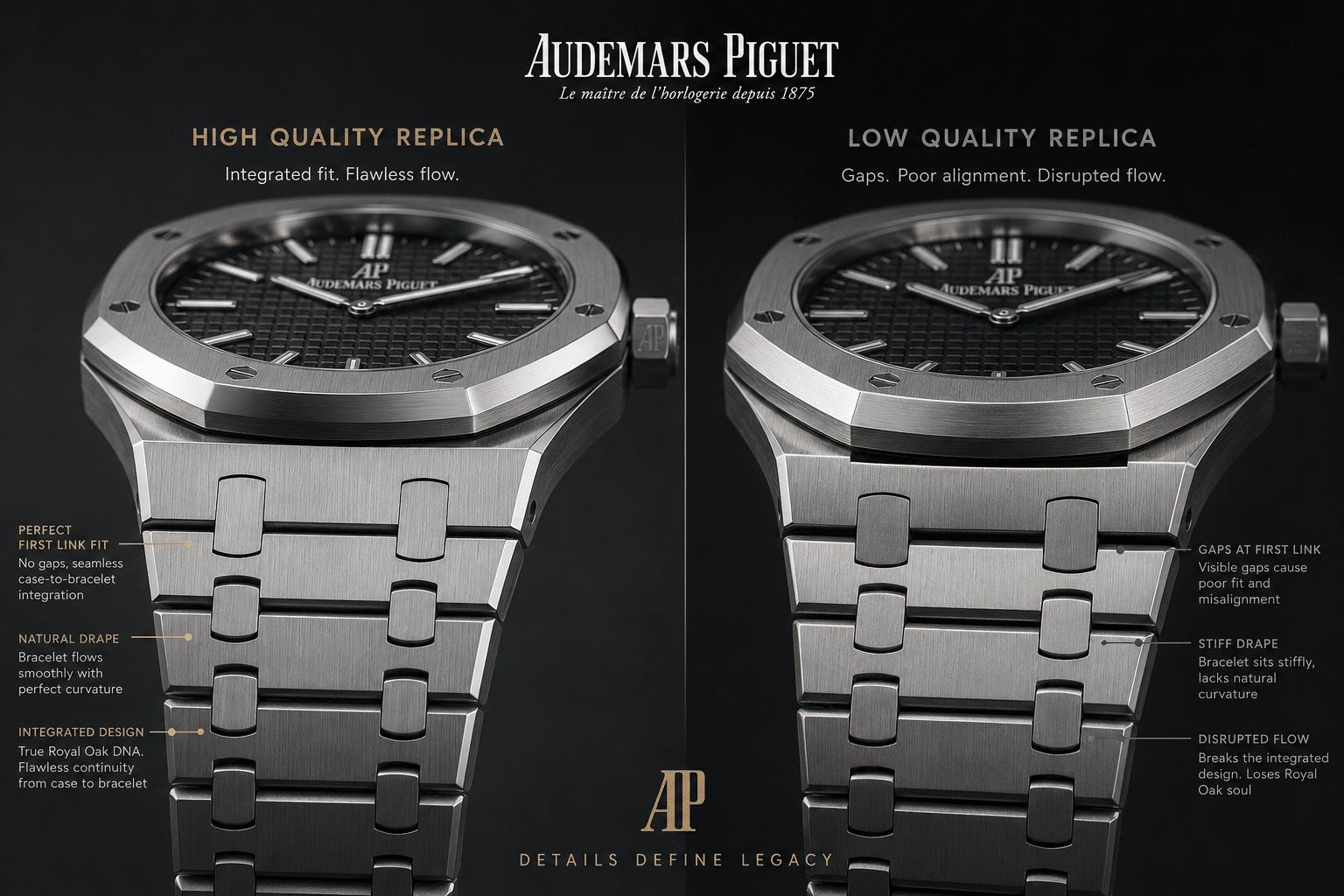
The case-to-first-link transition is the first place to check on any Royal Oak replica because it shows whether the bracelet grows out of the case or merely hangs from it. The Royal Oak first link controls the whole opening gesture of the bracelet. If that link sits too low, angles away awkwardly, or shows uneven gaps, the integrated design breaks immediately.
This area matters because it is both visual and functional. From the front, the Royal Oak head link should appear centered, balanced, and naturally aligned with the case. From the side, the first link should begin the bracelet’s downward curve without creating a hard step or a drooping hinge. If the transition is wrong, even a clean dial and sharp bezel cannot hide the problem.
Flush Fit Versus Visible Gaps
A good head-link fit does not mean the first link must be frozen in place. Some spacing and movement are necessary because the bracelet has to articulate. The problem is uneven spacing: one side tighter than the other, a visible side gap, or a first link that appears sunken below the case line. These are signs that the case integration is weak.
Buyers should pay special attention to the side profile. In straight-on QC photos, a small bracelet gap can disappear under reflection. From an angled view, the first-link gap becomes easier to see. If the link starts too far below the case or kicks outward before dropping, the watch will often wear wider and less refined than the dial photo suggests.
The strongest red flag is asymmetry. A small uniform gap may be a tolerance issue that does not ruin the watch. An uneven gap on one side of the head link is more concerning because it makes the integrated bracelet look mis-seated. On a Royal Oak replica, that kind of bracelet fit problem affects the whole case profile.
Useful Movement Versus Loose Movement
The first link should move, but it should not feel uncontrolled. Useful movement lets the bracelet bend around the wrist and reduces pressure near the case. Loose movement feels rattly, sloppy, or poorly seated. The difference is important because some buyers mistake any articulation for a defect, while others accept excessive play because they think it improves comfort.
A well-executed first-link articulation should have a controlled range. It should not stick straight out like a fixed end link, but it also should not collapse downward with no resistance. If the head link moves unevenly, clicks loosely, or leaves the case looking unstable, the bracelet may feel cheaper than the rest of the watch.
This is one of the fastest ways to separate a visually acceptable Royal Oak replica from one that feels better built. The bracelet does not need to be silent or perfect, but the first link should give the impression of engineered movement, not accidental looseness.
QC Angles That Reveal the First Link
For Royal Oak QC photos, the most useful bracelet images are not only close-ups. Ask for angles that show how the bracelet leaves the case. A straight front view can reveal symmetry and visible first-link gaps. A side-profile view shows whether the bracelet drops naturally or projects outward. A slight wrist-roll angle is often the most revealing because it shows the case-to-bracelet flow under light and curve.
Do not overread one harshly lit photo. Reflections on brushed steel can exaggerate small gaps or hide them completely. The safer approach is to compare multiple angles and look for the same problem repeating. If the first link looks awkward from every view, it is not a lighting issue; it is a bracelet execution issue.
For a Royal Oak replica, this should be checked before getting distracted by movement decoration or dial color. A weak first-link transition is not a small cosmetic flaw. It is the point where the whole integrated bracelet concept either works or fails.
Bracelet Drape and Articulation: The Difference Between Sharp and Stiff
A Royal Oak bracelet should look architectural, but it should not wear like a metal ruler. This is where many AP Royal Oak replica bracelet evaluations go wrong: buyers see crisp links in a flat photo and assume the bracelet is well made. The real test is not whether the bracelet looks sharp on a table. It is whether the links articulate enough to follow the wrist without forcing the case to sit wide, flat, or awkwardly high.
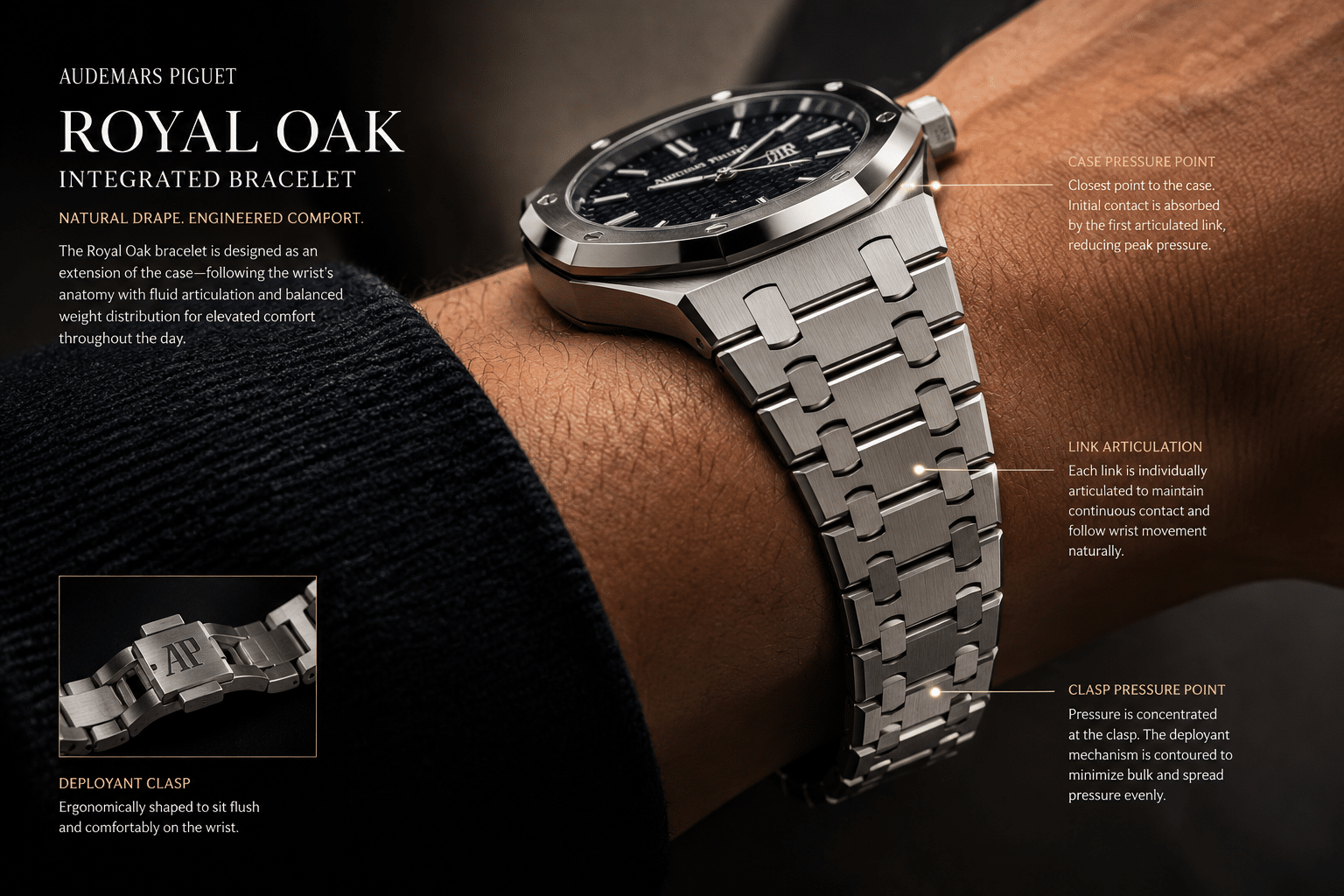
Royal Oak bracelet drape matters because the watch has no traditional lugs to separate the head from the bracelet. Once the bracelet leaves the case, the whole watch starts forming its wrist shape immediately, and the visual weight of an AP Royal Oak blue dial replica can make bracelet articulation even more noticeable. If the links are too stiff, the bracelet pushes outward instead of wrapping downward. On a smaller or rounder wrist, that can make even a correctly sized 39mm or 41mm Royal Oak replica feel larger than the numbers suggest.
The better versions usually have a controlled, segmented movement: each link moves enough to create a smooth curve, but not so much that the bracelet feels loose or rattly. Poor bracelet articulation falls into two opposite problems. Some bracelets are overly tight and behave like a rigid cuff. Others have loose link tolerance, where the bracelet moves but lacks precision. Neither feels right. The first creates pressure points; the second makes the watch feel cheaper than it looks.
Why Table Photos Can Mislead Buyers
Flat-table photos are useful for checking general alignment, but they are weak evidence for integrated bracelet comfort. A stiff Royal Oak bracelet can look clean when laid straight because the links are not being asked to curve. The problem appears when the bracelet has to wrap around an actual wrist, especially near the upper and lower sides of the case.
This is why wrist photos and slight wrist-roll angles matter more than many buyers realize. A bracelet that sits flat across the top of the wrist, then drops suddenly at the sides, usually indicates limited link flexibility. It may photograph well from above, but it can feel uncomfortable after an hour of typing, driving, or resting the wrist on a desk.
The most useful judgment is simple: if the bracelet looks sharp but refuses to contour, the sharpness is not a quality advantage. It is stiffness disguised as precision. A convincing Royal Oak replica should have enough link movement to soften the geometry on the wrist while still keeping the bracelet’s angular identity.
How Poor Drape Changes the Royal Oak Profile
Bad drape changes the entire Royal Oak profile. Instead of the case and bracelet forming one continuous shape, the watch starts to look like a case sitting on top of a bracelet platform. On wrist, this can make the watch appear wider across the span than its case diameter suggests. The visual issue is not only comfort; it affects wrist presence.
A stiff Royal Oak bracelet often creates pressure in two areas: near the case, where the bracelet fails to drop naturally, and near the clasp, where the curve becomes too abrupt. Buyers with flatter wrists may tolerate this better. Buyers with smaller or rounder wrists usually notice it immediately. This is why there is no universal comfort rule for every Royal Oak replica version, but there is a clear warning sign: if the bracelet sits flat instead of following the wrist contour, daily wear comfort will probably be compromised.
For this specific watch family, bracelet taper and articulation are not secondary details. They decide whether the Royal Oak wears like a designed object or like a stiff block of steel. A good dial cannot compensate for a bracelet that fights the wrist every time the watch is worn.
Brushing, Polished Bevels, and the Royal Oak Light Pattern
The Royal Oak bracelet is not just brushed steel with a few shiny edges. Its entire visual character depends on contrast: broad satin surfaces, narrow polished bevels, and repeated angular links that catch light in a controlled rhythm. When Royal Oak bracelet finishing is weak, the watch does not only look less refined under macro photos; it loses the crisp light pattern that makes the design recognizable on the wrist.
This is why bracelet finishing matters more on a Royal Oak replica than on many watches with simpler bracelets. A conventional three-link bracelet can hide small finishing inconsistencies because the shape is familiar and forgiving. The Royal Oak’s integrated bracelet is less forgiving. Each link is exposed, flat, angular, and repeated many times. Uneven brushing, cloudy satin texture, or weak polished bevels are repeated across the whole bracelet, so a small flaw becomes a pattern.
The buyer mistake is treating finishing as decorative. On this watch, finishing is geometry made visible. If the surfaces are brushed in inconsistent directions or the polished bevels are too soft, the bracelet stops looking architectural and starts looking generic.
Brushing Direction Across Each Link
Good brushing should look deliberate. The satin finish across the main link surfaces should have a clean direction, not a cloudy or scratched appearance. In QC photos, the bracelet should not look like different links were brushed with different pressure, different grain, or different angles. Some variation can be exaggerated by lighting, but obvious mismatched brushing across adjacent links is a real warning sign.
On a Royal Oak replica, controlled brushing does two things. First, it gives the bracelet a flatter, more precise surface appearance. Second, it supports the case design by keeping the visual flow consistent from the watch head into the bracelet. If the brushing becomes random, the bracelet may still be shiny and heavy, but it will not have the disciplined look that the Royal Oak requires.
Harsh seller lighting can hide or exaggerate this. Overexposed photos may wash out the brushing completely, while dramatic angled lighting can make normal grain look rougher than it is. The safest approach is to compare straight-on and slightly angled photos under neutral light. If the bracelet only looks good in one lighting angle, do not overvalue that photo.
Polished Bevels as the Bracelet’s Visual Edge
The polished bevels are the bracelet’s outline. They create thin reflective lines along the edges of each link and separate the brushed planes from the polished transitions. On a strong brushed and polished bracelet, these bevels should look consistent in width and direction. They should not disappear on some links, become too wide on others, or look rounded like soft jewelry finishing.
Weak polished bevels are one of the fastest ways a Royal Oak replica loses presence. If the bevels are too dull, the bracelet looks flat and heavy. If they are over-polished or rounded, the bracelet loses its sharp Genta-style geometry. The better compromise is not maximum shine; it is controlled contrast. The polished line should be bright enough to define the edge, but narrow enough to preserve the shape.
This is also where machine finishing shows its limit. Even good replica bracelets can be visually convincing in daily wear but less refined under close inspection. That does not automatically make the watch a poor choice. The practical question is whether the finishing looks orderly and consistent at normal viewing distance. If the bracelet appears messy without magnification, the issue is too large to ignore.
Close-Up Photo Checks for Finishing
For finishing checks, ask for or review close-ups that show the bracelet from both straight-on and angled positions. A straight-on image helps reveal brushing direction and link-to-link consistency. An angled image shows whether the polished bevels catch light evenly. A side-leaning photo can also reveal whether the edges look crisp or rounded.
The main red flags are cloudy brushing, uneven grain direction, dull bevels, over-rounded edges, and links that reflect light differently for no obvious reason. Minor dust, fingerprints, or lighting glare should not be confused with poor finishing. But if the bracelet surface looks inconsistent across multiple photos, that is not a lighting problem; it is a finishing problem.
Movement Choice, Case Thickness, and Bracelet Fit
Movement choice affects a Royal Oak replica more than many beginners expect because it can influence case thickness, weight distribution, crown position, and how the watch balances on the bracelet. A movement that looks attractive through a caseback does not automatically make the watch better to wear. For an integrated-bracelet watch, the movement route should be judged together with the case profile and bracelet drape, not as a separate specification.
Some Royal Oak replicas use thinner movement solutions to keep the case profile closer to the intended look, while others may use more practical or more available movements that create a thicker case. A slightly thicker case may still be acceptable for a buyer who values reliability and easier servicing, but it can change the way the bracelet leaves the case. If the case sits higher, the first links need to drop more naturally; otherwise the watch can feel top-heavy and flat across the wrist.
Decorated movement plates can be visually appealing, especially in seller photos, but decoration is not the same as performance. Buyers should listen for rotor noise if feedback is available, check whether the movement has a stable reputation in that exact version, and understand whether service options are realistic. A Royal Oak replica that looks closer from the back but uses a troublesome movement may be less suitable for daily wear than a version with a less impressive display but more predictable ownership.
This is where visual accuracy and reliability can pull in different directions. A buyer who mostly wants the watch for occasional use may accept a more appearance-focused movement route. A buyer who wants frequent wear should think about power reserve behavior, winding feel, date-setting smoothness, serviceability, and whether the movement contributes to uncomfortable case height. On a Royal Oak, movement choice is not only about the caseback; it can affect the whole wrist experience.
Movement Claims Should Stay Narrow
Movement names in replica listings should be handled carefully. A listing may describe a movement as clone-style, decorated, modified, thin, upgraded, or based on a familiar architecture, but those words do not prove the exact movement inside the individual watch unless the seller provides clear movement photos and a credible basis for the claim. Even then, movement appearance should not be confused with verified long-term performance.
For a Royal Oak replica, the buyer should connect movement claims to practical outcomes rather than prestige language. Does the movement route make the case thicker? Does it change crown height or hand stack appearance? Is date setting smooth? Is the rotor noisy? Is servicing realistic if something goes wrong? These questions are more useful than assuming that a more impressive movement description automatically means a better watch.
Water resistance should be treated with the same caution. The authentic design context does not prove the replica’s sealing quality, and a seller’s general statement is not the same as an individual pressure test. Unless the exact watch has been pressure-tested after purchase, buyers should avoid swimming, showering, or treating the watch as a sports-use piece.
Movement Transparency Note: Movement references in this article describe replica-market movement routes, decoration styles, and practical ownership effects such as case thickness, rotor behavior, setting feel, and service risk. They should not be read as claims of an official Audemars Piguet caliber or brand-authorized construction unless verifiable evidence is provided for the specific watch.
Movement traceability is especially important on Royal Oak replicas because the movement can influence parts that are visible even without opening the case. A thicker or noisier movement route may affect case height, crown position, caseback profile, and bracelet balance, while a more visually decorated movement may still have ordinary reliability or limited service convenience. Buyers should separate movement appearance, movement architecture, and daily-wear behavior instead of treating a movement name as a single quality score.
Screws, Link Construction, and Sizing Difficulty
Royal Oak bracelet screws are easy to overlook until the watch needs sizing. Then they become one of the most practical ownership issues. A bracelet can look good in photos, but if the screw heads are soft, poorly seated, over-tightened, or unevenly threaded, sizing a Royal Oak replica can become frustrating quickly.
This matters because the Royal Oak bracelet is not a loose, casual bracelet design. The links are small, angular, and visually exposed. Screw quality affects appearance, but it also affects whether links can be removed cleanly and reinstalled without damage. A stripped screw slot or uneven screw head is not just a cosmetic flaw. It can limit adjustment, create anxiety about future resizing, and make the bracelet feel less secure over time.
The best practical judgment is this: screw construction should be treated as part of bracelet quality, not as a repair detail to worry about later. If the screws already look damaged in QC photos, the buyer should not assume the problem will disappear after sizing.
Clean Screw Slots and Flush Seating
Clean screw slots should look neat and defined. They do not need to be perfectly aligned like decorative bezel elements, but they should not appear chewed, burred, or rounded before the watch is even worn. Damaged screw heads can suggest rough assembly, poor tools, or soft metal. Any of those can become a problem when links need to be removed.
Flush seating is just as important. The screw heads should sit evenly within the link, not raised on one side or sunk at inconsistent depths across the bracelet. A single slightly imperfect screw may be tolerable depending on price and version, but multiple uneven screws suggest weak link construction. That is the kind of issue that makes a bracelet feel less precise in hand, even if the watch head photographs well.
Loose bracelet screws are another concern. Some buyers focus only on tight screws, but a screw that backs out over time is worse for daily use. This is not something QC photos can always prove, but visible uneven seating or gaps around screw heads are warning signs worth taking seriously.
Why Sizing Can Be More Difficult Than Buyers Expect
Royal Oak bracelet sizing can be harder than buyers expect because the bracelet construction leaves little room for sloppy tools or rough tolerances. Tight screws, shallow slots, and inconsistent threading can turn a simple link removal into a risk of scratches or stripped heads. This is especially true if the bracelet has been assembled with too much force or if the screw machining is not clean.
The common beginner mistake is assuming every screw bracelet is easy to adjust at home. Some are. Some are not. With Royal Oak replicas, the safer approach is to judge the screw condition before purchase and use proper tools or a competent watch repair person if resistance feels excessive. Forcing a stubborn screw is usually how a small sizing job becomes permanent cosmetic damage.
Good sizing is also about fit precision. Because the Royal Oak case and bracelet have strong geometry, a slightly loose fit can make the watch slide and feel top-heavy, while a slightly tight fit can create pressure points at the case side and clasp. The screws and links decide whether that fit can be adjusted cleanly. A bracelet that is hard to size is not only inconvenient; it can prevent the watch from wearing the way the design requires.
Clasp Feel, Engraving, and the Final Wearing Impression
The Royal Oak clasp is where a visually good AP Royal Oak replica becomes either reassuring or disappointing. Photos can make the bracelet look clean, but the clasp tells you how the watch behaves in the hand: whether it closes with confidence, whether it feels thin or tinny, whether the underside has rough edges, and whether the folding mechanism sits comfortably under the wrist. This is why the Royal Oak clasp should not be treated as a small hidden part. It is the final contact point between the integrated bracelet and daily wear.
A weak clasp feel does not always mean the watch is unusable, but it changes the ownership impression quickly. If the clasp takes too much force, the buyer worries about bending something. If it closes too loosely, the watch feels less secure than its weight and design suggest. If it rattles, flexes, or has sharp underside edges, the bracelet may look acceptable on the table but feel cheaper every time the wearer types, drives, or rests the wrist on a desk. On a Royal Oak replica, the clasp is not the main visual attraction, but it can expose whether the bracelet was engineered as a complete system or simply made to look right from above.
Closing Action and Security Feel
A good Royal Oak clasp should close predictably. The action does not need to feel dramatic, but it should have a clean snap and a clear sense of engagement. The best AP replica clasp feel is firm without being stubborn: it should not require nervous pressure, and it should not pop open with light handling. Buyers often underestimate this because clasp action is hard to judge from standard QC photos. A watch can photograph well and still feel unsatisfying if the folding clasp has a hollow click or uneven resistance from one side to the other.
The main red flags are simple. A clasp that closes with a dull, loose feeling may indicate weak tolerance or poor spring tension. A clasp that needs excessive force may have misalignment in the folding blades or a locking point that is not finished cleanly. A clasp that feels overly thin can make the whole bracelet seem less substantial, even if the case and dial are convincing. This is especially noticeable on the Royal Oak because the bracelet has a broad, architectural look; the clasp should not feel like a separate lightweight shortcut underneath it.
Bracelet security is partly mechanical and partly psychological. If the clasp does not give the wearer confidence, the watch feels less wearable regardless of dial accuracy. For a daily-wear Royal Oak replica, a slightly less perfect engraving is usually easier to live with than a clasp that feels loose, sharp, or unpredictable. That is the practical hierarchy buyers should use.
Engraving and Underside Finishing
Clasp engraving is worth checking, but it should not dominate the decision. Clear engraving, even depth, and clean letter spacing contribute to the impression of better manufacturing, while shallow, blurry, or overly thick engraving can make the clasp look unfinished. Still, engraving is mostly a visual quality signal. The bigger ownership issue is how the clasp underside feels against the wrist.
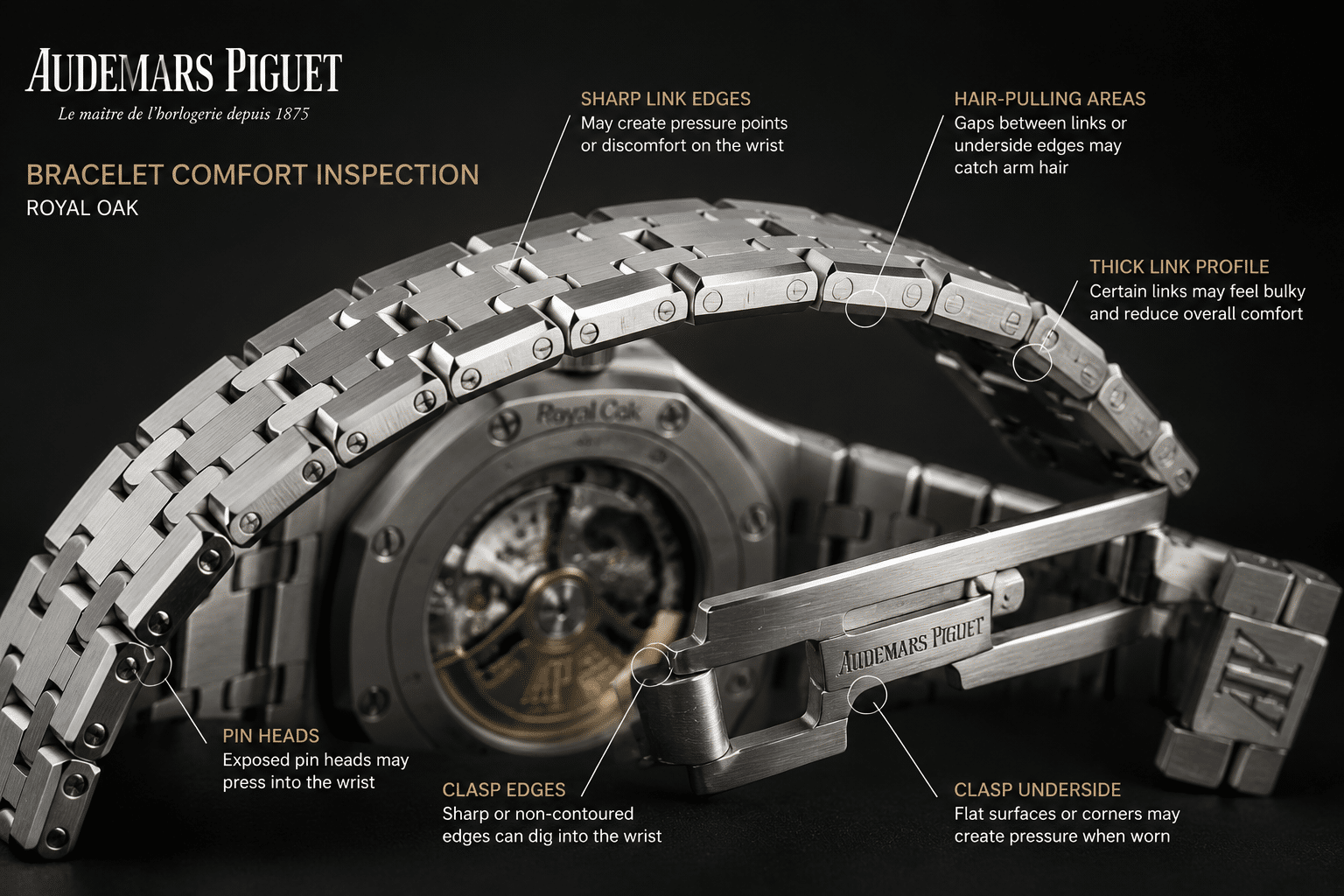
The underside should be smooth enough that it does not scrape, pinch, or create a hot spot during normal movement. Rough internal edges, poorly finished folding blades, or uneven corners can become annoying after an hour, even if they are barely visible in photos. This matters more on the Royal Oak than on many conventional bracelet watches because the integrated bracelet has less forgiveness. If the clasp sits too proud or has a bulky underside shape, it can concentrate pressure under the wrist when typing or resting the hand flat.
For QC review, ask for a clasp-open photo and a clasp-closed underside photo if available. You are not trying to prove authenticity; you are trying to avoid a bracelet that looks expensive from the top and feels unfinished underneath. The strongest clasp is the one you stop noticing during wear. The weakest one keeps reminding you that the bracelet quality was not carried through to the hidden parts.
Edge Comfort, Hair-Pulling, and Daily-Wear Pressure Points
Royal Oak bracelet comfort is not a secondary luxury detail. It decides whether the watch can actually be worn for a full day. Many buyers first judge a Royal Oak replica by dial color, tapisserie texture, bezel alignment, or movement claims, then discover the real problem only after wearing it: sharp bracelet edges, hair-pulling, pressure near the clasp, or a case that feels balanced but a bracelet that does not. A Royal Oak that looks strong in photos but irritates the wrist is not a successful daily watch.
The important distinction is that discomfort is not always caused by one obvious defect. It can come from several small tolerance issues working together: edges that are a little too raw, links that do not move evenly, a clasp that sits too thick under the wrist, or sizing that leaves the watch either too tight or too loose. This is why comfort feedback matters, but it must be interpreted carefully. Wrist shape, wrist hair, sizing preference, and bracelet batch can change the experience from one buyer to another.
Sharp Edges Versus Crisp Edges
The Royal Oak is supposed to have crisp geometry. Soft, rounded edges would weaken the design. The problem is when crisp becomes sharp. A well-made bracelet should have defined edges that catch light cleanly without scraping the skin. A poorly finished bracelet can feel abrasive along the link sides, clasp corners, or underside transitions. This is one of the easiest areas for a lower-quality AP Royal Oak replica bracelet to disappoint because the visual design encourages sharp lines, but the wearer still needs comfort.
Buyers should not reject every watch just because the bracelet looks angular in macro photos. The Royal Oak is an angular watch by design. The practical warning sign is roughness you can feel: edges that catch the fingertip, clasp corners that dig into the wrist, or link sides that feel unfinished when the bracelet flexes. In daily wear, tactile finishing matters more than a perfect-looking close-up under harsh light.
Hair-Pulling and Link Tolerance
Hair-pulling is often misunderstood. It is not automatically proof that the whole bracelet is bad, and it is not limited to replica watches. The Royal Oak bracelet uses many small link transitions, and hair can get caught when gaps, edges, and articulation interact poorly. On a better bracelet, the tolerances feel more controlled and the edges are less aggressive, so hair-pulling is reduced. On a rougher bracelet, uneven gaps and unfinished edges can make the problem frequent enough to ruin the wearing experience.
The risk is higher when the bracelet is sized too loose, because extra movement lets links shift and trap hair. It can also happen when the bracelet is too tight, because the links press into the wrist with less room to articulate naturally. For buyers asking, “does it pull hair?” the honest answer is version-dependent and wrist-dependent. The smarter question is whether recent examples of that Royal Oak replica version show clean link tolerance, smooth underside finishing, and consistent articulation around the wrist.
Pressure When Typing, Driving, or Resting the Wrist
Royal Oak daily wear often reveals itself during ordinary routines, not during a quick try-on. Typing can expose a clasp that presses into the underside of the wrist, while an Royal Oak replica models comparison can help frame how bracelet sizing, clasp engineering, and case proportions affect comfort over time. Driving can show whether the bracelet pinches when the wrist bends. Resting the wrist on a desk can reveal whether the clasp is too bulky or whether the bracelet is sized in a way that shifts the watch head forward. These are not dramatic flaws, but they decide whether the watch stays in rotation or sits in a box.
Pressure points usually come from three areas: the first few links near the case, the clasp underside, and the transition where the bracelet begins to taper. Even if earlier QC photos show a clean bracelet, comfort still depends on sizing. A half-link difference can change the Royal Oak from balanced to irritating. Buyers who want a Royal Oak replica for daily use should prioritize comfort over the most aggressive visual perfection, because a slightly imperfect macro detail is easier to ignore than a bracelet that bothers the wrist every afternoon.
Desk marks are another realistic part of ownership. The Royal Oak’s broad brushed surfaces and angular bracelet geometry can show wear faster than buyers expect, especially around the clasp and lower links. This is not a reason to avoid the model, but it is a reason to avoid overly polished expectations. A Royal Oak-style bracelet is visually impressive because it has large exposed surfaces; those same surfaces will collect contact marks with normal use.
Why Factory Claims Matter Less Than Bracelet Execution on the Specific Version
Factory reputation helps, but it does not settle the bracelet question. A Royal Oak factory comparison can point buyers toward stronger makers, yet the exact Royal Oak replica version, bracelet batch, and recent QC consistency matter more than the factory name printed in a listing. One factory may build a convincing bracelet on a 15500-style model and still have weaker clasp feel or rougher link tolerance on another reference. Treating “best factory” as a universal answer is one of the fastest ways to buy the wrong Royal Oak.
The bracelet is especially sensitive to batch variation because small changes have large wearing consequences. A slight change in first-link tolerance, screw seating, clasp spring feel, or underside finishing may not sound important in a product description, but it can change how the watch sits and feels. Marketing language usually says the bracelet is “upgraded” or “improved.” QC photos and recent buyer feedback are where you find out whether that update actually improved the watch.
Why “Best Factory” Is Too Simple for Royal Oak Bracelets
The Royal Oak bracelet is not one component that transfers perfectly across every model. Case size, bracelet width, taper, clasp type, and movement-driven case thickness all influence the final bracelet behavior. A factory with strong dial execution may not always have the best bracelet feel. Another factory may have slightly less impressive dial texture but a more comfortable bracelet, cleaner clasp action, or better case-to-bracelet integration on a specific reference.
This is why the better question is not “which factory makes the best Royal Oak?” but “which current version has the better bracelet for this specific reference?” At Clean VS Factory, we usually treat factory reputation as a starting filter, not the final decision. For Royal Oak buyers, the actual bracelet execution can outweigh a broad factory ranking because the bracelet controls so much of the watch’s wrist presence and daily usability.
Buyers should also be cautious with old forum opinions. A factory recommendation from a previous version may no longer describe the current batch. The reverse is also true: a factory that had earlier bracelet complaints may improve link finishing or clasp construction later. Royal Oak bracelet quality should be judged from recent examples, not from a permanent reputation label.
Version Updates Can Change Bracelet Behavior
Version updates are not always dramatic. Sometimes the change is a cleaner bevel, a slightly tighter head link, a modified clasp blade, or a better-polished underside edge. These updates may not look exciting in marketing photos, but they can make the watch feel more stable and less irritating in daily wear. On the other hand, an update that improves one area can introduce a new issue if tolerances shift elsewhere.
This is where buyers need to separate description from evidence. “New bracelet batch” does not automatically mean better bracelet comfort. “Updated clasp” does not automatically mean stronger clasp snap. “Improved finishing” does not tell you whether the underside edges are smoother or whether the screws are seated more cleanly. The useful evidence is visual and practical: recent QC photos, wrist-angle shots, clasp-open photos, and feedback from buyers who have worn the same version long enough to notice comfort issues.
How to Weigh Factory Talk Without Overclaiming
Factory names in the replica market are often useful shorthand, but they are not official verification. They may help buyers organize options, compare common versions, and understand why two similar-looking watches are priced differently. They should not be treated as proof that a bracelet uses a certain steel grade, crystal standard, movement source, clasp construction, or water-resistant build unless that exact claim is supported by direct evidence for the specific watch.
A more defensible comparison asks what the current example shows. If one version has cleaner first-link fit, smoother bracelet curvature, more consistent brushing, better screw seating, and a clasp that looks less crude inside, those visible details matter more than a broad claim that a factory is “best.” If another version has a stronger reputation but the provided QC photos show a stiff bracelet or damaged screws, the reputation should not override the evidence in front of the buyer.
Factory Name Clarification: Factory names in the replica watch market are buyer-facing references that can help organize comparisons, but they are not official brand affiliations or guarantees of identical quality across every Royal Oak model. Bracelet fit, clasp feel, screw seating, finishing consistency, and current-version QC should still be judged model by model.
A traceable Royal Oak comparison should move from the general label to the specific watch: factory name, model reference, version or batch, movement route, case thickness, first-link fit, bracelet finishing, screw condition, clasp behavior, and available QC evidence. CleanVSFactory’s editorial approach is to make those connections clearer, so buyers understand why two watches with similar names can wear and feel very differently.
Price Differences: What They May Reflect and What They Do Not Prove
A higher price on a Royal Oak replica does not automatically prove a better bracelet. Price can reflect the factory, movement route, case finishing, availability, seller margin, shipping risk, after-sale handling, or simple market hype around a specific batch. For this model, the important question is whether the extra cost is tied to visible and wearable improvements: cleaner first-link fit, better bracelet drape, more consistent brushing, smoother screw construction, a more secure clasp, or a movement choice that supports the case profile.
Some price differences are reasonable. A version with a better-finished bracelet, more stable movement, cleaner dial printing, and stronger QC consistency may be worth more than a cheaper option that requires accepting rough edges or uncertain clasp feel. But the buyer should be able to identify what is being paid for. “Latest version” or “top factory” wording is too vague unless it is supported by photos and specific details.
Cheaper versions can also make sense for certain buyers if the compromises are understood. A buyer who wants occasional wear may accept less refined clasp finishing if the case shape and bracelet appearance are acceptable at normal distance. A buyer who wants daily use should be more cautious because bracelet comfort, screw reliability, and movement stability affect ownership every week. The better value is not always the lowest price or the highest price; it is the version whose compromises match the buyer’s actual use.
When comparing two Royal Oak replicas at different prices, focus on the difference that will still matter after the first day. A slightly sharper macro dial may feel less important than a bracelet that sizes cleanly and does not create pressure points. A decorated rotor may be less useful than a movement with smoother setting and more predictable running. Price becomes meaningful only when it connects to details the buyer can verify and live with.
Prices can change by factory label, version, movement configuration, seller channel, availability, finishing quality, and after-sales support. Buyers should avoid treating any quoted price as permanent proof of quality or savings unless the source, date, currency, and exact version are clear. Before ordering, it is also sensible to confirm return terms, repair options, water-resistance testing, shipping expectations, customs risk, and after-sales support directly with the seller rather than assuming those protections are included.
Version Details to Confirm
Before forming a judgment, confirm the exact Royal Oak model reference, factory version, bracelet construction, clasp style, and whether the watch shown in QC matches the version being discussed. A 15400-style bracelet and a 15500-style bracelet should not be assumed identical just because both are Royal Oak replicas. Smaller references, chronographs, and ultra-thin-style models can all create different bracelet and clasp behavior.
- Model reference: Confirm whether the watch is based on a 15202, 15400, 15500, 15510, chronograph, Offshore, or another Royal Oak family.
- Factory and version: Ask for the current version, not only the factory name, because bracelet behavior can change by batch.
- Bracelet evidence: Review recent QC examples showing the clasp, underside, first links, screw seating, and wrist-side fit.
- Clasp construction: Check whether the clasp closes cleanly, sits flat, and avoids rough underside edges.
- Comfort feedback: Treat wearing reports seriously, especially comments about pressure points, hair-pulling, or weak clasp feel.
The strongest buying decision comes from combining factory reputation with version-specific evidence. A Royal Oak replica with a famous factory name but a rough, stiff, or weakly finished bracelet is still a poor match for buyers who expect daily-wear comfort. For this model, the bracelet is not where you accept vague claims. It is where you verify the actual watch.
How to Judge a Royal Oak Bracelet From QC Photos
Royal Oak QC photos are useful only if they show the bracelet doing what a Royal Oak bracelet is supposed to do: leave the case cleanly, taper with control, reflect light in an orderly way, and close without looking crude. A sharp dial photo or a decorated movement shot does not prove bracelet quality. For this model, the bracelet deserves its own review before any decision is made.
The mistake is judging the AP Royal Oak replica bracelet from one flat table photo. A bracelet can look neat when it is laid straight, but the real problems often appear when it curves, twists slightly, or meets the case at an angle. QC before buying should answer three practical questions: does the bracelet continue the case naturally, does it look well finished in close-up, and does it show obvious construction problems that will bother the buyer in daily wear?
Factory labels, QC photos, and seller descriptions should be treated as useful signals, not final proof. A label tells you what the watch is claimed to be. QC photos show the specific example from certain angles. Seller descriptions may explain the version, but they can also repeat factory marketing language. The buyer’s job is to connect these signals: if the listing claims an upgraded bracelet, the photos should show the upgraded areas clearly enough to evaluate them.
Front and Angled Photos for Case-to-Bracelet Flow
Start with the straight front photo, but do not stop there. The front view should show whether both sides of the bracelet begin evenly from the case. Look at the first link on the left and right side: the spacing should appear balanced, the link should not sit visibly lower on one side, and the bracelet should not look as if it is hanging from the case instead of growing out of it.
An angled front photo is even more useful because it reveals case-to-bracelet flow. On a well-executed Royal Oak replica bracelet, the first link should continue the case geometry without a sudden step, twist, or awkward drop. A small shadow line is normal because the first link must articulate. A large uneven gap, a tilted head link, or one side sitting tighter than the other is more concerning because it suggests poor first link fit or loose tolerance.
Buyers often overreact to tiny dark lines around the first link in harsh lighting. That is not always a red flag. The better judgment is symmetry. If both sides show similar spacing and the bracelet begins at a controlled angle, the transition is usually acceptable. If one side looks sunken, raised, or pushed away from the case, ask for another angle before accepting the watch.
Side Profile Photos for Thickness and Drape
The side profile photo is where many Royal Oak bracelet problems become easier to read. This angle shows whether the first link drops naturally from the case or extends too flat before bending. A bracelet that stays almost horizontal after leaving the watch head can make the whole watch wear wider than expected, especially on smaller wrists.
For a Royal Oak replica, the side profile should show controlled bracelet drape rather than a rigid metal plank. The links do not need to collapse loosely, but they should follow a natural curve. If the bracelet appears stiff, with only a few links bending while the rest remains flat, expect more pressure near the case and clasp during daily wear.
A wrist-style QC photo is helpful if available, but it should be interpreted carefully. Wrist size, tightness, and camera angle can exaggerate or hide stiffness. The useful detail is not whether the watch looks “good” on that wrist; it is whether the bracelet begins to wrap smoothly after the first few links. If the bracelet floats away from the wrist near the case, the integrated design loses much of its point.
Close-Ups for Screws, Bevels, and Clasp Details
Close-up photos should be used to inspect construction, not to chase every microscopic imperfection. On bracelet screw close-ups, look for clean screw slots, flush seating, and no obvious tool damage. A screw that sits slightly differently under lighting may be fine. A chewed slot, uneven depth, or a screw head that looks raised above the link is a more practical concern because it can affect both appearance and future sizing.
For link finishing, the Royal Oak bracelet depends on contrast. The brushed surfaces should look directional and controlled, not cloudy or random. The polished bevels should form thin, consistent bright lines along the edges. If the bevels disappear in some areas and become overly broad in others, the bracelet loses the crisp light pattern that makes the design convincing.
The clasp photo matters because the clasp is where finishing becomes tactile. Check that the clasp closes evenly, the interior edges do not look rough, and the engraving is clean enough without appearing heavy or sloppy. Engraving alone should not decide the watch, but poor clasp finishing often predicts a cheaper wrist feel. A beautiful case with a weak, tinny, or sharp clasp still feels disappointing in daily use.
Bracelet Red Flags Before You Decide
- Uneven first-link gaps: small articulation gaps are normal, but obvious left-right imbalance at the case is a real warning sign.
- Bracelet stiffness visible in wrist photos: if the bracelet sits flat and refuses to curve, the watch may wear wide and uncomfortable.
- Damaged screw slots: stripped or marked screws suggest poor handling and can make future sizing more difficult.
- Cloudy or mismatched brushing: random-looking brushing weakens the Royal Oak’s controlled light pattern.
- Weak polished bevels: dull, uneven, or over-rounded bevels make the bracelet look less precise even if the dial is strong.
- Rough-looking clasp underside: sharp interior edges or poor clasp alignment can become annoying when typing, driving, or resting the wrist.
- Visible bracelet twist: a slight natural curve is fine; a bracelet that appears torqued or uneven from side to side deserves more photos.
QC photos reduce risk, but they do not guarantee perfect comfort or long-term durability. They are a filter. If the bracelet passes the visible checks for first link fit, drape, link finishing, screws, and clasp construction, the Royal Oak replica has a better chance of feeling coherent on the wrist. If the bracelet fails several of these checks, a strong dial is not enough reason to ignore the warning.
QC photos should be used to reduce uncertainty, not to create unrealistic certainty. They help buyers judge visible execution before accepting a watch, especially when stock images, old review photos, or factory-market names do not show the exact Royal Oak replica being supplied.
Seller Language That Deserves Extra Caution
Some listing language sounds useful but does not give the buyer enough evidence. Phrases such as “perfect 1:1,” “same as genuine,” “factory certified,” “waterproof,” “latest top version,” or “inspection safe” should be treated carefully unless the seller can connect the claim to specific, verifiable details. For a Royal Oak replica bracelet, a stronger seller description explains the actual version, shows the current watch in QC photos, and gives clear answers about sizing, clasp feel, movement route, water-resistance testing, and after-sales terms.
Buyers should also separate visual comparison from authenticity language. It is reasonable to compare bracelet taper, case thickness, dial layout, and finishing style against a genuine reference design for educational context. It is not reasonable to describe the replica as genuine, authorized, identical, or suitable for resale as authentic. The safest use of factory and movement information is to avoid overpaying or misunderstanding quality, not to misrepresent the watch.
If a seller refuses to provide bracelet-side photos, clasp-open images, movement clarification, or basic policy information, that uncertainty should be factored into the decision. Lack of evidence does not automatically prove a bad watch, but it does reduce the buyer’s ability to verify the exact example being supplied. For an integrated-bracelet model, missing bracelet evidence is especially important because the most expensive-feeling parts of the watch are often the parts that standard dial photos hide.
Legal, Disclosure, and Ownership Boundaries
Replica watches can raise trademark, customs, import, resale, and disclosure issues depending on jurisdiction. This guide does not provide legal advice and should not be read as reassurance that a replica watch is lawful to import, resell, or represent as genuine in any location. Buyers should understand that these are imitation products, not authorized goods from Audemars Piguet or any original brand owner.
Clear disclosure also matters in practical ownership. A Royal Oak replica should never be described as authentic, authorized, or identical to a genuine watch. Even when a bracelet looks convincing at normal distance, buyers should expect differences in finishing depth, tolerance control, movement behavior, warranty support, water resistance, long-term serviceability, and legal status compared with an authentic watch.
This boundary is important because it keeps the buying decision realistic. The right question is not whether the replica is “the same as genuine.” The better question is whether the specific example has acceptable visible execution, comfortable bracelet behavior, honest disclosure, and a risk profile the buyer understands before purchase.
Buyers should also be cautious with language that turns a visual comparison into an authenticity claim. A Royal Oak replica may be compared against a genuine reference design for case shape, bracelet taper, dial layout, and finishing style, but it remains an imitation product and should not be represented as genuine. The safest use of factory, movement, and QC information is to understand quality and avoid overpaying or misunderstanding risk, not to support misrepresentation.
Buyer Conclusion: Treat the Bracelet Like a Core Movement-Level Decision
Royal Oak replica bracelet quality should be treated with the same seriousness buyers usually give to dial accuracy and movement route. That may sound aggressive until the watch is on the wrist. The Royal Oak is not a round case with a replaceable strap personality. The bracelet is part of the architecture, part of the silhouette, and part of the daily ownership experience.
A good AP Royal Oak buyer guide should not tell buyers to judge the watch from the dial first and the bracelet later. For this model, the bracelet is one of the first things to check because it controls how the watch wears, how it reflects light, and whether the integrated design feels believable. If the bracelet is stiff, rough, loose, or poorly finished, the whole watch feels compromised even before movement performance becomes relevant.
The Practical Evaluation Order
The most useful order is simple: case-to-first-link transition, bracelet drape, finishing quality, screws, clasp, and daily-wear comfort. This hierarchy works because it starts with the details that define the Royal Oak shape before moving into smaller construction checks.
First, inspect whether the bracelet leaves the case naturally. If that transition is wrong, the integrated design is already weakened. Second, judge whether the bracelet curves with the wrist or behaves like a rigid cuff. Third, check the brushing and polished bevels because the Royal Oak’s visual rhythm depends on clean light control. After that, review screws and clasp details for usability, sizing confidence, and tactile quality.
Comfort comes last in the photo sequence, but not because it matters less. It comes last because photos can only estimate it. Sharp edges, hair-pulling, pressure under the clasp, and desk comfort depend on wrist shape, sizing, and link tolerance. Still, if QC photos already show rough edges, poor drape, or a bulky clasp underside, the daily wear risk is not imaginary.
When a Good Dial Still Is Not Enough
A clean tapisserie dial can make a Royal Oak replica look impressive in a close-up image, but it cannot rescue a poor bracelet. The eye may go to the dial first, but the wrist feels the bracelet all day. That is the difference between a watch that photographs well and a watch that actually works as an integrated object.
The strongest Royal Oak replica decision is not based on one attractive feature. It is based on whether the case, bracelet, finishing, clasp, and comfort make sense together. A buyer who prioritizes only dial texture or movement decoration may end up with a watch that looks appealing in seller photos but feels wrong in normal use.
For this reason, the bracelet should not be treated as a secondary accessory or a cosmetic extra. It is a core decision point. If the first-link transition is controlled, the bracelet drapes naturally, the finishing is crisp, the screws are clean, the clasp feels secure, and the edges are wearable, the watch has a much stronger foundation. If several of those areas fail, choosing the watch because the dial looks good is usually the wrong compromise.
Disclosure: This article is for general educational and comparison purposes only. Replica watches are not genuine products from the original luxury brands, and brand names are used only to identify reference designs or comparison topics. Factory names, movement descriptions, prices, availability, QC details, seller policies, and version information can change, so readers should verify important details with the seller before making a purchase decision. Replica watches should not be represented, resold, or used as genuine watches.