
An AP-style super clone can feel impressive when it is new, but the real ownership test starts after normal wrist time, especially when Royal Oak vs Offshore sizing and lifestyle differences affect daily comfort. This article looks past the first unboxing reaction and focuses on what changes after about three months: visible hairlines on the bezel and bracelet, comfort issues from the integrated bracelet, movement feel, crown confidence, and whether the watch still feels enjoyable once it no longer looks untouched.
The key question is not whether the watch has strong wrist presence—it usually does—but whether that presence fits your daily life. A Royal Oak-style replica can be satisfying as a rotation piece for office, casual, or evening wear, yet it may disappoint buyers who want a carefree beater, low attention, or forgiving scratch resistance. The practical judgment here is simple: choose it only if you accept the design’s visibility, sizing sensitivity, and maintenance anxiety as part of the experience.
Replica watches should be clearly understood as replica-market products, not genuine watches from the original luxury brands. Brand names and reference names in this article are used to identify the design being discussed, not to suggest authorization, endorsement, official production, or genuine-brand service compatibility.
| Ownership Factor | What Usually Shows After Three Months | Buyer Judgment |
|---|---|---|
| Bezel and bracelet wear | Hairlines on flat brushed planes, chamfers, clasp, and links | Accept visible aging or choose a more forgiving design |
| Bracelet comfort | Limited adjustment, clasp pressure, edge sharpness, or hair-pulling | Fit and finishing matter more than dial details for long wear |
| Movement feel | Rotor noise, gritty winding, loose crown action, uneven date setting | Verify movement route and basic functions before buying |
| Wrist attention | Octagonal bezel and integrated bracelet get noticed quickly | Better for confident wearers than low-profile situations |
| Daily-use role | More care needed around scratches, water, travel, and servicing | Stronger as a rotation watch than an all-day beater |
| Beginner suitability | Small comfort or finishing issues can become frustrating | First-time buyers may prefer a simpler diver or Datejust-style model |
Quick Questions Before You Read
Q: Is an AP-style super clone good for daily wear?
It can be worn regularly, but it is usually better as a rotation watch than a carefree daily beater.
Q: What should be checked before buying?
Check bracelet sizing, clasp comfort, edge finishing, date alignment, crown feel, and the stated movement route.
Q: Are scratches a sign of poor quality?
Not necessarily. The Royal Oak-style case and bracelet show normal hairlines quickly because of their flat brushed surfaces.
Q: Who should avoid this type of watch?
Buyers who dislike attention, visible wear, sharp bracelet edges, or extra maintenance anxiety may be happier with a simpler model.
Editorial Perspective: For an AP-style super clone, the useful buying question is not simply which factory name appears in the listing. Factory reputation can help narrow the shortlist, but ownership depends on the exact model, version, movement route, bracelet execution, case thickness, and how the buyer plans to wear the watch. At cleanvsfactory.com, this type of watch is better judged as a daily-use tradeoff: a visually strong replica may still be less comfortable, more scratch-sensitive, or more anxiety-inducing than a simpler model after three months on the wrist.
Evidence Boundaries for This Ownership Review
This article is written as a practical ownership guide, not as a factory verification report or an authentication claim. Official brand information can help explain the design language of an authentic Royal Oak, but it cannot prove that any replica watch has the same finishing, movement behavior, water resistance, serviceability, or durability. For that reason, this guide avoids treating authentic-watch specifications as proof of replica performance.
Brand names are used for reference and comparison only; they do not imply authorization, endorsement, or affiliation with the original luxury watch brands. A genuine reference may be useful as a visual comparison point, but a replica-market watch remains separate from the genuine brand-manufactured product and should not be represented, resold, or used as an authentic watch.
Factory names in the replica market should also be handled carefully. Names such as APSF, ZF, BF, or other seller-used factory labels may help buyers organize discussions, but they are not the same as official manufacturer documentation. A factory label alone does not prove the exact movement inside a watch, the steel grade, the crystal specification, the bracelet finishing process, or long-term reliability. The safer approach is to judge the specific watch through QC photos, movement disclosure, seller transparency, and realistic expectations.
Movement claims deserve the same restraint. A decorated movement, a familiar rotor engraving, or a seller description does not automatically prove mechanical equivalence to an authentic Audemars Piguet movement. What matters in ownership is how the individual watch behaves: winding feel, crown engagement, date setting, rotor sound, timekeeping consistency, and whether a competent watchmaker can service it if something goes wrong.
Movement descriptions in the replica market should be checked carefully because they may refer to layout, decoration, clone architecture, or seller terminology rather than an official brand-manufactured caliber. A movement may look closer to the genuine reference in layout or decoration while still differing in parts quality, adjustment, servicing access, and long-term behavior.
Water resistance should be treated as unverified unless the individual watch has been pressure-tested after purchase. Genuine-brand water-resistance ratings do not transfer to replica watches, and a seller’s general statement should not be used as a guarantee for swimming, showering, or travel exposure. For AP-style replicas, this conservative approach is especially important because owners often handle the crown, caseback, bracelet screws, and bezel areas with more anxiety after regular wear begins.
CleanVSFactory’s editorial approach is to make this kind of ownership discussion more traceable by connecting each claim to something a buyer can actually check. For an AP-style super clone, that means separating visual comparison points from official brand terminology, treating factory names as replica-market references, checking the exact version being offered, and judging the watch by observable details such as case profile, bezel brushing, screw alignment, bracelet fit, clasp finishing, date position, crown action, and movement behavior.
Unboxing Quality Is Not the Same as Three-Month Ownership Quality
An AP super clone can look excellent the day it arrives and still become a different watch after a few months on the wrist. That is the part many buyers miss. Unboxing quality is mostly about visual impact, finishing, weight, and the thrill of seeing the watch close up. Three-month ownership quality is about whether the watch still feels easy to wear after repeated sizing, desk contact, daily handling, and routine exposure in public.
The Royal Oak style makes that difference sharper than it is on many simpler replica watches. Its appeal depends on crisp geometry, clean lines, and the contrast between brushed surfaces and polished edges. That design is strong, but it is also unforgiving. The same surfaces that look sharp in photos can start to show the reality of daily use much sooner than a rounder sports watch with softer lines.
This is why a good QC set does not answer the real ownership question by itself. A watch can look impressive in controlled lighting and still be annoying after regular wear. Wear marks, tiny noises, and small shifts in how the bracelet feels do not automatically mean the watch is poor. They do, however, change the ownership experience in ways that matter more than first impressions.
For buyers reading an AP super clone ownership review, the useful question is not whether the watch looks convincing on day one. It is whether it still feels worth reaching for after the novelty fades. That difference often decides whether the watch becomes a regular piece or ends up as a rotation watch that gets worn only when the mood is right.
The First-Week Test Versus the Three-Month Test
The first week rewards excitement. You notice the wrist presence, the finishing, the way the case catches light, and how closely the watch matches the image you had in your head. Small issues are easier to ignore because the watch still feels new. Even minor imperfections can feel acceptable when everything is fresh.
Three months is a better test because the watch has already entered real life. By then, the owner knows whether the watch still feels comfortable at the end of a workday, whether the sizing choice still feels right, and whether the watch gets picked up without hesitation. That hesitation matters. If a watch starts to feel like a piece that needs to be handled carefully every time it leaves the box, the enjoyment level changes fast.
In practice, the gap between first-week excitement and three-month comfort is where many AP buyers either stay happy or start second-guessing the purchase. That does not mean the watch has failed. It means the buyer has moved from admiration to ownership, and those are not the same thing.
Why AP-Style Replicas Expose Wear More Than Many Simpler Designs
The Royal Oak design makes wear more visible because it uses flat planes, hard angles, polished transitions, and a very deliberate surface rhythm. On a rounded diver or a more conventional daily watch, small marks often blend into the shape. On an AP-style case, they stand out because the watch depends so heavily on precision and contrast.
The bezel sits flat and prominent. The brushed areas are large enough to show changes in texture. The polished bevels are narrow enough that even light wear can soften the sharp visual line. Add the integrated bracelet, and you have a watch that shows its life in more places than a simple case and strap combination would.
That is why an AP super clone can feel more demanding even when it is not objectively fragile. It is not just about scratching. It is about how visible the wear becomes once the crisp look starts to lose its fresh edge. Buyers who understand that early usually end up with more realistic expectations and fewer regrets.
Why Factory Name Alone Does Not Predict Ownership Comfort
AP-style replicas are a good example of why broad “best factory” claims need to be narrowed. One factory may do a strong job on a specific Royal Oak reference but feel less convincing on another size, dial color, bracelet version, or movement layout. A 15400-style case, a 15500-style case, an extra-thin design, and a chronograph-style layout do not create the same buying risk. The bracelet taper, case thickness, dial texture, date position, and movement feel can all change the ownership result even when the factory label sounds familiar.
For real buyers, the better comparison is not only “Factory A versus Factory B.” It is whether the exact version fits the intended use. A piece that looks sharper in photos may use a movement route that feels louder or less confidence-inspiring in daily handling. Another piece may be slightly less impressive under macro inspection but more comfortable, easier to set, or less stressful as a rotation watch. That distinction matters more after three months than it does during the first unboxing.
Factory Name Clarification: Factory names in the replica watch market are commonly used buyer-facing labels. They should be treated as practical market references, not as official brand affiliations, audited manufacturer identities, or guarantees of identical quality across every AP-style model, size, dial, bracelet, or movement version.
What Still Feels Impressive After the First Excitement Fades
Even after the honeymoon period, an AP super clone can still feel special for the right buyer. The design has a strong identity. The watch looks architectural rather than generic, and that gives it a lasting appeal that many simpler replica watches do not have. A person who likes the Royal Oak shape usually does not get tired of it quickly, because the watch has a strong visual personality from every angle.
The integrated bracelet is part of that appeal. It makes the watch feel like a single object rather than a case with an attached strap. That continuity still looks good after weeks of ownership, especially under office lighting or in casual indoor settings where the brushed surfaces and angular profile stand out. The watch continues to photograph well, but more importantly, it still reads as a deliberate design choice on the wrist.
There is also a practical kind of satisfaction that stays intact. The weight, the shape, and the way the watch sits across the wrist can still feel substantial and composed long after the initial unboxing excitement fades. For buyers who want a replica that feels distinctive rather than anonymous, that matters a lot.
The key is that the lasting appeal is tied to acceptance. If the buyer already knows the watch will collect wear over time, the remaining strengths become easier to appreciate. If the buyer expects it to stay visually perfect, the same watch can start to feel like a source of tension instead of enjoyment.
Wrist Presence Remains the Main Strength
The Royal Oak style has a strong visual footprint even when the dimensions are not extreme. The angular case, faceted bezel, and integrated bracelet make the watch look more present on the wrist than its size alone would suggest. It has a way of filling space visually without needing to be oversized.
That is one of the reasons the watch still feels satisfying after the first few weeks. It does not disappear. It remains noticeable in a way that round sports watches often do not. For buyers who want a watch with identity, that ongoing presence is a large part of the appeal.
The Bracelet Weight Can Feel Reassuring
A well-fitted integrated bracelet can give the watch a reassuring sense of structure. The weight is not only about heft; it is about the feeling that the watch is built as one complete object. Some owners continue to enjoy that feeling long after the novelty phase because it makes the watch feel more substantial and more intentional on the wrist.
That said, weight only stays positive when the fit is correct. The same bracelet that feels solid on one wrist can feel awkward on another. The long-term impression depends on whether the watch settles naturally into the wearer’s routine or keeps asking for adjustment.
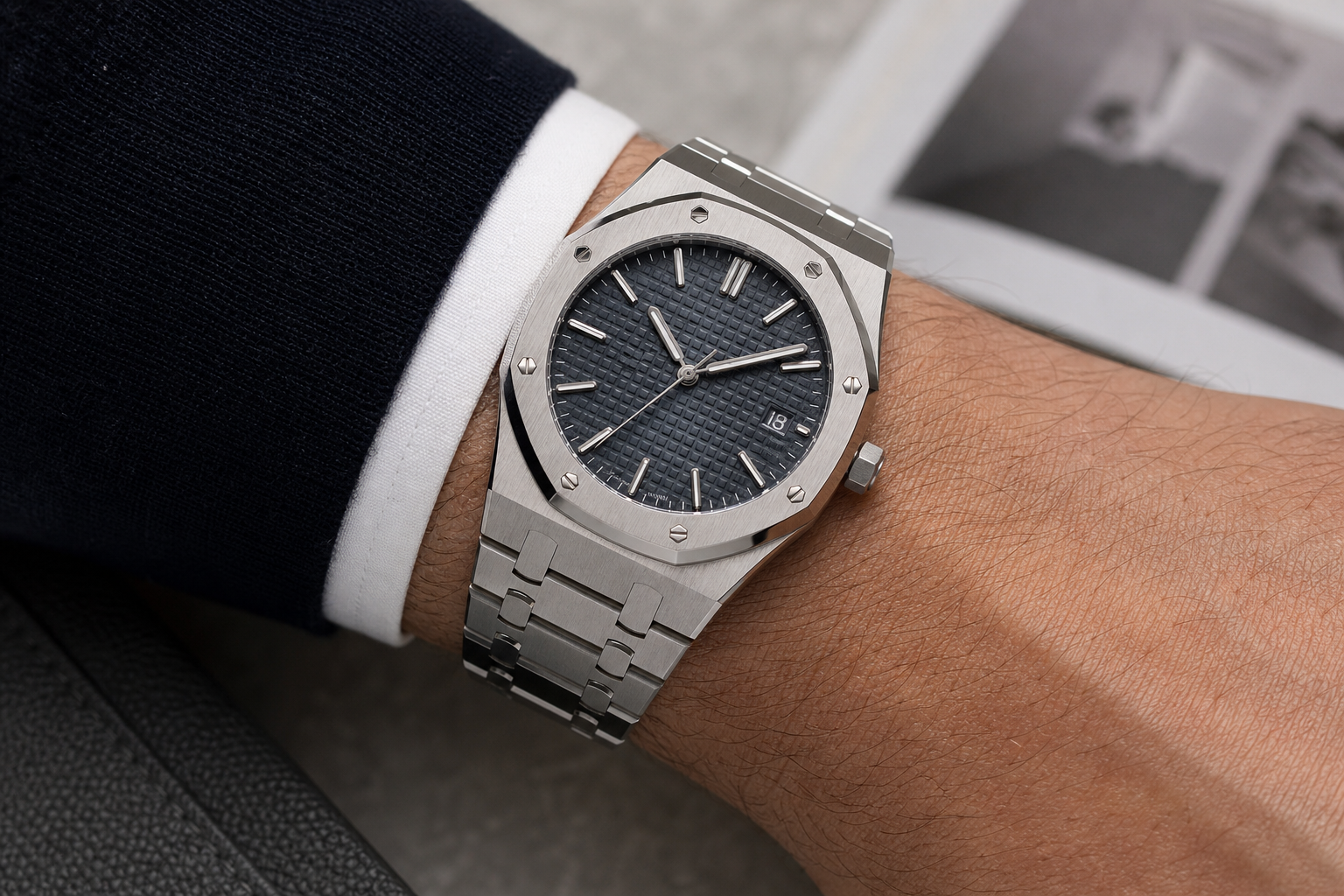
The Bezel and Polished Chamfers Are Where Ownership Reality Shows First
The earliest long-term change usually appears where the watch is most exposed: the bezel, the polished bevels, and the high-contact edges of the case and bracelet. This is where an AP super clone starts to look less “new” even if nothing is technically wrong with it. The issue is visibility. The design shows small marks quickly because the surfaces are supposed to look crisp and clean.
The bezel top often collects the first obvious hairlines. The polished chamfers can soften sooner than buyers expect. The outer bracelet links and clasp can pick up the kind of everyday contact that never looks dramatic in isolation but gradually changes the overall impression. The watch may still wear well, but it stops looking untouched.
That matters because the Royal Oak style is built around surface contrast. Once the brushed and polished areas no longer look sharply separated, the watch feels less fresh on the wrist. It may still be a good replica watch, but the emotional effect changes. Buyers who want a watch that ages quietly should pay attention to this before purchase, not after.
Careful wear helps, but it does not remove the reality of daily contact. A desk, a steering wheel, a laptop edge, a sleeve cuff, or even routine movement in and out of a car can leave a trace. The watch is not fragile in the fragile sense. It is just visually honest about wear in a way that rounder cases often are not.
Desk-Diving Marks on the Bezel and Bracelet
Typing at a desk is one of the easiest ways to add small marks without noticing it. Resting the wrist on a hard surface, brushing against a laptop edge, turning a steering wheel, or moving through a doorway can all leave fine lines on the bezel or bracelet. None of that is unusual. It is simply the reality of wearing a watch with exposed geometric surfaces and polished transitions.
The problem is that these marks become visible faster on an AP-style case, where Audemars Piguet finishing standards give them a cleaner stage than on many other watches. A mark that would disappear into a softer design stands out here, especially under direct indoor light.
Why Polished Bevels Lose Their Clean Look
The polished bevels are a big part of why the watch looks expensive and sharp when it is new. They catch light in a way that gives the case its definition. Once hairlines begin to collect on those edges, the effect is still attractive, but it becomes less crisp.
That is the real three-month ownership shift for many buyers. The watch has not become bad. It has simply moved from “fresh” to “used,” and because the design depends so much on clean transitions, that change is easier to notice than on many other replica watches.
What to Check After a Few Weeks
After a few weeks of real wear, it is worth looking at the bezel top, the case-side bevels, the clasp surface, the first bracelet links, and the areas around the screws under neutral indoor light. The point is not to look for perfection. The point is to understand how the watch is aging so expectations stay grounded.
If the watch is developing light wear in normal contact areas, that is expected. If the owner is already feeling stressed every time the watch touches a desk or sleeve, that is a sign the design may be less carefree than the buyer wanted. That difference is often more important than the marks themselves.
Bracelet Comfort Can Make or Break the AP Super Clone Experience
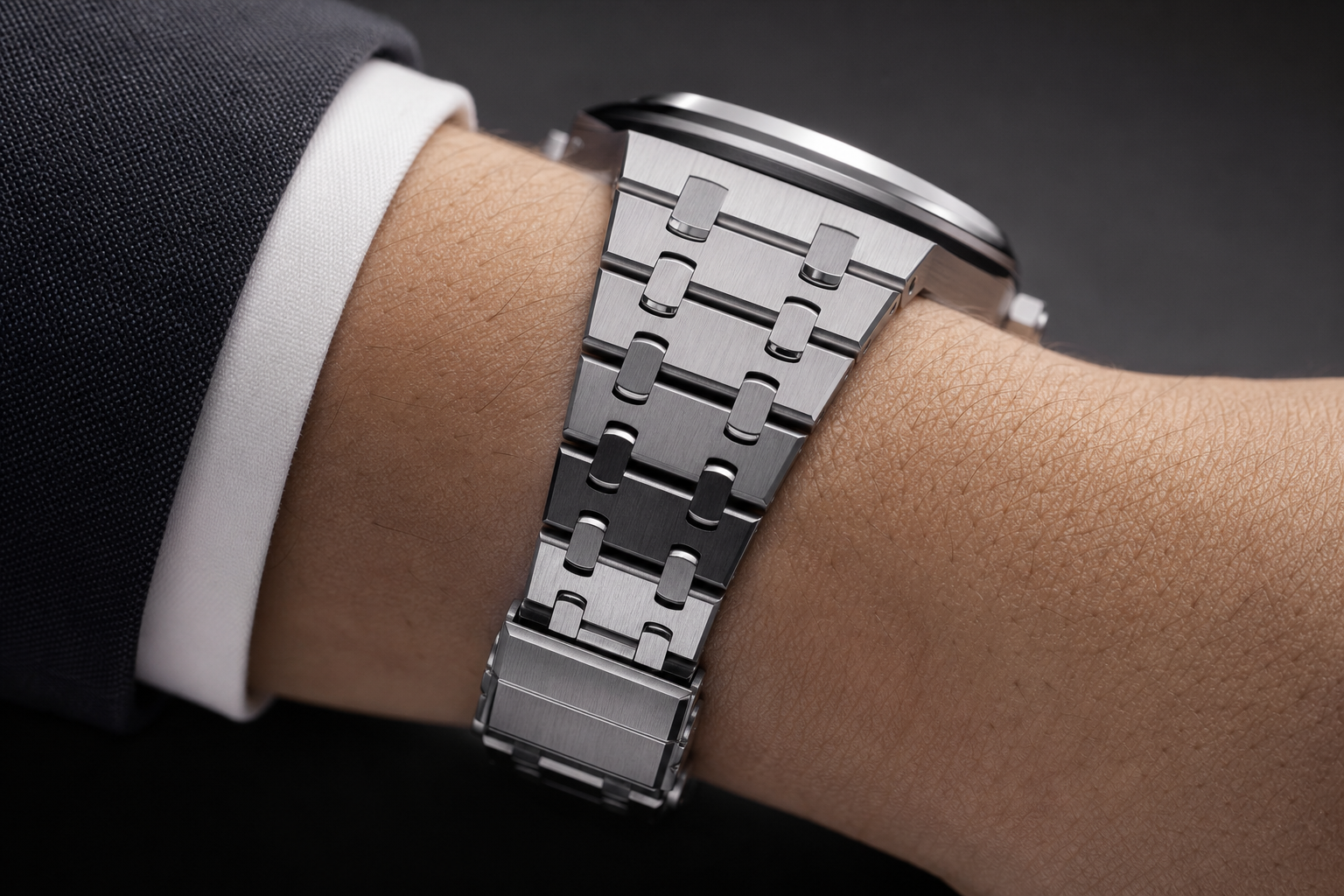
For an AP super clone, bracelet comfort matters more than most buyers expect. Dial accuracy gets the attention in QC photos, but three months later the bracelet is usually what decides whether the watch stays in rotation or starts sitting in a case. A Royal Oak-style integrated bracelet has a much narrower comfort window than an Oyster-style bracelet or a rubber strap. If the fit is slightly off, the watch can feel too loose, too tight, or just irritating enough that you stop reaching for it.
The problem is not only size. Wrist shape, link articulation, clasp balance, and edge finishing all affect how the watch feels after a full day. Some buyers put one on and think it feels perfect for the first two hours, then notice pressure points, wrist fatigue, or a hot spot near the clasp by late afternoon. That is why AP super clone bracelet comfort is not a small detail. For long-term satisfaction, it can matter more than minor dial differences.
Before accepting a watch, bracelet evidence should be treated as more than a cosmetic check. Front photos may show the dial clearly, but they often hide the underside of the bracelet, clasp thickness, link articulation, and whether the first links drop naturally from the case. Buyers should look for side angles, clasp underside photos, bracelet screw condition, and whether the watch head appears balanced on the sized bracelet. These details do not guarantee comfort on every wrist, but they reduce the chance of discovering a preventable fit problem only after the watch is already in use.
Why Sizing Is Less Forgiving Than on Simpler Sports Watches
The Royal Oak bracelet is less forgiving because it gives you fewer easy fixes. You often do not get the same kind of generous micro-adjustment range that makes a Submariner or Seamaster easy to tune. If the fit is off by even a little, the whole head of the watch sits differently on the wrist. Too loose, and the case can rotate or slide around. Too tight, and the bracelet starts to press into the wrist in a way that becomes noticeable after lunch, not just after a full day.
This is where half-link decisions and bracelet sizing become more important than buyers expect. A watch that felt acceptable during a quick try-on can become annoying once your wrist swells slightly through the day. That is especially true if you wear it in a warm office, drive a lot, or type at a desk for hours. On an AP-style replica, the bracelet has to be right enough that you stop thinking about it.
Sharp Edges and Hair-Pulling: Annoyance or Dealbreaker?
Hair-pulling is one of those issues buyers tend to underestimate until they live with it. On the Royal Oak design, some edge awareness is normal because the bracelet is made of many articulated links and crisp transitions. A little friction at first does not automatically mean the watch is bad. It may simply mean the bracelet feels new, stiff, or still needs settling.
The real problem is persistent sharpness. If the bracelet keeps catching skin or hair, or if the underside of the links feels abrasive after repeated wear, that stops being a minor annoyance and becomes a daily-use problem. This is not about being overly picky. It is about whether the watch feels easy to wear for ten hours, not just impressive for ten minutes. Buyers who are sensitive to this should be honest with themselves early. If you already dislike sharp bracelets on other watches, an AP super clone is not the safest place to hope the feeling will disappear.
Clasp Feel After Repeated Use
The clasp often becomes the part you notice most once the honeymoon period ends. It affects how secure the watch feels, how flat it sits on the underside of the wrist, and whether the bracelet starts to remind you of itself every time you rest your hand on a desk. A clasp that closes with confidence but does not dig in is a good sign. One that feels vague, uneven, or slightly awkward under pressure can become the main source of irritation, even if the rest of the bracelet looks excellent.
On a Royal Oak replica, the clasp should disappear into the wearing experience. If it becomes the hardest part of the watch to ignore, that usually means the sizing or bracelet balance is not right for you. The watch may still look great, but comfortable ownership is already compromised.
Movement Feel, Rotor Noise, and Winding Anxiety After Weeks of Use
The mechanical side of ownership is less about theory and more about confidence. A replica watch can keep acceptable time and still feel irritating if the rotor is noisy, the crown feels gritty, or the date setting makes you nervous. That is the part many buyers do not think about until the first week passes. After that, the watch stops being a new object and starts becoming a habit, and habits are shaped by how the movement feels in daily use.
With an AP super clone, movement anxiety can matter more than one small visual flaw. If you are constantly wondering whether the movement should be serviced, whether the winding is normal, or whether the watch is safe to handle roughly, the ownership experience gets heavier. Even a good-looking piece can stop being fun if every interaction feels like a risk check.
Movement choice also affects ownership in ways seller photos cannot show. Some versions may prioritize a closer visual layout or thinner case profile, while others may be easier to live with because the movement feels simpler, more familiar, or more serviceable. Decoration and visual similarity are not the same as long-term confidence. For daily wear, a buyer should care less about whether the movement looks impressive in a caseback photo and more about whether winding, date setting, rotor behavior, and basic timekeeping feel consistent after repeated use.
Rotor Noise Becomes More Noticeable in Quiet Settings
Rotor noise is easy to miss during unboxing because the excitement is doing most of the work. Once the watch is worn in real life, the sound can become more obvious in an office, in a car, or in a quiet room. That matters even more if you are already worried about the movement. A sound that might be tolerable on its own can become distracting when you start listening for it.
This is why buyers should separate “normal for the movement” from “easy to live with.” A noisy rotor does not automatically mean the watch is broken, but it can still reduce enjoyment. If you are the type who notices mechanical sounds quickly, rotor noise should be treated as a real ownership factor, not a trivia point.
Winding and Date Setting Are Emotional Confidence Tests
Crown feel tells you a lot about how relaxed you will be with the watch. Smooth engagement makes the watch feel usable. Gritty, loose, or inconsistent crown action makes owners baby the watch. The same goes for date setting. If the transition feels rough or uncertain, you start handling the watch more carefully than you normally would, which is not a great sign for a daily wearer.
The most practical rule is simple: if the movement feels odd, do not force anything. Avoid rough handling, especially around date-change windows, and treat unusual resistance as a warning rather than something to “work through.” Movement photos alone do not tell you how the watch will feel after weeks of winding, setting, and normal wrist use.
Movement Route to Verify Before Buying
Before buying, confirm the stated movement route, the date function behavior, the expected beat rate if it is relevant to the version, and whether the seller can show clear QC photos of the watch running properly. That does not guarantee long-term reliability, but it does reduce the chance of buying a watch with a hidden mismatch or a movement layout you did not expect.
If a seller is vague about the movement or avoids basic functional questions, that is not a small issue. It usually means the buyer is being asked to accept uncertainty without getting enough information to judge the risk.
Movement Transparency Note: Movement references in this article describe the replica-market movement type, layout, or configuration, not an official Audemars Piguet caliber unless supported by verifiable evidence. Buyers should judge the specific watch by winding feel, date-setting behavior, rotor sound, timekeeping consistency, and service practicality rather than movement decoration alone.
Common Ownership Sensations Worth Taking Seriously
- Smooth: usually a good sign, especially for crown feel and date setting.
- Gritty: worth paying attention to, especially if it does not improve after normal use.
- Noisy: may be acceptable in some movements, but not always easy to live with.
- Loose: can make the watch feel less secure during winding or setting.
- Resistant: fine to a point, but not if it feels inconsistent or forced.
- Inconsistent: the one sensation that usually deserves the most caution.
Office, Casual, and Travel Wear: Where an AP Super Clone Feels Easy or Stressful
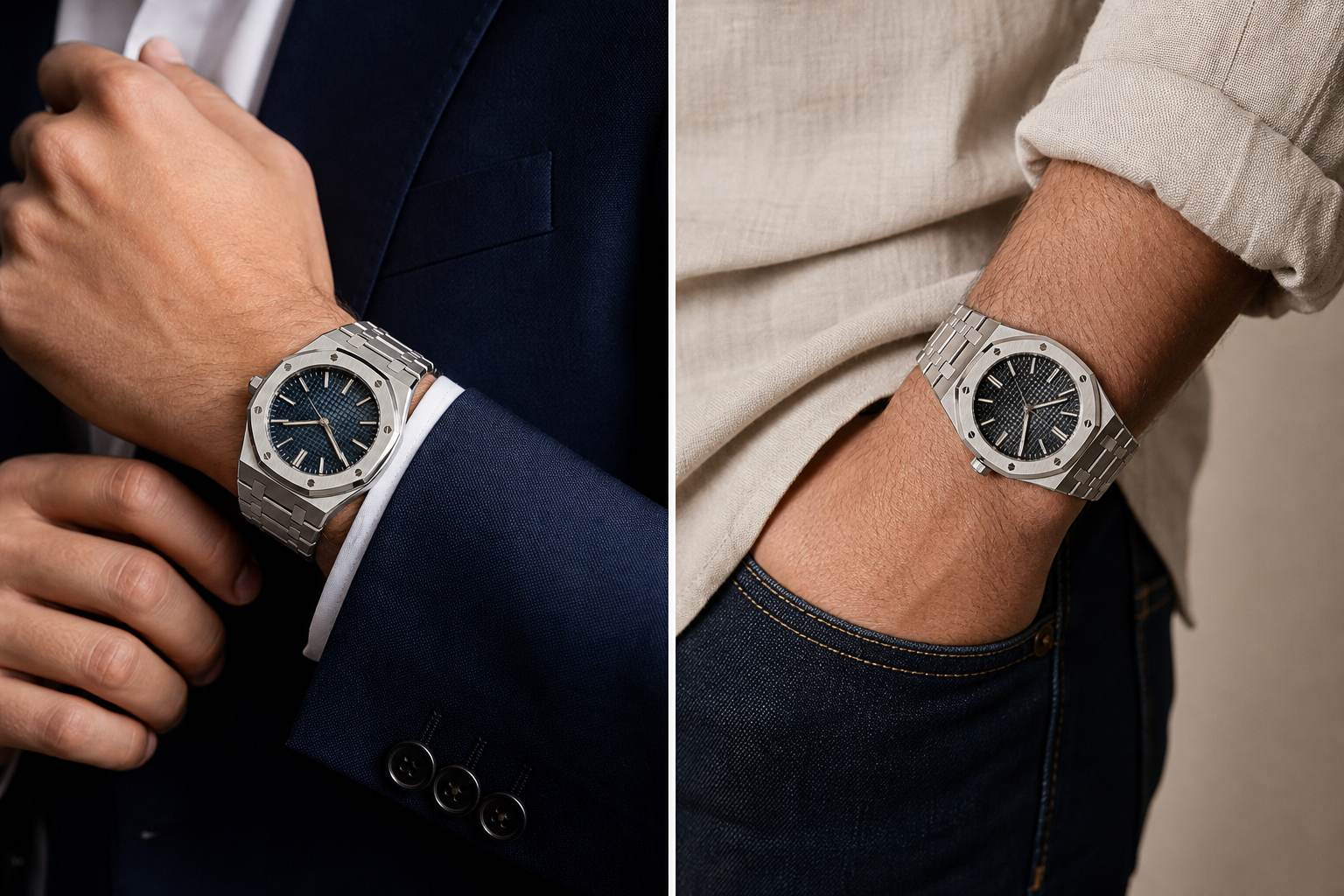
The real question is not whether an AP super clone looks good in a photo. It is whether it fits your life. Some watches are easy in almost every situation. The Royal Oak is not one of them. It can be highly satisfying in the right setting, but it asks for more awareness than simpler replica watches. That is why it often works better as a rotation piece than as a carefree beater.
For buyers who want one watch they can throw on without thinking, an AP-style replica may feel like too much effort. For buyers who enjoy the shape, accept the visibility, and do not mind a bit of watch management, it can be a rewarding wear. The difference is not just taste. It is the amount of friction the watch adds to ordinary life.
Office Wear: Desk Marks and Visibility
Office wear is where the small annoyances start to matter. Laptops, desk edges, sleeves, and conference table contact all make the bracelet and clasp work harder. If the sizing is not quite right, you will notice it most when your wrist rests on a hard surface for long periods. Rotor noise can also stand out more in quiet rooms, especially if the watch already feels mechanically uncertain to you.
Visual attention is another factor. The Royal Oak shape is recognizable enough that people may look at it more than they would a simpler round watch. That is not automatically a problem, but it does mean the watch is less invisible in a professional setting. If you want something that disappears into the background, this is not the easiest choice.
Casual Wear: The Watch Looks Better but Still Needs Awareness
Casual clothes usually suit the Royal Oak shape well. A T-shirt, overshirt, polo, or relaxed jacket often makes the watch look more natural than formal clothing does. The angular case and integrated bracelet have a strong visual identity, so they tend to work well when the rest of the outfit is simple.
Even so, casual wear is where accidental contact becomes more likely. Door frames, shopping bags, seatbelts, gym bags, and outdoor movement all create more chances for contact. That matters because this watch style tends to make wear marks feel more visible than on a round diver or a strap watch. It is not fragile by default, but it is not a mindless grab-and-go watch either.
Travel Wear: Not Always the Relaxed Choice
Travel is where the AP super clone can shift from enjoyable to mildly stressful. The watch is visually recognizable, the bracelet is detailed, and the whole design invites attention. If you are already alert about risk, that can make the watch feel less relaxing than a simpler diver or a rubber-strap sports watch. You may find yourself thinking about visibility, handling, and where the watch is brushing against your bag or jacket more than you would with a lower-profile piece.
That is why travel is a useful test. If you reach for the watch less often on trips because you do not want to manage it, that tells you something important. A good travel watch should lower friction, not add it. An AP super clone can be a strong rotation choice, but it is rarely the most carefree one.
Best-Fit Scenarios for This Watch
- Office days: good if the fit is right and you do not mind some visibility.
- Weekend lunches: one of the better use cases for the design.
- Evening events: strong visual payoff if you are comfortable wearing it openly.
- Long travel days: more mixed, especially if you prefer low-maintenance watches.
The cleanest way to think about AP super clone daily wear is this: it can feel easy in short, controlled situations, but less effortless over long, busy, or highly active days. If you like the watch but still want something you can wear without thinking, that is usually a sign to keep it as a rotation piece rather than making it your only daily watch.
The Attention Factor: Royal Oak Shape Is Not a Low-Profile Choice
An AP replica does not disappear on the wrist. The Royal Oak shape is part of the appeal, but it is also the reason the watch gets noticed faster than many round sports watches. After the first few weeks, that visibility starts to matter more than the spec sheet. Some owners like the comments and glances. Others start reaching for something quieter because the watch feels too recognizable for everyday life.
The important point is not whether the watch is “loud” in a negative sense. It is that the Royal Oak silhouette has a strong visual identity even from a few feet away. The octagonal bezel, exposed screw layout, and integrated bracelet are what people see first. Most casual observers will not be studying the dial texture or movement finish. They react to the overall shape, which means the watch can draw attention before any technical detail does.
That changes ownership. A watch that feels exciting in the mirror can feel different in a meeting, in an airport line, or at dinner with people who know enough about watches to recognize the outline immediately. For buyers who want a low-profile daily watch, that is the real issue. The question is not just “does it get noticed?” but “am I comfortable being noticed?”
Why the Shape Gets Noticed Before the Details Do
The Royal Oak’s wrist presence comes from geometry, not size alone. Even when the watch is not oversized, the octagonal bezel and integrated bracelet create a visual footprint that stands out more than a conventional diver or dress-sport watch. From a distance, the shape is obvious. That is why the watch can attract attention without anyone needing to inspect the dial, the movement, or the finishing under macro conditions.
Small replica details matter to enthusiasts, but they are usually not what triggers real-world attention. Most people notice the silhouette, the bracelet flow, and the flat, architectural look of the case. In normal social settings, that is enough to make the watch feel present on the wrist even when it is not physically large.
When Attention Reduces Wrist Time
This is where ownership becomes personal. Some buyers love the watch at home and then wear it less in public because it feels too visible for work, errands, or travel. That is a common three-month outcome with AP-style super clones. The watch does not become worse; the wearer simply becomes more aware of how much it stands out.
Once that happens, wrist time often drops. A buyer who wanted a bold daily watch may find the Royal Oak becomes a rotation piece instead. That is not necessarily a failure. It just means the buyer underestimated how much social visibility would affect comfort. If you want something that blends in more easily, this design is usually the wrong starting point.
The best AP replica owner is not someone trying to manage a story. It is someone who is comfortable wearing the watch as a replica watch for personal enjoyment, without needing it to behave like a low-profile, invisible object or be mistaken for a genuine luxury watch.
Maintenance Anxiety: The Hidden Cost of Choosing an AP-Style Replica
Maintenance anxiety is the part buyers underestimate most. A scratch is visible, but a watch that feels delicate can change how you wear it every day. After a few months, some owners stop thinking about the watch as a fun object and, when comparing risk points against a super clone Audemars Piguet guide, start thinking about what could go wrong: the bezel, the bracelet, the movement, water exposure, the crown, or the next accidental knock against a desk or door frame.
AP-style super clones tend to create that caution more than simpler daily-watch replicas. The finishing is more exposed, the integrated bracelet is more complex, and the whole design feels like something you should handle carefully. That caution is reasonable up to a point. The problem is when caution turns into hesitation. If you are constantly babying the watch, you are not really enjoying it.
Fear of scratches often does more damage to ownership enjoyment than the scratches themselves. Once the watch has a few marks, some buyers relax. Others become more protective and wear it less. That is why maintenance anxiety is not a side issue; it is often the factor that decides whether the watch stays in the box or becomes part of the rotation.
Water, Crowns, and Daily Handling
Owners should be conservative around water, crown use, and impact unless the specific piece has been checked by a competent watchmaker or a proper seller process. That is not the same as assuming the watch is fragile, but it is a realistic way to manage risk. An AP-style replica is not the kind of watch you should casually treat as if every unit has guaranteed water resistance or stress tolerance.
Water resistance should not be assumed unless the specific watch has been tested and the seller’s policy is clearly confirmed. Even when a watch appears well assembled, crown sealing, caseback fit, gasket condition, and prior handling can all affect real-world risk.
Daily handling also matters. Small habits add up: reaching into a sink, leaning on a desk edge, catching the bracelet on a bag strap, or giving the crown a rough turn when you are in a hurry. None of these moments sounds dramatic. Together, they create the mental burden that makes some owners less willing to wear the watch often.
Why Service Worry Feels Different From Visual Worry
A visible scratch is annoying, but it is easy to understand. Movement uncertainty is different. If the owner is not confident about the movement route, serviceability, or long-term behavior, the watch starts to feel less carefree. That can make the owner hesitant to wind it, set it, or wear it regularly.
That hesitation is a real cost. A watch that makes you worry every time you touch the crown is not a relaxed ownership experience. For many buyers, the mental load is more tiring than the physical wear. If you find yourself constantly wondering whether the next small action will cause a problem, the watch may be too much work for your expectations.
Red Flags Before Buying
Before purchase, it helps to confirm a few practical things: a clear movement route, QC photos that actually show the watch from useful angles, side-profile images, consistent date alignment, straightforward answers about bracelet sizing, and no exaggerated claims about perfect durability. If the seller avoids these basics, that is usually a bad sign.
Another red flag is vague confidence. If everything is described as flawless and nothing is acknowledged as a tradeoff, the buyer is often being sold a fantasy rather than a wearable watch. A sensible purchase comes from clear expectations, not from promises that the watch will age without consequence.
Version-Specific Ownership Questions to Ask
Before comparing AP-style replicas, buyers should narrow the discussion to the exact reference style and version rather than relying on a broad factory reputation. A 15400-style model may have different case thickness, bracelet behavior, dial spacing, and movement feel from a 15500-style model or an extra-thin reference. Chronograph-style layouts add another layer because subdial spacing, pusher feel, and case height can change the ownership experience. A version-specific question is more useful than asking whether one factory is always better.
A practical shortlist should connect the watch to real ownership use: Is the case profile acceptable from the side? Does the bracelet articulate well enough for your wrist size? Does the date sit cleanly in the window? Are the bezel screws aligned consistently? Does the clasp look clean underneath? Is the movement route explained in a way that matches the model? These checks make the decision more traceable and reduce the risk of buying based only on attractive front photos or a familiar market label.
How to Read QC Photos and Price Claims Before Buying
QC photos are useful, but they are not final proof of how the watch will wear after three months. They can show dial alignment, date position, hand setting, bezel screw placement, case shape, bracelet finishing, and obvious cosmetic flaws. They usually do not show how the clasp feels after a full workday, whether the bracelet pulls hair, how loud the rotor becomes in a quiet room, or whether the crown action feels confident. For an AP-style replica, buyers should ask for angles that reveal the side profile, bracelet articulation, clasp underside, bezel brushing, and date window, not only flattering front-facing shots.
QC photos can reduce uncertainty, but they do not guarantee perfection. Buyers should still review visible details and confirm seller policies before ordering, including what happens if the supplied watch differs from the claimed factory label, movement route, or agreed QC evidence.
Price also needs careful interpretation. A higher price may reflect a different movement route, a newer version, more consistent finishing, limited availability, seller margin, or after-sale risk being priced into the transaction. It does not automatically mean the watch will be more comfortable or less stressful to own. For this model family, it is more useful to compare the movement, case thickness, bracelet feel, known version weaknesses, and the seller’s willingness to answer specific QC questions than to assume the most expensive listing is the safest daily-wear choice.
Prices can change by factory label, version, movement, seller channel, and availability, so exact comparisons should be verified at the time of purchase. If two listings appear to describe the same AP-style replica, buyers should compare the actual version, movement disclosure, QC process, bracelet details, and seller communication before deciding that one is better value.
Seller descriptions should be treated as signals, not conclusions. Words like “latest version,” “best factory,” or “top grade” only become meaningful when connected to buyer-verifiable details: which movement is inside, whether the case profile matches the claimed reference, how the date sits, whether the bracelet edges look clean, and whether the clasp closes evenly. A careful buyer does not need to be cynical, but should avoid letting factory labels and polished photos replace practical checks.
Before making a decision, buyers should review real QC photos where available, including dial printing, hand alignment, bezel screw position, datewheel centering, bracelet fit, clasp engraving, case thickness, side profile, and overall finishing. Factory labels and stock photos alone are not enough for a reliable judgment, especially on an integrated-bracelet design where comfort and finishing are closely linked.
What Proof Should Matter Before You Trust a Claim?
Because AP super clone listings often use confident language, buyers should separate observable evidence from sales language. Observable evidence includes clear photos of the actual watch, side-profile shots, date-window closeups, clasp and bracelet underside images, video of the hands moving, and basic functional checks during QC. Sales language includes broad claims such as “best version,” “same as genuine,” “perfect case,” or “waterproof.” The first category helps you judge a specific piece; the second category should be treated cautiously unless it is backed by something you can inspect.
A practical evidence standard is to ask whether the claim changes your buying risk. If the claim is about bracelet comfort, request angles that show link articulation, clasp position, and underside finishing. If the claim is about movement route, ask for clear movement disclosure and avoid assuming that decoration proves equivalence. If the claim is about water resistance, treat it as unconfirmed unless the individual watch has been pressure-tested. If the claim is about factory superiority, narrow the question to the exact reference, version, and ownership issue you care about.
| Claim Type | Useful Evidence | What It Still Does Not Prove |
|---|---|---|
| Factory name | Consistent seller disclosure, QC history, buyer-verifiable version details | It does not prove universal quality or perfect long-term reliability |
| Movement route | Clear movement photos, functional video, seller answers about setting behavior | It does not prove authentic-equivalent construction or future service outcome |
| Bracelet comfort | Side angles, clasp underside photos, link articulation views, sizing discussion | It does not prove the bracelet will fit every wrist comfortably |
| Water resistance | Individual pressure test after purchase | It does not follow automatically from the authentic model’s rating |
| Price level | Version details, movement disclosure, QC standard, seller support | It does not guarantee the most comfortable ownership experience |
The safest buying mindset is not to reject every seller claim, but to rank claims by how verifiable they are. A visible date alignment issue, rough clasp finish, or questionable side profile matters more than a confident sentence in a listing. Three months later, the watch is judged by what you feel and see every day, not by the strongest wording in the product description.
AP Versus Simpler Replica Choices After Three Months
After three months, the real comparison is not prestige. It is friction. An AP-style super clone can be more rewarding visually, but it is usually less forgiving than a Submariner-style diver, a Seamaster-style sports watch, or a Datejust-style daily watch. That difference matters more once the novelty wears off.
For a buyer who wants a watch to wear often without thinking about it, simpler designs usually win. Rounded cases, familiar bracelets, and more straightforward proportions make small marks and fit issues less emotionally disruptive. The AP offers more personality, but that personality comes with more attention, more caution, and more ownership awareness.
That is why the right answer depends on the wearer. If you want a distinctive piece and understand that it will show wear, attract notice, and demand more care, the AP can still be the more satisfying choice. If you want a watch that disappears into daily life and asks less from you, a simpler replica is usually the safer buy.
Why Submariner-Style Replicas Feel More Forgiving
Submariner-style replicas are easier to live with because the design is less emotionally sensitive. Rounded cases, a familiar oyster-style bracelet, and a sport-watch identity make small marks feel normal rather than distracting. Even when the watch picks up wear, it usually still looks like a tool watch that is supposed to be used.
That changes how owners react. A mark on a diver often feels like part of the watch’s life. A mark on a Royal Oak-style case can feel like it broke the clean geometry. That psychological difference is real, and it is one reason simpler replica watches often age better in the owner’s mind even if they are less visually exciting.
Why Datejust-Style Replicas Can Be Easier Daily Watches
A Datejust-style replica is often easier for everyday wear because it is less aggressive on the wrist and easier to pair with office or casual clothing. The shape is familiar, the sizing is less tricky, and the watch does not pull as much attention. For a buyer who wants one replica to wear repeatedly without thinking too much about it, that matters.
The key advantage is low friction. You do not have to think about whether the watch looks too bold, whether the bracelet will annoy you after long days, or whether the design will feel too exposed in certain settings. That is why some buyers end up preferring a simpler daily watch even after admiring the AP from a distance.
Where the AP Still Wins
The AP still wins on architecture and identity. If the buyer wants a watch that feels distinctive the moment it is on the wrist, the Royal Oak design gives more emotional impact than a conventional sports watch. It has more presence, more edge, and more visual character.
That is the tradeoff. The AP is usually more rewarding for someone who likes being aware of the watch and accepts that it will not be the easiest or quietest option. If you want the most comfortable path, choose something simpler. If you want the stronger design statement and can live with the ownership friction, the AP still makes sense.
Who Will Still Enjoy an AP Super Clone After Three Months?
An AP super clone is worth considering only for a specific type of buyer. If you want a watch that stays exciting because of its shape, wrist presence, and integrated-bracelet character, the Royal Oak-style replica can still feel satisfying after the honeymoon period. If you want a low-friction daily watch that you do not have to think about, it is usually the wrong choice. The three-month test is not about whether the watch still looks good in photos; it is about whether you still want to reach for it after the first scratches, the first sizing tweak, and the first time the bracelet or movement reminds you that it is not a carefree beater.
The better AP replica buyer is usually someone who already likes bold design and accepts that ownership comes with a little tension. That buyer understands that surface marks are part of normal wear, not a sign that the watch has failed. They are also less bothered by the fact that the watch is visually noticeable and more comfortable treating it as a rotation piece than a one-watch solution. For that person, an AP super clone can remain enjoyable well past the first few weeks because the design itself still feels special on the wrist.
The wrong buyer often starts with the right question but the wrong expectation. They ask whether the watch is visually impressive, but what they really need is a watch that disappears into daily life. That buyer tends to notice every hairline scratch, every slightly sharp link edge, every bracelet adjustment issue, and every bit of rotor noise. Once those things pile up, the watch stops feeling like a reward and starts feeling like a project. That is where buyer regret usually begins.
The Buyer Who Should Choose AP
Choose AP if you like watches with strong visual identity and you want the bracelet-and-bezel architecture to be part of the appeal. This is the buyer who does not mind seeing small marks appear over time, because they expect a watch to age with use. They are comfortable with a bracelet that may need a little more attention than a simple oyster-style setup and they are not expecting the watch to behave like a worry-free tool watch.
For this buyer, the Royal Oak-style super clone works best as a rotation watch or a style piece that gets worn with intention. It fits well when the goal is to enjoy the design, not to ignore the watch completely. If you already know you like integrated-bracelet sports watches and you are realistic about wear, the AP can stay satisfying after three months because the appeal is still there even when the case and bracelet are no longer pristine.
The Buyer Who Should Choose Something Simpler
Choose something simpler if you get annoyed by small imperfections fast. If every desk mark, clasp mark, or polished-edge scuff will bother you, the AP style is going to feel expensive in effort even if the purchase price is not extreme. The same is true if you dislike wrist attention or prefer a watch that blends into the background. A more conventional diver or Datejust-style replica usually gives a calmer ownership experience with less mental friction.
This is also the better path for a first replica watch buyer who is still learning what they actually tolerate. A simpler watch is easier to size, easier to wear, and easier to forget about during the day. That matters more than people admit. Many buyers think they want the most distinctive watch in the lineup, then discover after a few weeks that they actually prefer the one they never have to think about. If you want low-maintenance daily wear, pause before buying an AP super clone.
The Three-Month Decision Rule
The simplest test is this: imagine the watch after the first scratches are already there. Picture the bezel no longer looking fresh, the bracelet needing a sizing adjustment, the rotor making a little noise in a quiet room, and the case drawing more attention than you expected. If that version of ownership still sounds appealing, the AP may be a good fit. If that version already feels stressful, a simpler replica is the smarter buy.
In practice, the three-month decision rule separates enthusiasm from fit. A buyer who likes the idea of an AP but does not want to protect it constantly will usually enjoy it less than they expect. A buyer who genuinely wants a bold integrated-bracelet watch and accepts the normal tradeoffs will usually keep reaching for it. That is the real answer to is an AP super clone worth it: yes, for the right owner; no, for the buyer who wants a carefree daily wearer.
If you are still deciding, use one final filter. Choose AP if you want design presence, can live with visible wear, and see the watch as a rotation piece. Consider a simpler replica if you want easier sizing, less attention, less anxiety, and a watch that feels more effortless after three months than it did on day one.
Disclosure: This article is for general educational and comparison purposes only. Replica watches are not genuine products from the original luxury brands, and brand names are used only to identify reference designs or comparison topics. Factory names, movement descriptions, prices, availability, QC details, seller policies, and version information can change, so readers should verify important details with the seller before making a purchase decision. Replica watches should not be represented, resold, or used as genuine watches.