
Audemars Piguet Royal Oak-style super clones are difficult to judge because the design gives manufacturers very little room to hide mistakes. Unlike many Rolex or Omega sports models, the Royal Oak depends on a thin side profile, sharp case geometry, and AP super clone ownership reality becomes especially clear when even bezel screws, strong brushing contrast, and an integrated bracelet must flow naturally from the case. A small issue in one area can make the whole watch look or feel off.
This article helps separate photo-friendly details from the parts that actually decide whether an AP-style replica is worth considering. Instead of focusing only on dial text or movement names, the practical judgment comes down to structure, finishing, bracelet comfort, screw alignment, and daily usability. Buyers who understand these pressure points are less likely to overpay for a version that looks convincing in close-up photos but feels wrong on the wrist.
For this model family, factory reputation should be treated as a starting filter, not a final answer. One factory may execute a particular Royal Oak reference well because it has a better case set, while another may be stronger on bracelet finishing, dial texture, or movement route. The useful question is not simply whether a factory name is popular, but whether the specific version being offered solves the Royal Oak’s most visible problems: thickness, case geometry, bracelet flow, screw seating, and dial depth.
| What to Check | Why It Matters on a Royal Oak-Style Clone | Buyer Judgment |
|---|---|---|
| Side profile and thickness | The thin case is central to the Royal Oak look and hard to fake cleanly. | A thick case is a major warning sign, even if the dial looks good. |
| Bracelet integration | The bracelet must flow from the case with smooth articulation and controlled gaps. | Prioritize wrist feel and case-to-bracelet transition over small dial details. |
| Bezel screw alignment | The exposed screws define the symmetry of the front view. | Uneven or poorly seated screws are more noticeable than minor surface marks. |
| Tapisserie dial depth | A flat or poorly printed dial weakens the watch’s visual structure. | Check texture, markers, date framing, and printing together, not separately. |
| Movement and usability | Movement shortcuts can affect thickness, winding feel, rotor noise, and reliability. | Do not judge by movement photos alone; consider daily wear behavior. |
| QC photo quality | Filtered or incomplete photos can hide case shape and bracelet issues. | Ask for straight front, side profile, bracelet junction, clasp, and date views. |
Brand and Reference Boundary: Brand names such as Audemars Piguet, Rolex, and Omega are used here to identify the genuine reference designs being discussed and to explain why certain replica-market watches are easier or harder to evaluate. These references do not imply authorization, endorsement, official production, or service compatibility with the original luxury watch brands. Replica watches should be understood as replica-market products, not genuine brand-manufactured watches.
Editorial Perspective: At cleanvsfactory.com, AP Royal Oak-style replicas are treated as model-specific buying decisions rather than simple factory rankings. A factory label, seller description, or attractive QC set can be useful, but none of them proves the watch will wear correctly. For this design, the most reliable judgment comes from comparing the exact version’s case thickness, bezel geometry, screw seating, bracelet articulation, dial texture, movement route, and expected daily-use behavior. A replica watch is not genuine, official, or authorized, so the buyer’s practical advantage comes from knowing which claims can be checked before purchase and which claims remain ownership risks after delivery.
Evidence Boundary: This guide uses cautious replica-watch language because many factory, movement, material, and waterproofing claims in this market are seller-driven and difficult to verify independently. Official Audemars Piguet information can help a buyer understand the authentic Royal Oak design target, but it should not be treated as proof that any replica has the same dimensions, materials, movement performance, finishing tolerance, or water resistance. Likewise, a factory name in a listing should be read as a claim to inspect, not as a guarantee of execution.
Quick Questions Before You Read
Q: Are AP Royal Oak super clones harder to buy safely than Rolex or Omega styles?
Often yes, because the Royal Oak’s exposed case, bezel, screws, and bracelet make small flaws easier to notice.
Q: What should I check first in QC photos?
Start with side thickness, bracelet flow, bezel screw alignment, and date centering before judging smaller cosmetic details.
Q: Does a better-looking dial mean the watch is a better choice?
Not by itself. A strong dial cannot compensate for poor case geometry, stiff bracelet fit, or awkward thickness.
Q: Is an AP-style clone a good first replica watch?
It can be, but it is less forgiving. Beginners may find Rolex or Omega-style sports models easier to evaluate and wear daily.
Why AP Super Clones Are Harder to Get Right Than Rolex or Omega
The main reason AP super clone difficulty is higher is not simply that Audemars Piguet is expensive. It is that the Royal Oak design gives replica makers very few places to hide compromise. A Rolex Submariner-style case or many Omega Seamaster-style cases can absorb small errors through bezel mass, conventional lugs, curved case sides, or a busier tool-watch layout. A Royal Oak exposes the entire structure: thin case profile, octagonal bezel, visible screws, integrated bracelet, sharp brushed surfaces, polished bevels, and a tapisserie dial that reacts to light from almost every angle.
This is why Royal Oak replica accuracy is judged differently from many other super clone watches. A replica can look impressive in a seller’s front-facing photo and still feel slightly wrong on the wrist if the case is too thick, the bevels are soft, the bracelet does not flow cleanly from the case, or the dial texture looks flat under normal lighting. AP is less forgiving because its design is architectural. The watch is not hiding behind a round case and a separate bracelet. The case, bezel, dial, and bracelet all form one visible geometry.
The common buyer mistake is treating AP as just a more expensive version of the same replica problem. That is the wrong lens. The better question is not only “which factory makes the best AP?” but “does this specific Royal Oak-style watch preserve the thinness, edge definition, alignment, and surface contrast that make the design work?” If those elements are weak, the watch does not merely lose a few technical points. It loses the visual tension that makes a Royal Oak recognizable.
Another mistake is assuming that the highest-priced AP-style option automatically solves the hard parts. Price can reflect a newer movement, a more limited batch, stronger finishing, seller margin, after-sale handling, or simple market hype. A higher price may be justified when it brings a cleaner case profile, better bracelet machining, or a more suitable movement route, but it should still be verified through photos and known version behavior. On this model, price alone is not a substitute for checking the architecture.
Exact price comparisons should be treated with restraint unless they are tied to a specific seller, version, and time of purchase. Two watches described with the same factory name can still differ because of batch variation, movement route, dial color, bracelet finishing, shipping method, QC standard, and after-sales handling. For AP-style replicas, the better evidence is not simply a higher or lower number; it is whether the seller can show the case profile, bracelet junction, screw seating, dial texture, and movement route clearly enough for the buyer to judge the actual watch being offered.
A traceable AP comparison should move from the broad claim to the specific watch. Start with the listed factory name, then narrow it to the exact Royal Oak reference, case size, dial color, movement route, version or batch, and available QC images. This prevents the buyer from assuming that a positive reputation on one Royal Oak model automatically applies to another size, complication, or dial variant.
Pricing and Value Boundary: Replica watch prices can change by factory label, version, movement configuration, seller channel, availability, finishing quality, and after-sales support. A watch should not be treated as a better value only because it is described as a newer factory release or a higher-tier version. The more useful comparison is like-for-like: the same reference style, same movement route, same bracelet construction, similar QC evidence, and clearly understood seller terms.
AP looks simple from far away, but it is visually exposed up close
From a distance, a Royal Oak can seem minimal: time, date, octagonal bezel, integrated bracelet. Up close, it is one of the least forgiving luxury sports watch designs to copy because almost every surface becomes a reference line. The bezel edges frame the dial. The screw positions create a visual grid. The bracelet links continue the case geometry. The brushed finish must run cleanly across flat surfaces while the polished bevels remain narrow, bright, and sharply separated.
That is where many AP replicas start to struggle. A small flaw on a conventional round watch may look like a minor finishing issue. On a Royal Oak, the same flaw interrupts the whole design. If the bezel chamfer is too rounded, the watch loses its crispness. If the case side is too tall, the slim profile disappears. If the bracelet starts with the wrong angle, the case no longer flows into the wrist. The problem is not one isolated defect; it is the way AP’s exposed architecture makes small defects interact with each other.
This is also why photos can be misleading. A straight-on image may hide case thickness, soften edge transitions, and make the bracelet look better than it feels. Many Royal Oak-style super clones are most flattering in controlled lighting from the front. The real test comes from side angles, wrist shots, and light hitting the bevels. If the finishing tolerance is not tight, the watch can look flatter, heavier, or less precise in person than it did in QC photos.
A useful buyer habit is to separate “photo accuracy” from “wear accuracy.” Photo accuracy is whether the dial color, logo position, and bezel layout look convincing in a still image. Wear accuracy is whether the watch keeps the right profile, drape, weight balance, and finishing impression as the wrist moves. The Royal Oak punishes weak wear accuracy more than many round sports watches because the case and bracelet are read as one continuous object.
Why expensive does not automatically mean easier to replicate
A higher-end watch is not automatically harder because of its price. Some expensive watches are difficult because of movement finishing or precious metal work, but their external shapes may still be relatively forgiving. AP is difficult for a more visible reason: the original design depends on exact proportion and surface control. The Royal Oak is expensive in the genuine market, but its replica challenge comes from geometry, not retail price.
This distinction matters for buyers. A super clone watch can use a decent movement, have acceptable dial printing, and still miss the Royal Oak feeling if the case and bracelet do not carry the design correctly. With AP, the eye notices structure before it notices specifications. A watch that is technically “upgraded” on paper may not be the better buy if the case profile becomes too thick or the finishing loses sharpness.
The stronger judgment is this: AP is a less forgiving replica target than many Rolex or Omega models because the design punishes shortcuts immediately. A buyer who wants the Royal Oak silhouette should be ready to inspect more carefully and accept that even strong versions may show limitations under close handling. A buyer who mainly wants a lower-risk first replica may find AP more demanding than expected.
This is also why “best factory” claims need narrowing. A factory may be the better choice for one Royal Oak size or reference but less convincing on another because the case set, dial source, bracelet machining, or movement thickness changes. When a seller uses a broad factory claim, the buyer should translate it into a specific question: is this exact reference, in this exact batch, strong in the areas that matter for my use?
Factory Name Clarification: Factory names in the replica watch market are commonly used buyer-facing labels. They should be treated as practical market references, not as official brand affiliations, audited manufacturer identities, or guarantees of identical quality across every Royal Oak-style model, size, dial color, or production batch.
A more reliable factory comparison is version-specific. For example, one AP-style version may be stronger because its case and bracelet set are better machined, while another may be preferred because its movement route keeps the case thinner or its dial texture is more convincing. The factory name helps organize the search, but the buyer still needs to verify the exact watch through visible execution and movement configuration.
Why Rolex and Omega Give Replica Makers More Room to Hide Mistakes
Rolex replica tolerance and Omega super clone design are often better for beginners because many models use more conventional watch architecture. This does not mean they are easy to clone perfectly. Rolex crown guards, bezel action, rehaut alignment, date magnification, and bracelet feel still matter. Omega replicas can have their own issues with case thickness, dial texture, helium escape valves, or movement decoration. The difference is that many Rolex and Omega designs provide more visual margin when something is slightly imperfect.
A typical round sports watch has an enclosed case design, a separate bezel, conventional lug shape, and bracelet that reads as attached rather than fully integrated into the case silhouette. These elements create buffers. A small case-side thickness error may be hidden by curved flanks. A slightly less refined bracelet link may not affect the entire visual identity of the watch. A dial with more markers, numerals, waves, or tool-watch details can distract the eye from minor depth or printing differences.
That is the real contrast. AP does not fail because Rolex or Omega are “better” brands for replicas. It fails more visibly because the Royal Oak has less cover. Rolex and Omega often give replica makers a structure that tolerates small manufacturing compromises better. AP puts those compromises directly on display.
This does not mean a Rolex-style or Omega-style replica is automatically the safer choice in every reference. A complicated chronograph, unusual ceramic case, decorated display-back movement, or very thin dress model can create its own risks. The point is model architecture. Simpler cases, conventional bracelets, and proven movements usually reduce the number of visible and mechanical failure points a beginner has to judge before purchase.
How conventional case shapes hide small flaws more easily
Round cases are naturally more forgiving because the eye reads them as continuous forms. If a curved case side is slightly off, the mistake may blend into the reflection. If a bezel is a little taller than ideal, it can still look acceptable because many sports watches are supposed to feel robust. Broader surfaces, thicker bezels, crown guards, and conventional lugs all help absorb small errors.
The bracelet also works differently. On many Rolex and Omega models, the bracelet is important, but it is not the entire architecture of the watch. The case head remains visually separate. If the end link fit is not perfect, the flaw may be noticeable, but it does not usually collapse the whole design. On a Royal Oak, the first bracelet link is part of the case’s visual line. A gap, wrong angle, or stiff transition is much harder to ignore.
There is also more design camouflage in many tool watches. A rotating bezel, large crown guards, thicker crystal profile, or stronger dial contrast can pull attention away from small errors. AP has fewer distractions. Its flat planes and hard transitions invite inspection, even when the viewer is not consciously trying to inspect it.
For daily wear, this visual forgiveness can matter more than a macro comparison suggests. A minor end-link gap on a diver-style watch may disappear once the watch is on wrist and moving. A minor bracelet-flow problem on a Royal Oak often remains visible because it changes the watch’s outline from the side and from the top. The flaw is not only a detail; it affects the shape.
Why the comparison matters for first-time buyers
For a first replica watch choice, this difference matters more than many buyers expect. Beginners often compare photos and assume the most iconic or expensive-looking watch is the smartest purchase. In practice, a more forgiving Rolex or Omega-style replica may create fewer surprises because the design hides small production variance better and is easier to evaluate before buying.
AP is not the wrong choice for every first-time buyer, but it is a less relaxed choice. The buyer needs to care about side profile, case-to-bracelet flow, bezel geometry, dial texture, and screw alignment. Those details are not optional on a Royal Oak. They are the watch. If a buyer is not prepared to judge them, the risk of disappointment is higher.
At Clean VS Factory, we usually separate visual payoff from ownership ease. AP offers a strong silhouette and high wrist impact, but it demands a more detail-sensitive buyer. Rolex and Omega replicas are often safer for someone who wants a convincing daily-wear watch without having every small finishing compromise exposed by the design itself.
The practical beginner question is not “which watch looks most impressive in listing photos?” It is “which watch will still feel convincing after a week of normal wear?” For many buyers, that answer depends on comfort, movement behavior, bracelet feel, and how visible small flaws are during ordinary use. AP can win on design impact, but Rolex or Omega-style models often win on lower inspection burden.
The Royal Oak Case Is Where Small Errors Become Obvious
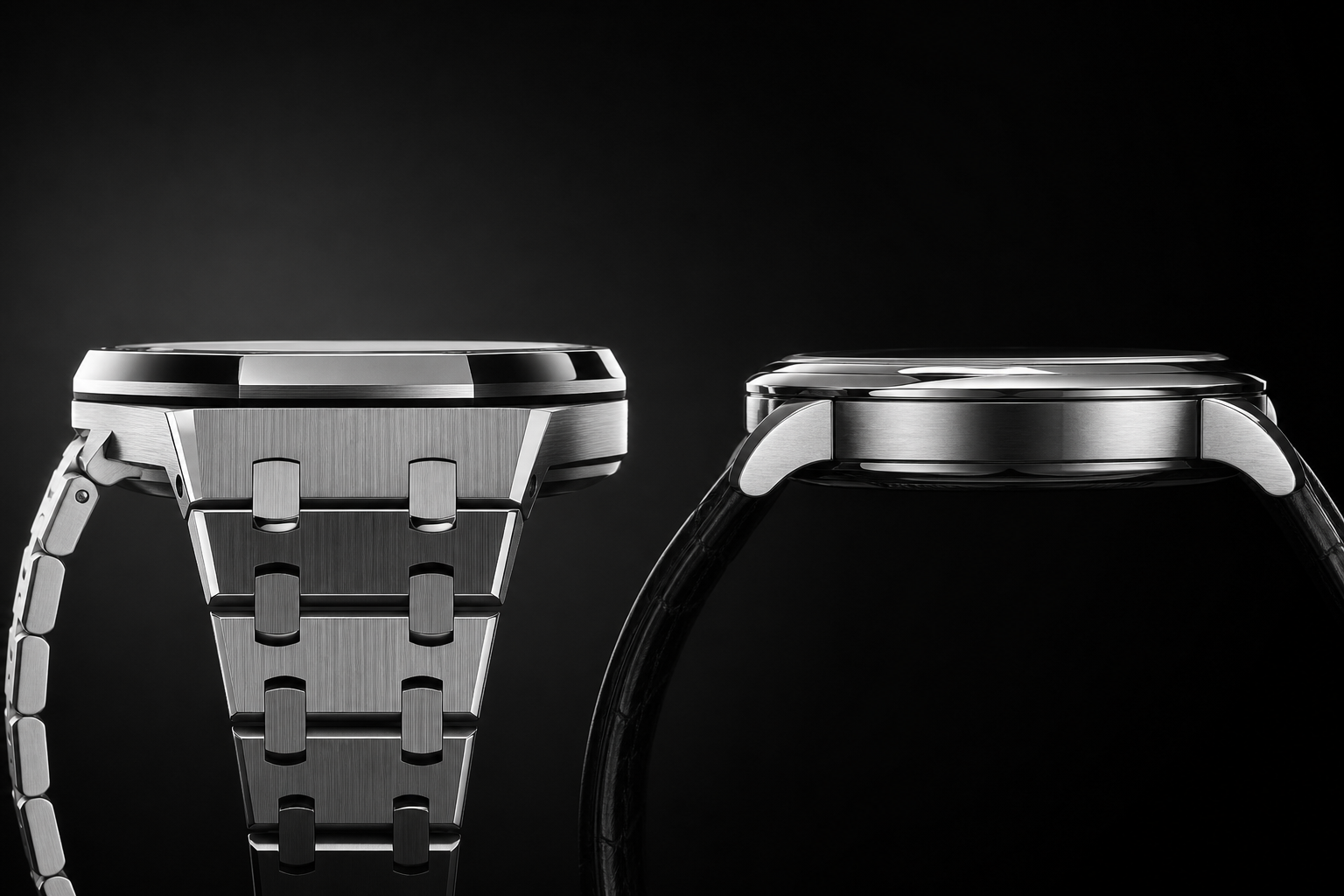
The Royal Oak case profile is the first place where a weak AP super clone starts to reveal itself. Before the dial is studied and before the movement is discussed, the case already tells the buyer whether the watch has the right attitude. A Royal Oak should look thin, wide, sharp, and structured. If the case looks too thick, the edges feel soft, or the bezel geometry is slightly wrong, the whole watch becomes less convincing even if the dial and bracelet are otherwise acceptable.
This is the central problem with the case: it has almost no visual hiding place. The flat bezel, angular mid-case, visible chamfer lines, and polished bevels all sit in direct view. On a more rounded watch, a soft transition can disappear into curvature. On a Royal Oak, it looks like a manufacturing shortcut. The design depends on contrast: brushed finish against polished bevel, flat plane against sharp edge, octagon against circular dial. When those contrasts blur, the watch loses its identity.
Buyers should not judge an AP case only by whether the diameter looks correct. Thickness, edge definition, side profile, and the way light travels across the bezel matter more in real wear. A Royal Oak-style replica with the right case size but a heavy side profile can still feel off because the original design is not meant to wear like a thick sports watch.
Case measurement claims should also be handled carefully. A seller may provide a thickness number, but the way the watch wears depends on where that thickness is distributed: crystal height, bezel height, mid-case depth, and caseback shape. Two watches with similar stated measurements can feel different if one has a flatter caseback and cleaner bracelet drop while the other stacks height in the middle and sits higher on the wrist.
Thin case walls demand sharper execution
A slim AP case gives factories less vertical space to work with. This matters because every shortcut has a visible consequence, and AP super clone buyer preferences often reflect how quickly thickness, balance, and wearability become apparent on the wrist. If the movement route, crystal height, caseback, or mid-case construction adds even a little extra height, the watch can start to look heavier than it should. The buyer may not know the exact millimeter difference, but the wrist presence changes immediately.
Thinness on a Royal Oak is not just a specification. It is part of the design language. The watch is supposed to look broad and architectural without becoming bulky. When the case walls are too tall, the bezel starts to look perched on top of the case instead of integrated into it. The bracelet also appears to drop away from the case rather than flow from it. This is why side profile photos are more important for AP than many buyers realize.
The sharper judgment is that a slightly better dial cannot fully rescue a case that wears too thick. On AP, proportion comes before decoration. If the case height is wrong, the watch may photograph well from the front but feel less convincing every time it is viewed from the side.
A buyer should also consider wrist size here. A case that is only slightly thick on paper may feel much more awkward on a smaller or flatter wrist because the integrated bracelet has less room to drape. On a larger wrist, the same watch may be more tolerable. This is another reason AP buying advice should be tied to actual wearing goals rather than a single universal ranking.
Octagon symmetry is unforgiving
The octagonal bezel is not merely a design signature. It is a symmetry test. Each side, corner, screw position, and polished bevel gives the eye a fixed point of comparison. If one line is too wide, one corner feels rounded, or the bezel shape is slightly stretched, the face of the watch begins to look unbalanced.
This is different from a round bezel, where small machining differences can be visually softened by the circular shape. An octagon has edges and corners that need to agree with each other. The Royal Oak bezel also frames the dial tightly, so any distortion affects the entire front view. A bezel shape that is technically close can still look wrong if the planes do not catch light evenly.
For buyers, the practical check is simple: do not only look at whether the bezel is octagonal. Look at whether it feels calm and even. A good Royal Oak case should not make the eye pause at one corner or one side. If the bezel shape is off, the watch tends to look “replica” before any small text or marker detail is inspected.
QC distortion can complicate this check. A phone camera held too close can stretch one side of the bezel or make the top and bottom look uneven. That is why a buyer should ask for a straight-on shot taken from a little distance, not an extreme close-up. If the shape looks wrong in multiple normal photos, it is more likely to be a watch issue than a camera issue.
Visual accuracy should be judged through specific details rather than broad claims. On a Royal Oak-style clone, case thickness, lugless case shape, bezel plane, hand length, date position, dial texture, screw seating, and bracelet construction all influence the final impression. A watch can look close in one cropped image while still losing the Royal Oak character when these details are checked together.
Brushed and polished transitions expose finishing quality
The Royal Oak case relies heavily on the contrast between satin brushing and polished bevels. The flat surfaces should have a controlled brushed finish, while the bevels should cut cleanly along the edges. If the transition is soft, wavy, or over-polished, the case loses the sharp industrial character that defines the model.
This is where finishing quality matters as much as shape. A case can have decent dimensions but still look weak if the brushing direction is inconsistent or the polished bevels are too wide. The best AP-style finishing is not simply shiny. It is disciplined. The polished areas should highlight the geometry without swallowing the brushed planes.
In person, soft finishing is often more damaging than a tiny printed dial flaw. A slightly imperfect word on the dial may only show under close inspection, but rounded bevels affect the whole wrist presence. If the edges feel melted instead of cut, the Royal Oak stops looking architectural and starts looking like a generic angular sports watch. That is one of the clearest signs that the case execution is not strong enough for this design.
There is a tradeoff, however, between very sharp exterior finishing and comfortable daily wear. Some replicas with aggressive edges can look impressive in macro photos but feel harsh on the underside of the bracelet or case. The ideal is not simply the sharpest possible edge everywhere; it is a controlled contrast where visible bevels remain crisp while contact surfaces do not feel unfinished or abrasive.
Why the Integrated Bracelet Is Harder to Execute on AP Than on More Traditional Watches
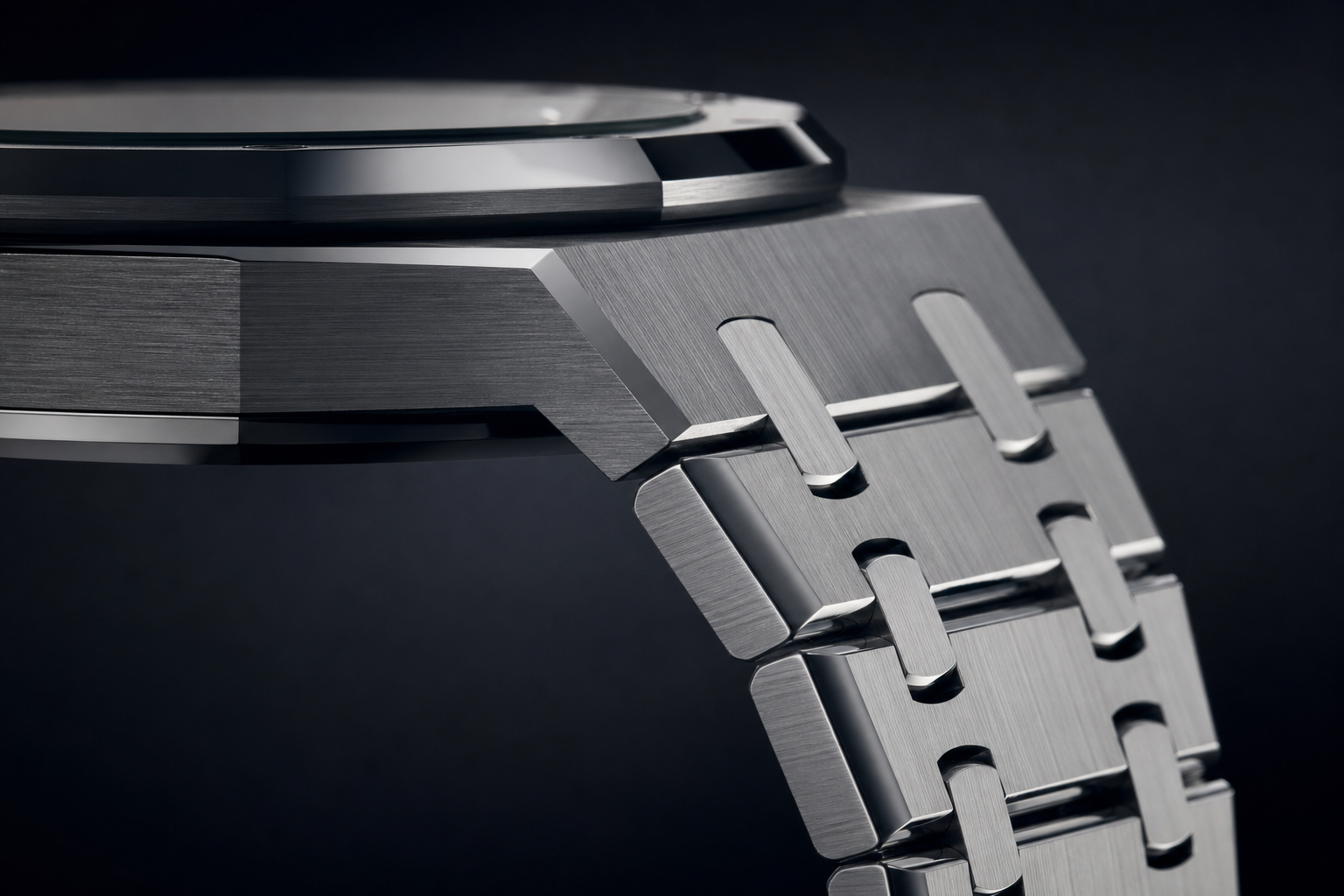
On a Royal Oak, the bracelet is not a strap attached to a watch head. It is part of the architecture. That is why integrated bracelet fit matters more on an AP super clone than it does on many traditional Rolex or Omega-style replicas. If the first link drops too sharply, if the bracelet gap near the case is uneven, or if the taper feels clumsy, the entire watch loses the flat, continuous silhouette that makes the Royal Oak recognizable.
This is one of the most underestimated reasons a Royal Oak bracelet replica can look impressive in a front-facing photo but feel wrong on the wrist. A conventional watch can often hide a slightly average bracelet because the lugs separate the case from the bracelet visually. The Royal Oak does not give that separation. The first links, mid-links, bevels, and clasp all have to work as one flowing object.
Bracelet quality also affects whether the watch is a realistic daily-wear choice. A buyer who mainly wants occasional photos may tolerate a bracelet that looks good from above but feels stiff. A buyer who plans to wear the watch through a full day should care more about articulation, underside finishing, clasp comfort, and whether the bracelet pulls or binds. These ownership details rarely appear in seller marketing, but they often decide satisfaction after delivery.
Case-to-bracelet flow is a visual test
The first thing to check is whether the bracelet appears to grow naturally from the case. On a well-executed Royal Oak-style replica, the first link should continue the case line without looking forced, pinched, or dropped. If the bracelet sits awkwardly, the watch can look top-heavy even when the dial and bezel are acceptable.
Poor case-to-bracelet flow usually shows up in three ways: a visible gap near the case, a first link that does not articulate cleanly, or a bracelet that falls too stiffly instead of draping around the wrist. This is not just a comfort issue. It changes the side profile and makes the watch look more like a case with a bracelet attached than a single integrated design.
This is where many lower-tier AP replicas fail quickly. They may copy the general octagonal face, but the bracelet junction gives away the shortcut. The head-link area requires controlled looseness: too tight and the bracelet feels rigid; too loose and the gap becomes visible. The better current AP factories have improved this area, but it remains a detail buyers should not ignore in QC photos.
The key judgment is simple: if the bracelet transition looks wrong, the rest of the watch has to work much harder to recover. For a Royal Oak, that is a bad tradeoff. A buyer who is sensitive to wrist presence should prioritize bracelet flow over small macro-level dial differences, because the bracelet shape is visible every time the watch is worn.
A practical QC request is to ask for the watch held sideways with the bracelet allowed to hang naturally. This can reveal whether the first links articulate smoothly or whether the bracelet behaves like a rigid slab. A flat table photo can be useful, but it does not always show how the bracelet will behave on a wrist.
Finishing quality changes the entire impression of the bracelet
The Royal Oak bracelet is difficult because every link carries finishing information. Flat brushed surfaces, polished bevels, link edges, screw heads, and the taper toward the clasp all contribute to the impression of quality. If the brushing is too rough, the bevels are soft, or the link edges feel unfinished, the whole watch feels lower grade even if the dimensions are close.
Traditional bracelets can be more forgiving because the eye often reads them as supporting parts. The Royal Oak bracelet is the visual body of the watch. Weak link refinement becomes obvious under normal movement, not only under macro inspection. A bracelet that looks acceptable in a still photo may feel cheap if the articulation is stiff, if the links bind, or if the clasp alignment feels loose.
Comfort also matters more than buyers expect. Some AP-style bracelets can pull wrist hair, pinch slightly, or feel sharp along the underside when the chamfers and link spacing are not well controlled. This does not always show in seller photos. A bracelet can look clean from above but still feel unpleasant after a full day of wear.
When comparing options, the more sensible choice is not always the one with the most dramatic dial photo. For daily wear, a Royal Oak super clone with cleaner bracelet articulation and smoother finishing will usually be more satisfying than one with a slightly better-looking face but a stiff, awkward bracelet. The bracelet is where the watch either feels integrated or falls apart as an object.
Bracelet sizing should also be considered before buying. Integrated bracelets can be less forgiving than strap-based watches because there may be fewer micro-adjustment options and the case shape may not sit well if the bracelet is slightly too loose or too tight. A watch that looks balanced in photos can become annoying if the clasp lacks useful adjustment or if the link size makes it hard to achieve a comfortable fit.
The Tapisserie Dial and Bezel Screws Leave Almost No Place to Fake Precision
The Royal Oak dial is not just a textured surface, and the bezel screws are not just decorative accents. Together, they create a grid of visual reference points. That is why tapisserie dial depth and bezel screw alignment matter so much on an AP super clone. If the dial looks flat, the print looks weak, or the screws are uneven, the eye catches the problem quickly because the design gives it nowhere to hide.
This is different from a simpler sunburst dial or a matte tool-watch dial, where minor surface issues may disappear in changing light. The Royal Oak face is built around rhythm: square texture, applied markers, date window framing, hands, bezel flats, and screw positions. When one part is off, the rest of the face makes the mistake easier to see.
Dial color can also change how forgiving the watch appears. Darker dials may hide shallow texture and small print softness better than lighter or brighter dials, while lighter dials can expose date-window framing, marker alignment, and printing thickness more clearly. Buyers comparing two colors should not assume the same factory performs equally well across every dial variant.
Tapisserie texture is harder than a simple dial finish
A convincing tapisserie dial needs depth, shadow, and consistent spacing. It should not look like a flat checkerboard printed onto the dial. The better examples create small changes in light across each square, so the dial has dimensional movement even under ordinary indoor lighting. If the texture is too coarse, too shallow, or too mechanically sharp, the face can look busy rather than refined.
This is where buyers often misjudge photos. Strong lighting can make a weak tapisserie pattern look deeper than it is. Dark blue or black dials can also hide texture problems better than lighter dials in seller images. The real test is whether the dial still has layered depth when the light is soft and direct, not only when it is photographed at a dramatic angle.
Dial printing is a separate issue from dial texture. A dial can have decent grid depth but still lose credibility through thick logo printing, soft minute text, uneven marker placement, or a date window that feels slightly crowded. On a Royal Oak, the dial is already structured like a measuring surface, so weak print edges are easier to notice than they would be on a less geometric watch.
The practical judgment is that buyers should not treat “good tapisserie” as one single feature. There are two layers to evaluate: the physical texture and the printed/applied details sitting on top of it. A replica with decent texture but sloppy print can still feel off; a replica with clean print but a flat dial may look lifeless in person.
Macro photos can help, but they can also exaggerate flaws that are not visible during normal wear. A buyer should use macro images to confirm that the dial is not obviously sloppy, then return to normal-distance photos to judge overall balance. The Royal Oak is detail-sensitive, but it is still worn at wrist distance, not under a loupe all day.
Bezel screws act like a visual ruler
The bezel screws are one of the most unforgiving parts of the Royal Oak face because they create eight fixed alignment points around the octagon. Even a small difference in spacing, depth, angle, or seating can disturb the symmetry of the whole watch. This is why bezel screw alignment becomes a trust signal before the buyer studies anything more technical.
Many buyers focus only on whether the screw slots appear to point in a similar direction. That matters, but it is not the whole issue. The size of the screw heads, their position relative to the crystal and bezel edge, and whether they sit flush with the bezel are just as important. Screws that look slightly too large or too centered can make the bezel feel heavier than it should.
In daily wear, uneven screws are more damaging than many small dial-print flaws. The bezel is the frame of the watch, and the screws sit exactly where the eye expects order. If one screw appears tilted, sunken, raised, or spaced differently, the watch starts to feel assembled rather than engineered.
At Clean VS Factory, we usually treat AP screw alignment as a higher-priority check than many small macro details because it affects the whole facial symmetry of the watch. A tiny print flaw may be acceptable if the overall face is balanced. Visibly uneven screws are harder to forgive because they interrupt the Royal Oak’s main design language.
It is also worth distinguishing a true alignment problem from photo angle. If a single screw looks strange in one angled image but appears normal in a straight-on photo, the issue may be reflection or distortion. If the same screw looks raised, rotated, or off-center across multiple images, it becomes a stronger rejection point.
Red Flags Before Buying
The warning signs that should change a buying decision are the ones visible under normal viewing, not only under extreme magnification. Be cautious if the dial looks flat in ordinary light, the tapisserie squares look overly stamped or uneven, the logo and minute text have soft edges, the date window appears poorly framed, or the lume plots do not sit cleanly with the markers.
For the bezel, uneven screw spacing, raised screw heads, inconsistent screw depth, or a screw that breaks the visual rhythm of the octagon should be treated as serious red flags. A small variation may be acceptable on a replica watch, but a face that looks unbalanced before close inspection is not a good candidate for a Royal Oak-style purchase.
A more moderate flaw, such as a tiny dust speck under protective film or a slight reflection over one marker, should not be treated the same as a structural dial or bezel issue. Good buying judgment means separating temporary photo noise from problems that will remain visible after the watch is delivered.
Movement Route and Case Thickness: Why the Inside Still Affects the Outside
Movement choice matters on an AP super clone because the Royal Oak does not have much vertical space to hide mechanical compromises. A movement route that works acceptably in a thicker or more conventional watch can create visible problems here: extra case thickness, a different caseback profile, louder rotor noise, weaker winding feel, or a less balanced wrist presence.
This is where buyers should be careful with the phrase “clone movement.” It may describe a more model-specific layout, but it does not automatically mean trouble-free ownership. The better question is whether the movement route supports the correct proportions and produces a reasonable daily-wear experience. On AP, the inside affects the outside more directly than many buyers expect.
Movement decoration and movement performance should be kept separate. A decorated rotor or bridge layout may improve the caseback appearance, but it does not prove the watch winds smoothly, holds power consistently, or will be easy to service. For buyers who wear the watch often, practical behavior matters more than whether a still photo of the movement looks impressive.
Movement Claim Check: Movement names in replica listings should be interpreted carefully. A description may refer to a movement style, a decorated movement appearance, or a seller’s shorthand rather than a fully verified mechanical specification. Unless the buyer has clear movement photos and a credible inspection basis, it is safer to evaluate the movement by what can be reasonably checked: case thickness, hand position, date behavior, winding feel, rotor noise, and the seller’s willingness to show the movement clearly. A movement label alone should not be treated as proof of authenticity, equivalence, or long-term reliability.
Movement Transparency Note: Movement references in this article describe replica-market movement types, layouts, or configurations, with a super clone Audemars Piguet guide serving only as a reference framework, not official Audemars Piguet, Rolex, Omega, or Swiss-manufactured calibers unless explicitly supported by verifiable evidence. Buyers should judge the movement by visible configuration, case thickness, winding behavior, rotor sound, date function, and service expectations rather than by a movement name alone.
Movement trust in this market depends on understanding what the claim actually describes. A listing may use a movement name to indicate architecture, decoration, hand layout, calendar position, rotor appearance, or simply a common seller label. For AP-style replicas, the important question is not whether the name sounds impressive, but whether the movement choice supports the correct case height, stable hand setting, acceptable winding behavior, and realistic service expectations.
How movement shortcuts can force visible compromises
A shortcut movement can look harmless on paper if the dial side is convincing. The problem is that the case still has to contain it. If the movement is too thick, needs decorative plates, or requires extra clearance for the rotor, the watch may gain height in the caseback or mid-case. On a Royal Oak, even a small increase can make the watch feel chunkier than the design should allow.
This is especially important on thinner Royal Oak references, where buyers are often attracted to the flat profile. A watch can be “thin but risky” if the factory uses an aggressive movement solution that looks good in photos but brings serviceability issues. It can also be reliable but visibly compromised if a thicker, simpler movement forces the case to sit too tall.
Rotor noise is another practical clue. Some movement routes, especially Miyota-based builds with decorative plates, can produce a noticeable whirring or spinning sound. That may not ruin the watch for every buyer, but it does affect the ownership experience. A visually strong AP replica can feel less convincing if the rotor announces itself every time the wrist moves.
Power reserve and date change behavior also matter in a practical way. Advertised specifications should not be treated as guaranteed real-world results. If the movement has inconsistent power reserve, rough winding feel, or an unreliable date change, the watch becomes less suitable for daily wear even if it passes a quick visual check.
For buyers comparing versions, it is useful to ask what the movement choice is supposed to improve. If it improves hand stack, date placement, thickness, or caseback layout, it may be relevant to AP accuracy. If it only sounds more impressive in a listing but does not improve wear, reliability, or proportions, the benefit may be smaller than the price increase suggests.
Why reliability and proportions are linked on AP
On many replica watches, buyers separate movement reliability from external accuracy. With AP, those two issues are connected. A movement that helps achieve the right case thickness may be more complex or less proven. A simpler movement may be easier to service but can force the case into proportions that weaken the Royal Oak silhouette.
This is why the safest answer is not always “choose the most advanced movement.” A newer integrated-style movement route may deliver better balance wheel position, cleaner case proportions, or a more credible caseback layout, but it can also carry less long-term ownership data. A proven workhorse movement may be easier to live with, but if it makes the case too thick or adds rotor noise, the design pays the price.
For AP buyers, the decision should be based on use case. If the watch is mainly about wrist presence and correct profile, a more model-specific movement route can be worth considering, provided the buyer accepts the service and batch-risk tradeoff. If low-maintenance ownership is the priority, a slightly less ambitious movement may be more rational, but only if the resulting thickness does not ruin the watch’s visual balance.
The important judgment is this: on a Royal Oak super clone, movement choice is not hidden inside the case. It affects how thin the watch looks, how it sounds, how it winds, and how confident it feels in daily use. A good AP replica is not just a good dial on top of any automatic movement; the movement, case thickness, and wrist feel need to make sense together.
Service expectations should stay realistic. Some movement routes may be harder for local watchmakers to source parts for, and some decorated builds may be less appealing to service than a simpler base movement. A buyer who wants easy ownership should consider not only how the movement looks now, but what happens if the watch needs regulation, cleaning, or repair later.
QC Photos That Reveal Whether an AP Super Clone Is Actually Well Executed
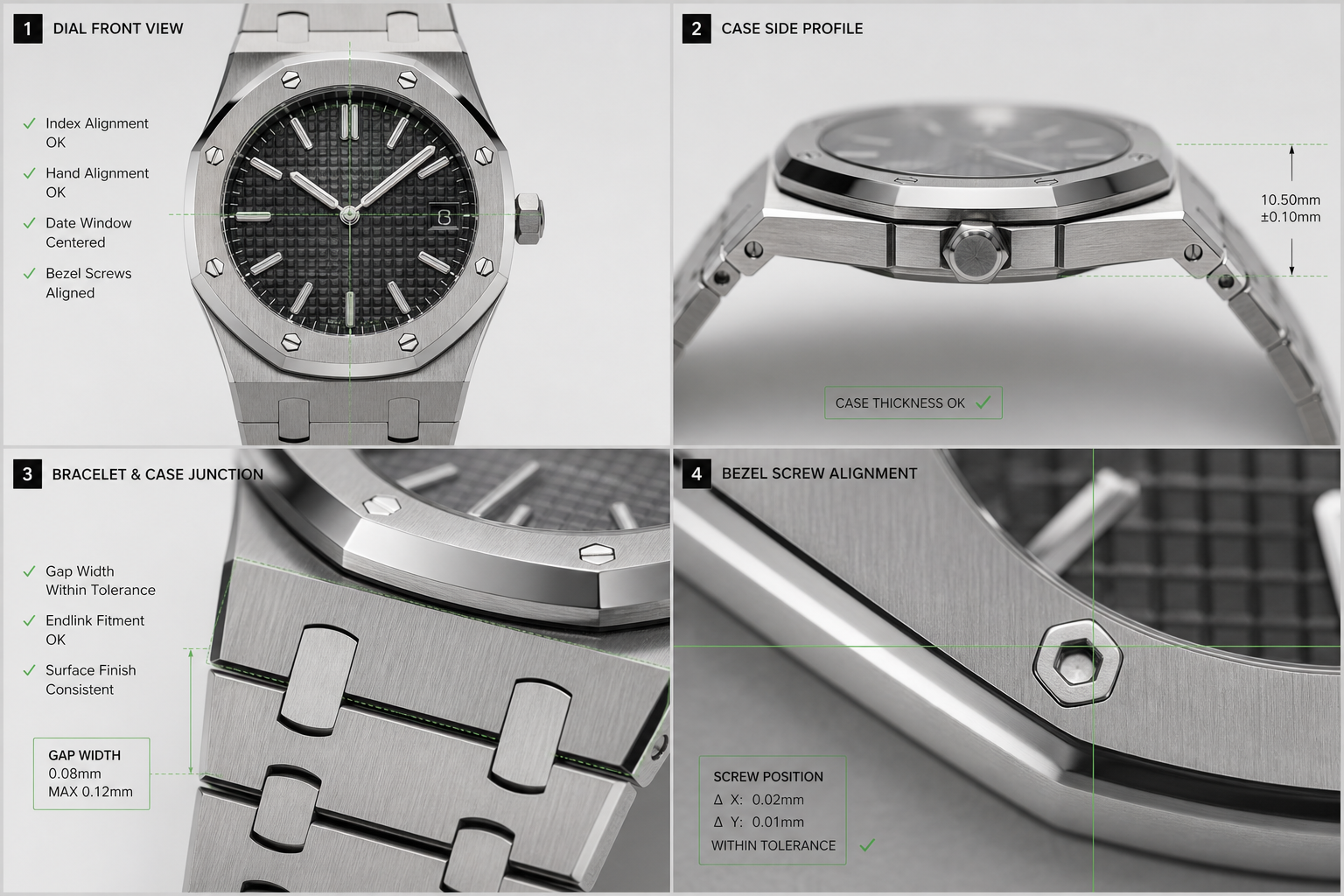
AP QC photos need to do more than show that the watch exists and the dial color is correct. A Royal Oak inspection should prove whether the watch holds its shape from multiple angles, because the most important flaws are not always visible in a polished front-facing seller photo. The front dial shot can make an AP super clone look clean; the side profile, bracelet junction, and bezel close-up usually tell the more honest story.
The first photos to ask for are simple: a straight-on dial shot, a close bezel shot, a side profile, a case-to-bracelet transition shot, a date window close-up, and one clasp or bracelet finishing shot. If the seller only provides dramatic angled photos under strong reflections, that is not enough. AP is a watch where lighting can hide weak dial depth, soften thick case proportions, and disguise uneven screw alignment. Clean, flat lighting is less flattering, but far more useful.
The key judgment is this: cosmetic flaws can sometimes be acceptable, but structural flaws should make you pause. A tiny dust mark, slight protective film distortion, or a small reflection on the crystal may not matter. A case that looks too thick, a bracelet that drops awkwardly from the case, visibly uneven bezel screws, or a dial that looks flat even under normal light are different problems. Those affect the whole impression of the watch, not just a macro-photo detail.
QC photos are evidence, not a guarantee. They can show alignment, finish, and obvious assembly issues, but they cannot fully prove long-term movement reliability, water resistance, real power reserve, or how the bracelet will feel after several hours. A cautious buyer uses QC to reject obvious problems, then still keeps realistic expectations about the limits of any replica watch purchase.
Before making a decision, buyers should review real QC photos where available, including dial printing, hand alignment, bezel position, datewheel centering, bracelet fit, clasp engraving, case thickness, caseback profile, screw seating, and overall finishing. Factory labels and stock photos alone are not enough for a reliable Royal Oak-style judgment.
Seller Policy Check: QC approval should not be confused with a warranty, return promise, waterproof guarantee, customs guarantee, or long-term service commitment. Before ordering, buyers should confirm the seller’s actual terms for returns, repair options, replacement handling, shipping expectations, water-resistance testing, and after-sales support. If those terms are unclear, the uncertainty should be treated as part of the buying risk rather than assumed away.
Water-Resistance Caution: Buyers should treat water resistance as unverified unless the individual watch has been pressure-tested after purchase by someone competent to test it. Genuine Royal Oak specifications, seller statements, or a screw-down crown appearance should not be used as proof that a replica is safe for swimming, showering, diving, or sports use. For a Royal Oak-style clone, the practical assumption should be dry daily wear unless the specific watch has been tested and the buyer accepts the remaining risk.
Front-on photos and side profile photos tell different stories
A front-on AP QC photo is useful for checking dial centering, bezel screw spacing, marker alignment, date window position, and whether the tapisserie pattern looks alive rather than printed flat. The watch should be photographed straight, not tilted to make the bezel look more symmetrical. If the octagonal bezel looks slightly pulled to one side, or if the screws create an uneven visual rhythm, the flaw will not become less annoying after delivery.
The side profile is where many buyers make their biggest mistake. A Royal Oak can look impressive from the front and still feel wrong on the wrist if the mid-case is too tall or the caseback creates a bulky stack. In AP QC photos, ask for a clean side shot taken at wrist level, not from above. You are looking for how the case, bezel, crystal, and caseback sit together. If the watch looks like a thick slab with a bracelet attached underneath, the design has lost one of its main strengths.
The bracelet junction deserves its own photo. The first link should flow from the case without a strange gap, hard drop, or rigid angle. Some slight play is normal on a bracelet, and even genuine integrated bracelets are not frozen in one perfect position. But if the first link looks disconnected from the case shape, the problem will be obvious in daily wear. On AP, bracelet flow is not a comfort detail only; it is part of the watch’s silhouette.
Date windows are also worth checking, especially because AP dials have strong grid geometry. A date that sits slightly high, low, or too far to one side becomes easier to notice when surrounded by such an ordered dial pattern. A minor datewheel font difference is usually less important than poor centering. Buyers often over-focus on the exact font shape and miss the more visible issue: whether the date sits cleanly inside the window.
If possible, compare the QC photos against known photos of the same replica version, not only against genuine reference images. Genuine comparison is useful for understanding the target, but version-to-version comparison helps identify whether the offered watch is a normal example or a weaker unit from the batch. This is especially useful for AP because small changes in case and bracelet finishing can change the entire impression.
What a movement photo can and cannot prove
A movement photo can confirm the broad movement route, rotor decoration, bridge layout, and whether the watch is using the claimed style of movement rather than an obviously cheaper substitute. It can also reveal careless assembly signs such as loose screws, dirty finishing, scratched plates, or badly printed engravings. For an AP super clone with a display caseback, this photo is worth asking for.
But a movement photo cannot prove long-term reliability. It does not tell you whether the movement is properly lubricated, whether the rotor will become noisy after a month, whether the date change is smooth, or whether the power reserve matches the advertised figure. A clean-looking movement can still be dry or poorly regulated. This is why movement photos should support the decision, not dominate it.
For Royal Oak inspection, the outside often deserves more weight than buyers expect. If the case thickness, bracelet transition, and dial execution are poor, a decorated movement photo will not save the watch. At Clean VS Factory, we usually treat movement images as one piece of evidence, not a guarantee. The better question is whether the movement choice supports the correct proportions and whether the visible build passes the AP-specific checks.
A short video can sometimes be more useful than an extra still image. Winding sound, rotor noise, hand-setting feel, date change behavior, and bracelet articulation are easier to judge in motion. A video still will not remove all uncertainty, but it can reveal issues that carefully staged photos hide.
Red Flags Before Buying
- Unusually thick side profile: If the case looks heavy or stacked from the side, do not rely on the front photo. AP proportions are unforgiving.
- Awkward bracelet attachment: A visible gap, sharp downward drop, or stiff first link can make the watch look cheaper immediately on wrist.
- Uneven bezel screws: Slight photographic distortion can happen, but visibly inconsistent spacing or crooked screw seats are serious warning signs.
- Flat-looking tapisserie dial: If the dial has no shadow, depth, or texture under clean lighting, it may disappoint in person.
- Poor date centering: A misaligned date is easy to notice because the dial geometry gives your eye fixed reference points.
- Overly filtered or angled photos: If every QC image is shot with dramatic reflections, ask for simpler photos before approving.
- Rough clasp or bracelet finish: The clasp is not the first thing people see, but rough edges or weak engraving often signal a lower overall execution level.
The most acceptable flaws are usually small cosmetic imperfections that do not disturb the watch’s geometry: a tiny speck on protective film, a minor reflection, or a slight angle difference caused by the photo. The flaws that should trigger caution are the ones that change the architecture of the watch. If the AP looks thick, stiff, uneven, or flat in plain QC photos, it will rarely become more convincing in real life.
When a seller explains a flaw as “only the angle,” the buyer should ask for one more neutral photo rather than arguing from a single image. If the issue disappears in a properly aligned shot, it may have been photo distortion. If it remains visible, the explanation should not override what the buyer can verify.
Who Should Buy an AP Super Clone, and Who Should Choose Rolex or Omega Instead
An AP super clone is not the safest first replica watch choice for every buyer. It has a high visual payoff, but it also demands more tolerance for inspection, version differences, and visible compromise. The Royal Oak is a design-focused watch. If you choose it only because it is expensive-looking or recognizable, you may be more sensitive to its flaws than you expect.
The cleanest decision rule is simple: choose AP if the Royal Oak shape is the reason you want the watch. Choose Rolex or Omega if your priority is a lower-maintenance daily wearer with more visual forgiveness. This is not a question of which brand is better. It is a question of which design gives a replica maker more room to be slightly imperfect without the whole watch looking wrong.
For a first replica watch choice, AP is usually better for buyers who are willing to study QC photos, compare version details, and accept that even a strong example will not remove every tell. Rolex and Omega replicas, especially simpler three-hand or diver-style models, often create fewer surprises because their designs are more enclosed and easier to evaluate. That makes them more practical for buyers who want a watch to wear, not a project to inspect.
The buyer’s intended use should guide the decision more than the watch’s status image. If the watch is mainly for occasional wear and visual impact, a strong AP-style version can make sense despite its inspection burden. If the watch is intended for frequent daily wear, travel, office use, or low-maintenance ownership, bracelet comfort, movement behavior, and serviceability may matter more than the most dramatic Royal Oak look.
Choose AP if you want the silhouette and accept compromise
The right AP super clone buyer is someone who cares about the Royal Oak’s architecture: the octagonal bezel, thin case impression, integrated bracelet, tapisserie dial, and sharp finishing contrasts. This buyer understands that the appeal of the watch comes from the same features that expose its weaknesses. If that tradeoff is acceptable, AP can be one of the most satisfying super clone watches to wear because the design has a presence that few conventional watches copy.
AP also makes sense for buyers who are detail-focused but realistic. You should be willing to reject a bad QC example, ask for side profile photos, and judge bracelet flow rather than approving a watch based only on a beautiful dial color. If you are already the type of buyer who notices date alignment, bezel geometry, and case thickness, AP gives you more to appreciate, but also more to manage.
The mistake is expecting AP to be a low-friction purchase just because current top-tier versions have improved. Better factories and better movements reduce risk, but they do not change the nature of the design. A Royal Oak replica can be visually strong and still require more careful selection than a more forgiving Rolex replica or Omega super clone.
It is also sensible to avoid overcomplicated AP references as a first step unless the buyer understands the added risk. More complications can introduce thicker cases, more fragile movement routes, extra alignment points, and more functions that need to work correctly. A simpler time-and-date Royal Oak-style model is usually easier to evaluate than a complicated version with more mechanical and visual variables.
Choose Rolex or Omega if you want more forgiveness
Rolex or Omega usually makes more sense if you want a replica watch that is easier to live with and easier to evaluate before buying. Many popular Rolex and Omega models have round cases, more conventional bracelet structures, stronger visual mass, and less exposed finishing geometry. Small flaws can still exist, but they are less likely to dominate the entire watch at a glance.
This matters most for first-time buyers. If you are asking, “Should I start with AP?” the cautious answer is: only if you specifically want the Royal Oak and are comfortable with more visible risk. If your real goal is a reliable daily-wear replica that looks convincing without constant second-guessing, a proven Rolex or Omega style is usually the better first step.
Rolex and Omega are also more sensible for buyers who dislike QC uncertainty. A Submariner-style or Seamaster-style watch can have flaws, but the inspection process is usually more straightforward: bezel, dial, date, bracelet, clasp, and movement behavior. With AP, those same categories interact more tightly. A small bracelet issue affects the case silhouette. A small dial issue affects the whole face. A small thickness issue changes the watch’s identity.
The final judgment is direct: AP is the higher-risk, higher-design-payoff choice. It rewards buyers who love the Royal Oak enough to accept its exposed architecture and inspection burden. Rolex or Omega is the more forgiving path for buyers who want daily wear, simpler QC decisions, and fewer visible penalties from small manufacturing compromises.
A careful buyer should resist turning this into a brand loyalty decision. The smarter comparison is model against model, version against version, and use case against use case. The best choice for wrist impact may not be the best choice for daily reliability, and the most famous factory name may not be the best match for every reference. For Royal Oak-style replicas, that distinction is especially important because the design itself leaves so little room for error.
For CleanVSFactory, the goal is to make replica watch comparison easier to understand by connecting factory names, movement claims, visible QC details, and realistic ownership limits. That means the safest recommendation is rarely a universal ranking. It is a traceable decision based on the exact Royal Oak-style version being considered, the photos available, the movement route used, and the buyer’s tolerance for visible and ownership-related compromise.
Misrepresentation Boundary: The purpose of factory, movement, and QC information is to help readers understand visible quality, ownership tradeoffs, and buying risk. It should not be used to represent a replica watch as a genuine Audemars Piguet, Rolex, Omega, or any other authentic luxury watch. A strong replica-market watch may look convincing in casual wear, but close inspection, movement examination, service review, or brand-side evaluation can still reveal differences.
Disclosure: This article is for general educational and comparison purposes only. Replica watches are not genuine products from the original luxury brands, and brand names are used only to identify reference designs or comparison topics. Factory names, movement descriptions, prices, availability, QC details, seller policies, and version information can change, so readers should verify important details with the seller before making a purchase decision. Replica watches should not be represented, resold, or used as genuine watches.