
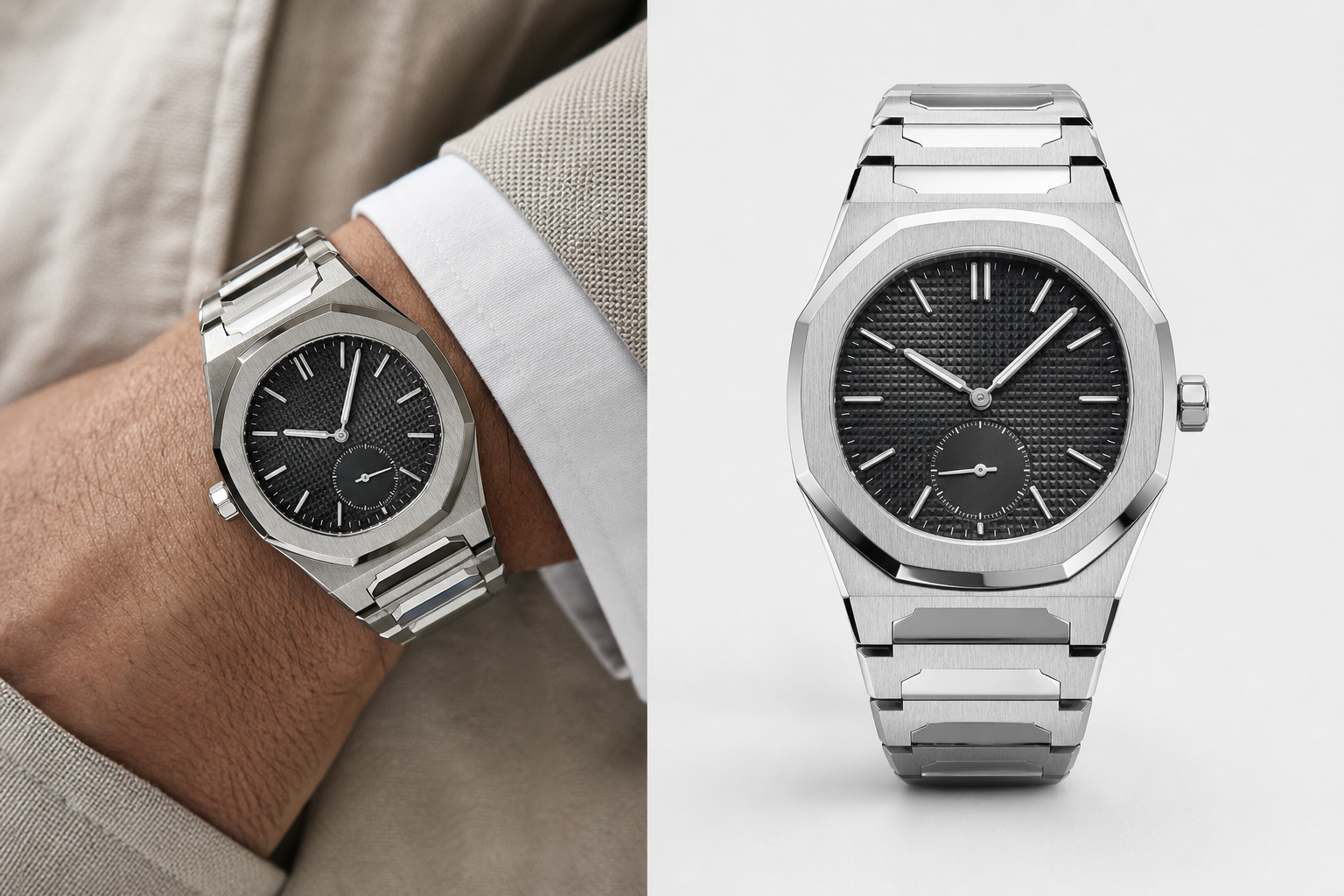
An Audemars Piguet-style super clone is often judged too quickly from photos, where the Royal Oak case shape, octagonal bezel, tapisserie-style dial, and integrated bracelet can create a strong first impression. This article looks beyond that surface effect and uses AP super clone buyer behavior as a lens for the parts buyers actually feel in use: bracelet articulation, clasp action, bevel transitions, dial depth, movement behavior, case thickness, and long-term confidence.
The main question is not whether a replica can capture the AP look at a glance, but where the experience begins to separate from a genuine watch. Simpler time-and-date Royal Oak models may offer the most convincing overall wearing impression, while Offshore, chronograph, skeleton, and openworked versions expose more visual and mechanical compromises. The goal is to help buyers judge which trade-offs are acceptable, which details deserve close inspection, and when a higher price reflects real execution rather than just expectation.
Replica watches should be clearly understood as replica-market products, not genuine watches from Audemars Piguet or any original luxury brand. Brand names are used here to identify the genuine reference design being discussed and to make the comparison clearer; they do not imply authorization, endorsement, or affiliation with the original luxury watch brands.
| Decision Point | What to Check | Practical Judgment |
|---|---|---|
| Royal Oak vs complex AP models | Thickness, subdial spacing, open movement layout, pusher feel | Simple time-and-date models are usually the safer choice |
| Bracelet experience | Link drape, sharp edges, end-link fit, clasp snap | Comfort and refinement depend heavily on bracelet execution |
| Dial realism | Tapisserie depth, marker crispness, printing balance, date window | Good photos are not enough; check the dial in changing light |
| Movement confidence | Rotor noise, winding feel, setting action, display-back finishing | Visual movement decoration does not guarantee smoother use |
| Price difference | Specific upgrades in case shape, bracelet feel, finishing, QC | Pay more only when improvements are visible and relevant |
| Quality control photos | Front, angled, side, bracelet, clasp, and movement-side views | AP geometry makes misalignment and rough finishing easy to notice |
Quick Questions Before You Read
Q: Is a Royal Oak-style super clone convincing enough for daily wear?
It can be satisfying if the case shape, bracelet flow, and dial balance are well executed, but the tactile refinement will still differ from a genuine AP.
Q: Which AP replica models are usually easier to choose?
Simpler time-and-date Royal Oak designs are generally less risky than Offshore, chronograph, skeleton, or openworked versions.
Q: What detail should be checked first before buying?
Start with the bracelet and clasp. Stiff links, rough edges, weak clasp action, or poor end-link fit quickly reduce the wearing experience.
Q: Does a higher price mean the watch is close to genuine quality?
Not by itself. A higher price is only meaningful if it brings specific improvements in finishing, proportions, movement stability, and quality control.
Editorial Perspective: For an Audemars Piguet-style replica, the more useful buying question is not “which factory is best” in a general sense. It is whether the exact model, version, movement route, bracelet execution, case thickness, and QC evidence match the way the buyer plans to wear the watch. At cleanvsfactory.com, AP comparisons are treated as model-specific judgments because a factory that performs well on a simple Royal Oak time-and-date may not deliver the same ownership experience on an Offshore chronograph, skeleton dial, or open-back complication.
Disclosure and Evidence Note: This article discusses imitation watches and buyer evaluation logic, not authorized Audemars Piguet products. Official brand information can clarify authentic model families and design context, but it cannot prove replica execution, factory performance, movement contents, water resistance, or long-term reliability. Because no external source list was provided with this article enhancement request, the guidance below avoids invented citations and treats factory, movement, price, and durability claims as practical buyer considerations rather than verified manufacturer facts.
Factory Names Help, but They Do Not Decide the AP Experience by Themselves
Factory reputation can be a useful starting filter, but it is not enough for an AP-style super clone. Audemars Piguet designs are difficult because the case, bezel, bracelet, dial texture, and movement behavior all sit in the foreground. A well-known factory label may indicate that the watch belongs on the shortlist, but it does not prove that the specific batch has the right case profile, bracelet feel, dial depth, or movement stability.
This matters especially with Royal Oak and Offshore models because the same factory name can perform differently across references. A factory may make a convincing three-hand Royal Oak because the watch depends mostly on shape, bracelet, and dial balance. That same factory may be less convincing on a chronograph if the case becomes too thick, the subdial spacing is off, or the pusher action feels generic. The factory name is a signal, not the final proof.
Seller photos and descriptions should be treated the same way. They can show useful information, but they are often taken under flattering light and may not reveal bracelet stiffness, rough clasp action, rotor noise, uneven brushing, or a side profile that wears too tall. A buyer comparing AP replicas should ask what the photos actually prove: do they show the watch from the side, do they show the bracelet drop, do they show the clasp, and do they show the movement side if the model has an open back?
The strongest AP choice is usually the one where the factory reputation, movement route, visual execution, and QC photos all point in the same direction. If one of those signals is missing, the buyer should treat the listing more cautiously. A high price, a famous factory label, or a clean front photo can all be helpful, but none of them alone confirms that the watch will feel refined in daily wear.
Factory language should also be read as informal market shorthand rather than official proof. Replica-factory names are often used by sellers and buyers to organize choices, but they should not be treated like audited manufacturer credentials. The more expensive or better-known label still needs to be checked against the individual watch, because the buyer receives a specific unit, not an abstract factory reputation.
How to Make a Factory Claim More Traceable
A factory comparison becomes more useful when it is tied to a specific reference, version, movement configuration, and visible execution detail. For example, a buyer should not stop at “this is from a strong AP factory.” The more traceable question is whether this particular Royal Oak-style reference has the correct case thickness, whether the first bracelet link drops naturally, whether the dial texture has enough depth, whether the date window is centered, and whether the movement route forces any visible compromise.
This version-specific approach also helps avoid overpaying for a name. In the replica market, a factory label can help organize choices, but it cannot prove the unit-level result. Batch variation, small supplier changes, bracelet tolerances, and movement substitutions can all affect the watch that actually arrives. CleanVSFactory’s editorial approach is to connect factory claims to visible checks, movement behavior, and buyer expectations rather than treating any factory name as a universal ranking.
Factory Name Clarification: Factory names in the replica watch market are commonly used buyer-facing labels. They should be treated as practical market references, not as official brand affiliations, audited manufacturer identities, or guarantees of identical quality across every model.
The Real Comparison Is Not Just “Looks Real” Versus “Looks Fake”
Audemars Piguet super clone vs genuine is a more useful comparison when you separate the experience into layers. Photos only tell you one part of the story. On the wrist, the watch is judged by how the design lands at normal distance, how the bracelet moves, how the movement sounds and feels, and whether the ownership experience carries the same confidence. Those are not the same thing, and they do not rise or fall together.
A high-end replica AP can be visually convincing enough to satisfy someone who mainly wants the Royal Oak or Royal Oak Offshore design language. That does not mean it reproduces the full genuine AP ownership feel. The article should be read as a comparison of daily-wear impressions, not as a guide to passing a replica as genuine.
A strong super clone may look convincing in normal wear, but close inspection can still reveal differences in finishing, movement architecture, case proportions, bracelet feel, dial details, or service compatibility. The purpose of this comparison is to help readers understand quality and risk, not to support misrepresentation of a replica watch as an authentic Audemars Piguet watch.
Visual Similarity Is Only the First Layer
The octagonal bezel, integrated bracelet, dial layout, and overall case shape create the first impression, and that impression is often strong. This is why AP replicas can look right quickly, especially in casual lighting or from a normal social distance. The design is so recognizable that the watch can feel “close” before the wearer has even studied it closely.
But visual similarity is only the entry point. A watch can resemble the silhouette and still feel different once it moves, reflects light, or sits on the wrist for a full day. That gap matters because AP is a design-led watch. Buyers are not just paying attention to the case shape; they are reacting to the whole visual language.
Visual accuracy should be judged through specific details rather than broad claims. Case thickness, lug shape, bezel edge definition, tapisserie-style dial texture, hand length, date-window placement, bracelet construction, and clasp finishing can all affect how convincing the watch feels in normal use. A watch may look close in a front-facing photo while still feeling less refined from the side, under angled light, or during daily handling.
Physical Feel and Mechanical Behavior Create the Second Impression
Once the watch is worn, bracelet articulation, finishing smoothness, winding feel, rotor behavior, and movement stability start to matter more than the front-facing look. This is where a replica AP can begin to separate itself from the genuine article in a way that is harder to ignore. The watch may still look convincing in motion, but the tactile feedback can feel less refined.
That is the real distinction many first-time buyers miss. A super clone can approximate the image of AP ownership, but the experience of handling the watch is built from smaller details that the eye does not fully capture in photos.
Ownership Emotion Is the Hardest Layer to Copy
The most difficult part to reproduce is not the shape or the bracelet pattern. It is the emotional certainty that comes with genuine ownership. That includes confidence in the product, confidence in support, and the feeling that the watch is not asking to be mentally explained every time it is worn.
For many buyers, that psychological difference becomes clear only after the watch has been owned for a while. The replica may deliver the look, but it rarely delivers the same calm sense of permanence that a genuine AP carries.
What a High-End AP Super Clone Can Feel Close to on the Wrist
A well-executed AP super clone can get closer than most people expect in the areas that matter at a glance and at normal viewing distance. The wrist presence can be convincing. The case silhouette can carry the right amount of angular attitude. The integrated bracelet can give the watch a strong architectural presence that feels expensive even before the details are examined closely.
That is the main reason buyers are drawn to these watches in the first place. The Royal Oak style has a strong visual rhythm, and when the proportions are decent, the watch can deliver a satisfying design impression without needing macro-level scrutiny.
The Royal Oak Outline Carries a Lot of the Experience
The octagonal bezel, exposed screw layout, slim angular case language, and integrated bracelet profile do a lot of the work. AP is one of those watches where the outline itself creates confidence. If the outline is off, the watch feels wrong quickly. If the outline is close, the first impression can be surprisingly strong.
That is why many AP-style replicas succeed emotionally before they succeed technically. The shape does enough to carry the look in everyday use.
Weight and Wrist Presence Can Be Convincing at First
A properly sized case and bracelet can create a substantial feel that reads well on the wrist. The watch can have enough mass to feel serious without being too light or toy-like. For many buyers, that matters more in daily wear than absolute technical detail.
Still, weight alone is not proof of quality. A heavy watch can feel impressive and still lack the refinement that makes a genuine AP feel finished rather than merely substantial. Weight creates presence; it does not create finesse.
The Bracelet Look Often Works Better Than Expected From a Distance
The integrated bracelet pattern gives the watch strong visual continuity. From across a table, in a mirror, or under casual lighting, that continuous flow from case to bracelet is one of the most convincing parts of the AP design. It is also one of the reasons the watch feels more complete than many other replica watch styles.
Close handling is a different test, but from a normal wearing distance the bracelet can do a lot to support the overall impression.
Where Genuine AP Case and Bezel Finishing Still Feel More Refined
This is where the genuine watch begins to separate itself in a way that is obvious to the hand as well as the eye. AP case finishing is not impressive because it is simply shiny. It is impressive because brushed planes and polished bevels are controlled with unusual precision. The transitions are part of the design, and the quality is felt in how cleanly those transitions move from one surface to another.
A super clone may copy the overall finishing pattern, but the refinement usually remains different under close handling. The edges may not feel as composed. The light may move across the case in a less disciplined way. The watch can still look good, but it does not always feel as tightly finished as the genuine object.
Brushing and Polishing Are Easy to Imitate, Hard to Refine
Copying the presence of brushed and polished areas is one thing. Reproducing the crispness of those surfaces is another. The difference is often in how the finishes meet each other. Genuine AP finishing tends to feel more deliberate, with sharper control over the transition points and a cleaner sense of surface separation.
On a replica, the same visual language may be present, but the surfaces can feel slightly less exact. That does not always jump out in photos. It becomes more noticeable when the watch is picked up, turned under light, and handled normally.
The Bezel Edge Is a Major Experience Point
The Royal Oak bezel is not a background detail. It is one of the most visible and tactile parts of the watch, and it sits at the center of the design identity. Because it is constantly in view, any weakness in edge treatment or finishing consistency affects the whole impression.
A genuinely well-finished bezel feels controlled. A less refined one may still look correct in profile, but the edge can feel less crisp, and the visual transitions may seem less disciplined as the wrist moves.
What to Notice During Normal Handling
During normal handling, the point is not to turn the watch into a detection exercise. It is to notice how the case feels in the hand. Smooth edges matter. Clean transitions matter. Uneven brushing can make the watch feel less composed. Bevels that look slightly harsh or inconsistent can break the refined AP impression even if the overall shape is right.
That is the practical difference. The replica may deliver the outline, but the genuine AP usually delivers a more complete sense of finish every time the watch is touched, tilted, or worn.
The Bracelet Is Where the Experience Often Becomes More Obvious
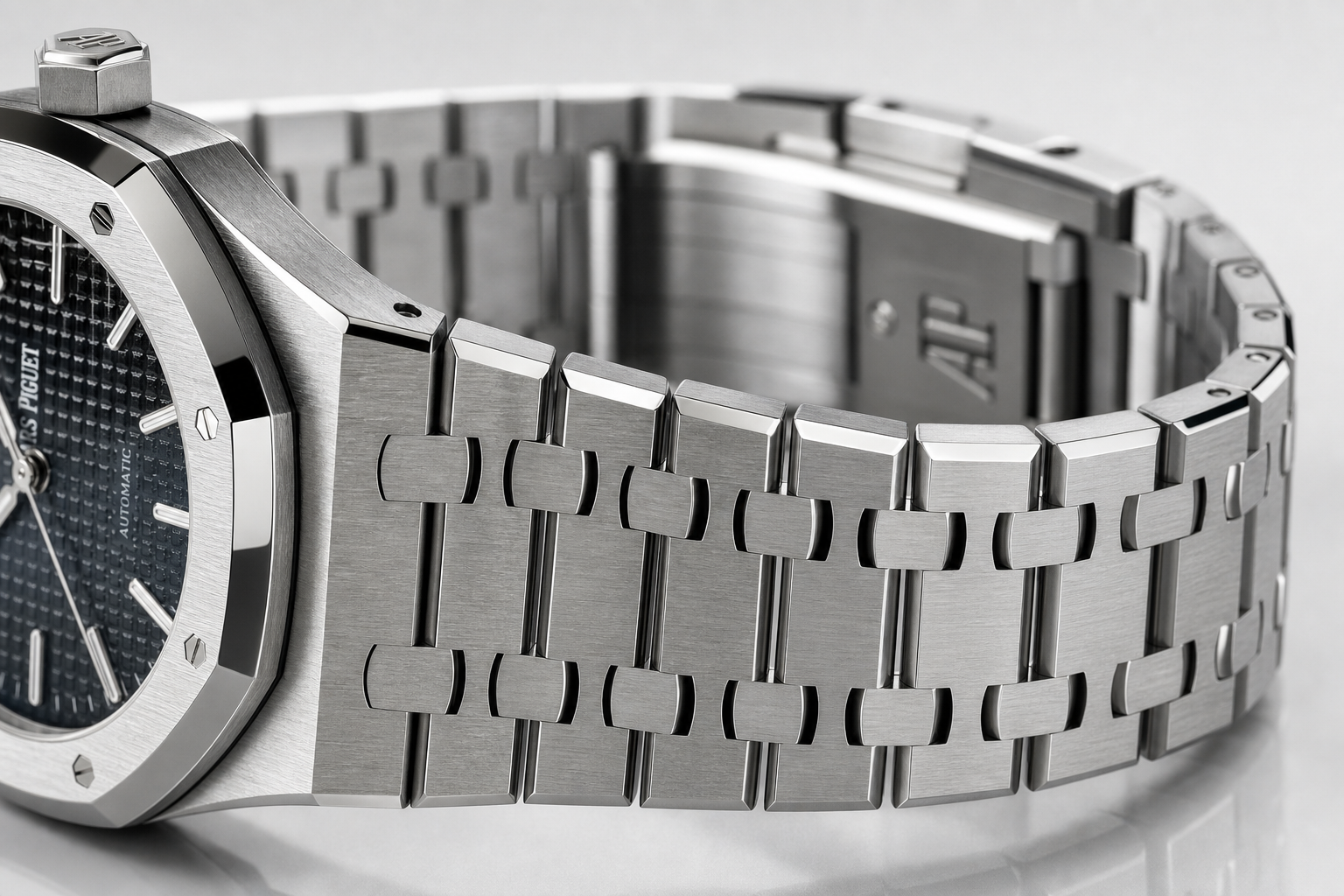
The Royal Oak integrated bracelet is not just part of the design; it is a major part of the wearing experience. This is where an AP super clone can look strong in photos and still feel less convincing once it is on the wrist. The bracelet is touched constantly, flexed constantly, and adjusted every time the watch moves. That means small differences in link tolerances, edge finishing, and clasp behavior become harder to ignore over time.
A good replica AP bracelet can get the broad look right. The taper, the polished bevels, the brushed flats, and the overall flow from case to bracelet may all seem very close at first glance. But genuine AP bracelets usually feel more controlled because the links articulate with a smoother, more deliberate motion. They drape differently. They sit flatter. They do not feel like separate parts being held together as much as a single structure that was designed to move as one unit.
The non-obvious issue is that bracelet quality affects comfort as much as appearance. A bracelet that is slightly stiff, slightly uneven, or slightly rough on the edges may not look dramatically wrong in a photo, but it can change how the watch settles on the wrist after an hour or two. That is why replica AP bracelet comfort matters more than many buyers expect. If the links do not move cleanly, the watch can feel less premium even when the case and dial are acceptable.
Clasp feel is another place where the ownership impression changes quickly. A clasp that closes with a firm, confident snap helps the watch feel complete, and the same tolerance discipline that separates blue dial AP super clones from simpler black or silver dial executions also matters in clasp engineering. A clasp that feels loose, thin, or vague weakens the whole experience because it breaks the sense of precision that the Royal Oak design depends on. On a watch like this, the clasp is not a minor detail. It is part of the wrist feel.
Integrated Bracelet Design Magnifies Small Differences
Because the bracelet is part of the watch’s architecture, minor flaws do not stay minor. A small gap at the end link, a slightly uneven link edge, or a bit of stiffness in the first few segments changes how the entire watch presents itself. The Royal Oak design is unforgiving in that way. It does not hide behind a traditional round case and separate bracelet. Everything is visually connected, so the bracelet either supports the design or exposes the compromise.
That is why genuine AP bracelet smoothness feels different in daily use. The bracelet does not just look refined; it behaves refined. It folds and settles with less resistance, which gives the watch a more natural presence on the wrist. A replica can capture the silhouette but still miss that quiet mechanical elegance in the way the links move together.
Fluidity Matters More Than Static Appearance
Many bracelet photos make two watches look closer than they really are. Under static lighting, an AP-style bracelet can appear sharp, clean, and expensive. Once the watch is sized and worn, the reality is easier to judge. Does the bracelet bend smoothly at the lugs? Does it drape without fighting the wrist? Does it rattle lightly in a way that feels cheap, or does it move with controlled articulation?
Those are the questions that matter more than isolated close-ups. A bracelet that looks nearly right on a table can still feel less refined when worn for several hours. That is especially true for buyers who care about daily wear feel rather than one-time visual impact. If the bracelet does not move naturally, the watch becomes less enjoyable even if it remains visually convincing from a distance.
Clasp Feel Can Change the Ownership Impression
The clasp can make a replica feel more complete or more compromised within seconds. Snap action, closing tension, hinge smoothness, and the comfort of the underside all influence how secure the watch feels. A weak clasp does not just create a technical concern; it changes the emotional impression of the watch. It makes the piece feel less settled, less finished, and less expensive in the hand.
That does not mean every genuine clasp is perfect or every replica clasp is unusable. It means the clasp is one of the easiest places to feel the difference in ownership quality. If the bracelet is the Royal Oak’s architecture, the clasp is the final proof that the architecture was executed well.
Dial Layout Can Look Close, but Tapisserie Depth Is Hard to Reproduce
The AP dial is one of the biggest reasons the watch feels special, but the dial is also one of the clearest places where a high-end replica can stop short of the genuine experience. A super clone can reproduce the overall layout, the grid pattern, the applied markers, and the general balance of the dial. What it usually cannot fully copy is the optical depth that makes the genuine dial feel alive under changing light.
That difference is easy to miss if you only look at a watch head-on in neutral light. At that angle, the dial may seem impressively close. The issue appears when the watch starts interacting with light instead of sitting flat under it. Genuine tapisserie dials create shadow, texture, and subtle movement across the surface. The dial does not just show the pattern; it seems to hold depth within the pattern. Replica dials often lose some of that layered effect and can look flatter by comparison.
The result is not usually a dramatic flaw. It is a refinement gap. The layout is there, but the dial may not have the same optical patience. Printing can look a little heavier. The markers may feel a little less crisp. The hands may not sit into the overall composition with the same delicacy. None of these points changes the basic identity of the watch, but they do change how close the dial feels in real use.
That distinction matters because many buyers focus too much on pattern match and too little on how the dial reads in motion. The AP dial is not only about the geometry of the squares. It is about how those squares catch light, how the markers sit against them, and how the whole surface keeps its balance from different angles. A replica can get the design language right while still feeling slightly less elegant once the watch is actually worn.
The Pattern Is Not the Same as the Depth
Copying the tapisserie geometry is one thing. Reproducing the genuine optical layering is another. A dial can be sharply stamped or crisply textured and still miss the softer dimensional quality that makes a genuine AP dial interesting up close. That is why some replica dials look surprisingly strong in photos but feel less nuanced when the wrist starts moving.
The light play is the real test. On a genuine dial, the pattern does more than repeat itself. It changes character with the angle. In a replica, the texture may stay too uniform or too flat, which makes the dial feel more static. The difference is subtle, but it is exactly the kind of subtlety that defines AP.
Hands, Markers, and Printing Affect the Sense of Refinement
Even when the main pattern looks close, small dial details shape the overall impression. Marker edges, hand finishing, logo placement, and minute track clarity all influence whether the dial feels clean or slightly coarse. The problem is not usually one dramatic error. It is the accumulation of small decisions that make the surface feel a little less controlled.
If the printing is too heavy or the hand surfaces do not catch light cleanly, the dial stops feeling as refined. Buyers often notice this only after wearing the watch for a while because the difference is not obvious in a single still image. It becomes more apparent when the dial is seen casually throughout the day, not under a macro lens.
Date Window Execution Can Affect the Whole Dial Balance
The date window is a small element, but on an AP-style dial it can influence the entire balance of the face. If the opening looks slightly off, if the font weight feels too bold, or if the framing does not sit naturally with the pattern around it, the dial can lose some of its calm symmetry. That matters because the Royal Oak design depends on order. It is a watch that looks best when every element seems placed with intention.
Even a minor mismatch can interrupt that feeling. The dial may still be attractive and recognizably AP, but the harmony is weaker. For a buyer focused on daily wear rather than forensic comparison, that harmony is often what separates a satisfying replica AP from one that feels merely acceptable.
Movement Behavior: The Gap You Hear and Feel More Than See
Movement behavior is one of the most important differences between a high-end replica and a genuine Audemars Piguet. The dial side may be visually close, but the watch can still feel different as soon as you wind it, set it, or wear it quietly through a full day. This is where ownership confidence starts to matter. The movement is not only a technical component; it shapes how the watch sounds, how it responds in the hand, and how secure it feels long term.
Many buyers underestimate how much the genuine AP experience depends on smoothness and silence. A genuine watch usually gives a calmer mechanical impression. The crown action feels more deliberate. The setting process feels more polished. The rotor is less likely to call attention to itself. A super clone may still function well, but it often does not reproduce that same sense of mechanical calm with the same consistency.
The difference is especially noticeable in daily use because the movement becomes part of the background of wearing the watch. If the rotor is audible, if the winding feel is rough, or if the date change feels less precise, the watch no longer disappears into the wearing experience. It reminds you that it is a replica. That reminder may not matter to some buyers, but it matters a lot to anyone who values the genuine AP feeling as much as the AP look.
Silence and Smoothness Are Part of the Genuine Luxury Feel
Rotor noise is one of the easiest ways to break the illusion of refinement. A watch can look excellent from the dial side and still feel mechanically less mature if the rotor is too noticeable. Winding resistance, crown feel, and the transition into setting mode also matter because they tell your fingers how the watch is built. If those actions feel coarse or inconsistent, the ownership experience changes immediately.
That is why the genuine AP impression is not just visual. It is tactile and acoustic. The watch feels engineered to move quietly. A replica can come close, but it often leaves small traces in the hand that become obvious after regular use. For many buyers, that is the point where the difference stops being theoretical.
Movement Decoration Is Especially Difficult on Open-Back Models
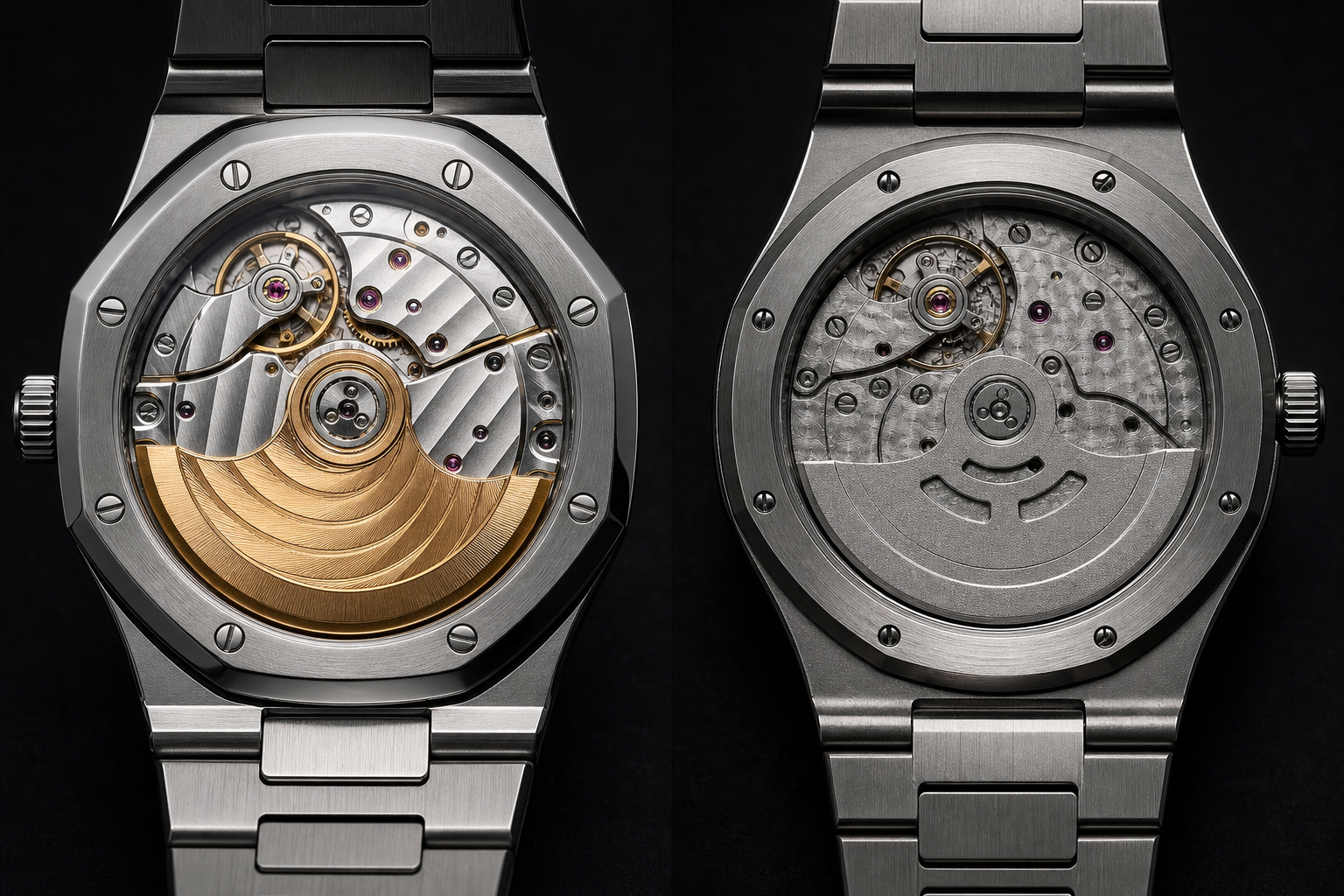
Display-back AP models raise the difficulty because the movement is part of the visible design. Bridges, rotor decoration, engraving depth, and surface finishing are not hidden. They sit directly under the crystal, where the eye can compare structure and polish instead of just function. A replica can imitate the general shape of a movement, but it often struggles to make the architecture feel as clean and purposeful as the genuine version.
This is not only about whether the movement looks expensive. It is about whether it looks coherent. If the decoration feels shallow or the finishing lacks consistency, the whole back side loses some credibility. That matters because an open-back watch does not allow the movement to hide behind the case. It becomes part of the ownership experience every time the watch is taken off and turned over.
Service Confidence Is Not the Same Experience
Genuine ownership includes something the replica cannot really duplicate: confidence in the support path behind the watch. That does not mean every genuine service experience is simple or cheap. It means the watch exists within a known support structure, with brand-backed repair pathways and a clearer long-term expectation. A replica does not offer that same sense of continuity.
For the buyer, this changes how the watch feels over time. Even if the movement is working well today, the uncertainty around future support remains part of the experience. That uncertainty is not always visible, but it affects how confidently the watch is worn.
Movement Route to Verify
If you are comparing AP super clone options, the practical questions are simpler than the marketing often suggests: what movement route is being used, how does the winding feel, how does the display-back execution look if the model has one, and what reliability expectations are realistic for that exact version? Those are the questions that affect ownership most. They do not guarantee a perfect result, but they do help prevent the common mistake of judging the watch only by its front-side appearance.
Movement claims deserve extra caution because a decorated bridge, engraved rotor, or familiar-looking layout does not prove the same architecture, quality control, or service pathway as the authentic caliber. Buyers should avoid treating movement decoration as evidence of mechanical equivalence. The practical test is whether the specific watch operates smoothly, can be serviced realistically, and does not force the case into proportions that weaken the design.
Movement Transparency Note: Movement references in this article describe replica-market movement routes, decoration, and configuration rather than official Audemars Piguet calibers unless verifiable evidence is provided. Buyers should judge movement claims by smooth operation, realistic serviceability, case thickness, and the specific version being offered.
Movement Choice Changes Ownership More Than Many AP Buyers Expect
For AP-style replicas, the movement decision is not only about whether the seconds hand moves smoothly or whether the caseback looks decorated. It can affect case thickness, crown position, rotor sound, setting feel, date behavior, power reserve, and long-term serviceability. A movement that looks more visually similar through a display back may not always be the most comfortable or predictable choice for daily wear.
This is an important tradeoff for buyers who are comparing closed-back, display-back, chronograph, and openworked AP models. On a closed-back time-and-date Royal Oak-style watch, a stable and serviceable movement route may matter more than decorative similarity. On an open-back model, visual architecture becomes more important, but that also increases the risk because the movement has to satisfy the eye and still behave well on the wrist.
Chronograph and complicated AP replicas add another layer of risk. The pushers may work, but the feel may not resemble the controlled mechanical action of the genuine watch. Subdial spacing may be dictated by the available movement rather than the original layout. Case thickness may increase to accommodate a movement that was never designed for the same architecture. These compromises can be acceptable if the buyer understands them, but they should not be hidden under a broad “best version” claim.
A practical buyer should separate movement decoration from movement performance. A rotor with AP-style engraving, bridge decoration, or a similar visual layout does not automatically mean quiet winding, good regulation, reliable date change, or easy future repair. For daily wear, the better choice is often the version with the most balanced combination of acceptable visual layout, reasonable thickness, smooth operation, and realistic maintenance expectations.
Movement Names Should Be Read as Configuration Clues
In replica listings, movement names often function as market descriptions rather than official caliber statements. A name may describe an ETA-style layout, a Miyota-based route, a decorated Asian movement, a chronograph configuration, or a clone-style architecture used to place the hands and date in a certain position. That information can still be useful, but it should not be read as proof that the movement is a genuine Audemars Piguet caliber or that it will behave like one.
The most useful movement traceability comes from matching the claim to the watch’s behavior and construction. Does the movement make the case noticeably thicker? Does the crown sit at the expected height? Does the date change feel clean? Is the rotor unusually loud? If the caseback is open, does the decoration look coherent or simply applied for appearance? These checks help the buyer understand what the movement claim actually means in use, instead of treating the name as a guarantee of refinement.
Royal Oak, Offshore, and Complicated AP Models Do Not Feel Equally Close
An AP super clone is not one single experience. That is the first thing buyers get wrong. A cleaner Royal Oak-style three-hand watch can feel surprisingly close in daily use because the replica only has to get the silhouette, bracelet flow, and dial balance in the right zone. Once you move into an AP Offshore replica, a chronograph, or anything with an openworked display, the gap usually grows fast. The watch may still look impressive in photos, but the ownership experience becomes more sensitive to case thickness, subdial spacing, movement display, and how the functions feel on the wrist.
The practical difference is simple: the more the original AP depends on architecture and movement presence, the harder it is for a replica to feel convincing. A time-and-date Royal Oak can lean heavily on shape and proportion. A chronograph or skeleton model has to reproduce more layers at once, and each added layer creates another place where the illusion weakens. That is why the question is not just which AP replica feels closest, but which model family is forgiving enough to live with.
Time-and-Date Royal Oak Designs Are Usually More Forgiving
A simpler Royal Oak design is usually the safer starting point because it concentrates the experience into the case profile, integrated bracelet, bezel geometry, and dial layout. There is no subdial spacing to judge, no chronograph actuator feel to notice, and no openworked movement architecture to expose. That matters more than many buyers expect. When a watch has fewer functional layers, the replica only has to approximate the overall design language instead of recreating a full mechanical performance.
This is why a three-hand Royal Oak-style watch can feel closer than a more technically ambitious AP replica even if both come from a strong factory. The watch is easier to wear, easier to read, and easier to forgive. Small compromises in finishing or thickness still exist, but they do less damage to the experience because the original reference itself is visually restrained. If you want the safest Royal Oak super clone experience, this is usually the model family that makes the most sense.
Offshore Models Add Size, Thickness, and Function Challenges
The Offshore changes the equation. It is a louder design, and that louder design exposes more problems. Larger cases make thickness more noticeable. Chronograph pushers add another point of interaction that can feel generic if the action is not convincing. Wider dials and more aggressive construction also make proportion issues easier to spot on the wrist. A watch can look sharp in a dealer photo and still feel less natural once the size, balance, and function behavior are loaded onto your wrist.
That is why AP Offshore replica buyers should expect more compromise than buyers of simpler Royal Oak models. The Offshore’s character depends on visual mass and mechanical presence, which are exactly the areas where replicas tend to become less refined. Even if the watch is attractive, the experience can drift away from the genuine version once you start using the pushers, adjusting the crown, or wearing it for a full day. For many buyers, the Offshore is the point where the ownership risk becomes more obvious than the initial appeal.
Skeleton and Openworked Designs Raise the Difficulty Quickly
Openworked AP models are in a different category of difficulty. The problem is not just that more of the movement is visible. It is that the watch has to look alive from every angle. Dial depth, bridge shaping, negative space, and the way the movement sits inside the case all matter at once. If any one of those elements looks flat or overbuilt, the entire watch loses credibility. This is a much harder experience to imitate than a closed dial with standard hands and markers.
For that reason, skeleton and openworked AP replicas are usually the least forgiving choice for buyers who care about the full experience rather than just the outline. They can be visually dramatic, but drama cuts both ways. Any mismatch in depth, finishing, or architecture becomes part of the daily view, not a detail hidden behind the caseback. If you are asking which AP replica feels closest, these are usually not the references to start with.
The Social Experience of Wearing an AP Design Can Feel Different From Wearing a Simpler Watch
Part of the AP super clone ownership experience has nothing to do with the watch’s construction. It has to do with how recognizable the design is. The Royal Oak is not a quiet watch. Its shape, bracelet, and status code are visible from across a room, and that changes how it feels to wear in public. For some buyers, that visibility is the appeal. For others, it introduces a level of self-awareness that a simpler watch never creates.
This is where a lot of buyers misjudge the watch. They focus on wrist presence and assume that is the whole story. It is not. A recognizable AP design can create pressure depending on where you wear it, who you are around, and how comfortable you are with attention. The watch may look excellent on the wrist and still feel wrong if the social message does not fit the wearer.
AP Has a Louder Social Signal Than Many Dress or Tool Watches
The Royal Oak carries a strong visual identity. It is angular, expensive-looking, and highly coded. That makes it easier to notice than a low-profile dress watch or a standard steel sports watch. Even people who do not know the exact reference usually register that it is a high-end design. That recognition is part of the AP appeal, but it also means the watch is not emotionally neutral.
For some wearers, that signal feels rewarding. For others, it feels loud. This matters because confidence wearing a replica is not only about whether the watch looks convincing in the mirror. It is also about whether the design feels comfortable in your actual life. A watch can be technically good and still feel too present for the wearer’s day-to-day environment.
Attention Can Reduce Enjoyment for Some Wearers
Attention sounds flattering until it becomes constant. A recognizable AP design can invite comments, glances, or internal pressure that the wearer did not expect. Some buyers enjoy that. Others quickly realize they do not want the social energy that comes with it. That is a real ownership issue, not a theoretical one.
The important point is that a watch’s appeal is not measured only by how close the case shape is to the original. If the design makes you self-conscious, the experience suffers even if the watch itself is well made. That is why the most accurate replica is not always the most comfortable choice.
Design Enjoyment and Ownership Confidence Are Not the Same
Many buyers enjoy the AP look long before they feel confident wearing it. Those are different stages. Liking the silhouette, bracelet, and dial layout does not automatically create the emotional certainty that comes with genuine ownership. A replica can deliver the design pleasure without delivering the psychological ease.
That distinction matters because it changes what “good enough” means. If the goal is only to enjoy the AP aesthetic on the wrist, the bar is one thing; in a super clone Audemars Piguet guide context, that difference becomes even clearer. If the goal is to feel completely settled every time the watch is visible, the bar is much higher. Those are not the same target, and buyers who confuse them usually end up disappointed.
QC and Version Consistency Matter Because AP Leaves Little Room for Sloppiness
AP’s geometry is unforgiving. The design looks clean only when the lines, angles, and spacing stay disciplined. That is why AP replica QC matters more here than it does on many softer-looking watches. Small inconsistencies do not disappear in the Royal Oak language. They stand out. The same is true for version consistency: a watch that looks acceptable in one batch can feel noticeably less polished in another if the bracelet, thickness, or finishing changed underneath the same model name.
The buyer should treat QC as an experience filter, not an authentication exercise. The goal is not to prove the watch is genuine. The goal is to avoid a version that looks fine in photos but feels loose, uneven, or awkward once it is actually worn.
Geometric Designs Make Alignment Issues Easier to Notice
The AP case gives you very little visual cover. Bezel screw orientation, dial centering, marker alignment, and date window placement all sit inside a rigid geometric frame. That frame is one reason the design works so well, but it also means the smallest inconsistency can break the balance. A watch with a slightly off-center dial or uneven visual spacing can feel wrong immediately, even to a buyer who is not trying to inspect it like a technician.
That is why Royal Oak super clone QC photos should be read with more than casual attention. Straight geometry makes tolerance issues easier to see, and once you notice one, the watch often feels less coherent on the wrist. A small cosmetic issue on a round, busier watch may be forgivable. On an AP, it can affect the whole wearing impression.
Side-Profile Photos Matter for Case Thickness and Wrist Feel
Front photos can hide a lot. Side-profile photos tell you much more about whether the watch will actually feel right. Thickness changes the way the case sits above the wrist, how the bracelet drops, and how integrated the watch feels from the side. If the mid-case is too tall or the bracelet does not flow cleanly into it, the watch loses some of the AP’s natural balance.
That is one of the more overlooked points for buyers comparing a Royal Oak vs Offshore replica. The watch can look acceptable from above and still feel heavier, blockier, or less refined once worn. Side view is where the proportions stop being abstract and start affecting comfort.
Bracelet and Clasp Checks Should Not Be an Afterthought
The bracelet often determines whether the watch feels polished or merely acceptable. Stiff links, rough edges, poor articulation, or a weak clasp action can ruin the experience even if the dial looks strong. On AP designs, the bracelet is not a support part. It is a major part of the identity. If the links do not move naturally, the watch stops feeling like a coherent object.
This is also where acceptable replica flaws become a buyer judgment call. Minor cosmetic variation may be tolerable if the bracelet drapes well and the clasp feels secure. But if the links are stiff or the clasp feels vague, the watch will remind you of its limitations every time you wear it. That is not a small issue. It changes the entire ownership experience.
QC Photos to Request
For AP models, the most useful QC images are the front dial, an angled dial shot, the side profile, a bracelet close-up, a clasp close-up, and the movement side if the caseback is open or displayed. Those angles tell you more about daily wear quality than a dozen flattering front-facing shots. If the model has a display back, the movement-side photo matters even more because it shows whether the visible architecture is convincing or simply busy.
Lighting still matters, of course. A strong photo can hide flat dial texture, uneven brushing, or a case that wears thicker than it should. That is why QC should be read as a practical filter, not a guarantee. The watch only feels right if the visible geometry, bracelet behavior, and thickness all agree with each other.
Buyers should also remember that QC photos are not laboratory evidence. They are a decision aid. They can reveal obvious problems, but they cannot prove water resistance, long-term durability, movement origin, official service compatibility, or the same finishing standard as an authorized watch. If a seller uses QC images to support a strong claim, the image should actually show the detail being claimed.
Before making a decision, buyers should review real QC photos where available, including dial printing, hand alignment, bezel screw layout, datewheel centering, side-profile thickness, bracelet fit, clasp engraving, caseback finishing, and movement-side views for open-back models. Factory labels and stock photos alone are not enough for a reliable AP-style comparison.
How to Read Seller Claims Without Overvaluing Them
Seller descriptions can be useful, but AP listings often use broad phrases that sound more decisive than they are. Terms such as “best version,” “latest upgrade,” “super clone,” or “top factory” should be narrowed to something a buyer can actually verify. What changed in the upgrade? Is the case thinner? Is the bracelet smoother? Is the dial texture improved? Is the movement route different? Without that kind of detail, the claim does not tell the buyer much.
QC photos also need context. A clean straight-on dial image may confirm marker alignment and general layout, but it does not show the most important AP wearing traits. It will not tell you whether the bracelet has sharp underside edges, whether the clasp feels secure, whether the rotor is noisy, or whether the case profile looks too slab-sided from the wrist. For this reason, a buyer should not treat a beautiful front photo as proof of a good daily-wear watch.
The better approach is to connect every seller claim to a practical ownership point. If the claim is better case finishing, ask for angled light shots that show brushing and bevel transitions. If the claim is improved bracelet quality, look for link articulation, end-link fit, and clasp construction. If the claim is a more accurate movement, decide whether that improvement affects visual similarity, thickness, reliability, or only decorative appearance through the caseback.
This is where AP differs from many simpler replica watches. The Royal Oak design leaves very little room for vague marketing because small execution problems are easy to feel and see. A careful buyer should use factory labels, price, seller notes, and QC photos as signals that guide the next question, not as final proof that the watch will deliver the intended experience.
Seller claims about “same as genuine,” “1:1,” or “authentic quality” should be treated especially carefully. Those phrases are usually too broad to be useful because they combine many separate issues: visual layout, case dimensions, finishing, movement architecture, bracelet behavior, water resistance, service support, and legal status. A more reliable conversation asks what exact part of the watch has improved and what evidence the seller can show for that exact improvement.
Unrealistic claims should also be evaluated by what they leave out. If a listing emphasizes a factory name but avoids side-profile photos, movement information, bracelet close-ups, or real unit images, the buyer has less traceable evidence to work with. The safest use of factory and movement information is to understand quality and avoid confusion, not to misrepresent a replica watch as genuine or assume that broad marketing language proves the watch’s actual execution.
Price Differences Should Be Read as Risk and Refinement Signals, Not Proof of Genuine-Level Experience
The AP super clone price question is often framed too simply. Buyers ask whether the more expensive version is “worth it,” but for an Audemars Piguet-style watch, the better question is what the extra cost is trying to reduce. On a Royal Oak or Offshore replica, a higher price may reflect a more developed factory version, a more suitable movement route, cleaner case finishing, better bracelet tolerances, or more consistent QC. It does not mean the watch has crossed into genuine AP ownership territory.
This distinction matters because AP is a refinement-heavy design. A cheaper Rolex-style sports replica can sometimes survive rough finishing because the basic design is more tool-like and forgiving. A Royal Oak-style watch is less forgiving. The flat bezel, exposed screw layout, integrated bracelet, brushed planes, polished bevels, and dial texture all sit in the open. If the execution is weak, the watch does not merely look “less accurate” under close viewing; it loses part of the AP design experience in normal wear.
Prices can change by factory label, version, movement, seller channel, and availability, so exact comparisons should be verified at the time of purchase. A price difference is most useful when it can be connected to visible details, specific movement configuration, QC evidence, or clearly stated seller terms rather than a broad promise of being closer to a genuine watch.
Higher Price May Reflect Better Execution, Not Perfection
A higher-priced AP super clone may be more rational when the added cost is tied to visible and tactile improvements: a case that sits closer to the intended thickness, a bracelet that articulates more naturally, cleaner brushing direction, a more stable movement route, or better batch consistency. These are not luxury extras. On an AP replica, they are the difference between a watch that feels coherent and one that feels like a heavy case attached to a bracelet trying to imitate the shape.
The most useful way to read a price difference is to ask what risk it is reducing. Is the premium buying a better movement architecture for the model? Is it buying a bracelet that will not feel sharp, loose, or stiff after sizing? Is it buying a dial that handles light better? Is it buying more predictable QC from a mature factory version? If the answer is only “the seller says it is the best,” the price is not giving the buyer enough information.
At Clean VS Factory, we usually treat price as one input, not the decision itself. A factory name, a premium label, or a higher quote can point toward a better version, but it still needs to be checked against the model, movement route, case proportions, bracelet feel, and known batch behavior. With AP-style replicas, paying more can reduce frustration, but it cannot buy the silence, hand-finishing confidence, service pathway, or emotional certainty of a genuine Audemars Piguet.
Cheap Versions Can Undermine the AP Design Experience
The cheapest AP-style option is rarely the better choice if the buyer actually wants the Royal Oak experience. The reason is simple: the Royal Oak is not carried by the dial alone. It is carried by the relationship between the bezel, mid-case, bracelet, and finishing transitions. If the case is too bulky, the bracelet feels rigid, the clasp feels weak, or the brushing looks coarse, the watch may still be recognizable as an AP design, but it will not wear with the same visual discipline.
This is where many buyers misjudge Audemars Piguet replica value. They compare front-facing photos and decide the cheaper watch is “close enough.” Front photos hide too much. They rarely show how thick the case feels from the side, how the first bracelet link drops from the case, whether the clasp closes with confidence, or whether the brushing catches light evenly across the bracelet. Those details become more important after the first day of ownership than they seemed during shopping.
A low-cost version can still make sense for someone who only wants the general AP silhouette as a casual fashion object. It becomes a poor choice when the buyer expects a refined super clone watch experience. In this category, weak execution is not a small compromise; it affects the exact qualities that make the Royal Oak desirable in the first place.
The Best Value Depends on Which Gap Bothers the Wearer Most
There is no single answer to whether a higher-priced AP clone is worth it because buyers are sensitive to different gaps. Some people care most about wrist presence and will accept a less refined movement if the case shape and bracelet look convincing. Others will enjoy the watch less if the rotor is noisy, the crown action feels rough, or the power reserve is inconsistent. Another buyer may be bothered most by bracelet stiffness, because that is felt every time the watch is worn.
The practical value question is not “How close is it to genuine AP?” in a broad sense. It is “Which part of the genuine AP experience am I trying to approximate, and which part am I willing to give up?” If the buyer mainly wants the angular design language and bold wrist presence, a strong upper-tier AP super clone may deliver enough satisfaction. If the buyer expects genuine-level hand finishing, movement decoration, quietness, and long-term service confidence, the price premium will not close that gap.
For AP, diminishing returns usually begin when the extra cost no longer improves the experience layer the buyer actually notices. Paying more for a better bracelet and cleaner case finishing can be sensible. Paying more for vague claims, decorative wording, or a version label that does not change the watch on the wrist is not. The smarter buyer reads price as a risk signal, then checks whether the risk being reduced is one they personally care about.
Choosing by Use Case Is More Practical Than Chasing the “Closest” AP
The best AP-style replica choice depends heavily on how the buyer plans to use it. A watch that is impressive for photos may not be the best daily-wear choice if the bracelet is stiff, the case is too thick, or the movement draws attention through noise and rough setting. For occasional wear, the visual hit may be enough. For frequent wear, comfort, movement behavior, clasp security, and serviceability become much more important.
For a first-time buyer, a simpler time-and-date Royal Oak-style model is usually the more forgiving path. It reduces the number of things that can go wrong: no chronograph pusher feel, no busy openworked bridge layout, fewer exposed movement details, and usually a cleaner dial structure. This does not make it equal to a genuine AP, but it does make the compromise easier to live with.
For a buyer who already understands replica tradeoffs and wants a more dramatic look, an Offshore or openworked model can be enjoyable, but the inspection standard should be stricter. Thickness, subdial spacing, caseback appearance, pusher action, and movement stability should all be checked before relying on the factory label or seller description. Complicated AP-style replicas can create more satisfaction visually, but they also create more points of disappointment.
The most grounded buying decision is to decide which experience matters most: visual wrist presence, bracelet comfort, dial texture, movement smoothness, or long-term reliability. No replica AP is likely to maximize all of those at once. A buyer who understands that tradeoff is less likely to overpay for the wrong feature and more likely to choose a watch that fits the real purpose.
Buyers should also define the environments where the watch will actually be worn. A watch that feels exciting for short social use may be less satisfying for work, travel, or long daily wear if it feels heavy, loud, or self-conscious. The closer the watch is to being a daily object, the more importance should be placed on comfort, clasp confidence, movement quietness, and realistic maintenance expectations.
A replica watch should be evaluated with realistic ownership expectations. Even a strong AP-style super clone can have limits in water resistance, long-term movement stability, servicing convenience, and close inspection compared with a genuine reference. Buyers should confirm return, repair, shipping, and after-sales terms before ordering, because those practical terms are separate from factory reputation and model appearance.
Water resistance should not be assumed from the model name or appearance. Buyers should confirm whether the specific watch has been tested and treat replica watches more cautiously around water than genuine watches designed and serviced through official channels.
Compliance Boundaries That Make the Comparison More Useful
A careful AP replica comparison should avoid two extremes. It should not pretend that every super clone is poor or useless, but it also should not suggest that a replica-market watch is commercially, legally, mechanically, or emotionally equivalent to a genuine Audemars Piguet watch. The useful middle ground is to describe what can be approximated, what usually remains different, and which claims need evidence before they should influence a buying decision.
Factory names are useful market references, but they do not guarantee identical quality across every model or version. A buyer should be especially cautious when a seller uses a factory label as the entire argument, because AP-style watches depend on many unit-level details: case shape, bezel finishing, dial depth, bracelet articulation, clasp feel, movement route, and visible QC. A factory reputation may justify closer inspection, but it should not replace inspection.
Movement descriptions in the replica market should be checked carefully because they may refer to layout, decoration, clone architecture, or seller terminology rather than an official brand-manufactured caliber. A decorated movement or AP-style rotor does not prove that the movement is an authentic Audemars Piguet caliber, that it has the same architecture, or that it can be serviced through genuine brand channels.
QC photos can reduce uncertainty, but they do not guarantee perfection. Buyers should still review visible details and confirm seller policies before ordering, especially for return terms, repair options, water-resistance testing, shipping expectations, and after-sales support. Those practical terms should be confirmed directly with the seller rather than assumed from a factory name, price level, or promotional description.
The Balanced Verdict: Strong Design Experience, Incomplete Genuine Ownership Experience
The most honest AP super clone vs genuine experience comparison is not that one is “the same” and the other is “overpriced.” That misses the real difference. A well-executed Audemars Piguet replica can deliver a strong version of the design experience: the octagonal bezel, integrated bracelet profile, broad wrist presence, recognizable dial layout, and the visual attitude that makes the Royal Oak and Offshore so distinctive. For many buyers, that is the part they are chasing.
What it does not fully deliver is the complete genuine ownership experience. Genuine AP ownership is not only a look. It includes finer finishing transitions, more controlled bracelet fluidity, deeper dial texture, quieter and smoother mechanical behavior, stronger service confidence, and the emotional certainty of owning the original object. A high-end replica can approach some visual and tactile cues, but it usually cannot reproduce all of those layers together.
Who May Find the Experience Satisfying
A high-end AP super clone can be satisfying for the buyer who is primarily drawn to the Royal Oak or Offshore design language and understands the compromise before buying. This person wants the case shape, bracelet architecture, dial layout, and wrist presence more than they want the full emotional and mechanical assurance of genuine AP ownership. For that buyer, the watch can be enjoyable if the version is chosen carefully and expectations stay grounded.
The most suitable buyer is also realistic about use. They do not expect the movement to feel exactly like a genuine AP caliber, they do not assume bracelet finishing will match hand-finished Swiss work, and they do not treat the watch as a substitute for genuine service support. They judge the watch as a design-focused replica object, not as an ownership replacement for Audemars Piguet.
Who Will Still Feel the Difference Quickly
The difference becomes obvious faster for buyers who are sensitive to touch, sound, and finishing. If bracelet fluidity matters to you, AP is a difficult category because the bracelet is central to the whole watch. If you notice the way brushed surfaces transition into polished bevels, genuine AP finishing will still feel more controlled. If rotor noise, winding feel, date action, or movement decoration affect your enjoyment, a replica movement can become the part that reminds you most often what the watch is not.
The same is true for buyers seeking emotional certainty. A super clone can satisfy curiosity about the design, but it cannot reproduce the confidence that comes from genuine provenance, official service options, and the knowledge that the object is the original article. That difference is not visible in a wrist shot, but it can shape how the watch feels every time it is worn.
The Most Honest Way to Compare Them
The cleanest comparison is design experience versus full ownership experience. A strong AP super clone can approximate the first surprisingly well from normal viewing distance. It can look powerful on the wrist, capture the geometry, and give the wearer a practical sense of why the Royal Oak design has such pull. That is a real experience, and it is the reason these watches attract attention in the replica watch market.
But the full genuine AP experience is broader than the outline of the case. It is the consistency of the finishing, the way the bracelet settles, the depth of the dial, the quietness of the movement, the service confidence, and the emotional assurance behind the watch. The balanced verdict is simple: a high-end AP super clone can be a strong design approximation, but it should not be mistaken for complete genuine Audemars Piguet ownership.
Disclosure: This article is for general educational and comparison purposes only. Replica watches are not genuine products from the original luxury brands, and brand names are used only to identify reference designs or comparison topics. Factory names, movement descriptions, prices, availability, QC details, seller policies, and version information can change, so readers should verify important details with the seller before making a purchase decision. Replica watches should not be represented, resold, or used as genuine watches.