
Choosing a first Royal Oak super clone is not just a question of picking the newest 41mm Audemars Piguet reference; blue dial super clone complexity often matters more than the reference number itself, because the 15400, 15500, and 15510 may look close at a glance, but they lead to different buyer decisions due to dial layout, case impression, movement route, factory history, and version clarity. A beginner who treats them as interchangeable can easily overpay for a vague “latest version” claim or choose a model that is harder to verify.
This guide focuses on the practical decision path: which reference is safer for a first AP-style purchase, where factory and batch claims need checking, and which QC points matter before accepting a watch. The main takeaway is measured rather than hype-driven: the 15400 is often the safer classic route, the 15500 is usually the stronger modern default, and the 15510 should be chosen only when the seller can document the exact version, dial layout, movement route, and recent QC clearly.
Brand names are used here to identify the genuine reference designs being discussed. Replica watches and super clone watches are replica-market products, not genuine Audemars Piguet watches, not authorized AP products, and not commercially equivalent to original luxury watches. The purpose of this comparison is buyer education, version awareness, and risk reduction, not helping anyone represent a replica watch as genuine.
| Buyer Decision | Safer Direction | What to Verify First |
|---|---|---|
| First AP-style Royal Oak | 15400 for classic balance or 15500 for modern availability | Exact reference, factory, version, and recent QC photos |
| Considering the 15510 | Treat it as higher-verification, not automatically better | Dial layout, batch, movement route, and whether “latest” is specific |
| Movement claims | Prefer clear movement route over vague caliber wording | Rotor noise, winding feel, date action, and service practicality |
| Visual QC priority | Check alignment before small finishing details | Dial markers, date centering, bezel screws, and case profile |
| Price judgment | Pay for proof and consistency, not reference hype | Batch evidence, bracelet fit, clasp quality, and seller transparency |
Quick Questions Before You Read
Q: Is the newest 15510 the safest first choice?
Not necessarily. It can be appealing, but it needs stricter verification than the more established 15400 and 15500 routes.
Q: Why is the 15400 often recommended for beginners?
Its proportions, dial layout, and clone development history are more mature, making flaws and version claims easier to evaluate.
Q: When does the 15500 make more sense?
It suits buyers who want a cleaner modern dial and stronger current availability, provided the batch and QC details are checked.
Q: What is the biggest mistake to avoid?
Do not rely on factory name or “latest version” wording alone. Confirm the exact reference, movement route, dial, and recent QC evidence.
Editorial Perspective: At cleanvsfactory.com, this kind of comparison is treated as a model-specific buying question rather than a simple factory ranking. The factory name helps narrow the shortlist, but the final decision still depends on the movement, case profile, dial execution, bracelet feel, and how the buyer plans to wear the watch. For Royal Oak replicas in particular, a strong result on one reference does not automatically carry over to another, so the safer approach is to verify the exact version rather than assume that “best factory” means best choice for every 15400, 15500, or 15510 listing.
CleanVSFactory’s editorial approach is to make replica watch decisions more traceable by connecting factory claims to visible details, movement behavior, version differences, and practical QC checks. This does not turn a replica-market factory name into an official Audemars Piguet affiliation, and it does not replace careful unit-by-unit review. It simply gives buyers a more disciplined way to ask what can be seen, what can be checked, and what remains uncertain before purchase.
Before You Compare Factories, Separate Visual Accuracy From Ownership Risk
One of the most useful ways to evaluate a first AP super clone is to stop treating “looks correct” as the only goal. A Royal Oak can be visually impressive in photos and still be a less comfortable long-term choice if the movement is noisy, the bracelet feels stiff, or the version claims are vague. That is why the better buying question is not just whether the watch resembles the genuine reference at a glance. It is whether the reference, factory, and movement route create a watch that the buyer can actually live with.
This distinction matters because the replica market often blurs two different priorities. Visual accuracy is about how the watch looks from the front, in QC photos, and under casual inspection. Ownership risk is about what happens after approval: how the crown feels, whether the date changes cleanly, whether the bracelet drapes properly, and how much confidence the buyer has in the specific batch. A watch can score well on one side and still be the wrong choice on the other.
For first-time buyers, the most practical approach is to rank the decision factors in the right order. Start with reference clarity, then movement route, then case thickness and bracelet fit, and only then focus on small finishing details. This is especially important for AP Royal Oak models because the design is unforgiving: slight misalignment is easier to spot than on many other sports watches, and a weak bracelet or odd side profile can change the whole wearing experience.
Evidence Boundary: What This Guide Can and Cannot Prove
This article discusses imitation watches and buyer decision logic, not authorized Audemars Piguet products. Official model information can help a buyer understand the authentic reference family, but it cannot prove that a replica watch has the same construction, finishing, movement performance, water resistance, material quality, or serviceability. Any comparison here should be read as practical replica-market guidance, not authentication, endorsement, or a claim of equivalence with an authentic Royal Oak.
Factory names, movement labels, and version claims should also be treated as seller-facing identifiers rather than independently verified manufacturer statements. In this market, a phrase such as “clone 3120,” “clone 4302,” “latest version,” or “APSF/ZF batch” may help organize the discussion, but it does not remove the need for current QC photos, movement-route explanation, and seller transparency. The more expensive or newer the listing is, the more important this evidence boundary becomes.
Factory names in the replica watch market are useful buyer-facing references, but they should not be treated as official luxury-brand affiliations or automatic guarantees of quality across every model. The safest use of factory information is to compare specific versions and avoid misunderstanding quality, not to represent a replica watch as genuine.
How to Use Genuine Reference Information Responsibly
Genuine Audemars Piguet reference information can be useful when checking broad design logic, such as whether a 15400, 15500, or 15510 dial layout is being described correctly. It should not be treated as proof that a replica watch uses the same materials, movement, finishing process, assembly standard, waterproofing, or official service route as an authentic AP watch. The genuine reference is a comparison point, not a certificate of authenticity for a replica-market product.
Buyers should also avoid reading this type of guide as a way to make a replica pass as genuine. A strong Royal Oak super clone may look convincing in normal wear, but close inspection can still reveal differences in case finishing, dial texture, bracelet construction, movement architecture, engravings, and service compatibility. The responsible use of reference knowledge is to understand what is being purchased and where the risks are, not to misrepresent the watch in resale, gifting, servicing, or social situations.
What Sellers’ Photos Can Show, and What They Often Hide
Seller photos are useful, but they are not final proof. They can show dial layout, general finishing, bezel symmetry, and whether the watch appears close to the intended reference. They cannot fully prove how the watch will feel in hand, whether the movement is the exact route claimed, or whether the bracelet articulation is smooth enough for daily wear. Macro shots can also make tiny issues look worse than they are, while beauty shots can hide poor side profile proportions.
This is why cleanvsfactory.com-style buyer guidance should not stop at factory reputation. QC photos are best used as verification tools, not as a replacement for specification checking. If the listing says “latest AP version” but does not explain which movement is inside, which factory produced it, and what the case profile should be, the buyer is still guessing. A clear listing should reduce uncertainty, not create it.
Why Some Royal Oak References Are More Forgiving Than Others
Not every Royal Oak replica carries the same risk. Simpler dial layouts, more mature references, and better-known movement routes are usually more forgiving for first buyers. The 15400 often benefits from this because its development history is longer and its visual language is more established. The 15500 is also relatively manageable when the batch is current and the seller is specific. The 15510 is the least forgiving of the three if the version description is loose or inconsistent.
That difference matters because a beginner usually does not need the most technically ambitious option. He needs the watch that is easiest to verify, easiest to wear, and least likely to create regret after arrival. In replica watch buying, the safest watch is often the one with the clearest tradeoff profile, not the one with the loudest factory label.
Buyer Checklist Before Committing to a First AP
Before paying, it is worth checking whether the listing answers the questions that actually change ownership quality. Ask which exact reference is being sold, which movement route is inside, whether the photos show the current batch, and whether the bracelet and clasp photos look consistent with the claimed factory. If the seller cannot answer those points directly, the buyer is relying on marketing language rather than evidence.
It is also worth asking how the watch is intended to be used. A Royal Oak bought mainly for photos may tolerate a different risk profile than one intended for regular wear. A watch with a beautiful dial but a questionable bracelet may still work for occasional use, while a slightly less dramatic piece with stronger movement consistency may be better for everyday rotation. That is the kind of tradeoff a first-time buyer should make deliberately, not by accident.
The First AP Super Clone Mistake: Treating 15400, 15500, and 15510 as the Same Watch
The first mistake many new buyers make is asking for the best AP super clone before deciding which Royal Oak generation actually fits them. The Audemars Piguet super clone market is not one single category where 15400, 15500, and 15510 are interchangeable 41mm steel watches. They are different ownership choices with different dial layouts, movement expectations, factory maturity, and version risks.
A typical first-time buyer wants one Royal Oak replica that feels safe, wearable, visually convincing, and not painful to evaluate from QC photos. That is a reasonable goal. The problem is that many sellers and forum comments compress the decision into factory slogans: “best AP factory,” “latest version,” or “newest model.” Those phrases are incomplete unless they are tied to a specific reference number, movement route, dial color, and current batch.
The 15400 is the more classic route. The 15500 is the modern high-volume route. The 15510 is the newer-reference route that can be attractive but needs stricter version discipline. A buyer who treats them as the same watch may end up choosing the newest name when the more mature reference would have been easier to own, or choosing an older model without checking whether the available batch is still current and well executed.
Why “Best AP Super Clone” Is Too Broad for a First Buyer
Searching for the best AP super clone usually leads to a factory debate, but the better first question is narrower: which AP super clone should I start with? For a first AP replica, that question matters more than chasing the most talked-about factory. The Royal Oak is not forgiving in the way a simple round sports watch can be. Its dial texture, octagonal bezel, visible screws, integrated bracelet, case thickness, and movement display all create more places where a weak version can show itself.
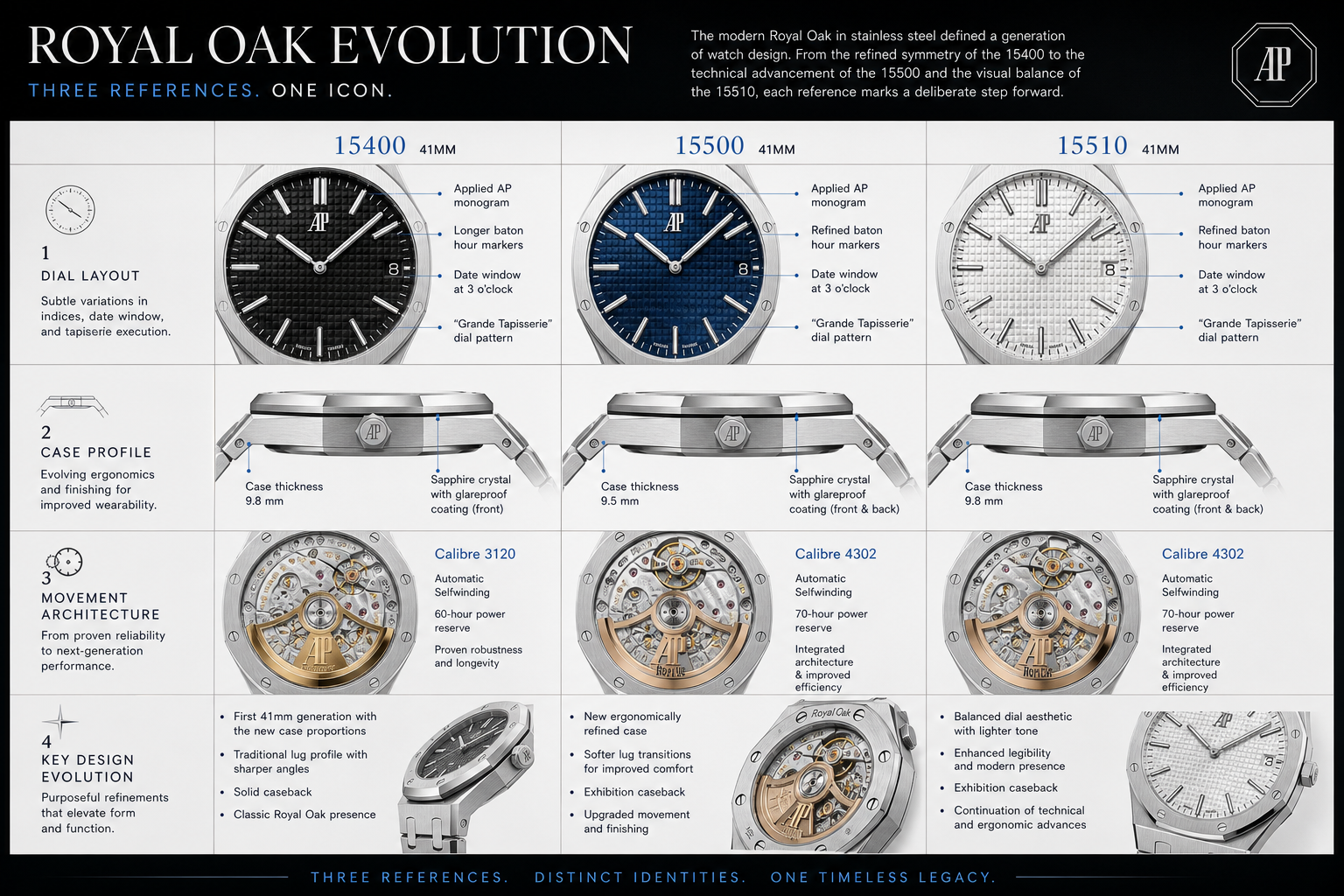
The 15400, 15500, and 15510 also belong to different model-generation moments. The 15400 carries the older Royal Oak dial balance with “Automatic” text and a more traditional feel. The 15500 moves into a cleaner, more open modern layout. The 15510 continues that newer direction, but because it is a more recent reference in the replica market, buyers must be more careful about exactly what version is being offered.
This is where beginners often misread the market. A strong factory reputation on one Royal Oak replica does not automatically make every reference from that factory the safest choice. A mature 15400 from a well-understood production route may be less stressful than a newer 15510 with vague “latest version” claims. A current 15500 may be easier to source and compare than an older 15400 if the available 15400 stock is inconsistent. The answer changes with the model, not just the logo on the factory listing.
At Clean VS Factory, we usually treat this as a version comparison before a factory ranking. A factory name is useful, but it does not tell the buyer whether the dial layout, movement route, case thickness, bracelet fit, and QC baseline all work together on the exact reference being considered.
The Five Decision Factors That Matter More Than Hype
For a first Royal Oak, the safest decision usually comes from five factors, not from the newest model name. The first is dial layout. The 15400 has a more classic, filled-out dial personality, while the 15500 and 15510 feel cleaner and more open. That difference changes wrist presence more than many buyers expect.
The second factor is case proportion. Royal Oak fit is shaped by the flat case, angular bezel, and integrated bracelet, not just the stated diameter. Two watches listed in the same 41mm category can feel different because the dial opening, bracelet flare, and thickness change the visual footprint.
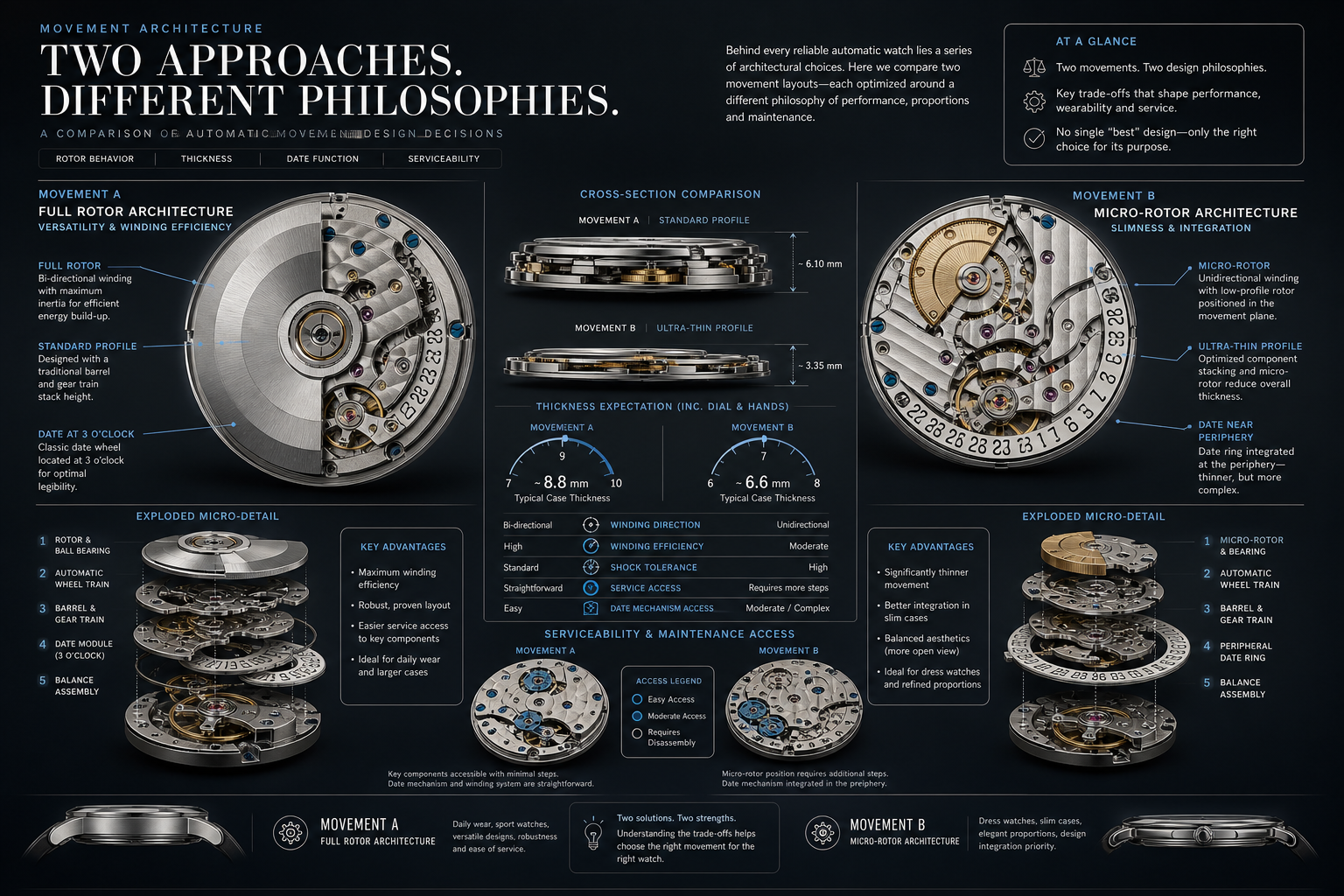
The third factor is movement generation. A clone 3120-style route in the 15400 and a clone 4302-style route in the 15500 or 15510 are not just decorative differences. They affect thickness expectations, winding feel, date behavior, rotor sound, and long-term confidence. The movement does not need to be romanticized, but it should not be ignored.
The fourth factor is factory maturity. A mature model usually has more known strengths, more known flaws, and a more predictable QC baseline. That does not make it perfect. It simply reduces the number of surprises for a buyer who does not yet know what to reject or accept.
The fifth factor is version clarity. This is especially important with newer references. “Latest version” is not a specification. A serious comparison should identify the reference, factory, movement route, dial color, approximate case profile, and recent QC examples. If those details are unclear, the buyer is not comparing watches; he is comparing claims.
The practical judgment is simple: the safest first Royal Oak is not automatically the newest one. It is the one where the model generation, factory execution, movement route, and buyer expectations are easiest to verify before purchase.
Royal Oak 15400: The Classic First-AP Choice With Mature Factory Support
The AP 15400 super clone remains a serious first-AP option because it solves a different problem from the newer references. It is not the choice for the buyer who must have the newest AP watch name. It is the choice for someone who wants the classic 41mm Royal Oak feel, a more established replica development history, and fewer version surprises than many newer-market releases.
The Royal Oak 15400 replica has also benefited from years of factory attention. Earlier generations of AP replicas struggled with movement layout, case thickness, and caseback appearance. Later 15400 versions from stronger factories improved the formula through clone 3120-style movements and better case proportions. That history matters because first-time buyers usually do better with a known reference than with a model where every seller is using different version language.
Why the 15400 Still Appeals to First-Time Buyers
The 15400 has a dial that feels more traditionally Royal Oak than the newer 15500 and 15510 layouts. The “Automatic” text, the marker structure, and the overall spacing give the watch a more filled and balanced look. For some buyers, especially those coming from Rolex replica watches or simpler sports models, that balance makes the watch feel less visually empty and easier to understand on the wrist.
Its discontinued-reference status also adds a different kind of appeal. A buyer does not choose the 15400 because it is the freshest AP design. He chooses it because it represents a more classic Royal Oak generation. In replica terms, that can be an advantage: older but mature often beats newer but unclear, especially for a first AP replica.
The clone 3120 route is part of that comfort. The appeal is not that every clone 3120 is risk-free or equal to an authentic AP caliber. The appeal is that the movement route is familiar in the 15400 context and has been developed around this case style for a longer period. For a beginner, familiarity reduces uncertainty. It gives the buyer a clearer idea of what the watch should look like, how thick it should feel, and which claims deserve extra checking.
Where the 15400 Can Be Easier to Live With
The 15400 can be easier to live with because the reference has a more stable QC baseline. Buyers have a better sense of what the dial should look like, where the date window should sit, how the bracelet should integrate, and what a reasonable case profile should be. That does not mean every example is good. It means the buyer has fewer moving targets.
This matters more than many first-time buyers realize. On a Royal Oak, small quality issues are not hidden by a round case or a busy bezel. The octagonal geometry, exposed bezel screws, tapisserie dial, and integrated bracelet all create straight lines and repeat patterns. A mature reference helps because its common issues are easier to identify before approval.
For daily wear, the 15400 also has a slightly less aggressive modern presence than the 15500 family. It is still a bold integrated-bracelet watch, but the dial composition feels more traditional and compact. Buyers who want a safer classic AP replica and do not need the newest reference often find the 15400 more comfortable as a first step into Royal Oak ownership.
The Tradeoff: Older Reference, Not Always the Freshest Availability
The 15400’s strength is maturity, but that same maturity creates the main tradeoff: availability. Because the model is no longer the newest market focus, buyers may encounter older stock, mixed batches, or listings that recycle outdated claims. A mature reference is only helpful if the actual watch being offered is from a strong current or well-preserved batch.
This is where “is 15400 a good first AP clone?” needs a qualified answer. Yes, it can be one of the safer classic choices, but not if the seller cannot clearly identify the factory, movement route, dial color, and version. A weak or old 15400 does not become better just because the reference itself is mature.
The buyer should also avoid assuming that all 15400 examples have the same case feel. Some older versions were thicker or used less convincing movement-decoration solutions. Current stronger examples may be much more convincing in profile, but the listing has to be checked rather than accepted at face value.
Version Details to Confirm
Before choosing a Royal Oak 15400 replica, confirm the claimed factory, dial color, movement route, and whether the piece is from a current batch or older inventory. If the seller provides a case thickness claim, treat it as something to verify through photos and known version information, not as a guarantee.
Bracelet fit is also important on the 15400. The watch depends heavily on how the first links articulate from the case and whether the bracelet feels fluid rather than stiff or loose. A visually attractive dial will not save the ownership experience if the bracelet pulls hair, leaves uneven gaps, or feels poorly finished at the clasp.
The practical judgment: the 15400 is still one of the most sensible first AP super clone choices for buyers who value classic Royal Oak balance and reduced version confusion. The mistake is buying it casually because it is “proven” without checking whether the specific unit still matches that reputation.
Royal Oak 15500: The Modern High-Volume Choice With Stronger Current Availability
The AP 15500 super clone is often the practical modern option for first-time Royal Oak buyers. It sits in the middle of the decision: newer and more current than the 15400, but generally less verification-heavy than a 15510 if the buyer chooses a well-documented version. For many buyers looking for the best modern AP clone, the 15500 becomes the natural starting point.
The reason is not simply that the 15500 is newer. It is because the Royal Oak 15500 replica has received heavy market attention, multiple factory attempts, and broad current availability. Strong availability helps a first-time buyer because there are more recent QC examples to compare, more discussion around dial colors and case execution, and less need to chase older stock.
Why the 15500 Became the Modern Default
The 15500 became the modern default because it gives buyers the contemporary Royal Oak look without moving too far into newer-reference uncertainty. It has the larger, cleaner dial impression associated with the current generation of 41mm Royal Oak design, and it is widely produced by major AP-focused factories. That makes the first Royal Oak 15500 easier to evaluate than a model with limited examples or unclear factory support.
Current availability also changes the risk profile. A buyer comparing 15500 vs 15400 is not only comparing design. He is comparing how easy it is to find a fresh, well-documented example. A 15400 may have the safer classic identity, but the 15500 often has more active factory competition and more recent samples in circulation.
This is why the 15500 can be a better default for someone who wants a modern AP presence and does not want to spend the entire buying process confirming whether an older batch is still relevant. It is not automatically better than the 15400. It is often easier to shop in the current market.
Dial Layout: Cleaner, Larger, and More Modern Than 15400
The 15500’s dial is the first thing a buyer should understand. Compared with the 15400, it removes the “Automatic” text and creates a more open, cleaner surface, so AP super clone QC photos should be reviewed for dial balance before approval. The AP logo, text balance, date placement, and marker spacing give the watch a more modern visual rhythm. On the wrist, this can make the same general 41mm category feel larger and more assertive.
That openness is attractive, but it is also less forgiving. A cleaner dial gives the eye fewer distractions, so tapisserie texture, logo placement, marker alignment, and date positioning matter more. A strong 15500 dial can look very sharp in daily wear; a weak one can feel flat or slightly off even before the buyer knows exactly why.
Dial color also matters. Blue is popular, but blue Royal Oak dials are notoriously difficult to judge because lighting changes the tone dramatically. Grey, black, and silver may be easier for some buyers to live with because they can appear more stable across different lighting. The right choice is not only the most iconic color; it is the color where the factory execution and buyer expectations line up.
Factory Competition: APSF and ZF Need Model-Specific Judgment
APSF and ZF Factory are both important names in the AP 15500 super clone conversation, but a first-time buyer should not reduce the decision to a permanent factory winner. APSF is often discussed for movement-route strength and dial development on certain versions, while ZF is often discussed for case and bracelet finishing. Those reputations are useful, but they still need to be checked against the actual batch, dial color, and QC photos.
The clone 4302 route is also part of the 15500 decision. It supports the modern reference logic better than older plate-style approaches, but buyers should still keep expectations realistic. Movement generation can affect case thickness, rotor behavior, date action, winding feel, and service confidence. It does not remove the need for QC, and it does not make every 15500 equal.
The strongest judgment for a first buyer is this: the 15500 is usually the more practical modern Royal Oak choice if the seller can clearly identify the factory version, movement route, and current batch. If those details are vague, the advantage of current availability disappears, and the buyer is back to guessing from attractive photos.
Royal Oak 15510: The Newer Reference That Needs More Version Discipline
The AP 15510 super clone is attractive for an obvious reason: it represents the newer Royal Oak language. For a buyer who wants the most current-looking 41mm Royal Oak replica, the 15510 feels like the natural answer. The problem is that “newer” is not the same as “safer,” especially for a first AP buyer who may not yet know how to separate a real reference update from a seller’s version label.
The 15510 should be treated as a newer-model decision, not simply as a renamed 15500. In the replica market, newer references often carry more mixed claims: revised dial details, updated logo positioning, different movement descriptions, and factory version names that may not be used consistently from seller to seller. That does not make the Royal Oak 15510 replica a bad choice. It does mean the buyer has to do more verification before deciding.
Why Newer Can Be Less Beginner-Friendly
A mature model gives buyers more reference points. There are more QC examples, more owner feedback, and a clearer sense of what a strong batch should look like. A newer reference usually has less settled production. Factories may improve the case, dial, bracelet, or movement route over several rounds, and early versions can look convincing in listing photos while still having small mismatches that become obvious once buyers know the genuine design language.
This is where first-time AP buyers often make the wrong assumption. They ask, “Is 15510 better than 15500?” as if the answer depends only on the date of the original release. In practice, the safer question is: which 15510 version is being offered, what movement route does it use, and how consistent is the current batch? A well-sorted 15500 can be a more rational first Royal Oak than a vague “latest AP replica” listing with unclear factory and movement details.
The 15510 also has a psychological trap. Because it is newer, buyers may tolerate less clarity than they would on an older reference. They may accept phrases like “latest version,” “new upgrade,” or “same as genuine update” without asking what changed. That is not enough. If the seller cannot explain the factory, movement generation, dial color, version label, and recent QC examples, the buyer is not comparing watches. They are comparing marketing language.
The Main Risk Is Not the Design, but the Version Claim
The 15510 design itself is not the main problem. The Royal Oak formula remains familiar: octagonal bezel, integrated bracelet, tapisserie dial, slim sports-watch profile, and a modern open dial layout. The risk is that the replica market can use the 15510 name loosely, especially when a model is still being updated by different factories.
Version confusion matters because small AP details are not isolated. A dial update can affect logo placement and marker spacing. A movement route can affect case thickness, rotor behavior, date action, and caseback appearance. A factory update may improve one area while leaving another unchanged. A buyer who only asks for the “newest AP super clone” may end up with a watch that is newer in name but not necessarily stronger as an ownership choice.
For the 15510, buyers should be especially careful with broad factory claims. A factory that performs well on one Royal Oak reference does not automatically produce the most convincing 15510. The correct comparison is not “best AP factory” in general. It is factory, reference, version, movement route, dial color, and current batch together. At Clean VS Factory, we usually treat this kind of model as a version-verification purchase, not a simple factory-name purchase.
Who Should Still Consider the 15510
The 15510 makes sense for a buyer who specifically wants the newer Royal Oak look and is willing to verify the details before accepting the watch. If the goal is to own the most current-style AP super clone rather than the easiest first AP, the 15510 can be a legitimate choice. The buyer just needs a higher tolerance for checking claims and rejecting unclear listings.
It is less ideal for someone who wants the most straightforward first Royal Oak replica with the least homework. If a buyer dislikes version uncertainty, does not want to compare movement descriptions, and wants a broader base of owner feedback, the 15510 may feel more stressful than necessary. In that case, the better first step is usually a more established reference before moving into the newest model generation.
Movement Route to Verify
Before choosing a 15510, confirm the stated movement generation and make sure the movement description matches the reference being sold. Ask whether it is being represented as a clone 4302-style movement or a different route, and do not rely only on decorative caseback photos. The practical concerns are date behavior, winding feel, rotor noise, realistic power reserve expectations, and whether the movement supports the claimed case proportions.
Power reserve claims deserve caution. A listing may quote a number associated with the genuine movement or with an idealized clone specification, but real-world performance can vary by unit and batch. For a first-time buyer, the better move is to focus on consistency: clean date change, normal crown feel, acceptable rotor noise, and a movement description that does not conflict with the watch reference.
Dial Layout and Wrist Presence: Why the Same 41mm Label Can Feel Different
The 15400, 15500, and 15510 are often grouped together because they sit in the 41mm Royal Oak category, but that label hides a major buying issue. A 41mm Royal Oak does not wear like a 41mm round sports watch, and the three references do not create the same visual impression on the wrist. For a first AP buyer, this matters more than most spec sheets suggest.
Royal Oak wrist size is shaped by the case geometry, bracelet integration, bezel shape, dial openness, and how the first bracelet links leave the case. The watch can feel broader than expected because the bracelet does not drop straight down like a conventional strap. It flares from the case as part of the design. This is why the question is not simply “Can I wear 41mm?” but “Can my wrist carry the Royal Oak’s flat, angular spread?”
Visual accuracy should be judged through specific details rather than broad claims. Case thickness, lug shape, dial texture, bezel tone, hand length, date placement, bracelet construction, and clasp execution can affect how convincing a Royal Oak-style replica feels in real use. A front-facing photo may make several versions look close, while side profile, bracelet drape, and dial depth can separate a wearable watch from one that only photographs well.
Why Royal Oak Fit Is Different From a Round Sports Watch
A round watch usually has lugs that curve downward and a strap that wraps quickly around the wrist. The Royal Oak is different. Its case is angular, the bezel is wide and flat, and the integrated bracelet starts with a strong visual line from the case. Even when the listed diameter is familiar, the watch can occupy more horizontal space than a buyer expects.
This is one reason AP super clone buyers should not judge fit from diameter alone. Case thickness also matters, but on the Royal Oak, the top-down shape and bracelet flare often matter more. A watch can be technically slim and still feel wide because the bracelet forms part of the case architecture. For smaller wrists, this can be the difference between a confident daily wearer and a watch that always feels slightly too present.
15400: More Traditional Balance
The 15400 tends to feel more traditionally balanced because its dial layout carries more classic Royal Oak density. The “Automatic” text, marker arrangement, and overall dial composition give the face more structure. Some buyers read this as slightly busier; others see it as better proportioned. For a first AP buyer who wants the watch to feel less empty and less aggressively modern, the 15400 often makes more sense visually.
This does not mean the 15400 is physically small. It is still a 41mm integrated-bracelet Royal Oak. The advantage is visual balance, not compactness. On the wrist, the dial has a more anchored feel, and that can make the watch look more controlled even when the case size is similar. Buyers who worry that a Royal Oak may look too large should not ignore this. Dial layout can change perceived size almost as much as the case measurement.
15500 and 15510: More Open, More Modern, More Noticeable
The 15500 and 15510 lean into a cleaner, more open modern Royal Oak look. The dial has more negative space, and the absence or reduction of older-style dial text makes the watch feel visually larger. Many buyers like this because it looks fresher and more contemporary. The tradeoff is that the watch can become more noticeable on the wrist, especially in blue or lighter dial colors where the tapisserie pattern catches more light.
This is where “which AP fits better” becomes a preference question as much as a size question. The 15500 and 15510 can look cleaner in photos, but cleaner is not always quieter. A more open dial can make the same 41mm case feel broader. A first-time buyer who wants a low-key Royal Oak may actually prefer the 15400’s traditional balance, while a buyer who wants a modern AP presence may prefer the 15500 or 15510.
Exact replica dimensions should always be checked against the specific factory listing and QC photos. Different versions may vary in case thickness, crystal height, bracelet fit, and side profile. A claimed 41mm case does not guarantee the same wrist experience across factories or batches.
What This Means for Daily Wear
For daily wear, do not choose only by reference popularity. Consider wrist width, sleeve compatibility, bracelet comfort, and how much visual presence you actually want. The Royal Oak is not a soft, rounded watch. It has edges, flat surfaces, polished bevels, and a bracelet that draws attention even when the dial is simple.
If you want classic balance and a less empty dial, the 15400 is usually the safer visual choice. If you want a modern, cleaner AP look and do not mind stronger wrist presence, the 15500 or 15510 fits that preference better. For smaller wrists, the best AP clone for smaller wrist comfort is not automatically the newest model; it is the version whose case profile, bracelet articulation, and dial balance feel controlled in real use.
Movement Generation: Clone 3120 vs Clone 4302 Is an Ownership Decision
The movement question is easy to underestimate because most buyers first notice the case, dial, and bracelet. But for a first AP super clone, clone 3120 vs clone 4302 is not just a technical footnote. It changes the ownership risk profile. The movement route affects case thickness expectations, winding feel, rotor behavior, date operation, long-term service confidence, and how much uncertainty the buyer accepts.
A strong AP replica movement is not only one that looks decorated through the caseback. It needs to make sense for the reference. The 15400 belongs to the 3120 generation, while the 15500 and 15510 are tied to 4302-style expectations. If the movement description does not match the reference, or if the case proportions do not line up with the claimed movement route, that is a warning sign.
Movement Evidence Standard for a First Buyer
Movement claims are among the easiest parts of a replica listing to overstate. A decorated rotor, engraved bridge, or familiar caliber label does not prove that the movement has the same architecture, tolerance, power reserve, finishing, or service behavior as an authentic Audemars Piguet movement. For buyer decision-making, the safer standard is practical: the seller should be able to explain the movement route in plain terms, show relevant photos when available, and avoid making claims that cannot be checked before purchase.
A first-time buyer should separate three different questions. The first is visual: does the caseback presentation look consistent with the claimed reference? The second is functional: does the watch wind, set, and change date normally? The third is ownership-related: can the movement be serviced if something goes wrong? A listing can look strong visually while still being weak on the second or third question, which is why movement route should be treated as an ownership decision rather than a decorative feature.
Why the Movement Route Changes the Buyer’s Risk Profile
Movement route matters because it connects the visible watch to the ownership experience. A visually impressive Royal Oak can still become frustrating if the rotor is noisy, the date change is inconsistent, the crown feels rough, or the movement is difficult to service. For first-time buyers, these issues often matter more after purchase than the small dial differences that seemed important in photos.
The movement also affects how to read QC. A front dial photo will not tell you everything. Buyers should ask whether the movement generation matches the reference, whether the date changes cleanly, whether winding feels normal, and whether the case thickness claim is plausible for that movement. This is not about expecting genuine-level performance. It is about avoiding a version that combines good external photos with a weaker or mismatched technical base.
Clone 3120 Appeal in the 15400
The appeal of the clone 3120 route in the 15400 is maturity. It is familiar in the market, widely discussed, and tied to a reference that has been developed over multiple replica generations. For a first AP buyer, that kind of maturity reduces uncertainty. It does not make the watch risk-free, but it gives the buyer a clearer baseline for what should be checked and what performance expectations are realistic.
In the 15400 context, the clone 3120-style route also supports the watch’s classic identity. Buyers are not choosing it because it is the newest movement story. They are choosing it because the reference, case profile, dial layout, and movement generation work together in a more settled way. If the buyer’s main question is “which AP clone movement is safer for a first Royal Oak,” the 3120-based 15400 argument is usually about familiarity and fewer surprises rather than raw modern specification.
Clone 4302 Expectations in the 15500 and 15510
The clone 4302 route belongs to the modern 15500 and 15510 decision. It is part of why these references appeal to buyers who want the newer Royal Oak generation. The buyer should still be careful, because “4302” can be used too loosely in listings. Some descriptions focus on the caseback appearance or advertised power reserve without clearly explaining the actual movement architecture, batch, or expected behavior.
For the 15500, there is generally more market experience and more comparison material, so buyers can evaluate claims with a stronger baseline. For the 15510, the same movement language may require more discipline because version updates and factory descriptions can be less settled. The practical checks are simple: does the movement route match the reference, does the case thickness make sense, does the date function behave properly, and are rotor noise and winding feel within reasonable expectations?
Serviceability should be treated cautiously. No buyer should assume universal parts availability or guaranteed repair outcomes just because a movement is called a clone. A more mature movement route may be easier to understand and discuss with a watch technician, but replica movement support still depends on parts, skill, and the specific unit. For a first AP buyer, the safest choice is not always the movement with the most impressive advertised specification. It is the one with the clearest reference fit, most consistent version history, and least confusing ownership risk.
Movement Transparency Note: Movement references in this article describe replica-market movement types or configurations, such as clone 3120-style or clone 4302-style routes. They should not be read as claims of an official Audemars Piguet caliber, official Swiss manufacture, or identical performance; buyers should judge the specific unit by movement route, date behavior, winding feel, rotor sound, case fit, and available QC evidence.
Reading Movement Names Without Overclaiming
Movement descriptions in the replica market should be checked carefully because they may refer to layout, decoration, clone architecture, or seller terminology rather than an official brand-manufactured caliber. A seller using terms like “3120” or “4302” may be describing a replica-market movement route, not a genuine Audemars Piguet movement and not a promise of identical durability, accuracy, finishing, or service compatibility.
For a first buyer, the more useful question is not whether the movement name sounds prestigious, but whether the movement route is coherent for the reference and practical for ownership. Ask whether the date action is stable, whether winding feels normal, whether rotor sound is acceptable, whether the case thickness matches the claimed configuration, and whether servicing options are realistic. These checks are more valuable than assuming that a familiar caliber number proves quality.
Factory Maturity and Version Confusion: Why the Factory Name Alone Is Not Enough
The most common shortcut in an AP Royal Oak factory comparison is also the least reliable one: asking for the “best AP replica factory” without naming the exact reference, movement route, dial color, and version. APSF and ZF are both important players in the Royal Oak market, but neither name automatically solves the 15400 vs 15500 vs 15510 decision. A strong factory reputation on one Royal Oak reference can become less useful when the model generation changes.
For a first-time buyer, the safer question is not “Which factory is best?” It is “Which factory version is most settled for this specific reference?” That difference matters because the 15400, 15500, and 15510 do not sit at the same point in the replica development cycle. The 15400 benefits from years of maturity. The 15500 benefits from current competition and availability. The 15510 is attractive because it is newer, but newer references often create more confusion around version labels, movement descriptions, and batch changes.
At Clean VS Factory, we usually treat factory reputation as a starting point, not a final answer. A factory name can narrow the search, but the actual buying decision still depends on whether the watch being offered matches the claimed reference, movement route, case profile, bracelet execution, and recent QC examples.
Factory Name Clarification: Factory names such as APSF, ZF, Clean Factory, VS Factory, or similar replica-market labels are practical buyer-facing references, not official affiliations with Audemars Piguet or any luxury brand. They can help organize comparisons, but they are not guarantees of identical quality across every model, dial color, movement route, or production batch.
Factory Strength Changes by Reference
APSF may be discussed heavily for integrated movement development and Royal Oak technical maturity, while ZF is often praised for overall case and bracelet execution on certain AP models. That does not mean the same ranking applies equally to a 15400, 15500, and 15510. The factory strength has to be judged reference by reference.
On a 15400, maturity is a major part of the value. The buyer is usually looking for a known Royal Oak formula: balanced dial layout, clone 3120-style movement route, thinner-feeling case profile, and fewer surprises around what the reference should look like. Here, a well-established version can matter more than chasing a newly advertised update.
On a 15500, factory competition becomes more important. Buyers comparing APSF vs ZF AP options are not only comparing logos on a listing. They are comparing tapisserie texture, dial color execution, case brushing, bracelet feel, movement presentation, and whether the current batch is consistent. The 15500 is popular enough that multiple versions may look close in casual photos, but differ noticeably in dial depth, bracelet comfort, or finishing transitions in hand.
On a 15510, the factory question becomes more sensitive because the model is newer and version language can be less settled. A seller calling something the “latest version AP clone” is not enough. The buyer needs to know whether it is truly configured as a 15510, whether the movement route matches the claim, and whether the dial and case details correspond to that reference rather than being a loosely updated 15500-style build.
A factory comparison is most useful when it is tied to the specific reference, version, movement, and visible execution details rather than treated as a universal ranking. For example, a factory may be strong in bracelet brushing on one reference but weaker in datewheel positioning on another, or it may improve a dial color while leaving case thickness unchanged. Buyers should therefore compare the actual watch configuration, not only the factory label attached to the listing.
Why Mature References Can Be Easier for Beginners
Mature references are not automatically better watches, but they are usually easier to evaluate. That is why the 15400 can remain a sensible first AP super clone even though it is no longer the newest Royal Oak generation. More market history means more known flaws, more comparison material, and fewer vague claims hiding behind novelty.
This is the practical advantage of maturity: it reduces interpretation work. A first-time buyer does not have to decode every new version announcement or guess whether the factory has solved a recent production issue. The reference has had time to stabilize. Factories have had time to correct case thickness, dial layout, movement positioning, and bracelet fit. The watch may still have flaws, but the flaw pattern is less mysterious.
The 15500 sits in the middle. It is modern, widely available, and actively competed over, which is good for buyers. But high volume also means more version variation in the market. Two Royal Oak 15500 replica listings may both use familiar factory names while differing in dial batch, movement decoration, datewheel execution, or bracelet finishing. That is why “15500 from a known factory” is still not specific enough.
The 15510 is where beginners should slow down most. Its appeal is obvious: it sounds current, updated, and closer to what a new Royal Oak buyer may see online. But in replica watches, a newer reference can be less beginner-friendly precisely because the market has not fully settled. The buyer is paying not only for the model, but also accepting more responsibility to verify the version.
How “Latest Version” Claims Can Mislead New Buyers
“Latest version” is one of the most overused phrases in the AP replica market. Sometimes it refers to a real update, but without a structured super clone Audemars Piguet guide covering factory comparison, movement changes, batch evolution, and finishing standards, the claim can be difficult to verify. Sometimes it refers to a small dial change. Sometimes it is just a sales phrase attached to old stock. For a first AP buyer, this language is risky because it sounds precise while often providing no useful technical information.
A version update can involve many different things: a new dial texture, revised case thickness, different movement decoration, altered rotor engraving, adjusted bracelet link shape, changed datewheel, or a new clasp finish. Those updates do not all carry the same value. A slightly improved caseback engraving matters far less than a movement route that affects thickness, winding feel, rotor behavior, and long-term service confidence.
This is especially important with 15510 listings. A vague “new 15510 version” claim can hide whether the watch is actually built around a newer-reference layout or simply marketed as newer because the dial has been changed. The risk is not that the 15510 is a bad reference. The risk is buying it without enough version discipline.
The clear judgment is simple: first-time buyers should prioritize version clarity and QC consistency over factory hype. A less dramatic but well-documented 15400 or 15500 is often a safer first Royal Oak than a newly promoted 15510 with unclear factory, movement, or batch details.
Version Details to Confirm Before Comparing Factories
Before deciding between APSF, ZF, or any other AP Royal Oak factory option, confirm the exact watch being discussed. At minimum, the buyer should know the reference number, factory name, dial color, stated movement route, version or batch label if provided, and whether recent QC examples match the listing photos.
Case thickness claims should also be treated carefully. They are useful only when tied to the actual version being offered, not copied from a generic spec sheet. A Royal Oak can look strong from the front but lose much of its convincing wrist presence if the side profile, mid-case, or caseback thickness feels wrong.
The same applies to dial color. Blue Royal Oak dials are popular, but they are also less forgiving because texture, sunburst effect, and shade can vary between batches. A factory that looks strong on a black or grey dial may not automatically be equally convincing on blue.
- Confirm the reference: 15400, 15500, and 15510 should not be mixed casually.
- Confirm the factory and version: APSF, ZF, or another label is only useful if the version is clear.
- Confirm the movement route: clone 3120-style and clone 4302-style expectations are not interchangeable.
- Confirm the dial color and batch: dial execution can change the whole impression of the watch.
- Ask for recent QC examples: stock photos do not prove current batch consistency.
QC Difficulty: What First-Time AP Buyers Should Inspect Before Choosing
AP Royal Oak QC is less forgiving than QC on many round sports watches. The design gives the eye too many straight lines and reference points: octagonal bezel, exposed screws, tapisserie grid, applied markers, date window, case bevels, integrated bracelet, and clasp. A small alignment issue that might disappear on a round diver can stand out more clearly on a Royal Oak replica.
This does not mean every tiny flaw should cause panic. Macro photos can exaggerate dust, reflection, and angle distortion. The goal of AP Royal Oak QC is not professional authentication or perfection. The goal is to avoid obvious defects that will bother the owner in daily wear: crooked markers, badly centered date, uneven bezel screws, poor bracelet integration, weak clasp fit, or a case profile that looks noticeably off.
The practical QC hierarchy is important. A barely imperfect caseback engraving is not the same problem as a misaligned 12 o’clock marker. A tiny finishing inconsistency under magnification is not the same as a bracelet that does not articulate smoothly. First-time buyers should spend their attention where the Royal Oak is most visually exposed.
Dial and Date Window Checks
The dial is where many AP QC mistakes become obvious because the tapisserie pattern creates a built-in grid. On a Royal Oak 15400, 15500, or 15510, check whether the AP logo sits cleanly, whether the applied hour markers are straight, and whether the minute track or printed text appears level. A slightly soft print may be tolerable; a visibly tilted marker at 12, 3, 6, or 9 is harder to ignore.
The date window deserves more attention than many beginners give it. Look for vertical and horizontal centering of the date number. One slightly high or low date in a QC photo can be due to angle, but if multiple dates appear consistently off-center, that is a stronger warning sign. Datewheel font also matters, but centering is usually the bigger daily-wear issue because the eye catches it every time the watch is checked.
For the tapisserie dial, the buyer should not expect genuine-level guilloché depth. Even strong super clone watches use a different production approach, and under close inspection the texture will not have the same smooth, cut depth as the genuine dial. The more useful QC question is whether the pattern is clean, evenly finished, and consistent across the dial. Uneven texture, obvious dust under the crystal, or a dial that looks flat and muddy in normal lighting should be treated more seriously than small macro-level differences.
Bezel, Case, and Screw Alignment
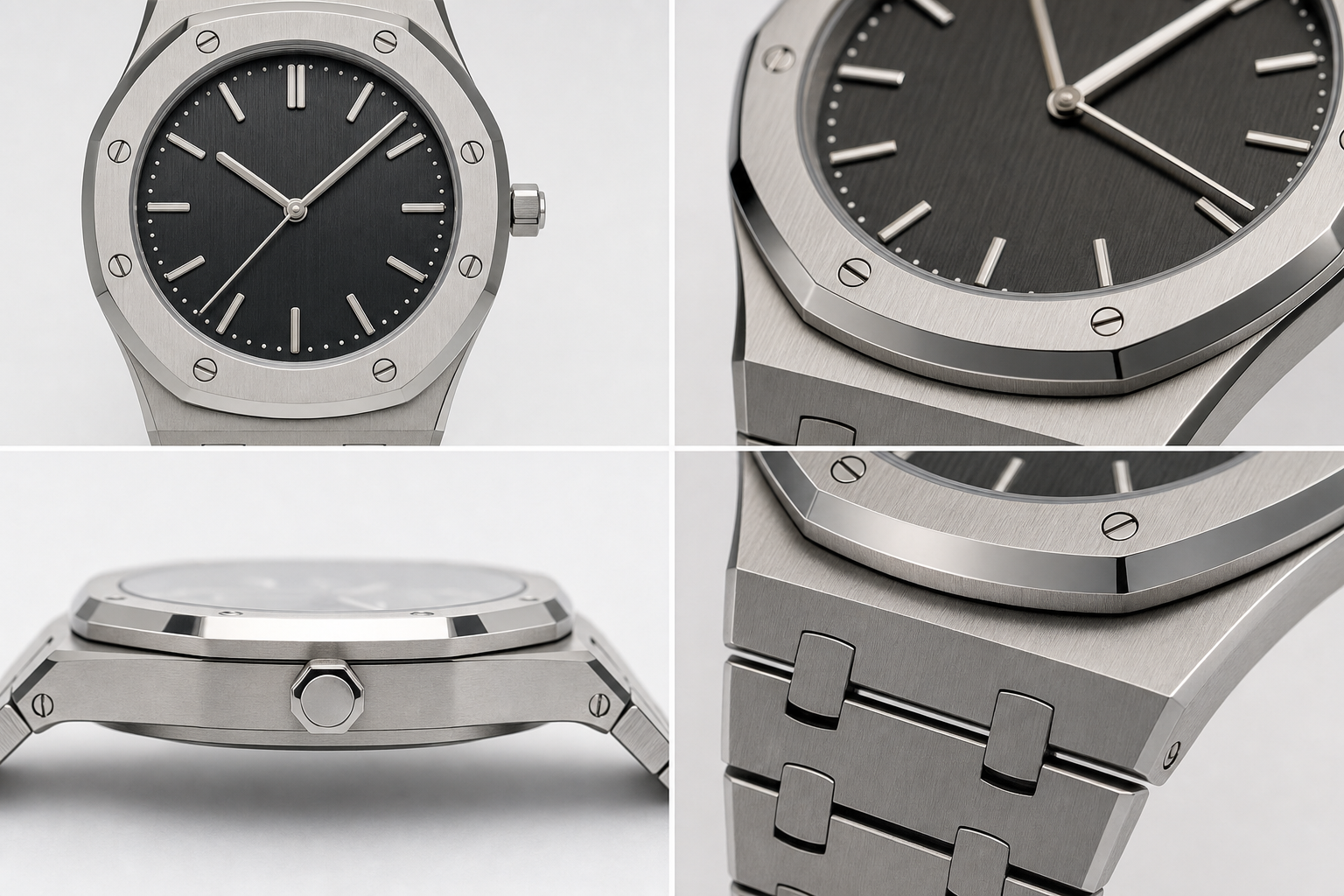
The Royal Oak bezel is one of the easiest places to spot poor QC because the shape is geometric and unforgiving. Check that the octagonal bezel sits evenly around the crystal and that the brushed surfaces and polished bevels look clean. The case should not appear twisted, swollen, or overly rounded at the edges. A Royal Oak relies heavily on sharp transitions; if the case looks soft, the whole watch loses its character.
Bezel screw alignment is a common buyer obsession, and for good reason, but it needs context. On replicas, the visible screw system may not behave exactly like the genuine construction, so absolute perfection should not be assumed. What matters for QC is whether any screw is obviously rotated, sunken, raised, damaged, or visually out of pattern compared with the others.
Side profile photos are important because Royal Oak replicas can look convincing from the dial side while feeling too thick from the side. This is especially relevant when comparing references with different movement routes and factory versions. A case that is slightly thicker on paper may still wear acceptably if the profile is balanced; a bulky mid-case or awkward caseback can make the watch feel less convincing immediately.
Bracelet and Clasp Fit
The bracelet is not just a comfort feature on a Royal Oak. It is part of the case design. Poor bracelet fit can make even a good dial feel cheap. Check the first links where the bracelet leaves the case, because visible gaps or stiff articulation at this point affect both appearance and wrist comfort.
Bracelet articulation should look fluid, not frozen. The links should drape naturally rather than hanging like a rigid plate. A Royal Oak bracelet that is too stiff can wear larger than expected, while one with loose gaps can feel lower-grade even if the watch head photographs well.
Clasp quality is another ownership issue that buyers often underestimate. A weak clasp, rough edges, shallow engraving, or inconsistent closing action will be noticed every time the watch is worn. For a first AP super clone, bracelet and clasp comfort may matter more than a small movement engraving detail hidden behind the caseback.
QC Photos to Request
Do not judge an AP Royal Oak from one straight-on beauty photo. A good QC set should show enough angles to separate real defects from camera distortion. The minimum useful set includes a front dial photo, a date close-up, both side profiles, a crown-side view, a bracelet integration shot, clasp photos, and a short view of the caseback or movement route where available.
Ask for the watch to be shown level when checking dial alignment. Angled photos can make markers, date windows, and bezel screws look worse than they are. If something looks suspicious, a second photo from a corrected angle is more useful than debating a distorted image.
- Front dial: check markers, logo placement, date centering, and dial cleanliness.
- Date close-up: verify that the number sits properly in the window.
- Bezel close-up: inspect screw consistency and surface finishing.
- Side profile: judge thickness, caseback shape, and crown-side balance.
- Bracelet articulation: look for stiff first links, uneven gaps, or poor drape.
- Clasp photos: confirm closing fit, engraving quality, and rough finishing.
- Movement-route confirmation: useful when the listing makes specific clone movement claims.
QC photos reduce uncertainty, but they do not remove every risk. Buyers should review real watch photos where available, including dial printing, hand alignment, bezel position, datewheel centering, bracelet fit, clasp engraving, case thickness, and overall finishing. Factory labels and stock photos alone are not enough for a reliable judgment.
Price, Availability, and Long-Term Support: How to Read Value Without Chasing the Cheapest Listing
AP super clone price should not be read like a simple quality ladder where the highest number always means the best watch. With Royal Oak 15400, 15500, and 15510 options, price usually reflects a mix of factory label, movement route, batch timing, dial color, bracelet execution, seller positioning, and current availability. Some of those factors matter. Some are just noise.
The cheapest Royal Oak replica listing is rarely the safest first AP decision. It may be older stock, a less clear movement route, a weaker bracelet, or a watch described with vague factory language. But the opposite mistake is also common: assuming a higher price automatically means a better version. A premium is justified only when it buys something concrete, such as clearer factory identification, a stronger current batch, better QC consistency, or a movement route that properly supports the reference.
For first-time buyers, value should mean reduced ownership risk, not just a lower purchase price. A Royal Oak that costs less but arrives with poor bracelet comfort, unclear movement claims, or obvious dial flaws is not better value. It is just a cheaper problem.
Prices can change by factory label, version, movement configuration, seller channel, availability, finishing quality, and after-sales support. Because exact price claims can become outdated quickly, buyers should compare like-for-like details at the time of purchase rather than relying on broad statements such as “factory-direct,” “lowest price,” or “best value” without supporting evidence.
Why Similar Royal Oak Clones Can Be Priced Differently
Two Royal Oak 15500 replica watches may appear nearly identical in front-facing photos but carry different pricing because they are not actually the same package. One may use a more current factory batch, a better dial texture, cleaner bracelet finishing, or a more desirable dial color. Another may use older stock or a less convincing movement presentation while borrowing the same broad model description.
Factory premiums also vary by reference. On a 15400, a buyer may be paying for a mature clone 3120-style route, better-established dimensions, and fewer version surprises. On a 15500, the price may reflect stronger present-market competition, current availability, and more refined dial or bracelet execution. On a 15510, part of the price may come from the appeal of being newer, but that does not automatically mean the watch is more settled or more sensible for a beginner.
Dial color can also affect value. Blue Royal Oak dials often receive more attention, but they are harder to judge because shade, sunburst, and tapisserie texture can vary noticeably. A slightly less hyped grey, black, or silver dial may sometimes be the more rational choice if the execution is cleaner and the buyer wants fewer visual risks.
When Paying More May Actually Reduce Risk
Paying more can make sense when the extra cost is tied to real clarity. A well-identified factory version with recent QC examples, a confirmed movement route, and consistent bracelet finishing may be worth more than a cheaper listing with vague descriptions. In this case, the buyer is not paying for magic. The buyer is paying for lower uncertainty.
This matters most for the 15500 and 15510. The 15500 has enough factory competition that version differences can be meaningful. The 15510 needs even more caution because newer-reference claims are easier to blur. If a higher-priced option provides clearer version identification and better QC evidence, it may be the safer choice for someone who does not want to gamble.
Long-term support also matters, though it should be understood realistically. No replica movement should be treated as risk-free, and no seller claim should be read as a guarantee of future parts or service. But watches based on more common, better-known movement routes generally create fewer headaches than obscure or poorly described builds. For daily wear, movement familiarity can be more valuable than a dramatic listing title.
Buyers should also confirm return, repair, shipping, and after-sales terms before ordering, because those terms can vary by seller and should not be assumed from a factory label or price level. This kind of policy confirmation is separate from watch quality: even a well-executed replica can still leave the buyer exposed if expectations about communication, handling problems, or service support are unclear.
When a Cheaper Option May Be Good Enough
A cheaper option can be rational when the reference is mature, the version is clear, and the QC is acceptable. This is where the 15400 can make sense for a first AP buyer who values classic Royal Oak balance and does not need the newest reference. If the watch has a known factory route, clean dial alignment, good bracelet fit, and reasonable case profile, chasing a more expensive “latest” listing may not improve the ownership experience.
The same can apply to a 15500 if the buyer is choosing a stable current batch rather than paying extra for vague upgrade language. A modest price difference may be worth it for cleaner QC, but paying significantly more for a listing that cannot explain its factory, movement route, or version details is not a smart upgrade.
The 15510 is the reference where cheaper should be treated most carefully. A low price on a newer Royal Oak replica may indicate weak version clarity, older components, or a model description that is more marketing than specification. It may still be acceptable for a buyer who understands the compromise, but it is not the easiest first AP path.
The best value rule is straightforward: pay for proof, not adjectives. Clear factory, clear reference, clear movement route, recent QC, and acceptable bracelet execution are worth more than phrases like “top,” “latest,” or “best version” without evidence.
First-AP Recommendation Logic: Which Reference Fits Which Buyer?
The best first AP super clone is not the same answer for every buyer. In a 15400 vs 15500 vs 15510 decision, the right reference depends less on which model sounds newest and more on how much uncertainty you are willing to accept. For a first Royal Oak clone, the safest path is usually the one with the clearest version identity, the most predictable factory execution, and the fewest surprises after the watch arrives.
Here is the practical judgment: choose the 15400 if you want the safest classic choice, choose the 15500 if you want the safest modern choice, and approach the 15510 only if you are comfortable checking version details carefully. The 15510 is not a model to avoid automatically, but it is not the easiest first AP clone for buyers who want a simple, low-confusion purchase.
Choose 15400 If You Want the Safest Classic Royal Oak Feel
The 15400 is the better fit for a buyer who wants the older Royal Oak balance: more traditional dial proportions, a familiar 41mm presence, and a reference with more settled replica development behind it. It does not feel like the “latest AP,” but that is exactly why it can be easier to buy as a first AP super clone. Mature references tend to have fewer vague version claims and a more established baseline for what good QC should look like.
This is the reference I would lean toward for a first-time buyer who says, “I want one AP that feels classic and I do not want to study every batch update.” The 15400 still needs careful checking, especially dial color, bracelet fit, and the claimed movement route, but the buying problem is usually easier to define. You are not trying to decode whether a seller’s “latest update” actually means a meaningful improvement or just a newer label.
The tradeoff is that the 15400 is an older discontinued reference, so current availability can be less straightforward than the 15500. A good 15400 can be a very sensible first Royal Oak clone, but a leftover or poorly described older batch is not automatically better just because the reference itself is mature. If the listing is vague, the maturity advantage disappears.
Choose 15500 If You Want the Safest Modern Default
For many buyers asking which AP clone should I choose today, the 15500 is the most practical modern default. It has the newer Royal Oak look, broader current-market attention, and stronger present-day factory competition. That does not make every 15500 better than every 15400, but it does make the 15500 easier to source in a current, actively discussed version.
The 15500 is usually the best fit for a buyer who wants a clean modern dial, does not want the older “Automatic” dial balance, and wants more recent QC examples to compare. It still requires care with dial color, movement route, case profile, and bracelet finishing, but the buying path is usually more straightforward than a newer 15510 listing with unclear version language.
The main warning is not to assume that every 15500 from a known factory is the same. A buyer should still check the exact batch, dial color, date centering, bracelet articulation, and movement description. The 15500 is a strong modern default only when the seller gives enough detail to prove which version is actually being offered.
Choose 15510 Only If You Want the Newer Look and Can Verify the Version
The 15510 is the better fit for a buyer who specifically wants the newer Royal Oak look and is willing to do more homework. It can be a satisfying choice when the seller is precise about the factory, version, movement route, dial layout, and current QC. It is not the right choice if the buyer simply assumes newer means better.
For a first AP purchase, the 15510 should be approached with a stricter checklist than the 15400 or 15500. Ask whether the watch is a true 15510-style build rather than a loosely updated 15500-style listing. Ask whether the dial layout, date position, movement route, case thickness, and caseback presentation all match the claimed reference logic. If the answers are vague, move slower.
The 15510 is best for buyers who accept that the newest route can carry more version confusion. If you enjoy comparing details and rejecting weak listings, it may be worth considering. If you want the least stressful first Royal Oak clone, the 15400 or 15500 is usually the safer starting point.
Legal, Disclosure, and Expectation Boundaries
Replica watches can raise trademark, import, resale, disclosure, and customs issues depending on jurisdiction. This article is not legal advice and should not be read as a statement that any specific purchase, shipment, resale, or import route is risk-free. Buyers should understand that the watches discussed here are imitation products, not authorized Audemars Piguet goods.
Disclosure also matters in any resale or gifting situation. A replica Royal Oak should not be represented as authentic, factory-authorized, or equivalent to an authorized watch. Even when a replica is visually strong, buyers should expect differences in finishing, materials, movement behavior, water resistance, warranty access, service options, and legal status compared with an authentic watch.
Water resistance should also be treated as unverified unless the individual watch has been pressure-tested after purchase. A genuine Royal Oak specification does not prove that a replica has the same sealing, gasket condition, crown construction, or pressure performance. For a first AP super clone, the safest assumption is that the watch should be kept away from swimming, showering, and heavy water exposure unless a competent watchmaker has tested that exact unit.
Seller Policy and Risk Questions to Confirm Separately
Watch quality and seller policy are separate issues. A visually strong Royal Oak replica can still be a poor buying experience if the seller is unclear about QC approval, problem handling, repair options, shipping expectations, or after-sales communication. Unless a policy is clearly provided by the seller, buyers should not assume that any factory label includes a warranty, return right, waterproof guarantee, customs-safe delivery, or future parts support.
Before ordering, ask practical questions in plain language: what happens if the QC photos show a defect, whether the exact watch in the photos is the one being shipped, how movement problems are handled, whether water-resistance testing is offered or excluded, and what support exists after delivery. These questions do not guarantee a perfect outcome, but they help separate a transparent seller from one relying mainly on factory hype and vague promises.
Final Recommendation: Do Not Buy the Newest Reference Until the Evidence Is Clear
If this is your first AP-style Royal Oak super clone, do not begin with the question “Which one is newest?” Begin with the question “Which one is easiest to verify and live with?” That framing usually leads to a more rational decision. The 15400 is the safest classic route when the buyer values mature proportions and a more settled reference history. The 15500 is the safest modern default when the buyer wants current availability and a cleaner dial. The 15510 is the newer-reference option, but it demands more version discipline.
For most first-time buyers, the 15500 will be the easiest modern recommendation because it balances current-market availability with a familiar Royal Oak generation. The 15400 remains highly sensible for buyers who prefer classic dial balance and lower version confusion. The 15510 should be chosen only when the seller provides enough specific evidence to make the purchase more than a “latest version” gamble.
The safest first AP super clone is not the one with the loudest factory name or the newest reference number. It is the one where the reference, factory version, movement route, dial execution, bracelet fit, and QC evidence all point in the same direction. If those details are clear, the decision becomes manageable. If they are not clear, the better move is to slow down, ask for proof, or choose a more established Royal Oak route.
Disclosure: This article is for general educational and comparison purposes only. Replica watches are not genuine products from the original luxury brands, and brand names are used only to identify reference designs or comparison topics. Factory names, movement descriptions, prices, availability, QC details, seller policies, and version information can change, so readers should verify important details with the seller before making a purchase decision. Replica watches should not be represented, resold, or used as genuine watches.