
Why Factory Choice Matters More Than the Model Itself
In the IWC replica market, the factory often matters more than the model name. Two watches carrying the same IWC reference can look similar in photos yet feel completely different on the wrist once you live with them for a few weeks. This difference rarely comes from branding or price alone. It comes from how a specific factory interprets proportions, builds the case, and engineers the movement inside.
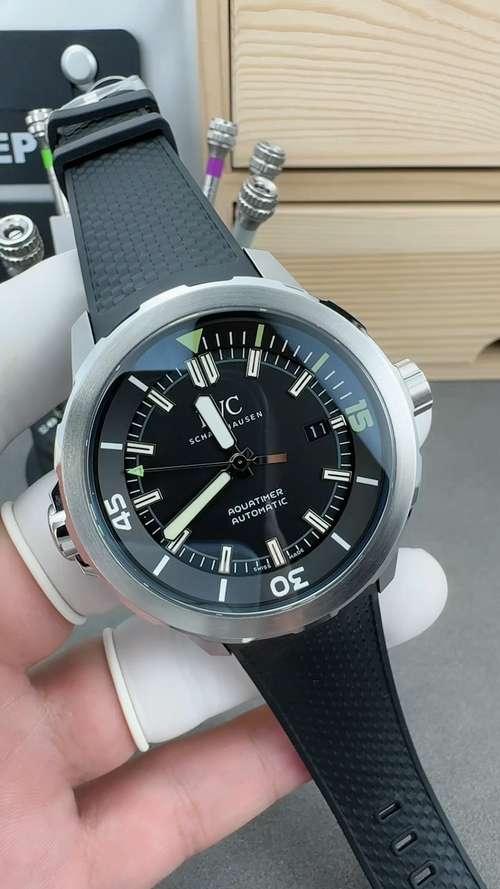
Case shape accuracy is the first divider. IWC designs rely heavily on subtle geometry: bezel thickness, lug curvature, mid-case height, and how the case transitions into the bracelet or strap. One factory may get the dial color right but miss the lug angle by a fraction, resulting in a watch that looks correct flat but wears awkwardly. Over time, that discomfort becomes impossible to ignore.
Dial printing and lume quality create the second gap. IWC dials look simple, but they are not forgiving. Font weight, spacing, and lume fill depth are immediately noticeable in real use, especially under natural light and at night. Some factories use acceptable printing but uneven lume that ages poorly, while others prioritize dial depth and lume consistency even if it costs more.
Movement architecture is where the largest long-term differences appear. Marketing often reduces this to “ETA” versus “Asian,” but real performance depends on layout, torque distribution, and whether complications are functional or cosmetic. A power reserve indicator that actually tracks mainspring tension behaves very differently over months of wear than a decorative hand driven by a simple gear. Factories that invest in movement architecture produce watches that age predictably; others produce watches that look fine until they don’t.
Choosing the right factory is not about chasing the most popular name. It is about understanding which workshop solved the specific engineering problems of a given IWC design and which ones took shortcuts that only show up after ownership begins.
How the IWC Replica Market Is Structured in China
The so-called “letter factories” are not corporations in the traditional sense. They are workshop-based production groups, often built around a small number of technical leads and long-standing supplier relationships. Each factory tends to specialize in a narrow set of models rather than attempting to replicate the entire IWC catalog.
This specialization is not accidental. Developing a convincing IWC replica requires expensive case tooling, dial experiments, and movement modification. Once a factory invests in solving one problem—such as long power reserve architecture or integrated bracelet tolerances—it rarely makes economic sense to pivot to unrelated models. As a result, no factory is universally good at everything.
The Chinese IWC super clone market functions as a fragmented ecosystem. One workshop may dominate Portuguese models, another may excel at modern tool watches, and a third may focus on thin three-hand pilots. When buyers assume there is a single “best IWC replica factory,” they misunderstand how this ecosystem actually works. The best choice is always conditional on the model category and intended use.
Common Myths About “The Best IWC Replica”
Myth 1: One Factory Is Best for All IWC Models
This belief persists because it feels efficient. In practice, it fails almost immediately. A factory that produces an excellent Portuguese 7 Days often struggles with slim pilot watches, and a workshop known for integrated bracelets may deliver mediocre chronographs. Repeated market observation shows that factories peak in narrow zones of competence. Ignoring that reality leads to mismatched expectations and avoidable disappointment.
Myth 2: Swiss ETA = Best Quality
Movement origin is frequently oversimplified. A poorly integrated Swiss ETA can perform worse than a well-regulated Miyota or a properly engineered Chinese long power reserve movement. What matters is whether the movement architecture matches the watch design. Many so-called Swiss ETA claims are marketing shorthand rather than functional guarantees, and they often distract buyers from more important factors like thickness, torque balance, and serviceability.
Myth 3: Higher Price Always Means Better Replica
Price reflects tooling costs, production scale, and sometimes hype, but it does not automatically correlate with daily usability. Some higher-priced replicas prioritize visual accuracy at the expense of wearability, while more modestly priced models deliver years of stable performance because they avoid unnecessary complexity. Paying more only makes sense when it buys you something you will actually notice after months of use.
Understanding these myths is less about becoming cynical and more about becoming precise. The IWC replica market rewards buyers who align factory strengths with real-world priorities rather than chasing labels or assumptions.
ZF Factory – Best for Portuguese & Pilot Chronographs
What ZF Factory Does Best in IWC Replicas
ZF’s strength in IWC replicas comes from solving technical problems rather than chasing surface-level resemblance. This is most obvious in the Portuguese 7 Days models, where ZF committed early to building a real long power reserve architecture instead of relying on decorative indicators. The power reserve hand responds to actual mainspring tension, not a secondary gear illusion, which changes how the watch behaves over weeks of wear rather than minutes of inspection.
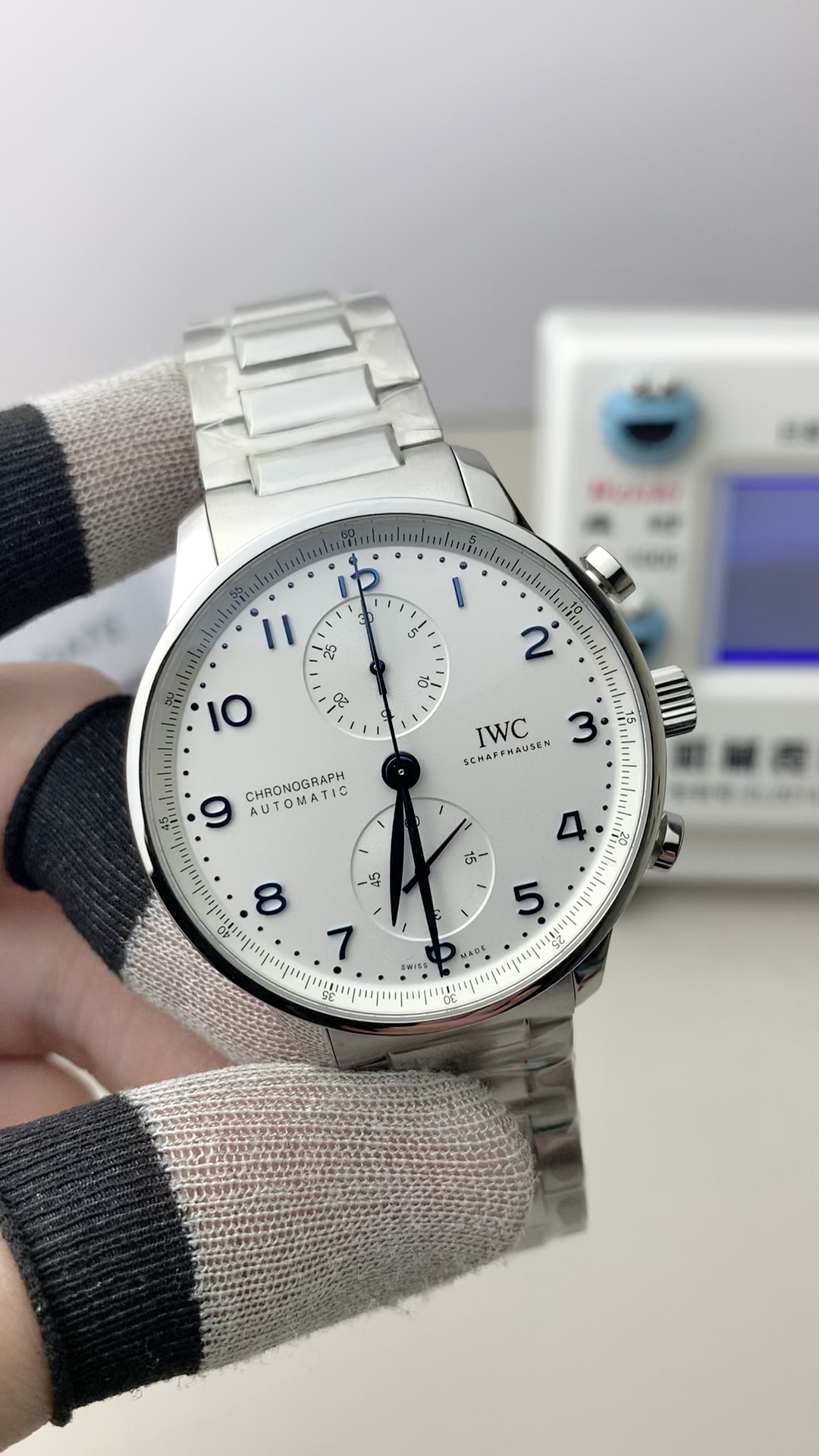
Dial layout accuracy is another area where ZF shows its priorities. On Portuguese and pilot chronographs, sub-dial spacing is unforgiving. A millimeter shift changes the entire visual balance. ZF’s layouts consistently sit where the eye expects them to be, especially on models like the Portuguese Chronograph and Pilot Chronograph 3777. This accuracy is not dramatic in photos, but it becomes obvious once you compare wrist presence side by side with other factories.
ZF also spends time correcting case geometry instead of masking issues with finishing. Lug length, bezel thickness, and mid-case height are tuned to preserve the original proportions, even when that means accepting a slightly thicker case rather than forcing an unrealistically slim profile.
ZF’s Strengths (Where It Clearly Outperforms Others)
Dial & Case Proportions
ZF watches tend to look right from a distance because their proportions are internally consistent. The relationship between dial diameter, bezel width, and case height matches genuine IWC design language. This is why ZF Portuguese models feel calm and balanced rather than crowded. Many replicas look acceptable in isolation but collapse visually once worn; ZF avoids that problem by prioritizing geometry over shine.
Movement Architecture (Especially Long Power Reserve)
The defining advantage of ZF is movement architecture. Their long power reserve movements for Portuguese and Big Pilot models are not perfect replicas, but they are structurally honest. Torque delivery is predictable, power reserve indicators behave logically, and the watches age in a stable way. Over time, this matters more than decoration. Owners report fewer surprises after months of use, which is a direct result of mechanical choices rather than cosmetic ones.
Overall Visual Authenticity
ZF’s visual authenticity comes from restraint. Fonts are not exaggerated, lume is not overly bright, and polishing is controlled. This creates watches that resemble genuine IWC pieces under normal lighting, not just under studio photography. The result is a replica that blends into real-world environments instead of constantly drawing attention to itself.
ZF’s Limitations (Who Should Think Twice)
Thickness in Some Models
ZF often accepts extra thickness to preserve movement integrity. On chronographs and long power reserve models, this can result in cases that are slightly thicker than ideal. For some buyers, especially those sensitive to wrist profile or cuff clearance, this trade-off may not be acceptable.
Not Ideal for Entry-Level Buyers
ZF replicas are not forgiving purchases for beginners. They cost more, require better understanding of model-specific strengths, and offer diminishing returns if the wearer does not care about mechanical behavior over time. If someone is simply looking for a low-risk daily watch, ZF may be excessive rather than optimal.
Best IWC Models to Buy from ZF Factory
The Portuguese 7 Days is ZF’s strongest work, particularly references using the long power reserve layout with functional indicators. Pilot Chronographs, especially the 3777 series, are another safe choice due to accurate sub-dial spacing and stable chronograph behavior. Big Pilot models from ZF are also worth considering, but only specific references where the long power reserve movement and case proportions align well; not every Big Pilot benefits equally from ZF’s approach.
ZF is at its best when mechanical structure and visual balance matter more than price or simplicity, and less convincing when judged purely as an entry-level option.
V7 Factory – Best for Ingenieur & Modern Tool Watches
Why V7 Became Relevant in the IWC Market
V7 is a late entrant compared to long-established factories, but its rise was not accidental. The turning point was the 2023 release of the Ingenieur Automatic 40. This model exposed a gap in the replica market: existing factories struggled with integrated bracelets, case tolerances, and the specific geometry of modern IWC tool watches. V7 focused narrowly on solving that one problem instead of spreading resources across many models.
That decision paid off. The Ingenieur 40 requires precision in areas where replicas often fail, such as bracelet articulation, bezel screw alignment, and overall case symmetry. V7’s execution showed a level of patience and tooling investment that immediately separated it from factories producing generic pilot or dress watches. Rather than copying older IWC designs, V7 aligned itself with IWC’s current industrial design language, which is cleaner, tighter, and less forgiving.
V7’s Strengths
Case Construction & Integrated Bracelets
V7’s strongest advantage is case construction. The Ingenieur 40 case depends on sharp transitions between brushed and polished surfaces, and any rounding or misalignment is instantly visible. V7 cases maintain crisp edges and consistent finishing across the bracelet and case, which preserves the visual continuity of the design. The integrated bracelet feels structurally intentional rather than added on, and the articulation distributes weight evenly across the wrist.
Slim Profile with 2892-based Movements
By using 2892-based movements, V7 achieves a slimmer profile without forcing compromises elsewhere. This matters for modern IWC designs, which rely on relatively thin cases to balance their industrial aesthetic. The watches sit lower on the wrist, slide under sleeves more naturally, and feel closer to genuine modern IWCs in daily wear.
Modern IWC Design Accuracy
V7 understands contemporary IWC proportions better than most competitors. Dial texture, applied markers, and bezel geometry align well with current production models rather than older references. This makes V7 particularly convincing for buyers who prefer IWC’s recent design direction instead of heritage-inspired pieces.
V7’s Weak Points
Limited Model Range
V7’s focus is also its limitation. The factory produces a narrow selection of IWC models, and outside that range, its relevance drops quickly. Buyers looking for variety or classic IWC references will not find many strong options here.
Not Ideal for Classic Portuguese Models
V7 is not a good choice for Portuguese models. Long power reserve architecture, dial spacing on large dress watches, and classic IWC proportions are not V7’s strengths. Attempting to apply V7 logic to Portuguese models usually results in watches that feel visually correct but mechanically uninspiring.
Best IWC Models from V7 Factory
The Ingenieur Automatic 40 is V7’s defining achievement and the clearest reason to choose this factory. A small selection of modern pilot tool watches without chronograph complications can also make sense, provided they share similar case construction logic. Outside these categories, V7 offers little advantage.
MKS Factory – Best for Mark Series & Entry-Level IWC
Why MKS Is Popular Among First-Time Buyers
MKS earns its reputation by being predictable. It does not chase complicated movements or visual drama. Instead, it produces watches that run reliably, wear comfortably, and require minimal attention from the owner. For first-time buyers, this matters more than novelty.
Daily wear exposes weaknesses quickly. Over time, thin cases, stable movements, and consistent assembly matter far more than decorative features. MKS understands this and builds accordingly, which is why its watches are often kept longer than more ambitious replicas.
MKS Strengths
Reliable Miyota 9015 Movements
The Miyota 9015 is not exotic, but it is dependable. MKS uses it well. The movement delivers stable timekeeping, tolerates daily wear, and is easy to service if needed. Over months of ownership, this reliability becomes more valuable than any cosmetic advantage.
Thin Case Profile
MKS prioritizes wearability. Cases remain thin, balanced, and comfortable on a wide range of wrists. This makes MKS watches suitable for extended daily use rather than occasional wear. They feel unobtrusive, which aligns well with IWC’s understated design philosophy.
Consistent QC for Simple Models
MKS performs best when complexity is limited. Its quality control for simple three-hand watches is consistent, and defects are relatively rare. This consistency reduces risk, especially for buyers who do not want to manage returns or repairs.
MKS Limitations
Not Suitable for Complicated Models
MKS struggles with complexity. Chronographs, long power reserve indicators, and advanced complications expose the factory’s limitations quickly. These watches may function, but they lack the refinement and long-term stability seen in simpler designs.
Less Accurate for Power Reserve Displays
When MKS attempts power reserve models, accuracy often becomes decorative rather than functional. Indicators may move, but they do not reflect real mechanical behavior over time. For buyers who care about mechanical authenticity, this is a clear drawback.
Best IWC Models from MKS Factory
The Mark XVIII remains MKS’s strongest offering and a safe choice for daily wear. Simple pilot three-hand models also perform well, especially for buyers prioritizing comfort and reliability. Basic Portofino Automatic models make sense too, provided they avoid complications beyond date display. MKS excels when restraint is respected.
GF, APS, EW & Other Factories – Who Should Avoid and Why
Factories with Inconsistent Quality Control
Not every factory operating in the IWC replica space is trying to solve the same problem. Some are optimized for speed and price rather than long-term ownership. This is where factories like GF, APS, EW, and various unnamed workshops usually fall—not because every piece they produce is unusable, but because consistency is not their priority.

The risk shows up over time rather than on day one. A watch may arrive looking acceptable, only to reveal issues after weeks of wear: loose hands, misaligned date wheels, uneven lume aging, or unstable timekeeping. These factories often shift suppliers or internal processes between batches, meaning two watches with the same model name can behave very differently. For buyers without access to reliable after-sales support, this unpredictability becomes the real cost.
Common Issues Found in Lower-Tier IWC Replicas
Incorrect Dial Fonts
IWC dials depend heavily on font discipline. Lower-tier factories frequently miss this. Numerals may be too thick, spacing may feel cramped, or printing may lack depth. These flaws are subtle but persistent, and once noticed, they are difficult to unsee, especially in natural daylight.
Fake or Non-Functional Power Reserve
Decorative power reserve indicators are a recurring problem. In many cheaper IWC replicas, the hand moves independently of actual mainspring tension or is driven by a simplified gear that has little relation to remaining power. This creates a watch that feels mechanically dishonest and behaves unpredictably during real use.
Over-marketed “Swiss ETA” Claims
Claims of Swiss ETA movements are often used as a shortcut to justify pricing rather than as evidence of quality. In practice, many of these watches use mixed or modified components with unclear provenance. Even when a Swiss movement is present, poor integration can negate its advantages. Buyers end up paying for a label rather than improved performance.
When These Factories Might Still Make Sense
Lower-tier factories are not automatically wrong for every buyer. For someone with a strict budget, short-term use expectations, or purely aesthetic goals, they can serve a purpose. If the watch is intended for occasional wear or experimentation rather than long-term ownership, the trade-offs may be acceptable.
The key is alignment. Problems arise when buyers expect ZF-level mechanical behavior or MKS-level stability from factories that were never built to deliver that. Understanding what these watches are—and what they are not—allows budget-conscious buyers to make informed compromises rather than accidental mistakes.
Factory Recommendations by Buyer Type
Best IWC Factory for Beginners
For beginners, MKS is the most sensible entry point. The reason is not excitement or prestige, but stability. MKS watches tend to work as expected, wear comfortably, and avoid mechanical surprises. Pricing is moderate, risk is low, and ownership does not require deep technical knowledge. For someone learning what matters in an IWC replica, this predictability is more valuable than chasing peak accuracy.
Best IWC Factory for Collectors
Collectors should look toward ZF. ZF rewards patience and attention to detail, especially for those who care about proportions, dial balance, and how a movement behaves over extended use. These watches reveal their value slowly rather than immediately. For collectors who rotate watches, compare references, and notice long-term behavior, ZF offers the most satisfying depth.
Best IWC Factory for Daily Wear
For daily wear, MKS and V7 serve different but overlapping needs. MKS excels when comfort, thinness, and low maintenance are priorities. V7 makes more sense for modern tool watches where integrated bracelets and case construction define the experience. Both offer reliable movements and wearable profiles, which matter far more than novelty in daily use.
Final Verdict: There Is No “One Best IWC Replica Factory”
The best IWC replica factory depends on what you value most—mechanical honesty, visual accuracy, or the quiet reliability that makes a watch easy to live with day after day.
| Factory | Typical Movements Used | Best-Suited IWC Models | Visual Accuracy | Build & Long-Term Quality | Price Positioning |
|---|---|---|---|---|---|
| ZF Factory | Custom long power reserve movements (DanDong-based), modified 7750 chronographs | Portuguese 7 Days, Portuguese Chronograph, Pilot Chronograph, select Big Pilot references | Very high for case proportions, dial layout, and sub-dial spacing; strongest on classic IWC designs | Strong mechanical integrity, stable over long ownership cycles; slightly thicker cases accepted for reliability | High-tier pricing, justified when accuracy and movement architecture matter |
| V7 Factory | 2892-based automatic movements (Asian or Swiss base depending on batch) | Ingenieur Automatic 40, modern non-chronograph Pilot tool watches | High for modern IWC designs; excellent case geometry and bracelet integration | Good stability for simple tool watches; limited track record outside core models | Mid to upper-mid pricing, fair for modern sports designs |
| MKS Factory | Miyota 9015 automatic movements | Mark XVIII, simple Pilot 3-hand models, basic Portofino Automatic | Good overall, strongest on simple dials and classic pilot layouts | Very reliable for daily wear; minimal complications reduce failure points | Mid-range pricing, strong value for first-time buyers |
| GF / APS / EW & similar | Mixed Asian movements, often advertised as ETA-based | Scattered IWC models without clear specialization | Inconsistent; common issues with fonts, lume, and dial depth | Quality varies by batch; higher risk of long-term issues | Low to mid pricing, appealing mainly to strict budget buyers |
Related IWC Articles: If you found this helpful, you might also enjoy IWC Portuguese 7 Days IW5007 Replica Deep Dive (ZF vs V9 + Real Power Reserve Reality), and IWC Tourbillon Replica Movement Explained: Gimmick, Decoration, or Real Engineering?. You may also like Guangzhou IWC Watch Market Explained: How IWC Replicas Actually Move From Factory to Buyer, and IWC Replica Watches Guide: Best Factories, Movements & Models Explained.