
Classic Overseas Replica Configurations (Three-Hand / Chronograph / Complications)
Within the Vacheron Constantin Overseas family, configuration matters more than finish. These watches look like variations on the same design, but structurally they are not equivalent. Every added function introduces another interface, another tolerance stack, and another opportunity for small assembly deviations to surface visually. That is why configuration choice is not aesthetic preference. It is an engineering decision that determines how forgiving the watch will be once real-world production variance enters the picture.
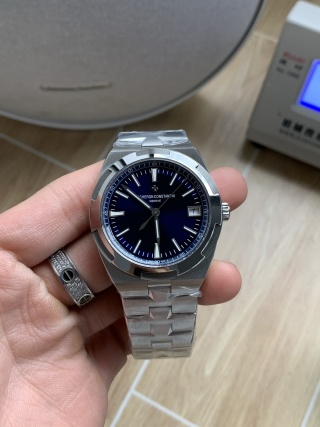
The Overseas platform is unusually sensitive because its visual balance depends on strict central symmetry. The bezel geometry, integrated case, and radial dial layout all converge on a single center axis. When that axis drifts, even slightly, the entire composition destabilizes. Simple layouts expose core alignment quality. Complex layouts multiply exposure. Understanding this progression is the fastest way to reduce risk before any discussion of materials, finishes, or provenance even begins.
Three-Hand Overseas: Baseline Geometry
The three-hand Overseas establishes the structural baseline. With one central axis, a minimal hand stack, and a largely uninterrupted dial plane, it shows you exactly how well the case, dial, and movement are seated relative to each other. There are no sub-dials to redistribute attention and no additional modules to mask small errors. What you see is the raw outcome of case machining, dial placement, and stem alignment.
In daily wear, this simplicity becomes diagnostic. If the hour markers feel evenly spaced at a glance and the date window sits naturally within the dial aperture, you are looking at a build where the center axis is behaving. When those elements feel “off” in normal lighting, that sensation usually traces back to microscopic displacement between the dial feet and the movement plate or uneven pressure during case closure. These are not cosmetic issues. They indicate how precisely the watch was assembled at its most fundamental level.
The reason experienced collectors start with three-hand configurations is not conservatism. It is clarity. This layout removes interface stacking and lets you judge the underlying geometry without interference. If a three-hand Overseas cannot hold symmetry, adding complications will not fix it. It will only make the misalignment louder over time as wear, temperature changes, and shock introduce further micro-movement.
Practical judgment tip: minute-track quadrant check (12 / 3 / 6 / 9)
You do not need tools to assess baseline geometry — hold the watch at arm’s length and compare the radial distance from the minute track to the dial edge at 12, 3, 6, and 9 under neutral light, then again under a single overhead source, because your eye is remarkably good at detecting imbalance when given four reference points, a simple yet revealing inspection method tied to the tolerance-exposure dynamics described in the market drift and structural risk patterns in Vacheron Constantin super-clones.
If any quadrant reads tighter or wider, that usually means the dial has shifted relative to the case or the movement is not seated squarely. On a simple three-hand layout, this asymmetry appears immediately because there are no sub-dials to absorb visual weight. Catching it here saves you from chasing downstream problems later.
Chronograph Overseas: Stacked Interface Risk
Chronograph configurations add an entire layer of mechanical and visual complexity. Central seconds now sit above the timekeeping hands. Sub-dials introduce secondary axes. Pushers require precise stem alignment through the case wall. Each of these interfaces carries its own tolerance, and none of them exist in isolation.
In practice, this stacking converts small assembly deviations into visible artifacts. A fraction of a millimeter in hand height becomes a central seconds hand that floats unnaturally above the dial. Slight misplacement of a sub-dial plate turns into off-center registers that the eye keeps returning to, even when you are not consciously inspecting the watch. Coupling backlash inside the chronograph mechanism shows up as hesitant starts or soft resets. These behaviors are not random. They reflect how consistently the movement, module, and case were brought together during assembly.
Chronographs therefore act as amplifiers. They do not merely add features. They magnify whatever alignment quality already exists in the base build. A well-executed three-hand foundation can carry a chronograph acceptably. A marginal foundation will unravel once vertical stacking and lateral sub-dial placement enter the system.
Practical judgment tip: reset behavior + sub-dial return
Start the chronograph, let it run for a minute, then reset it. Pay attention to three things at once: the snap of the reset, the exact return point of each sub-dial, and the verticality of the central seconds hand at zero. A clean system returns decisively and lands precisely on its markers.

If the reset feels soft, if a sub-dial stops just shy of center, or if the central seconds leans perceptibly, you are seeing the cumulative effect of fixture accuracy, hand-stack tolerance, and coupling alignment — upstream signals that rarely improve with use and often worsen as components bed in, exactly the behavior-centric inspection criteria set out in the Vacheron Constantin Overseas replica guide with geometry-based inspection methods.
Tourbillon / Dual-Time Overseas: Decorative Complexity + Alignment Amplification
High-complication Overseas configurations are often approached as upgrades. Structurally, they are stress tests. Open apertures, rotating cages, and secondary time displays expose depth stacking and axis drift in ways closed dials never will. The moment you cut a hole in the dial or add a second time plane, you remove visual forgiveness.
A tourbillon cage must sit concentrically within its aperture while rotating freely beneath the hands. Dual-time windows must align perfectly with printed indices while coexisting with central hands that now travel over uneven dial terrain. Every added display plane increases the chance that hand clearance becomes marginal or that visual balance collapses under oblique light. These effects are subtle in photographs and unmistakable on the wrist.
What makes these configurations risky is not the complication itself. It is the way decorative complexity exposes geometric truth. Depth errors that remain hidden on a flat dial become obvious when a rotating cage casts shadows across an uneven aperture edge. Axis drift that feels tolerable on a three-hand watch becomes distracting when a second time indicator refuses to sit square in its frame.
Practical judgment tip: aperture symmetry + cage centering
Look at the tourbillon or dual-time opening from multiple angles. The gap between the cage and the aperture should read evenly all the way around, and the cage should appear centered throughout its rotation. Then check hand clearance by slowly advancing the time and watching how the hands pass over the opening.
Uneven aperture spacing, off-center cages, or hands that skim too close to the complication window point to compounded tolerance stacking. These are not isolated defects. They indicate that multiple interfaces were allowed to drift in the same direction, producing a result that no amount of surface finishing can disguise.
Configuration Stacking Law: Functions Multiply Tolerance Exposure
Every additional function in an Overseas build adds a new interface, and every interface carries its own tolerance band. Those tolerances do not average out. They accumulate. A second dial layer introduces another seating surface. Extra hands require additional vertical clearance. Couplings between modules introduce backlash that did not exist in simpler layouts. What begins as a barely perceptible offset at the center axis becomes amplified once depth stacking and lateral alignment start interacting.
This is why configuration choice should be treated as a structural decision, not a feature checklist. A three-hand layout concentrates all error into a single plane, where it is either acceptable or immediately visible. Add a chronograph, and that same error now propagates through hand heights, sub-dial placement, and reset geometry. Add open apertures or secondary time displays, and you expose depth relationships that were previously hidden. Each layer converts small assembly variance into visible behavior under changing light, wrist angle, and daily wear.
In practical terms, this law explains why complex builds feel inconsistent even when they look impressive at first glance. The watch is no longer judged by one alignment event but by a chain of them. When several tolerances drift in the same direction, the result is not subtle. The composition loses coherence. Hands feel crowded. Registers look slightly off. Shadows behave unevenly across the dial. None of this requires extreme defects. It emerges naturally from stacked interfaces that were never brought into tight convergence at assembly.
Why Guangzhou Output Stratifies by Execution, Not Parts
Within Guangzhou production, component sourcing converges far more than most people expect. Dials, cases, crystals, and even base movements often come from overlapping supplier pools. Yet finished results vary dramatically. The difference does not come from parts. It comes from execution discipline.
Fixture accuracy determines whether a dial is pressed squarely or introduced at a microscopic angle. Assembly sequencing determines whether stresses are distributed evenly or locked in asymmetrically. Cumulative tolerance control decides whether small deviations are corrected at each stage or allowed to compound. These are process decisions, not material choices. Two watches built from nearly identical inputs can diverge completely depending on how consistently those steps are managed.
Overseas designs expose this divergence faster than most sports watches. Their integrated case geometry and strict radial symmetry leave little room for forgiveness. When assembly fixtures drift, you see it in bezel alignment. When seating pressure varies, you see it in dial rotation. When stem alignment is rushed, you feel it in crown resistance. The output stratifies because the system stratifies. What looks like randomness from the outside is usually the visible footprint of disciplined sequencing versus opportunistic assembly.
Interpreting Visible Defects as Upstream Manufacturing Signals
Surface flaws are rarely isolated. They are the downstream expression of earlier decisions. A bezel that reads slightly off-square usually traces back to case clamping inconsistency. A dial that appears rotated did not “slip” on its own; it was introduced under uneven pressure or indexed against a drifting fixture. A crown that feels tight in one direction and loose in another points to stem alignment that was forced rather than guided.
Learning to reverse-read these signals changes how you evaluate a watch — instead of asking whether a defect is acceptable, you ask what it reveals about the process that produced it: hand clearance issues imply vertical stack mismanagement, sub-dial drift implies plate seating variance, and uneven reset behavior implies coupling alignment that was never stabilized, with each symptom indicating where tolerance was allowed to escape, a diagnostic mindset outlined in the VC replica ownership reality FAQ and buyer judgment framework for Vacheron Constantin super-clones.
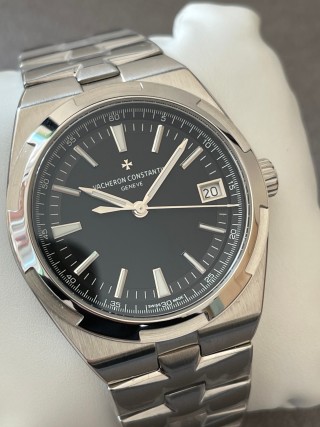
Once you adopt this lens, cosmetic judgment gives way to system judgment. You stop treating imperfections as isolated annoyances and start seeing them as indicators of how the entire assembly chain was handled. This perspective is especially important on Overseas configurations, where visual balance depends on multiple interfaces arriving in agreement. When they do not, the watch communicates that failure continuously through use, not just at inspection.
Closing Judgment: Configuration Choice Is Engineering Choice
Choosing a configuration is choosing how much tolerance exposure you are willing to carry, and while simpler layouts minimize interface stacking, complex builds demand far stricter acceptance standards, leaving the final decision in your hands.