
The Unseen Philosophy: Panerai’s Integrated Quality Control vs. Replica Assembly
The allure of a “1:1 replica” often overshadows the fundamental differences in manufacturing philosophy that truly define a luxury watch. Understanding the nuances of Radiomir design evolution claims helps clarify this distinction. While Clean Factory and other top-tier replica makers have achieved remarkable visual fidelity, they operate on an assembly-line replication model. Their goal is to mimic the outward appearance as closely as possible, often by reverse-engineering existing genuine pieces. Panerai, conversely, employs an integrated, end-to-end quality control (QC) system that begins with raw material selection and extends through every stage of in-house manufacturing, culminating in meticulous final inspection.
This isn’t merely a difference in scale; it’s a difference in intent. Panerai designs for longevity, precision, and a consistent brand experience across its entire output, backed by decades of heritage. Replica factories design for visual approximation and market demand, often optimizing for cost and speed. The implications for durability, performance, and long-term ownership are profound.
Material Sourcing and Metallurgy Standards
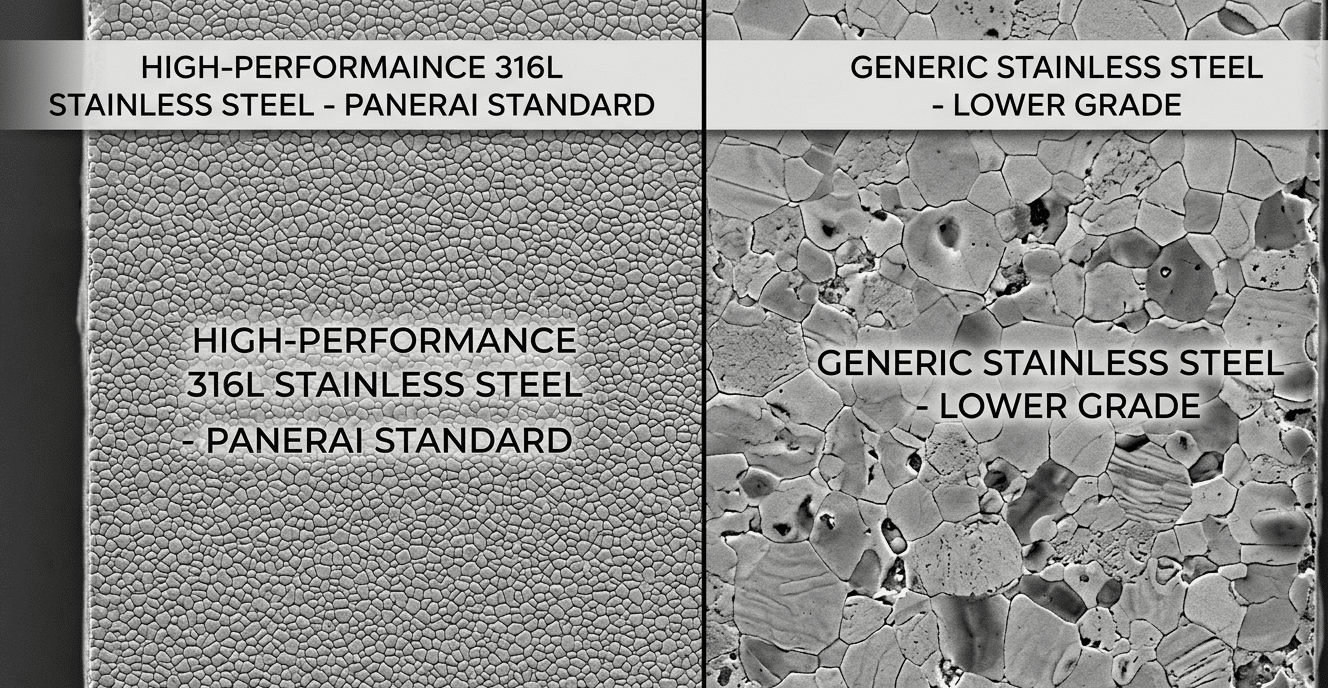
Panerai’s commitment to quality starts at the molecular level. For its steel models, the brand consistently uses AISI 316L stainless steel, known for its superior corrosion resistance and strength. Beyond just the grade, Panerai specifies precise metallurgical properties, including trace elements and specific heat treatment processes, to ensure optimal performance and aesthetic consistency. For specialized models like the Submersible, proprietary materials such as Carbotech (a carbon fiber composite) are developed and manufactured in-house, offering unique properties that are integral to the watch’s design and function.
Clean Factory and other replica makers, while often claiming to use 316L steel, operate without the same rigorous material science oversight. While top-tier replicas from factories like VS or XF have been found, through XRF (X-ray fluorescence) analysis, to use genuine 316L steel with compositions matching industry standards, this isn’t a universal guarantee. Mid-tier replicas sometimes use 304 stainless steel, a cheaper alternative with lower corrosion resistance. This difference, while not immediately visible, can manifest as premature pitting or discoloration over years of wear, particularly in humid or saline environments. Similarly, replica carbon fiber composites, while visually convincing, often lack the precise layering and compression of genuine Carbotech, potentially affecting structural integrity and long-term resilience.
In-House Manufacturing Tolerances and Finishing Protocols
A genuine Panerai case is a testament to precision engineering. Components are typically manufactured using multi-axis CNC (Computer Numerical Control) machines capable of micron-level tolerances. This ensures that every curve, angle, and aperture is perfectly executed, leading to a consistent fit and finish across all watches. Internal markings, such as reference numbers or material designations, are often laser-engraved, providing crisp, permanent identification that resists wear. Following machining, cases undergo multi-stage manual finishing processes—polishing, brushing, sandblasting—each performed with specific grit sequences and quality checks. These steps are not merely cosmetic; they refine the surface to protect against corrosion and provide the distinct Panerai aesthetic.
Replica factories employ similar CNC technology, but their execution often falls short of Panerai’s exacting standards. While they can achieve impressive surface finishes, close inspection frequently reveals subtle imperfections. For instance, the transition points between polished and brushed surfaces on a replica might show a slight blurring or a less defined edge compared to the razor-sharp delineation on a genuine piece. Tool marks, which would be meticulously removed during Panerai’s multi-stage finishing, can sometimes be observed under magnification on replica cases. These small variances, often less than 0.1mm, accumulate to affect the overall tactile and visual quality, and are a key indicator for expert authenticators.
Multi-Stage Inspection and Certification Processes
Panerai’s quality control is a continuous, multi-stage process. Every component, from the smallest movement screw to the largest case element, undergoes systematic inspection. Gaskets are checked for material integrity and precise seating; movements are chronometry-certified (often to COSC standards or Panerai’s equally stringent internal benchmarks); and finished watches undergo rigorous water resistance testing to their specified depth ratings. Finally, trained artisans perform a comprehensive aesthetic scrutiny, ensuring every aspect, from dial alignment to hand placement, meets the brand’s impeccable standards. This entire process is documented, providing a verifiable chain of quality assurance.
In replica production, such a rigorous, documented multi-stage QC is largely absent or superficial. While replica factories do conduct some form of quality check before shipping to dealers, it is primarily focused on visual acceptability and basic functionality. Comprehensive chronometry certification is unheard of, and water resistance testing, if performed, rarely matches the genuine depth ratings. For instance, while a genuine Luminor Marina is rated to 300m, a top-tier replica, despite often claiming the same, is rarely tested beyond 50-100m, making it unsuitable for serious diving. This lack of robust, integrated QC means that inconsistencies and potential failures are far more common in replica watches, even those considered “super clones.”
Expert Authentication Insight
Authenticating a Panerai often involves forensic examination of these subtle manufacturing differences. For example, microscopic examination of internal case back markings on a genuine Panerai reveals precisely laser-etched batch codes and serial numbers with consistent depth and font fidelity. On many replicas, these markings might be less precise, shallower, or even inconsistent in their application. Furthermore, non-destructive testing like XRF analysis can confirm the exact alloy composition of the case, differentiating between true 316L and lesser steels. A Vickers hardness test can also reveal differences in surface treatment and material density, exposing discrepancies that are invisible to the naked eye but indicative of a departure from Panerai’s stringent metallurgical standards. A watchmaker in Dallas once told me off the record, “You can fake the look, but you can’t fake the atoms.”
Dial Craftsmanship: Precision Printing and Lume Application
The dial is the face of the watch, and for Panerai, it’s a canvas for distinctive design and uncompromising legibility. The brand’s iconic sandwich dials and crisp printing are hallmarks of its identity. Replicating this seemingly simple component to genuine standards proves to be one of the most challenging hurdles for even the most advanced replica factories, including Clean Factory.
Print Definition and Font Fidelity
Panerai employs sophisticated multi-layer printing techniques to achieve the crisp, often slightly raised, appearance of its text, indices, and logos. This process involves precise pad printing or stenciling, ensuring uniform ink thickness, sharp edges, and consistent spacing between characters. The font weights and specific kerning (spacing between letters) for elements like “Luminor Panerai” or “Automatic” are meticulously controlled, contributing to the brand’s recognizable aesthetic. Any deviation from these exact specifications is an immediate tell for a discerning eye.
Clean Factory has made significant strides in dial printing, but imperfections persist. Under high magnification (60x+), replica dials often reveal subtle ink bleed, particularly around smaller text or the edges of indices. The thickness of the printed elements might be uneven, or the font rendering could show slight variations in weight or spacing compared to a genuine piece. For instance, the date wheel font on some VS Factory Panerai clones occasionally runs slightly bolder than the genuine, a minor detail that can be a dead giveaway for an experienced authenticator. These micro-discrepancies, while individually small, cumulatively detract from the dial’s overall precision and clarity.
Sandwich Dial Construction and Lume Fill
The Panerai sandwich dial is an engineering marvel in itself. It consists of two layers: a base plate coated with Super-LumiNova, and a top plate with precisely cut-out numerals and markers. This construction allows for a deep, even application of luminous material, giving the indices a distinctive “floating” appearance and exceptional legibility. The cut-outs are executed with extreme precision, ensuring perfectly clean edges and consistent depth across all markers. The quality and uniformity of the lume paste application, including its texture and color when uncharged, are critical elements of Panerai’s aesthetic.
Replica factories, notably XF, have achieved impressive results in mimicking the sandwich dial construction. XF was the first to truly master this technique, moving beyond painted “faux-sandwich” designs. However, even top-tier replicas can exhibit issues. Under close scrutiny, the cut-out edges on some replica sandwich dials might appear slightly rougher or less defined than those on a genuine Panerai. Inconsistent lume fill, where some areas are slightly thinner or clumpier than others, can also be observed. These minor imperfections compromise the crispness and uniformity that define a genuine Panerai sandwich dial.
Luminescence Quality, Duration, and Color Consistency
Panerai utilizes high-grade Super-LumiNova, often Grade A, specifically chosen for its optimal brightness, sustained glow, and consistent color. Depending on the model, this can range from a distinctive cream/off-white (for vintage-inspired pieces) to a bright white in daylight, glowing green or blue in the dark. A genuine Panerai lume should remain clearly visible for 8+ hours after a full charge, with consistent intensity across all luminous elements.
Replica lume, while often bright initially, frequently falls short in longevity and color consistency. Many top-tier replicas use BGW9 or equivalent blue-white lume that can match genuine initial brightness. However, their glow duration typically runs 6-8 hours, compared to the genuine’s 8-10 hours. More tellingly, under UV light, replica lume can sometimes show patchiness or an incorrect hue. The most obvious “tell” for budget replicas is the use of cheap, green-glowing lume that is immediately identifiable as fake in darkness. As the community often quips, “If it glows green at night, it’s not a Panerai — genuine or replica.” Even for higher-end replicas, the specific chemical compounds and application methods used by Panerai result in a superior, more consistent, and longer-lasting luminescence that replicas struggle to perfectly match.
Expert Authentication Insight
To differentiate, an authenticator uses high-magnification photography (60x or more) to analyze the ink droplet size, edge crispness, and texture uniformity of the dial printing. Any irregularities, even microscopic ones, become apparent. For luminescence, a standard test involves exposing the watch to UV light for 30 seconds, then immediately placing it in darkness and timing the decay of the glow. Spectrophotometric analysis can also be used to precisely measure the color and intensity of the lume, revealing subtle differences in the chemical composition of the luminous material. These are objective, measurable differences that transcend subjective visual impressions.
Case and Bezel Finishing: Geometry, Edges, and Surface Treatments
The robust, distinctive case and bezel are perhaps the most recognizable features of a Panerai watch. Their geometric precision, the seamless transitions between different finishes, and the sheer tactile quality are hallmarks of genuine craftsmanship. Replicating these external elements to the standard of official Panerai quality control is an immense challenge for Clean Factory and its peers.
Case Geometry and Lug Proportions
Panerai cases are defined by exact dimensions, precise lug angles, and carefully calculated curvatures. Whether it’s the iconic cushion case of a Luminor or the more complex structure of a Submersible, every measurement, down to sub-0.01mm, contributes to the watch’s intended aesthetic and ergonomic fit. The precision of drilling for strap bars, for instance, ensures that straps sit flush against the case with no unsightly gaps, and that the watch maintains perfect symmetry on the wrist. These details are not arbitrary; they are the result of meticulous design and manufacturing.
Replica variations, while often appearing close to the naked eye, frequently fall short under scrutiny. Case thickness can vary by a fraction of a millimeter (e.g., the Luminor Due replica from VS Factory achieves 10.8mm versus the genuine’s 10.3mm, a notable difference for a “thin” watch). Lug-to-lug distance, lug curvature, or even the subtle angles of the crown guard can show inconsistencies. For instance, some VS Factory crown guards have shown minor asymmetry under high magnification, a detail that would be caught and corrected in Panerai’s QC process. These seemingly minor geometric discrepancies affect the watch’s overall proportion and balance, making it feel subtly “off” compared to a genuine piece.
Surface Finishing Transitions and Edge Definition
One of the most striking aspects of a genuine Panerai is the flawless execution of its surface finishes. Panerai’s cases feature seamless transitions between highly polished, finely brushed, and sometimes satin-finished surfaces. These transitions are razor-sharp, with no blurring or unevenness, a testament to skilled manual finishing. The specific grit and direction of brushing patterns are consistent across all surfaces, creating a uniform and appealing texture. This meticulous attention to detail is a hallmark of luxury watchmaking.
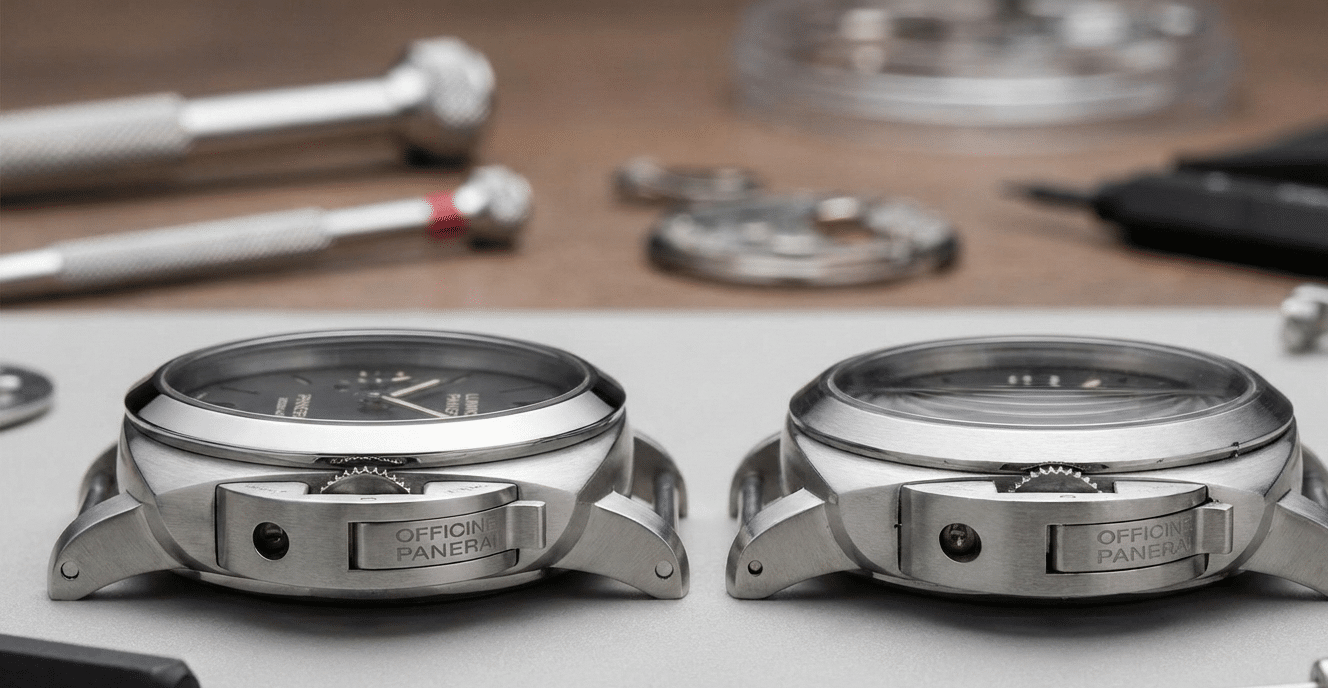
Replica finishing, while visually impressive from a distance, often reveals its limitations upon closer inspection. Edges that should be crisp and distinct on a genuine Panerai might appear softer or slightly rounded on a replica. Inconsistent brushing patterns, visible tool marks at transition points, or a less uniform satin finish are common tells. The crown guard, a signature Panerai feature, is a prime example: genuine crown guard machining shows precise 90-degree angles with no tool marks, whereas replicas can show minor rounding or visible machining lines. These imperfections, while small, indicate a less refined manufacturing process and a lower standard of finishing quality.
Bezel Construction, Fit, and Rotation (if applicable)
For models with a fixed or rotating bezel, Panerai’s engineering ensures precision and durability. Fixed bezels are integrated with the case with virtually invisible tolerances, creating a monolithic appearance. Rotating bezels, found on models like the Submersible, offer precise tactile feedback, perfect alignment of markers with the dial, and absolutely no play. The quality of bezel inserts, whether ceramic or steel, and their seamless integration into the case, are meticulously controlled. The 120-click action of a genuine Submersible bezel is firm, crisp, and aligns perfectly every time.
Replica bezels often fall short in these critical areas. Rotating bezels on replicas can exhibit noticeable wobble or play, a less satisfying “click” action, or misaligned markers. The bezel’s fit against the case might not be as tight, creating minute gaps that can compromise water resistance over time. Even for fixed bezels, the integration with the case might not be as seamless, with slight unevenness around the edges. While some replica factories like V6 have achieved commendable accuracy in the appearance and action of Submersible bezels, understanding genuine movement architecture reveals that these subtle differences in fit, finish, and tactile quality are still discernible to those familiar with the genuine article.
Expert Authentication Insight
To quantify these differences, professional authenticators employ precision tools. Digital calipers and micrometers are used to measure case thickness, lug width, and bezel height with sub-0.01mm accuracy, revealing even minute deviations from genuine specifications. For surface finishes, a dedicated surface roughness tester (profilometer) can quantify the texture of brushed and polished areas, providing objective data on the consistency and quality of the finishing. Visual inspection under high magnification, combined with these precise measurements, allows for an undeniable comparison between the advertised “1:1” replica and the true Panerai standard.
Movement Accuracy, Finishing, and Durability
The mechanical heart of any watch is its ultimate measure. While a genuine Panerai movement is the culmination of decades of horological engineering, Clean Factory and other top-tier replica makers have invested heavily in cloning these calibers. This section dissects the mechanical differences, comparing Panerai’s in-house or modified movements to Clean Factory’s cloned versions in terms of finishing, performance, and long-term reliability.
Movement Architecture and Component Finishing
A genuine Panerai movement, whether an in-house P.9000 or a historically significant ETA/Unitas modification, displays a meticulous level of finishing. Expect to see traditional decorative techniques like
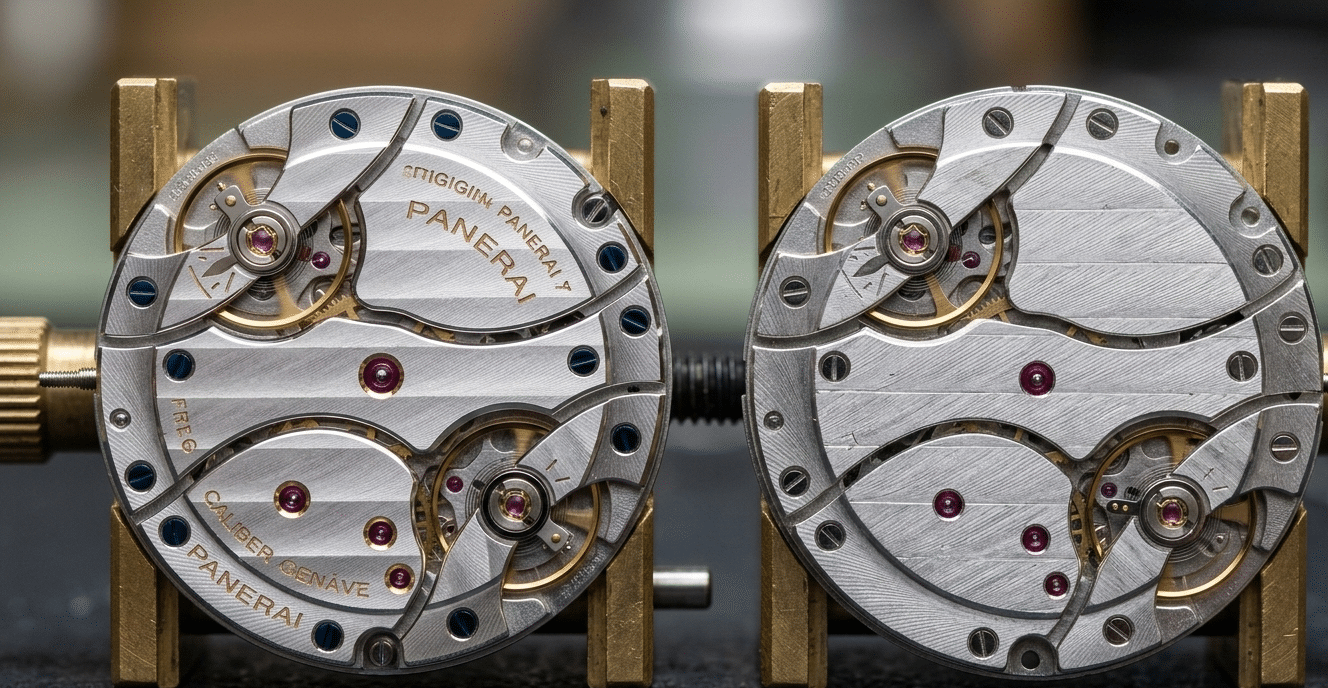
Clean Factory’s cloned movements, such as the widely praised VS P.9000 or XF P.3000, have made impressive strides. The VS P.9000, for instance, boasts approximately 85% parts compatibility with genuine Panerai movements, a truly remarkable engineering feat. However, under magnification, the finishing often reveals its origins. While superficial decoration might mimic the patterns, it’s typically applied by machine, lacking the depth, crispness, and consistency of hand-finished edges or the precise grain of genuine
Chronometric Performance and Regulation Standards
Panerai watches are designed for robust, reliable timekeeping. Many models adhere to COSC (Contrôle Officiel Suisse des Chronomètres) standards or equally rigorous internal chronometry benchmarks, ensuring a daily deviation typically within -4/+6 seconds per day across multiple positions and temperatures. This precision is achieved through meticulous regulation and extensive testing during and after assembly, a process that adds significant cost and expertise.
Clean Factory movements, particularly the VS P.9000, are generally considered stable for a replica. Community reports often cite daily rates within +5 to +15 seconds per day, which is acceptable for many users. However, consistency across different positions (dial up, dial down, crown up, etc.) and temperature fluctuations is where replicas typically fall short. They rarely undergo the same multi-position regulation and rigorous long-term testing as genuine movements. This means while a Clean Factory clone might perform well on a timegrapher in one position, its real-world performance on the wrist, subject to varying orientations and temperatures, will likely be less consistent than a genuine Panerai.
Power Reserve and Winding Efficiency
Panerai’s in-house movements are known for their extended power reserves, often 3-day (72-hour) or even 8-day. The P.9000 and P.3000 calibers are designed with dual mainspring barrels to achieve these durations, coupled with efficient automatic winding systems (like the P.9000’s bidirectional, ball-bearing rotor) or smooth, satisfying manual winding mechanisms. This extended power reserve is a significant convenience for daily wearers, allowing a watch to be set down for a weekend without stopping.
Clean Factory has made significant strides here. The VS P.9000 clone famously achieves a power reserve of 70–72 hours, almost perfectly matching the genuine. The XF P.3000 clone, for manual-wind models, typically delivers 65–68 hours, close to the genuine’s 72 hours. However, the winding efficiency of automatic versions might be slightly lower, meaning it could take more wrist motion to achieve full reserve. Manual winding, while functional, might not possess the same silky smoothness or precise tactile feedback as a genuine Panerai, which can be a subtle but noticeable difference for an experienced enthusiast. While the numbers are close, the engineering behind maintaining that power reserve consistently over years of use is where the genuine article truly differentiates itself.
Expert Authentication Insight
To truly assess movement quality, a timegrapher is indispensable. A genuine P.9000 will consistently show a beat rate of 28,800 vph, an amplitude between 280–310 degrees, and a beat error under 0.3 ms across all six positions. A Clean Factory VS P.9000 might match the beat rate, but amplitude could be lower (<260 degrees), and beat error and daily rate deviation will likely show more variance between positions. Furthermore, a microscopic examination of the movement bridges will distinguish genuine
Crystal and Gasket Integrity: Optical Clarity and Water Resistance
The crystal and gaskets are the watch’s first line of defense against the elements. Panerai’s reputation for robust, water-resistant watches depends entirely on the quality and engineering of these components. This section highlights Panerai’s superior engineering for durability, optical performance, and water resistance, versus the inherent compromises in Clean Factory replicas.
Sapphire Crystal Quality and Anti-Reflective Coating
Genuine Panerai watches utilize high-grade, optically pure sapphire crystals. These crystals are incredibly scratch-resistant and offer exceptional clarity. Crucially, Panerai often applies multi-layer anti-reflective (AR) coatings to the
Clean Factory has made significant advancements in crystal quality. Many top-tier replicas now feature sapphire crystals and, notably, VS Factory has achieved correct interior-only AR coating on models like the Luminor Due. However, some Clean Factory batches, particularly older ones or those for less popular models, might still use inferior or single-sided AR coatings. This can result in noticeable glare or a less defined “blue hue” at an angle. Furthermore, the optical purity of replica sapphire, while good, may not always match the pristine clarity of genuine crystals, which can manifest as slight distortions or a less crisp view of the dial under certain lighting conditions. Budget replicas, on the other hand, are often immediately identifiable by mineral glass or poor AR coatings that produce rainbow reflections.
Gasket Materials and Sealing Mechanisms
The integrity of a Panerai’s water resistance relies on high-quality gaskets. Genuine Panerai uses specific, high-durability rubber or synthetic materials, such as Viton, for the case back, crown, and crystal. These materials are chosen for their long-term resilience to water, chemicals, UV light, and temperature fluctuations, ensuring the watch maintains its rated water resistance for years between services. Proper seating and compression of these gaskets during assembly are critical, involving precise tolerances and strict quality control.
Replica gaskets, even in top-tier Clean Factory models, often use lower-grade rubber or silicone compounds. While these might provide adequate water resistance initially, they are more prone to degradation over time, especially with exposure to chlorine, saltwater, or heat. This leads to a faster breakdown of the seal, compromising water resistance prematurely. Moreover, the assembly process in replica factories might not adhere to the same stringent standards, leading to improperly seated gaskets or uneven compression, which can cause leaks even in a new watch. While Clean Factory replicas are generally advertised as water-resistant, few, if any, are tested to the genuine Panerai standards (e.g., 300m or 1000m), and most experienced replica owners recommend a maximum of 50–100m for daily wear.
Crown Tube and Lever Guard Sealing
Panerai’s iconic crown guard and robust crown tube are not merely aesthetic; they are fundamental to the watch’s water resistance. The precision engineering of the crown tube ensures a tight seal, and the lever guard mechanism, when locked down, applies consistent pressure to the crown, compressing its internal gaskets to create a virtually impenetrable barrier against water ingress. This system is designed for both extreme environments and long-term reliability.
Clean Factory replicas often struggle to perfectly replicate the nuanced engineering of this system. While visually impressive, replica lever guards can exhibit subtle play or less precise engagement when locked. The machining of the crown tube itself might have slightly looser tolerances, leading to a less robust seal. Under magnification, minor asymmetry in the crown guard machining or visible tool marks can be subtle tells. These minute differences, while seemingly minor, can compromise the watch’s long-term water resistance, making it more susceptible to moisture intrusion under strenuous conditions or as the gaskets age.
Expert Authentication Insight
The most definitive test for water resistance is a hydrostatic pressure test, typically performed by a professional watchmaker. A genuine Panerai will comfortably pass its rated depth (e.g., 300m, 1000m), while a replica will likely fail or show signs of stress at much shallower depths. For optical clarity, a refractometer can measure the crystal’s refractive index, and spectroscopic analysis can confirm the type and thickness of AR coatings. Visual inspection under high magnification will reveal the quality of the crown stem alignment and the compression marks left by the lever guard on the crown, indicating the precision of the sealing mechanism.
Luminescence and Material Quality: Beyond the Glow
Beyond the primary components, the details of luminescence and the quality of non-case materials significantly contribute to a watch’s overall feel, authenticity, and longevity. This section extends beyond dial lume to examine the quality of luminous elements on bezels or hands, and the overall material integrity of other components, comparing Panerai’s standards to Clean Factory.
Applied Luminous Markers and Bezels
Panerai’s reputation for exceptional legibility, particularly in low light, is built on its superior luminous material and application. Genuine Panerai uses high-grade Super-LumiNova (often Grade A), which can appear as a distinctive cream/off-white on vintage-style models or bright white on modern ones. This material is precisely applied to hands, dial markers, and, where applicable, bezel markers, ensuring evenness, strong adhesion, and a consistent glow that can last 8+ hours after charging. The texture of the lume is smooth and uniform, a result of meticulous application techniques.
Clean Factory has significantly improved its lume quality, with current batches often using BGW9 or equivalent blue-white lume that closely matches the initial brightness of genuine Panerai. However, the longevity typically runs 6–8 hours compared to the genuine’s 8–10 hours. More importantly, inconsistencies can arise in the application: unevenness in thickness, slight bleeding at the edges of markers, or even minor flaking over time. On luminous bezels, the alignment of the lume within the engraved markers might not be as perfectly centered or uniformly filled as on a genuine Panerai. The most obvious “budget tell” for any replica is green-glowing lume; as the community often states, “If it glows green at night, it’s not a Panerai — genuine or replica.”
Strap Material Durability and Stitching Quality
A Panerai watch is often defined by its strap. Genuine Panerai offers a range of high-grade straps, from robust natural leathers (like alligator or calfskin) and vulcanized rubber to durable textiles. These straps are crafted with meticulous attention to detail: precise, even stitching; carefully finished edges; and materials chosen for their comfort, durability, and resistance to wear. The attachment points are engineered to fit flush with the case, without gaps, ensuring both aesthetics and security.
Replica straps, even those accompanying Clean Factory watches, are almost universally a weaker point. While they might look convincing at first glance, they often use lower-quality leathers or rubber that lack the suppleness, aroma, or long-term resilience of genuine materials. Stitching can be less consistent, showing minor irregularities in spacing or tension, and edge finishing may be rougher or prone to peeling over time. A common tell is the fit at the lugs; replica straps frequently leave a 0.5–1mm gap where they meet the case due to imprecise spring bar positioning or less accurate lug hole drilling. This not only detracts from the aesthetic but can also compromise the security of the watch on the wrist over time.
Buckle and Clasp Construction and Finishing
The buckle or clasp on a Panerai is an integral part of its design and functionality. Genuine Panerai buckles and clasps are characterized by solid construction, precise machining, and consistent finishing that matches the case (e.g., polished, brushed). Such quality standards are essential benchmarks in any super clone factory comparison. They are designed for secure closure, comfortable wear, and smooth operation, with components fitting together seamlessly and spring bars that are robust and perfectly seated.
Clean Factory buckles and clasps generally replicate the design well, but often fall short in tactile quality and minute finishing details. Edges can feel slightly rougher, machining might not be as precise, leading to minor play in articulated parts, or spring bars might be of a lower grade or less accurately fitted. The finishing, while appearing correct from a distance, may lack the uniform grain of brushing or the mirror-like polish of genuine components, especially in less visible areas. These are small differences, but they contribute to the overall impression of quality and durability, and an experienced eye can often detect them.
Expert Authentication Insight
To assess strap quality, tensile strength testing can quantify the durability of materials and stitching. For buckles, microscopic examination of the pin holes and the fit of the spring bars will reveal machining quality. For luminous elements, a UV light examination is crucial. Not only does it confirm the color and brightness of the glow, but it also highlights uniformity. Any patchiness, unevenness, or incorrect hue of luminous material on hands, markers, or bezels under UV light is a significant red flag that can differentiate a genuine Panerai from even a top-tier Clean Factory replica.
Long-Term Performance and Serviceability: The True Test of Quality
This section addresses the often-overlooked aspects of watch ownership – how a watch performs over years, its resilience to wear, and the feasibility and cost of servicing, contrasting Panerai’s design for longevity with replica’s inherent limitations.
Aging and Patina Characteristics of Materials
Genuine Panerai watches are designed with a deliberate consideration for how their materials will age. For instance, Panerai’s use of specific bronze alloys (like CuSn1 in the Bronzo models) is intended to develop a unique, natural patina over time, reflecting the wearer’s journey. Carbotech, with its layered carbon fiber and titanium construction, is engineered for long-term structural integrity and a consistent aesthetic that resists typical wear patterns. Even their AISI 316L stainless steel is chosen for its specific corrosion resistance and ability to maintain its finish over decades of daily wear.
In contrast, replica materials, while often visually similar initially, frequently lack this engineered longevity. Bronze replicas might use alloys that patina unpredictably, developing uneven discoloration or an undesirable greenish hue rather than a rich, stable brown. Steel replicas, even if they use 316L, might have metallurgical impurities or less precise heat treatments that lead to premature pitting, micro-scratches that don’t buff out as easily, or an accelerated dulling of the finish. Carbotech replicas, while mimicking the visual layers, might use lower-grade carbon fiber composites or less robust bonding agents, potentially leading to delamination or chipping with prolonged use.
Service Interval and Component Availability
A cornerstone of genuine luxury watch ownership is the brand’s commitment to long-term serviceability. Panerai recommends service intervals typically every 3 to 5 years, ensuring the movement remains within chronometric specifications and seals are refreshed. Crucially, Panerai guarantees the availability of genuine spare parts through its authorized service centers for decades, meaning a watch purchased today can be maintained for a lifetime. This access to proprietary components, specialized tools, and factory-trained watchmakers ensures consistent, high-standard maintenance.
Replica watches, even the best “super clones,” operate in a fundamentally different ecosystem. They often require more frequent servicing due to lower-grade lubricants, less refined component tolerances, or inferior movement finishing that accelerates wear. The “VS P.9000 clone,” for example, while stable, might need attention every 18-24 months under daily wear, compared to the genuine’s 3-5 years. The biggest challenge is component availability: there is no guaranteed supply chain for replica parts. Watchmakers servicing clones must often improvise, cannibalize other replica movements, or use generic parts, which can compromise performance and lead to compatibility issues. This often results in a cycle of unauthorized, lower-quality repairs that diminish the watch’s already limited lifespan.
Resale Value and Market Authenticity
The established resale market for genuine Panerai watches is robust, underpinned by verifiable authenticity, documented provenance, and a clear service history. A genuine Panerai retains significant value, often appreciating or holding steady, especially for desirable or limited-edition models. Buyers in the secondary market rely on the ability to authenticate a watch, often through serial numbers, official papers, and the watch’s inherent quality.
For replicas, the concept of “resale value” in any legitimate sense is non-existent. While they might be traded in grey markets among enthusiasts aware they are purchasing a counterfeit, their value is a fraction of their initial purchase price and entirely dependent on their perceived similarity to a genuine article, not inherent quality or brand integrity. Attempting to sell a replica as genuine is illegal and unethical, leading to potential legal repercussions and severe damage to one’s reputation. The true cost of a replica isn’t just its purchase price; it’s the complete absence of long-term value, the inability to verify its origin, and the risk of misrepresentation.
Expert Authentication Insight
From a diagnostic standpoint, long-term performance disparities become evident upon
disassembly. We frequently find internal gaskets in replicas showing signs of premature degradation – cracking, hardening, or swelling – often due to incorrect material compounds or improper seating during assembly. This directly impacts water resistance, making even advertised 50m replica ratings unreliable. Furthermore, microscopic assessment of movement components in a replica after a year or two of use often reveals wear patterns inconsistent with expected genuine performance. We might see excessive wear on pivots, premature rounding of gear teeth, or debris from degraded lubricants, all indicative of lower-grade materials or less precise manufacturing tolerances compared to a genuine Panerai movement under comparable conditions.
The “1:1” Myth: Debunking Replica Claims with Reality
This concluding section directly confronts and dismantles the replica industry’s “1:1” claim by summarizing the cumulative evidence of differences across all inspected categories, emphasizing that true quality is more than superficial resemblance.
Cumulative Evidence of Micro-Discrepancies
The “1:1 replica” is a marketing fiction. While top-tier replicas from factories like Clean Factory achieve impressive visual fidelity at arm’s length, a closer inspection reveals a “death by a thousand cuts” – a multitude of small, individual flaws that collectively create a significant divergence from genuine Panerai standards. We’ve detailed these throughout this analysis:
- Dial Printing: Slight ink bleed, inconsistent font weight, or minor misalignment (e.g., date wheel font occasionally running slightly bold on VS P.9000 clones).
- Case Finishing: Minor rounding at crown guard edges, visible machining lines under magnification, or subtle variations in lug proportions (e.g., XF Radiomir wire lug thickness sometimes 0.3mm over genuine).
- Movement Decoration: Superficially stamped patterns instead of genuine perlage or Côtes de Genève, less refined beveling on micro-rotors, and generic shock protection.
- Material Quality: Patina on bronze that develops unpredictably, or XRF analysis revealing 304 stainless steel instead of 316L in some mid-tier replicas.
- Lume: Shorter glow duration (6-8 hours vs. 8-10 hours for genuine), or subtle color inconsistencies (e.g., older XF batches running slightly greener).
- Crystal: Inferior AR coatings (sometimes double-sided when genuine is single-sided), or slight refractive index differences.
Each of these discrepancies, in isolation, might seem minor. However, when combined across all components of a watch, they form an undeniable pattern of compromise. The cumulative effect is a product that, while superficially similar, fundamentally lacks the precision, consistency, and material integrity of an authentic Panerai.
The Impossibility of Replicating Intangible QC
Beyond the tangible components, the “1:1” myth crumbles when confronting the intangible aspects of quality control. A replica factory, no matter how sophisticated, cannot replicate Panerai’s institutional knowledge – decades of accumulated engineering expertise, proprietary manufacturing processes developed through extensive R&D, and in-house metallurgical expertise that ensures specific material performance. They lack the consistent feedback loop from authorized service centers globally, which informs continuous improvement in design and manufacturing.
Moreover, the human element of skilled artisans performing meticulous quality checks at every stage of production, guided by a brand philosophy of uncompromising excellence, is simply not present in a replica assembly line. Panerai’s QC isn’t just about passing a checklist; it’s about a culture of precision, a commitment to enduring quality, and a deep understanding of horological craft. This integrated, end-to-end quality philosophy, from raw material to finished product, is impossible to reverse-engineer or clone. It’s the sum of a brand’s heritage, investment, and dedication, none of which can be bought or imitated by a counterfeit operation.
The Legal and Ethical Implications of Misrepresentation
While this article focuses on the technical aspects of quality, it’s crucial to acknowledge the broader context. The replica industry operates outside the law, undermining intellectual property rights and often funding unregulated operations. Under U.S. federal law (18 USC § 2320), trafficking in counterfeit goods carries severe penalties, including imprisonment and substantial fines. While purchasing for personal use isn’t a federal crime, importing counterfeits is unlawful, and U.S. Customs and Border Protection can and will seize such goods.
Beyond the legal risks, there are significant ethical implications. Supporting the replica market implicitly endorses intellectual property theft and contributes to an ecosystem where misrepresentation is rampant. While some replica communities maintain an internal code against selling fakes as genuine, the very existence of high-quality replicas fuels the grey market for misrepresentation, where unsuspecting buyers can be defrauded. True luxury ownership, in part, lies in the integrity of the brand and the authenticity of the product, both of which are directly threatened by counterfeiting.
Expert Authentication Insight
The ultimate forensic diagnostic to debunk the “1:1” claim often requires instrumentation beyond the loupe. A comprehensive side-by-side comparison under an electron microscope, for example, can reveal fundamental differences in surface molecular structure, grain orientation of metals, and the uniformity and composition of anti-reflective coating layers – details that are simply impossible to replicate perfectly at scale. These are not merely cosmetic differences; they reflect deep-seated variations in material science, manufacturing processes, and quality control that no replica can genuinely match, regardless of how visually convincing it may appear to the naked eye.
Decision Framework for Panerai Buyers: Beyond the “1:1” Myth
For any reader considering a Panerai purchase, especially when confronted with the seductive claims of “super clones” like those from Clean Factory, it’s vital to recognize that true Panerai quality control is a multi-faceted standard encompassing material integrity, precision engineering, and long-term performance. No replica, regardless of its initial visual appeal, can genuinely match this comprehensive standard.
Here’s a checklist of critical authentication points and red flags to verify before making a purchase decision:
- Provenance & Documentation: Always prioritize genuine watches with original box, papers, and verifiable service history. This immediately establishes authenticity and chain of ownership.
- Weight & Feel: A genuine steel Luminor Marina (44mm) should weigh approximately 160-165g with its strap. Replicas, even top-tier ones, often feel noticeably lighter (155-160g at best, often less). The overall tactile impression of precision and solidity is hard to fake.
- Crown Guard & Case Finishing: Examine the crown guard for razor-sharp 90-degree angles and absence of tool marks. Transitions between polished and brushed surfaces on the case should be seamless and crisp. Replicas often show softer edges or visible machining imperfections under close scrutiny.
- Dial Printing & Lume: Use a 10x loupe to inspect dial text for absolute crispness, consistent ink density, and perfect alignment. Check lume color and consistency; genuine Panerai lume (Super-LumiNova) has a specific cream/off-white or bright white hue and glows brightly for 8+ hours. Any greenish tint or patchy glow is a red flag.
- Movement (if visible): Through a display caseback, genuine Panerai movements (P.9000, P.3000, etc.) will exhibit specific finishing patterns (perlage, Côtes de Genève), polished anglage, and blued screws. Clone movements often have simpler, machine-stamped decorations and less refined components.
- Crystal Clarity & AR Coating: Genuine Panerai uses high-grade sapphire with AR coating typically on the interior* surface only. Look for exceptional optical clarity and minimal glare. Rainbow reflections or a noticeably blue tint from the front are often tells of inferior replica crystals or incorrect AR application.
- Strap & Buckle Quality: Genuine straps use high-grade materials with meticulous stitching and edge finishing. Buckles and clasps are solid, precisely machined, and operate smoothly. Replicas often fall short here with cheaper materials, inconsistent stitching, or rougher buckle finishing.
- Price: If a deal seems too good to be true, it almost certainly is. A genuine Panerai will command a market-appropriate price. Be extremely wary of offers significantly below established market rates, even for pre-owned pieces.
Ultimately, while the visual resemblance of “super clones” can be impressive, the true value of a Panerai lies in its uncompromising quality control, the integrity of its materials, its long-term performance, and its guaranteed serviceability. These are the facets that no replica, including those from Clean Factory, can truly replicate, making the genuine article a distinctly superior and more secure investment.