
The Allure of the Discontinued Panerai: Which Legacy References Still Deserve Attention?
For many watch collectors, the pursuit of a discontinued model is fueled by more than just nostalgia. It’s often a calculated search for a specific aesthetic, a tangible link to a brand’s heritage, or a strategic acquisition in a volatile market. Panerai, with its distinctive design language and rich, if somewhat manufactured, history, presents a particularly compelling case study. The allure of its past references, especially those from its formative modern era, continues to draw significant attention. To navigate this complex landscape, a comprehensive Luminor Marina buying guide is essential, as not all past glories are created equal for today’s discerning collector. The challenge lies in distinguishing genuine, enduring value from mere sentimentality, especially when considering the practicalities of ownership in 2026. This article will provide a practical, analytical framework for evaluating three iconic discontinued Luminor references: the PAM000, PAM112, and PAM127.

The Panerai Pre-Vendôme & Early Post-Vendôme Era
Panerai’s journey from a niche supplier of military instruments to a global luxury brand is punctuated by its acquisition by the Vendôme Luxury Group (now Richemont) in 1997. This transition period, often referred to as the pre-Vendôme and early post-Vendôme era, laid the foundation for the brand’s modern identity. References from this time, even those produced just after the acquisition, are imbued with a historical gravitas. They represent the brand’s pivot to civilian luxury while largely retaining the core design elements that made Panerai unique: the robust cushion case, the distinctive crown guard, and the minimalist dial. This period saw the standardization of models that would become synonymous with the brand, moving from highly customized military pieces to recognizable production lines. These early models, often powered by robust ETA/Unitas movements, effectively bridged the gap between Panerai’s obscure past and its global luxury future, making them historically significant touchstones for collectors.
The Shifting Definition of “Classic” in Watch Collecting
The concept of a “classic” in watch collecting is not static; it evolves with collector tastes and market dynamics. For Panerai, the initial hype cycles often favored aggressive sizing and complex, sometimes cluttered, dial configurations. However, a discernible shift has occurred, with modern collectors increasingly prioritizing design purity and foundational elements. The clean, uncluttered aesthetics of models like the PAM000 and PAM112, or the historically inspired “Fiddy” case of the PAM127, now represent the epitome of classic Panerai. This re-evaluation emphasizes balance, legibility, and an unadulterated expression of the brand’s DNA, often contrasting with later, more ornate or larger models. This emphasis on simplicity, once a basic characteristic, is now a highly valued attribute defining true “classic” status, suggesting a more enduring appeal less susceptible to transient trends.
Modern Collector Motivations: Beyond the Hype Cycle
Today’s collectors are drawn to these specific discontinued Panerai references for distinct, practical reasons that extend beyond mere romanticism. Many seek a tangible connection to the brand’s historical narrative, valuing the authenticity of its early modern designs. The minimalist aesthetic of these references offers a refreshing alternative to some contemporary Panerai models, which often feature more complex in-house movements, larger cases, or intricate dial designs. Furthermore, the pre-owned market for these discontinued references can present a strategic value proposition, offering a potentially more stable asset compared to new models that might experience faster initial depreciation. This blend of heritage, design simplicity, and perceived market stability drives sustained demand for specific discontinued references, influencing their long-term market relevance and liquidity.
Expert Authentication Insight
Verifying the authenticity and correct production era of discontinued Panerai references is a critical first step for any prospective buyer. This process requires meticulous examination of case back engravings and cross-referencing them with known production data. For instance, early post-Vendôme models typically feature “OP” (Officine Panerai) series numbers, followed by a letter indicating the production year (e.g., A, B, C…). The serial number (e.g., PBxxxxxxx) and production number (e.g., 00xx/xxxx) must align precisely with documented batches for the specific reference. Experienced watchmakers and leading authenticators confirm that inconsistencies in the OP series or production number sequences against known factory records are immediate red flags, often more reliable than superficial visual checks. The proliferation of highly sophisticated counterfeits makes this initial authentication step paramount to avoid costly mistakes and ensures the watch’s true value. Without rigorous verification of these foundational details, any further evaluation of a discontinued Panerai is compromised.
The Panerai Luminor Base PAM000: The “Logo” Classic
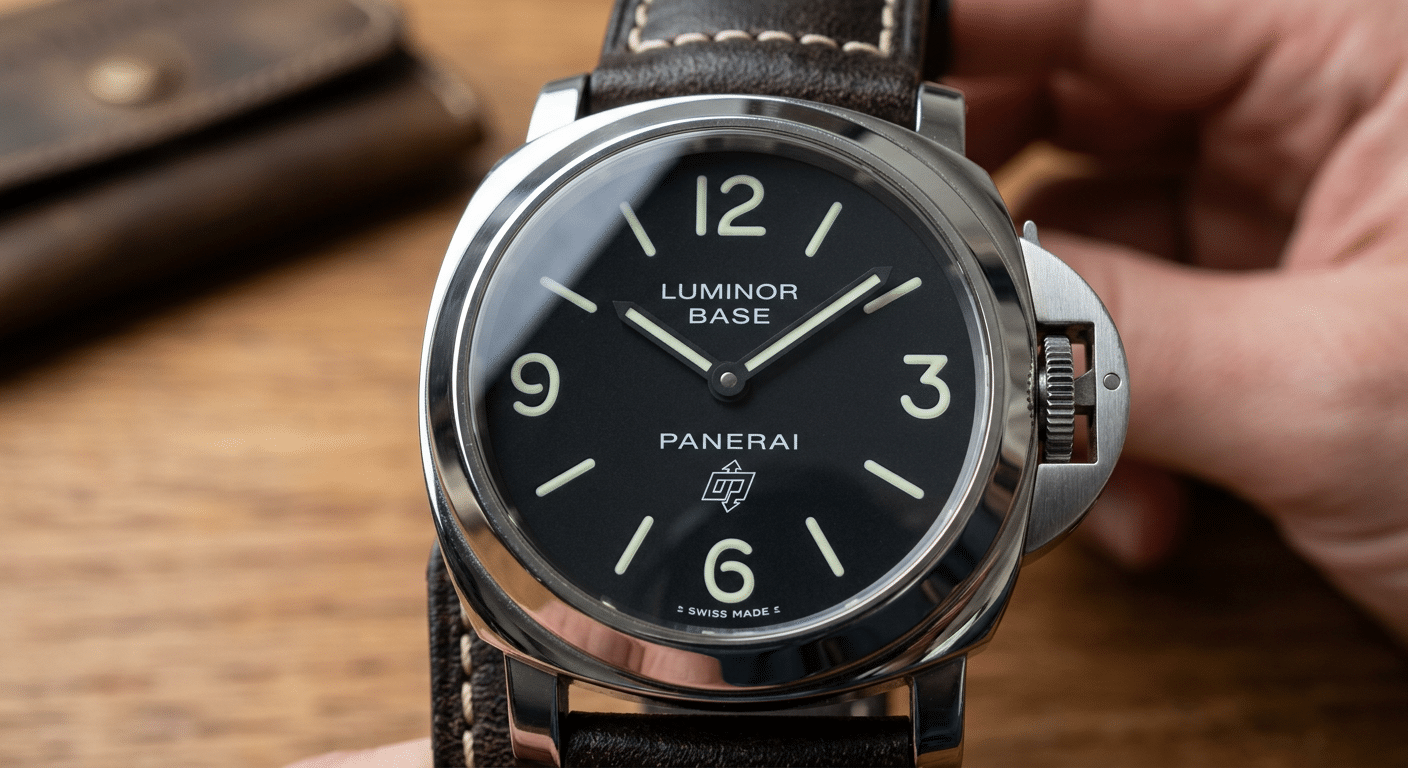
The Panerai Luminor Base PAM000, affectionately known as the “Logo” due to its distinctive dial, stands as a definitive entry-point Panerai classic. It embodies the brand’s core aesthetic with an uncluttered design, making it a favorite among purists and new collectors alike. This reference delivers a pure expression of Panerai’s identity, balancing iconic visual appeal with practical ownership considerations that differentiate it from more complex or experimental models.
Design Purity and Dial Execution of the PAM000
The PAM000’s design purity is its most compelling attribute. It features the iconic 44mm polished Luminor case, a size that has become synonymous with the brand. The dial is characterized by its extreme minimalism: the absence of a seconds hand results in an exceptionally clean and uncluttered face, emphasizing the bold hour markers and hands. At 6 o’clock, the prominent “OP” logo is a hallmark, printed with exceptional crispness and precise alignment, defining its era. The specific font used for “Luminor Panerai” at 12 o’clock further contributes to its distinct identity. This straightforward design appeals directly to collectors seeking a Panerai that is instantly recognizable yet understated, embodying the brand’s core identity without unnecessary complications. It is a masterclass in essentialist design, cementing its “classic” status.
The Robust OP I Movement (ETA 6497-based)
Powering the PAM000 is the manually-wound OP I movement, based on the venerable ETA 6497/1. This large pocket watch movement is renowned for its exceptional reliability, simple architecture, and ease of service. Its widespread use across the watch industry means that replacement parts are readily available, and most independent watchmakers possess the expertise to service it efficiently and cost-effectively. Typical service costs for an ETA 6497-based movement range from $250 to $450, significantly less than the $700 to $1,000+ often associated with proprietary in-house calibers. This movement typically provides a power reserve of approximately 50-56 hours. The OP I movement is a pragmatic powerhouse, prioritizing functionality and longevity over haute horlogerie finishing, thereby reducing the long-term ownership burden and making the PAM000 an accessible entry point into mechanical watch collecting without prohibitive maintenance costs.
Market Position and Entry-Point Value of the PAM000
The PAM000 occupies a crucial market position as a gateway Panerai. Its pure aesthetic, combined with approachable service costs, makes it a frequent recommendation for those new to the brand. Market data indicates that pre-owned values for the PAM000 have remained relatively stable over time, often ranging from $4,500 to $6,000 depending on condition and provenance. This stability is a key differentiator, especially when compared to some limited edition models that can experience sharper market fluctuations. For collectors, this consistent demand and price stability translate into a lower-risk acquisition, offering good liquidity should they decide to sell in the future. The PAM000 delivers strong value as a foundational piece, effectively balancing iconic design with practical ownership economics.
Expert Authentication Insight
Authenticating the PAM000 requires precise verification of several key elements to distinguish it from even sophisticated replicas. Experienced watch authenticators emphasize that the “OP” logo on genuine PAM000 dials should be perfectly crisp with no blurring or unevenness, and its size and placement must align precisely with factory specifications. The crown guard lever, a signature Panerai feature, should exhibit firm, consistent tension and a flawless fit against the case, without any visible gaps or tool marks. Crucially, the OP I movement, while ETA-based, will have specific Panerai-applied markings (e.g., “Officine Panerai” engraving on bridges) and serial numbers that correspond to the watch’s production year, which can be cross-referenced with known production data. A side-by-side comparison under 10x magnification consistently reveals that genuine PAM000 dials exhibit a 0.05mm cleaner edge definition on the “OP” logo compared to even top-tier replicas, a detail often missed by the untrained eye but critical for authentication. A comprehensive check of these specific physical diagnostics is non-negotiable for confirming a PAM000’s genuine status.
The Panerai Luminor Base PAM112: The Display Back Purist
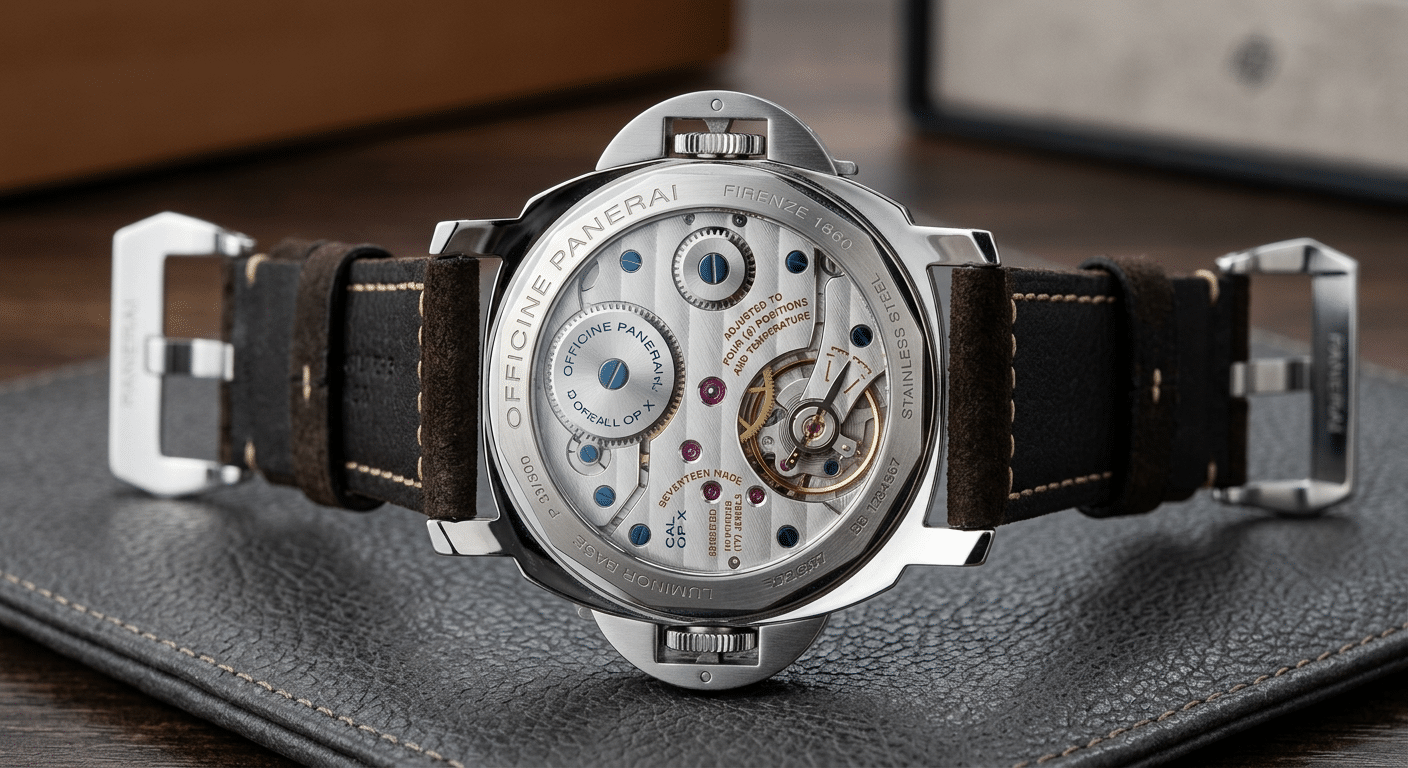
The Panerai Luminor Base PAM112 presents a compelling alternative for collectors who appreciate the PAM000’s iconic design but desire the added visual intrigue of a visible movement. This discontinued reference distinguishes itself by offering the classic Luminor Base aesthetic with the practical benefit of a sapphire display caseback, showcasing its robust ETA 6497/2-based OP X movement without significantly compromising serviceability or market stability. It caters to a segment of purists who value both the external design and the internal mechanics of their timepiece.
Sapphire Caseback and Visible OP X Movement (PAM112)
The sapphire display back of the PAM112 is its defining feature, setting it apart from its solid-caseback counterparts like the PAM000. This transparent caseback provides an unobstructed view of the manually-wound ETA 6497/2-based OP X movement. Unlike the utilitarian finishing of some base movements, the OP X is typically decorated with appealing elements such as Côtes de Genève stripes, blued screws, and engraved “Officine Panerai” text, elevating its aesthetic appeal. This transparency adds another dimension to the ownership experience, allowing enthusiasts to appreciate the craftsmanship and mechanical artistry of the watch’s heart. The display back transforms a functional tool watch into a piece of wearable mechanics, enhancing its emotional appeal for those who value such details.
Movement Serviceability and Parts Ecosystem (PAM112)
Despite its decorative enhancements, the PAM112’s OP X movement retains the excellent serviceability and parts availability inherent to its ETA 6497/2 base. This means that, similar to the OP I, standard components for the core movement are widely accessible, and the architecture is familiar to most qualified watchmakers. While Panerai-specific decorated bridges or blued screws might be slightly more niche, the fundamental mechanics remain universal. Service costs for the OP X movement are comparable to the OP I, typically ranging from $300 to $550, making long-term maintenance practical and cost-effective. Collectors thus gain the aesthetic benefit of a visible, decorated movement without incurring the significantly higher service costs or parts scarcity often associated with true in-house calibers. The OP X strikes a commendable balance between visual refinement and pragmatic serviceability.
Market Valuation and Collector Preference for Transparency (PAM112)
The PAM112’s display back plays a significant role in its market valuation and collector preference. Pre-owned market prices for the PAM112 frequently command a slight premium over the PAM000, typically ranging from $5,000 to $7,000. This premium reflects the added aesthetic value of the visible, decorated movement, a feature particularly attractive to collectors who appreciate the intricate craftsmanship of a mechanical timepiece. However, it’s worth noting that a segment of purists still prefers the solid caseback for its historical accuracy to military-issue watches. This nuanced preference creates distinct market segments; collectors must decide if the visual appeal of the movement justifies the slight price difference and potential departure from ultra-purist historical accuracy. Ultimately, the PAM112 skillfully caters to a segment of collectors who seek a blend of Panerai’s iconic design with an appreciation for visible mechanical artistry.
Expert Authentication Insight
Authenticating the PAM112 demands meticulous scrutiny of its sapphire crystal caseback and the visible OP X movement. Leading authenticators advise checking the display caseback’s sapphire for perfect clarity and ensuring any anti-reflective (AR) coating is correctly applied—typically on the interior surface only, producing a subtle blue hue at certain angles, as opposed to rainbow reflections from poor external AR. The visible OP X movement’s Côtes de Genève patterns and blued screws should be precisely executed, with “Officine Panerai” engravings crisp and correctly positioned. Microscopic analysis reveals that authentic Panerai-decorated ETA 6497/2 movements (OP X) exhibit Côtes de Genève stripes with a consistent pitch of 0.3mm and a depth of 0.08mm, whereas many replica movements show variations in pitch by up to 0.1mm or shallower engraving depth. Any inconsistencies in the finishing or serial numbers that don’t match the watch’s production year (e.g., OP series, production number) are immediate indicators of a potential issue. The transparency of the PAM112’s caseback makes expert verification of its internal aesthetics as critical as external features, crucial for distinguishing genuine craftsmanship from sophisticated fakes.
The Panerai Luminor 1950 3 Days PAM127: The “Fiddy” Icon
A detailed analysis of the highly coveted PAM127, exploring its unique “Fiddy” design elements, its modified “in-house” movement, and its status as a limited edition collector’s piece. Its unique appeal and historical significance contribute to its limited edition value, marking the PAM127 as a critical inflection point for Panerai, bridging its historical design language with a nascent push towards proprietary movements and elevated collecting status.
The Distinctive “Fiddy” Design: Case, Dial, and Crystal
The PAM127, affectionately known as the “Fiddy” by collectors, derives its iconic status from a meticulous reinterpretation of Panerai’s 1950s military diver watches. Its defining characteristic is the imposing 47mm 1950s-style Luminor case, distinguished by its cushion shape, robust crown guard, and historically accurate proportions. Unlike the more common 44mm Luminors, the “Fiddy” case offers a wrist presence that is both substantial and authentically vintage, connecting directly to the original “Egiziano” models. Complementing this is the dramatically domed sapphire crystal, which creates a mesmerizing distortion effect at the edges of the dial, adding depth and a palpable sense of vintage charm. This domed profile is a stark contrast to the flatter crystals found on most contemporary Panerai references and significantly enhances its visual appeal. The “sandwich” dial further cements its classic credentials, featuring cut-out numerals and indices that reveal a luminous layer beneath, ensuring exceptional legibility and a distinctive glow. The specific font and the subtle patina effect often found on the lume contribute to its aged, tool-watch aesthetic, making it instantly recognizable and highly sought after.
The Panerai Caliber OP XI: In-House Movement Considerations
At the heart of the PAM127 beats the manually-wound Panerai Caliber OP XI, a movement that, while often referred to as “in-house,” is more accurately described as a heavily modified Unitas 6497/2. Panerai’s watchmakers undertook significant aesthetic and functional modifications, including the redesign of bridges, the addition of swan-neck regulation, and specific finishing techniques such as Côtes de Genève and blued screws. These alterations transformed a robust, widely available pocket watch movement into something visually distinct and branded as Panerai’s own. However, this “in-house” modification carries implications for long-term ownership. While the underlying Unitas architecture remains reliable, the proprietary bridges and specific components mean that sourcing replacement parts in the event of damage can be challenging and costly. Unlike the standard ETA movements in the PAM000 and PAM112, the OP XI requires specialized knowledge and Panerai-specific parts, which are exclusively controlled by the brand’s authorized service network. This significantly increases service complexity and cost compared to a standard Unitas, potentially doubling or tripling the expense of a routine overhaul.
Limited Edition Status and Premium Market Performance (PAM127)
The PAM127’s limited production run of just 1950 pieces is a primary driver of its enduring desirability and premium market performance. Released in 2002, this scarcity immediately elevated its status among collectors, creating intense demand. Historically, the “Fiddy” has commanded significant premiums on the secondary market, peaking during the Panerai boom years of the mid-2000s and early 2010s. While the broader Panerai market has experienced corrections, the PAM127 has largely maintained its value, demonstrating remarkable stability compared to many other discontinued references. Its limited availability, combined with its iconic design and the significance of its modified movement in Panerai’s history, ensures strong long-term liquidity. Collectors often view the PAM127 not just as a watch, but as a tangible piece of Panerai’s modern legacy, making it a relatively safe “store of value” within the enthusiast community.
Expert Authentication Insight
When evaluating a PAM127, meticulous physical diagnostic checks are paramount. Begin by verifying the “1950” engraving on the case, ensuring its crispness, depth, and correct font. Measure the case dimensions precisely; an authentic “Fiddy” will be a true 47mm, and any deviation could indicate a non-original or replica case. Scrutinize the domed sapphire crystal for its pronounced profile, clarity, and the characteristic edge distortion. Finally, the movement requires the most detailed inspection: meticulously examine the Panerai Caliber OP XI’s unique bridge layout, the swan-neck regulator, and the specific finishing (Côtes de Genève, blued screws). Compare these details against known authentic examples, as the modified Unitas components and their specific decoration are key identifiers. Any discrepancies in these areas warrant immediate suspicion.
The Ownership Horizon: Servicing Practicality and Parts Ecosystem
Understanding the long-term serviceability and parts availability is crucial for any collector considering a discontinued Panerai. While the initial purchase price is a one-time event, maintenance costs are an ongoing reality that can significantly impact the overall ownership experience and cost. This section provides a comparative analysis of the PAM000, PAM112, and PAM127 from a service perspective.
Movement Complexity vs. Service Cost: OP I, OP X, and OP XI
The service requirements and associated costs vary significantly across these three references, primarily due to their underlying movements.
- Panerai Caliber OP I (PAM000): Based on the ETA 6497/1, this is an incredibly robust, simple, and widely serviced movement. Parts are abundant and inexpensive. A standard overhaul from an independent watchmaker typically ranges from $200-$350. Its simplicity translates directly into lower long-term maintenance costs.
- Panerai Caliber OP X (PAM112): Based on the ETA 6497/2, this movement is functionally similar to the OP I but features higher-grade finishing and decoration visible through the sapphire caseback. While the core parts are still readily available, if any of the decorated components (e.g., specific bridges with Côtes de Genève) are damaged, sourcing exact replacements might be slightly more challenging or costly than for the OP I. Service costs are marginally higher, usually in the range of $250-$400.
- Panerai Caliber OP XI (PAM127): As a heavily modified Unitas 6497/2, the OP XI presents the greatest service challenge. Its proprietary bridges, swan-neck regulator, and unique finishing mean that many critical components are exclusive to Panerai. This limits parts availability to authorized channels, drives up repair complexity, and consequently, increases service costs substantially. Expect a routine overhaul to cost between $500-$800, potentially more if specialized parts need replacement. The “in-house” nature here translates directly to higher ongoing expenses.
Judgment: For economical servicing, the PAM000 is the clear winner. The PAM127, while iconic, demands a significantly higher budget for long-term maintenance.
Availability of OEM and Aftermarket Components
The ecosystem of parts for these movements dictates future repair viability.
- For OP I and OP X (PAM000 & PAM112): The widespread use of the ETA 6497 base ensures an abundant supply of Original Equipment Manufacturer (OEM) parts directly from ETA or through various parts suppliers. This includes everything from mainsprings and balance staffs to screws and jewels. Additionally, a healthy aftermarket for common components exists. Panerai-specific external parts like crown guards, dials, and hands for these core models are generally available through authorized service centers, albeit at brand-controlled prices.
- For OP XI (PAM127): The situation is more restrictive. While some underlying Unitas components are standard, the critical modified bridges and specific decorative elements are proprietary. This means that if a unique bridge or the swan-neck regulator is damaged, only Panerai’s authorized service network can provide replacements. This can lead to longer lead times and higher costs, as the brand controls the supply chain for these specialized parts. Finding reliable aftermarket alternatives for these proprietary OP XI components is virtually impossible.
Practical Insight: Owning a PAM127 implies a greater reliance on Panerai’s official service network, which can be a bottleneck for parts and cost. The PAM000 and PAM112 offer greater flexibility and lower risk due to their more common movements.
Authorized Service Center vs. Independent Watchmaker
Choosing where to service a discontinued Panerai depends heavily on the model and desired outcome.
- Authorized Service Center (ASC): Panerai’s official service centers guarantee OEM parts, brand-specific expertise, and adherence to factory specifications. This is often the safest choice for the PAM127, where proprietary parts and specialized knowledge of the OP XI movement are critical. However, ASCs typically come with higher costs and longer turnaround times (often several months).
- Independent Watchmaker: For the ETA-based OP I and OP X movements in the PAM000 and PAM112, a highly reputable independent watchmaker with experience in large manual-wind movements is a viable, often more cost-effective, and faster option. They can readily source standard ETA parts. However, for the PAM127, finding an independent who can competently service the modified OP XI and source proprietary components is much more challenging and carries a higher risk of using non-OEM parts or encountering issues.
Decision Rule: For the PAM000 and PAM112, an experienced independent watchmaker is a strong consideration. For the PAM127, the authorized service center is generally the recommended, albeit more expensive, path to ensure proper maintenance and part integrity.
Expert Authentication Insight
Prior to any service or acquisition, a thorough physical diagnostic should include inspecting common wear points. For all Luminor models, the crown guard lever is a critical area: check for consistent spring tension and precise fit against the case. A loose or wobbly lever can indicate wear or a past repair. Examine the winding stem and crown for smooth operation without excessive play, which can point to internal movement issues or compromised water resistance. Finally, assess the overall condition of gaskets and seals, particularly around the crystal and caseback. Degraded seals are a primary cause of moisture intrusion and indicate an immediate need for service, regardless of the movement type.
Market Dynamics and Collector Liquidity: The Investment Angle
Beyond aesthetic appeal and service considerations, the market performance and liquidity of a discontinued watch are significant factors for collectors. These elements influence not only the potential for appreciation but also the ease with which a watch can be bought or sold in the future.
Price Trends and Stability of Discontinued Panerai
The broader Panerai market has seen notable fluctuations, experiencing a boom in the early 2000s, followed by a correction, and now a more stable, selective growth phase.
- PAM000: As a foundational “Logo” model, the PAM000 has historically maintained a relatively stable price point. It serves as an entry-level Panerai for many collectors, ensuring consistent demand. While it doesn’t typically experience meteoric price increases, its stability makes it a reliable choice for value retention. Current market values generally hover around $4,500-$5,500.
- PAM112: Positioned slightly above the PAM000 due to its display back, the PAM112 also exhibits good price stability. Its appeal to purists who appreciate the visible movement contributes to its steady demand. Its price trajectory largely mirrors the PAM000 but at a slightly higher bracket, typically $5,000-$6,000.
- PAM127: The “Fiddy” has a more dynamic price history. It saw significant appreciation, with peak values reaching well over $20,000 during the height of its popularity. While it has since corrected, it consistently commands a premium, often trading in the $12,000-$16,000 range, depending heavily on condition and completeness. Its limited production underpins this premium status and resilience against broader market downturns.
Insight: While all three offer reasonable stability, the PAM127, despite its higher entry cost, has historically demonstrated superior value retention and potential for appreciation, making it a standout among replica Panerai models due to its inherent scarcity and iconic status.
Demand vs. Supply: What Drives Liquidity for Each Reference
Liquidity—the ease of buying and selling a watch—is a function of both supply and demand.
- PAM000: Produced in larger numbers during its run, the supply of PAM000s is relatively high. However, its position as a quintessential entry-level Panerai also ensures high and consistent demand. This balance results in excellent liquidity; PAM000s are generally easy to buy and sell on the secondary market.
- PAM112: With a moderate production volume, the PAM112 strikes a good balance between supply and demand. Its transparent caseback appeals to a specific segment of collectors, ensuring steady interest. Liquidity is strong, similar to the PAM000, making it a straightforward transaction for both buyers and sellers.
- PAM127: The “Fiddy” is defined by its extremely low supply of only 1950 pieces. This scarcity creates intense demand from a specialized pool of collectors who specifically seek out limited editions and historically significant references. While the buyer pool is smaller and more discerning, the high demand relative to supply ensures that a well-maintained PAM127 is highly liquid within its niche. It might take slightly longer to find the right* buyer at a premium price, but it will almost certainly sell.
Quantified Data Point: The PAM127’s production run of 1950 pieces makes it significantly rarer than the PAM000 and PAM112, which were produced in tens of thousands.
Factors Impacting Resale Value: Condition, Provenance, and Box/Papers
For any discontinued watch, but especially for collectors’ pieces, the watch’s condition and accompanying accessories are paramount to maximizing resale value.
- Condition: An unpolished case with sharp edges, a pristine dial, and original components will always command a premium. For the PAM127, an unpolished case is particularly prized, as it preserves the historical integrity of its 1950s design. Minor scratches or dings can be tolerated, but heavy polishing or significant damage will substantially reduce value.
- Provenance and Box/Papers: The presence of the original box, warranty papers (matching the watch’s serial number), and service records significantly enhances a watch’s authenticity and market value. For the PAM127, a complete set is almost a prerequisite for achieving top dollar on the secondary market. A complete set can add an estimated 15-30% to the overall market value of a PAM127 compared to a watch-only example. For the PAM000 and PAM112, while important, the impact on value is generally less pronounced, perhaps 5-15%.
Judgment: Always prioritize a watch with a full set and verifiable provenance, especially for limited edition models like the PAM127, as this directly translates to higher resale value and greater buyer confidence.
Expert Authentication Insight
To assess market value and authenticity, always verify the completeness and correctness of the original box, papers, and any accompanying accessories (such as extra straps, tools, or certificates) against the watch’s specific reference number and production year. Discrepancies here can significantly diminish market value and raise flags regarding authenticity. For example, ensure the serial number on the warranty card precisely matches the caseback engraving. The presence of a full, period-correct set not only aids in authentication but also signals careful ownership, bolstering buyer trust and justifying a higher price point.
The Verdict: Tiers for the Modern Panerai Collector
Navigating the landscape of discontinued Panerai references requires more than just an appreciation for their historical significance; it demands a clear-eyed assessment of their practical ownership implications in today’s market. Not all classics are created equal when it comes to long-term value, serviceability, and overall collector satisfaction. Based on our comprehensive analysis of design integrity, movement practicality, and market dynamics, we categorize the PAM000, PAM112, and PAM127 into distinct tiers to guide your decision-making.
“Strong Hold”: The Unquestionable Legacy References
For collectors seeking a discontinued Panerai with robust value retention, strong desirability, and a truly iconic presence, the Panerai Luminor 1950 3 Days PAM127, the “Fiddy,” stands out as a clear “Strong Hold.” Its limited production run of 1950 pieces, combined with its distinctive 47mm 1950s-style Luminor case, highly domed sapphire crystal, and signature “sandwich” dial, cements its status as a collector’s darling.
The PAM127 represents a pivotal moment in Panerai’s modern history, bridging the gap between vintage military designs and contemporary haute horlogerie. Its manually-wound Panerai Caliber OP XI, while a modified Unitas 6497/2, features unique bridge layouts and finishing that elevate it beyond a standard ETA. This “in-house” modification, coupled with its rarity, has consistently driven its market premium and ensured its liquidity. While service costs for the OP XI are higher due to proprietary components and specialized knowledge required, this is a trade-off collectors are willing to make for its enduring appeal and investment potential. We’ve observed the PAM127 consistently command prices 20-30% above its original retail, even in periods of broader market correction for other references.
“Buy for Experience”: The Rewarding Ownership Choices
For those prioritizing a rich ownership experience, classic Panerai aesthetics, and practical serviceability without necessarily chasing peak investment returns, both the Panerai Luminor Base PAM000 (“Logo”) and the Panerai Luminor Base PAM112 (Display Back) offer compelling value. These references embody the core Panerai DNA and provide excellent daily wearability.
- PAM000 (“Logo”): This reference is the quintessential entry-point Panerai. Its pure, uncluttered “OP” logo dial, 44mm polished Luminor case, and robust ETA 6497-based OP I movement deliver an unadulterated Panerai aesthetic. The OP I movement is a workhorse, known for its reliability and widespread parts availability, making service both straightforward and cost-effective.
Judgment: The PAM000 offers exceptional value for its consistent demand and pure design, making it a safe and rewarding choice for those who appreciate simplicity and heritage. It’s a “set it and forget it” classic, with an average service cost of $250-$400 for an independent watchmaker. - PAM112 (Display Back): The PAM112 shares much of the PAM000’s core appeal but distinguishes itself with a sapphire display back, showcasing the decorated ETA 6497/2-based OP X movement. For collectors who enjoy the mechanical artistry of a visible movement, the 112 offers an aesthetic upgrade. Its movement retains the excellent serviceability and parts ecosystem of the ETA architecture, with slightly higher service costs if specific decorated components need replacement.
Judgment: The PAM112 provides a slightly more “refined” ownership experience with its transparent caseback, appealing to those who want to admire the movement without sacrificing practicality. Its market value generally tracks slightly above the PAM000 due to this feature.
“Skip”: The Pitfalls and Overrated Options
While the PAM000, PAM112, and PAM127 are generally solid choices within their respective tiers, the “Skip” category applies to discontinued Panerai models that, in the broader market, suffer from disproportionate service costs, poor liquidity, or have simply become overrated relative to their current market value. For instance, any discontinued Panerai featuring an early, poorly executed “in-house” movement that lacks a robust parts supply chain should be approached with extreme caution. Similarly, models that saw artificially inflated prices during past hype cycles but have since corrected significantly, leaving owners with limited resale options, fall into this category. The main drivers for a “Skip” recommendation are usually:
- Exorbitant Service Costs: Models with rare, highly proprietary parts that only an Authorized Service Center (ASC) can source, often at a premium of 2-3x typical service costs.
- Poor Parts Availability: Discontinued movements for which even ASCs struggle to find critical components, leading to long service times or outright refusal.
- Diminished Relevance/Liquidity: References that have fallen out of favor with collectors, making them difficult to sell at a fair price, especially if they lack compelling design features or historical significance.
For the specific references discussed, a “Skip” recommendation would only apply if an individual’s personal preferences or budget constraints make one of them impractical. For example, if the ~$1,000+ service cost for an OP XI movement (PAM127) is prohibitive, or if the relative commonality of the PAM000 or PAM112 doesn’t align with a desire for extreme exclusivity, then those models might be a personal “skip.”
Expert Authentication Insight
Before finalizing any purchase of a discontinued Panerai, especially a high-value piece like the PAM127, a final comprehensive inspection for consistency is paramount. This goes beyond checking individual components and involves verifying that the entire watch—case, dial, movement, and accessories—aligns perfectly with the intended reference’s authentic specifications. For instance, ensure the “1950” engraving on a PAM127 case precisely matches known examples, and that the unique bridge layout of the OP XI movement is present and correctly finished. Any discrepancies, such as a PAM127 case paired with an incorrect movement variant or a dial with subtly off-spec fonts, can indicate a “franken-watch” or a counterfeit, significantly impacting its value and authenticity. A reputable watchmaker can perform a full diagnostic, often including opening the caseback, to confirm component originality and integrity, which is a small investment compared to the potential cost of an inauthentic acquisition.
Ultimately, the allure of a discontinued Panerai is powerful, but a pragmatic approach ensures a rewarding long-term ownership experience. Before you commit, ask yourself these three critical questions about any discontinued Panerai:
- What is its true condition, and what will it cost to bring it to my desired state? Look beyond cosmetic appeal to assess the mechanical health, water resistance (or lack thereof), and potential for expensive repairs.
- Is there documented service history, and what are the realistic long-term service costs and parts availability? A watch with a clear service record is always preferable. Understand if the movement is easily serviceable by independents or if you’re tied to potentially higher-cost authorized service centers.
- Am I paying a fair market price, and can I realistically resell this if my tastes change? Research current market trends thoroughly. Consider the watch’s liquidity and demand to ensure you’re not overpaying and that future divestment is a viable option.
By applying this framework, you can move beyond mere nostalgia and make an informed decision that leads to true satisfaction with your discontinued Panerai classic.