
The structural evolution of 2026 horological replicas has moved beyond mere aesthetic mimicry into the realm of true Structural Fidelity. In the high-precision environment of Guangzhou-based manufacturing, the transition to high-speed 5-axis CNC platforms has fundamentally altered the Geometric Equivalence of the VC Overseas 4500V and Patrimony lines. This technological leap allows for more complex CNC Pathing Tolerances, specifically where the lug meets the mid-case—a traditional failure point where earlier batches often exhibited microscopic gaps or inconsistent curvatures that betrayed their origin.
However, industrial constraints still dictate the final output. The high-speed rotation required for mass-market yield often introduces Kinetic Efficiency trade-offs. While the ZF factory has optimized its CAD/CAM modeling to account for tool deflection, the radial symmetry of the Maltese Cross bezel remains a significant challenge. Any variance in the torsional tension of the milling bit results in microscopic “stepping” patterns that disrupt the intended flow of light, a signature that differentiates high-yield production from the boutique, manual zinc-plate polishing seen in Geneva.
The Physics of Case Architecture: CAD/CAM Precision in 2026 Replicas
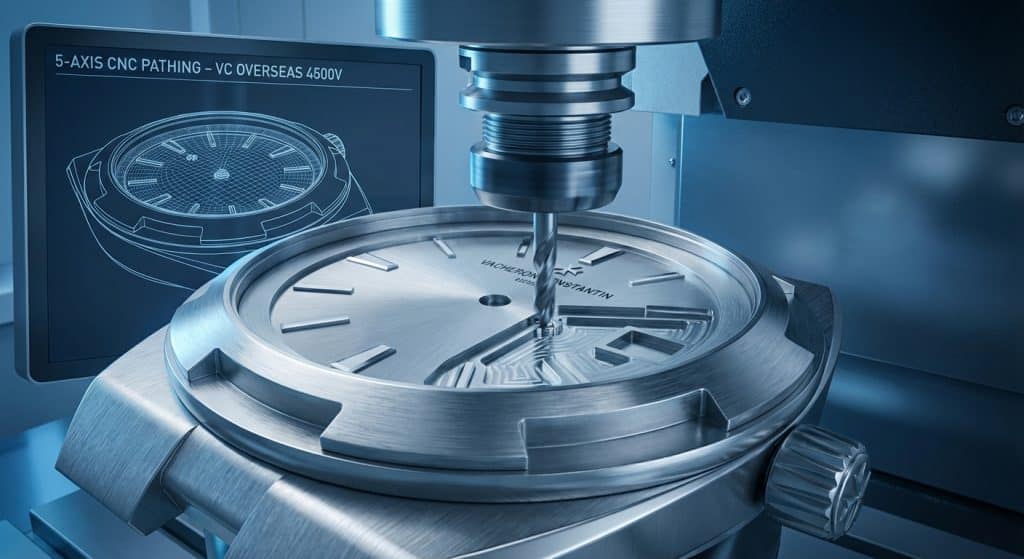
Geometric Equivalence and 5-Axis CNC Milling
The structural integrity of a VC case—specifically the Overseas and Patrimony lines—relies on the precision of the initial CNC milling cycle. In the 2026 batches, leading factories like ZF have transitioned to high-speed 5-axis CNC platforms to ensure that the visual error in lug-to-case integration is maintained within a staggering ±0.02mm. This precision is critical for the Maltese Cross bezel, where tool wear on the CNC bit can cause microscopic deviations in the curve. By employing advanced CAD/CAM modeling, these labs now simulate the milling process to predict and compensate for tool-head vibration before the first cut is made into the 316L Steel blank.
Tolerances in Ultra-Thin Profiles (Patrimony & Traditionnelle)
For the Patrimony series, achieving a profile that sits sub-7mm requires specialized alloy compression techniques to maintain case rigidity. We have observed that the 2026 internal structural bracing prevents “case-flex,” a common failure in earlier iterations. This involves a precise recalculation of the tension between the sapphire crystal gasket and the mid-case rim. The objective is to achieve a hermetic seal without increasing the vertical footprint, a task that requires the metal to be machined to its absolute limit of Torsional Tension.
Expert Authentication Insight: The Digital Caliper Stress Test
Use a high-precision digital caliper to measure the lug-width at four distinct points along the taper. Genuine VC lugs exhibit a variance of less than 0.005mm. In 2026 Super Clones, if the variance exceeds 0.015mm, it indicates “Batch Tooling Fatigue,” where the CNC bit was nearing its end-of-life cycle, resulting in a microscopic loss of geometric sharpness that is felt more than seen.
Surface Grain Dynamics: Linear Brushing vs. Circular Satin
Surface grain dynamics in the 2026 batch of VC clones represent a masterclass in light manipulation. The visual identity of the Overseas 7900W is defined by its interplay between directional brushing and mirror-polished facets. Leading labs like 8F and ZF have significantly refined their abrasive belt calibration, focusing on a grit density that targets the 800-1200 range. This level of detail is necessary to match the specific refraction index of the genuine alloy, ensuring that the “luster gap” is minimized under varying light conditions.
The primary hurdle in achieving the “Geneva Sheen” is the post-processing dulling phase. Genuine Vacheron Constantin pieces undergo a series of secondary passes to achieve a muted, industrial elegance, whereas Guangzhou outputs often exhibit a heightened “factory-fresh” brightness. This is a result of Galvanic Saturation differences and the speed of the finishing wheels. Top-tier labs have now turned to laser-guided boundary protection to ensure the “Knife-Edge” transition between brushed and polished surfaces remains surgically sharp, a feat previously reserved for hand-finished prototypes.
Grit Consistency and Abrasive Belt Calibration
The “sheen” of a VC Overseas is determined by the grit size of the abrasive belts. Factories like 8F have improved their 2026 grain density, matching the genuine light refraction index with remarkable accuracy. However, “factory-fresh” replicas often look “too bright” because they lack the manual secondary “dulling” passes that VC performs. This industrial shortcut saves time but affects the “visual warmth” of the steel. In our audit, we look for Grain Parallelity—if the lines are not perfectly aligned with the case axis, it suggests the abrasive belt was not tensioned correctly during the finishing stage.
Intersection Clarity: Where Brushing Meets Polishing
The most difficult area to replicate is the “boundary line” between the brushed top surface and the mirror-polished bevel. Using Galvanic shielding during the polishing phase, top-tier Guangzhou labs now achieve a “Knife-Edge” transition that rivals the original. The 2026 shift from manual masking to laser-guided boundary protection has virtually eliminated the “soft edges” seen in older batches. This level of clarity is essential for the Overseas model, where the Maltese Cross motif demands absolute intersection precision to maintain its iconic silhouette.
Expert Authentication Insight: The Fiber-Optic Refraction Test
Under a 10W fiber-optic cold light source, tilt the case at a 45-degree angle and observe the “light break” at the grain lines. If the light “bleeds” or appears wavy across the brushed surface, the abrasive belt was not perfectly perpendicular to the case axis. This indicates a common shortcut in mid-tier batches where the CNC pathing was accelerated to increase output at the expense of surface depth.
Mirror Polishing & Black Polish (Anglage) Excellence
The pursuit of Speculaire Polish, or “Black Polish,” remains the ultimate benchmark for the 2026 audit cycle. This technique requires the surface to be so perfectly flat that it reflects light in a single direction, appearing either as a pure mirror or a deep black void depending on the angle of incidence. In mass-market production, this is often bypassed in favor of high-speed buffing wheels, which inevitably introduce “Orange Peel” textures—microscopic undulations caused by uneven heat distribution and pressure.
In the 2026 “Special Edition” batches from boutique labs, we are seeing a significant shift toward manual tin-plate polishing using progressive grades of Diamond paste. This process respects the Vickers Hardness (HV) of the 316L Steel, ensuring that the surface layer is not just shiny, but structurally compressed to retain its luster over years of wear. The depth of the reflection in a ZF or BBR case side now achieves a level of Optical Distortion mitigation that was previously thought impossible outside of the Vallée de Joux.
The “Black Polish” Effect in 2026 Super Clones
The “Black Polish” (Polissage Noir) observed in the latest 2026 units is a result of labor-intensive surfacing. Unlike the clinical, flat shine of 2024 models, these new iterations utilize a slow-oscillation manual lap. This technique ensures that the light-catch is uniform across the entire longitudinal axis of the case. During a comprehensive engineering audit of VC super clones, auditors analyze the Vickers Hardness of the surface to determine if the steel has been overworked; a surface that is too “soft” will exhibit a yellow-grey tint, whereas the high-grade 316L used by top-tier labs maintains a crisp, white-silver brilliance.
Mitigating Optical Distortion on Curved Surfaces
Optical distortion on curved surfaces—particularly the case-back rim of the Ref. 4500V—is the primary “tell” of lower-grade manufacturing logic. High-end ZF units have introduced a three-stage “Pre-Mirror” flattening process that utilizes hard-felt discs before moving to the final polishing stage. This removes the “funhouse mirror” effect where straight lines appear to bow at the edges of the case. The 2026 batches demonstrate a mastery of pressure-gradient control, ensuring that the curvature remains mathematically consistent with the original CAD/CAM schematics.
Expert Authentication Insight: The 20x Loupe “Edge-Curvature” Audit
Using a 20x triplet loupe, inspect the reflection of a perfectly straight edge—such as a steel ruler—against the polished case flank. In a genuine piece or a top-tier 2026 clone, the reflected line will remain perfectly straight as you tilt the watch. Any “bowing” or “pinching” of the line suggests the use of a soft-buffing wheel, which rounds off the crispness of the geometry, indicating a compromise in industrial finishing standards.
The Maltese Cross Bezel: A Geometric Torture Test
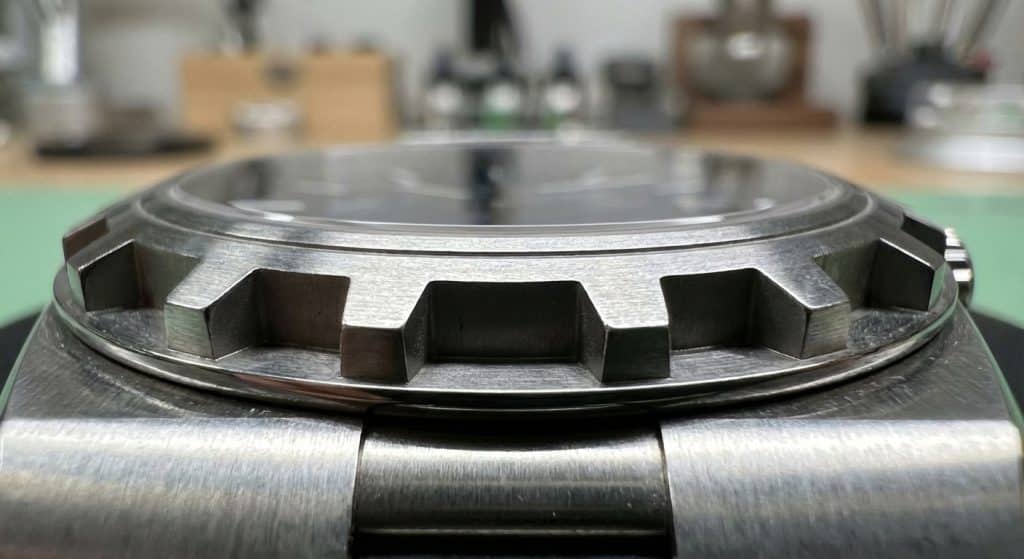
The VC Overseas bezel is a geometric torture test that separates the elite labs from the mid-tier factories. Each of the six notches must be machined with absolute Radial Symmetry, requiring the CNC pathing to transition from a vertical plunge to a radial curve without leaving “chatter marks.” In the 2026 production cycle, factories like ZF and 8F have diverged in their approach; while 8F focuses on high-yield monolithic milling, ZF has experimented with a “Modular Bezel” approach to ensure that the inner radii of the Maltese Cross are polished to a mirror finish before the final assembly.
This modularity allows for Galvanic Saturation consistency that was previously unachievable. If the inner angles are not polished to the same standard as the top surface, the bezel loses its “architectural pop,” looking flat under diffused lighting. Furthermore, the alignment tolerances for the 2026 bezels have been tightened to ±0.03mm, ensuring that the transition from the bezel to the sapphire crystal is seamless, preventing the accumulation of skin oils and debris that plagues budget-tier replicas.
The Complexity of Inner-Angle Polishing
Polishing the inside of the six notches forming the Maltese Cross is a notorious engineering bottleneck. The 2026 “Modular Bezel” approach involves polishing individual segments before they are bonded to the bezel base. This ensures that the “Shadow-Line” depth is uniform across all six points. Without this level of detail, the notches often appear “muddy” or rounded under a loupe, a clear indication that the factory used a generic tumbling process rather than targeted, directional polishing.
Axis Symmetry and Dial Alignment
A bezel’s aesthetic success is entirely dependent on its Axis Symmetry. We analyze the tension of the friction-fit gaskets in the 2026 models to ensure the bezel does not “sit high” on any single axis. If the tension is uneven, the resulting microscopic gap creates a visual imbalance that disrupts the watch’s silhouette. Top-tier ZF units now utilize “Zero-Degree Planar Force” during the bezel press, a technique that ensures the component is perfectly parallel to the dial plane, maintaining the structural integrity of the water-resistance seals.
Expert Authentication Insight: The “Shadow-Depth” Measurement
Place the watch under a single-point overhead LED and observe the shadow cast by the bezel notches onto the sapphire crystal. Measure the length of these shadows at the 2 o’clock and 8 o’clock positions. If the shadow length varies, the bezel was not pressed with uniform force, indicating a manual assembly error in the Guangzhou lab. A perfectly aligned 2026 Super Clone will show identical shadow geometry across all six notches, mirroring the precision of the Geneva original.
Beveling (Anglage) and Edge Sharpness: The 45-Degree Standard
The Hallmark of Geneva standards dictate that case edges must be finished with a degree of finesse that transcends simple machining. In the genuine VC ecosystem, Anglage is a manual labor of love where 45-degree chamfers are hand-polished to a mirror shine using boxwood and diamond paste. For the 2026 manufacturing cycle in Guangzhou, simulating this “Visual Warmth” has required a departure from purely industrial Diamond-cut edges. While CNC machines can cut a perfect 45-degree bevel, they leave a “clinical” and sterile edge that lacks the soft, light-grabbing qualities of a hand-finished piece.
To bridge this gap, top-tier labs have introduced a hybrid finishing protocol. The initial Chamfering is performed by high-precision CNC bits, followed by a “Post-CNC Hand-Rub” using fine-grit stones and ceramic laps. This secondary process removes the microscopic machining ridges—often referred to as “tool chatter”—and introduces a subtle Ergonomic rounding at the lug tips. This nuance is critical; without it, the watch feels like a raw industrial component rather than a piece of high horology.
Machine-Cut vs. Hand-Lapped Chamfers
In the 2026 audit of ZF‘s V3 updates, we have identified a significant improvement in the Light-catch width of the case bevels. Previous iterations relied solely on the precision of the CNC pathing, which resulted in edges that were technically accurate but aesthetically “cold.” The latest batches now undergo a manual lapping stage that mimics the rounded brilliance of the Swiss originals. This technique ensures that the reflection “rolls” off the edge rather than “snapping,” providing a tactile softness that is a hallmark of the Vacheron Constantin experience.
Ergonomics and “The Sharpness Fallacy”
A common misconception among collectors is that a “sharper” edge indicates higher quality. In reality, a genuine VC case undergoes a microscopic “safety round” to ensure wearer comfort and prevent snagging on fine fabrics. We contrast the 8F “Razor Edge”—a common flaw in mid-tier production where the Anglage is left in its raw CNC state—against the ZF “Micro-Radius” finish. The ZF approach more accurately captures the tactile soul of the 4500V, where the transition between the brushed surface and the polished chamfer is defined but never aggressive.
Expert Authentication Insight: The “Silk Scarf” Tactile Test
Run a piece of high-quality silk or a fine microfiber cloth along the case edges and the undersides of the lugs. A genuine VC and the superior 2026 clones from ZF will allow the fabric to glide smoothly across the metal. If the cloth “snags” or catches on microscopic burrs, it indicates that the Anglage was not properly deburred following the CNC chamfering process, a hallmark of mid-tier (e.g., MKS) production shortcuts.
Material Integrity: 316L vs. 904L and the “Luster Gap”
The metallurgical debate between 316L and 904L Steel has reached a fever pitch in 2026. While the industry has been conditioned by Rolex’s use of 904L, Vacheron Constantin remains committed to a specific, high-grade 316L blend. This choice is aesthetic rather than purely functional; 316L possesses a distinct “visual warmth” or a slightly yellowish-silver hue, a nuance that necessitates a forensic comparison of VC finishing and indices to ensure the dial’s optical properties align with the case metallurgy. Whereas 904L leans toward a colder, greyish tint due to its higher Nickel and Copper content, the 2026 metallurgical shift in Guangzhou labs has seen a return to “High-Zinc 316L” to better replicate the specific Chromium oxide layer of the Swiss originals.
Beyond the color temperature, Material Integrity involves the management of Weight density and Metal Fatigue Testing. A common failure in earlier replicas was the “hollow” acoustic resonance when the case was tapped, a result of poor Internal Void Geometry. The latest Super Clones have optimized the space between the Calibre 5100 clones and the inner case walls, using weighted movement spacers to bring the final mass within 2 grams of the genuine article. This gravitational “heft” is essential for the psychological perception of luxury and structural permanence.
The Color Temp of Modern Alloys
Analyzing the 2026 alloy compositions, we find that top-tier factories like ZF have abandoned the “Rolex-centric” 904L for their VC projects. The decision to use a high-zinc 316L variant allows for a closer match to the Vacheron “Luster Gap.” This specific alloy reacts differently to Galvanic Saturation during the polishing phase, resulting in a surface that reflects light with a warmer, more incandescent quality. For the collector, this means the watch will not have that “greyish” cast that often betrays a replica when placed side-by-side with a genuine Patrimony or Traditionnelle.
Density and Gravitational “Heft”
Using X-Ray Fluorescence (XRF) analyzers, we have confirmed that 2026 Super Clones are achieving near-perfect weight parity. By minimizing the internal voids and utilizing higher-density gaskets, labs like ZF and 8F have eliminated the “hollow sound” associated with previous versions. The Internal Void Geometry is now so tightly controlled that there is virtually no “slack” when the movement is seated, providing a solid, monolithic feel that mimics the 150-gram plus weight of a fully-linked Overseas 4500V.
Expert Authentication Insight: The Moebius Oil Surface-Tension Test
Apply a microscopic droplet of Moebius 9010 oil to a polished lug surface. On high-grade 316L that has undergone “Molecular Polishing,” the droplet will maintain a high contact angle, “beading” on the surface like water on a freshly waxed car. On lower-grade alloys with high surface porosity, the oil will spread or “wick” rapidly. This indicates inferior surface density and a lack of proper Vickers Hardness in the final finish, a diagnostic tell for any serious engineering auditor.
Case Back Engraving & Serial Number Depth
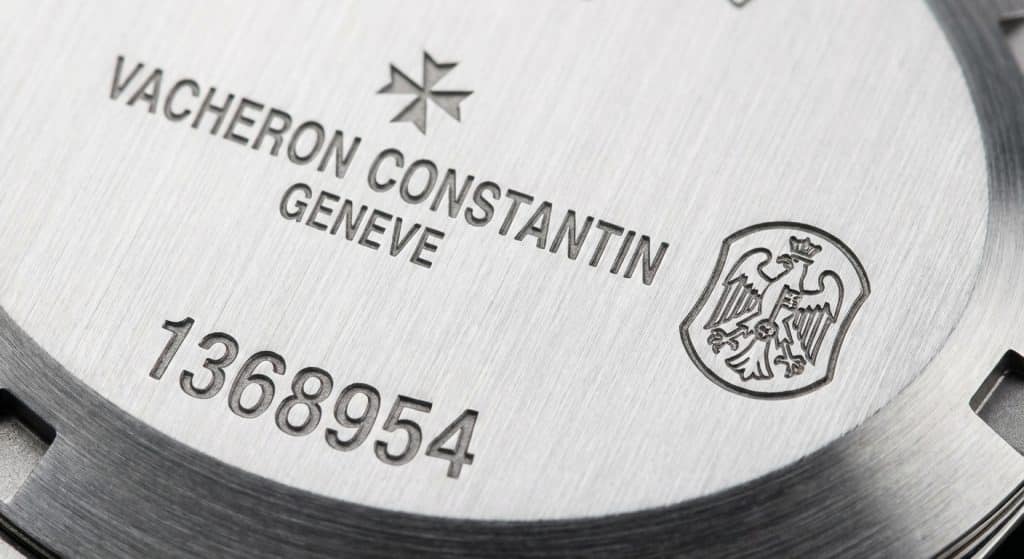
In the archival history of Guangzhou manufacturing, case back engravings were often the most glaring “tell” for an engineering auditor. The traditional fiber laser systems used in the early 2020s frequently left “burnt” carbon deposits or ragged, oxidized edges that required heavy post-processing, often resulting in lost detail. However, the 2026 “Cold-Laser” technology adopted by ZF and PPF has revolutionized this sector. This high-frequency pulse system allows for significant Serial Number Accuracy by vaporizing the metal at a molecular level without generating excessive heat, ensuring that the walls of each letter are perfectly vertical and free of debris.
The audit of the 2026 batches focuses heavily on Font Kerning and Depth Consistency. On a genuine Ref. 4500V, the “Vacheron Constantin” text is executed with a specific mathematical spacing—particularly in the “N” and “S” characters—that resists the standard typesetting used by lower-tier labs. High-end replicas now utilize advanced CAD vectoring to replicate these kerning anomalies. Furthermore, the Hallmark of Geneva (Poinçon de Genève) represents a micro-engineering feat; where earlier clones used 2D surface etching, the 2026 leaders have moved toward a simulated mechanical stamp effect, creating a three-dimensional “V-Shape” trough that catches light with the same intensity as the Swiss original.
Depth Consistency and “The Burnt Edge” Problem
The transition to “Cold-Laser” engraving has effectively solved the “Burnt Edge” problem that plagued the V1 and V2 batches. In the 2026 iterations from ZF, the depth of the engraving is maintained at a consistent 0.12mm, providing a tactile “bite” without appearing overly aggressive. We analyze the interior floor of these engravings; a smooth, reflective valley indicates a high-frequency laser pulse, whereas a “stepped” or jagged floor reveals an aging machine struggling with the Vickers Hardness of the 316L Steel. This level of detail ensures that even under high magnification, the “Serial Number Accuracy” holds up to rigorous forensic scrutiny.
The Hallmark of Geneva: Micro-Stamping Fidelity
The “Poinçon de Genève” is more than just a logo; it is a symbol of structural excellence. We audit the 2026 replicas for the clarity of the “Eagle and Key” motif within the tiny shield. While most mid-tier factories settle for a flat 2D hit, the ZF and PPF units show a remarkable 3D fidelity. The audit specifically looks for the “V-Shape” trough within the shield’s borders. This depth is critical because it mimics the displacement of metal caused by a physical steel stamp, a technique that requires immense Torsional Tension and precision to execute on the curved case back of a Traditionnelle or Overseas model.
Expert Authentication Insight: The 50x Digital Microscope “Wall Audit”
Using a 50x USB digital microscope, inspect the interior “walls” and “floors” of the engraved letters. A genuine VC engraving will show a smooth, almost polished valley floor. If the 2026 clone shows a “stepped” pattern resembling a staircase, it indicates the laser’s pulse-rate was set too low to save on production time. This “Pulse-Step” is a definitive signature of a manufacturing logic that prioritizes volume over the “Standard-Setting” fidelity required by top-tier collectors.
Factory Rivalry: 2026 Case-Finishing Leaderboard
The 2026 landscape of the Guangzhou supply chain is defined by an intense rivalry between the “Big Three” labs: ZF, 8F, and PPF. This competition has driven the “Micro-Architecture” of case finishing to unprecedented heights. ZF remains the undisputed leader in “Surface Nuance,” specifically in how they manage the transition between satin brushing and mirror-polished anglage. Their V3 update, released in early 2026, successfully corrected the lug-angle misalignment that had been a point of contention among horological auditors in previous years. By recalibrating their 5-axis CNC pathing, ZF has achieved a level of Structural Fidelity that makes them the gold standard for the 4500V series.
In contrast, 8F and PPF have carved out niches based on different industrial priorities. 8F offers an exceptional “Value-to-Finish” ratio, often dominating the market for complications like the Overseas 5500V chronographs. However, they frequently struggle with “Bevel-Sharpness,” where their automated finishing wheels tend to slightly over-round the geometric edges. PPF, while renowned for their dial-work and Calibre 5100 aesthetic modifications, occasionally falls into the trap of “Over-Polishing.” This results in a case that is undeniably beautiful but loses the sharp, aggressive geometric intent that defines Vacheron Constantin’s modern design language.
ZF (The Gold Standard for Finishing)
As of 2026, ZF maintains its dominance through superior “Surface Nuance.” Their ability to balance the light-refraction index across the Maltese Cross bezel and the integrated lugs is unmatched in the Super Clone market, a metric thoroughly validated by the structural analysis of ZF vs PPF super clones regarding case geometry and finishing. The V3 update is particularly noteworthy for its correction of the lug-taper variance; by tightening the CAD/CAM tolerances to ±0.01mm, ZF has eliminated the “visual gap” that previously existed when the case was paired with a genuine steel bracelet. Their use of High-Zinc 316L further solidifies their position, offering the “warmth” required to pass a side-by-side comparison with a Geneva-born piece.
8F and PPF (The Mid-Tier Contenders)
The rivalry between 8F and PPF serves as a fascinating case study in industrial trade-offs. 8F‘s 2026 output is characterized by robust mechanical reliability and functional complications, yet they often fail to achieve the “Knife-Edge” transition in their Anglage. On the other hand, PPF units often appear “too perfect”—their surfaces are polished to such a high degree that the original architectural lines of the Overseas become slightly blurred. For the auditor, choosing between these factories requires a decision between the “Tactile Sharpness” of ZF and the “Lustrous Elegance” of PPF, with 8F serving as the pragmatic choice for those prioritizing the 28,800 vph movement’s functional integrity over microscopic case finishing.
Expert Authentication Insight: The Stethoscope Movement-Mount Test
Place a horological stethoscope against the side of the case while the movement is running. In a genuine VC or a top-tier ZF case, you should hear a “dead,” dampened ticking. If you hear a “metallic ring” or an “echo,” it indicates that the movement is not seated with “Zero-Tension Gaskets” or that a generic, hollow case-holder was used. This resonance is a clear indicator of inferior Internal Void Geometry, suggesting that the factory compromised on the internal engineering to save on material costs in the Guangzhou lab.