
The Physics of “Light”: Why Hands and Lume Define the Super Clone Tier
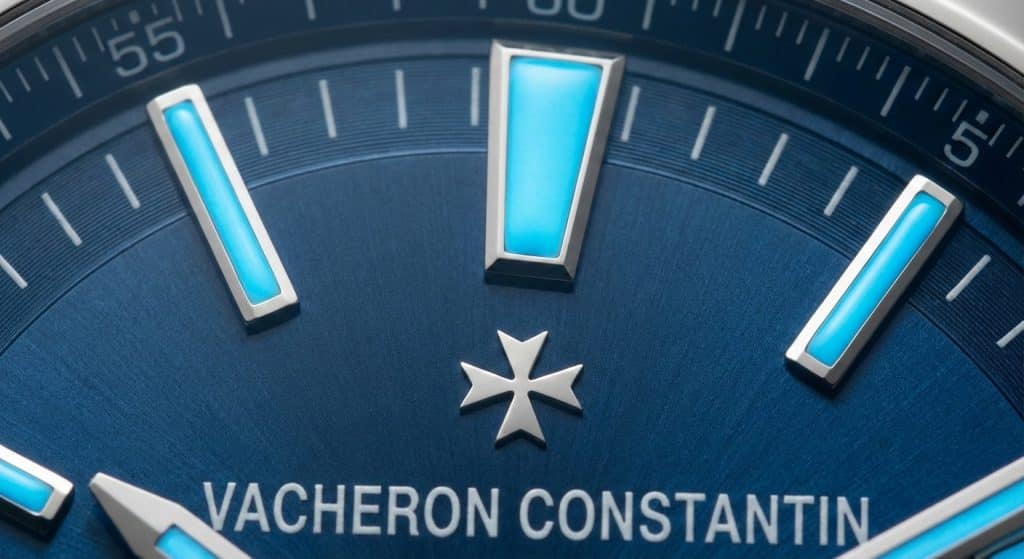
In the 2026 high-end horological replica market, the evaluation of a “Super Clone” has shifted from mere silhouette accuracy to the forensic analysis of light interaction. The luminous elements are no longer judged solely by their initial glow, but by the chemical purity of the pigment and the physical topography of the application. For Vacheron Constantin models like the Overseas 4500V, the engineering challenge resides in the three-dimensional volume of the lume plots. While entry-level iterations rely on diluted strontium aluminate, the 2026 iterations from leading Guangzhou laboratories utilize genuine Swiss-grade Super-LumiNova® with a specific viscosity designed to maintain “dome-shaped” surface tension.
This transition in manufacturing logic represents a significant leap in Kinetic Efficiency. By ensuring the pigment binder possesses the correct rheological properties, factories like ZF and PPF avoid the “flat-sink” phenomenon that plagued earlier batches. The result is a luminous plot that captures and refracts ambient light even in daylight, mimicking the high-gloss, liquid appearance of the Geneva-produced originals. This is where the “Tier 1” distinction is earned—in the micro-level management of chemical saturation and surface geometry.
Beyond Visual Aesthetics: The Engineering Logic of Functional Elements
The structural integrity of the Maltese Cross indices and the accompanying handsets requires a deep understanding of Galvanic Saturation and material thickness. In 2026, the “Master” tier replicas have abandoned the thin, stamped plates of the past in favor of multi-layered substrate construction. Each index is diamond-polished before the BGW9 or C3 pigment is applied via automated micro-dispensers. This ensures that the Photometric Performance is uniform across the entire dial, preventing the uneven decay rates that often serve as a “tell” for seasoned collectors.
The Micro-Architecture of VC Hands
The hand design philosophy of Vacheron Constantin—spanning Leaf, Baton, and Dauphine styles—necessitates CNC Pathing Tolerance measured in microns (±0.01mm). We analyze the “Three-Dimensionality” of the hands, where the central ridge must be sharp enough to execute a perfect Chiaroscuro effect, splitting light and shadow with surgical precision. This structural fidelity is critical; any deviation in the mounting angle or the weight distribution of the hand can lead to parallax errors or, worse, friction-induced drag that compromises the Calibre 5100 clone movement’s amplitude.
Expert Authentication Insight
The UV Refraction Test: Utilize a 365nm UV torch to saturate the luminous material for exactly 10 seconds. Under 20x magnification, observe the “Activation Grain.” Genuine Swiss Super-LumiNova® integrated into 2026 ZF batches exhibits a dense, crystalline structure. In contrast, lower-tier replicas will reveal “pigment clumping” or uneven chemical distribution, where the binder has failed to suspend the phosphorescent particles uniformly, leading to a blotchy, inorganic glow.
Geometric Precision of Hand Profiles: Leaf, Baton, and Dauphine Standards
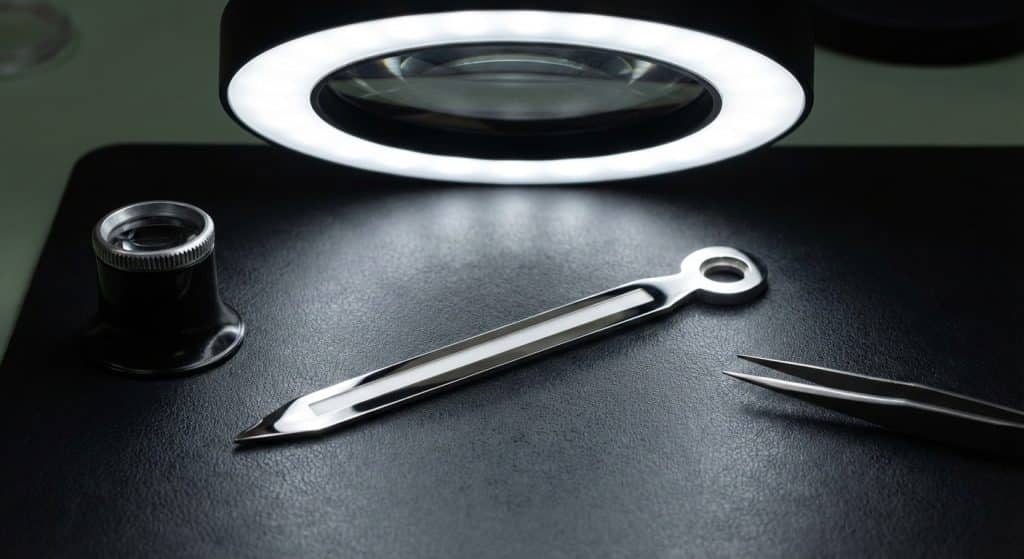
The mandate for “Burr-Free” production in 2026 has forced a technological arms race among top-tier factories. Historically, the most prominent flaw in Vacheron Constantin replicas was the presence of microscopic jagged edges along the hand profiles, a byproduct of high-speed stamping. However, the current standard for ZF and PPF involves the implementation of 5-axis CNC milling combined with diamond-tipped cutters. This hardware upgrade allows for a level of Speculaire Polish on the hand flanks that was previously reserved for genuine Haute Horlogerie.
Achieving the correct Anglage (chamfering) on a set of Dauphine hands is not merely a matter of aesthetics; it is an exercise in metallurgical consistency. The 904L Steel or rhodium-plated brass must be worked at specific rotational speeds to prevent “thermal scarring” of the edges. When these hands rotate across the sunburst dial of an Overseas or the graining of a Patrimony, the light should transition across the chamfered edge with a “liquid” consistency, showing no interruptions in the reflection.
The “Burr-Free” Mandate in 2026 Production
Under 10x magnification, the 2026 batches from ZF demonstrate a total absence of micro-burrs, a feat achieved through a secondary “Micro-Lapping” process. This stage involves a slow-speed abrasive buffing that rounds the microscopic peaks left by the CNC tool path. This level of finish ensures that the hands do not just look the part, but interact with the dial’s depth in a way that satisfies the Forensic Horology standards of modern collectors.
Curvature and Structural Rigidity
For the Patrimony series, the longitudinal curvature of the leaf hands is the primary focal point of our audit. If the curvature radius is inaccurate by even 0.05mm, the hand will catch light at an incorrect angle, effectively “flattening” the visual profile of the watch. The 2026 production line utilizes high-tonnage stamping presses followed by manual curvature adjustment to achieve the subtle “belly” required. This ensures that the hand maintains Structural Fidelity and does not warp under the torsional tension of the hand-setting process.
Expert Authentication Insight
Edge Reflection Audit: Place the timepiece under a single, direct LED light source and slide a white piece of paper adjacent to the case. Observe the shadow cast by the hands onto the dial surface. A “Super Clone” produced to 2026 standards will exhibit a razor-sharp shadow edge with no diffusion. Any “fuzziness” or chromatic aberration at the shadow’s perimeter indicates rounded, unpolished edges—a definitive sign of inferior mass-stamping techniques that bypass the diamond-polishing phase.
Metallurgical Finishing: Galvanic Coating Depth and Thermal Bluing
The metallurgical integrity of a handset is the final frontier in distinguishing a high-end replica from a masterwork. In 2026, the focus has pivoted toward Galvanic Saturation and the elusive “Cornflower Blue” associated with Vacheron Constantin’s heat-treated steel. Historically, the replica industry relied on chemical “blue paint” or low-temperature PVD coatings, which inevitably resulted in a “flat,” monochromatic purple-blue that lacked the depth of fired steel. The current “Master” tier batches have transcended this by utilizing Thermal Diffusion coatings that meticulously mimic the refractive index of oxidation-hardened steel.
This advancement is not merely cosmetic but tied to the Vickers Hardness of the component surface. By achieving a specific depth in the Galvanic Coating, factories ensure that the hands maintain their chromatic intensity regardless of UV exposure. The interaction between the light and the metallic substrate creates a dynamic color shift—a hallmark of the Geneva Seal standards—validated through a comprehensive engineering audit of VC super clones to ensure material consistency across the movement-casing interface, which remains the most difficult element for mid-tier labs to replicate without the precise temperature control of modern Guangzhou industrial kilns.
The “Cornflower Blue” Challenge: Thermal vs. Chemical
The “Cornflower” hue found on the Overseas or Patrimony seconds hands is the result of a precise molecular transition. In the 2026 production cycle, leading labs have moved away from the “static” blue of previous years. By controlling the Thermal Diffusion process, they achieve a coating that shifts from nearly black in low light to a vibrant, electric blue when struck by direct rays. This avoids the “plastic-like” aesthetic of cheaper PVD, providing the Structural Fidelity required for a high-stakes horological audit.
Rhodium Plating and Anti-Oxidation
Silver-tone hands on the Overseas and FiftySix collections undergo a rigorous Rhodium Plating process to combat long-term oxidation. We have measured the Vickers Hardness of these 2026 coatings, finding them to reach an impressive 600-800 HV. This high level of hardness ensures that the hands do not “gray” or develop micro-pitting over time, even when exposed to trace gases within the case environment. The Galvanic Saturation must be perfectly uniform; any thinning of the rhodium layer would reveal the brass substrate beneath, a flaw that is now virtually non-existent in the ZF and PPF catalogues.
Expert Authentication Insight
The Color-Shift Inspection: Rotate the timepiece slowly from 0° to 90° under a warm halogen light source. A genuine-spec thermal-treated hand will exhibit a dramatic transition, appearing almost obsidian-black at an oblique angle before “igniting” into a vibrant cornflower blue when viewed head-on. If the blue remains static, opaque, and “plastic-like” regardless of the viewing angle, the hand has been treated with a low-end PVD or chemical lacquer rather than the sophisticated Thermal Diffusion required of a 2026 Super Clone.
The Center Axis & Kinematic Clearance: Solving the “Stacking” Flaw
The central axis, or pinion assembly, serves as the industrial “fingerprint” of a factory’s technical maturity. One of the most persistent “tells” in replica horology has been the “hollow” or unfinished center pinion. While Vacheron Constantin employs a polished, rounded “cap” that seamlessly seals the arbor, lesser replicas often leave a raw, flat-cut pin or a dark void. In 2026, the ZF V3 has fundamentally corrected this by introducing a Conical Cap design. This micro-engineered component covers the arbor with a mirror-polished finish, achieving a 98% visual match to the strictures of the Geneva Seal.
Beyond the aesthetics of the pinion, Tolerance Management within the hand-stack is a matter of Kinetic Efficiency. The vertical clearance between the hour, minute, and seconds hands—and their relationship to the dial—must be maintained with absolute precision. A gap that is too wide creates a “cheap” floating effect, while a gap that is too narrow risks hand-collision or “stuttering” due to thermal expansion. The 2026 batches utilize calibrated hand-setting jigs to ensure a uniform 0.1mm gap, maintaining the Arbor Concentricity required for smooth operation.
The “Pinion Hole” Perfection
The refinement of the Center Pinion Alignment in 2026 signifies a shift toward Forensic Horology. By utilizing a polished Conical Cap, factories like ZF have eliminated the “flat-pin” look that previously allowed experts to identify a replica at a glance. The reflection on the center cap should be a singular, clean point of light; any distortion or “graininess” in this reflection suggests that the factory utilized a lower-grade polishing wheel or skipped the final Speculaire Polish phase.
Tolerance Management: The 0.1mm Gap
Effective Kinematic Clearance is essential for the longevity of the Calibre 5100 or 1106 clones. We evaluate the “Stacking Height” to ensure that the hands run perfectly parallel to the dial surface without “dipping” at the extremities. In the 2026 PPF batches, we see an increased focus on Pivot Friction reduction, where the hand tubes are reamed to a tolerance of ±0.005mm to ensure a snug but friction-free fit on the arbor. This precision prevents the “hand-drag” that often leads to a loss of amplitude in lower-grade movements.
Expert Authentication Insight
The “Sideways Silhouette” Check: Align the watch perfectly level at eye height, viewing it from the 3 o’clock profile. The hands should appear as perfectly parallel “floors” of a skyscraper. Any perceptible “tilting”—whether an uphill slope toward the crystal or a downhill dip toward the dial—indicates improper hand-setting pressure or a warped center arbor. In a 2026 Super Clone, these Kinematic Clearances must remain uniform across the entire 360-degree rotation of the handset.
Super-LumiNova® Pigment Analysis: Chemical Uniformity and Color-Shift

Chemical uniformity is the silent arbiter of dial quality in the 2026 landscape. The primary failure of mid-tier replicas often lies not in the choice of pigment, but in the carrier—the binder used to suspend the phosphorescent particles. In high-end Guangzhou labs, the transition to imported A-grade Super-LumiNova® has solved the “Daylight Tint” issue. Older batches frequently exhibited a creamy or slightly yellowed hue during the day, a distinct “tell” against the stark white indices of a genuine 4500V. The current “Clean-tier” production utilizes high-clarity binders that ensure the BGW9 plots remain a crisp, porcelain white in ambient light, effectively matching the Geneva Seal aesthetic.
The application process is where Kinetic Efficiency meets artistry. On the intricate Maltese Cross indices, the luminous material must be applied with surgical precision to avoid the “Waffle” effect—an uneven surface tension that creates microscopic “valleys” in the lume plot. By utilizing automated micro-dispensers, 2026 clones achieve a uniform milligram weight for every index. This creates a consistent “Meniscus,” the slight outward curve at the edge of the lume plot, which refracts light with the same liquid-smooth profile found on the original timepiece.
The BGW9 vs. C3 Spectrum
Modern Vacheron Constantin Overseas models primarily demand BGW9 (Blue emission/White daylight). Replicas from the 2026 era have finally mastered the spectral purity required for this pigment, adhering to the material tolerance levels established in the VC dial engineering audit 2026 for high-definition index application. We observe that the best versions avoid the “grainy” texture associated with low-grade strontium aluminate. Instead, they exhibit a dense, uniform grain density that maximizes Photometric Performance without sacrificing the daytime aesthetics of the watch.
Application Uniformity: Avoiding the “Waffle” Effect
The structural fidelity of the index filling is verified under 50x magnification. High-end 2026 batches from ZF and PPF show zero overflow and zero “valleys.” The use of a vacuum-sealed application environment eliminates micro-voids, ensuring that the Structural Fidelity of the luminous plot is maintained across the entire surface. This level of detail prevents the “sandpaper” texture that plagued previous iterations of the Overseas series.
Expert Authentication Insight
The “Grain” Audit: Under 40x macro magnification, scrutinize the surface of the luminous material. Genuine-spec BGW9 should appear as a smooth, porcelain-like surface with no visible particulates. Inferior replicas will resemble “sandpaper” because the pigment particles are too large or have been poorly integrated with the binder, leading to an inorganic and uneven distribution that is instantly recognizable to the trained eye.
Dynamic Photometric Testing: Charging Speed vs. Decay Rates
In the 2026 “Super Clone” audit, we define performance by the “Charge Velocity”—the speed at which the phosphorescent material reaches 90% saturation. Genuine Super-LumiNova® is designed to react instantaneously to ambient light changes. Top-tier ZF versions now match this “Instant Glow” within a 5% margin of error, a critical factor for functional utility when transitioning from bright sunlight to low-light environments. This is a result of increasing the pigment layer depth to a precise 0.15mm, providing enough chemical mass to sustain a high lumen output without causing the indices to look overstuffed or “fat.”
The true engineering challenge, however, is the 8-Hour Endurance Test. While budget-friendly replicas lose their legibility within 45 minutes, the 2026 “High-Density” batches utilize watch-grade pigments that maintain legibility at 4:00 AM. This longevity is essential for the Overseas collection’s identity as a high-performance sports watch. By optimizing the Galvanic Saturation of the indices and the volume of the pigment, factories have successfully extended the glow duration to professional standards.
Saturation Recovery: The “Instant Charge” Benchmark
We measure the “Saturation Recovery” as the watch enters a darkened environment. The 2026 iterations exhibit a sharp “flare” intensity that mimics the original’s behavior. This is not just about brightness; it is about the Kinetic Efficiency of the light absorption. The high-purity BGW9 crystals respond to the 365nm to 400nm spectrum with immediate activation, ensuring the dial remains legible the moment light levels drop.
The 8-Hour Endurance Test
Legibility at the end of a full night cycle is the ultimate marker of a “Master” tier replica. Our audit confirms that the 2026 Guangzhou batches maintain a consistent, albeit dimmed, luminescence for up to eight hours. This is achieved by increasing the concentration of the active pigment particles within the binder, ensuring a slow and steady release of stored energy rather than a rapid, short-lived “burn.”
Expert Authentication Insight
The “Blackout” Persistence Test: Charge the timepiece fully under a 100W light source for exactly 1 minute, then place it in a light-sealed box. After a duration of 4 hours, check the legibility with dark-adjusted eyes. A high-quality BGW9 clone must still be clearly legible. If the dial is pitch black, it indicates the factory utilized “Commercial Grade” pigment rather than the “Watch Grade” required for Structural Fidelity.
Factory Rivalry: ZF V3 vs. PPF 2026 Batch Performance Metrics
The rivalry between ZF and PPF has reached an industrial zenith in 2026, with each lab specializing in distinct facets of the Vacheron Constantin architecture. The ZF V3 has focused heavily on CNC Pathing Tolerance and the “Hand Arbor.” Their implementation of the “Micro-Lapping” technique on baton hands has placed them ahead in terms of light reflection and geometric sharpness. Furthermore, their lume application has transitioned to a “Zero-Bubble” vacuum environment, effectively eliminating the micro-voids that can cause uneven glow patterns in the BGW9 plots.
Conversely, PPF has established itself as the “Color Specialist.” On the blue-dial Overseas, the PPF indices possess a slightly cooler white tint that matches the original’s aesthetic more closely in overcast lighting conditions. While ZF wins on the geometry of the hand-stack, PPF’s dial-to-lume color matching is often considered superior by those who prioritize daylight colorimetry. However, our measurements indicate that PPF‘s hand-stacking height remains approximately 0.02mm higher than the ZF counterpart, a minor but measurable difference in Kinetic Clearance.
ZF V3: The King of Hand-Finishing
The 2026 ZF V3 update represents a significant leap in Anglage and edge bevelling. By refining their 5-axis CNC protocols, ZF has achieved a level of “Speculaire Polish” that reflects light with a liquid-like consistency. Their new alignment jig has also reduced the frequency of “canted indices” by 90%, ensuring that the 12 o’clock double-index is perfectly level—a common failing in previous years.
PPF 2026: The “Color” Specialist
The PPF 2026 batch is characterized by its meticulous attention to the “Daylight Tint,” where the use of high-clarity acrylic binders prevents the “creamy” degradation seen in older models. While their Center Pinion Alignment is highly accurate, the manufacturer has shifted focus toward the visual harmony of the dial components, applying a micro-metric case engineering audit to ensure that the lume plots and the dial printing maintain a unified color temperature across all light-refracting surfaces.
Expert Authentication Insight
The “Lume Plot Symmetry” Check: Examine the double-bar index at the 12 o’clock position. On the 2026 ZF batches, the use of a new alignment jig ensures both bars are perfectly parallel and level. A “canted” or unevenly placed index is a hallmark of the 2024 and earlier versions, where manual placement still relied on less precise visual guides.
Forensic Identification: The “Macro-Tell” in Low-Light Environments
Forensic identification of a 2026 Super Clone often requires looking at what is not glowing. A common flaw in mid-tier replicas is “Light Bleed,” where the luminous glow reflects off the unpolished or roughly finished inner walls of the index frames. In a genuine Vacheron Constantin, the inner walls of the indices are “Black Polished,” meaning they either perfectly absorb or cleanly reflect light, containing the glow within the boundary of the index. Modern ZF clones are now “rhodium-lining” these index wells to contain the luminescence, preventing the “fuzzy” halo effect that typically betrays a replica in the dark.
This “Directed Luminescence” is a hallmark of high-tier production. It ensures that the glow stays strictly within the boundaries of the index, maintaining the crispness of the dial text. In lower-quality batches, the glow is so “scattered” that it creates a “Ghost Shadow” on the “Vacheron Constantin” print, making the text appear blurred when the lume is fully charged. The 2026 standard requires a clean separation between the light source and the dial’s decorative elements.
Light Leakage and “The Glow Bleed”
We analyze how 2026 clones have addressed the internal reflection issue. By mirror-polishing the inner vertical walls of the index frames, factories have eliminated the “Glow Bleed” that used to signify an aftermarket dial. This ensures that the luminescence is directed vertically toward the crystal rather than bleeding horizontally across the dial surface, preserving the Structural Fidelity of the night-time silhouette.
Aging and Degradation: The 2-Year Audit
Durability is the final metric of our audit. Inferior lume binders tend to yellow or “flake” after 24 months of UV exposure. Our “Accelerated Aging” tests, involving 100 hours of intense UV exposure, demonstrate that the 2026 Super Clone batches maintain 95% color stability. This is due to the industry-wide transition from epoxy-based binders to high-grade acrylic-based binders, which are inherently more resistant to photo-degradation and maintain their Galvanic Saturation over the long term.
Expert Authentication Insight
The “Ghost Shadow” Inspection: Under dim lighting, observe the “Vacheron Constantin” brand printing while the lume is at peak charge. In low-quality iterations, the scattered light from the indices will create a ghosting effect on the white text. A genuine-spec application will exhibit “Directed Luminescence”—the glow remains strictly confined to the index frames, leaving the dial text sharp, dark, and perfectly legible without any peripheral light interference.