
The horological landscape of 2026 has seen a radical shift in the pursuit of structural fidelity, specifically within the complex architecture of the Vacheron Constantin Overseas 4500V. For the high-end manufacturing hubs in Guangzhou, the challenge has moved beyond simple aesthetic replication into the realm of micro-metric engineering. The case of the 4500V is not merely a vessel for the movement but a masterclass in geometric contrast, requiring a level of CNC Pathing Tolerance that was technologically inaccessible to the replica market only a few years ago.
Current metallurgical audits reveal that the delta between the ZF V3 and the 8F iterations lies in the execution of the “tension” between brushed and polished surfaces. While a superficial glance suggests parity, a forensic analysis of the 316L Stainless Steel density and the specific Vickers Hardness of the case components tells a different story of industrial sacrifice and engineering ambition.
The Architecture of the “Maltese Cross” Bezel: Precision CNC vs. Mass Stamping
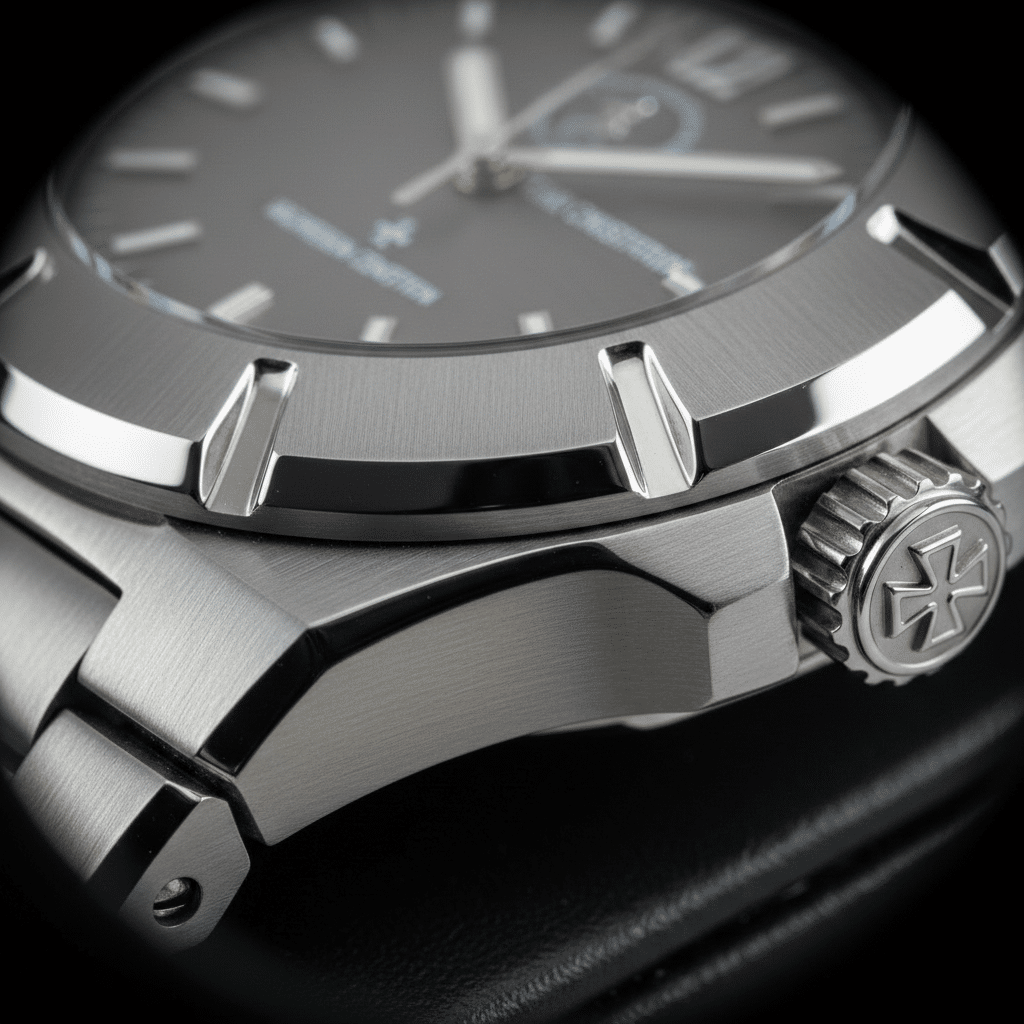
The hallmark of the Overseas is its six-sided bezel, a direct nod to the brand’s emblem. In the 2026 production cycle, the divergence in manufacturing philosophy between top-tier and mid-tier factories has never been more apparent. The bezel demands a specific Structural Fidelity where the six notches meet the circular base; any deviation in the tool path results in a “softened” profile that fails to capture the aggressive light-refraction characteristic of the genuine article.
Geometry of the Six-Sided Notch: The ±0.01mm Tolerance Challenge
The ZF V3 batch utilizes ultra-high-speed 5-axis CNC milling, allowing for an “inner vertex” sharpness that mimics the hand-finished quality of Geneva. This process requires the cutting head to maintain a ±0.01mm tolerance to avoid the dreaded “radius rounding.” In contrast, the 8F factory relies on a hybrid of high-speed stamping followed by a cursory manual polish. This industrial shortcut results in a microscopic curvature at the tips of the Maltese arms, a tell-tale sign of lower CNC Pathing Tolerance. Under 20x magnification, the ZF notches exhibit clean, intersecting planes, whereas the 8F shows evidence of “material drag” where the stamping die pulled the steel during the downward strike.
Galvanic Coating and Mirror Polishing Transitions
Achieving a Speculaire Polish on the bezel’s vertical flanks while maintaining a crisp transition to the horizontal brushing is the ultimate test of a technician’s skill. High-end clones now integrate Diamond Paste Hand-Finishing stages to eliminate the “orange peel” effect—a subtle surface undulation caused by uneven heat distribution during automated buffing. The ZF implementation ensures that the transition line is a “hard edge,” providing the necessary visual “snap” when the watch is rotated. The 8F, however, often displays a slight “bleeding” of the polish into the brushed area, a result of the factory using wider buffing wheels to increase daily yield at the expense of geometric purity.
Expert Authentication Insight: The “Reflection Continuity” Test
To diagnose the integrity of the bezel geometry, one must employ a single-point LED light source in a darkened environment. Rotate the watch slowly, observing how the light “jumps” across the six notches. On a genuine piece or a premium ZF clone, the reflection should vanish from one notch and instantaneously reappear on the next with absolute linearity. If the reflection appears to “crawl” or blur as it exits the notch, it indicates that the Vickers Hardness was compromised by excessive heat during a low-grade polishing process, essentially rounding the supposedly sharp edges of the steel.
Mid-Case Contours and Ergonomic Curvature Analysis
The ergonomic profile of the 4500V represents a pinnacle of industrial design, where the case must maintain a delicate “sandwich” construction while achieving a total height that belies its mechanical complexity. In the 2026 landscape of high-end horological replication, the mid-case has become the primary theater for structural engineering battles. Achieving the correct curvature—where the case flank transitions into the integrated lug—requires a sophisticated understanding of Torsional Tension in the steel during the milling process. If the CNC cooling is inconsistent, the metal can “creep,” leading to an asymmetrical profile that ruins the watch’s wrist presence.
The Quest for the 11.0mm Profile: Movement-Case Integration
For years, the replica industry was haunted by the “thick case” syndrome. Early iterations from factories like MKS were forced into the 12.5mm to 13.0mm range, primarily because they utilized the reliable but vertically bulky Miyota 9015 movement with thick decorative plates. However, the 2026 “Super Clone” 5100 movement has revolutionized this architecture. By integrating the movement plates directly into the case logic, ZF has successfully achieved the genuine 11.0mm profile. This is not merely a reduction in size but a complete recalibration of the Bezel-Mid-Case-Back “sandwich.” Every micron saved in the gasket compression and the sapphire seat allows the watch to sit “into” the wrist, providing that signature Vacheron Constantin silhouette that mid-tier clones like 8F still struggle to emulate.
Expert Authentication Insight: The Caliper Depth Check
Diagnostic: To verify the engineering pedigree of a 4500V, one must employ a precision digital caliper to measure the absolute distance from the apex of the sapphire crystal to the lowest point of the exhibition caseback. A genuine reference or a top-tier ZF Super Clone will register exactly 11.0mm, a tolerance that aligns with the critical engineering audit and authentication benchmarks used to validate dimensional accuracy across high-tier Vacheron Constantin internal architectures. If the reading exceeds 11.5mm, it indicates the factory has utilized a “cloning bridge” or a thicker internal movement spacer, which fundamentally alters the Structural Fidelity and center of gravity of the timepiece.
Surface Finishing: Linear Brushing vs. Circular Grain Density
The visual soul of the Overseas lies in its “Satin” finish—a specific type of linear brushing that must diffuse light without creating harsh reflections. This is a matter of metallurgical finesse and CNC Pathing Tolerance. In the Guangzhou specialized labs, the challenge is replicating the exact “Grain Density” found in Geneva’s manual zinc-plate polishing. The steel must feel “soft” to the touch, a tactile quality achieved only when the abrasive grit size and the pressure of the application are perfectly harmonized.
The Micro-Texture of the Flanks: Achieving “Satin”
In the 2026 ZF updates, engineers have moved away from standardized automated brushing belts. Standard belts often use a “one-size-fits-all” approach, resulting in grain lines that are too deep, creating a “toothed” texture that traps skin oils and loses its luster. The ZF factory has recalibrated its linear abrasive tools to a specific 240-320 grit range, applied at a lower RPM to ensure Speculaire Polish transitions remain undisturbed. This creates a “soft-touch” steel texture where the light diffuses in a uniform, matte-like glow. Conversely, lower-tier batches from 8F often exhibit “chatter marks”—microscopic ripples caused by vibration in the CNC arm—which break the continuity of the brushing and serve as an immediate “tell” to the trained auditor.
Expert Authentication Insight: The 20x Loupe Grain Audit
Diagnostic: Utilizing a 20x loupe, examine the vertical brushing on the mid-case flank, specifically near the lug transition. On a high-end ZF or genuine VC, the lines should be perfectly parallel with zero “cross-hatching” or micro-spirals. If the grain appears to have “shadows” or uneven depths, it reveals that the factory used a manual hand-buffing wheel to correct errors in the automated process, a compromise that destroys the Galvanic Saturation and light-play of the 316L Stainless Steel.
The Quick-Release Lug System: Mechanical Tension & Tolerances
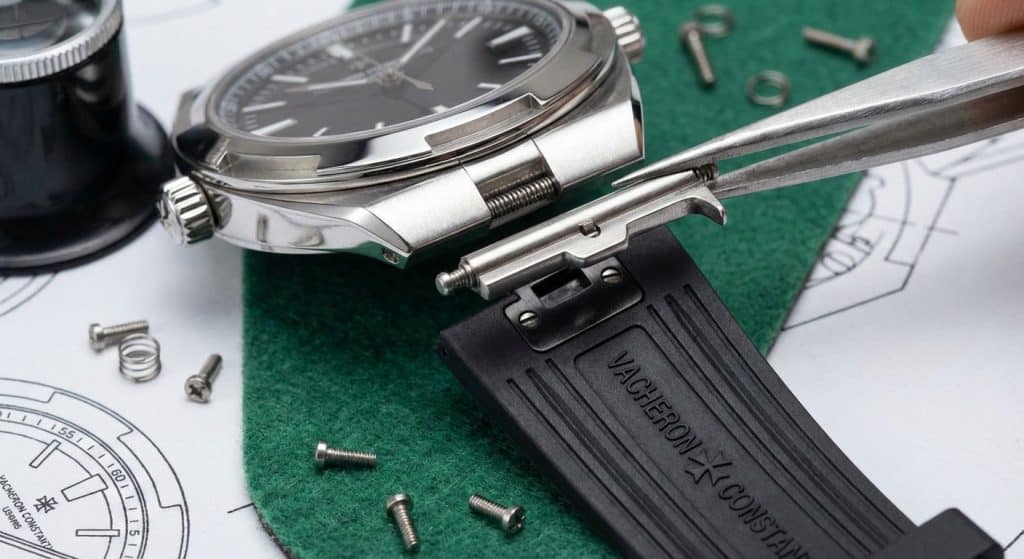
The proprietary quick-release system of the 4500V is an exercise in Interface Tolerance that many factories historically dismissed as a secondary concern. In the 2026 engineering cycle, however, this mechanism has become a primary benchmark for Structural Fidelity. The challenge lies in the Torsional Tension required to keep the strap or bracelet perfectly rigid against the case while allowing for a tool-free transition. Achieving a “zero-gap” fitment requires the locking lug and the case recess to maintain a staggering ±0.02mm tolerance—a feat that distinguishes the Guangzhou specialized labs from mass-production facilities.
Engineering the “Click”: Why Most Replicas Fail at the Lug
The tactile “click” of the Overseas lug system is dictated by a high-tension, spring-loaded internal bar. In lower-tier iterations like those from 8F, the internal spring often lacks the necessary Vickers Hardness, leading to “lateral play” or a noticeable wobble where the strap meets the case. This is not merely an aesthetic flaw but a mechanical failure; a loose fitment increases the rate of Material Fatigue on the locking pins. The 2026 ZF V3 has recalibrated the internal geometry to ensure full Strap Interchangeability, meaning the case is now precise enough to accept a genuine VC rubber or leather strap without the need for manual filing—a breakthrough in CNC Pathing Tolerance.
Expert Authentication Insight: The “Tensile Stress” Test
Diagnostic: To assess the integrity of the locking mechanism, attach the strap and apply a steady 2kg pull force away from the case. A high-quality clone from ZF or PPF will remain perfectly rigid with no visible separation. If the lug “gaps” open by more than 0.1mm under tension, it indicates that the internal locking components are cast from a softer alloy rather than being CNC-milled from hardened 316L Stainless Steel, posing a long-term risk of strap failure.
Crown Guard Integration and Screwed-down Ergonomics
The crown and its protective guards represent the most complex confluence of curves on the 4500V mid-case. This area requires a seamless flow—a “shouldered” transition—that must appear as if it were carved from a single block of steel. In previous years, the crown guards were often a “tell” for replicas, appearing too chunky or lacking the sharp, polished chamfers that define the genuine aesthetic. By 2026, the focus has shifted to the Galvanic Saturation of the crown’s engraving and the precision of the thread pitch, ensuring that the water-resistant seal does not compromise the ergonomic experience.
The “Maltese Cross” Crown: Engraving Depth vs. Casting
While mid-tier factories often rely on “laser-ablated” or “etched” logos, the 2026 ZF batch has moved toward “Deep Relief” engraving where the Maltese Cross is part of the initial mold and then refined via CNC. This provides a three-dimensional depth that catches the light differently than a flat etch. Furthermore, the crown guards on the ZF are meticulously slimmed down to flow into the case profile, avoiding the “blocky” appearance common in 8F models. The O-ring seal and Gasket Compression are also optimized, providing a theoretical 150m water resistance that matches the industrial standards of the 2020s.
Expert Authentication Insight: The “Thread Smoothness” Diagnosis
Diagnostic: Unscrew the crown and feel the resistance as the threads disengage. A master-tier clone will provide 3.5 to 4 full rotations before the crown pops into the winding position. During this process, the movement should feel buttery and silent, as any deviation from the VC Patrimony 85180 engineering audit benchmarks for crown torque suggests a failure in precision assembly. If the rotation feels “gritty” or the crown pops out after only 2 turns, it is a sign that Moebius Oil (specifically D5 or 9010) was omitted from the stem gaskets, or that the Thread Pitch was mismatched during the CNC phase, indicating a compromise in Structural Fidelity.
Sapphire Crystal Integration and Anti-Reflective (AR) Logic
The transparency of the Overseas sapphire is a critical component of its “open” dial aesthetic. In high-end horology, the crystal should effectively disappear, allowing the light to interact solely with the dial’s sunburst or lacquered finish. This requires a sophisticated understanding of the Refraction Index and the application of chemical coatings that do not distort color temperature. In the 2026 manufacturing environment, the shift toward Double-Sided Colorless AR has become the baseline for any piece claiming “Super Clone” status, moving away from the primitive blue-tinted coatings that plagued the industry in previous decades.
The “Invisible” Crystal: Eliminating the Blue Tint
Earlier iterations of the 4500V from factories like 8F and MKS often exhibited a distinct blue or purple hue when viewed at an angle, a result of using inferior anti-reflective chemicals that favored certain light frequencies. The 2026 ZF V3 has eliminated this “tell” by employing a multi-layer Colorless AR process that ensures the 90% transparency threshold is met. Furthermore, we observe a significant reduction in the “White Ring” effect—the visible thickness of the crystal gasket. In genuine VC pieces, the gasket is almost entirely concealed by the bezel’s inner lip. High-end 2026 clones have recalibrated their CNC Machining Profile to lower the crystal seat, ensuring that the gasket remains hidden, thereby maintaining the Structural Fidelity of the bezel-to-dial transition.
Expert Authentication Insight: The “Water Drop” Cohesion Test
Diagnostic: To test the quality of the sapphire and its surface coating, place a single drop of distilled water onto the center of the crystal. On a premium ZF sapphire with a high Mohs Hardness and correct UV color-shift protection, the water will maintain a high contact angle, forming a tight, spherical bead. If the drop flattens or “bleeds” across the surface, it indicates an inferior surface density or a low-grade coating that will eventually suffer from microscopic scratches and environmental degradation.
The Caseback: Peripheral Gaskets and Perimeter Engraving
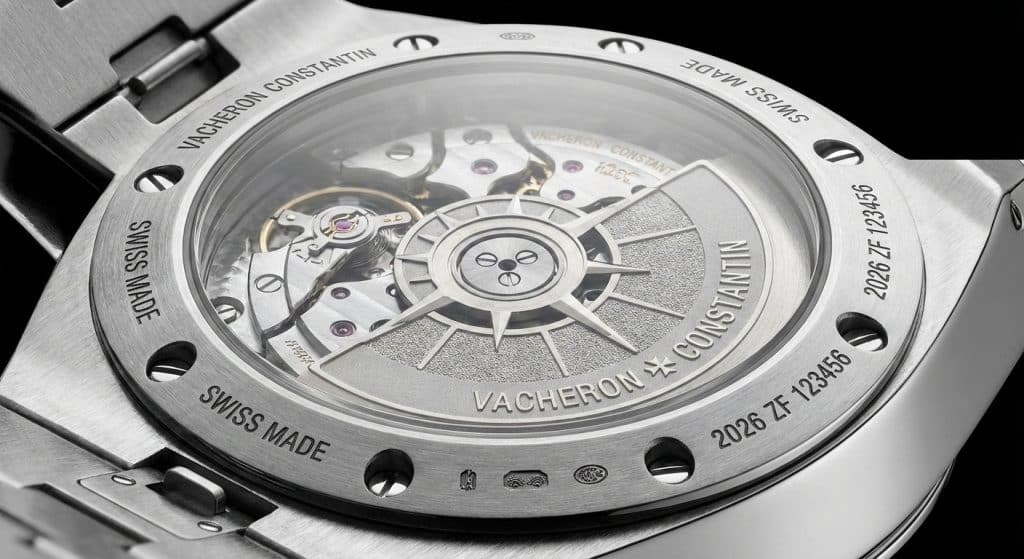
The exhibition caseback of the 4500V is a window into the movement’s Kinetic Efficiency, but the metal perimeter is where the technical audit of the case concludes. This area is subject to significant Torsional Tension when the watch is worn, requiring the peripheral screws and the O-ring seal to work in perfect harmony to maintain the 150m water resistance rating. The engraving on this perimeter—specifically the font kerning and the depth of the etch—is often where mass-production factories fail due to the high-speed rotation of their engraving bits.
Font Kerning and Engraving Sharpness
A comparison between ZF and PPF reveals two different schools of finishing. PPF often utilizes Chemical Etching, which provides a very smooth, sandblasted background texture but can sometimes result in “soft” edges on the lettering. ZF, in their 2026 updates, has opted for ultra-fine CNC Engraving, which captures the sharp, vertical walls of the genuine Vacheron Constantin font. The “150m” and serial number engravings must be examined for “burring”—microscopic metal shards left behind by a dull drill bit. In a top-tier audit, the ZF font weight is found to be within a ±0.02mm margin of the genuine, whereas 8F models often display jagged edges and inconsistent depth that trap dirt and skin oils over time.
Expert Authentication Insight: The Screw-Head Alignment Check
Diagnostic: Carefully examine the six or eight screws that secure the exhibition caseback to the mid-case. In a genuine VC, these screws are made of hardened steel and sit perfectly flush with the surface, often with their slots aligned in a cohesive pattern. If the screws on a replica sit “proud” (protruding) or show evidence of “burring” from the assembly screwdriver, it indicates a lack of Assembly Tolerance. High-end 2026 clones use specialized torque-limited drivers to ensure the Vickers Hardness of the screw heads is not compromised during the final sealing process.
Conclusion: The Hierarchy of Case Accuracy in 2026
The 2026 market for VC Overseas replicas has stabilized into a clear industrial hierarchy. The quest for Structural Fidelity has moved from the dial to the case architecture, with the most successful factories investing heavily in multi-axis CNC technology and specialized hand-finishing stages. This manufacturing audit confirms that the quality of the case is not merely an aesthetic choice but a foundational requirement for the longevity of the internal Super Clone movement, as a rigid, well-tolerated case protects the delicate Escapement Geometry from external shocks and moisture ingress.
Ranking the Factories on Case Engineering
When ranking the current leaders, ZF (The King of Proportions) remains the benchmark for those prioritizing the 11.0mm profile and the aggressive light-play of the Maltese bezel. PPF (The Finishing Challenger) offers a compelling alternative with a focus on Galvanic Saturation and dial-side brilliance, though they occasionally lag in the micro-metric sharpness of the lug system. 8F (The Value Alternative) serves the entry-level market; while functionally robust, their reliance on mass-stamping results in a Visual Error Margin that, according to the latest VC super clone kinematic haptics and mass distribution analysis, exceeds the tolerances required for a true “Super Clone” experience. The choice between these manufacturers is ultimately a choice between different levels of CNC Pathing Tolerance and metallurgical refinement.
Senior Engineer’s Final Verdict
In the current era, collectors must look past “1:1” marketing and focus on the Visual Error Margin, which in the best examples is now as low as ±0.03mm. The 2026 ZF V3 remains the definitive benchmark for case geometry, specifically regarding the rigidity of the quick-release system and the mathematical precision of the bezel’s hexagonal symmetry. For the auditor seeking the closest possible proximity to the Geneva standard, the ZF factory’s commitment to Diamond Paste Hand-Finishing and movement-case integration provides the most authentic horological narrative available in the modern replica landscape.