
Why Comparing IWC Replica vs Genuine Matters (Especially for New Buyers)
IWC is one of the most frequently searched brands when it comes to “real vs fake” comparisons, and that is not an accident. Unlike brands that rely on oversized logos, precious stones, or aggressive visual signatures, IWC watches are deliberately restrained. Their designs are quiet, balanced, and almost conservative. That restraint is exactly what makes them difficult for new buyers to judge.
With IWC, the difference between a genuine watch and a replica rarely jumps out at first glance. The logo is small. The dial layouts are clean. The proportions are forgiving. Most of what separates authentic IWC watches from imitations lives at the craftsmanship level: printing precision, finishing transitions, lume behavior, movement architecture, and long-term wear consistency. These are not things most first-time buyers know how to evaluate.
This is why IWC attracts a high volume of misleading products. Low-end replicas can look convincing in photos while cutting corners in places that only reveal themselves after weeks of wear, under low light, or when the watch is handled closely. Many buyers are not trying to “pass off” a fake as genuine. They are simply trying to avoid being overcharged for a low-quality watch that is marketed dishonestly.
The goal of this comparison is not to teach anyone how to impersonate ownership of a genuine IWC. It is to help readers understand where the real differences are, why those differences exist, and how to avoid being trapped by superficial similarities. For readers who want a broader understanding of factories, models, and quality tiers, a full breakdown is available in the IWC Replica Watches Guide.
Models Used for Comparison: Why Big Pilot & Portuguese 7 Days
Big Pilot and Portuguese 7 Days are not random choices. They are stress tests.
The Big Pilot amplifies differences because of its scale and functionality. Its oversized case makes proportions harder to fake. Its lume is bold and exposed. Its power reserve indicator is constantly visible. Its movement architecture is simple enough to understand but demanding enough to execute properly. Any weakness in finishing, printing, or mechanical honesty becomes obvious faster on a Big Pilot than on a smaller, simpler watch.
Portuguese 7 Days tests a different set of skills. It is a dress watch that relies almost entirely on refinement. The dial is open and unforgiving. The typography must be precise. The power reserve display needs depth and smooth progression. The case polishing has to feel controlled rather than flashy. Small mistakes stand out because there is nowhere for them to hide.
Together, these two models represent opposite ends of IWC’s design language while sharing the same underlying philosophy: clarity, restraint, and mechanical integrity. If a replica can hold up under scrutiny on both a Big Pilot and a Portuguese 7 Days, it has already crossed into the top tier of the replica market. Anything that fails here is unlikely to perform better elsewhere.
Dial Printing & Font Accuracy: The First Visual Check
Logo, Text Alignment & Font Weight
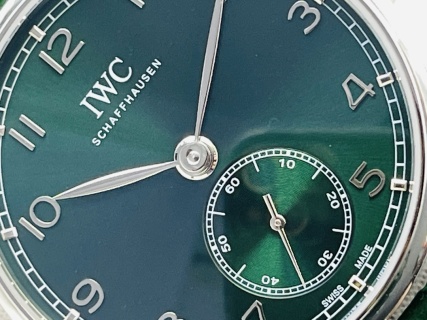
Dial printing is the first place where experience starts to matter more than eyesight. At a glance, almost any IWC dial looks “clean,” but authenticity lives in restraint. On a genuine IWC, the “IWC” logo is thinner than most people expect. The strokes are controlled, the edges are sharp without looking aggressive, and the ink sits flat on the dial surface rather than appearing raised or heavy.
The word “Schaffhausen” is even more revealing. On authentic dials, letter spacing feels calm and intentional. Each character breathes. Nothing crowds, nothing floats. On low-end replicas, this balance collapses quickly. Fonts are often slightly too bold, spacing is inconsistent, and the ink density varies from letter to letter. Under direct light, you can sometimes see uneven saturation where the printing process failed to settle cleanly.
High-end replicas from factories like ZF and VS have narrowed this gap dramatically. Their font weight is close, alignment is stable, and printing sharpness holds up under casual inspection. Still, when compared side by side or examined under strong light, genuine dials tend to look quieter. The difference is subtle, but it repeats across examples, and repetition is what turns suspicion into confidence.
Sub-dials & Power Reserve Scale Details
Power reserve indicators are where printing accuracy and mechanical honesty intersect.
On the Big Pilot, the power reserve scale should feel naturally spaced. The numerals are not cramped, the arc flows evenly, and the edges of each marking remain clean even under magnification. Genuine examples maintain this balance across the entire scale. On low-tier replicas, spacing errors are common. Numbers may sit too close together, alignment drifts along the arc, and the ink often looks soft or slightly fuzzy at the edges.
The Portuguese 7 Days is less forgiving. Its power reserve sub-dial relies on depth and layering rather than bold contrast. On genuine watches, the sub-dial sits slightly recessed, with crisp separation between the scale, the background, and the surrounding dial surface. Light interacts with these layers subtly, creating depth without drama.
Top-tier replicas come close here. The layout is usually correct, and the depth is visually convincing from straight-on angles. Where they still fall short is consistency. Under oblique light, genuine dials maintain uniform depth and edge definition, while replicas may reveal flatter transitions or slightly uneven layering. This is not something most wearers notice day to day, but it remains one of the few reliable tells for trained eyes.

Lume Performance: Night Visibility Tells the Truth
Color Tone & Brightness in the Dark
Lume behavior is one of the fastest ways to separate honest construction from cosmetic shortcuts, especially on the Big Pilot.
Genuine IWC lume tends toward a cold white or icy blue tone in darkness. It charges evenly, glows uniformly, and fades in a controlled, predictable way. There are no bright hotspots and no dull patches. The light feels balanced across numerals, markers, and hands, which reflects careful application rather than raw brightness.
Low-end replicas fail here almost immediately. Their lume often skews green or yellow, with uneven intensity across the dial. Some markers flare while others barely glow. The inconsistency is obvious in real use, not just in photos, and it becomes more noticeable after repeated charging cycles.
High-end replicas have improved significantly. Modern lume compounds are closer in color, and initial brightness can look impressively similar to genuine IWC. The difference usually appears over time. Replicas tend to fade faster and less evenly, losing definition sooner in low-light conditions. It is not a dramatic failure, but it is consistent enough to matter if you wear the watch at night regularly.
In real life, lume is less about absolute brightness and more about behavior. Genuine IWC lume behaves predictably, night after night. Replicas can imitate the look, but matching the long-term performance remains one of the hardest challenges to overcome.
Case Shape & Finishing: Where Craftsmanship Shows
Case Proportions & Edge Finishing
Case finishing is where IWC’s design philosophy becomes tangible. The brand does not rely on dramatic bevels or decorative excess. Instead, it uses controlled transitions and quiet geometry. When those transitions are wrong, the watch feels wrong, even if the dimensions are technically correct.
On the Big Pilot, the lugs tell the story immediately. Genuine examples have a natural curvature that flows from the case body into the wrist. The edges are defined but never sharp, and the transitions between brushed and polished surfaces are clean without being aggressive. Low-end replicas often miss this balance. Their lugs look stiffer, with edges that feel either blunt or unnaturally crisp, as if the finishing was rushed or simplified to save time.
The Portuguese 7 Days reveals a different weakness. Its case is deceptively simple, dominated by polished surfaces that demand restraint. On genuine watches, the polish has depth without glare. Light rolls across the case smoothly, never flashing harshly. Many replicas, even good ones, tend to over-polish. Under strong light, they appear slightly too bright, too reflective, and too eager to catch attention. This is not a dramatic flaw, but it changes the character of the watch. Instead of feeling composed, it feels performative.
High-end replicas have improved edge transitions and case symmetry significantly, but the finishing still leans toward exaggeration. The difference is subtle, yet consistent, especially when the watch is handled rather than just viewed.
Crown & Engravings
The Big Pilot’s onion crown is not just a visual signature. It is a test of precision.
On a genuine IWC, the crown engraving has depth and structure. The letters are cut cleanly, with sharp internal angles and consistent depth. When light hits the engraving, it reveals clear contours rather than soft impressions. The crown itself feels solid when handled, with threading that engages smoothly and predictably.
Low-tier replicas often get this wrong in both directions. Some engravings are too shallow, barely visible unless light hits at the right angle. Others are cut too deep, making the lettering look crude and heavy. Both mistakes disrupt the balance that defines IWC’s aesthetic.
Caseback engravings follow the same logic. Genuine IWC casebacks are restrained. The lines are precise, the text is measured, and nothing feels overstated. On cheaper replicas, engravings are frequently overdone to compensate for weak finishing elsewhere. Text may be too deep, too bold, or uneven in depth, which draws attention for the wrong reasons.
Higher-end replicas have closed much of this gap. Their crown engravings are cleaner, and caseback markings are more controlled than before. Still, under close inspection, genuine IWC engravings tend to look calmer and more intentional. They do not try to impress. They simply exist, which is exactly why they are hard to fake perfectly.
Movement Comparison: The Biggest Gap You Can’t See at First
Genuine IWC Movements vs Replica Movements
This is where clarity matters more than optimism. A replica IWC does not, and cannot, use a genuine IWC movement. Anyone suggesting otherwise is either misinformed or deliberately misleading.
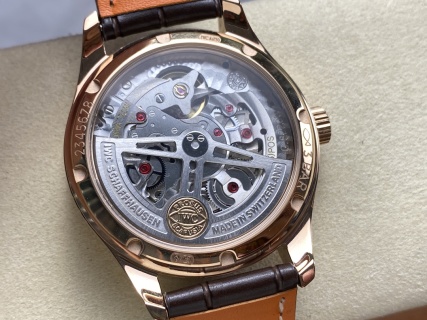
Genuine IWC watches rely on in-house calibers or heavily modified Swiss movements, depending on the model and era. These movements are built around proprietary design choices: material composition, gear tolerances, finishing standards, and long-term durability targets that are defined internally and protected by cost, tooling, and supply chains. They are not just layouts. They are systems refined over decades of production and service feedback.
High-end replicas approach the problem differently. For models like the Big Pilot and Portuguese 7 Days, top-tier factories rely on the Dandong long power reserve movement. Architecturally, this movement gets many things right. The layout mirrors the genuine structure closely. The power reserve mechanism is real, not decorative. The balance position, bridge shapes, and overall proportions are designed to match what you would expect when viewing the watch through a caseback or during servicing.
Low-end replicas expose themselves immediately. Their “power reserve” is often fake, driven by gearing disconnected from actual stored energy or replaced entirely with static indicators. Decorative plates hide generic movements underneath. These watches may look convincing from the front, but mechanically they are closer to props than instruments.
The key difference is not whether a replica moves, but whether it behaves. High-end replicas behave plausibly. Low-end ones do not.
What High-End Replicas Get Right (And What They Still Can’t)
Modern high-end IWC replicas deserve credit where it is due. They have crossed a threshold that did not exist a decade ago.
Real power reserve functionality is now standard at the top tier. The indicator responds to winding and depletion in a way that reflects actual energy storage. Layouts are no longer guesswork. They are studied, measured, and reproduced with intent. In daily use, these movements feel coherent. They wind smoothly, hold power predictably, and deliver stable timekeeping within reasonable expectations.
That said, limits remain, and pretending otherwise helps no one.
Replica movements cannot replicate IWC’s proprietary metal formulations. They do not share the same alloy compositions, heat treatments, or long-term fatigue characteristics. Finishing consistency is another gap. Genuine movements maintain uniform finishing across bridges and components, even in areas most owners never see. Replicas may look convincing at first glance but tend to reveal variation when examined closely or serviced repeatedly.
The goal of a high-end replica movement is not equivalence. It is functional honesty within constraint. When understood that way, the comparison becomes rational rather than emotional. High-end replicas succeed by delivering correct behavior and credible structure. They fail only when judged against standards they were never designed, or priced, to meet.
Recognizing both sides of that equation is the difference between informed ownership and unrealistic expectation.
Strap, Buckle & Wearing Experience Differences
Straps are one of the few areas where genuine IWC still holds a clear, tactile advantage. Original IWC leather straps feel denser and more refined in hand. The grain is tighter, the edges are sealed more cleanly, and the leather softens gradually with wear rather than collapsing early. This is not about luxury branding; it is about material selection and finishing time.
Replica straps, even on high-end watches, are usually competent rather than exceptional. They look correct, fit well, and hold shape initially, but the leather tends to feel drier and less nuanced over time. The important point is that this gap is easily narrowed. Replacing a replica strap with a high-quality aftermarket leather strap closes most of the difference immediately, often to the point where the wearing experience becomes indistinguishable.
Buckles tell a similar story. Genuine IWC buckles have smoother edge transitions and more consistent finishing, especially around corners and engraved areas. Replica buckles, even good ones, sometimes feel slightly sharper or less fluid in hand. That said, once the watch is on the wrist, this distinction fades quickly.
In daily wear, most users will not feel a meaningful difference. Weight distribution, balance, and comfort are driven more by case geometry than strap origin. For practical use, strap and buckle differences exist, but they are rarely decisive.
Can You Tell the Difference on the Wrist?
At normal social distance, the answer is simple: almost never.
When worn on the wrist, a high-end IWC replica and a genuine IWC present nearly identical impressions. Proportions look right. The dial reads cleanly. The watch behaves as expected. In real-world settings—meetings, travel, daily wear—there is no practical way for an observer to reliably tell the difference.
The situation changes under scrutiny. With a loupe, strong lighting, and familiarity with IWC’s finishing language, trained eyes can identify differences. Printing restraint, lume behavior over time, movement finishing consistency, and subtle case transitions become visible. These are not casual observations. They require intent and expertise.
This reframes the question of “real vs fake.” For most wearers, the difference is academic, not practical. It matters intellectually and mechanically, but it rarely affects how the watch is experienced or perceived in everyday life.
Final Thoughts: Understanding Differences Before Making a Choice
Collectors who value provenance, long-term service history, and brand continuity should choose genuine IWC; practical wearers who care about design and function can find satisfaction in top-tier replicas; new buyers should avoid low-end options entirely and start by understanding quality tiers through resources like guides on best IWC replica factories and IWC replica models explained available in the IWC Replica Watches Guide, because the right choice depends less on ideology and more on how the watch will actually be used.
Related IWC Articles: If you found this helpful, you might also enjoy IWC Replica Power Reserve & Stability Rankings (2026): Which Movement Is Best for Daily Wear?, and IWC Replica Chronograph Movement Guide: Asian 7750 Reliability, Weak Points, and Care. You may also like IWC Pilot’s Chronograph Top Gun Replica Guide: Ceramic Case, ZF Factory Breakthroughs & Spitfire Comparison, and IWC Replica Watches by Series (Portuguese, Pilot, Ingenieur & Portofino).