
This page exists to clarify how IWC replica movements actually work, where they succeed, and where they fundamentally diverge from genuine IWC engineering. It is not written to promote any watch, factory, or purchase decision. It is written to reduce misunderstanding. If you are looking for reassurance, this page may feel uncomfortable. If you are looking for clarity, it should feel grounding.
Why IWC Movements Are Hard to Replicate
The difficulty of replicating IWC has very little to do with dials, cases, or finishing. Those problems have largely been solved. The real barrier has always been movement philosophy. IWC does not build movements to chase thinness, decorative complexity, or novelty. It builds movements around stability under load, long torque delivery, and mechanical headroom. That philosophy creates structural problems that replicas cannot solve directly, only approximate.
IWC’s Movement Philosophy (Why It’s Different)
IWC designs movements as large systems first and timekeeping devices second. Case sizes are generous not for aesthetics, but to allow wide gear trains, larger balance assemblies, and barrels that can store and release energy gradually. This is why many IWC in-house calibers look oversized relative to the dial opening and why spacer rings are rarely needed in genuine watches.
Long power reserve in IWC is not a marketing feature. It is an architectural choice. Twin barrels, extended mainsprings, and carefully managed torque curves are used to keep amplitude stable across multiple days, not simply to extend runtime. The goal is consistency from hour ten to hour one hundred, not just endurance on paper.
This is also why thinness is rarely the priority. IWC accepts vertical space if it improves durability, shock tolerance, and service intervals. Movements like the 52010 or 52110 families are not elegant in the traditional Swiss sense, but they are mechanically conservative and forgiving under daily wear. That conservatism is expensive to reproduce.
Why 1:1 Movement Replication Is Unrealistic
No serious discussion of IWC replicas works unless this point is settled early: there is no replica that uses a true IWC in-house movement. The reasons are not moral or legal abstractions. They are practical.
Cost vs Engineering Reality
Developing a true in-house caliber requires years of iteration, proprietary tooling, and a tolerance budget that only makes sense when amortized over tens of thousands of units. Replica production runs are measured in hundreds or low thousands. Even if legality were irrelevant, the economics collapse immediately.
Long power reserve movements amplify this problem. Barrel metallurgy, spring alloy behavior, and torque curve shaping are not things that scale cheaply. Replica factories can copy dimensions and visual layouts, but they cannot replicate material science at that level without pricing the product out of its own market.
Structural Differences You Can’t See from the Dial
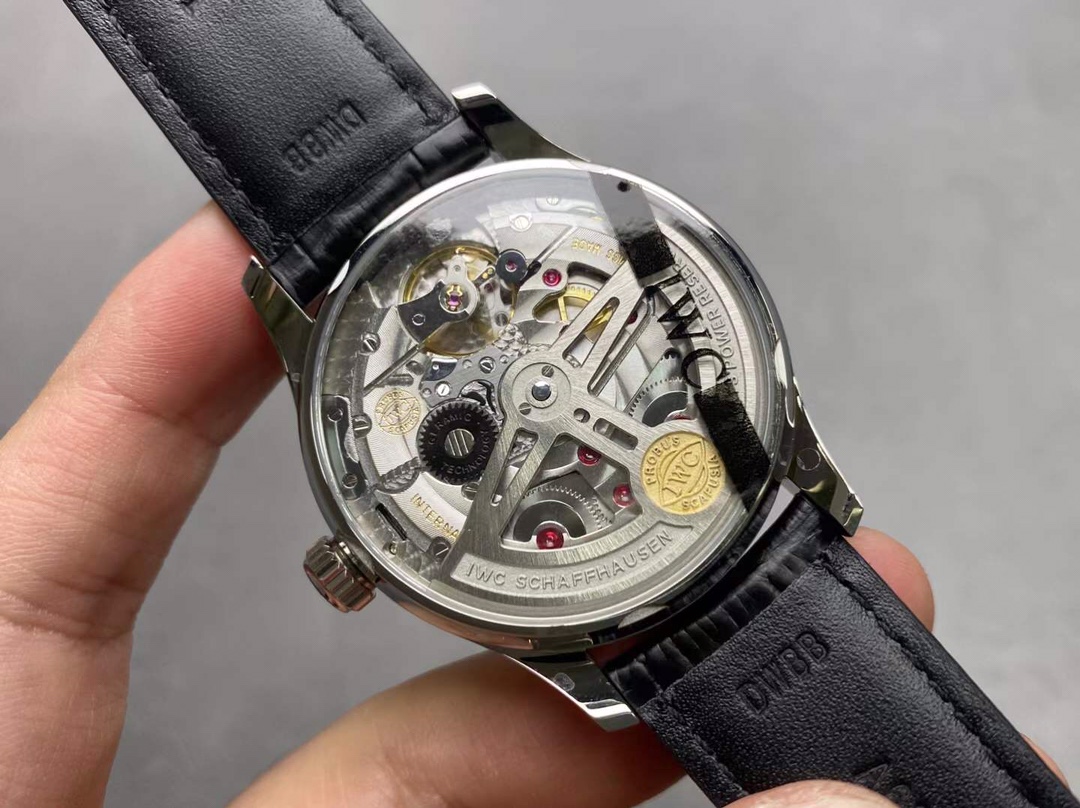
From the front, a replica Portuguese 7 Days may look convincing. Internally, the compromises are structural. Gear train thickness, pivot diameter, jewel placement, and balance mass are all adjusted to work with available base movements. These changes are invisible unless the movement is disassembled, but they directly affect longevity, amplitude stability, and shock tolerance.
Genuine IWC movements are designed as integrated systems. Replica movements are adaptations. Even when power reserve indicators function correctly, they are often driven by simplified mechanisms that respond differently to partial winding, inactivity, or uneven wear.
Why Even High-End Replicas Use Alternative Solutions
High-end replicas do not avoid these issues; they manage them. Long power reserve replicas rely on extended single-barrel designs or modified architectures that prioritize acceptable runtime over torque consistency. Chronograph replicas lean on proven third-party platforms like the 7750 because building a new integrated chronograph from scratch would be irrational.
Three-hand replicas favor movements like the 2892 or its derivatives because stability, serviceability, and thin architecture matter more in daily use than visual similarity through a display back. These are not shortcuts taken out of ignorance. They are deliberate trade-offs made by factories that understand their constraints.
No replica uses a true IWC in-house movement, and that fact does not automatically make replicas worthless. It simply defines the boundary between imitation and equivalence. Understanding that boundary is the starting point for every informed decision that follows.
7-Day Power Reserve Replica: Real or Fake?
The question is not whether a 7-day power reserve IWC replica exists. It does. The real question is what that claim actually means once the watch leaves a spec sheet and enters daily use. In replicas, “7-day power reserve” is neither fully fake nor truly equivalent. It sits in an uncomfortable middle ground that rewards informed users and punishes assumption-driven buyers.
What “7-Day Power Reserve” Means in Genuine IWC Watches
In genuine IWC movements, a 7-day power reserve is not simply about how long the watch runs before stopping. It is about how consistently it runs during that time. IWC achieves this through twin barrel systems that store energy across two mainsprings instead of forcing one spring to do all the work. This spreads load, reduces peak stress, and flattens the torque curve delivered to the gear train.
Torque curve management is the quiet achievement here. As a mainspring unwinds, torque naturally drops. IWC designs its barrels, gear ratios, and escapement tolerances to keep amplitude within a usable range for days, not hours. This is why a genuine Portuguese 7 Days often shows stable timekeeping even after being off the wrist for two or three days. The reserve is not just long. It is usable.
This matters because power reserve without torque stability is a hollow metric. A watch that runs for seven days but keeps poor time after day two has technically met the claim while failing the purpose.
How Replica Factories Imitate 7-Day Power Reserve
Replica factories approach the problem from the opposite direction. They begin with available movement architectures and stretch them as far as practical without redesigning the system from scratch. The result is functional, but fundamentally different.
Modified Long Power Reserve Movements
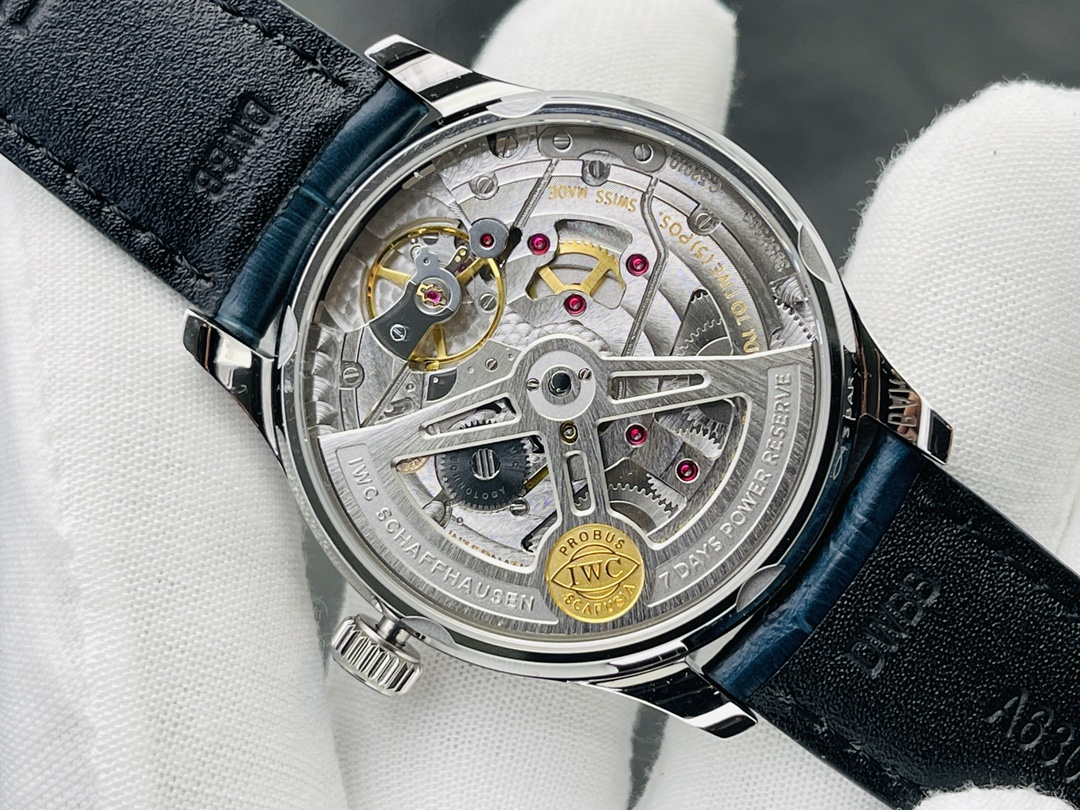
Most high-end 7-day IWC replicas use modified long power reserve movements developed specifically for large case designs. These movements often rely on extended mainsprings housed in enlarged barrels or optimized single-barrel configurations. They are capable of running longer than standard three-hand movements, but they do not replicate the torque management strategy of genuine IWC calibers.
In practice, this means the movement may run impressively long when fully wound, but amplitude declines more sharply as energy depletes. The watch keeps time well early in the cycle and less well later. This is not a defect. It is a predictable outcome of simplified architecture.
Decorative vs Functional Power Reserve Indicators
Not all power reserve indicators are fake. Some are fully functional and mechanically linked to the winding system. Others are purely decorative or loosely coupled, moving in a way that looks convincing but lacks precision. The problem is not deception by default, but inconsistency across factories and versions.
Even functional indicators often behave differently from genuine ones. Partial winding may not register accurately. The indicator may drop faster than expected or fail to reflect true remaining torque. It tells a story, but not always the right one. Treating it as a visual reference rather than a measurement tool avoids frustration.
The Realistic Power Reserve You Should Expect
Claimed 7 Days vs Actual Runtime
Many replicas can physically run beyond five days if fully wound and left untouched. Some approach or exceed six days under ideal conditions. However, usable power reserve and advertised power reserve are not the same thing. Once amplitude drops below a certain threshold, timekeeping quality degrades even if the watch continues to run.
Why 60–72 Hours Is the Practical Reality
In real wear conditions, most long power reserve replicas deliver their best performance in the first 60 to 72 hours after winding. During this window, amplitude remains healthy, beat error stays manageable, and regulation holds. Beyond that, the watch may still run, but accuracy becomes increasingly sensitive to position and motion.
This does not make the movement bad. It defines how it should be used. Treating a 7-day replica like a 3-day watch with extra buffer leads to better outcomes than expecting it to behave like a genuine IWC caliber.
Risks of Long Power Reserve Replica Movements
Increased Torque Stress
Extended mainsprings store more energy. When that energy is released through a simplified gear train, stress concentrates on fewer components. Over time, this can accelerate wear if the movement is poorly lubricated or improperly regulated. High-end factories mitigate this, but they cannot eliminate it entirely.
Sensitivity to Poor Regulation
Long power reserve movements amplify regulation errors. Small deviations at full wind become larger problems near the end of the reserve. A poorly regulated example may feel acceptable for a day or two and then drift noticeably. This is why regulation quality matters more here than in standard three-hand replicas.
Why Daily Wear Matters More Than Specifications
These movements perform best when worn regularly. Daily motion keeps the mainspring within a stable operating range and avoids deep discharge cycles that stress components. Ironically, treating a long power reserve replica as a weekend-only watch often leads to worse results than wearing it daily.
Should You Buy a 7-Day Power Reserve IWC Replica?
A 7-day power reserve IWC replica makes sense for wearers who value dial presence, enjoy interacting with the watch, and understand that the reserve is a convenience buffer rather than a performance guarantee. It suits people who rotate watches frequently but still want their watch running when they return after a day or two.
It is less suitable for buyers who expect set-and-forget accuracy across a full week, dislike manual winding, or equate longer power reserve with lower maintenance. These movements reward involvement and punish neglect.
The decision is not about whether the movement is good or bad. It is about whether its behavior matches how you actually wear a watch.
Asian 7750 in IWC Chronographs – Pros & Cons
The Asian 7750 remains the backbone of most IWC chronograph replicas, not because it is perfect, but because it survives contact with reality. In a market full of ambitious claims, the 7750 persists for reasons that have little to do with marketing and everything to do with long-term usability. Understanding what it does well, and where it predictably fails, is essential before choosing any IWC chronograph replica.
Why the 7750 Is Still Widely Used in IWC Replicas
The continued dominance of the 7750 is not a sign of stagnation. It is a consequence of constraints.
Availability matters more than most buyers realize. The 7750 platform exists at scale, with parts compatibility across generations and multiple production lines. This allows factories to build, regulate, and replace movements without reinventing the wheel every year. When something goes wrong, the solution exists.
Cost is the second reason. A true integrated chronograph movement built from scratch would push replica pricing into territory where buyers would rightly question the point. The 7750 offers a functional chronograph at a cost that still makes sense relative to the product’s purpose.
Serviceability is the quiet third pillar. Watchmakers around the world understand the 7750. Even imperfect examples can often be stabilized, regulated, or repaired. Exotic alternatives may look impressive on paper but become disposable once problems appear. The 7750 is rarely elegant, but it is rarely terminal.
What the 7750 Does Well in IWC Chronographs
Functional Chronograph Layout
In most IWC chronograph replicas, the 7750 delivers a fully functional chronograph with correct operational logic. Start, stop, and reset behave as expected. Subdials record elapsed minutes and hours in a way that matches real use, not just visual expectation. For wearers who actually use the chronograph, this matters more than cosmetic perfection.
Acceptable Accuracy for Daily Use
When properly regulated and used conservatively, a 7750-based IWC chronograph can maintain acceptable daily accuracy. It will not match the stability of a simple three-hand movement, but it does not need to. Within its intended operating range, timekeeping remains predictable enough for everyday wear.
The key is understanding that chronograph engagement changes load dynamics. Accuracy is best judged with the chronograph disengaged, where the movement spends most of its life.
Easier to Repair Than Exotic Movements
This is where the 7750 quietly outperforms more ambitious alternatives. Parts availability, watchmaker familiarity, and decades of accumulated knowledge mean that issues are usually solvable. Even when wear occurs, it tends to be gradual rather than catastrophic. That makes ownership less stressful over time.
Common Problems with 7750-Based IWC Replicas
Thickness & Case Proportions
The 7750 is not thin. This creates predictable challenges in case design. Some IWC chronograph replicas compensate well, others less so. Slightly increased case thickness or softened proportions are common side effects. These are not defects, but trade-offs. Anyone sensitive to case profile should evaluate this before buying, not after.
Subdial Spacing Limitations
Subdial spacing is determined by the movement, not the dial designer. The 7750’s architecture does not always align perfectly with genuine IWC layouts. Good replicas minimize this discrepancy, but it never disappears completely. The issue is often subtle, visible mainly to those who already know what to look for.
Long-Term Wear on Chronograph Components
Chronograph components experience higher mechanical stress than standard timekeeping parts. Continuous or careless use accelerates wear. Levers, cams, and coupling wheels do not fail suddenly, but they do fatigue. Most long-term issues with 7750 replicas stem from misuse rather than inherent weakness.
How to Reduce Risk When Choosing a 7750 IWC Replica
When Not to Use the Chronograph Function
The chronograph should be treated as an occasional tool, not a constantly running complication. Leaving it engaged for long periods adds unnecessary load and heat. If the chronograph is not actively needed, it should remain off. This single habit extends movement life more than any specification upgrade.
Wearing Habits That Extend Movement Life
Regular wear helps. Consistent motion keeps lubrication distributed and avoids repeated full wind and deep discharge cycles. Sudden shocks, frequent resets, and aggressive button use do the opposite. A 7750 rewards calm ownership. Treated with restraint, it can remain stable for years. Treated as a toy, it will eventually protest.
The Asian 7750 is neither a mistake nor a shortcut. It is a compromise that works when its limits are respected. In IWC chronograph replicas, it offers a balance of function, durability, and survivability that no alternative has convincingly replaced.
2892-Based IWC Replicas – Why They’re Often More Reliable
If reliability is the primary goal, 2892-based IWC replicas quietly outperform more complex alternatives. This is not because they are more impressive, but because they ask less from both the movement and the wearer. In replica watches, simplicity is not a downgrade. It is often the reason a watch survives years of regular use without becoming a project.
Why Simple IWC Watches Age Better as Replicas
There is a persistent assumption that simpler watches are entry-level or compromised choices. In the replica world, the opposite is often true. Simple IWC models avoid the structural stress that complications introduce and allow factories to focus on proportion, finishing, and regulation rather than mechanical improvisation.
Three-hand IWC replicas with date functions mirror the original intent of many genuine IWC tool watches. They are meant to be worn, not managed. Over time, fewer moving parts translate directly into fewer failure points. Owners notice this not in the first month, but after the novelty fades and the watch is still running predictably.
What Makes 2892-Based Movements So Stable
Thin Architecture
The 2892 architecture is naturally thin, which allows cases to stay close to genuine proportions without forcing compromises. This reduces internal pressure on components and avoids the stacked modules that complicate servicing. Thin does not mean fragile here. It means efficient use of space.
Lower Torque Requirements
Unlike long power reserve or chronograph movements, the 2892 does not need to manage high torque loads. Energy transfer remains smooth and conservative. This gentler operating environment reduces wear on pivots, gears, and the escapement. Over long periods, this matters more than peak performance.
Better Regulation Consistency
The 2892 platform responds well to regulation. Small adjustments produce predictable results, and those results tend to hold. Once regulated properly, these movements maintain stable daily rates with minimal drift. This consistency is why watchmakers often prefer them for watches intended for continuous wear.
Which IWC Series Typically Use 2892-Based Movements
Several IWC replica lines rely on 2892-based movements because the architecture aligns naturally with the design.
The Mark series, including models inspired by the Mark XVIII, benefit from the movement’s thin profile and stable timekeeping. These watches emphasize legibility and balance, and the movement supports that intent without drawing attention to itself.
Simple Pilot three-hand models follow the same logic. They prioritize clarity and durability over spectacle, making the 2892 a logical match.
Portofino Automatic replicas also commonly use 2892-based movements. Their clean dials and restrained cases leave little room for mechanical inconsistency. A stable, thin movement preserves the elegance these watches depend on.
Trade-Offs of Choosing 2892-Based IWC Replicas
Less Visual Drama
There is little to admire through a caseback, assuming there is one at all. The movement does its job quietly. For some, this feels underwhelming. For others, it is exactly the point.
No Complications or Power Reserve Displays
Choosing a 2892-based IWC replica means accepting functional restraint. There are no long power reserve indicators, no chronograph functions, and no interactive displays. What you gain is predictability. What you give up is spectacle.
For wearers who value stability over novelty, this trade-off is not a compromise. It is a preference grounded in experience.
Which IWC Replicas You Can Wear Daily (Movement-Based)
Daily wear exposes every weakness a watch can hide on paper. Power reserve claims fade, complications lose novelty, and what remains is how the movement behaves when worn repeatedly, adjusted casually, and ignored for long stretches. Judging IWC replicas by daily wearability requires shifting focus away from models and toward movement behavior over time.
Ranking IWC Replica Movements by Daily Reliability
At the top are 2892-based three-hand movements. They tolerate inconsistent wearing schedules, handle minor shocks without complaint, and maintain stable timekeeping with minimal attention. Their reliability comes from restraint. They do less, and they do it consistently.
Next are simplified long power reserve movements. When worn regularly and treated as 3-day watches with extra margin, they perform well. Their weakness appears when they are expected to behave like genuine 7-day calibers. Used within realistic limits, they can be dependable daily companions.
Last are 7750 chronographs, not because they are fragile, but because they demand discipline. Used conservatively, with the chronograph engaged sparingly, they can survive daily wear. Used aggressively or carelessly, they accumulate wear faster than simpler alternatives. Reliability here depends as much on the wearer as on the movement itself.
This ranking is not absolute. It reflects how these movements behave under typical, imperfect human habits rather than idealized use.
Movement-First Buying Advice (Instead of Model-First)
Most disappointment in replica ownership comes from choosing with the eyes instead of the wrist. A watch should match how it will be worn, not how it looks in isolation. Complications that feel exciting at purchase often become irrelevant or burdensome in daily life.
Choosing a movement first forces an honest assessment of habits. Do you rotate watches often or wear one daily? Do you enjoy interacting with complications or prefer indifference? Are you willing to adjust behavior to suit the movement, or do you want the movement to tolerate you?
When those questions are answered first, model selection becomes easier and regret becomes rare. Appearance matters, but it matters less than alignment between movement behavior and real use.
Final Thoughts: The Best IWC Replica Movement Is the One You Understand
There is no perfect IWC replica movement — only informed choices, made with clarity about how the watch will actually live on your wrist.
| Movement Type | Common IWC Replica Series | Core Strength | Real-World Weakness | Daily Wear Reliability | Who It Actually Suits |
|---|---|---|---|---|---|
| 2892-Based Automatic (Three-Hand) | Mark Series (e.g. Mark XVIII), Simple Pilot Models, Portofino Automatic | Thin architecture, low torque demand, stable regulation over time | No complications, visually unexciting, limited “watch interaction” | Very High | Wearers who want a watch that runs quietly for years with minimal attention |
| Modified Long Power Reserve (7-Day Style) | Portuguese 7 Days, Big Pilot Power Reserve Models | Long runtime buffer, functional power reserve display, strong wrist presence | Torque drops after ~60–72 hours, sensitive to regulation quality | Medium–High (with daily wear) | Users who rotate watches but still wear this one frequently and understand its limits |
| Asian 7750 Chronograph | Pilot Chronograph, Portuguese Chronograph, Special Edition IWC Chronos | Fully functional chronograph, proven platform, serviceable worldwide | Thicker cases, subdial spacing compromises, wear if overused | Medium (user-dependent) | Owners who value chronograph function and are disciplined in how they use it |
Related IWC Articles: If you found this helpful, you might also enjoy IWC Big Pilot Replica Review (IW5009): ZF Version, Real Wear Behavior, and What Actually Matters, and Beyond the Big Three: APS, YL, and Other Niche IWC Replica Factories Explained.