
This guide is not about finding the cheapest IWC replica or chasing a single “best version.” It is about understanding which IWC series actually translate well into replicas, which ones quietly fail despite popularity, and why series-level design matters more than individual model hype. Some IWC watches become excellent replicas because their structure allows it. Others remain compromised no matter how many factories try. Knowing the difference saves time, money, and frustration.
How Different IWC Series Perform in the Replica Market
Not every IWC series deserves equal attention in the replica market. Some perform consistently well across multiple generations of replicas, while others remain structurally limited despite strong demand. The critical mistake many buyers make is assuming that popularity, retail price, or brand prestige correlates with replica success. It does not.
Replica performance is dictated by design logic, not market buzz. A complex-looking watch may replicate more successfully than a simple one, while a best-selling genuine model may remain frustratingly inaccurate as a replica. The determining factors sit beneath the surface: how the case is constructed, how forgiving the dial layout is, and whether a viable movement architecture exists that factories are willing to refine over time.

Series-level design creates a ceiling for replica accuracy. Individual models operate within that ceiling, but they cannot break it. That is why evaluating IWC replicas by series, not by reference number, leads to far more reliable judgments.
Why Series Matters More Than Individual Models (for Replicas)
Series defines the engineering boundaries a replica must operate within. Case construction determines whether tolerances can be held consistently. A simple round case with traditional lugs allows far tighter replication than an integrated bracelet case with compound angles. Dial architecture matters just as much. Symmetrical layouts hide small deviations naturally, while minimalist or highly textured dials amplify every flaw.
Movement compatibility is another decisive constraint. Some IWC series are built around calibers that have close mechanical substitutes. Others rely on proprietary layouts that cannot be convincingly replicated without major compromises. When a factory finds a workable solution, it tends to refine it for years, sometimes across multiple brands. When it does not, the series stagnates.
Factory investment follows these realities. Factories are rational. They return repeatedly to series that reward incremental improvement and abandon those that consume effort without producing stable results. Over time, this creates clear winners and losers at the series level, regardless of how iconic a specific model may be.
IWC Portuguese Replica – Why It’s the Flagship Choice
Among all IWC collections, the Portuguese series stands apart as the most structurally compatible with high-accuracy replicas. This is not accidental, nor is it purely a matter of popularity. The Portuguese line offers a rare combination of visual complexity and mechanical coherence that suits replica manufacturing exceptionally well.
Large cases, open dials, and restrained symmetry give factories room to work. Errors that would be fatal on smaller or busier watches become manageable here. As a result, Portuguese replicas have benefited from long-term refinement rather than constant reinvention.
Why the Portuguese Series Works So Well as a Replica
The Portuguese design is forgiving in the ways that matter most. The oversized dial reduces the visual impact of small proportional deviations. Subdials and power reserve indicators are placed with deliberate spacing, allowing mechanical layouts to remain honest rather than forced.
Complications are concentrated instead of scattered. A power reserve display, small seconds, and date are all mechanically achievable without layering unstable modules. This encourages factories to build integrated solutions instead of shortcuts. Once a workable architecture is established, refinement becomes worthwhile.
Just as important, manufacturers commit to this series. The Portuguese line has seen consistent investment across many years, not one-off releases. Incremental improvements in case geometry, dial finishing, and movement decoration accumulate. The result is not perfection, but maturity.
Accuracy Level of Portuguese Replicas (Realistic Expectations)
Case Size & Proportions
Portuguese replicas generally succeed in overall proportions. Case diameter and lug length are usually correct, and wrist presence closely mirrors the genuine watches. Thickness remains slightly exaggerated in some versions, but the large case masks this better than most IWC lines.
Dial Layout & Power Reserve Display
Dial symmetry is where Portuguese replicas shine. Subdial spacing is typically correct, and the power reserve display is functional rather than decorative. Minor differences remain in font weight, dial texture, and printing depth, but these are subtle and rarely obvious outside direct comparison.
Movement Architecture vs Genuine
This is where the line must be drawn. Replica movements do not replicate IWC’s in-house calibers at a structural level. They replicate function and layout, not engineering philosophy. Power reserve duration, gear finishing, and long-term torque stability differ from genuine movements. These limits are real and persistent, but they do not undermine everyday usability.
Who Should Buy a Portuguese Replica (and Who Shouldn’t)
Ideal For: Collectors & Dress Watch Lovers
Collectors who value balanced design, visible mechanics, and calm wrist presence tend to appreciate Portuguese replicas. Dress watch enthusiasts benefit from the series’ maturity and visual credibility, especially in formal or semi-formal settings.
Not Ideal For: Small Wrist / Ultra-Thin Watch Fans
The Portuguese series is unapologetically large. Smaller wrists will struggle with fit, and anyone seeking ultra-thin elegance will find the case presence overwhelming. These are design truths, not replica shortcomings.
IWC Pilot Replica – Mark vs Big Pilot vs Chronograph
The IWC Pilot line is often treated as a single category, but in the replica world it behaves like three separate families with different strengths, risks, and long-term outcomes. Lumping them together leads to bad decisions. Understanding the internal split between Mark, Big Pilot, and Chronograph models is essential if accuracy, durability, and wearability actually matter.
Why the Pilot Series Is the Most Diverse Replica Category
The Pilot series is not unified by engineering logic but by visual language. Under that shared aviation aesthetic sit three very different design philosophies.
The Mark series is a pure tool watch. Its success as a replica depends on restraint, not spectacle. The Big Pilot is an emotional object first and a watch second, defined by scale and presence. Pilot chronographs are mechanically dense instruments where function pushes the limits of replica movements.
These differences explain why one Pilot replica can feel nearly bulletproof while another feels impressive but fragile. The category itself is not risky. Misunderstanding its internal logic is.
Mark Series Replica – The Daily Wear Champion
Design Simplicity = High Replica Stability
The Mark series is the least dramatic and the most dependable segment of the entire IWC replica lineup. Clean dials, straightforward three-hand layouts, and conservative case proportions create a structure that replicas handle exceptionally well. There are fewer visual traps and fewer mechanical compromises.
Dial printing, indices, and date windows are usually accurate enough that errors only appear under magnification. Case thickness is well controlled because the design never demands aggressive packaging. The result is a watch that looks correct on the wrist without needing excuses.
Movement Reliability Over Visual Drama
Mark replicas prioritize movement stability over cosmetic complexity. Most rely on proven three-hand automatic architectures that have been refined for decades. These movements are not exotic, but they are predictable, serviceable, and consistent over time.
This is why the Mark series is widely considered the safest entry point into IWC replicas. It is difficult to “get wrong” in ways that affect daily wear. For most users, this matters more than visual fireworks.
Big Pilot Replica – Iconic but Not for Everyone
What Replicas Do Well (Visual Impact)
Big Pilot replicas succeed where emotion matters most. Size, dial layout, oversized crown, and wrist presence are convincingly reproduced. On the wrist, the impression is immediate and unmistakable. Few replicas communicate identity as clearly as a Big Pilot.
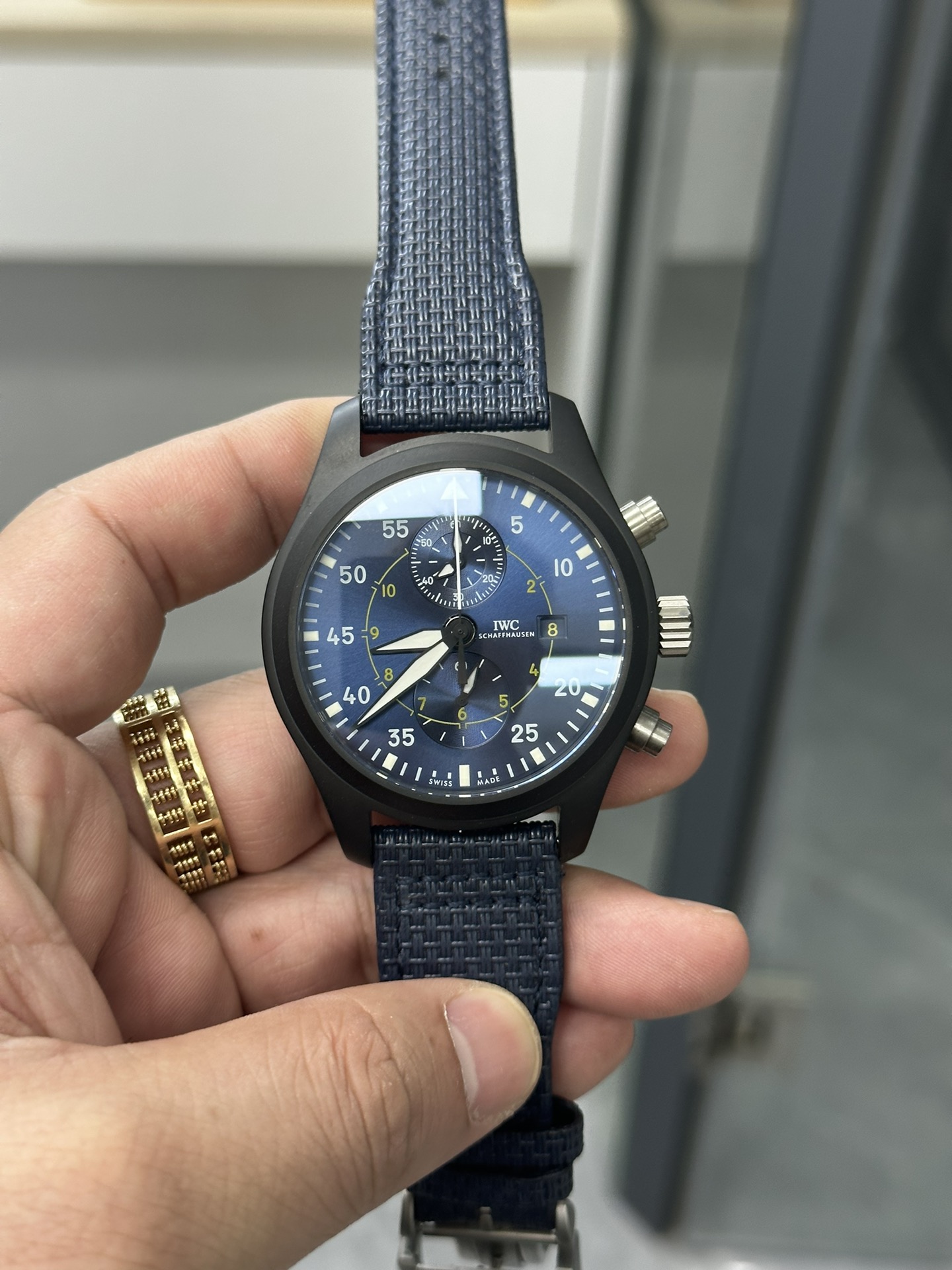
Power reserve displays are usually functional, and the broad dial hides small imperfections better than compact designs. From normal viewing distance, the experience is convincing.
Where Replicas Compromise (Thickness & Weight)
The trade-off is physical reality. Big Pilot replicas tend to be thicker and heavier than their genuine counterparts. Movement architecture requires space, and the large case does not eliminate that requirement.
For some wearers, this is irrelevant. For others, it becomes tiring over long periods. The Big Pilot replica is best understood as a statement piece rather than a daily companion. It rewards presence but demands tolerance.
Pilot Chronograph Replica – High Reward, Higher Risk
Dial Symmetry & Subdial Spacing
Pilot chronographs look straightforward, but their symmetry is unforgiving. Subdial spacing, hand alignment, and date placement must all work together. When they do, the result is visually satisfying. When they do not, the flaws are obvious.
Some chronograph replicas achieve respectable balance, but consistency varies. Even within the same production run, alignment can differ. This is not a cosmetic flaw alone; it reflects mechanical strain.
Chronograph Movement Limitations
Chronograph replicas operate closer to mechanical limits than any other Pilot variant. Movements are more complex, tolerances tighter, and long-term reliability more sensitive to use patterns. Frequent chronograph operation accelerates wear.
These watches can be rewarding, but they demand realistic expectations. They are not maintenance-free instruments, and they punish careless handling more than simpler designs.
Which Pilot Sub-Series Is Best for You?
For daily wear and long-term stability, the Mark series stands clearly above the rest. For visual impact and emotional satisfaction, the Big Pilot delivers presence few replicas can match. For those drawn to mechanical function and complexity, Pilot chronographs offer depth, but only if approached with caution and restraint.
IWC Ingenieur Replica – 2023 New Model Explained
For years, the Ingenieur line sat on the edge of the replica world: admired, discussed, and mostly avoided by serious manufacturers. The 2023 Ingenieur 40mm changed that position almost overnight. It did not suddenly become easy to replicate, but it became possible in a way earlier generations were not.
Why Ingenieur Replicas Were Rare Before 2023
Integrated bracelet watches expose weaknesses that conventional case designs hide. The Ingenieur’s case, bezel, and bracelet are not separate components that can tolerate minor mismatch. They function as a single visual system. Any misalignment between bezel screws, case brushing, or bracelet articulation immediately breaks the illusion.
Earlier Ingenieur references compounded the problem with inconsistent dimensions and aggressive geometry. Screw placement had to be exact. Bezel thickness could not drift. Bracelet taper and end-link curvature needed precision that most factories could not justify for a niche model. The cost-to-reward ratio simply did not work, so most attempts stopped at mediocrity and quietly disappeared.
What Changed with the 2023 Ingenieur 40mm
Simplified Dimensions
The 2023 Ingenieur 40mm reduced complexity without abandoning identity. Case diameter, thickness, and lug geometry became more balanced and more repeatable. The proportions no longer demanded extreme tolerances to look correct on the wrist, which immediately lowered the replication barrier.
Modern Movement Choices
Movement selection became more practical. Instead of forcing awkward adaptations, factories could rely on slim, stable automatic architectures that fit the case naturally. This reduced internal stress and improved consistency across units. The result is not a clone of the genuine caliber, but a layout that behaves predictably in daily wear.
Increased Factory Interest
Once the structural math worked, factories paid attention. The Ingenieur 40mm offered something rare: an integrated bracelet sports watch without the entrenched competition of older icons. That combination justified tooling investment. Multiple factories began refining the same reference instead of scattering effort across abandoned variants.
Replica Accuracy of the New Ingenieur Series
Case & Bezel Alignment
This is the defining test. On successful replicas, bezel screws sit evenly, align consistently, and maintain correct spacing relative to the case edge. When this works, the watch feels coherent. When it fails, nothing else matters. Current high-tier versions generally pass this test, though variation still exists between batches.
Dial Texture & Finishing
The grid-pattern dial defines the Ingenieur visually. Replicas now reproduce the texture with reasonable depth and uniformity, though the sharpness and light response still differ from genuine examples under close inspection. Color consistency, especially on darker or green dials, has improved but remains an area where subtle deviation persists.
Bracelet Integration Quality
Bracelet quality determines whether the watch feels engineered or assembled. Better replicas show smooth articulation, consistent brushing, and minimal edge sharpness. Inferior versions feel stiff or uneven. This is not a minor detail. Comfort and perceived quality live here.
Should You Buy an Ingenieur Replica Now?
Yes, an Ingenieur replica is now a reasonable purchase, but only with informed restraint. The best examples reward careful selection and punish impulse buying. This is a series that has crossed from “avoid entirely” to “worth considering,” not one that guarantees satisfaction by default.
IWC Portofino Replica – Dress Watch or Skip?
The Portofino series looks like the easiest IWC to replicate. That assumption is usually wrong. Simplicity removes places to hide, and the Portofino exposes every decision a factory makes. This makes it one of the most divisive IWC replica families: quietly competent in some areas, unforgiving in others.
Why Portofino Is a Double-Edged Sword in Replicas
Minimalist dress watches demand restraint and precision at the same time. There is no visual noise to distract from dial texture, printing sharpness, or hand finishing. A small deviation that would disappear on a sports watch becomes obvious here.
Factories often underestimate this. They treat the Portofino as mechanically easy, which it is, but visually trivial, which it is not. The result is a watch that functions well but fails to convince collectors who value nuance.
Where Portofino Replicas Perform Well
Case Thickness
Portofino replicas generally succeed in profile. Thin cases are achievable with existing movement options, and the resulting wrist feel often matches expectations for a formal watch. This is one of the series’ quiet strengths.
Simple Dial Layout
Clean three-hand layouts reduce mechanical risk. Date windows, when present, are usually positioned correctly and function reliably. There is little that can go catastrophically wrong in the layout itself.
Reliable Three-Hand Movements
The movements used in Portofino replicas are among the most stable in the replica ecosystem. They prioritize consistency over novelty, which suits the watch’s purpose. For everyday timekeeping, they are dependable.
Where Portofino Replicas Often Fall Short
Dial Texture & Printing Precision
This is where most Portofino replicas lose credibility. Dial surfaces often lack the subtle grain or depth of genuine pieces. Printing can appear slightly flat or overly bold. These differences are small, but on a minimalist dial, they accumulate.
Hands & Polishing Details
Hand shape and polishing quality matter more than many expect. Minor inconsistencies in length, edge finishing, or reflectivity disrupt the overall balance. These flaws rarely show in photos but become apparent in hand.
Who Portofino Replicas Make Sense For
Portofino replicas suit wearers who prioritize formal aesthetics and understated presence over microscopic detail accuracy. They work best for occasional dress use and minimalist wardrobes. They are less satisfying for collectors who scrutinize finishing or seek emotional depth in design.
IWC Aquatimer Replica – The Series That Never Fully Clicked
The Aquatimer occupies an awkward position in the IWC replica landscape. It is neither a failure nor a success in the way other series clearly are. Instead, it sits in a gray zone where the concept is attractive, the genuine watches are respected, but the replica results remain uneven and, for many buyers, ultimately unsatisfying.
This is not because dive watches are inherently hard to replicate. It is because the Aquatimer’s defining features create problems that replicas struggle to solve cleanly or consistently.
Why the Aquatimer Is Structurally Unfriendly to Replicas
On paper, the Aquatimer looks like a safe candidate. Large case, sporty design, strong identity. In practice, its complexity is concentrated in exactly the wrong places.
The external–internal rotating bezel system is the core issue. Genuine Aquatimers use a sophisticated mechanical linkage between the outer bezel and the inner timing ring. This system must feel smooth, resist accidental movement, and remain water-tight. Replicas rarely reproduce this mechanism faithfully. Most rely on simplified constructions where the outer bezel rotates independently or where the inner ring is loosely coupled. The visual effect survives. The tactile and functional experience does not.
Case construction adds another layer of difficulty. Aquatimer cases often combine brushed, blasted, and polished surfaces with sharp transitions. These transitions are unforgiving. Small errors in finishing or alignment immediately cheapen the watch’s appearance, especially on titanium or coated versions.
What Aquatimer Replicas Do Reasonably Well
Visually, Aquatimer replicas can be convincing at a glance. Dial layout, handset proportions, and overall case size are usually acceptable. The bold indices and heavy lume work in the replica’s favor, masking minor printing inconsistencies.
Some replicas manage acceptable bezel action for casual use, especially if the wearer treats the watch as a visual object rather than a functional dive instrument. For occasional wear, the shortcomings may never surface.
Chronograph Aquatimer replicas, particularly those with simpler dial layouts, can also look impressive when viewed head-on. The larger case hides thickness better than thinner sports watches.
Where Aquatimer Replicas Consistently Fall Short
The moment interaction matters, limitations appear. Bezel feel is rarely comparable to the genuine watch. Resistance, feedback, and precision are inconsistent. Over time, looseness often increases.
Water resistance is another practical concern. While many replicas claim dive capability, the complex bezel system and case construction make true reliability unpredictable. Even when sealed well initially, long-term integrity is uncertain. This undermines the Aquatimer’s core identity as a professional dive watch.
Movement choices also reflect compromise. Aquatimer replicas usually rely on standard automatic or chronograph movements without adapting them meaningfully to the case’s tool-watch intent. The result is a watch that looks like a diver but behaves like a desk watch.
Who an Aquatimer Replica Is (and Isn’t) For
An Aquatimer replica can make sense for someone drawn to its aesthetics who treats it as a casual sports watch and does not rely on its diving functions. In that context, expectations remain aligned with reality.
It is a poor choice for buyers who want functional parity, tactile satisfaction, or long-term ruggedness. Among IWC replicas, the Aquatimer is one of the clearest examples where design ambition outpaces what replicas can reliably deliver.
For most people deciding whether an IWC replica is worth buying, the Aquatimer is better understood as an interesting outlier than a core recommendation.
Which IWC Series Has the Highest Replica Accuracy?
Accuracy depends on what the wearer values, but patterns are clear. The Mark series leads in consistency and daily reliability. The Portuguese series follows closely, offering strong visual accuracy with manageable compromises. The new Ingenieur sits behind them, promising but still evolving. Big Pilot replicas succeed emotionally but not ergonomically for everyone. Portofino replicas trail the list, not because they fail mechanically, but because their simplicity leaves no room for error.
Ranking IWC Series by Replica Success Rate
When judged by long-term wearability, consistency across batches, and tolerance for real-world use rather than isolated visual wins, the hierarchy becomes clear. The Mark series sits at the top because it combines structural simplicity with mechanical stability; it rarely surprises the owner, which is exactly the point. The Portuguese series follows closely, offering strong visual fidelity and functional complexity without pushing movements beyond their comfort zone. The new Ingenieur earns its place next, not because it is flawless, but because it finally crossed the threshold where alignment, bracelet integration, and proportions work more often than they fail. Big Pilot replicas rank below that, not due to poor execution, but because their size and weight amplify compromises that some wrists and habits cannot tolerate. Portofino comes last, not because it is badly made, but because its simplicity exposes every shortcut and leaves no room for forgiveness.
Why “Accuracy” Means Different Things for Different Buyers
Accuracy is not a single standard. Visual-focused buyers judge accuracy at arm’s length, where proportions, dial balance, and presence dominate. Stability-focused wearers care more about how a watch behaves after months of use, how predictably it runs, and how rarely it demands attention. Collectors often accept fragility in exchange for closeness to the original concept, while daily wearers prefer resilience even if it means subtle deviations.
These priorities change outcomes. A chronograph that looks impressive but requires restraint may feel accurate to one buyer and burdensome to another. A Mark series replica that never draws attention yet never misbehaves can feel more authentic in daily life than a visually dramatic piece that constantly reminds the wearer of its limits.
Final Thoughts: Choose the Series First, Then the Factory
If you want an IWC replica that makes sense over time rather than on first impression, choose the series whose design logic aligns with how you actually wear a watch, then let factory choice refine that decision rather than define it.
Related IWC Articles: If you found this helpful, you might also enjoy IWC Replica Movements Explained (7750, 2892 & 7-Day Power Reserve), and 7750 vs 2892 Movements: The Real Differences Inside IWC Replica Watches (2026 Guide). Another related article is IWC Big Pilot Replica Review (IW5009): ZF Version, Real Wear Behavior, and What Actually Matters.