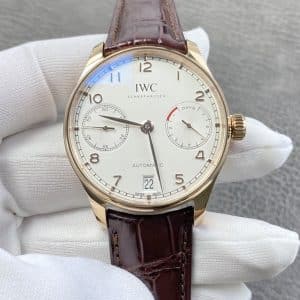
IWC Pilot Watches: What Actually Holds Up in the Replica Market
Most people arrive at IWC pilot watches because of the design, but they stay—or leave—because of wear reality. Big numerals, matte dials, oversized crowns, and tool-watch proportions sound simple, yet these same traits brutally expose weak replicas. Flat lume, wrong case geometry, thick profiles, or unstable movements stand out immediately on a pilot watch. That is why the IWC pilot category has quietly become one of the clearest separators between serious factories and everyone else.
This category is not about hype pieces. It is about repeatable daily wear, legibility in real light, and movements that survive long ownership cycles.
Why IWC Pilot Watches Are Harder to Replicate Than They Look
On paper, an IWC pilot watch is just steel, three hands, and Arabic numerals. In practice, it demands precision in areas where replica factories historically fail.
The first issue is dial proportion. Pilot dials are open and unforgiving. Any misalignment in numerals, uneven printing, or incorrect font weight becomes obvious within seconds. Factories that succeed here typically invest more time in dial tooling than in case finishing.
The second issue is thickness discipline. Genuine IWC pilot watches, especially Mark XVIII and Big Pilot models, wear thinner than most people expect. Many early replicas looked acceptable in photos but failed on the wrist because the case height destroyed the balance. This single factor eliminated dozens of factories over the years.
The third issue is movement logic. Pilot watches are not display-caseback jewelry pieces. They need stable torque delivery, predictable date changes, and resistance to daily knocks. Decorative movements mean nothing if the watch gains thirty seconds a day after six months.
Because of these constraints, only a small group of factories remain relevant in the IWC pilot replica space.
Mark XVIII: Where Practical Judgment Matters More Than Specs
If there is one model that exposes factory maturity, it is the Mark XVIII. At 40mm with a restrained dial, this watch leaves no room for visual tricks.
In real-world use, MKS has proven itself as the most consistent producer of Mark XVIII replicas. The decision to move away from early Sea-Gull 2892 variants toward Miyota 9015 was not about marketing. It was about reducing long-term return rates. The result is a watch that holds time within acceptable daily variance and survives multi-year wear without chronic rotor noise or erratic date jumps.
V7 also produces a technically competent Mark XVIII, particularly for buyers who want a 2892-based feel. However, over time, the difference becomes clear. MKS prioritizes case thickness, dial spacing, and overall balance, while V7 tends to focus on incremental detail tweaks. For most owners, balance matters more than microscopic wins.
The Mark XVIII is not a watch you buy for novelty. It is a watch you wear repeatedly. That reality favors stability over perfection.
Big Pilot: Real Power Reserve or Nothing at All
The Big Pilot category has one unforgiving rule: fake power reserve indicators are unacceptable. Early replicas failed here, using decorative hands linked to nothing meaningful. Those watches aged poorly, both mechanically and reputationally.
ZF changed the landscape by committing to a genuine long-power-reserve architecture using a custom Dandong-based movement. This was not flawless at launch, but over successive iterations it became reliable enough to justify the size and price of the watch.
In daily use, ZF Big Pilot models deliver what matters: visible power reserve behavior that matches actual winding, stable amplitude across multi-day wear, and correct dial spacing that preserves the visual dominance of the watch. The case finishing is competent, but the movement choice is what keeps this model relevant.
Other factories have produced Big Pilot replicas, but most collapse under long-term ownership. Once the novelty wears off, unstable torque and drifting indicators turn the watch into a drawer piece. In this category, ZF is not perfect, but it is functionally alone.
Pilot Chronograph: Complexity Exposes Weak Judgment
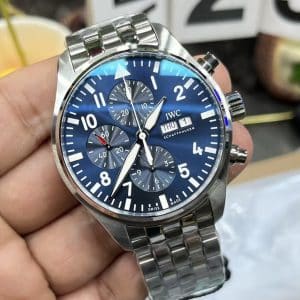
Chronograph pilot watches attract buyers who want visual complexity, but they also attract mechanical risk. The 7750-based architecture remains the only viable option at this level, and how it is implemented matters more than branding.
ZF’s pilot chronographs succeed because they respect functional limits. The cases remain thick, but proportionally correct. Sub-dials function as intended. Weekday and date displays advance reliably. Most importantly, the factory does not attempt gimmicks that destabilize the movement.
These watches reward disciplined use. If you treat the chronograph as a tool rather than a toy—no constant resets, no careless date adjustments—they hold up. Many alternatives look similar in photos but fail under routine wear.
In this category, restraint is the hidden virtue.
Movement Choice Is a Long-Term Decision, Not a Specification Sheet
Across the pilot watch category, movement selection follows a simple truth: boring movements age better.
Miyota 9015-powered watches rarely impress on paper, but they survive ownership. Modified 2892 architectures offer thinness and familiar feel, but demand better assembly discipline. Long power reserve movements only work when the factory commits to iteration, not shortcuts.
Pilot watches punish instability. If a movement cannot handle daily crown interaction, temperature changes, and repeated wear, the watch becomes frustrating fast.
Factories that understand this build fewer models and improve them slowly. Factories that chase variety usually disappear.
What Experienced Buyers Actually Choose
After novelty fades, experienced replica buyers tend to converge on a narrow set of pilot watches:
- Mark XVIII for daily wear and low maintenance
- Big Pilot for statement size with functional integrity
- Pilot Chronograph for controlled complexity
These choices are not about trends. They are about watches that still make sense after the honeymoon phase ends.
The Real Standard for a Pilot Watch Replica
A good IWC pilot replica does not need to be perfect. It needs to remain coherent after months of wear. The dial must still feel balanced. The case must still sit correctly. The movement must still behave predictably.
Factories like MKS and ZF succeed here not because they promise perfection, but because they respect long-term use more than first impressions.
That distinction defines this category.
If you want an IWC pilot replica that remains convincing after ownership replaces excitement, choose the version built for stability rather than spectacle.