

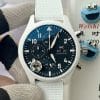
De-Homogenization Through Color Discipline, Not Saturation
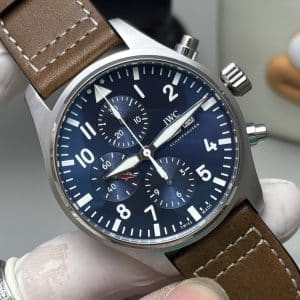
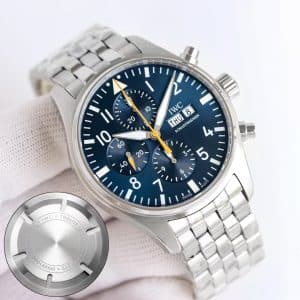
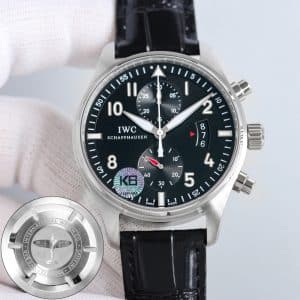
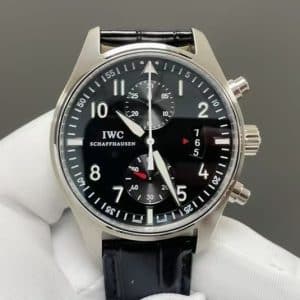
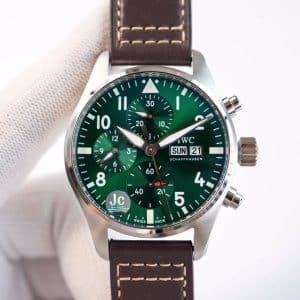
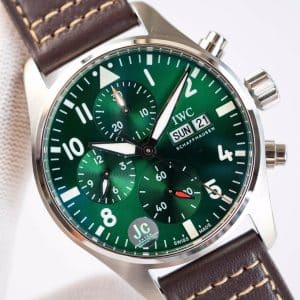
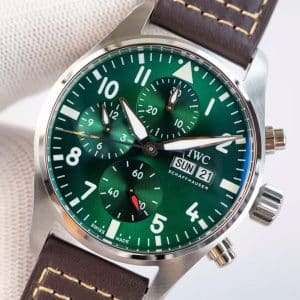
Green dials punish excess. Too glossy and they reflect everything. Too dark and they collapse into black indoors. This JC Factory version of the IWC Pilot Chronograph Spitfire IW377724 keeps the green dial restrained, with readability treated as the main priority rather than color novelty.
The tone is best understood as controlled rather than bright. In product photos and QC photos, the buyer should check how the dial behaves under both direct light and softer indoor light, since green finishes can shift more noticeably than black or blue dials.
This is where the page’s de-homogenized angle matters: the watch is positioned around measured color, practical contrast, and chronograph layout discipline.
Entity Snapshot
| Model context | IWC Pilot Chronograph Spitfire IW377724 replica watch |
|---|---|
| Factory version | JC Factory |
| Product category | Pilot chronograph watch |
| Dial color | Green |
| Case | 43 mm stainless steel |
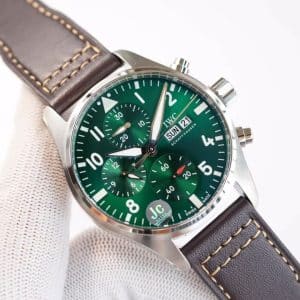
| Strap | Brown leather strap |
| Crystal | Sapphire crystal with restrained anti-reflective treatment as described in the source copy |
| Layout | Day-date chronograph with Arabic pilot numerals |
| Movement description | 7750-based automatic chronograph movement, described as modified toward IWC 79320 or 6938x architecture |
| Not specified | Case thickness, lug width, weight, water resistance, clasp type, power reserve, and structured SKU |
Stainless Steel Case and Proportion Control
The 43 mm stainless-steel case gives this Spitfire chronograph a full pilot-watch presence. Brushing is the dominant case language, with polished edges used more as definition than decoration. That keeps the watch closer to an instrument-style chronograph than a dress-oriented design.
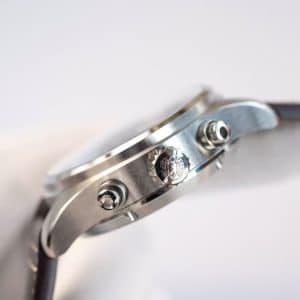
Because this is a 43 mm chronograph, buyers should expect more wrist presence than a slim two-hand watch. In QC photos, check that the lugs sit evenly, the crown and pushers line up cleanly, and the brushed surfaces look consistent across the case flanks and bezel edge.
Dial Layout, Typography, and Long-Term Readability
The dial follows the Spitfire chronograph layout described in the product copy:
– 30-minute counter at twelve
– Running seconds at nine
– 12-hour counter at six
– Day-date at three
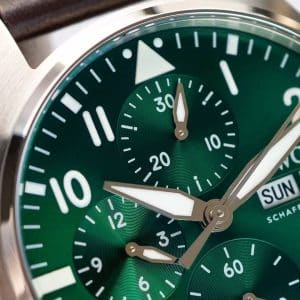
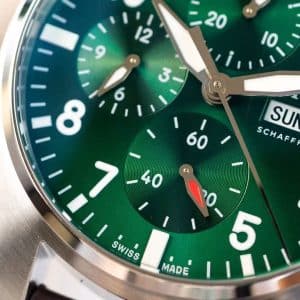
Sub-dial spacing, date-window centering, and numeral printing are the main visual checkpoints. The Arabic numerals should appear sharp at the edges, with even stroke weight and no obvious bleeding under close-up inspection.
The small red chronograph detail at six o’clock adds orientation without turning the dial into a loud color mix. It should be checked for clean placement and alignment with the lower counter.
Crystal and Anti-Reflective Restraint
The sapphire crystal is described with a controlled anti-reflective treatment rather than a heavy blue glare effect. On a green chronograph dial, this matters because glare can make the dial look darker, brighter, or less even depending on the angle.
When reviewing photos, ask for at least one straight-on dial image and one angled image. This helps separate normal crystal reflection from dial-color inconsistency.
Movement Choice and Chronograph Reality
JC Factory describes this watch as using a 7750-based automatic chronograph movement modified toward the IWC 79320 / 6938x architecture, supporting chronograph and day-date functions.
Movement behavior should be treated as something to confirm during QC rather than assumed from copy alone. Ask whether the central chronograph hand resets to zero, whether the 30-minute and 12-hour counters advance correctly, and whether the day-date display changes and centers cleanly in the window.
This is a practical automatic chronograph setup, but buyer confidence should come from function checks and clear photos, not broad claims about perfect movement equivalence.
Strap Integration and Wearing Character
The brown leather strap gives the green dial a warmer, more traditional pilot-watch appearance. It also keeps the watch away from a modern ceramic or rubber-strap character.
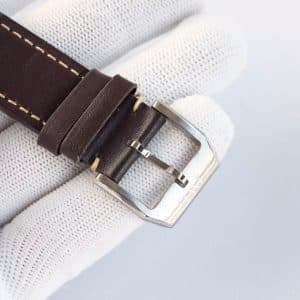
In QC photos, inspect stitch spacing, strap edge finishing, hole alignment, and how the strap sits between the lugs. Strap thickness and clasp or buckle details are not specified as structured product attributes, so visible-photo confirmation is useful.
QC Photo Checklist
- Check the green dial in direct and softer light for even tone and readable contrast.
- Inspect Arabic numeral printing for sharp edges, consistent thickness, and clean spacing.
- Confirm sub-dial placement: 30-minute counter at twelve, running seconds at nine, and 12-hour counter at six.
- Check that the day-date window at three is centered and not visibly tilted or crowded.
- Look at the red chronograph detail at six for clean placement and color control.
- Confirm the central chronograph hand resets exactly to zero.
- Ask for chronograph start, stop, and reset confirmation if function testing is available.
- Inspect crown and pusher alignment from the case side.
- Review brushed case finishing for even grain and clean transitions at polished edges.
- Check crystal glare from an angled photo to understand the anti-reflective behavior.
- Review strap stitching, strap seating, and clasp or buckle details if visible.
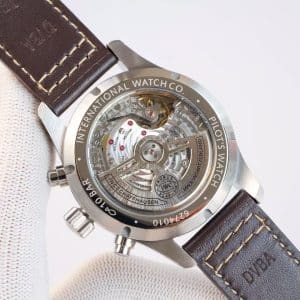
- Ask for caseback photos if caseback finishing is part of your decision.
Buyer-Visible Compromises and Inspection Cautions
Colored dials are more sensitive to lighting than neutral dials, so the green tone should be judged from multiple photos rather than a single studio angle. A dial that looks restrained in one image may read darker or brighter in another.
Chronograph replicas also need careful alignment checks. The central chronograph hand, sub-dials, and day-date window are all easy to inspect in QC photos and should be reviewed before selection.
The 43 mm case gives the watch its pilot-chronograph character, but it is not an ultra-thin or minimal watch. Buyers who want a flat dress profile should consider that before inquiry.
Where JC Factory Separates This Version From Louder Green Chronographs
Many green-dial pilot chronographs chase immediate visual impact. This JC Factory IW377724 page is better framed around controlled color, balanced sub-dials, and practical legibility.
The key decision is not whether the dial is the brightest green available. It is whether the restrained green, brown leather strap, 43 mm steel case, and day-date chronograph layout match the buyer’s idea of a daily pilot chronograph.
Who This Watch Is For—and Who It Isn’t
This watch suits buyers who want a restrained green pilot chronograph, a larger 43 mm stainless-steel case, day-date utility, Arabic numeral readability, and a brown leather strap look.
It is not ideal for buyers seeking an ultra-thin case, ceramic materials, a minimal two-hand dial, an official IWC product, or a very bright green colorway. This version is built around measured pilot-watch character rather than statement color.
Design Context
The Spitfire-style pilot chronograph format relies on a dense but orderly dial: large Arabic numerals, three chronograph registers, a day-date display, and a strong case shape. On this IW377724 green-dial version, the color needs to support that structure instead of competing with it.
The 43 mm steel case and brown leather strap give the watch a grounded, aviation-tool profile. The main visual test is whether the dial remains easy to read once the chronograph registers, day-date window, red lower detail, and crystal reflections are all present together.
Key Feature Notes
- Restrained green dial: Designed to read as controlled and practical rather than bright or novelty-driven.
- 43 mm pilot case: Offers a larger chronograph presence with stainless-steel finishing.
- Day-date chronograph layout: Combines timing functions with a practical calendar display at three.
- Brown leather strap: Supports the warmer Spitfire-style appearance without pushing the watch into a sporty rubber-strap direction.
- 7750-based automatic movement: Described as a functional chronograph base; operation should be confirmed through QC checks.
FAQ
What identifies this as the IW377724 green-dial version?
The key identifiers are the green dial, 43 mm stainless-steel case, brown leather strap, Arabic pilot numerals, day-date window at three, and three-register chronograph layout.
What should I inspect first in QC photos?
Start with dial color consistency, numeral printing, sub-dial spacing, day-date centering, and whether the central chronograph hand resets to zero.
Is the 43 mm case suitable if I dislike thin dress watches?
Yes, this is positioned as a larger pilot chronograph with stronger wrist presence. It is better suited to buyers who want a substantial case than those looking for an ultra-thin profile.
What does the 7750-based movement wording mean?
It means the movement is described as an automatic chronograph based on the 7750 platform and modified toward the stated IWC-style architecture. Chronograph reset, counter movement, and day-date operation should still be confirmed before selection.
Why check the green dial under different lighting?
Green dials can shift in appearance depending on glare, angle, and light temperature. Multiple photos help confirm whether the color remains restrained and readable.
Inquiry Guidance
Before making a decision, request current photos that clearly show the dial, case sides, crown and pushers, brown leather strap, day-date window, and chronograph reset position. For this JC Factory IWC Pilot Chronograph Spitfire IW377724, the strongest confirmation points are controlled green-dial readability, clean day-date alignment, balanced sub-dials, and a properly reset central chronograph hand.
This JC Factory Spitfire Green Chronograph is best evaluated through its restraint: green dial control, 43 mm pilot proportions, day-date chronograph utility, and QC-photo alignment checks.
Watch Specifications
- Factory version
- JC Factory
- Movement
- 7750-based automatic chronograph movement, described as modified toward IWC 79320 or 6938x architecture
- Case size
- 43 mm stainless steel case
- Thickness
- Not specified on this product page
- Bracelet / strap
- Brown leather strap
- Crystal
- Sapphire crystal with restrained anti-reflective treatment as described on this product page
- Dial details
- Green dial with Arabic pilot numerals, day-date at three, 30-minute counter at twelve, running seconds at nine, 12-hour counter at six, and red chronograph detail at six
- Bezel
- Not specified on this product page
- Caseback
- Not specified on this product page
- Model / reference family
- IWC Pilot Chronograph Spitfire IW377724 replica watch
- Colorway
- Restrained green dial with stainless steel case and brown leather strap
- QC focus
- Check dial color consistency, numeral printing, sub-dial spacing, day-date centering, central chronograph hand reset, crystal glare, crown and pusher alignment, case brushing, and strap stitching in current photos
Known Flaws
- Green dial tone and print: Inspect the dial in straight-on and angled photos for color consistency, sharp Arabic numeral edges, and clean minute-track printing. Green dials can shift under lighting and reveal uneven printing more easily than darker dials; this is moderately important for buyers who chose this version for restrained readability.
- Chronograph hand and sub-dial alignment: Check that the central chronograph hand resets exactly to zero and that the 30-minute counter at twelve, running seconds at nine, and 12-hour counter at six look evenly placed. Small alignment errors are visible on a busy pilot chronograph, so this is a high-priority QC point for most buyers.
- Day-date window at three: Confirm that both day and date sit centered in the aperture, with no obvious tilt, crowding, or uneven spacing. A slightly off calendar display can be noticed during daily use, making this a medium-to-high concern depending on how sensitive the buyer is to dial symmetry.
- Crystal glare and dial distortion: Review at least one angled photo to see how the sapphire crystal and anti-reflective treatment affect the green dial. Reflection is normal, but heavy glare or edge distortion can reduce legibility; for most buyers this is a moderate issue unless it hides the dial in common viewing angles.
- Case thickness impression and side finishing: Because this is a 43 mm automatic chronograph, inspect side-profile photos for wrist presence, pusher alignment, crown seating, and even brushed finishing. The size is part of the pilot-chronograph character, but buyers expecting a slim watch should treat this as an important fit consideration.
- Brown leather strap fit and finishing: Look at strap seating between the lugs, stitch spacing, edge finishing, and buckle or clasp details if visible. Strap flaws are usually less serious than dial or chronograph alignment issues, but they affect the first visual impression and comfort of this green-dial Spitfire setup.
Best For / Not Ideal For
Best For
- Buyers who want a restrained green pilot chronograph rather than a bright or novelty-focused green dial.
- Buyers comfortable with a 43 mm stainless-steel case and the stronger presence expected from an automatic chronograph.
- Buyers who value practical dial legibility, Arabic pilot numerals, and a day-date chronograph layout with clear sub-dial organization.
- Buyers who prefer the warmer brown leather strap look over rubber, bracelet, ceramic, or more modern sport styling.
- Buyers willing to evaluate QC photos for dial color consistency, day-date centering, chronograph hand reset, crystal glare, and case finishing before deciding.
Not Ideal For
- Buyers looking for an ultra-thin, minimal, or dress-style watch; this is a 43 mm pilot chronograph, and thickness is not specified.
- Buyers who want a very bright green dial or a more attention-driven colorway instead of a controlled Spitfire-style green.
- Buyers who prefer ceramic materials, integrated bracelets, rubber straps, or a more technical modern pilot-watch appearance.
- Buyers who do not want to check chronograph alignment, day-date positioning, pusher and crown alignment, and other QC-photo details.
- Buyers seeking an official IWC product or guaranteed movement equivalence; the movement is described as 7750-based and should be assessed through function confirmation.
Design Background
The IWC Pilot Chronograph Spitfire IW377724 format is defined by a dense but readable pilot-chronograph layout: Arabic numerals, three registers, a day-date window at three, and a case shape with stronger tool-watch presence than a minimal dress watch. On this JC Factory replica version, the green dial is the main decision point because it needs to stay controlled enough for the chronograph display to remain legible.
The stated 43 mm stainless-steel case gives this version a larger pilot-watch profile, while the brown leather strap keeps the overall character warmer and more traditional than a rubber-strap or ceramic-style chronograph. Case thickness is not specified, so buyers should judge side-profile photos carefully rather than assuming a slim wearing feel.
The dial layout described for this model includes a 30-minute counter at twelve, running seconds at nine, a 12-hour counter at six, a day-date display at three, and a small red chronograph detail at six. This makes QC-photo inspection important: sub-dial spacing, numeral edge sharpness, day-date centering, and central chronograph hand reset should all be checked before comparison with similar green pilot chronographs.
The sapphire crystal is described with restrained anti-reflective treatment, which matters on a green dial because reflections can change how the color reads in photos. The movement is described as a 7750-based automatic chronograph modified toward IWC 79320 or 6938x architecture, so buyer confidence should come from visible alignment checks and requested function confirmation rather than broad assumptions about movement equivalence.
Pilot models tend to reveal factory differences through dial layout, numerals, and overall wrist presence. IWC Pilot factory overview.