
46mm tool-watch presence, 7-day architecture claims, and the thickness trade-off.
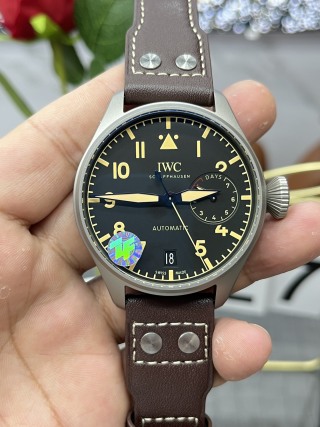
Big Pilot replicas don’t succeed or fail on decorative finishing. They live or die on ergonomics. The crown has to feel deliberate, not vague. The strap has to control a heavy case, not let it float. The dial has to stay readable at arm’s length, in uneven light, and while moving. If those three things work together, the watch feels purposeful. If they don’t, no amount of polished edges saves it.
That is why Big Pilot replicas behave differently from most IWC replicas. The size amplifies every mistake. A half-millimeter of extra thickness becomes wrist leverage. Slightly soft crown teeth become daily irritation. Printing that would pass unnoticed on a 40mm dress watch becomes obvious across a 46mm pilot dial.
Among current builds, ZF is widely preferred in enthusiast circles for Big Pilot executions. Not because it is perfect, but because it tends to get the structural fundamentals right more often than most. This review focuses on a ZF IW5009-style build and evaluates it the way owners actually experience it: on the wrist, through the crown, across the dial, and over time.
Model Identity: What “Big Pilot” Means (IW5009 / IW5010) and Why Replicas Fail Here
The Big Pilot Formula: 46mm, Oversized Crown, Date at 6, Power Reserve at 3
The Big Pilot formula is simple on paper and unforgiving in practice. A 46mm case, a large conical crown, a date window at six, and a power reserve indicator at three. That layout leaves no visual margin for error. Spacing has to be right. Balance has to feel natural. Legibility has to survive distance and motion.
Most replica failures happen in the small stuff. The power reserve hand is often the wrong length, stopping short of the printed scale. The date window sits too shallow or too deep, creating an artificial shadow. Subtle mis-centering of printing throws off the entire dial, especially around the 12 o’clock triangle. Even numeral thickness matters here. On a Big Pilot, inconsistent stroke width reads as cheap immediately.
This is not a decorative watch. It is a legibility instrument. Anything that interferes with that shows up every time you check the time.
IW5009 vs IW5010 vs “Big Pilot 43”: Don’t Mix Them Up
The classic Big Pilot references, including IW5009 and IW5010, are 46mm watches with external power reserve displays and oversized crowns. The newer Big Pilot 43 drops the power reserve entirely and shrinks the case. Dial text changes. Caseback styles change. Proportions change.
Replica listings frequently blur these lines. A 43mm layout gets paired with a 46mm case. A 7-day dial appears on a smaller body. Casebacks copy the wrong generation. That confusion creates watches that look almost right until you live with them.
The quick identifiers are straightforward: the 46 mm classics carry the power reserve at three and the date at six, and as noted in the dimensional and configuration breakdown of the IWC Portuguese 7 Days IW5007 replica dial and case architecture review, smaller variants do not; casebacks on the older models tend to be simpler and more tool-like while newer designs lean more decorative, so this article stays with the 46 mm IW5009-style architecture and avoids mixing families.
What We’re Reviewing: ZF IW5009-Style Build (and What “ZF” Usually Gets Right)
This evaluation focuses on one popular high-tier execution rather than every Big Pilot on the market. ZF’s IW5009-style build is close in silhouette and generally consistent in assembly, while still variable in micro-details.
That distinction matters. This is not a claim of perfect replication. It is an assessment of how one widely circulated build behaves when worn, wound, and lived with.
Case & Thickness: The Real Comfort Problem (and the Engineering Reason)
Thickness Isn’t Cosmetic: It Changes Where the Watch Sits and How the Crown Feels
Big Pilot thickness is not a visual issue. It is a mechanical one.
Long power reserve architectures stack components vertically. The mainspring barrel is larger. The power reserve linkage adds height. The automatic winding system sits on top of everything. That stack height pushes the center of mass upward, which changes how the watch balances on the wrist.
In daily wear, this shows up as top-heaviness. A stiff strap lets the case hover instead of settling. The crown starts to press into the back of the hand when the wrist bends. You feel the watch before you admire it.
ZF manages this better than most by keeping overall thickness within a tolerable range for a 46mm tool watch, but the physics remain. This is still a tall, heavy case. Anyone expecting dress-watch comfort will be disappointed.
What to Measure (Practical) and What to Ignore (Marketing)
Case diameter alone tells you almost nothing about comfort.
What matters is total thickness, lug-to-lug length, and the span from crown tip to crown guard. Those three measurements define how the watch occupies space on your wrist and how it interacts with movement.
A Big Pilot can measure 46mm across and still feel wearable if the lugs curve properly and the crown sits where it should. It can also feel unmanageable at the same diameter if the lugs run straight and the crown protrudes too far. Numbers on a spec sheet do not predict that. Geometry does.
Case Geometry and Finishing Checks (Fast tells)
There are quick ways to judge case quality without tools.
Look at the seam between bezel and midcase. It should be uniform all the way around. Check brushing direction on the case sides and lugs. Inconsistent grain usually signals rushed finishing. Examine the caseback engraving. Crisp edges indicate proper machining. Soft lettering suggests shallow stamping.
Run a finger across the crown knurling. It should feel grippy, not razor sharp. Overly aggressive teeth look dramatic but become uncomfortable during winding.
These details don’t make the watch, but they tell you how much care went into assembling it.
Dial, Printing, and Lume: How Legibility Reveals Build Quality
Printing and Track Alignment: The Stuff You See Every Day
The Big Pilot dial exposes everything.
Minute track spacing should be even. The “IWC” and “Schaffhausen” lines need consistent separation. Numerals must carry uniform thickness. The 12 o’clock triangle has to sit square, with both side dots aligned.
Tiny deviations become obvious because the dial is so open. On smaller watches, these issues hide. On a Big Pilot, they stare back at you. That is why this model is such a good test of printing discipline.
When these elements are right, the watch feels calm. When they are not, your eye keeps searching for balance that never arrives.
Lume Behavior: Brightness vs Evenness vs Color
Lume performance is not a single metric. It has three phases.
First is charge time. A healthy application takes light quickly. Second is the first five minutes, where brightness should peak evenly across hands and numerals. Third is the 30–60 minute mark, where decay reveals inconsistencies.
Common replica issues appear here. Grainy lume fill creates patchy glow. Individual plots fade faster than others. Hands age differently from numerals, producing mismatched color in low light.
A Big Pilot relies on lume for identity as much as function. When it fades unevenly, the watch loses its tool character.
Crystal & AR: Why Some Big Pilots Look “Flat” in Photos
Anti-reflective coating shapes how the dial presents itself.
Proper AR reduces glare and adds depth, letting the dial appear to sit below the crystal. When AR is weak or absent, the watch photographs flat and glassy, even if the printing underneath is good.
If you want to evaluate AR, don’t shoot straight on. Tilt the watch under indirect light. That oblique angle reveals tint and reflection control far better than any head-on image.
In the end, Big Pilot replicas are not judged by spec sheets or macro photos but by how they settle on your wrist, how the crown answers your fingers, and how the dial speaks across a room, and while we can show how it is built and how it behaves, how it fits into your life is a decision only you can make.
The 7-Day Claim: Power Reserve Indicator, Winding Efficiency, and Realistic Expectations
What “7-Day” Means in Real Use (Even on Genuine)
A long power reserve is not about chasing a headline number. It is about maintaining a stable torque curve over several days so timekeeping does not collapse once the mainspring moves off its initial tension peak. That is true on genuine Big Pilots, and it remains true on replicas.
In practical terms, a healthy long-reserve watch should still feel strong on day two and day three. The seconds hand should not hesitate. Amplitude should not visibly sag. Crown resistance during manual winding should remain smooth rather than turning vague. If the watch feels tired after forty-eight hours, the architecture is not doing its job, regardless of what the dial claims.
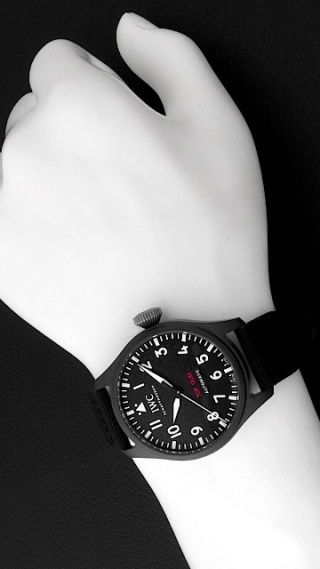
Even authentic Big Pilots rarely deliver a perfect seven days under normal wear. Wrist motion varies, winding efficiency varies, and resting positions matter. Expecting laboratory numbers from a daily-worn mechanical watch sets the wrong baseline. What matters is whether the watch stays consistent across the middle of its reserve, because that is where most owners actually live.
Power Reserve Indicator: What to Test (and What Can Be Faked)
The power reserve display is easy to animate and surprisingly easy to fake.
Start with a full manual wind to the natural stop point. If you can, count turns. You are not chasing an exact number. You are learning how resistance builds and where it plateaus. A healthy system tightens progressively and stops cleanly. Soft endings or spongy limits usually point to slipping or poorly tensioned components.
Watch the power reserve hand as you wind. It should travel smoothly across its scale. Jerky movement or visible stepping often means the linkage is crude or poorly lubricated.
Then park the watch dial-up for twenty-four hours and check the drop. A meaningful reserve will show a measurable but proportional decrease. Red flags appear when the indicator moves dramatically while runtime barely changes, or when the hand jumps in chunks instead of sweeping. Those patterns usually mean the display is decorative rather than mechanically honest.
A real power reserve system ties directly into barrel behavior. Anything that feels disconnected probably is.
Rotor and Auto-Wind Reality: Why Big Pilots Expose Weak Winding Modules
Big Pilots are unforgiving to lazy automatic systems.
The case is heavy. The mainspring is large. The reserve is long. All three amplify inefficiencies. On smaller watches, a weak winding module hides behind light weight and short reserves. On a Big Pilot, you notice it within days.
Rotor noise becomes more than an annoyance — it becomes feedback about bearing quality and winding geometry, and as the winding-efficiency and feedback behavior section of the IWC Aquatimer replica guide to rotor dynamics and reserve build explains, efficient systems stay quiet and build reserve steadily through normal movement while inefficient ones chatter, spin freely, and still fail to keep the watch topped up; daily-wear stability depends on this, because if the watch loses reserve during active use, manual winding becomes routine rather than occasional, and that is not how a Big Pilot is meant to behave.
Date Change Timing at 6: Risk Window and Correct Behavior
The date at six looks simple, but it lives inside the same crowded movement stack as the power reserve system.
Most Big Pilot architectures enter their changeover phase well before midnight. The danger zone typically starts a few hours earlier and extends until the date has fully seated. For safety, avoid quickset adjustments anywhere near that window.
Treat the mechanism like what it is: mechanical, layered, and sensitive to timing. Set the date with the hands well away from the transition period. Do not force resistance. Convenience habits damage calendar works faster than wear ever will.
Crown Feel: Torque, Stem Play, and the “Big Crown” Trap
What the Crown Should Feel Like (and What Feels Wrong)
The oversized crown is a defining Big Pilot feature, but it also magnifies every tolerance error in the winding system.
Good crowns deliver consistent resistance through the entire winding arc. They feel deliberate. There is no gritty grinding. There are no sudden slips. Each turn builds tension in a predictable way.
Bad crowns wobble on the tube. They produce crunchy clicks under load. They change resistance abruptly mid-rotation. Those sensations point to stem play, poor lubrication, or misaligned gears. Once you notice them, they tend to get worse with use.
Because the crown is so prominent, these flaws surface early. That makes crown feel one of the fastest ways to judge overall assembly quality.
Manual Winding as a Diagnostic Tool
Manual winding tells you more about a Big Pilot than any timegrapher snapshot.
Smooth, progressive resistance usually means the barrel, intermediate wheels, and keyless works are aligned and lubricated correctly. Abrupt spikes in torque often signal dry contact points or binding gears.
If resistance suddenly increases, stop. Do not force past it. Mechanical systems communicate through feel. Ignoring that feedback shortens service intervals dramatically.
A few deliberate manual winds each week also help maintain lubrication distribution in long-reserve movements. Think of it as preventative care rather than compensation for weak auto-winding.
Crown Guards and Tube Alignment: Cosmetic Detail That Becomes Mechanical
Crown guards and tube placement look cosmetic, but they dictate how force enters the movement.
If the tube sits slightly off-axis, the crown engages at an angle. The result is an “angry” winding feel that never quite smooths out. Over time, that misalignment accelerates wear on the stem and keyless components.
This also ties into water resistance. Misaligned tubes compromise gasket compression, even if everything appears tight. Unless the watch has been pressure tested, assume splash resistance only and behave accordingly.
Big Pilots invite interaction. When those interaction surfaces are aligned, the watch feels confident. When they are not, every turn of the crown reminds you.
Strap & Buckle: Where “Luxury Feel” Usually Breaks
Strap Thickness, Stiffness, and Break-in (46mm Watches Amplify This)
On a watch this large, the strap does not play a supporting role. It controls the entire experience.
Most replica Big Pilots ship with straps that look convincing but behave poorly out of the box. The leather is usually thick and surface-finished for appearance rather than flexibility. On a 46mm case, that stiffness lifts the watch off the wrist, leaving it perched instead of planted. The result is a floating sensation, amplified crown pressure, and constant micro-adjustments throughout the day.
Break-in should be gradual. Wear the watch in short sessions at first. Let body heat soften the leather naturally. Avoid aggressive bending near the lugs, where the strap transitions from rigid to flexible. Forcing that curve early creates permanent creases and weakens the spring bar area. A Big Pilot settles best when the strap learns your wrist over time rather than being trained in one afternoon.
Lug Fit and Spring Bar Seating
Lug fit is one of the most overlooked contributors to perceived quality.
Start by checking for visible gaps at the lug ends. Even small spaces allow the strap to shift under load. Then perform a gentle wiggle test. The watch head should not rock independently of the strap. If it does, the spring bars are either undersized or not seated correctly.
Poor seating does more than threaten security. It makes the watch feel unstable in motion. Every step introduces movement between case and strap, which exaggerates the top-heavy nature of the Big Pilot and turns a confident tool watch into something that never quite settles.
Buckle Engraving and Edge Finish
Buckles tell quiet truths.
Look at engraving depth first. Shallow, washed-out logos usually indicate fast stamping. Proper buckles carry crisp lettering that remains legible under oblique light. Then run a finger along the edges. Cheap buckles bite the skin with sharp corners that should have been chamfered away.
Finally, check alignment. The logo should sit square within brushed surfaces, not drift toward one side. These details do not affect timekeeping, but they shape daily comfort. On a watch this size, the buckle spends as much time touching you as the case does.
Side-by-Side Reality: ZF vs “Typical” Mid-Tier Big Pilot Builds
Where ZF Usually Wins
ZF’s advantage is not dramatic innovation. It is consistency.
Case geometry tends to be more controlled, with fewer asymmetries around the bezel and midcase transitions. Dial printing usually shows better discipline, especially in numeral thickness and track alignment. Assembly feels more deliberate, from crown engagement to caseback fit.
None of this makes ZF untouchable. It simply means fewer surprises. Compared to typical mid-tier builds, ZF watches arrive closer to their intended shape and require less correction to feel coherent on the wrist.
Where Even High-Tier Replicas Still Diverge
There are limits that no current replica fully crosses.
Movement architecture under a display back still tells a different story than genuine, especially around barrel layout and finishing depth. Exact power reserve runtime varies from piece to piece, even within the same batch. Anti-reflective coating tone often misses the subtle hue of the original. Strap leather, while serviceable, rarely approaches genuine quality in suppleness or longevity.
These are not minor nitpicks. They are structural realities of replica engineering. ZF narrows the gap, but it does not erase it.
Who Should Not Buy a Big Pilot Replica
Big Pilots demand physical space.
If your wrist is under 6.5 inches, the combination of 46mm diameter and substantial thickness will dominate, regardless of strap choice. The watch will wear you instead of the other way around.
And if you expect a literal seven-day reserve with perfect winding efficiency and laboratory consistency, this category will disappoint. Long-reserve mechanical watches trade theoretical numbers for lived behavior. Understanding that trade-off is part of owning one.
QC Checklist Before You Accept (Strict, Big Pilot-Specific)
Dial and Hand Checks
Start with the hand stack, because this is where tolerance errors show up fastest.
The power reserve hand must clear the dial cleanly throughout its full arc, and as the clearance and stacking tolerance criteria in the IWC replica watches series comparison for Portuguese, Pilot, Ingenieur, and Portofino vertical spacing and hand-clearance evaluation make explicit, any hint of rubbing or hesitation usually means poor vertical spacing; likewise, the minute hand should pass over the numerals without grazing their edges even when viewed from shallow angles, and on Big Pilots that clearance is tight by design, so marginal builds reveal themselves quickly here.
Then move to the date at six. The numeral should sit centered in its window, not biased high, low, or to one side. Off-center dates are not cosmetic. They often signal misaligned calendar components deeper in the movement.
If any of these fail, do not rationalize them away. These are structural indicators, not surface flaws.
Function Checks (Must-pass)
Begin with a full wind from empty to roughly eighty percent. You are not chasing the stop point here. You are feeling for consistency. Resistance should rise smoothly, without gritty patches or sudden drops.
Watch the power reserve hand during this process. It should advance continuously, not in visible steps. Stuttering usually points to crude linkage or dry contact points.
Then set the watch down for twenty-four hours and observe timekeeping. Note the drift, not just the absolute number. Stable behavior matters more than headline accuracy. Large swings between positions suggest balance or lubrication issues that will only grow with wear.
These checks take a day. They save months of frustration.
Strap and Hardware Checks
Finish with the parts that hold everything together.
Confirm lug fit by looking for gaps at the strap ends. Perform a gentle wiggle test to verify spring bar security. The case should not rock independently of the strap.
Inspect buckle alignment and closure. The logo should sit square. The clasp should close positively, without needing force or adjustment. Hardware problems turn daily wear into a constant negotiation.
Ownership Reality: Durability, Service, and Water Resistance
Long-Reserve Movements: What Usually Fails First
Long-reserve architectures concentrate stress in predictable places.
The automatic winding module tends to wear first, especially if rotor bearings are marginal. Lubrication becomes more critical as torque loads increase, and dry contact points show up as rough winding feel long before they become visible failures. Power reserve linkages can loosen over time, leading to indicators that move but no longer reflect actual runtime.
None of this is catastrophic. These movements are serviceable. But they are not ignore-and-forget mechanisms. Treat them like mechanical systems that benefit from periodic attention, not sealed appliances.
Water Resistance: Conservative Rules
Unless the watch has been pressure tested, assume splash resistance only.
Pay attention to crown feel and tube alignment. A crown that wobbles or engages at an angle rarely seals well, even if gaskets are present. The Big Pilot crown is large, exposed, and frequently used. That combination magnifies any sealing weakness.
Rain and handwashing are one thing. Submersion is another. Act accordingly.
Engineering Summary: Big Pilot Replicas Live or Die by Wear Behavior
Final Judgment
Big Pilot replicas succeed when crown feel stays deliberate, the case settles instead of floating, the dial remains readable at a glance, and the power reserve behaves proportionally rather than theatrically, and while you can learn how it is built and how it behaves by understanding the movement architecture differences explained in our guide on how to identify the movement inside your IWC replica, how it ultimately fits into your daily life is a decision only you can make.
Related IWC Articles: If you found this helpful, you might also enjoy 2026 IWC Replica Factory Ranking: ZF, V7, and MKS — A System-Based Evaluation, Not a Popularity Contest, and Is the MKS Portofino Worth Buying? A Dress-Watch–Focused Review Based on Wear, Not Marketing. You may also like ZF Factory IWC Portuguese Chronograph IW3714 Replica Review (Deep-Dive), and IWC Replica Watches Guide: Best Factories, Movements & Models Explained.