Why Vacheron Constantin Models Do NOT Fail Equally in Replication
Vacheron replicas separate themselves by model long before they separate by execution. This brand’s design language exposes tolerance errors immediately because symmetry, spacing, and visual calm leave nowhere for mistakes to hide. What looks “luxurious” on paper is irrelevant in practice; the real variable is geometry density—how many reference planes, alignment lines, and vertical interfaces must agree at once for the watch to feel coherent on the wrist. Once you see this, the question stops being “Which factory?” and becomes “Which model is structurally survivable?”

The sharp stratification comes from how VC layouts behave under imperfect assembly. Calm dials amplify nothing, while complex layouts amplify everything. A single misstep in hand height, date framing, or sub-dial centering reads as instability across the whole watch because the brand avoids visual noise by design. That is why two replicas that share similar parts quality can age very differently in daily wear: one tolerates drift, the other advertises it.
This is the bridge most buyers miss. Model choice determines how errors propagate over time, how quickly alignment fatigue becomes visible, and how forgiving the watch remains after months of setting, winding, and casual knocks. Get the model right and minor imperfections stay minor. Get it wrong and small deviations accumulate into constant friction with the watch.
Calm Design = Low Error Amplification
Visually simple VC models are mechanically forgiving because they reduce the number of ways the system can argue with itself. Fewer reference lines mean fewer opportunities for misalignment to declare itself. When there are no stacked complications and the dial remains flat, vertical hand conflict drops, clearance margins widen, and everyday interaction feels stable instead of tentative.
This is not an aesthetic argument; it is an operational one. Each removed layer shortens the causal chain between movement behavior and what your eye perceives. Setting feels cleaner, minute alignment holds longer, and the watch communicates its condition honestly. Simple does not mean boring here. Simple means survivable across real ownership cycles.
The practical effect shows up after repeated use. Crowns feel consistent across the setting range, hands stay visually disciplined at twelve, and date windows keep their relationship to the dial baseline. These are not luxuries. They are the quiet signals that geometry is cooperating instead of negotiating.
Complexity Multiplies Error Visibility, Not Value
Every added module introduces another coaxial relationship that must remain true under load — stack a calendar, add a phase display, or layer registers, and you multiply the number of interfaces that can drift, and because VC layouts offer no visual distraction to soften these failures even small deviations present as systemic imbalance rather than isolated quirks, a multidimensional interface exposure challenge explored in the why VC replicas are hard to evaluate through photos alone.
Complexity also compresses tolerance budgets. More parts compete for vertical space, torque paths lengthen, and reset symmetry becomes sensitive to assembly order. What might register as a mild annoyance on a busier dial becomes an immediate credibility problem here. The watch does not “look complicated.” It looks unsettled.
Treat complications as risk multipliers, not upgrades. They increase exposure without adding forgiveness, and they surface weaknesses earlier in ownership. If your goal is a replica that stays coherent under daily handling, complexity works against you from the first week.
✅ Beginner-Friendly VC Replica Models (Low Structural Risk)
There is a safe entry zone where geometry, dial logic, and mechanical load stay aligned. These models keep reference planes simple and avoid vertical congestion, which allows minor imperfections to remain localized instead of contagious. For newcomers, this matters more than any promise of feature richness.
The value here is not hype. It is predictability. Watches in this category make it easy to see what you are getting, easy to diagnose if something drifts, and easy to live with once they are on the wrist. They teach you how VC behaves in replica form without forcing you to manage layered compromises.
Start where the system has room to breathe. Learn how alignment holds over time. Then decide whether you want to trade that stability for added display complexity later.
Overseas Three-Hand (Time + Date)
This is the most forgiving VC layout because the dial stays flat and the bezel carries strong geometry that masks micro-variance in the case. With no stacked complications, vertical conflicts stay low and the visual hierarchy remains clean. If something is wrong here, it shows itself immediately—and it is usually correctable without chasing cascading issues.
Daily interaction reinforces that stability. Hand alignment remains legible at a glance, the date sits in a predictable relationship to the dial text, and the overall feel rewards repeated setting rather than punishing it. The watch tells you the truth early, which is exactly what you want at the entry point.
From a survivability standpoint, this model teaches discipline. It exposes assembly errors fast, but it also limits how far those errors can spread. That combination makes it an honest starting line.
Patrimony Base Models (No Calendar / Small Seconds)
Dress simplicity works only when it stays minimal. A clean dial plane, low hand stack, and restrained print density create a layout that tolerates small deviations without turning them into constant distractions. Remove the extra displays and the watch regains vertical margin, which translates into calmer operation over time.
The restraint matters in use. Setting feels lighter, visual alignment holds longer, and the watch maintains composure during everyday handling. Add nothing, and the design rewards you with coherence. Add even one extra layer, and that balance begins to thin.
Patrimony in its base form is a lesson in subtraction. It proves that elegance here is not about thin claims or decorative bravado. It is about preserving structural quiet so the watch can age without announcing every compromise.
⚠️ Intermediate-Risk VC Replica Models (Tolerance Starts to Slip)
This is the gray zone where watches remain attractive on first contact but begin to demand judgment over time. The layouts still look balanced, yet internal stacking starts to matter, and alignment becomes conditional rather than inherent. These models do not collapse immediately, but they introduce dependencies between modules that make consistency harder to preserve through real use.
What changes here is not appearance but behavior. Added layers increase assembly variance, and small deviations stop staying local. A hand that sits a fraction higher than ideal now affects date framing, sub-dial symmetry, or pusher feel. This is where replicas begin to feel “fine” one day and subtly unsettled the next, not because anything dramatic failed, but because tolerance margins narrowed.
For most owners, this category marks the point where maintenance expectations rise. You can still enjoy these watches, but you must accept that alignment and interaction quality depend more heavily on how precisely everything was stacked at assembly—and how gently the watch is treated afterward.
Overseas Chronograph
The case architecture that feels calm in a three-hand configuration becomes sensitive once chronograph hardware enters the stack — module height pushes the hand column upward, which tightens vertical clearances and increases the chance of micro-contact during resets or rapid setting, leading not to immediate malfunction but to a gradual loss of mechanical composure, a structural risk vector documented in the market drift and structural risk patterns in Vacheron Constantin super-clones analysis.
Dial symmetry also becomes conditional. Sub-register spacing must agree with pusher alignment, and any offset shows up as visual tension even when the watch is technically running. Reset behavior turns into a stress test: if hands hesitate or fail to land crisply, that inconsistency propagates across every timing cycle.

Chronographs in this family tend to fail functionally before they fail visually. You feel it first in uneven pusher resistance or imperfect zeroing, long before anything looks obviously wrong. That early feedback is useful, but it also signals that you have crossed from structurally forgiving territory into conditional stability.
Moonphase & Calendar Variants
Display accuracy becomes the weak link once discs and framed apertures enter the equation. Depth control matters here, because the relationship between the disc surface and the dial opening defines whether the complication feels integrated or pasted on. When that spacing drifts, the watch loses coherence even if all functions technically operate.
Aperture framing adds another reference plane that must remain true. Date windows and calendar cutouts amplify tiny alignment errors, and phase displays expose printing shortcuts through flat stars, shallow contrast, or imprecise centering. None of this stops the watch, but it erodes credibility every time you glance down.
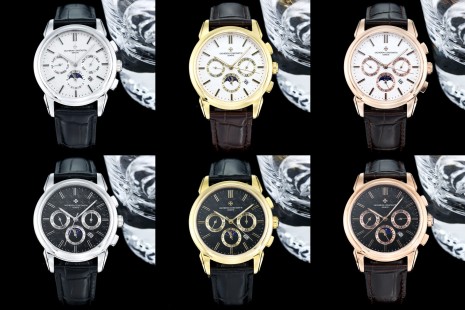
Moonphase errors do not break watches. They break trust. These models teach a hard lesson: once visual storytelling depends on layered displays, replicas must maintain multiple geometric relationships at once, and any compromise becomes part of the daily experience.
❌ High-Risk VC Replica Models (Structural Failure Zone)
This is where vertical geometry collides with full visual exposure. In this category, replicas are asked to compress height, distribute torque across multiple systems, and present everything openly at the same time. The design leaves no buffer for approximation, and small assembly shortcuts become permanent features.
For non-experts, this zone consumes time and money without delivering proportional satisfaction. Problems do not appear as isolated defects; they emerge as systemic instability. Hands argue with bridges, calendars resist clean transitions, and the entire watch feels like it is negotiating with itself.
The red line here is simple. When a model demands both extreme thinness and layered display complexity, replication stops being an exercise in tolerance and becomes an exercise in compromise.
Skeleton / Openworked Models
Exposure is fatal in replicas because there is nowhere to hide vertical error. Without a dial, every bridge becomes a reference surface, and hand height is judged against raw architecture rather than printed markers. Any unevenness reads immediately as imbalance.
Finishing shortcuts also lose their camouflage. Edge treatments, surface continuity, and component symmetry stand fully visible, and minor inconsistencies multiply into a sense of mechanical disorder. What might pass unnoticed on a closed dial becomes unavoidable in an open framework.
Skeletons do not forgive. They accuse. These models transform small deviations into constant visual reminders, making them the least tolerant environment a replica can inhabit.
Perpetual Calendar & Ultra-Thin Automatics
These fail structurally, not cosmetically. Vertical compression leaves no room for stable layering, while torque must travel through stacked systems that were never designed to coexist at such reduced height. Calendar jumpers become sensitive, transitions lose decisiveness, and long-term reliability depends on margins that replicas simply do not possess.
The instability shows up in use patterns. Settings feel uneven across modes, displays hesitate during changeovers, and the watch develops a rhythm that never quite settles. Even when everything appears aligned at delivery, the architecture encourages drift as components wear into their constrained spaces.
If a replica claims both ultra-thin proportions and perpetual display logic, walk away unless you already understand where and why it fails. These configurations demand manufacturing discipline that replicas cannot sustain over ownership cycles.
How to Use This Model Map (Without Memorizing Lists)
You do not need to remember categories to apply this framework. Count visible reference planes first: every additional surface that must agree visually increases replication risk. Then count stacked functions, because each layer narrows tolerance and shortens the distance between mechanical behavior and what your eye perceives.
Next, observe how much the dial must forgive. Flat layouts with minimal apertures absorb small deviations. Layered displays broadcast them. When evaluating a new release, ask how many systems must stay aligned simultaneously for the watch to feel calm on the wrist.
New releases deserve extra skepticism, because first batches often reveal tolerance stacking that marketing photos cannot show. Early production runs tend to carry alignment variance, immature assembly flow, and unfinished interaction tuning, which is why initial impressions frequently age poorly after weeks of real setting and wear. This is where early tolerance drift usually appears: hands begin to lose symmetry, displays hesitate during changeovers, and interfaces stop feeling neutral. Treat every fresh model as provisional until repeat batches confirm that geometry holds beyond the showroom phase.
This map turns classification into judgment: once you understand how geometry, stacking, and visual exposure interact, you can assess unfamiliar models on sight, without waiting for long-term reports or secondhand opinions — an evaluative insight reinforced by the dimensional fidelity and structural discipline patterns detailed in the Vacheron Constantin replica structural and alignment performance review.