

Overseas maintenance is not a service schedule. It is a continuous interrogation of geometry under motion. The integrated case, Maltese-cross bezel, and thin sport profile compress tolerances in every direction, which means daily wear becomes a live audit of china super clone Vacheron execution quality coming out of Guangzhou. Classical VC lines hide small assembly weaknesses behind thicker cases and softer proportions. Overseas does the opposite: it surfaces them through motion, temperature change, and wrist impact, turning ordinary use into a systems test that never really pauses.
What makes this model unforgiving is not complexity but coupling. Bracelet, case, dial stack, and rotor sit closer together than in most dress references, so energy moves through the watch with fewer buffers. Over time, that coupling exposes marginal assembly discipline faster than almost any other VC layout. If something is slightly off, Overseas does not wait months to tell you. It starts communicating through rate drift, hand behavior, and crown feel within normal ownership cycles.
Rotor Energy, Oil Migration, and the Overseas Thin-Sport Penalty
Overseas replicas begin losing lubrication stability earlier because their thin automatic architecture concentrates motion into a smaller vertical envelope. High-activity rotor shear operates closer to bridges and pivots, while reduced clearances leave less room for oil to remain where it was placed. Sport wear compounds this by introducing repeated acceleration spikes, which drive capillary creep across contact surfaces that would stay quiet in thicker cases. The result is not immediate failure, but a gradual redistribution of lubricant that changes how the system breathes.
In practical terms, this shows up as amplitude drift before it shows up as outright stopping. Hands begin to feel less anchored during quick wrist motion, and timing becomes more sensitive to position. These are not regulation problems. They are early signs that energy transfer is no longer symmetric across the train.
On Overseas replicas, this progression happens faster because the design removes slack from the system. Every swing of the rotor carries more consequence, and every micro-shock has a shorter path into the movement. That is the thin-sport penalty: efficiency on paper, accelerated exposure in real use.
Integrated Case + Thin Hand Stack = Faster Oil Travel
The integrated case does more than unify aesthetics. It shortens the mechanical distance between bracelet shock and rotor response. Compressed hand stack tolerance and short bridge spacing leave less dead space to absorb vibration, so energy moves upward through the dial plane and downward into the automatic works with very little loss.

This geometry encourages lubricant to migrate along pivots and jewel interfaces under normal motion cycles. The thinner the stack, the less gravitational resistance oil encounters as it shifts position. Over time, what began as even distribution becomes directional, favoring the lowest-resistance paths created by assembly variance.
Dial geometry participates in this process. When the dial plane sits closer to the train, small deviations in seating pressure alter how vibration propagates. Overseas turns ordinary wear into accelerated lubricant redistribution because its architecture couples surfaces that are isolated in thicker, classical designs.
Practical Judgment Tip: 24-Hour Rotor Lock + Restart
Immobilize the rotor for twenty-four hours, then release it and observe the rate during the first hour versus after several hours of normal wear. A healthy system stabilizes quickly once motion resumes. A marginal one shows delayed recovery, with timing slowly drifting back toward baseline.
That delay is not regulation error. It reflects lubricant that has crept away from optimal contact zones and needs sustained motion to re-equilibrate. When recovery consistently lags, you are seeing early oil migration amplified by Overseas geometry.
Bracelet Motion as an Energy Multiplier
Steel bracelets on Overseas do not merely attach the watch to the wrist. They act as energy multipliers. The rigid end-link integration transfers micro-shock directly into the case, feeding oscillation into the rotor instead of dissipating it through softer interfaces.
This is why marginal assemblies surface faster on bracelet wear than on static handling. Every step, every desk contact, every directional change becomes part of the automatic system’s workload. Over time, this added load accelerates the exposure of weak tolerances that might remain hidden on softer mounts.
The consequence is predictable. Replicas that appear stable during light testing begin to reveal crown feel changes, hand instability, or rate sensitivity once subjected to real bracelet motion. Overseas does not forgive borderline assembly discipline, and the steel bracelet ensures the movement hears everything your wrist does.
Thermal Swing in Sport Profiles: Why Overseas Drops Amplitude First
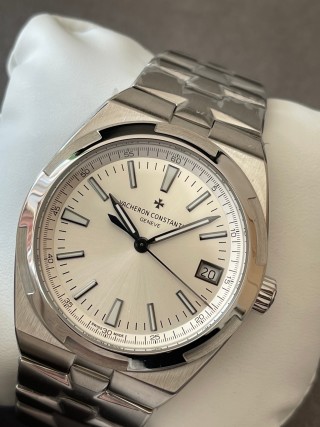
Overseas replicas lose amplitude earlier than thicker VC designs because their slim sport cases amplify temperature effects instead of buffering them. Balance elasticity shifts with even modest ambient changes, lubricant viscosity responds immediately, and the bezel–midcase interface expands along predefined vectors rather than diffusing stress across mass. In practical wear, this means the system reacts faster to cold entry, warm exits, and wrist heat than classical references with deeper cases and softer geometry. What feels like a minor temperature swing becomes a measurable performance event.
The thin profile removes thermal inertia. Heat moves through the case faster, reaches the dial stack sooner, and alters clearances before the movement has time to stabilize. Lubricants thicken in cool air and thin rapidly on skin contact, changing friction characteristics across pivots while the balance is already operating inside a compressed vertical envelope. This is why Overseas replicas produced within guangzhou replica watch production environments tend to reveal instability through amplitude loss first, long before obvious timing failure appears.
The important distinction is speed, not magnitude. Overseas does not require extreme temperature to react; it responds to ordinary transitions that occur dozens of times per day. That responsiveness turns daily life into a repeated thermal stress test, surfacing assembly limits that remain dormant in heavier, more insulated VC architectures.
Maltese Bezel as a Distortion Frame
The Maltese-cross bezel is not decorative. It acts as a distortion frame that concentrates expansion at eight fixed facets, translating thermal change into localized seating pressure on the dial plane. As the bezel and midcase expand unevenly, stress resolves at the cardinal points first, where facet geometry directs force inward toward the minute track and index ring.
This is where dial geometry becomes diagnostic: when expansion vectors converge, the dial does not move as a uniform disc but flexes across its seating points, so minute-track spacing begins to change subtly at 12, 3, 6, and 9 long before any gross misalignment becomes visible, and those spacing shifts are not cosmetic defects but upstream signals that case geometry is transmitting thermal load into the dial stack—a tolerance-cascade and geometry-stability dynamic central to how geometry, rework rate, and assembly discipline create cost in Overseas replica price bands and value logic.
Overseas exposes this behavior because its bezel is rigidly integrated and its case walls are thin. Thicker bezels dissipate expansion across volume. The Maltese frame channels it. What you see at the minute track is the visible endpoint of structural alignment behavior that started in the case.
Practical Judgment Tip: Cold–Warm Bezel Index Check
Place the watch in a cooler environment for fifteen minutes, then return it to ambient wrist temperature and immediately compare index-to-minute-track distances at 12, 3, 6, and 9. Repeat the observation after another fifteen minutes of wear. A stable system shows uniform change or no perceptible difference across quadrants.
Unequal change indicates asymmetric expansion, which points to poor system assembly discipline rather than incidental variation. When one quadrant tightens while another opens, you are observing how bezel geometry is loading the dial unevenly. That pattern does not originate at the hands. It originates in how the case stack was seated.
Why Overseas Thermal Issues Are Systemic
Thermal drift in Overseas replicas is rarely a single-component problem. The response is coupled across case, dial feet, and stem axis, with each interface contributing to how stress resolves under temperature change. When the case expands, dial feet experience altered preload, the stem axis shifts microscopically, and the hand stack responds to a new vertical relationship. These changes arrive together, not independently.
This coupling explains why treating amplitude loss as an isolated balance issue leads to repeated disappointment. The balance is reacting to geometry, not failing on its own. Hand stack tolerance, dial seating pressure, and stem concentricity all participate in the outcome, which is why adjustments that ignore the surrounding structure produce short-lived improvement at best.
Overseas makes tolerance stacking visible because its architecture leaves no room for thermal ambiguity. When drift appears, it reflects accumulated alignment decisions made during assembly, not a single weak part. Recognizing this prevents misdirected fixes and reframes temperature sensitivity as what it truly is: a system-level behavior emerging from compressed sport geometry.
Conclusion: Overseas replicas do not merely react to heat and motion—they translate them into structural feedback, and only assemblies with disciplined geometry remain stable once daily life begins.
Quick-Release Straps and Calendar Shock in Overseas
The quick-release system on Overseas looks like a convenience feature, but mechanically it behaves like a recurring geometry stressor. Every strap change alters end-link seating pressure, shifts how the lugs preload the case, and subtly changes how force travels into the dial stack. At the same time, calendar quickset use introduces impulse loads through the jumper and date ring, especially when adjustments happen immediately after strap swaps. These actions do not damage the watch outright. They redistribute tolerances.

What makes this relevant for vacheron constantin replica watches is modular density. Overseas compresses bracelet interface, case shell, dial plane, and calendar works into a shallow vertical envelope. When you detach and reattach straps, you are not just changing external hardware. You are reloading the entire seating system. Small differences in end-link engagement or spring-bar symmetry translate into changes in lug flare and dial plane tension, which then surface as date-ring eccentricity or horizon drift days later.
Calendar shock compounds the effect. Quickset operations drive the date jumper against a ring that already sits inside tight concentric limits. If the case-seat geometry has shifted even slightly from a strap change, the jumper no longer meets uniform resistance. Over time this produces uneven date advancement and subtle off-center printing alignment. Overseas modularity multiplies tolerance exposure because adjustments act on coupled systems, not isolated parts.
Strap Rotation as a Geometry Test
Strap rotation is one of the fastest ways to reveal hidden assembly drift. Steel, rubber, and leather each load the lugs differently, changing how force resolves across the midcase and into the dial plane. A watch that appears stable on one strap can show immediate end-link gaps, asymmetric lug flare, or horizon tilt on another. These changes are not cosmetic. They are indicators of how evenly the case was seated during assembly.
Watch the end links first. On steel, gaps appear where seating pressure is weakest. On rubber, lug flare becomes more obvious because the strap does not mask asymmetry. On leather, horizon stability becomes the primary signal, as softer material removes external rigidity and lets dial plane errors express themselves. When alignment behavior changes across straps, the root cause is systemic. The assembly does not return to the same geometry after each load condition.
This is why strap swaps are diagnostic rather than neutral. Overseas exposes case-seat tolerance through variation. If alignment remains consistent across all three materials, the underlying structure is likely sound. If it shifts, the watch is already telling you where its limits lie.
Practical Judgment Tip: Three-Strap Rotation Sequence
Run a simple sequence: steel, then rubber, then leather. After each change, inspect end-link gaps, lug symmetry, and the dial horizon against a flat reference. Do not rush the process. Give each configuration several minutes on the wrist so the case can settle before observing.
What matters is not absolute perfection but change dependence. If misalignment appears only on certain straps, you are seeing case-seat tolerance expressed under different load vectors. That pattern confirms system assembly discipline issues rather than strap-specific defects. Consistency across all three indicates a stable geometry. Variability indicates latent drift.
Monthly Full Setting Cycle (Overseas Edition)
Overseas calendars benefit from a complete traversal cycle once per month, especially after strap changes. Advancing the date through a full rotation re-seats peripheral rings and redistributes contact pressures that may have shifted during modular adjustments. This is not about accuracy. It is about restoring concentric equilibrium.
During daily wear, the date ring experiences localized loading from the jumper. Over time, especially after geometry changes at the lugs, that loading becomes directional. A full cycle forces the ring to re-engage evenly across its entire circumference, helping it find a neutral resting position again. Owners who skip this step often notice progressive off-center dates that do not correct themselves.
The practice is simple: move the calendar forward through all positions until it returns to the current date. When performed monthly, this stabilizes calendar geometry and reduces the accumulation of eccentricity introduced by strap rotation and quickset use.
Daily Wear vs Static Storage in Integrated Sports Cases
Integrated sports cases deteriorate faster under inactivity than under controlled daily motion; in Overseas replicas, static periods allow oil to pool, gaskets to take set, and balances to develop rest-point bias, and without movement these effects compound quietly so that when wear resumes the system no longer starts from a neutral state—a real-world use and balance transition behavior described in the Overseas wearing behavior, styling logic, system balance, strap transitions and real world use judgment analysis.
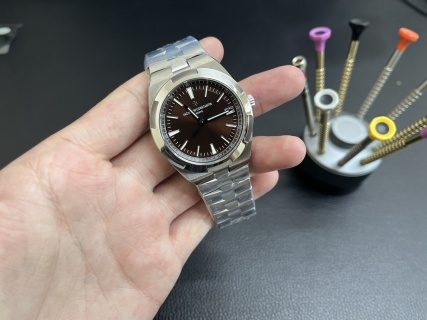
This is particularly pronounced in china super clone vacheron builds because tolerances already operate near visible thresholds. Oil that migrates during storage does not redistribute itself without motion. Gaskets compressed in one orientation retain memory. The balance settles into a preferred position that skews initial amplitude. None of this appears dramatic at first. It manifests as sluggish recovery, inconsistent rate, and delayed stabilization after being picked up.
Controlled daily wear interrupts these patterns. Motion keeps lubricants mobile, prevents seals from imprinting asymmetrically, and continually resets balance equilibrium. Overseas suffers more from inactivity precisely because its integrated design leaves less margin for passive recovery.
Motion as Tolerance Equalization
Regular movement acts as a tolerance equalizer in Overseas. Micro-vibration travels from bracelet to case to dial stack, constantly redistributing stresses that would otherwise accumulate in fixed positions. This does not correct poor assembly, but it masks minor errors by preventing them from consolidating.
The effect is subtle but repeatable. Watches worn consistently tend to show smoother crown feel, steadier hand behavior, and more stable rate than identical pieces left dormant for long stretches. Motion keeps interfaces dynamic. It discourages localized preload from becoming permanent.
This is not lifestyle advice. It is mechanical observation. Integrated cases rely on motion to prevent bias from settling in. When that motion stops, small asymmetries gain time to organize themselves.
Practical Judgment Tip: 7-Day Alternating Wear Test
Alternate one day of full wear with one day of rest over a seven-day period while observing rate stability and hand behavior. Compare this to a week of continuous wear. Improvement during the alternating phase indicates borderline tolerances that benefit from periodic redistribution.
If performance degrades during rest days and recovers with wear, you are seeing motion-dependent stability. That pattern signals assemblies operating close to their tolerance edge, where activity temporarily equalizes stresses that inactivity allows to accumulate.
Dial Plane Memory After Storage
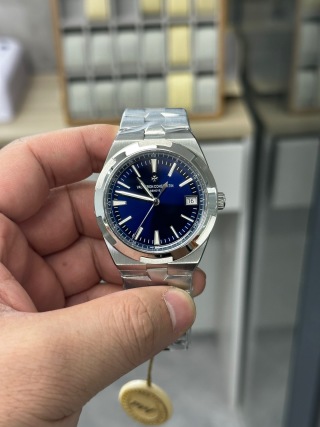
After extended storage, Overseas replicas often reveal drift first at 12 and 6. This is dial plane memory in action. Gravity biases the dial feet in flat sport cases, encouraging minute asymmetry to settle along the vertical axis. When the watch returns to the wrist, that bias does not immediately disappear.
The result is subtle minute-track imbalance or slight horizon deviation that was not present before storage. These effects usually soften with regular wear as motion reintroduces dynamic seating. When they persist, they indicate that storage allowed structural preload to consolidate beyond what motion can easily undo.
This behavior reinforces a simple reality. Overseas geometry does not tolerate long stillness. It is designed to live in motion, and when deprived of it, the system remembers where gravity left it.
Crown Interaction on Overseas: Reading Stem Axis Health
The crown on an Overseas replica is not just an interface for setting time. It is a mechanical probe that reports how well the integrated case, midcase bore, and movement axis were aligned during assembly. Because the sport case is thin and tightly coupled to the bracelet structure, even small deviations in stem concentricity translate directly into tactile feedback. What you feel at the crown is the summed result of keyless preload, tube alignment, and how evenly the movement is seated inside the shell.
Crown feel consistency matters because it predicts future behavior upstream. A crown that winds smoothly today but returns unevenly tomorrow is not changing on its own. The surrounding geometry is shifting under load. On Overseas, that shift propagates into dial seating and hand stack alignment over time. Owners who learn to read crown behavior early avoid being surprised later by horizon tilt or creeping hand instability.
Setting Smoothness vs Hidden Lug Seat Drift
Rough setting rarely originates in the keyless works alone. In Overseas replicas it is more often a downstream symptom of lug seat drift and midcase preload imbalance. When the lugs do not resolve force symmetrically, the case subtly twists under bracelet load. That twist migrates toward the stem axis, introducing backlash variance during winding and setting.
This is why tactile resistance changes after strap swaps or periods of heavy wear. The crown begins to feel granular in one direction and elastic in another. That asymmetry reflects case-seat misalignment rather than internal wear. Over time, the same distortion that alters crown smoothness also changes how the dial plane sits, which is why rough setting frequently precedes visible horizon tilt by weeks or months.
Alignment behavior follows touch before it follows sight. If setting action becomes uneven, geometry is already moving.
Practical Judgment Tip: Triple-Position Crown Symmetry Check
Cycle the crown through all three positions—winding, date setting, and time setting—while paying attention to resistance and return. Each position should engage with comparable smoothness and release with similar spring-back. Perform the sequence slowly and repeat it after several minutes of wear.
Position-dependent feel is the key signal. If one mode feels heavier, slower to return, or less centered than the others, stem-axis deviation is already present. That deviation originates in how the movement sits inside the case, not in the crown itself. Consistent feel across all positions indicates intact system assembly discipline. Variability confirms that alignment has begun to drift.
Why Overseas Crowns Expose Guangzhou Execution
Overseas crowns are unusually sensitive because the sport midcase is thin and the crown tube passes through a compressed structural stack. There is little material depth to absorb angular error, so any misalignment during casing-up expresses itself directly at the interface you touch most often. Thicker dress cases hide these issues behind mass. Overseas does not.
This sensitivity is why guangzhou replica watch production outcomes stratify so sharply on this model. Two watches may share identical components, yet differ dramatically in crown feel based solely on how precisely the tube, stem, and movement axis were aligned during assembly. The crown becomes an early-warning sensor for execution quality, revealing whether the system was squared under load or merely forced together.
When crown behavior changes over time, it reflects how well the original geometry resists cumulative stress. Overseas simply reports that story sooner than other VC designs.
Long-Term Overseas Geometry: Quarterly Checkpoints
Overseas replicas benefit from a geometry-based maintenance cadence rather than reactive fixes. Quarterly checkpoints focus on center-axis stability, minute-track symmetry, and hand interaction under motion. These reviews do not require tools. They require attention to patterns that develop slowly and compound quietly.
The purpose is prevention. Small shifts caught early remain manageable. Left unattended, the same shifts consolidate into visible defects that feel sudden but were building for months. Regular geometry checks turn ownership into observation rather than surprise.
This approach is especially relevant for vacheron constantin replica watches because integrated sports cases operate close to tolerance limits from day one. They do not fail catastrophically without warning. They drift.
Quarterly Bezel-to-Dial Symmetry Review
The Maltese bezel provides a built-in reference frame for structural audits. Each facet corresponds to a cardinal load path into the dial plane. By comparing facet-to-index alignment at regular intervals, you can detect center-axis migration long before the eye registers obvious misalignment.
What matters is change, not absolute perfection. Measure visually how each bezel facet relates to its nearest hour marker. If one quadrant begins to close while the opposite opens, the case stack is redistributing preload. These shifts forecast larger assembly drift because they reflect how expansion, wear, and bracelet load are resolving through the midcase.
Dial geometry tells the truth about what the case is doing underneath, because subtle shifts in track spacing, seating planes, and axis alignment are direct reflections of how the mid-case geometry, crystal, and dial stack interact under load — an inspection logic elaborated in the Vacheron Constantin Overseas replica guide with geometry-based inspection methods.
Practical Judgment Tip: 12/3/6/9 Facet Mapping
At each quarterly check, compare index-to-facet spacing at 12, 3, 6, and 9. Use the same lighting and viewing angle every time. Look for unequal spacing or directional change rather than chasing symmetry in a single session.
Persistent differences across quadrants confirm center-axis displacement. When spacing changes over successive reviews, you are watching geometry move. That observation alone provides enough information to adjust wear patterns or strap usage before visible defects appear.
Hand Clearance as a Sport-Wear Predictor
Hand clearance is a quiet indicator of vertical tolerance health. In Overseas replicas, minute and hour hands operate inside a compressed stack that leaves little margin for overlap under shock. As assembly preload changes, that clearance narrows first during motion spikes rather than at rest.
Pay attention to how the minute hand behaves when the watch experiences sudden movement. If interaction becomes hesitant or the hands appear closer during dynamic wear than during static inspection, vertical tolerances are collapsing. This is not cosmetic. It signals progressing hand stack tolerance loss driven by case-seat drift and cumulative vibration.
Reduced clearance predicts future contact. Observed early, it provides time to modify usage patterns and slow progression. Ignored, it eventually becomes visible interference. Overseas makes this progression readable if you know where to look.
Conclusion: On Overseas replicas, crowns, bezels, and hands form a continuous feedback loop, and only assemblies that preserve geometric discipline across time, motion, and temperature remain stable in real ownership.