
AP Royal Oak replicas are often judged from dial photos first, but the movement route can decide whether the watch actually wears correctly and feels stable over time, especially after the 2021 factory raids reshaped batch availability and movement sourcing. A movement label such as SH3120, SH4302, or DD4302 is not just a technical name; it can affect case thickness, date position, rotor clearance, crown feel, power reserve, and the level of servicing risk a buyer may face later.
This article focuses on the practical difference between established Shanghai-style clone routes and newer Dandong claims for AP replicas. The key point is not that one origin is automatically better, but that reference compatibility, batch maturity, current owner feedback, and honest seller disclosure matter more than hype. A careful buyer should match the movement to the Royal Oak reference, check side profile and date behavior, and treat newer DD4302 options as promising only when the exact batch has enough evidence behind it.
Replica watches should be clearly understood as replica-market products, not genuine watches from the original luxury brands. Brand names are used here to identify the genuine reference design being discussed; they do not imply authorization, endorsement, or affiliation with Audemars Piguet or any other luxury watch brand.
| Buyer Check | Why It Matters for AP Replicas | Practical Judgment |
|---|---|---|
| Movement-reference match | 3120-based and 4302-based Royal Oaks need different architecture. | Choose SH3120 for older 3120-style models; SH4302 is usually more established for newer 4302 references. |
| DD4302 claims | Dandong reputation from other models does not automatically transfer to AP case design. | Consider only with clear batch disclosure, real owner feedback, and no visible case or date compromise. |
| Side profile and caseback | Front photos can hide thickness, spacer use, and rotor clearance issues. | Ask for side-profile QC and check whether the watch sits naturally for the reference. |
| Date and crown behavior | Date alignment, date change, and winding feel reveal assembly consistency. | Prioritize stable operation over a newer or more fashionable movement label. |
| Daily-wear reliability | Power reserve, rotor noise, lubrication, and parts familiarity affect long-term use. | A proven route with known flaws is often safer than a newer route with limited history. |
| Seller explanation | Movement names are often used loosely across batches and factories. | Trust clear current-batch details more than broad claims such as “4302 clone.” |
Quick Questions Before You Read
Q: Is a Dandong DD4302 automatically better than SH4302?
No. It may be promising, but AP fit, batch maturity, and real feedback matter more than origin alone.
Q: Why does movement origin affect case thickness?
Royal Oak cases are thin and integrated, so movement architecture can influence profile, caseback depth, and rotor clearance.
Q: What should be checked first in QC photos?
Check side profile, date alignment, caseback depth, crown position, and bracelet fit before focusing on small dial details.
Q: Which route is safer for daily wear?
Usually the route with more current owner reports, known repair experience, stable date action, and realistic service expectations.
Editorial Perspective: For cleanvsfactory.com, this movement comparison is treated as a practical ownership question, not a contest over which origin name sounds stronger. A factory label, movement nickname, or seller photo can help narrow the shortlist, but it does not prove that the watch will have the right case thickness, stable date action, quiet rotor behavior, or manageable service risk. The more useful buyer approach is to connect the movement route to the exact Royal Oak reference, the current batch, the visible side profile, and real daily-wear feedback before treating any SH3120, SH4302, or DD4302 claim as a meaningful advantage.
Evidence Boundary for This Movement Comparison
This guide uses movement-origin language as buyer-facing market terminology, not as official manufacturer confirmation. Terms such as SH3120, SH4302, DD4302, Shanghai, Jinghe, and Dandong are commonly used in replica-watch discussions and seller listings, but they should not be treated as independently verified factory documentation unless a specific seller can support the exact watch being offered with current movement photos, version details, and consistent batch evidence.
Official brand information can clarify what the authentic Royal Oak reference is associated with, but it cannot prove the quality, movement source, case construction, or reliability of any replica. Likewise, a seller’s movement photo can help identify visible architecture, bridge layout, or rotor style, but it cannot prove lubrication quality, internal finishing, long-term durability, or future parts availability. For that reason, this article avoids presenting any AP replica movement as equivalent to a genuine Audemars Piguet caliber.
Readers should treat all movement-origin claims as risk signals rather than guarantees. The strongest practical evidence is usually a combination of current-batch QC photos, side-profile comparison, caseback view, basic operation video, seller clarity, and repeated owner feedback over time. No single label, factory nickname, or promotional phrase is enough to establish that a replica watch is mechanically superior, waterproof, serviceable, or indistinguishable from an authentic watch.
Traceability is strongest when the same claim can be checked from several angles. For example, a claimed 4302-style route should make sense with the reference family, the visible caseback architecture, the date position, the side thickness, and the seller’s version description. If one of those signals contradicts the others, the buyer should slow down and ask whether the movement name is being used precisely or only as a marketing shortcut.
Movement Transparency Note: Movement references in this article describe replica-market movement routes and buyer-facing configurations, not official Audemars Piguet calibers or brand-manufactured components. Buyers should judge SH3120, SH4302, and DD4302 claims by visible architecture, current-batch evidence, date behavior, rotor clearance, and service expectations rather than assuming equivalence from a similar movement name.
Why Movement Origin Matters Even When the AP Replica Looks the Same From the Front
Movement origin matters because the movement controls far more than the part you see through the dial. Two AP Royal Oak replicas can look almost identical in front-facing QC photos, especially if the dial color, bezel brushing, hands, and markers are close. The difference often appears later: in the side profile, the date behavior, the rotor sound, the crown feel, the power reserve, and the confidence you have wearing the watch every day.
This is especially true for the Royal Oak because the design gives the movement very little room to hide. A Submariner-style sports watch can absorb a slightly thicker or less model-specific movement more easily. A Royal Oak cannot. The case is thin, the flank is flat and visible, the bracelet flows directly from the case, and the display back often invites buyers to care about movement layout. If the AP clone movement is poorly matched to the case, the watch may still look strong from the front but feel wrong on the wrist.
A common buyer mistake is treating movement origin as a prestige label: Shanghai, Jinghe, Dandong, SH3120, SH4302, DD4302. The better question is not which name sounds more desirable. The better question is whether that Royal Oak replica movement has the right architecture for the reference, enough market history to judge its behavior, and a realistic ownership record across batches. A newer movement name can be interesting, but it does not automatically make the safer AP replica choice.
A careful buyer should also separate three different goals that often get mixed together: visual accuracy, daily reliability, and service practicality. A movement can improve the caseback appearance without improving the winding feel. Another route can be less visually dramatic but easier to understand because more owners have used it for months. A third route may sound technically advanced but still need proof that it works inside a thin Royal Oak case without creating a thickness or rotor-clearance compromise.
Front-Facing Similarity Can Hide Mechanical Differences
Front photos are useful, but they are also flattering. A straight-on dial shot will not tell you whether the movement forces the caseback to sit deeper, whether the date wheel sits naturally under the aperture, or whether the rotor is noisy during normal wrist movement. It also will not show winding feel, hand-setting smoothness, or whether the date snaps cleanly instead of dragging through the changeover.
This is where AP replicas become more technical than many buyers expect. A watch with a less suitable movement route may need extra spacing, altered dial height, or a thicker rear profile to make everything fit. That can create a Royal Oak that looks acceptable in a photo but wears slightly bulky compared with the reference it is trying to represent. On an angular integrated-bracelet watch, that extra thickness is easier to feel than buyers expect.
Rotor sound is another hidden difference. Some movements are naturally quieter and more stable in the case; others create a sharper whirring or scraping sensation if the rotor system, clearance, or assembly quality is not well controlled. This does not always mean the movement is failing, but it affects confidence. A Royal Oak replica that looks expensive but sounds loose when you move your wrist quickly becomes less satisfying as a daily watch.
Date action also deserves more attention than it usually gets. Buyers often check whether the date is centered in the window, but not how it changes. A clean, predictable date advance is a practical sign that the movement and date mechanism are behaving properly. A hesitant or rough date change can indicate a less refined setup, poor adjustment, or a movement route that has not matured enough across batches.
The same logic applies to the crown. A watch can photograph well even if the crown feels gritty, the keyless works feel fragile, or time-setting requires more care than expected. That does not always mean the watch should be rejected, but it changes the ownership calculation. For a display-back Royal Oak replica, the buyer is not only buying a dial view; they are buying the daily interaction between a thin case, an integrated bracelet, and a movement that has to work within tight space.
The Real Ownership Questions Behind Movement Origin
The useful way to judge movement origin is to translate it into ownership questions. Does the watch wind smoothly? Does the crown feel stable when setting the time? Does the date change consistently? Is the power reserve close to what the seller claims, or is the number mostly marketing language? Does the case profile stay close to the intended Royal Oak reference, or did the movement force a compromise?
At Clean VS Factory, we usually treat the movement as part of the buying decision, not a technical footnote. A visually strong AP replica can still be the wrong choice if the movement route is poorly proven, difficult to service, or mismatched to the case construction. For Royal Oak buyers, movement origin is really a confidence signal: it tells you how much is known about the architecture, the batch behavior, and the likely ownership experience.
This does not mean any AP clone movement should be treated as equivalent to a genuine Audemars Piguet caliber. It should not. The realistic goal is narrower: choosing the movement route that gives the replica the best balance of correct proportions, predictable daily behavior, and manageable long-term risk. That is why a same front view, different movement scenario is not a small detail. It can be the difference between a watch that looks good only in QC photos and one that remains satisfying after weeks of actual wear.
One practical way to think about this is to ask what kind of mistake would bother you most. If the watch is mainly for photos and occasional wear, dial color, bezel finishing, and bracelet appearance may be the first priority. If it will be worn several days a week, rough winding, inconsistent date change, or a rotor that sounds loose may become more irritating than a tiny dial-printing flaw. If the buyer has no local watchmaker willing to touch replica movements, serviceability and movement familiarity become even more important than a small visual gain.
From Miyota Plate-Modified AP Replicas to Integrated Clone Movements
Older AP replicas often used a practical but compromised solution: a Miyota AP replica movement with decorative plates, spacers, or visual modifications. This route made sense for the market at the time. Miyota-based movements were available, relatively affordable, thin enough for many watch cases, and familiar to watchmakers who were willing to service replica watches. For a buyer who wanted a decent-looking Royal Oak without paying for a more complex integrated clone movement, the approach was understandable.
The problem was not that every Miyota-based AP replica was automatically bad. The problem was architectural. A Royal Oak is not just a round case with a dial placed on top of a generic automatic movement. The relationship between movement height, dial position, date-wheel layout, caseback depth, and bracelet integration affects the whole watch. A plate-modified movement can improve the view through the display back, but it does not necessarily solve the deeper construction issue.
This is why integrated clone movements changed AP replicas. They were not important merely because they looked more interesting through a caseback. They allowed factories to build the watch around a movement route closer to the intended layout of the reference. That matters for Royal Oak thickness, date placement, rotor location, and the overall case profile.
For buyers, the shift also changed how price should be interpreted. A higher price on an integrated clone version may reflect the movement architecture, case machining, lower production volume, or batch risk rather than simply “better quality” in every area. A cheaper Miyota-based watch may be less accurate architecturally but easier to understand mechanically. The point is not to praise one route blindly; it is to know which compromise you are accepting.
Why Miyota-Based Builds Were Common
Miyota-based builds became common because they solved the easiest problem first: making the watch run. A Miyota 9015-style route offered acceptable reliability, a reasonable power reserve, and broad market familiarity. For many older AP replicas, that was enough to create a wearable product at a lower price than a custom clone movement would allow.
The weakness appeared when buyers started comparing the full Royal Oak package instead of only the dial. Decorative plates could make the caseback look more AP-inspired, but the base movement still carried its own architecture. The balance position, rotor behavior, date mechanism, and spacer requirements could differ from the movement being imitated. In practice, that often meant thicker cases, less convincing movement views, or date alignment that looked slightly forced.
Rotor noise was also a frequent ownership complaint with Miyota-style routes. The movement could be reliable in a basic sense but still feel less refined in daily wear because of the free-spinning rotor sound. Some buyers tolerated it because the watch looked good and the movement was familiar. Others found that the sound made the watch feel cheaper than the case and bracelet suggested.
Another buyer-facing advantage of Miyota-style routes was that problems were often easier to describe. A noisy rotor, ordinary reserve, or non-reference movement view was not ideal, but buyers knew what they were dealing with. With newer integrated routes, the upside can be greater, but the failure modes may be less familiar until the market has seen enough examples. That is why beginners should not automatically assume that the more complex movement is the more relaxed ownership choice.
What Integrated Clone Architecture Changed
An integrated clone movement is more than a decorated base movement. In the AP replica context, its value is that the movement architecture is designed to support the reference more directly. That can affect the dial-side geometry, the date-wheel position, the caseback appearance, and the amount of internal spacing needed to assemble the watch.
For the Royal Oak, this is a real improvement. A better-matched movement can help the case stay closer to the correct thickness instead of relying on a deeper caseback or added internal height. It can place the date more naturally in the window. It can also make the display-back view less like a generic automatic movement wearing an AP-style costume.
The most important change is buyer confidence. With an integrated clone movement, the factory is no longer only decorating around a compromise; it is trying to solve the watch as a whole. That is why SH3120 and SH4302-style routes became meaningful in AP replica discussions. They represented a shift from “make it fit” to “build it closer to the model’s architecture.”
Still, the buyer should check whether the integrated architecture improves the areas that matter for that specific reference. A better-looking caseback is useful if the watch has a display back, but it does not replace checking thickness, date-window height, and crown behavior. A more reference-like movement layout is meaningful, but it should be judged alongside the delivered watch, not only the factory announcement.
The Tradeoff Buyers Often Miss
The tradeoff is that integrated does not automatically mean safer. A decorated Miyota-based build can be mechanically ordinary but familiar. A newer integrated clone movement may look more correct and support a better case profile, but if the route is immature, buyers may face unknowns around lubrication, date behavior, power reserve consistency, rotor clearance, and parts availability.
This is the point many forum recommendations oversimplify. Miyota versus clone movement is not a simple old-versus-new argument. The practical question is whether the improved architecture is mature enough to justify the added complexity. For a Royal Oak replica, a well-proven integrated clone movement is usually the more convincing path. A poorly tested one can become a more expensive way to inherit new problems.
A balanced buyer should therefore ask two separate questions. First, does the integrated movement help the watch become more accurate as a Royal Oak replica? Second, does that exact movement route and batch make the watch easier or harder to own? When both answers are positive, the upgrade is meaningful. When only the first answer is positive, the watch may be attractive for photos but less convincing as a daily-wear choice.
Shanghai and Jinghe’s Role in SH3120 and SH4302 Movement Development
Shanghai and Jinghe-style movement discussions matter because SH3120 and SH4302 became reference points for a more mature AP clone movement route. In buyer language, these movements are usually discussed as Shanghai clone movement or Jinghe movement routes, especially in relation to Royal Oak models that needed more correct architecture than older plate-modified builds could provide.
The important point is not to treat the origin name as a magic guarantee. Movement labels in the replica market are not always used with perfect consistency, and assembly quality can still vary by factory and batch. The value of the SH3120 movement and SH4302 movement is that they have been used enough in AP replica discussions to create a larger body of feedback. Known behavior is not the same as perfection, but it is more useful than a fresh claim with little owner history behind it.
For cautious buyers, that maturity matters. A proven AP clone movement is easier to evaluate because buyers, sellers, and technicians have had more time to observe common patterns: how the date behaves, whether power reserve claims are realistic, whether rotor sound is acceptable, and whether the movement fits the case without obvious dimensional compromise.
That market history also makes the conversation more honest. When a movement route has been in circulation for a while, the discussion usually includes both strengths and complaints. That is more useful than a new listing that only shows clean promotional photos. A buyer does not need a movement to be flawless; the buyer needs enough information to know whether the flaws are acceptable for the intended use.
A factory comparison is most useful when it is tied to the specific reference, version, movement, and visible execution details rather than treated as a universal ranking. In AP replicas, even a respected route can perform differently depending on case machining, bracelet fitting, dial stack height, and the way the factory regulates or lubricates the current production run. The movement name is the starting point for comparison, not the final proof of quality.
How to Read Movement-Origin Evidence Without Overstating It
When a seller describes a watch as SH3120, SH4302, or DD4302, the claim should be matched against visible and behavioral evidence. A caseback photo may support that the watch has a certain visible movement layout, but it does not prove the origin of every component. A short video may support that the crown and date work on that unit, but it does not prove long-term reliability. Owner feedback may show common experience, but it is still not the same as controlled technical testing.
The most defensible buying approach is to stack modest pieces of evidence instead of expecting one proof point to answer everything. Current-batch photos can support case and date evaluation. Seller communication can support whether the route is being described clearly. Repeated owner comments can suggest whether the movement has settled into predictable behavior. A watchmaker’s inspection, when available, can provide stronger insight, but even that applies to the inspected piece rather than every unit sold under the same movement label.
This matters because overconfident evidence can mislead buyers in both directions. A single bad report does not prove every movement in the route is poor, and a single excellent delivery does not prove the route is safe. The goal is not certainty; it is reducing the chance of approving a watch where the movement claim, case construction, and ownership evidence do not line up.
SH3120 and the Earlier Royal Oak Clone Movement Phase
The SH3120-style route became important in the older Royal Oak clone movement phase because it addressed problems that buyers had already learned to notice. On 3120-based Royal Oak references such as the Royal Oak 15400, the movement was not only a caseback decoration issue. It affected the overall construction of the watch.
A better-matched AP 3120 clone helped factories move away from the obvious compromises of earlier Miyota-based builds. The case could be closer to the expected profile, the display-back layout could look more coherent, and the movement no longer felt like a generic engine hidden behind AP-style plates. For buyers comparing older and newer generations, this was a meaningful step.
The practical judgment is straightforward: SH3120-style movements became trusted not because they were flawless, but because they reduced the most visible architecture compromises in the 15400-style category. They gave buyers a more logical foundation for the watch. That is different from saying every SH3120 example is equal. Batch condition, lubrication, regulation, and factory assembly still matter.
For a buyer looking at a 15400-style AP replica, SH3120 should therefore be judged as a reference-matching route rather than simply an older movement name. The question is whether that route supports the case thickness, date location, and display-back appearance expected for the model. If a seller uses SH3120 language loosely on a watch that does not match the reference logic, the movement label becomes less meaningful.
SH4302 and the Shift Toward Newer Royal Oak References
The SH4302 movement became relevant as the market shifted toward newer 4302-based Royal Oak references, especially the Royal Oak 15500 family. The genuine 15500 generation changed buyer expectations because the movement architecture, power reserve discussion, and dial layout were no longer the same as the older 3120-based models. A replica using the wrong movement logic could still look acceptable from the front, but the case and ownership behavior would tell a different story.
A 4302-style architecture matters because the 15500 is judged as a complete package. Buyers expect the case thickness to make sense, the date position to look natural, and the movement view to align with the model’s identity. The SH4302 AP replica route helped make those expectations more realistic in the super clone watch market, even though individual examples still need to be judged by batch and condition.
Power reserve is a good example of why buyers should stay practical. The SH4302 route is often discussed with long power reserve claims, but real-world results can vary depending on movement condition, assembly, lubrication, and batch. A buyer should not choose a watch only because a listing mentions a large number. The better sign is consistent feedback from the same movement route over time.
For newer Royal Oak references, SH4302 is often the comparison baseline because more buyers know what to inspect. That does not make it automatically superior to every later movement option. It means there is usually more discussion around its common behavior, its case-fit implications, and its ownership compromises. In a market where seller descriptions can be short and optimistic, that additional context has real value.
Why Market Maturity Can Be More Useful Than Hype
Market maturity is a form of risk reduction. A movement route that has been used across multiple batches gives buyers more reference points. People have seen how it winds, how the date changes, how noisy the rotor can be, and what problems appear after months of use. That accumulated experience is often more useful than a new movement name that sounds impressive but has not yet been tested widely.
This is why Shanghai and Jinghe-style SH3120 and SH4302 discussions remain important. They are not exciting because they are new; they are useful because buyers have more context. Known weaknesses can be managed. Unknown weaknesses are harder to price, harder to service, and harder to judge before buying.
The safest reading is not “Shanghai is always better” or “Jinghe solves everything.” The safer reading is that a mature movement route gives the buyer a clearer risk map. In AP replicas, where case thickness, date action, rotor sound, and serviceability all affect ownership, that clarity can matter more than hype around the latest label.
This is also why “best factory” claims should be narrowed to the exact model and version. A factory or movement route can be strong for one AP reference and less convincing for another. A buyer who treats reputation as universal may miss the fact that the Royal Oak’s thin case, integrated bracelet, and movement display make it less forgiving than many simpler watches. The safer habit is to ask what the factory is good at for this reference, in this batch, with this movement route.
Dandong DD4302 Discussions: What a Later Entry Changes and What It Does Not Prove
The DD4302 movement gets attention because the Dandong name already carries weight in other replica movement discussions. Many buyers have seen Dandong associated with desirable clone movement routes in Rolex-style super clone watches, so when a Dandong AP clone movement appears in the conversation, the instinct is to treat it as an automatic upgrade. That is the first mistake. AP is not Rolex, and the Royal Oak is not a case where movement reputation can be imported from another model family without testing.
The useful question is not simply, “Is DD4302 better?” The better question is whether the Dandong 4302 clone has proved itself inside the specific AP replica case, with the correct dial layout, acceptable case thickness, stable date behavior, reasonable rotor clearance, and consistent performance across more than one batch. A movement can look promising on paper and still be less predictable than an older route with more field history.
For first-time AP buyers, the DD4302 discussion should be treated with extra care because early movement excitement can make risk feel smaller than it is. A buyer who already owns several replicas may accept a newer route as an experiment. A buyer who wants one daily-wear Royal Oak may be better served by the movement route with more known behavior, even if it is less fashionable in current forum discussion.
Why Dandong Gets Immediate Buyer Attention
Dandong gets immediate buyer attention because movement-origin names often become shorthand for confidence. Buyers hear “Dandong” and assume more mature engineering, smoother operation, or better long-term reliability. In some watch categories, that reputation may have a basis. In AP replicas, it still has to be earned reference by reference.
The Royal Oak puts a different kind of pressure on a movement. It is not only about whether the movement runs. It must support a thin angular case, a display back, a visible rotor layout, and the tighter tolerances associated with Shenzhen AP CNC finishing, while still keeping a date window that sits naturally and a wearing profile that does not look inflated from the side. A Dandong AP clone movement may be interesting, but it should not be judged by the same standards buyers use for a thicker Rolex replica case where movement height and caseback architecture are more forgiving.
This is why Dandong versus Shanghai movement discussions can become misleading when they are reduced to brand reputation. Shanghai/Jinghe-style SH4302 routes have accumulated more AP-specific market feedback in many current discussions. DD4302-style claims may develop into a serious alternative, but a later entry needs proof in the AP platform, not just borrowed credibility from another product category.
A useful analogy is factory performance across different complications. A factory that makes a strong simple three-hand sports watch may not automatically make the best chronograph, perpetual calendar-style display, or ultra-thin integrated bracelet model. The same caution applies to movement origin. A movement maker’s reputation is a signal worth noting, but the Royal Oak case determines whether that signal becomes a real advantage.
The Difference Between Potential and Proven Stability
Potential means the movement route sounds technically attractive. Proven stability means buyers have seen enough real examples across multiple batches to identify what usually goes right, what commonly fails, and which issues are isolated QC problems rather than design weaknesses. Those are not the same thing.
A newer AP movement route can initially look cleaner because fewer complaints exist. That does not automatically mean fewer problems exist. It may simply mean there has not been enough batch testing, long-term daily wear, or service exposure yet. Early owner feedback often focuses on excitement: the watch arrived, the caseback looks good, the rotor turns, the date changes. The more useful feedback comes later, after buyers report power reserve consistency, date behavior after weeks of use, winding feel, rotor noise, and whether the movement remains stable after normal wear.
The strongest judgment here is simple: a DD4302 movement should be treated as promising but not automatically safer than SH4302 until the specific batch has enough evidence behind it. For a cautious buyer, known behavior is often more valuable than a new label. Unknown weaknesses are harder to price, harder to service, and harder to avoid during QC.
There is also a timing issue. The first batch of a new movement route may not behave the same as the third or fourth batch. Factories may quietly adjust rotor clearance, lubrication, dial height, or caseback fitting after early feedback. That can be positive, but it means a buyer should not rely on one early review forever. Current-batch evidence matters more than old excitement or old criticism.
Movement Route to Verify
Before treating a DD4302-style listing as an upgrade, verify how clearly the seller describes the actual movement route. A vague “4302 clone” claim is not the same as a clear distinction between SH4302 and DD4302. The listing or communication should ideally state the movement route, the current batch or version, and whether the watch is using a Dandong 4302 clone rather than a Shanghai/Jinghe-style SH4302.
Power reserve claims also deserve caution. If a listing advertises a high reserve, the buyer should ask whether that claim is based on the movement specification, the factory claim, or consistent current-batch feedback. The difference matters. A replica movement may be capable of a strong reserve in ideal condition while individual delivered pieces vary due to assembly, lubrication, regulation, or batch quality.
Movement photos can help, especially if the caseback shows bridge layout, rotor shape, engraving style, and visible finishing differences. They still do not prove long-term movement stability. Treat photos as part of buyer confidence, not as a guarantee. The safest reading is movement route plus batch evidence plus seller clarity, not movement label alone.
If the seller cannot explain why the DD4302 version costs more, that is also useful information. The price difference may reflect a newer movement, limited supply, factory margin, seller margin, or simply market demand around a fashionable label. A higher price is not proof that the delivered watch will be better for daily wear. It should be supported by visible case fit, consistent QC, and owner feedback that matches the claimed improvement.
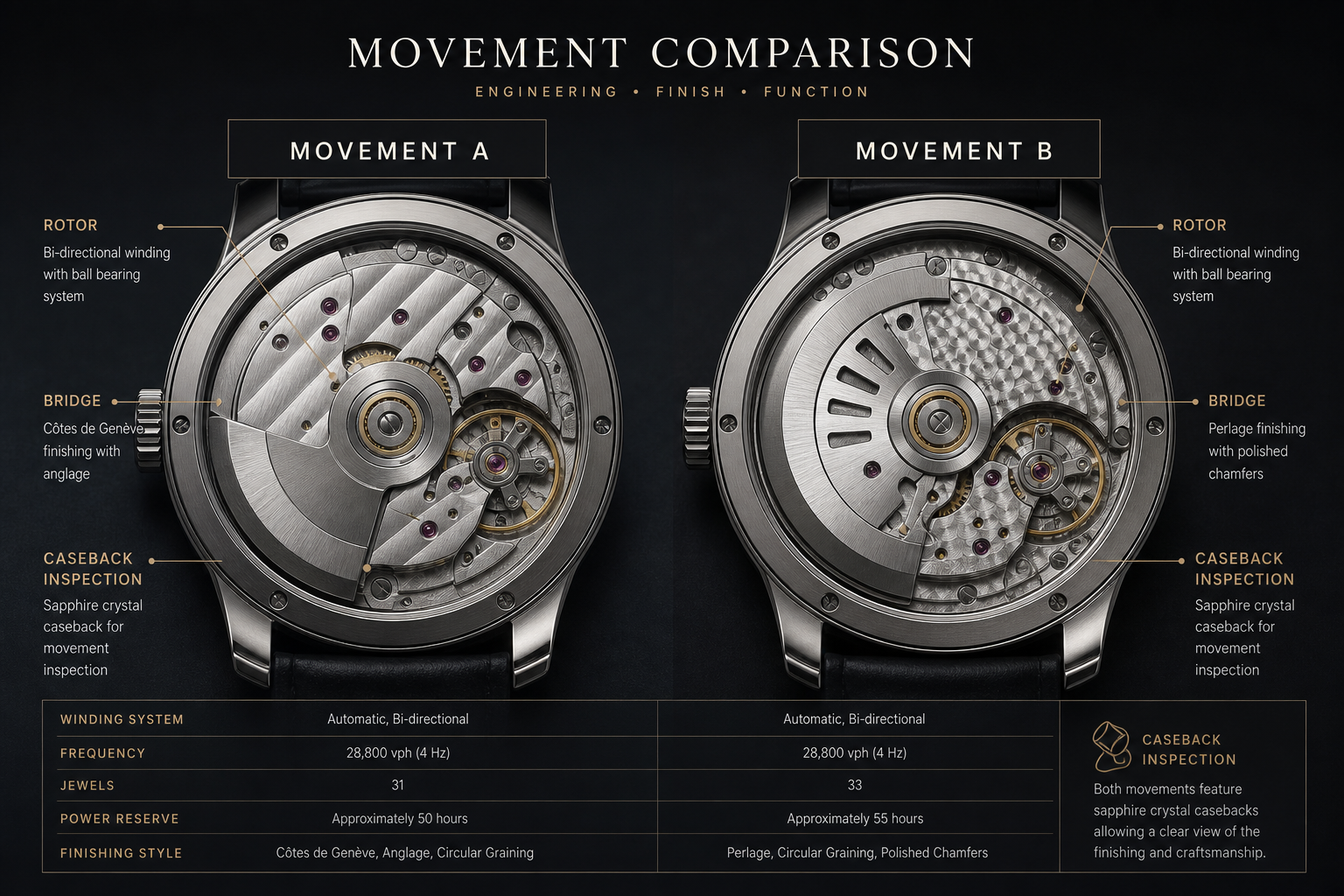
Architecture Differences That Affect Case Thickness, Date Position, and Wearing Feel
AP replica case thickness is not a small technical footnote. On a Royal Oak, movement architecture affects the entire object: how the case flank looks, how the bracelet meets the case, how deep the caseback sits, and whether the watch feels like a flat integrated sports watch or a dressed-up thick case with Royal Oak styling.
This is why clone movement architecture matters more in an AP Royal Oak replica than it might in a chunkier sports watch. The Royal Oak has a thin mid-case, a sharp bezel, a visible side profile, and an integrated bracelet that flows directly from the case. If the movement sits too high, needs extra spacing, or forces the dial stack upward, the front photo may still look convincing while the watch loses the flat, architectural feel that makes the Royal Oak recognizable on the wrist.
A buyer should treat thickness as both a visual and comfort issue. A thicker caseback may be hidden in a front-facing photo, but it can change how the watch sits under a cuff, how the bracelet angles down from the lugs, and how top-heavy the watch feels during daily wear. On the Royal Oak, the side silhouette is part of the identity, so a movement-related thickness compromise is not the same as a tiny printing flaw that only appears under macro inspection.
Visual accuracy should be judged through specific details rather than broad claims. Case thickness, lug shape, mid-case flatness, bezel height, hand length, date depth, bracelet taper, and clasp construction can all affect whether a Royal Oak replica feels coherent in real use. A watch may look convincing in a cropped front image while still showing proportion issues once the side view and bracelet integration are checked.
Why the Royal Oak Case Leaves Little Room for Movement Compromise
The Royal Oak case is unforgiving because there is very little visual hiding space. A Submariner-style case can absorb some internal compromise with a thicker caseback, taller mid-case, or more robust sports-watch proportions. The Royal Oak cannot do that as easily. Its side profile is part of the design, not an afterthought.
When the movement height is not well matched to the case, factories often have to compensate somewhere. That may show up as a deeper caseback, a slightly swollen case flank, a dial that sits higher than expected, or a watch that wears thicker than the reference suggests. Even if the stated diameter is correct, the wrist impression changes because the bracelet no longer flows as cleanly from the case.
This is where some buyers misjudge AP replicas from QC photos. A straight-on dial shot can make two watches look nearly equal. The side view may tell a different story. If one version uses architecture that allows a cleaner case profile and another needs extra internal spacing, the difference is usually more visible in wear than in a cropped front image.
The most useful comparison is not only the numerical thickness printed in a listing. Listings can be approximate, and buyers may not measure the same points. It is often more practical to compare side-profile photos from the current batch against known examples of the same reference. Look for whether the caseback protrudes unnaturally, whether the crown appears too low or high relative to the mid-case, and whether the bracelet drops from the case in a natural line.
Date Window Position Is Not Just a Dial Detail
Date alignment is often discussed as if it were only a printing or QC issue. In AP replicas, it can also be a movement-layout issue. The date wheel position, dial height, and dial opening have to work together. If the movement route is not well matched to the reference, the date may sit too high, too low, too deep, or slightly off-center in a way that repeats across examples rather than appearing as a one-off flaw.
A slightly imperfect date may not bother every buyer, but a date that looks buried or poorly centered changes the quality impression immediately. It is one of the few details that normal wear reveals often, because the date is viewed every time the owner checks the watch. Macro-level engraving flaws may fade from attention; a poor date position does not.
The practical lesson is that date-window alignment should be evaluated together with movement architecture. If several examples from the same route show the same date behavior, it is probably not just unlucky QC. It may be a sign that the movement, dial stack, and case construction are not working as naturally as the listing suggests.
Buyers should also check more than one date number when possible because date wheels can behave differently across the disc. A single-digit date may look centered while a double-digit date appears cramped, low, or too far to one side. This does not always indicate a movement-origin problem, but if the same weakness appears across multiple examples from one batch, it becomes a batch-level consideration rather than a one-watch QC issue.
Side Profile Can Reveal What the Front View Hides
For AP replicas with different movement routes, side-profile QC photos are not optional decoration. They are one of the most useful checks a buyer can request. The side view shows whether the caseback looks overly deep, whether the mid-case appears too thick, and whether the crystal, bezel, and case layers sit in a believable relationship.
A Royal Oak should not look like a tall case sitting on a bracelet. The bracelet should feel integrated, and the case should appear controlled rather than stacked. If the watch looks good from the dial but bulky from the side, the movement route may have forced compromises that the factory photos are not emphasizing.
At Clean VS Factory, we usually treat side-profile evaluation as part of movement assessment, not only case assessment. If the movement architecture forces the case to grow in the wrong place, the buyer is not just accepting a technical compromise. They are accepting a different wearing experience.
Side profile is also useful because it is harder to disguise with dial lighting. A glossy dial, strong hand finishing, or sharp bezel brushing can make the front view exciting, but it cannot fully hide a caseback that sits too deep or a mid-case that looks inflated. For a Royal Oak replica, the buyer should give the side view nearly the same weight as the dial view.
Case and Date Checks
Before choosing between AP replica versions with different movement claims, compare the side profile, crown-side thickness, caseback depth, and how the first bracelet links leave the case. The watch should not appear unusually thick for the claimed reference, and the caseback should not look like an obvious spacer added to solve an internal fit problem.
The date should be checked from a normal front angle, not only under magnification. Look for centering in the window, consistent height, and whether the numeral appears too recessed. If possible, review more than one date number, because some date wheels show acceptable alignment on single digits but weaker centering on double digits.
The most important judgment is that case thickness and date position are not separate from movement choice. They are often the visible consequences of movement choice. A buyer who ignores side profile and date-window behavior may end up choosing the newer-sounding movement route while missing the construction compromise that affects daily wear.
A useful buyer rule is to reject the idea that one photo can settle the decision. A front photo, a caseback photo, and a side photo each answer different questions. The front photo answers whether the watch looks convincing at a glance. The side photo answers whether the architecture is believable. The caseback photo answers whether the visible movement presentation matches the claim. None of them alone proves the watch will be reliable, but together they reduce the chance of approving the wrong version.
Reliability, Date Action, Rotor Sound, and Power Reserve: What Buyers Should Compare
AP clone movement reliability is not something a buyer can fully judge from one caseback photo. The more useful comparison is behavioral: how the movement winds, how the date changes, whether the rotor sounds controlled, whether the power reserve claim is realistic, and whether current owners report stable daily wear. These details determine whether a Royal Oak replica feels enjoyable after the first week.
A visually strong AP replica can still be frustrating if the movement feels rough, noisy, or inconsistent. This is especially true with 4302-style discussions, where buyers may focus on whether the movement is SH4302 or DD4302 but overlook the practical questions that matter more in use. The label matters, but behavior matters more.
For daily wear, the buyer should think in routines rather than specifications. Will the watch still be running after being left overnight? Does it start smoothly after a few crown turns? Does the date behave predictably at the end of the month? Does the rotor noise become distracting during normal wrist movement? These questions are less glamorous than movement-origin labels, but they are closer to the real ownership experience.
Power Reserve Claims Need Batch Context
AP replica power reserve claims should be read carefully. A listing may repeat a movement specification, a factory claim, or an ideal-condition figure. That does not always match what buyers see from delivered pieces. Regulation, lubrication, winding efficiency, and batch assembly can all affect the real reserve.
A high claimed reserve is meaningful only if the current batch supports it consistently. One excellent test result does not prove every watch will perform the same way. This is especially important when comparing a newer movement route with a more established one. A new DD4302-style claim may sound attractive if it promises strong reserve, but the buyer should ask whether enough examples have shown that performance in normal use.
For daily wear, a slightly lower but consistent reserve is often less annoying than an ambitious claim that varies heavily from unit to unit. Predictability matters. If the watch is worn every day, stable winding and normal overnight running may matter more than chasing the largest advertised number.
When possible, buyers should ask whether the seller has observed the current batch running after a full wind or whether the reserve number is simply copied from the factory description. This is not about demanding laboratory testing for every piece. It is about understanding whether the claim is based on actual delivered watches or only on a spec sheet. In replica buying, that difference often matters.
Date Action Is a Practical Reliability Signal
Date action tells buyers more than many people realize. A clean date change, consistent centering, and normal crown operation suggest that the calendar system is at least working in a controlled way. A date that hesitates, sticks, jumps unevenly, or sits inconsistently can become a daily irritation and may also indicate weaker adjustment or assembly.
Buyers should also understand that calendar mechanisms have vulnerable periods. Rough quick-setting near the date-change window can damage or disturb many mechanical movements, including replica movements. A careful owner avoids aggressive date adjustment during those hours and does not force the crown if resistance feels abnormal.
The key point is not that one movement route guarantees better date action. It is that smooth, repeatable date behavior is one of the best practical signs to compare across examples. If several watches from the same batch show rough or inconsistent date behavior, the buyer should treat that as more important than a polished movement description.
A short QC video can be more useful than another high-resolution dial photo here. A video that shows the crown positions, hand-setting, quickset date operation, and date transition around midnight can reveal whether the movement feels controlled. It still cannot predict every future issue, but it can expose obvious roughness before the buyer approves the watch.
Rotor Sound and Winding Feel Affect Daily Confidence
Rotor sound is often dismissed as a minor annoyance, but it changes how confident a watch feels on the wrist. A little mechanical sound is not unusual in replica watches. A loud, loose, scraping, or unstable rotor sound is different. It can make a watch feel cheaper than it looks and may point to rotor clearance, bearing, lubrication, or assembly issues.
Winding feel matters for the same reason. The crown should not feel gritty, excessively tight, slipping, or inconsistent. A Royal Oak replica may have a beautiful dial and bracelet, but if winding feels crude every time the buyer starts the watch, the ownership experience becomes less convincing. This is where movement maturity shows itself in small daily interactions.
Rotor noise and winding feel should be judged realistically. No buyer should expect a replica movement to feel like a finely serviced genuine AP caliber. But there is a difference between acceptable mechanical character and a movement that feels poorly assembled. For a daily-wear AP replica, acceptable sound and smooth crown operation are more important than having the newest movement label.
Rotor sound should also be separated from bracelet noise. A Royal Oak-style bracelet can produce its own metallic sound, especially if the links or clasp are not perfectly finished. When checking a video, ask whether the noise appears when the watch head is moved, when the bracelet is shaken, or when the rotor spins. This distinction helps avoid blaming the movement for a bracelet issue or ignoring a movement issue because the bracelet looks good.
Water Resistance and Durability Should Stay Outside Movement Hype
Movement-origin discussions should not be used to imply that an AP replica is safe for swimming, showering, diving, or heavy sports use. A watch can have a more convincing movement route and still have unverified gaskets, uncertain crown sealing, inconsistent caseback closure, or assembly variation that affects water resistance. Unless the individual watch has been pressure-tested after purchase, water resistance should be treated as unknown.
Durability claims need the same restraint. A mature SH3120 or SH4302-style route may give buyers more confidence because there is more ownership history, but that does not prove shock resistance, moisture resistance, or long-term stability for every delivered piece. A newer DD4302-style route may be mechanically promising, but without enough current-batch evidence, it should not be described as stronger for daily abuse. For practical ownership, movement maturity is one part of risk reduction; it is not a substitute for careful use, reasonable expectations, and post-purchase inspection when possible.
A replica watch should be evaluated with realistic ownership expectations. Even a strong super clone can have limits in water resistance, long-term movement stability, servicing convenience, regulation consistency, and close inspection compared with a genuine reference. Buyers should confirm return, repair, shipping, and after-sales terms before ordering, because those terms can vary by seller and should not be assumed from the movement label.
What to Compare Before You Decide
Before choosing between SH4302, DD4302, or another 4302-style route, ask practical questions instead of only asking which name is newer. Is there current feedback on rotor noise? Do owners report consistent date action? Does the seller distinguish the movement route clearly? Is the stated AP replica power reserve supported by recent batch reports, or is it only a repeated factory claim?
QC photos and short videos can also help. A video showing hand setting, date advance, and rotor behavior is often more useful than another beauty shot of the dial. It will not prove long-term durability, but it can reveal rough operation before the buyer commits.
For most buyers, the safer daily-wear choice is the movement route with the best combination of stable feedback, acceptable case fit, smooth date action, tolerable rotor sound, and realistic service expectations. Novelty is interesting. Predictability is what keeps the watch enjoyable after the first impression fades.
If the buyer’s priority is only visual presentation, the calculation may be different. A watch with a more convincing display-back view but a less proven movement may still appeal to someone who wears it occasionally. But for daily wear, a movement route with slightly less excitement and more predictable behavior is usually the more rational choice. The article’s movement discussion should therefore be read through the buyer’s intended use, not as a universal ranking.
Market Testing and Batch Maturity: Why Proven Use Matters More Than a New Movement Name
In AP replicas, a new movement name can create attention faster than the movement earns trust. That is the trap. A DD4302-style claim may sound more exciting than an older SH4302 route, especially because Dandong is already a familiar name in other replica movement discussions. But AP replica batch maturity is not built by reputation alone. It is built by repeated production, owner feedback, version updates, repair experience, and enough failed examples for the market to understand what actually goes wrong.
This is why clone movement market testing matters. A movement that has been used across several batches may not be perfect, but it is easier to judge. Buyers can usually find patterns: whether the date action is stable, whether rotor clearance creates noise, whether the movement sits correctly in the case, whether early batches needed adjustment, and whether later versions improved. With a newer movement route, the first wave of comments often describes potential, not proven ownership.
Batch maturity is also where seller descriptions can become too simple. A listing may say “latest version” as if that automatically means improved, but latest can mean several things: a movement change, a dial update, a caseback adjustment, a bracelet finishing change, or simply the newest production run. The buyer should ask what actually changed and whether the change solves a known problem or only refreshes the marketing language.
Known Weaknesses Can Be Easier to Manage Than Unknown Ones
Experienced buyers do not always choose the newest movement. They often choose the route with the most documented behavior. That sounds conservative, but it is practical. If an SH3120-style or SH4302-style movement has known weak points, those weak points can be checked before purchase, discussed with the seller, or weighed against the buyer’s tolerance. Unknown weaknesses are harder because they may not appear in the first QC photos or first few days of use.
A known issue is not automatically acceptable, but it is easier to price into the decision. For example, if a movement route has occasional reports of dry assembly, inconsistent regulation, or a date mechanism that needs careful handling, the buyer can decide whether the watch is still worth owning. A newer DD4302-style claim may eventually prove stronger, but early production risk remains real until multiple batches show consistent behavior in normal use.
The clear judgment is this: a proven movement route with manageable flaws is often safer than a new movement route with cleaner marketing language. Newer does not mean better until the movement has survived enough real ownership to expose both strengths and weaknesses.
This principle is especially useful for buyers who do not plan to modify or service the watch immediately. Some experienced collectors are comfortable receiving a watch, regulating it, lubricating it, or sending it to a watchmaker. A beginner usually wants the watch to work acceptably out of the box. For that buyer, known batch behavior is not boring; it is protection against surprises.
Batch Variation Can Change the Same Movement Label
Movement labels can make AP replicas sound more standardized than they are. Two watches described as SH4302, or two watches advertised under a DD4302-style label, may not behave identically. Assembly quality, lubrication, regulation, rotor fit, calendar adjustment, and even small case-fitting differences can change the ownership experience. The label gives a starting point; it does not guarantee the exact same result across every factory version or production run.
This matters more with AP Royal Oak replicas than with many thicker sports-watch designs because the movement is tightly connected to the case construction. A small batch change can affect rotor clearance, caseback depth, date-window presentation, or how confidently the crown feels during winding and setting. A buyer comparing AP replica version risk should not ask only, “Which movement is inside?” The better question is, “Which batch, which version, and what feedback exists for this exact configuration?”
SH3120 and SH4302-style routes benefit from more accumulated market feedback, but they still need version-specific evaluation. A mature label can be weakened by poor assembly, a rushed production run, or a factory update that solves one issue while creating another. Market maturity reduces uncertainty; it does not remove the need to check the actual watch.
A buyer should also be cautious when older reviews are used to justify a current purchase. A review from a previous production run may not apply if the factory changed the dial supplier, caseback, bracelet, or movement decoration. Older information is still useful for understanding the route, but the approval decision should be based on the current watch being offered, not only the reputation of a previous batch.
Forum Hype Can Move Faster Than Real Testing
Replica forums and dealer channels react quickly to new movement names. A few strong photos, a confident factory claim, or one positive early review can make a movement route look settled before it has enough long-term reports. This is especially true when the movement origin name carries weight from other model families. Buyers may assume that because a Dandong movement route has performed well elsewhere, a Dandong AP clone movement must be automatically superior. That shortcut is risky.
AP movements need to be judged in AP cases, under AP-specific constraints. The Royal Oak is thin, angular, and unforgiving. A movement that looks promising on paper still has to prove that it can support consistent case fit, acceptable rotor behavior, stable date function, and repeatable assembly quality over time. Early enthusiasm is useful, but it is not the same as batch-proven confidence.
At Clean VS Factory, we treat market feedback as a risk filter, not as a popularity contest. If a movement route has been through several versions and buyers can point to both its strengths and its common failures, high-end AP replica origins become part of the same factory comparison logic rather than a separate branding claim. That information is more valuable than a new label with limited owner history. The safer AP replica choice is usually the one where the buyer understands the tradeoff before paying, not the one with the most fashionable movement name that month.
Hype can also distort price. When a new movement name becomes popular, some listings may rise in price before the ownership evidence improves. That does not automatically make the watch poor value, but it means the buyer should ask what the extra cost buys: better case architecture, stronger reserve, improved finishing, lower supply, or simply demand. Without that distinction, price becomes another marketing signal instead of useful evidence.
Serviceability and Long-Term Risk for SH3120, SH4302, and DD4302 Routes
Serviceability is where many AP replica buyers become too optimistic. A movement running well on arrival does not answer the longer-term question: what happens if it develops a problem six months or two years later? AP clone movement serviceability depends on more than basic mechanical quality. It depends on watchmaker familiarity, parts availability, donor movement access, and whether the movement has a known repair pattern.
This is one reason mature movement routes carry practical value. SH3120 and SH4302-style movements have been discussed and handled for longer in the AP replica market, so buyers and technicians who work on replica watches have more reference points. That does not mean every watchmaker will accept the job, and it does not mean repair is always economical. It means the route is less mysterious than a newer movement with limited service history.
Long-term risk should be part of the purchase price calculation. A watch that costs less but has a replaceable or familiar movement may be easier to own than a more expensive watch with a movement that looks better but has unclear parts support. On the other hand, a well-executed integrated movement may justify a higher price if it improves both case architecture and daily behavior. The right judgment depends on the buyer’s tolerance for future service uncertainty.
Why Familiarity Matters for Future Repairs
A technician willing to handle replica movement repair usually works faster when the movement route is familiar. They may already know where wear tends to appear, whether the calendar works smoothly, how the rotor assembly is typically constructed, and whether replacement options exist. This reduces diagnosis risk. It does not make the watch equivalent to a genuine AP movement, but it can make ownership less uncertain.
For SH3120-style movements, the market has had more time to identify common behavior in 3120-based Royal Oak replicas. For SH4302-style movements, repeated use in newer 4302-based references has created more feedback around winding, power reserve variance, and date behavior. The advantage is not perfection. The advantage is that buyers are not relying only on launch claims.
A newer DD4302-style route may develop the same service familiarity over time, but early buyers are partly accepting the role of testers. That can be fine for an experienced buyer who understands the risk. It is less suitable for someone who wants the least complicated daily-wear path.
Familiarity also helps with diagnosis before a full repair. If many owners report similar symptoms, a watchmaker or experienced seller may know whether the issue is likely regulation, lubrication, rotor contact, calendar adjustment, or something more serious. With a new route, the same symptom may take longer to understand because there are fewer examples to compare.
Parts Availability Is Often Less Clear Than Buyers Expect
Many buyers ask, “Can this movement be serviced?” The more useful question is, “Can this movement be serviced economically if a specific part fails?” Cleaning, oiling, and regulation are one level of service. Replacing a movement-specific calendar component, rotor assembly, bridge, or setting part is a different problem.
Parts availability for replica movements is rarely as transparent as buyers imagine. Sometimes a donor movement is easier to source than an individual component. Sometimes a seller may claim parts access, but that access depends on current factory supply rather than a stable parts network. Sometimes a movement can be repaired in theory but not worth repairing in practice because labor and sourcing difficulty exceed the value of the watch.
This is where SH4302 service risk should be understood realistically. Even a more established AP clone movement is not automatically easy to maintain. It is simply more likely to have accumulated knowledge around what fails, what can be adjusted, and when replacement is more sensible than repair. Buyers should treat service confidence as a probability, not a promise.
Before paying extra for a movement route, a buyer can ask what the after-sale path looks like if the watch arrives with a rotor issue, date issue, or poor timekeeping. The answer does not need to promise a perfect outcome, but it should be specific enough to show whether the seller understands the movement and the batch. A vague answer such as “no problem, very good movement” is less useful than a clear explanation of what can be checked, adjusted, or replaced.
Newer Movement Routes Carry More Unknowns
DD4302-style discussions should not be dismissed. A newer route can bring genuine improvement if the architecture is well executed and factory assembly becomes consistent. But until there are enough long-term reports, the buyer is dealing with more unknowns: how stable the movement remains after regular wear, whether parts will be accessible, whether technicians will become comfortable with it, and whether early batches differ from later updates.
The non-obvious risk is not only mechanical failure. It is uncertainty. If a DD4302-style movement has an issue, the buyer may have fewer examples to compare against, fewer repair discussions to reference, and fewer technicians familiar with that exact construction. That does not make it a bad choice; it makes it a choice for a buyer with higher tolerance for movement-route uncertainty.
For long-term ownership, the safer hierarchy is usually simple: established route with known batch feedback first, newer route with strong current evidence second, vague movement claim last. If the seller cannot clearly explain which route is being used, which version is being supplied, and what current feedback supports it, the buyer should slow down.
A buyer who chooses a newer movement route should do so intentionally. That means accepting that the watch may be more interesting, more visually correct, or more technically promising, but also less documented. When the buyer understands that tradeoff, the decision can still make sense. The problem is only when the buyer pays a premium for the label while assuming the risk has already been solved.
How to Interpret Factory and Seller Claims About AP Movement Origin
AP movement origin claims need careful reading because the replica market does not always use technical labels consistently. A factory listing may say SH3120, SH4302, DD4302, Shanghai, Jinghe, or Dandong, but the label alone may not tell the full story. Sometimes it refers to movement origin. Sometimes it refers to a market nickname. Sometimes it is copied from another listing because the name currently sells better.
The point of replica movement verification is not to help anyone present a replica as genuine. It is to help the buyer understand what they are actually paying for and what risk profile they are accepting. A correct AP movement origin claim should make sense together with the model reference, the claimed factory version, the case thickness, the date layout, the caseback view, and the current batch discussion.
Seller language is most useful when it can be connected to something the buyer can verify. “Latest DD4302” is weak if there is no movement photo, no batch detail, and no explanation of why it improves the watch. “Current 15500 version using SH4302-style architecture, with side profile photos and date checks available” is more useful because it connects the claim to the watch’s physical execution.
Factory Name Clarification: Factory and origin names in the replica watch market are commonly used buyer-facing labels. Shanghai, Jinghe, Dandong, SH3120, SH4302, and DD4302 should be treated as practical market references, not official brand affiliations, audited manufacturer identities, or guarantees of identical quality across every model, batch, or seller listing.
Movement Labels Are Not Always Used Consistently
SH, DD, Shanghai, Jinghe, and Dandong are useful terms, but they are not always used with laboratory precision in listings or conversations. A seller may describe a movement as “Shanghai” because that is the common market route. Another may use “Jinghe” because of supplier association. A newer listing may emphasize “DD4302” because buyers connect Dandong with stronger clone movement reputation in other watch categories. None of those words should be treated as proof by themselves.
This is especially important when a seller says DD4302 in a short listing title but provides no version detail, no movement photo, and no explanation of how it differs from SH4302. The claim may be accurate, incomplete, or simply loose market language. The buyer should not reject every claim, but should ask for enough context to make the claim meaningful.
A strong AP movement origin claim usually has three qualities: it names the movement route, matches the AP reference being sold, and fits the current factory version being discussed in the market. If one of those pieces is missing, the claim deserves caution.
It is also worth checking whether the seller uses the same movement description across different AP references. If every Royal Oak listing receives the same generic “best clone movement” wording, the description may be marketing rather than model-specific guidance. A useful seller explanation should change when the reference changes because a 15400-style and 15500-style watch do not raise identical movement questions.
What QC Photos Can and Cannot Show
QC photos can help, but they do not prove everything. A front-dial photo may show date centering and hand alignment, but it will not confirm the full internal architecture. A caseback or movement photo may show bridge layout, rotor engraving, and general movement appearance, but it may not reveal lubrication quality, regulation stability, internal component finishing, or long-term durability. A side-profile photo can suggest whether the movement supports the correct case construction, but it still cannot guarantee future reliability.
Movement photos are most useful when they are compared against the exact claim being made. If the listing says SH4302, the visible bridge layout and rotor style should not obviously contradict that. If the listing says DD4302, the seller should be able to distinguish the route from SH4302 in more than one sentence. If the watch is a reference where an older plate-modified route is still common, the buyer should be especially careful with vague “clone movement” wording.
The practical judgment: QC photos are evidence, not certainty. They reduce blind buying risk, but they do not turn a movement-origin label into a guarantee.
Lighting and angles also matter. A watch can look thinner when photographed from above at a flattering angle, and a date window can look more centered when the camera is not square to the dial. Buyers should ask for normal, direct photos rather than only dramatic beauty shots. The goal is not to make the watch look bad; it is to see the same watch in conditions closer to normal ownership.
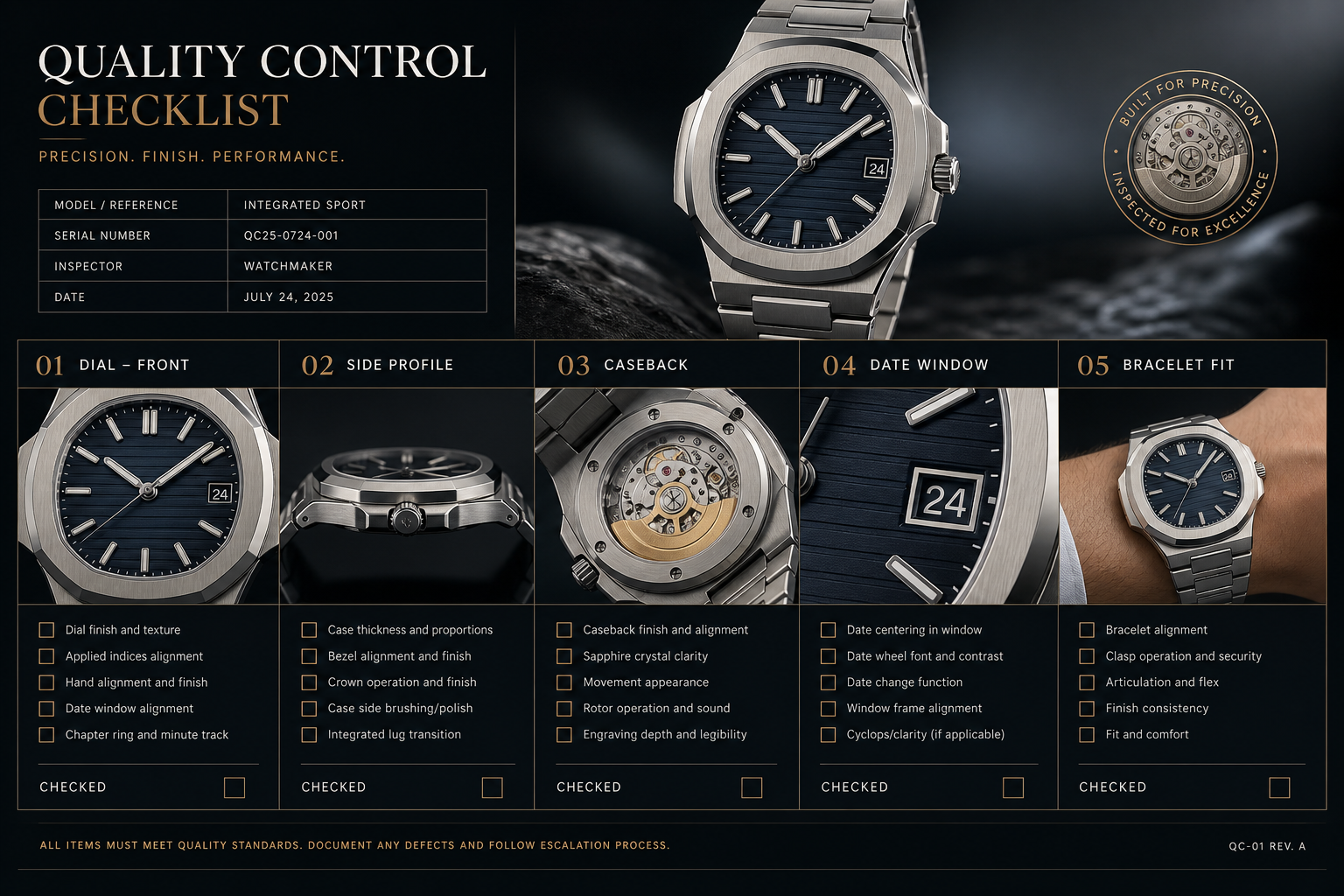
Before making a decision, buyers should review real QC photos where available, including dial printing, hand alignment, bezel position, datewheel centering, case thickness, bracelet fit, clasp engraving, caseback view, crown position, and overall finishing. Factory labels and stock photos alone are not enough for a reliable judgment.
Version Language Matters More Than a Short Label
Short labels are convenient, but version language often tells the buyer more. “SH4302” is less useful than “current batch 15500 with SH4302-style integrated movement, updated case fit, and recent buyer feedback.” “DD4302” is less useful than a clear explanation of which factory version uses it, whether the batch has shipped widely, and whether current owners report stable behavior.
This is where many buyers make a wrong turn. They compare SH4302 versus DD4302 as if the answer is only movement name against movement name. In practice, the better comparison is movement route plus factory version plus batch feedback. A strong older route can be weakened by poor assembly. A newer route can become attractive if multiple batches show consistency. A vague factory claim should not outrank specific evidence.
If a seller cannot explain the movement route beyond a label, the buyer should not treat the label as a premium feature. In AP replicas, clarity is part of value. Confusion is part of risk.
Version language should also be tied to intended use. A buyer who wants occasional wear may accept a version with excellent visual accuracy and less documented movement history. A buyer who wants daily wear should place more weight on owner feedback, service familiarity, and smooth operation. The “better” version is not always the same for both buyers.
QC Photos to Request
For movement-route confidence, request photos that connect the technical claim to the physical watch. The goal is not deception or resale misuse; it is basic buyer protection before approving a watch that may look strong from only one angle.
- Dial front: Check hand alignment, dial spacing, and whether the date sits naturally in the window.
- Side profile: Look for case thickness, caseback depth, and whether the watch appears unusually tall for the claimed AP reference.
- Caseback or movement view, if available: Review bridge layout, rotor style, engraving quality, and whether the visible movement matches the stated route.
- Date display: Ask for a clear date-window shot, preferably with more than one date if there are concerns about centering.
- Crown side: Check crown position, case flank thickness, and whether the crown sits naturally relative to the case.
- Clasp and bracelet fit: These do not confirm movement origin, but they help confirm the watch is consistent with the claimed factory level and version.
The strongest buying decision comes from consistency. If the AP movement origin claim, QC photos, side profile, version description, and current batch feedback all point in the same direction, confidence improves. If the seller only repeats a movement label while the rest of the information is vague, the buyer is being asked to pay for a claim rather than evidence.
A short functional video can be added to this list when movement behavior is a major concern. It should show the crown being used gently, the hands moving, the date advancing, and the watch being tilted enough to hear whether the rotor sounds controlled. This does not replace long-term feedback, but it helps separate a watch that merely photographs well from one that behaves acceptably during basic operation.
Buyer Decision Framework: When SH3120, SH4302, or DD4302 Makes More Sense
The safest way to answer “which AP clone movement should I choose” is not to rank SH3120, SH4302, and DD4302 as if they all belong to the same watch. They do not. The better question is whether the movement route fits the Royal Oak reference, whether the current batch has enough real feedback, and whether the buyer wants daily-wear predictability or is comfortable testing a newer route.
For most buyers, the mistake is chasing the newest movement name before asking whether the watch itself benefits from it. An AP replica can be visually strong from the front and still become the wrong choice if the movement route forces an awkward case profile, inconsistent date action, noisy rotor behavior, or uncertain service support. Movement origin should narrow the risk, not replace judgment.
The decision also depends on the buyer’s experience level. A beginner often benefits from a more stable and documented route because there are fewer surprises to interpret. A more experienced buyer may accept a newer movement route because they know how to inspect QC, ask the right questions, and handle service uncertainty. The same watch can be reasonable for one buyer and unsuitable for another.
| Buyer Priority | More Sensible Movement Route | Practical Reason |
|---|---|---|
| Older 3120-based Royal Oak context | SH3120-style route | Usually makes more sense where the reference was built around the 3120 architecture and where market feedback is easier to interpret. |
| Newer 4302-based Royal Oak context | SH4302-style route | Often the more established option for 15500-style discussions because buyers have more batch history and ownership reports to compare. |
| Interest in newer movement claims | DD4302-style route | Worth considering only when the specific version has credible feedback, clear movement-route disclosure, and no obvious case or date-layout compromise. |
| Daily wear with low tolerance for surprises | Most proven batch, not necessarily newest name | Stable date behavior, acceptable rotor sound, and service confidence usually matter more than having the latest label. |
For Buyers Who Prioritize Proven Market Feedback
If buyer confidence matters more than novelty, SH3120 and SH4302-style routes are easier to evaluate because they have longer market exposure. That does not make them perfect, and it does not mean every watch using those labels is automatically good. It means the buyer has more reference points: common complaints, version changes, realistic power reserve reports, date behavior patterns, and service familiarity.
In the SH3120 versus SH4302 decision, the model reference should lead. SH3120 makes more sense in older 3120-based Royal Oak replica contexts, especially where case thickness and balance-position discussions were central to improving beyond older plate-modified builds. SH4302 makes more sense when the watch is based around the newer 4302 generation, where the buyer expects the case architecture, date layout, and power reserve discussion to match that family more closely.
The non-obvious point is that a known weakness can be less dangerous than an unknown one. If a movement route has a documented tendency toward rotor noise or date hesitation in certain batches, a careful buyer can ask better questions and inspect the right areas. A new movement claim with limited field use may sound cleaner on paper, but there may not yet be enough ownership history to know what fails, how often it fails, or how easy it is to correct.
This priority is especially sensible for buyers who want a watch to wear regularly rather than discuss as a new release. A mature route lets the buyer focus on the individual watch: dial alignment, bracelet feel, case finishing, and movement behavior in QC. It does not remove risk, but it makes the risk more visible.
For Buyers Who Prioritize Newer Movement Claims
DD4302-style options are not something to dismiss automatically. A later Dandong AP clone movement discussion can be interesting if the architecture supports the watch properly and the current batch shows stable results. The caution is that Dandong’s reputation in other replica movement categories should not be imported into AP without proof. Royal Oak replicas are unusually sensitive to thickness, date placement, rotor clearance, and caseback construction, so the movement must be judged inside this model family.
In a SH4302 versus DD4302 comparison, the DD4302-style route becomes more reasonable when three conditions are met: the seller or listing clearly distinguishes it from SH4302, the specific batch has credible feedback beyond launch excitement, and QC photos do not show a case profile or date-window issue that the movement claim is supposed to solve. If those pieces are missing, the newer label is not enough.
At Clean VS Factory, we treat this as a version comparison, not a prestige contest between movement-origin names. A DD4302-style claim may become more convincing over time, but the buyer should not pay for the idea of improvement before the watch has demonstrated it through repeated batch performance.
A buyer who chooses DD4302 should ask what problem it solves compared with the established route. Does it improve reserve consistency? Does it reduce thickness? Does it improve the caseback layout? Does it reduce rotor noise? If the answer is unclear, the choice may be based on novelty rather than practical benefit.
For Daily Wear, Predictability Usually Beats Novelty
For daily wear, the safer AP replica movement is usually the one that behaves consistently, not the one that sounds most advanced in a listing title. A daily-wear Royal Oak replica has to wind without feeling rough, change the date cleanly, keep an acceptable power reserve for the buyer’s routine, and avoid rotor noise that makes the watch feel cheap on the wrist. These are ownership details, not forum talking points.
This is where many buyers overvalue movement naming and undervalue fit. A slightly older but well-tested movement route in a mature batch can be more satisfying than a newer route that still needs real-world sorting. The buyer who wears the watch several days a week should prioritize stable date action, comfortable case thickness, acceptable rotor behavior, and realistic service confidence. The buyer who enjoys experimenting with new versions can reasonably consider DD4302-style options, but only with a higher tolerance for uncertainty.
The clearest decision rule is simple: match the movement to the reference first, then choose the most mature batch available, then decide whether the remaining risk fits your expectations. If the watch is an older 3120-based Royal Oak replica, SH3120-style logic is usually more relevant. If it is a newer 4302-based Royal Oak replica, SH4302 is the established comparison point, while DD4302-style options should be judged by current batch evidence rather than the name alone.
For a buyer who is still unsure, it can help to rank the purchase priorities in order: case profile, dial execution, bracelet comfort, movement behavior, power reserve, caseback appearance, and price. Most wrong purchases happen when the buyer lets one priority, usually factory name or movement label, override all the others. A Royal Oak replica is too integrated for that kind of shortcut.
Disclosure, Legal, and Resale Caution for AP Replica Buyers
Movement-origin research should not blur the basic disclosure point: AP replicas are imitation watches, not authorized Audemars Piguet products. A more convincing SH3120, SH4302, or DD4302-style movement route does not change the watch’s legal or commercial status, and it should not be used to describe the watch as genuine, factory-authorized, official, or equivalent to an authentic Royal Oak.
Buyers should also be cautious about import, customs, trademark, resale, and disclosure issues because rules and enforcement can vary by jurisdiction. This article does not provide legal advice and does not claim that any replica watch is safe to import, safe to resell, or free from trademark-related risk. The practical point is simpler: movement details may help a buyer understand product risk, but they do not remove legal or disclosure concerns.
If a buyer later sells or trades the watch, the movement claim should never be used to misrepresent authenticity. Even a well-executed clone movement remains a replica movement inside an imitation product. Clear disclosure protects both sides of a transaction and prevents technical language such as “4302 clone” or “Dandong route” from becoming misleading shorthand for something the watch is not.
Claims such as “perfect,” “same as genuine,” or “guaranteed to pass inspection” should be treated with caution. A more reliable comparison looks at the actual model version, movement configuration, finishing details, and available QC evidence. The safest use of factory and movement information is to avoid overpaying or misunderstanding quality, not to represent a replica watch as genuine.
Balanced Conclusion: Movement Origin Is a Confidence Signal, Not a Guarantee
Movement origin matters in an AP clone movement comparison because it affects more than the caseback view. It influences how the Royal Oak replica is built, how thick it feels, how the date behaves, how the rotor sounds, how believable the case profile is, and how much confidence the buyer can have after the first week of ownership. A movement label is not decoration; it is part of the wearing experience.
The balanced view is that Shanghai/Jinghe-style SH3120 and SH4302 routes benefit from longer exposure in the AP replica market. Buyers can find more discussion, more version history, and more known strengths and weaknesses. Dandong DD4302-style discussions may become important, especially if newer batches prove stable, but the label alone does not settle the Shanghai versus Dandong movement question. Newer is not always better until the movement has survived real use across more than one round of early enthusiasm.
The final buying decision should also recognize that replica watches are not genuine, official, authorized, or brand-approved products. The realistic buyer goal is not to find a guaranteed perfect movement, but to reduce avoidable risk by checking whether the movement, case, date, bracelet, seller description, and current-batch evidence all support the same conclusion. That restrained approach is usually more useful than chasing the strongest-sounding claim.
The Safest Answer Is Usually Model-Specific
The best movement route for an AP replica depends on the reference first. A 15400-style watch and a 15500-style watch do not ask the same mechanical questions, and a movement that makes sense in one case can be the wrong benchmark in another. That is why SH3120 versus SH4302 should be read as a reference-generation decision, while SH4302 versus DD4302 should be read as a maturity and batch-confidence decision.
A buyer who wants the lowest practical AP replica buyer risk should not choose by factory reputation, forum shorthand, or the newest movement name alone. The more sensible path is to check whether the movement route matches the model, whether the batch has credible feedback, whether the case profile looks natural, and whether the buyer can accept the remaining reliability risk. Movement origin is useful because it gives context, not because it guarantees the outcome.
This model-specific approach also prevents overgeneralizing from other watches. A movement origin that performs well in a thicker sports watch may still need proof in a Royal Oak. A factory that is respected for one AP reference may not be equally strong across every dial color, size, bracelet version, or movement generation. The buyer’s safest question is always narrower: does this exact version make sense for this exact use?
Newer Movements Need Time to Prove Themselves
DD4302-style options may become more convincing if repeated batches show stable power reserve, clean date action, reasonable rotor behavior, and consistent case fit. Until then, they should be treated as promising rather than automatically superior. A new movement route becomes trustworthy through accumulated ownership feedback, not through a short label in a listing.
The practical conclusion is not that SH3120, SH4302, or DD4302 is universally best. The better conclusion is that movement origin matters, but batch evidence matters more. For long-term ownership, buyer confidence comes from the whole package: reference fit, movement maturity, version consistency, service familiarity, and realistic expectations. If those pieces align, the watch is a more rational choice. If they do not, even an attractive movement name will not save the purchase.
For careful buyers, the most useful habit is to treat every movement label as the start of the evaluation rather than the end. Ask how the movement affects thickness, date position, rotor sound, power reserve, crown feel, and service path. Then compare those answers against current QC and owner feedback. That is a slower way to buy than following the newest hype, but it is usually the better way to choose an AP Royal Oak replica that remains satisfying after the first photos have been approved.
Disclosure: This article is for general educational and comparison purposes only. Replica watches are not genuine products from the original luxury brands, and brand names are used only to identify reference designs or comparison topics. Factory names, movement descriptions, prices, availability, QC details, seller policies, and version information can change, so readers should verify important details with the seller before making a purchase decision. Replica watches should not be represented, resold, or used as genuine watches.