
The biggest mistake in today’s AP replica market is treating old 2018–2020 factory advice as if nothing changed, a context in which Chinese AP replica reviews often become confusing to Western buyers. The 2021 raids disrupted major production lines, affected availability, and changed which factories are relevant for specific Royal Oak and Offshore references. Names such as JF, XF, and Noob still matter historically, but they are not enough to judge a current watch.
This article explains how the market shifted after the raids and why buyers now need to compare exact references, active factory versions, movement routes, batch details, and QC evidence. The practical question is not which factory had the strongest reputation years ago, but which current version handles the model’s main weakness most effectively: Jumbo thinness, 15400/15500 proportions, exterior finishing, bracelet feel, or Offshore chronograph compromises.
| Buyer Question | What Changed After 2021 | Practical Check |
|---|---|---|
| Can old JF or XF advice still guide a purchase? | Only as historical context; production continuity changed. | Verify the current factory, version, batch, and QC photos. |
| Is APS automatically the right choice? | APS became more relevant where clone movement architecture helps proportions. | Check thickness, date position, display-back layout, and service risk. |
| Where does ZF still make sense? | ZF remains competitive through exterior finishing and broad model coverage. | Compare dial tone, bracelet finish, case shape, and movement option by reference. |
| When is APF worth considering? | APF is mainly relevant for Royal Oak Offshore chronographs. | Focus on subdial spacing, case thickness, strap fit, pushers, and chrono reliability. |
| What matters most for the 15202 Jumbo? | XF’s closure made old Jumbo guidance less reliable. | Prioritize thin case profile, bracelet flow, dial tone, and movement thickness. |
| Are newer versions always better? | Not necessarily; some changes solve one issue while creating another. | Look for documented improvements rather than version numbers alone. |
Quick Questions Before You Read
Q: Should I still trust AP replica reviews from before 2021?
Use them to understand common flaws, but do not rely on them for current factory guidance or availability.
Q: Is one factory now clearly the safest choice for all AP replicas?
No. APS, ZF, and APF each make more sense for different references and priorities.
Q: What should I check first before choosing an AP replica?
Start with the exact reference, then compare current factory version, movement route, and real QC photos.
Q: Why do Offshore chronographs need a different buying standard?
They involve thicker cases, chronograph layouts, pusher feel, and reliability compromises that thin Royal Oaks do not.
Editorial Perspective: The post-2021 AP replica market should be judged as a current-production problem, not as a nostalgia contest between factory names. At cleanvsfactory.com, a factory label is treated as a useful clue, but not final proof. For Royal Oak and Offshore buyers, the more reliable comparison is whether the exact version’s movement route, case thickness, dial execution, bracelet or strap fit, and QC photos match the buyer’s intended use. A watch that looks strong in seller photos may still be less suitable for daily wear if the movement is noisy, the bracelet feels sharp, the chronograph action is fragile, or the case profile is too thick for the reference.
Evidence Boundary: Factory names in the AP replica market are informal buyer and seller labels, not official Audemars Piguet production categories. This article uses names such as JF, XF, Noob, APS, ZF, and APF as market shorthand only. It does not claim authorization, affiliation, official supply relationships, or verified factory ownership. When a factory reputation is discussed, it should be understood as buyer-facing market context rather than a formally documented manufacturer statement.
How to Read the Claims: Statements about “rise,” “relevance,” or “market attention” describe how buyers commonly frame the post-raid replica market, not a guaranteed ranking of quality. A factory that is often discussed for one reference may be less suitable for another. The most defensible evidence in a purchase is still watch-specific: current QC photos, side-profile images, movement photos where available, seller transparency, and a clear description of the exact version being offered.
Replica-versus-genuine caution: Official Audemars Piguet model design can help buyers understand why Royal Oak and Offshore replicas are difficult to copy, but official AP information would not prove anything about a replica’s movement, materials, water resistance, finishing standard, or long-term durability. Replica watches should be treated as imitation products with differences in serviceability, legal status, warranty access, and quality control compared with authorized watches.
Brand and Reference Boundary: Audemars Piguet, Royal Oak, Royal Oak Offshore, and related model names are used here only to identify the genuine reference designs being discussed. Replica watches and super clone watches are not genuine Audemars Piguet products, are not produced through the original brand’s authorized channels, and should not be represented, sold, or serviced as authentic brand-manufactured watches.
Purpose of the Comparison: The factory and movement discussion in this article is intended to help readers understand market changes, version differences, and realistic ownership risks. It is not intended to help anyone misrepresent a replica watch as genuine or suggest that a replica-market watch is legally, commercially, or technically equivalent to an authentic luxury watch.
The Short Answer: Old AP Replica Advice Often Belongs to a Different Factory Era
A lot of old AP replica advice is not wrong because the reviewer was careless. It is outdated because the AP replica market changed underneath it. A recommendation written around the JF, XF, or early Noob era may describe a factory landscape that no longer exists in the same form after the 2021 factory raids. For a buyer looking at a Royal Oak replica today, that matters more than most forum threads admit.
The practical answer is simple: do not read a 2018, 2019, or 2020 AP super clone recommendation as if it automatically applies to the current AP factory landscape. The factory may be gone, the version may be unavailable, the movement route may have changed, or the same model number may now be produced by a different factory with a different set of strengths and weaknesses. This is especially important with Audemars Piguet replica watches because small differences in case thickness, bracelet flow, bezel geometry, dial texture, and movement architecture are more visible than they are on many simpler sports watches.
The 2021 factory raids did not simply remove a few names from dealer lists. They disrupted the old hierarchy. JF and XF had shaped much of the pre-raid AP replica market, while Noob-era assumptions influenced how buyers talked about “top factory” status across the broader replica watch market. After the reset, buyers had to pay more attention to APS, ZF, APF, and other active factories instead of relying on old rankings that were built around discontinued production.
The mistake is not reading old AP replica recommendations. The mistake is treating them as current buying instructions. Older posts can still teach useful things about Royal Oak case shape, tapisserie dial flaws, bracelet finishing, or why a 15202 is harder than it looks. But factory rankings age quickly when production sources, parts supply, and movement development change. A good old review can still be educational; a good old “best factory” answer may be stale.
Why the Same Model Name Can Mean a Different Watch Today
A Royal Oak 15400, 15500, 15202, or Offshore chronograph is not defined only by the reference number printed in a listing. In the replica market, the more important question is often: which factory made it, which version is it, which movement route does it use, and from which batch did it come? Two watches sold under the same model name can feel very different on the wrist if one uses an older plate-decorated movement and another uses a more integrated clone-style movement that allows better case proportions.
This is where many buyers get trapped. They search for “best AP 15400 replica” or “best AP 15202 factory,” find an older thread, and assume the answer still points to the safest current watch. But the same model name can now refer to a completely different production reality. A 15400 recommendation from the JF period may have been reasonable for its time, but it does not automatically tell you whether a modern APS or ZF version has better thickness, dial execution, bracelet feel, or movement layout. A 15202 recommendation is even more sensitive because the Jumbo gives factories less room to hide compromises.
The model number should start the research, not end it. For AP replicas, the reference tells you what problems to inspect. The factory and version tell you how those problems are currently being handled.
The Key Shift: From Legacy Dominance to Modern Specialization
Before the raids, older AP replica discussions often revolved around a few familiar names. JF was a major reference point for Royal Oak replicas, XF became closely associated with the 15202 Jumbo, and Noob influenced the wider replica watch culture even if its AP role was not the same as its Rolex role. Those names shaped buyer expectations: people wanted a clear winner, a stable hierarchy, and a shortcut answer.
After the reset, the market became more specialized. APS became more important in movement-driven Royal Oak discussions, especially where case thickness and movement architecture affected the final result. ZF remained relevant because exterior execution, case finishing, dial work, and broader model coverage still matter even when movement talk dominates the conversation. APF became more visible in Offshore chronograph-style replicas, where the evaluation is different from a thin Royal Oak or Jumbo. None of this means one factory now owns the entire AP category. The post-2021 market rewards model-specific judgment more than factory loyalty.
This is the main buyer-facing change: the best question is no longer “Which old factory had the strongest reputation?” It is “Which active factory currently makes the most sensible version of this exact AP reference, with this movement route, in this batch?” That is a narrower question, but it leads to fewer bad purchases.
Factory Name Clarification: Factory names in the replica watch market are commonly used buyer-facing labels. They should be treated as practical market references, not as official brand affiliations, audited manufacturer identities, or guarantees of identical quality across every model.
A more traceable factory comparison connects the name to observable evidence. For an AP replica, that means checking whether the claimed factory version actually matches the case profile, bracelet construction, dial texture, datewheel position, caseback layout, and movement route expected for that reference. If a seller uses a well-known factory name but cannot explain the version, movement configuration, or visible differences from earlier batches, the factory label should be treated as incomplete information rather than proof of quality.
Reader Takeaway Before Going Deeper
Before trusting any AP replica recommendation, ask three questions. When was the recommendation written? Which factory and version was it describing? Does that same factory version still exist in the same form today? If the answer is unclear, treat the recommendation as background information, not a buying decision.
At Clean VS Factory, we usually separate old design criticism from current factory advice. A 2020 comment about weak dial texture may still help you inspect a modern Royal Oak replica, but a 2020 factory ranking may not tell you which factory matters now. That distinction is the difference between learning from old information and being misled by it.
Before the Raids: Why JF Dominated Royal Oak Replica Discussions
JF dominated older Royal Oak replica discussions because it gave buyers something the AP replica market badly needed at the time: a recognizable benchmark. The Royal Oak is not a forgiving watch to copy. Its flat case planes, octagonal bezel, exposed screw layout, integrated bracelet, polished bevels, brushed surfaces, and tapisserie dial leave very little room for sloppy execution. In that environment, a factory that could deliver repeatable results across popular Royal Oak references naturally became the name buyers remembered.
That does not mean every JF AP replica was the best possible version of every Audemars Piguet model. It means JF became the pre-raid reference point for many buyers comparing Royal Oak replicas, especially models like the Royal Oak 15400 and 15450. Older JF AP reviews often focused on the details that matter most on this design: case shape, bracelet integration, bezel finishing, dial texture, and the overall wrist presence of the watch. Those were not small issues. On a Royal Oak, the bracelet and case are almost one continuous object, so poor finishing is obvious even before anyone looks at the movement.
JF’s Strength Was More Than Factory Hype
JF’s reputation was not only a forum slogan. The factory gained trust because buyers saw repeated coverage, multiple versions, and a relatively stable visual standard for Royal Oak replicas during its strongest years. In a market where many factory names appeared and disappeared quickly, JF became a common reference point. If someone asked about a JF Royal Oak replica, other buyers usually knew the general category being discussed.
That recognition mattered because AP replicas are hard to judge from a single listing photo. The Royal Oak’s quality impression comes from many small surfaces working together. The bezel cannot look too soft. The brushing needs to run in the right direction. The polished bevels need to catch light cleanly. The bracelet links need enough articulation without feeling loose or cheap. The dial texture should not look flat, plasticky, or overly stamped. JF was valued because it gave buyers a more predictable standard for several of these visible areas compared with many lower-tier options of the same period.
The non-obvious point is that JF’s advantage was partly about reducing uncertainty. Many buyers were not choosing JF because it solved every technical problem. They were choosing it because the alternative was often a less documented watch with unknown case finishing, rough bracelet feel, or inconsistent dial execution. In the pre-raid market, that kind of predictability carried real value.
Why Royal Oak Replicas Rewarded a Factory With Consistency
The Royal Oak punishes inconsistency more than many watches. A Submariner-style case can hide some finishing softness because the design is rounder and more utilitarian. A Royal Oak cannot. Its geometry is exposed. The bezel is a large flat frame. The bracelet starts immediately at the case and becomes part of the watch’s identity. If the first links sit wrong, if the brushing is messy, or if the polished bevels are uneven, the watch loses its character quickly.
This is why JF’s consistency mattered in older discussions. Buyers wanted a factory that could keep the Royal Oak’s structure believable, not just print the right logo on the dial. The case and bracelet had to feel related. The bezel screws had to sit cleanly enough. The tapisserie dial had to create some visual depth. The clasp and bracelet finishing had to support the premium-sport look rather than collapse into budget-watch feel.
For daily wear, bracelet feel is often more important than buyers expect. A Royal Oak replica can photograph well from the front and still disappoint if the bracelet feels stiff, sharp, hollow, or poorly articulated. JF’s place in older AP replica advice came partly from giving buyers a stronger bracelet and case-finishing baseline for its era. That is a more serious reason than simple factory hype.
The Problem With Treating JF-Era Advice as Current Advice
The danger today is using JF-era advice as a shortcut. A recommendation that made sense before 2021 may not apply to a buyer comparing current AP super clone options. JF’s old reputation does not automatically make an old-stock piece a smart purchase, and it does not prove that a modern version from another factory is worse. The production context changed.
Old-stock claims also require caution. A watch described as “JF” may be old, mixed, misidentified, stored poorly, or priced more for nostalgia than actual condition. Even if the factory source is genuine to the claim, age matters. Lubrication can dry out, bracelets can show handling marks, crystals and gaskets may not be in the expected condition, and version details can be unclear. Paying extra for a factory name without confirming the specific watch is not careful buying.
The better use of JF-era information is historical comparison. It helps explain why Royal Oak replicas were judged so heavily on case finishing, bracelet construction, and dial execution. It does not settle which AP replica a buyer should choose now. In the current market, a factory name is only useful when tied to model, version, movement route, batch quality, and QC evidence.
That is the key judgment: JF deserves its place in AP replica history, but chasing the name alone today is usually a weaker strategy than evaluating the strongest current version of the exact reference you want.
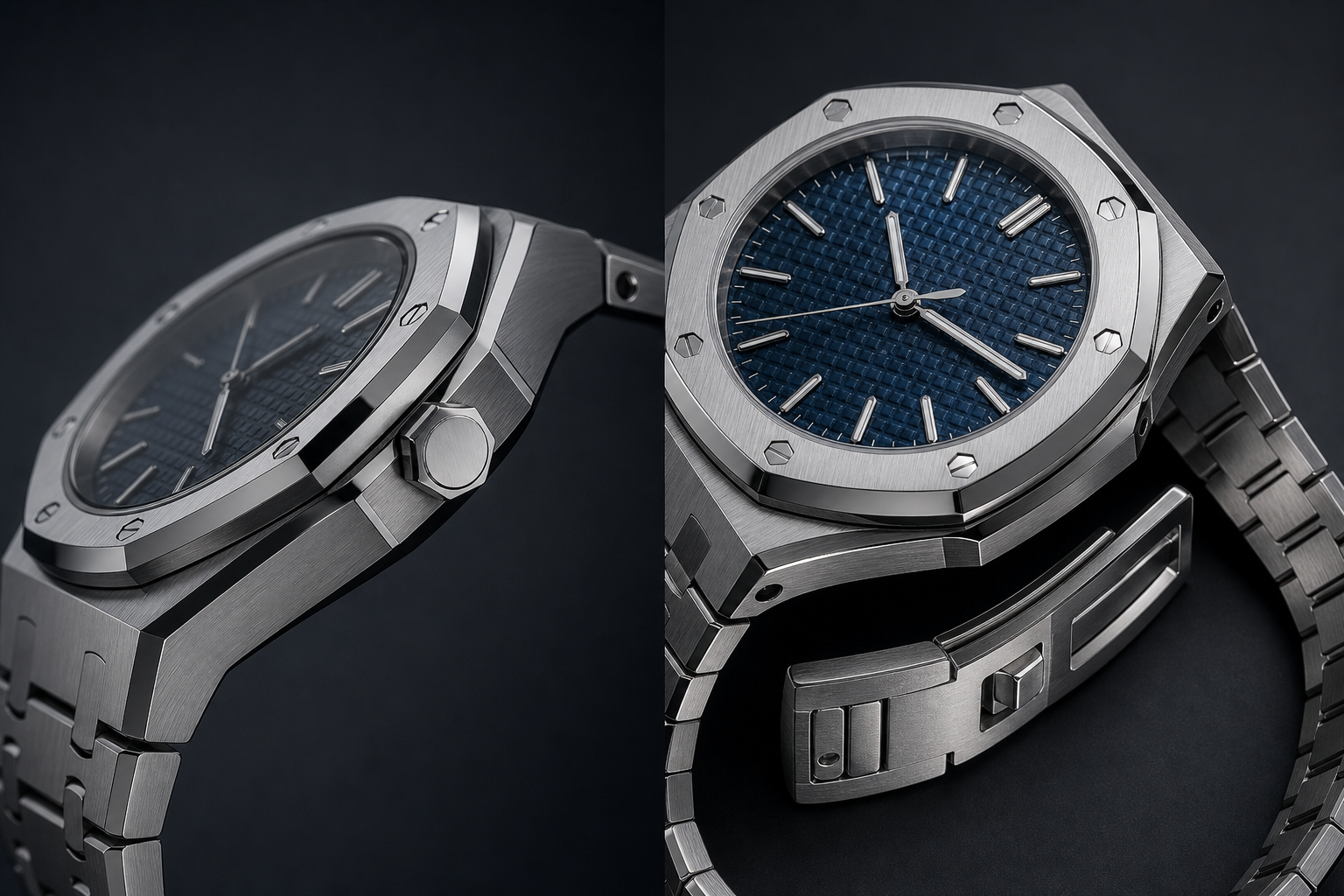
XF and the 15202 Jumbo Gap: The Model That Exposed the Market Reset
The XF 15202 replica matters because it shows how the 2021 market reset was not just about factory names disappearing. It created model-specific gaps. The AP 15202 Jumbo replica was one of the clearest examples because the Jumbo is not simply a smaller Royal Oak. It is a thinner, more restrained, more proportion-sensitive watch where tiny compromises become easier to see.
Older buyers often spoke about the XF 15202 replica because XF had become strongly associated with the Royal Oak Jumbo segment. That reputation was not based on complication or visual drama. It came from the fact that the 15202 is extremely hard to make convincing. The case has to stay thin, the dial has to look calm rather than busy, the bracelet must flow naturally from a 39mm case, and the movement route cannot force the watch into a chunky profile. When XF disappeared from the active market, buyers lost a familiar reference point in one of the most difficult AP replica categories.
Why the 15202 Was Not Just Another Royal Oak
The 15202 looks simple to casual buyers, which is exactly why it is dangerous. There is no chronograph bezel, no oversized Offshore case, no aggressive rubber strap, and no busy dial layout to distract the eye. The whole watch depends on proportion. The ultra-thin case, slim bezel, petite-style dial texture, restrained blue tone, short visual height on the wrist, and integrated bracelet taper all have to work together.
On a thicker Royal Oak model, a factory can sometimes get away with a little extra height because the original watch has more physical presence. On a 15202-style Jumbo, thickness is the central issue. If the case becomes too tall, the watch stops feeling like a Jumbo. If the bracelet is too stiff or the first link sits awkwardly, the elegant low-profile character is weakened. If the dial blue is too bright, too purple, or too flat, the watch calls attention to itself in the wrong way.
The movement route is the hidden problem behind many visible flaws. A slim-looking AP 15202 Jumbo replica requires a movement solution that supports the case profile. If the movement architecture is too thick or requires decorative work that adds height, the case has to compensate. That is why Jumbo comparisons cannot be reduced to dial color or factory logo. The mechanical packaging affects the entire shape of the watch.
What XF’s Closure Changed for Jumbo Buyers
XF’s closure changed the 15202 conversation because buyers could no longer rely on the old shorthand. Before the reset, “look at XF” was a common answer in many Jumbo discussions. After the reset, that answer became less useful unless the buyer was evaluating a specific old piece with known condition and version details. The market had to move from a familiar factory reference to a more careful inspection process.
For modern Jumbo buyers, the decision has to be more skeptical. Case thickness claims need to be checked. Dial tone matters because the 15202 blue dial is one of the easiest places for a replica to feel off in person. Bracelet construction and drape matter because the 39mm case does not have the visual bulk to hide poor integration. Movement execution matters because the wrong architecture can damage the slim profile even if the front view looks attractive.
This is the broader lesson from the XF gap: a factory shutdown does not affect every model equally. Losing a producer in a forgiving category may be inconvenient. Losing a producer in an ultra-thin, proportion-sensitive category changes the whole buying standard. The 15202 exposed that difference more clearly than many other AP references.
Version Details to Confirm
Any AP 15202 Jumbo replica discussion should be tied to specific details, not vague labels. Confirm the claimed factory source, the version, the movement route, including Shanghai vs Dandong movements when the seller describes AP replica caliber origin, the case thickness claim, the dial color, the bracelet construction, and whether the watch is current production or old stock. Phrases like “XF-style” or “same as XF” are not enough. They may describe an aesthetic target, a seller claim, or a parts-based comparison, but they do not prove the watch has the same proportions, movement solution, or finishing standard.
Be especially cautious with old-stock XF claims. Even if the claim is accurate, condition and version matter. A stored watch can have movement dryness, handling marks, bracelet wear, or unclear service history. A rare name can also inflate expectations beyond what the actual watch delivers. The safer approach is to judge the physical watch in front of you: side profile, bracelet articulation, dial tone, date position, caseback execution, and movement behavior.
The 15202 is not the best place for casual factory-name buying. It is a model for buyers who understand that a small thickness difference, a slightly wrong bracelet feel, or an overconfident old recommendation can change the entire character of the watch.
For a 15202-style Jumbo, real QC photos are more useful than stock images because the critical flaws are often visible only from side angles, bracelet-drape shots, date-window close-ups, and neutral-light dial photos. QC photos reduce uncertainty, but they do not prove long-term movement stability, water resistance, or how the bracelet will feel after extended wear.
The 2021 Raids as a Structural Turning Point, Not Just Industry Gossip
The 2021 replica factory raids matter to AP buyers because they changed the decision map. The useful point is not the drama around who was targeted, who owned what, or which private stories circulated afterward. The visible effect was simpler and more important: several factory names that had shaped AP replica recommendations either disappeared, lost continuity, or stopped representing the same buying option they once did.
For a buyer researching AP replicas after 2021, this means an old ranking is not automatically wrong, but it may be anchored to a production structure that no longer exists. A post from the JF, XF, or early Noob period might describe a real advantage at the time, yet the watch behind that recommendation may no longer be available in the same form. That is the real market disruption. The raids did not just reduce stock; they broke the chain between old reviews and current factory choices.
The AP replica market is especially sensitive to this kind of reset because Royal Oak and Offshore models depend on many specialized parts working together. Case machining, bracelet finishing, tapisserie dials, decorated movements, datewheels, rotors, crystals, screws, and clasps may come from different parts of the supply chain. When a factory shutdown happens, the buyer does not only lose a label. Version continuity can be interrupted, suppliers can change, movement routes can be replaced, and QC consistency can become less predictable for a period of time.
What Can and Cannot Be Proven From Raid-Era Information: Public buyer discussions can help explain why certain factory names became less available or less central after 2021, but they rarely prove exact factory ownership, supplier routes, internal production dates, or movement sourcing. For that reason, this article avoids treating raid stories as technical proof. The more useful evidence for a buyer is whether the current watch can be inspected through version-specific photos, movement-side images, and a seller explanation that matches the visible construction.
Why this matters for AP: A Royal Oak replica can change meaningfully when only one component route changes. A different dial supplier may alter color and texture; a different bracelet route may change wrist feel; a different movement architecture may affect thickness and date position. Because those changes are difficult to verify from factory-name language alone, post-2021 recommendations should be tied to the physical watch rather than to broad claims about what happened during the raids.
Why Factory Shutdowns Change More Than Availability
A common beginner mistake is assuming a shutdown only means “less stock.” In practice, factory shutdowns affect the reliability of comparisons. If a 2020 review praised a JF Royal Oak bracelet, that does not automatically help the buyer judge a current APS, ZF, or APF version. The old review may still teach you what to inspect, but it no longer tells you which modern production run is safest.
Version continuity is the first casualty. A factory may have improved a case over several batches, corrected a dial flaw, or stabilized bracelet fit over time. When that production line stops, the next available version from another factory may not inherit those improvements. It may solve one problem and introduce another. This is why AP replica factory changes after 2021 made the market harder to summarize with one-line advice.
Parts sourcing also becomes less transparent after a disruption. A seller may describe a watch as “same style,” “old version,” or “updated batch,” but those phrases do not confirm whether the case, movement, dial, or bracelet follow the same route as the watch shown in an older review. This matters more on AP than on many Rolex replicas because the Royal Oak bracelet and case finishing are not forgiving. Small changes in link articulation, bezel brushing, or dial texture can change the whole wrist impression.
Movement routes became another practical issue. Some older AP replicas used reliable but visually compromised base movements with decorative plates. Newer versions may use more ambitious clone movement routes that better support case thickness, date position, and display-back appearance. That is a meaningful advance, but it also changes ownership risk. A more correct-looking movement is not automatically easier to service or more durable in daily use.
How the Raids Reordered AP Factory Attention
After the 2021 replica factory raids, buyers naturally started paying more attention to APS, ZF, and APF because the older reference points no longer covered the market the way they once did. This was not just a popularity shift. It was a practical response to missing production paths.
APS became more important because modern Royal Oak buyers increasingly cared about movement architecture, case thickness, date behavior, and whether the movement display looked coherent through the caseback. ZF remained relevant because exterior execution still matters heavily on Royal Oak models: brushing, bezel geometry, dial printing, bracelet feel, and overall case profile can make or break the watch before the movement is even discussed. APF gained attention in a different lane, especially where Offshore chronograph-style models required a separate evaluation logic.
The key judgment is this: the post-2021 AP market did not create one new universal winner. It created a more segmented market. A buyer looking at a thin Royal Oak, a 41mm 15500-style model, and a bulky Offshore chronograph should not be using the same factory logic. The raids accelerated that separation by removing older shortcuts and forcing buyers to ask more specific questions.
This is why old factory rankings changed. The issue is not that every older factory was overrated or every newer factory is superior. The issue is that the market’s center of gravity moved. AP replicas after 2021 have to be judged by current factory capability, current version, movement route, and QC evidence, not by a factory hierarchy frozen in 2019 or 2020.
What Buyers Should Not Assume From Raid Stories
The first bad assumption is that old factories were always better. Some legacy pieces were strong for their time, and some older details are still respected, but age creates its own problems: unknown storage condition, limited parts support, inflated reputation, and unclear version identity. Chasing an old-stock factory name can be rational only if the buyer can verify exactly what the watch is and accepts the ownership risk.
The second bad assumption is that new factories are automatically worse because they came after the reset. That is too simple. In several AP segments, newer movement routes and more focused production have improved practical realism, especially where case thickness and movement layout were major weaknesses in the older era. The improvement is not universal, but it is real enough that dismissing modern APS, ZF, or APF options just because an old forum thread praised JF or XF is a poor buying method.
The third bad assumption is that a raid story explains a watch’s quality. It does not. The only useful question is what the current watch does well and where it still fails. For AP, that means checking model-specific execution: case profile, bracelet integration, dial texture, bezel screw placement, date alignment, movement behavior, and batch consistency. The raid history explains why the market changed; it does not replace inspection.
At Clean VS Factory, we usually treat the 2021 reset as a warning against lazy factory-name buying. A factory name can point you in the right direction, but it cannot confirm the version, movement, or QC condition of the specific AP replica in front of you. That is the buyer lesson from the post-2021 landscape.
APS Factory’s Rise: Clone Movements and the New Royal Oak Conversation
APS Factory became more important after the raids because the AP market needed more than another exterior copy of the Royal Oak. Buyers had already seen years of decent-looking Royal Oak replicas that still carried movement-related compromises: thicker cases, awkward balance positions, noisy rotors, incorrect display-back appearance, or date behavior that did not match the model’s design logic. APS entered the modern conversation by attacking those problems through the movement route.
This does not mean every APS Factory AP replica is automatically the best choice. It means APS changed what serious buyers started asking. Before, many AP replica discussions focused on which factory had the better bracelet or dial. After the market reset, the question became broader: does the movement architecture allow the case, dial, date, thickness, and display back to make sense together?
That shift is especially important for Royal Oak references such as the AP 15400 replica and AP 15500 replica, where the genuine watches have visible identity tied to movement proportions and case profile. A Royal Oak is not a deep case watch where extra thickness disappears. The flat case, integrated bracelet, and open caseback give the movement route more influence than buyers sometimes expect.
Why Movement Route Became a Bigger Selling Point After 2021
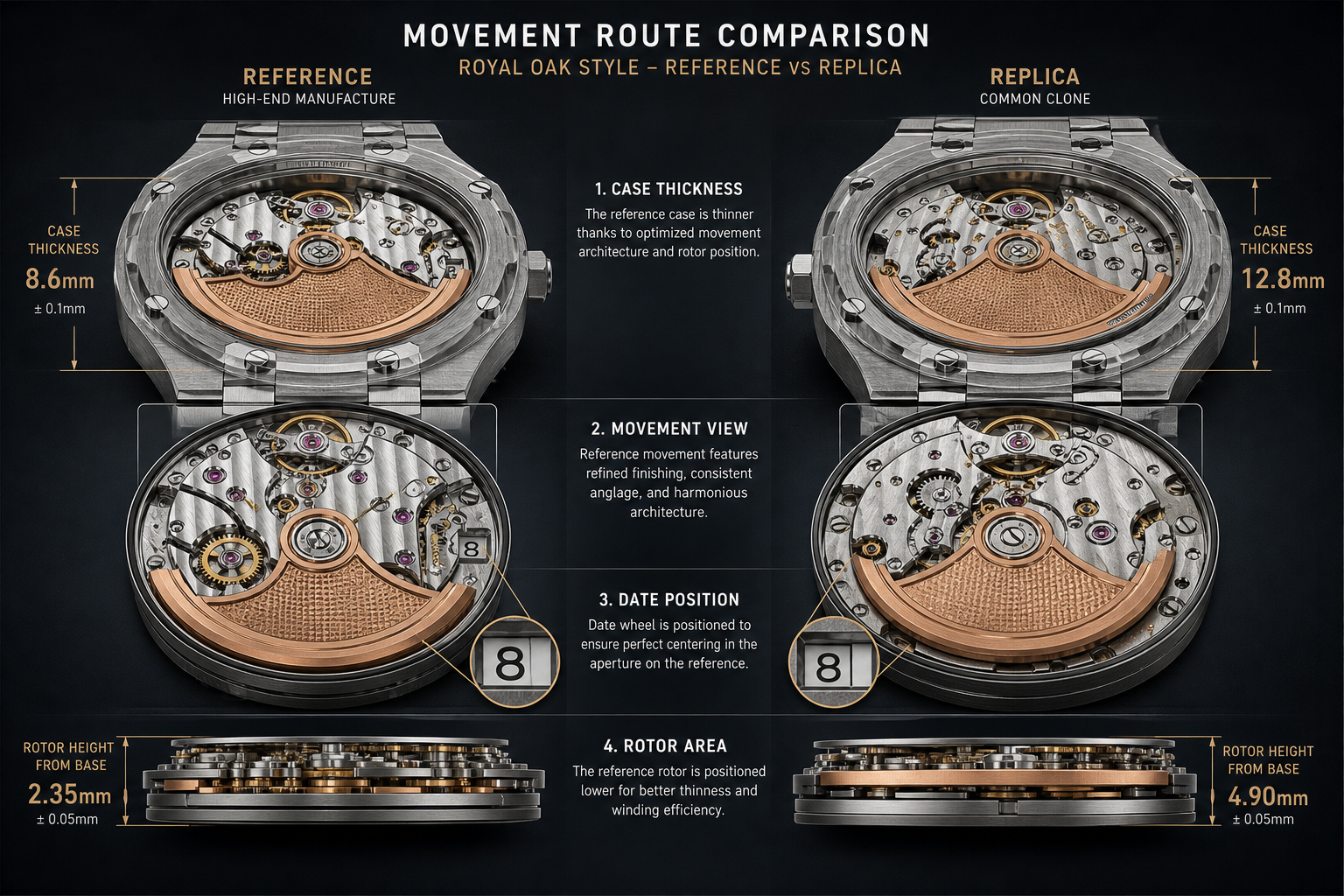
After the raids, the market had to rebuild confidence around current production. A clone movement became attractive not because buyers suddenly became movement collectors, but because the movement route affects the entire watch. On a Royal Oak, movement thickness helps determine case thickness. Calendar architecture affects date position and date change behavior. Rotor design affects noise and winding feel. Bridge layout and decoration affect how convincing the caseback looks.
This is where APS gained attention. Compared with older plate-modified movement approaches, an integrated clone movement route can support a cleaner overall design. On the right model, it can help reduce the “stacked” feeling of a decorative plate over a generic base movement. It can also make the display caseback less obviously compromised at a glance.
The tradeoff is ownership complexity. A more ambitious clone movement may look more complete and allow better proportions, but it may not be as easy to service as a common Miyota-based setup. Parts availability, watchmaker familiarity, rotor behavior, power reserve consistency, and calendar reliability all matter. A buyer who only hears “clone movement” and treats it as a guarantee is missing the real question: has this specific movement route proven stable enough for the way you plan to wear the watch?
For daily wear, the best movement route is not always the most exciting one on paper. It is the one that supports the correct case architecture while remaining predictable enough to own. That balance is why APS became important, but also why buyers still need to verify the exact version rather than assume the factory name settles the matter.
Movement Transparency Note: Movement references in this article describe the replica-market movement type or configuration, not an official Audemars Piguet or Swiss-manufactured caliber unless explicitly stated with verifiable evidence. Buyers should judge each movement route by visible layout, case-thickness impact, date behavior, service expectations, and the specific version being offered.
Movement trust in the replica market depends on knowing what the movement description is trying to communicate. Sometimes it refers to architecture, sometimes to decoration, sometimes to a modified Asian base movement, and sometimes to a clone-style layout designed to resemble the genuine reference from the back. Those categories do not carry the same service expectations. A decorated plate can improve the caseback view while leaving the underlying movement behavior unchanged, while a more integrated clone-style movement may improve proportions but introduce parts and maintenance uncertainty.
Movement Claim Boundary: A movement name in a replica listing should not be read as proof that the watch contains a genuine Audemars Piguet caliber or an official brand-manufactured movement. In many replica-market discussions, movement naming describes a layout, clone-style architecture, decoration style, or seller shorthand. The safer reading is to ask what the movement does for this specific watch: whether it changes the case thickness, date position, rotor behavior, caseback view, and service expectations.
Serviceability Consideration: A visually ambitious movement can make an AP super clone more coherent from the outside, but it can also make repairs more dependent on parts access and watchmaker familiarity. Buyers should avoid treating a clone movement as a promise of long-term reliability. The more useful question is whether the movement route is appropriate for the intended use, whether obvious operating issues are known for that version, and whether the seller can explain realistic support options without making unsupported guarantees.
Where APS Changed the Buyer Conversation
APS changed the post-2021 Royal Oak conversation by making older JF-era assumptions less useful. In the JF era, buyers often accepted movement compromises because exterior execution was the main benchmark. After APS pushed more integrated movement routes into modern AP super clone discussions, the standard moved. A good AP replica was no longer judged only by whether the bracelet looked sharp in photos. Buyers started asking whether the movement helped the watch sit correctly on the wrist.
This was an important shift for 15400-style and 15500-style Royal Oak replicas. These models are simple enough on the dial that thickness, date placement, and caseback layout become more visible. If a factory improves the movement route but the case still looks too tall, the improvement is incomplete. If the case thickness improves but the dial texture looks flat or the bracelet feels stiff, the watch still falls short as a daily-wear object.
APS also made the market more movement-aware. That is useful, but it creates a new form of hype. Some buyers now overvalue the movement label and undercheck the visible watch. A modern APS Royal Oak replica can be a strong option in the right reference and version, but the buyer still needs to inspect the tapisserie dial, bezel screws, crystal height, bracelet articulation, date centering, and brushing transitions. Movement progress does not erase AP’s exterior finishing challenge.
The most sensible way to frame APS versus old JF is not “new beats old” or “old beats new.” It is this: JF was a historical benchmark for its era, while APS helped define the modern movement-driven Royal Oak discussion. The buyer’s job is to compare the current APS version against today’s alternatives, not against a memory of what JF represented in older forum rankings.
Movement Route to Verify
Before trusting a claim about an APS Factory AP replica, confirm the movement route being offered for that exact model. The same factory name can appear across different references, versions, and movement configurations. A seller’s description should not be accepted as enough if the watch is being priced as a modern AP super clone.
- Claimed movement type: Check whether the watch is described as an integrated clone movement or a base movement with decorative plates. The difference affects thickness, caseback appearance, and future service expectations.
- Visible movement layout: For display-back Royal Oak models, compare bridge shape, rotor position, balance location, engraving style, and overall architecture. Do not expect genuine-level finishing, but look for obvious mismatches.
- Case thickness impact: A better movement route should support a more convincing case profile. If the case still looks too tall from the side, the movement claim has limited practical value.
- Date behavior: Confirm date centering, datewheel font, date change behavior, and whether the date sits naturally in the window. AP dials leave little room for sloppy calendar execution.
- Winding and rotor expectations: Ask whether rotor noise, winding feel, and power reserve are known issues on that version. A quiet photo does not tell you how the watch behaves on the wrist.
- Version timing: APS versions can change over time. A review of one batch may not describe the exact watch currently being offered.
A clone movement is valuable when it supports the watch as a whole. It is less valuable when it becomes a marketing word used to distract from thickness, dial, or bracelet problems.
ZF’s Survival and Adaptation: Why It Stayed Relevant After the Reset
ZF stayed relevant after the 2021 reset because the AP replica market did not need only movement innovation. It also needed consistent exterior execution and broad model coverage. Royal Oak buyers may talk about clone movements more than before, but the first impression of an AP replica still comes from the case, bezel, dial, bracelet, and the way the watch sits flat and sharp on the wrist.
This is why ZF AP replica discussions continued after the raids. ZF occupied a useful middle position: familiar enough to appear in older conversations, adaptable enough to remain part of modern ones, and broad enough to cover multiple AP references. That does not make ZF the automatic answer. It makes ZF a factory that has to be read carefully by date, model, and version.
The strongest judgment here is that ZF should not be treated as one fixed standard. A ZF Royal Oak replica from one year, one reference, and one batch may not represent another. Buyers who ask “is ZF still good for AP?” are asking the wrong first question. The better question is: which ZF model, which version, and what are its known strengths against current alternatives?
ZF as a Bridge Between Old and New AP Recommendations
ZF appears in both older and newer AP discussions, which is exactly why it can confuse buyers. A pre-2021 mention of ZF may reflect a different competitive environment, different movement expectations, and different alternatives. A more recent mention may compare ZF against APS, APF, or other post-reset options. The factory name is the same, but the market around it changed.
This bridge role is useful if the buyer reads it correctly. ZF can help connect older AP replica advice to modern comparisons because it remained visible while other names faded or disappeared. But that also makes ZF vulnerable to reputation carryover. A strong review of one ZF 15500-style version does not prove that every ZF Royal Oak, Offshore, or older reference deserves the same confidence.
Version timing matters because AP replicas improve unevenly. A factory may update a dial texture, adjust a bracelet, change a movement route, or correct a caseback detail without turning every model into a new benchmark. ZF after the raids should be evaluated as a living production label, not as a frozen forum reputation.
Why Exterior Execution Still Matters Even When Movements Improve
The Royal Oak is one of the worst watches to judge by movement alone. Its case and bracelet are the design. The flat bezel, exposed screws, brushed planes, polished chamfers, integrated bracelet, and tapisserie dial create a watch where exterior execution is not decoration; it is the main event.
ZF remained relevant because buyers still cared about those visible details. On a Royal Oak 15500 or Royal Oak 15400 style replica, a more advanced movement will not save weak brushing, soft bevels, poor dial printing, stiff bracelet links, or awkward end-link fit. These are the details a buyer notices every time the watch catches light.
AP case finishing is also less forgiving than many buyers expect. Rolex-style sports replicas can sometimes hide small case or bracelet compromises behind rounded surfaces and familiar tool-watch proportions. The Royal Oak cannot. Its geometry is too flat and too exposed. If the brushing direction is inconsistent or the polished bevels look rounded instead of crisp, the watch loses the AP character even if the movement sounds impressive in the listing.
ZF’s best role in the post-2021 AP market is therefore not simply “alternative to APS.” It is a reminder that exterior execution remains a decision driver. Movement route matters, but a Royal Oak with poor bracelet feel is still a weak Royal Oak.
The Risk of Treating ZF Mentions as One Single Standard
The biggest risk with ZF recommendations is compression. Forum posts, seller descriptions, and casual comments often reduce the watch to “ZF AP” as if that phrase contains all the needed information. It does not. ZF performance can vary by reference, batch, movement route, dial color, and production timing.
Blue dials are a good example of why broad claims are risky. A factory can have strong case finishing and still struggle with dial tone, sunburst effect, or tapisserie depth under different lighting. A black or grey dial may appear more forgiving, while a blue dial attracts more scrutiny because buyers compare it to the most recognizable Royal Oak look. Saying “ZF has good dials” is not specific enough to guide a purchase.
Bracelet and case QC also need version-level attention. SEL-style fit is not the AP issue; bracelet integration is, and AP replica factory sourcing is where the first links, link articulation, clasp closure, screw seating, brushing transitions, and whether the bracelet drapes naturally instead of feeling blocky become obvious. These details vary more in real use than many factory rankings admit.
The practical way to use ZF advice is to treat it as a lead, not a conclusion. If a current ZF Royal Oak replica is being considered, ask for the exact reference, current batch, movement route, side-profile photos, dial close-ups, date alignment, bracelet shots, and clasp photos. If the recommendation cannot be tied to those details, it is too vague to rely on.
ZF survived the reset because it adapted and continued to offer meaningful AP options. But its value is model-specific. For today’s buyer, the safest approach is not to believe or dismiss ZF as a brand name. It is to compare the specific ZF version against the specific APS, APF, or other current alternative that actually competes with it.
APF and the Offshore Chronograph Niche: A Different Post-Raid Opportunity
APF’s rise after 2021 was not the same kind of story as APS gaining attention through integrated Royal Oak movements or ZF staying relevant through broad exterior execution. APF became more visible because the Royal Oak Offshore chronograph replica sits in a different buying category. It is larger, louder, and more complicated than a 15202, 15400, or 15500, so the usual Royal Oak checklist does not fully apply.
This is where many buyers make a bad comparison. They judge an APF Offshore replica as if it were a thin Royal Oak dress-sport model, then focus on the wrong flaws. A standard Royal Oak lives or dies by thinness, bracelet flow, dial texture, and case geometry. A Royal Oak Offshore chronograph replica has a different set of pressure points: chronograph layout, case thickness, rubber strap fit, pusher feel, subdial spacing, and whether the movement route is something the buyer can realistically live with.
The Offshore case can be more forgiving visually because it is already oversized and aggressive. A slightly heavier case, deeper bezel, or bolder pusher assembly may not look as immediately wrong as a thick 15202 Jumbo. But that forgiveness cuts both ways. The same big case can hide proportion issues in photos while making the watch feel bulky, top-heavy, or mechanically rough in daily wear. For Offshore buyers, wrist presence is not the problem. Controlling that wrist presence is the problem.
Why Offshore Chronographs Needed Their Own Factory Logic
The Offshore chronograph is not just a Royal Oak with extra subdials. Its design adds pushers, crown guards, rubber or hornback-style strap integration, thicker bezels, larger screws, more pronounced case layers, and a busier dial. Each added element creates another place where a replica factory can either look convincing or feel compromised.
On a thin Royal Oak, the integrated bracelet is often the center of the experience. On an Offshore, the strap and case interface become just as important. A poor rubber strap fit can make the watch feel cheaper than the case finishing suggests. Gaps at the strap end, a stiff strap that does not curve naturally, or hardware that feels light can weaken the whole watch even if the dial looks strong in photos.
The chronograph display also changes the risk profile. Subdial spacing is one of the easiest ways for an Offshore chronograph replica to look wrong to anyone familiar with the reference. If the movement architecture does not naturally support the correct layout, factories may accept spacing compromises or case thickness increases. A buyer who only asks for the “best Offshore replica factory” may miss the more important question: does this specific reference have a movement layout that supports the dial and case properly?
Pusher construction deserves more attention than it usually receives. Many buyers check whether the chronograph starts, stops, and resets, but they ignore how the pushers feel. A pusher that feels gritty, overly stiff, or uneven is not just an aesthetic issue. It can hint at movement stress, poor assembly, or a chronograph mechanism that should be treated cautiously. In practice, Offshore chronograph replica risk is often less about whether the watch looks dramatic and more about whether the mechanical package feels stable enough for regular use.
Where APF Became More Visible After the Market Reset
APF became more relevant because the post-2021 AP market needed factories that were not only chasing the clean Royal Oak formula. The Offshore segment had room for a factory willing to work around chronograph-style cases, rubber strap construction, bold bezels, and large visual profiles. That gave APF a clearer niche than it might have had in a market still dominated by old JF and XF-era assumptions.
The sensible way to view APF after 2021 is as a specialist candidate, not a universal AP answer. APF is worth discussing when the buyer is looking at Royal Oak Offshore chronograph-style replicas, especially where case presence, dial layout, and strap integration matter more than ultra-thin refinement. It should not be used as a shortcut answer for every AP replica, and it should not be compared to APS or ZF as if all three factories are solving the same problem.
This distinction matters because Offshore buyers often accept tradeoffs that a Jumbo or 15500 buyer would reject. A slightly thicker case may be less damaging on an Offshore than on a 15202. A busier dial can hide some printing and texture flaws that would be obvious on a restrained Royal Oak. But the buyer is paying for that forgiveness with higher movement complexity, more parts to check, and a greater chance that the chronograph is better treated as an occasional function rather than a daily toy.
A strong APF Offshore replica can make sense for a buyer who wants the Offshore look and understands the ownership compromise. It is less sensible for someone expecting the same low-risk daily-wear profile as a simpler time-and-date Royal Oak. Bigger does not mean safer. It only means the flaws move to different places.
Chronograph Checks Before You Trust a Recommendation
Before trusting any APF Offshore replica recommendation, the buyer should ask what movement route the watch uses and how that route affects the dial layout. Subdial spacing, subdial height, running seconds position, date placement, and hand alignment should be checked together. If one detail is off because the movement cannot support the correct architecture, the issue is usually structural rather than a one-piece QC problem.
Case thickness also needs to be judged against the specific Offshore reference, not against a standard Royal Oak. Offshore watches are thick by design, but a chronograph replica can still cross the line from bold to clumsy. Side-profile photos are more useful than front-facing beauty shots because they reveal how the bezel, mid-case, caseback, and strap sit together.
Pusher feel should be treated with caution. If the chronograph action feels inconsistent, heavy, or rough, the buyer should not assume it will improve with use. Some chronograph replicas are best owned with the chronograph treated mainly as a visual feature. That is not ideal, but it is a more realistic expectation than buying a complicated replica and using the pushers constantly without considering service risk.
The final checks are practical: confirm strap fit at the case, date centering, reset alignment of the chronograph hands, bezel screw seating, and whether the watch sits flat enough on the wrist. For an Offshore, a convincing front photo is only the first filter. The real decision is whether the case, strap, pushers, and movement behavior make sense as one package.
How Factory Recommendations Became More Model-Specific After 2021
After the 2021 reset, asking for the “best AP replica factory” became a less useful question. The better question is narrower: who currently makes the strongest version of this specific AP reference, with this movement route, in this version or batch? That shift is the main reason older factory rankings can mislead buyers today.
Before the market disruption, buyers often leaned on dominant factory names because the hierarchy felt simpler. After JF and XF lost their old roles, and newer factories became more specialized, the AP super clone comparison became more fragmented. A 15202 buyer, a 15500 buyer, and an Offshore chronograph buyer are not solving the same problem. Treating them as one “AP replica” category leads to lazy recommendations.
At Clean VS Factory, we usually separate factory reputation from model suitability. A factory name is a useful starting point, but it is not a buying decision by itself. The reference, version update, movement route, exterior execution, and QC consistency all matter more than a broad factory label repeated from an old forum post.
How CleanVSFactory Frames Factory Comparisons: CleanVSFactory’s buyer-facing approach is to make replica watch comparison clearer by connecting factory names, movement claims, visible QC details, version differences, and realistic ownership limits. That does not mean CleanVSFactory certifies a factory label, verifies official production sources, or guarantees a particular watch. The useful role of a comparison is to narrow the questions a buyer should ask before making a decision.
What a Factory Comparison Can Do: A careful comparison can show why APS may be discussed for movement-led Royal Oak versions, why ZF may remain relevant for exterior execution, and why APF may be considered for Offshore chronographs. It cannot prove that every watch under a factory label is built to the same standard, that a seller’s listing is accurate, or that a replica watch will perform like the genuine reference. The buyer still needs version-specific evidence.
Start With the AP Reference, Not the Factory Name
The AP reference tells you what the factory has to solve. A 15202-style Jumbo demands thinness, restraint, a no-seconds dial layout, and a bracelet that does not overpower the case. A 15500 asks for correct 41mm proportions, dial texture, date position, case thickness, and a movement route that supports the modern layout. An Offshore chronograph adds pushers, subdials, strap integration, and movement-function risk.
Those watches should not be researched through the same factory logic. A factory that is strong on a modern Royal Oak may not be the safest Offshore choice. A factory that handles a large chronograph case well may not produce the most convincing ultra-thin Jumbo-style watch. This is why model-specific factory strength matters more after 2021 than inherited factory reputation.
The practical decision path starts with the reference number and design architecture. Is the watch thin or thick? Time-and-date or chronograph? Bracelet or rubber strap? Display caseback or closed back? Simple dial or openworked dial? Each answer changes what should be checked first.
Separate Version Claims From Factory Reputation
One of the most common post-2021 mistakes is treating a factory name as a fixed quality level. In reality, version timing can matter as much as the factory itself. A newer version from a less-hyped factory can correct a dial, case, or movement issue that an older version from a more famous factory still carries.
This is especially true in AP replicas because small version updates can change the buying decision. A revised dial texture, better bracelet articulation, corrected datewheel position, improved movement decoration, or adjusted case thickness can make a current batch more sensible than an older “famous” recommendation. The factory label may be the same, but the watch is not necessarily the same.
Buyers should be careful with phrases like “latest version” unless the seller or reviewer identifies what changed. Latest does not automatically mean better. It may mean a new movement route, a supplier change, a dial update, or simply a new production batch with no meaningful improvement. The useful information is not the word “new.” It is the specific change and whether that change solves a real flaw.
Use Movement Route as a Filter, Not a Magic Answer
Movement route became more important after 2021 because AP case proportions often depend on what is inside the watch. A better-matched movement can support thinner cases, more accurate date placement, improved caseback appearance, and a more complete overall package. For modern AP super clone watches, this is not a minor specification.
But movement route should not be treated as a magic answer. A watch can have a more ambitious movement and still disappoint if the dial color is poor, the bracelet feels stiff, the bezel screws sit wrong, or the case finishing lacks sharpness. The movement tells you whether the architecture makes sense. It does not automatically prove that the watch is the best finished or the safest daily wearer.
The opposite is also true. A simpler movement route may be more rational for some buyers if the visual compromise is acceptable and the ownership risk is lower. The buyer has to decide whether the extra mechanical ambition actually improves the watch they will wear, or whether it mostly improves the specification sheet.
A Simple Decision Sequence
A practical AP replica evaluation should follow a sequence, not a slogan. Start with the exact model reference. Then identify the current factory options for that reference, not for AP in general. After that, check the version date or version name, but only if the seller can explain what changed.
- Confirm the reference: 15202, 15400, 15500, 15510, Offshore chronograph, Diver, perpetual calendar, or another AP family.
- Identify current factory options: do not rely on factory names that belonged to a discontinued or older market era.
- Check the version or batch: ask what was updated and whether the update affects visible accuracy or ownership risk.
- Verify the movement route: look at thickness, date behavior, rotor noise expectations, decoration, and service complexity.
- Review exterior execution: case profile, bezel geometry, dial texture, marker alignment, bracelet or strap fit, clasp feel, and finishing transitions.
- Use QC photos as a final filter: check the actual watch, not only stock photos or factory claims.
- Set daily-wear expectations: decide whether the watch is a practical wearer or a visually impressive but higher-risk choice.
This sequence prevents the most common post-2021 mistake: buying a factory reputation instead of a specific watch. A current AP replica recommendation is only useful when it connects factory, version, movement, and QC evidence to the exact model the buyer wants.
Reading Old Forum Posts Without Getting Misled
Old AP replica reviews are not useless. Many of them contain careful observations about case shape, tapisserie dial flaws, bracelet construction, bezel screw size, and movement compromises. The problem begins when a reader treats old AP replica forum advice as current buying guidance without checking the date, factory status, version, and model availability.
This distinction matters more for AP than for many simpler replica watch categories because the market changed sharply after 2021. A post written before the raids may describe a factory landscape that no longer exists. A thread written shortly after the raids may reflect temporary shortages, uncertain replacement options, or early versions that have since been updated. The information may be intelligent and still be time-sensitive.
Check the Date Before You Trust the Ranking
The first filter is the review date. If a ranking was written before 2021, it may belong to the JF, XF, or early Noob-era market structure. If it was written in 2021 or 2022, it may capture the confusion of the transition period rather than a stable factory hierarchy. Even a well-written comparison can age badly if the factories, movements, or batches behind it changed.
Price references are especially fragile. A quoted price from an old thread may not reflect current factory consolidation, movement upgrades, stock scarcity, or seller-side variation. The same applies to claims like “easy to source” or “latest version.” Those phrases expire quickly in the replica watch market.
The buyer’s job is not to dismiss old posts automatically. The smarter approach is to label them correctly. A 2019 thread may still teach you what a correct Royal Oak case profile should look like. It should not automatically decide which factory to buy from now.
Look for the Factory, Version, and Reference Number Together
Vague claims like “best AP” or “best Royal Oak” are not precise enough. Useful AP replica advice should connect at least three things: the factory, the version or batch, and the exact reference. Without that combination, the recommendation is too broad to guide a current purchase.
For example, a comment about a factory’s 15202 does not automatically apply to its 15500. A note about a time-and-date Royal Oak does not apply to an Offshore chronograph. A statement about an older Miyota-based version does not apply cleanly to a later clone-movement version. The same factory name can cover meaningfully different watches.
This is also where “old stock” claims become risky. A discontinued factory name can sound attractive because it carries nostalgia, but the buyer still has to verify what the watch actually is. Old stock may have unknown storage history, uncertain version identity, aging lubrication, or inflated reputation attached to it. A famous factory label does not erase those risks.
Separate Design Criticism From Buying Advice
The most valuable part of an old comparison thread is often not the final ranking. It is the design criticism. If an experienced reviewer explains why the bezel screws are too large, why the dial texture looks stamped, why the bracelet does not drape correctly, or why the caseback profile is too thick, that information can remain useful even after the factory recommendation becomes outdated.
Buying advice is more perishable. Claims such as “this is the best factory,” “this is the latest version,” “this movement is the one to get,” or “this is available now” depend on a live market. Once factories close, suppliers change, or versions update, those claims need to be rechecked.
A good research habit is to extract the flaw, not just the winner. If an old review teaches you that the 15202 is difficult because thickness and bracelet balance are unforgiving, that lesson still helps. If the same review tells you to buy a factory that no longer produces the same watch, that part should not drive the purchase.
Red Flags in Older Recommendations
Older AP replica recommendations become risky when they lack basic identifiers. A useful post should not make the reader guess which reference, factory, movement route, or version is being discussed. If those details are missing, treat the recommendation as background reading rather than current guidance.
- No review date: without a date, you cannot tell whether the advice belongs to the pre-raid, transition, or modern factory landscape.
- No exact reference number: “Royal Oak” is too broad; a 15202, 15400, 15500, and Offshore chronograph require different evaluation.
- No version or batch information: factory performance can change across updates, especially after movement or dial revisions.
- No movement route: movement architecture affects thickness, date position, rotor noise, caseback appearance, and service risk.
- No QC photos or only stock photos: factory claims do not show the actual unit’s alignment, date centering, dial printing, or case finishing.
- Discontinued factory claims presented as current: references to JF or XF need extra context because old reputation can be used loosely in listings.
- Vague “best ever” language: strong claims without model-specific evidence usually age poorly.
- Old prices presented as normal today: price can shift with stock, movement route, factory consolidation, and demand.
The safest way to read old forum material is to treat it as technical context, not a final buying instruction. Keep the observations about design flaws. Recheck the factory map, version, movement route, and QC evidence before applying the advice to a current AP replica purchase.
Price, Photos, and Factory Labels After the Reset
The post-2021 AP market also made pricing harder to read. A higher price may reflect a better movement route, stronger finishing, tighter availability, added after-sale risk, seller margin, or simple demand around a factory name. It does not automatically prove that the watch is the best current version. This matters especially with AP because two watches can look similar in a front-facing photo while differing sharply in case thickness, movement architecture, bracelet feel, rotor noise, or chronograph reliability.
Factory labels should be treated the same way: useful, but incomplete. A listing that says APS, ZF, or APF gives the buyer a starting point, not a finished judgment. The next step is to ask whether the photos show the actual watch or stock images, whether side-profile shots confirm the thickness claim, whether the date sits centered, whether the bracelet or strap integrates cleanly with the case, and whether the movement shown matches the claimed route. On display-back Royal Oaks, the caseback photo can reveal whether the movement architecture supports the listing description or whether the description is relying on broad marketing language.
QC photos are helpful because they show the specific unit, but they have limits. They can show dial alignment, bezel screw position, date centering, obvious case marks, crystal clarity, hand alignment, and bracelet fit. They usually cannot prove long-term movement stability, real power reserve, winding feel, rotor noise, pusher feel, water resistance, or how sharp the bracelet edges feel on the wrist. A buyer choosing between visual accuracy and daily reliability should decide which risk matters more before paying more for a specification that may not improve ownership.
A practical rule is to separate “photo strength” from “wearing strength.” A Royal Oak with a strong dial and attractive front view may be a good photo watch but still feel disappointing if the bracelet is stiff or the case is too thick. An Offshore chron