
Chinese AP replica reviews can be difficult for Western buyers because many phrases are translated too literally and lose the buying context behind them. Terms such as “version restored,” “integrated movement,” “CD texture,” or “ceiling version” may sound technical, but AP super clone quality tiers often combine factory shorthand, sales language, and real observations in the same sentence. The useful question is not what the phrase sounds like, but what it helps you verify before choosing a watch.
This article explains how to read those translated reviews with a practical lens. Instead of accepting movement labels, version names, dial descriptions, or bracelet claims at face value, the focus is on checkable evidence: case thickness, date position, first-link articulation, rotor noise, finishing consistency, side-profile photos, and service risk. That approach helps buyers separate meaningful details from vague upgrade language.
Brand names are used here to identify the genuine reference design being discussed. Replica watches are not genuine products from the original luxury brands and should not be represented, sold, or used as authentic watches.
| Review Claim | What It May Really Mean | What To Check Before Deciding |
|---|---|---|
| Integrated movement | Closer construction route, but possible service trade-offs | Thickness, date alignment, rotor noise, power reserve |
| Plate-modified movement | Often cheaper or simpler, with decorative layout limits | Caseback look, reliability feedback, repair options |
| Head link or bracelet upgrade | May refer to first-link articulation and wrist drape | Side photos, wrist fit, bracelet flow from case |
| CD texture or radial sunburst | Describes light behavior, not full dial accuracy | Close-ups under varied light, printing, markers, date window |
| V3, latest, ceiling version | Useful only if specific corrections are named | Measured thickness, corrected parts, batch photos |
| Perfectly restored or no difference | Usually promotional without supporting evidence | Neutral images, angled finishing shots, independent comparison |
Quick Questions Before You Read
Q: Should Chinese AP replica review terms be trusted literally?
No. Treat them as clues that need photos, measurements, or ownership details to confirm.
Q: Is an integrated clone movement always the better choice?
Not always. It may improve thickness and layout, but serviceability and reliability still matter.
Q: What is the first detail to verify on a Royal Oak-style replica?
Case thickness and bracelet articulation, because they strongly affect profile, fit, and wrist presence.
Q: Are version labels like V3 or latest useful?
Only when the review explains the exact corrected parts and shows evidence you can check.
Why Direct Translation Makes Chinese AP Replica Reviews Sound Strange
Chinese AP replica reviews often sound confusing in English because they are not written like Western watch reviews. A translated replica watch review may combine factory sales language, local market shorthand, movement claims, photo commentary, and real technical observations in the same paragraph. Once that text is run through direct translation, phrases like “integrated movement,” “head link loosened,” or “version restored” can sound either strangely mechanical or unrealistically confident.
The main problem is not that the review is always wrong. The problem is that the wording is compressed. Chinese AP replica reviews often assume the reader already understands the local replica watch market, factory naming habits, and the difference between a real construction change and a seller-style upgrade phrase. Western buyers reading those lines in English are usually asking a different question: what does this term mean, and is this review claim reliable?
A good example is the phrase “version restored.” In plain English, that sounds almost meaningless. Restored to what? Restored by whom? In replica industry wording, it may mean the factory claims to have corrected a detail closer to the genuine Audemars Piguet reference, such as case thickness, bracelet articulation, dial texture, or movement layout. But the phrase itself does not prove which part changed. Without context, the buyer may overvalue the claim and miss the actual inspection point.
This is why literal translation can be risky for AP super clone language. A phrase can be grammatically understandable but still fail as buyer guidance. The useful question is not “does this sentence sound impressive?” but “which watch part is this sentence actually describing?” If the answer is unclear, the phrase should be treated as incomplete until photos, measurements, or model-specific details support it.
A second translation problem is that many Chinese review phrases are written for readers who already know the informal hierarchy of local factory claims. A Western buyer may see a sentence as a technical specification, while the original reader may understand it as a loose market description. That gap is important because it changes how much trust should be placed on the wording. Treating every translated phrase as a specification can make a watch sound more proven than it really is.
Literal Meaning vs. Replica Industry Meaning
In normal English watch language, “integrated movement” might suggest a movement designed as part of the watch architecture. In translated Audemars Piguet replica terminology, it usually points to a movement route that is meant to look or fit closer to the original AP caliber layout than a base movement covered by decorative plates. That is a meaningful distinction, but the translated phrase alone does not tell you whether the movement is reliable, properly finished, quiet, or easy to service.
The same issue appears with bracelet language. “Head link” sounds awkward because it is a literal translation of a Chinese term for the first bracelet link near the case. Once understood as local shorthand, the term becomes useful. It tells the buyer to look at the case-to-bracelet transition, first-link movement, wrist drape, and whether the Royal Oak-style design wears naturally instead of flaring out from the case.
This difference between literal meaning and industry meaning is the first thing Western buyers need to understand. Chinese review wording often does not separate technical description from evaluation. A reviewer may say a watch has “corrected head link, integrated movement, upgraded dial texture, and restored thickness” as if all claims carry the same weight. They do not. Some are visible and checkable. Some are partially useful. Some are mainly factory review wording designed to make a version sound newer than it is.
The safest reading habit is to slow down the sentence and remove the emotional force from it. If a phrase sounds like a specification, ask whether it is actually measurable. If it sounds like a verdict, ask whether it names the evidence behind the verdict. This is especially important in replica watch content because the same paragraph may mix practical observations with seller-style persuasion.
Factory names, Chinese review nicknames, and version labels should be treated as replica-market references rather than official brand terminology. They can help buyers organize information, compare samples, and ask better questions, but they do not prove authorization, production source, or consistent quality across every model. A useful translation turns those labels into practical checks: which reference, which version, which movement route, which visible parts, and which photos support the claim?
Why AP Reviews Are Especially Hard to Translate
AP replicas are harder to describe cleanly than many Rolex replicas because the Royal Oak design exposes almost every weakness at once. The case is thin and angular. The bracelet is integrated, so the first link affects both comfort and silhouette. The dial uses textured square patterns that change under light. The bezel, screws, brushing, polished bevels, and case thickness are all visible from normal wrist angles. A simple front-facing photo can look strong while the side profile or bracelet fit tells a different story.
That is why translated Chinese AP replica reviews often feel more technical than the wording can support. The reviewer may be pointing to real AP-specific problems, but the English translation turns those observations into strange phrases. “Thickness restored” may refer to a serious improvement if an older version wore too tall. “CD texture” may describe a visible dial effect, not an actual manufacturing process. “Movable head particle” may sound absurd in English, but it can refer to first-link articulation that affects real wearing comfort.
The mistake is to dismiss all of this as bad translation or accept all of it as proof of a top-tier super clone watch. Both reactions are too simple. The better approach is to treat each phrase as a clue. Some clues lead to real evaluation areas. Others lead only to marketing language.
AP review language also becomes difficult because many visible details are connected. A movement route can affect thickness. Thickness can affect bracelet drop. Bracelet drop can affect whether the case looks too wide. A dial that looks strong in one lighting environment may look less convincing once the case and bracelet are judged together on the wrist. A translated review may mention these details separately, but the buyer has to reconnect them into one complete wearing experience.
The Reader’s First Rule
Before judging any translated AP replica review phrase, first identify its category. Is it talking about movement structure, visual accuracy, bracelet fit, dial texture, case thickness, finishing quality, or version marketing? If you cannot place the phrase into one of those buckets, do not let it influence your buying judgment yet.
This rule prevents the most common mistake Western buyers make with Chinese AP review language: reacting to confidence instead of evidence. A review can sound extremely detailed and still avoid the detail that matters. For AP, the practical value comes from translating the phrase into something you can inspect, such as a side-profile photo, bracelet drop, dial texture under angled light, or movement layout through the caseback.
At CleanVSFactory, we usually treat translated factory language as a starting point, not a conclusion. The wording may point in the right direction, but the decision should come from what the claim changes on the actual watch.
It is also useful to separate “factory language” from “ownership language.” Factory language often says what was supposedly upgraded. Ownership language asks how the watch behaves after the buyer receives it: whether the bracelet is comfortable, whether winding feels stable, whether the rotor is distracting, whether the date alignment remains acceptable, and whether the case profile looks convincing outside of staged photos.
Editorial Perspective: For AP replica reviews, the factory name or translated upgrade phrase should never be treated as final proof. A Royal Oak-style replica that looks strong in front-facing seller photos can still be weak as a daily wearer if the movement makes the case too thick, the first bracelet link does not drop naturally, or the rotor and crown feel are inconsistent. At CleanVSFactory, this kind of article is approached as a buyer-verification guide: factory labels, QC photos, and Chinese review terms are useful signals, but the final judgment should come from model-specific evidence such as side profile, bracelet articulation, dial texture under neutral light, movement route, and after-sale service risk.
Movement Terms: Integrated Clone Movement vs. Plate-Modified Movement
AP replica movement terms are some of the most misunderstood phrases in translated Chinese watch reviews. “Integrated clone movement” sounds powerful in English, while “plate-modified movement” sounds inferior before the buyer even understands what is being compared. The distinction matters, but not because one phrase automatically guarantees a better ownership experience.
In Chinese AP replica movement terms, an integrated clone movement usually signals that the movement has been designed or arranged to resemble the original AP movement architecture more closely. That may affect the visible layout through the caseback, the balance position, the date position, and sometimes the ability to keep the case closer to the correct thickness. A plate-modified movement usually means a base movement is covered or dressed with decorative plates to imitate the look of an AP caliber from certain angles.
The buyer’s mistake is treating movement language as a badge of rank. A clone movement in replica review language is not an official manufacture, not a brand-approved caliber, and not a promise of genuine-equivalent engineering. It is a replica market description of movement route. The right question is not “does clone movement matter?” but “what practical problem does this movement route solve, and what risk does it add?”
Because replica movement claims are usually seller- or factory-facing descriptions rather than independently verified specifications, they should be handled more cautiously than official movement documentation from an original watch brand or movement manufacturer. A label may help you understand the claimed construction strategy, but it does not prove the actual movement inside the individual watch, the quality of assembly, or future service support.
What “Integrated Clone Movement” Usually Tries to Signal
When a Chinese AP review praises an “integrated clone movement,” it is usually trying to signal a closer relationship between movement architecture and watch design. On Royal Oak-style watches, this can be important because movement thickness and layout influence the case profile, dial spacing, date position, and display-back appearance. If the movement is too tall or poorly matched, the watch may look acceptable from the front but feel wrong from the side.
The strongest practical argument for an integrated clone movement is not romance about mechanical complexity. It is proportion control. AP watches, especially Royal Oak models, depend heavily on thinness, flat planes, and balanced case geometry. A movement route that helps the factory maintain a more convincing case thickness can matter more on the wrist than extra movement decoration hidden behind a rotor.
Still, “integrated” does not automatically mean safer. More specialized movements can be harder to service, more dependent on factory-specific parts, and more variable from batch to batch. A buyer who only wants a simple daily wearer may care more about stable winding, acceptable noise, and serviceability than a more ambitious movement claim printed in a review.
The word “clone” should also be kept in perspective. In replica-market language, it usually refers to imitation architecture or visual arrangement, not authorized production or guaranteed interchangeability with genuine parts. Buyers should avoid assuming that a clone-labeled movement can be serviced like the authentic caliber or that all local watchmakers will accept it for repair.
What “Plate-Modified Movement” Usually Means in Review Language
A plate-modified movement is usually a practical shortcut. The factory starts with a known base movement and adds decorative bridges, plates, rotor engraving, or other visual elements to resemble the AP movement seen through the caseback. In photos, especially low-angle or low-resolution photos, this can look convincing enough for casual viewing.
The limitation is that decorative similarity is not mechanical equivalence. Plates can hide the true movement architecture. The balance position, winding system, date behavior, movement thickness, and rotor sound may still reveal that the movement underneath is not arranged like the original AP caliber. This is not always a deal-breaker, but it changes what the buyer is paying for.
A plate-modified route can be more rational in some watches if it uses a proven base movement and keeps cost down. It becomes less attractive when the seller prices it like a true integrated clone route or uses caseback decoration to distract from a thicker case, noisy rotor, or incorrect dial/date layout. For AP, where thinness and side profile carry real visual weight, that tradeoff should be judged carefully.
One practical advantage of the plate-modified route is that the underlying movement may be more familiar to independent repairers if it is based on a common architecture. However, that possibility should not be converted into a guarantee. Decoration plates, altered hand heights, modified date systems, or tight case tolerances can still complicate repair even when the base movement is familiar.
Why Movement Language Can Be Marketing-Heavy
Movement claims are often used to justify factory status and price. A review may describe a movement as “new generation,” “integrated,” “exclusive,” or “fully restored,” but those phrases do not tell you enough. The practical result matters more than the vocabulary. Does the watch sit at the expected thickness? Does the date sit cleanly in the window? Is the rotor behavior acceptable? Does the crown feel stable when winding and setting? Are power reserve claims supported by real use, or only repeated from factory copy?
This is where Western buyers should be skeptical but not dismissive. Some movement upgrades are real and important. Others are mostly there to make an older architecture sound modern. The difference is usually visible in the consequences: case height, dial layout, caseback view, winding feel, and long-term service expectations.
A movement photo can also be misleading. Many review photos show the decorated side of the movement, not the architecture that affects daily use. A beautiful rotor does not prove quiet winding. A bridge engraving does not prove power reserve. A movement name does not prove parts availability. In AP replicas, the movement route should be treated as an ownership-risk category, not just a visual specification.
When a review includes exact-sounding claims such as power reserve, beat rate, or movement thickness without showing a source or testing basis, those details should be treated as unverified claims. They may be accurate for the listed movement family, but they may also be copied from seller descriptions, older factory notes, or assumptions about the movement type. The buyer should separate a stated specification from observed behavior.
Movement Route to Verify
- Case thickness: Check whether the movement route helps the case stay close to the expected profile for that AP reference. A movement claim is less valuable if the watch still wears too thick.
- Dial and date alignment: Look at whether the date sits centered and the dial layout feels natural. Movement architecture often affects these details.
- Winding and crown feel: A strong-looking movement can still feel rough, loose, or inconsistent during winding and setting.
- Rotor noise: Do not assume a movement is quiet because it is called a clone. Rotor sound depends on construction, lubrication, winding design, and unit condition.
- Power reserve claims: Treat advertised figures as claims requiring confirmation, especially when reviews repeat factory language without real testing.
- Movement photos: Ask whether the photos show meaningful architecture or only decorative plates, rotor engraving, and attractive finishing angles.
- Serviceability: More specialized clone movements may look better but can be harder to repair if parts are scarce or the movement is unfamiliar to local watchmakers.
A useful movement evaluation should combine visible evidence with practical risk tolerance. If the buyer values visual caseback similarity, a more ambitious movement route may be worth considering. If the buyer values repair simplicity, predictable winding, and lower ownership stress, the most impressive movement label may not be the best choice.
Movement Transparency Note: Movement references in this article describe replica-market movement routes, construction claims, or visual configurations, not official Audemars Piguet calibers or brand-approved engineering. Buyers should judge each movement claim by visible layout, case thickness, date behavior, winding feel, rotor noise, and service risk rather than assuming reliability from the word “clone” or “integrated” alone.
Bracelet Language: Head Link, Articulated Head Link, and Integrated Fit
The AP replica bracelet is where many translated Chinese reviews sound especially strange. Terms like “head link,” “head particle,” or “movable head link” are awkward in English, but they point to one of the most important Royal Oak replica issues: how the bracelet leaves the case and wraps around the wrist.
On a standard watch with normal lugs, the strap or bracelet can hide small fit issues. The Royal Oak does not give the factory that luxury. The case and bracelet are part of one visual system. If the first link is too stiff, too tall, or poorly angled, the watch wears larger, creates a visible gap, and loses the flat, integrated feel that defines the design. This is why AP replica bracelet language matters more than it first appears.
In most Chinese review wording, “head link” refers to the first bracelet link nearest the case. “Articulated head link” or “movable head link” means that this first link can drop more naturally instead of staying rigid in a fixed outward position. For buyers with smaller, flatter, or narrower wrists, this can change the wearing experience more than a minor dial-printing improvement.
Bracelet claims are especially important because they are difficult to fix after purchase. A buyer can sometimes tolerate a small dial printing issue, but a first link that flares outward can make the entire watch feel too large every time it is worn. For Royal Oak-style replicas, bracelet fit is not just comfort; it is part of the visual identity of the case.
Why the First Link Matters on a Royal Oak Replica
The Royal Oak bracelet does not simply attach to the case; it visually continues the case. The first link controls the transition from the angular case body into the bracelet taper. If that first link sits too high or refuses to turn downward, the watch can look like it is floating above the wrist. The dial may look accurate, the bezel may be clean, and the screws may appear acceptable, but the silhouette still feels wrong.
This is a non-obvious AP buying point because many buyers judge replicas from straight-on photos. A front photo can hide a stiff first link. The issue appears in side views and wrist shots, where the bracelet either flows downward or extends outward before bending. On a Royal Oak replica, that outward flare makes the watch wear larger than the case diameter suggests.
The first link also affects comfort. Poor articulation can create pressure points at the case edge or leave the bracelet sitting unevenly. This is one reason some AP replicas look impressive in product photos but disappoint in daily wear. Bracelet fit is not a small finishing detail; it is part of the watch’s basic geometry.
It is helpful to evaluate the first link both with the bracelet open and with it sized on a wrist. A loose watch lying flat on a table can make the link look more flexible than it feels when the bracelet is closed around a real wrist. Wrist shots from the side and three-quarter angle usually tell more about wearing behavior than a single close-up of the link joint.
How “Articulated Head Link” Changes Wearing Experience
An articulated head link gives the bracelet more natural downward movement near the case. This helps the watch wrap around the wrist instead of forming a rigid shelf. For AP Royal Oak replicas, that improvement can make the same case size feel more wearable, especially on wrists that are not large or round enough to fill the bracelet’s fixed shape.
The practical benefit is wrist drape. A better-articulated first link lets the bracelet follow the wrist earlier, reducing the visual gap between case and bracelet. It also helps the watch sit flatter and feel less top-heavy. This is why Chinese reviewers often make a big deal out of “movable head link” updates. The phrase sounds minor, but the wearing result can be immediate.
Still, articulation alone does not make a bracelet excellent. A loose first link can improve drape but introduce wobble or uneven gaps if the tolerances are poor. The better version is not simply the one that moves more; it is the one that moves naturally while keeping tight, even, controlled spacing.
When reviewing QC images, look for symmetry between both sides of the bracelet. One side may drop more naturally than the other because of the way the watch is positioned, but obvious asymmetry can indicate tolerance issues, poor link fit, or an angle chosen to hide stiffness. A good bracelet should look controlled from both sides of the case.
When Bracelet Terms Become Overstated
Bracelet language can also become marketing-heavy. A review may celebrate an “articulated head link” while ignoring rough brushing, sharp link edges, weak clasp action, or uneven link gaps. That is a common imbalance in factory review wording: one corrected part receives attention, while the larger wearing system is not fully discussed.
For a real buyer, bracelet quality should be judged as a complete chain of details. The first link must articulate, but the bracelet should also taper cleanly, avoid obvious gaps, feel controlled at the clasp, and not create uncomfortable pressure points. If a watch is mainly for photos, bracelet comfort may matter less. If it is intended for daily wear, bracelet feel and clasp behavior may matter more than a small dial texture difference visible only in macro shots.
A review that shows only a bracelet “upgrade” close-up may still be incomplete. Ask for or look for full bracelet flow, clasp closure, side wrist fit, and link finishing. The first link is important, but it should not be isolated from the rest of the bracelet system.
Dial Texture Terms: Radial Sunburst, CD-Pattern Micro-Texture, and Tapisserie Claims
Chinese AP replica reviews often describe dial texture with visual metaphors rather than strict watchmaking terms. That is why a translated review may say the dial has “radial lines,” “CD texture,” “three-dimensional squares,” or “restored grain,” even when the writer is really talking about how the dial reacts to light in photos. For an English-speaking buyer, the key is not to treat every phrase as a manufacturing claim. Most of the time, these words describe an optical effect.
This matters because the AP replica dial texture is one of the easiest areas to overrate from review photos. Strong lighting can make a flat dial look more dramatic, while poor lighting can make a decent tapisserie dial look dead. A review that praises “strong sunburst” may be pointing to a real improvement, but it may also be showing the dial under the most flattering angle. The safer reading is simple: texture language is useful only when it helps you judge depth, light play, and surface behavior, not when it becomes vague praise.
Dial texture should also be separated from dial manufacturing claims. A review may use language that sounds like guilloché, engraving, stamping, or layered finishing, but unless the production method is shown clearly and credibly, the buyer should judge the final visible effect rather than assume a specific process. In replica evaluation, the visible result matters, but unsupported process claims should be handled cautiously.
What “Radial Sunburst” Means in Translated Reviews
In translated Chinese AP replica reviews, “radial sunburst” usually means the dial reflects light outward from a center point, creating a spreading effect rather than a flat block of color. On some Royal Oak-style dials, reviewers use this phrase when the grid surface, subdial area, or background finish catches light in a circular or outward-flowing pattern. It does not necessarily mean the dial was made with the same process as the genuine AP dial.
The practical value is that radial sunburst can make an AP replica dial look less flat on the wrist. A weak dial may have the correct square pattern but still look lifeless because the surface does not shift under light. A stronger dial gives some movement as the wrist turns. This is especially important on darker blue, grey, or black dials, where poor texture can make the watch look printed rather than built in layers.
The common mistake is judging sunburst from one dramatic close-up. Reviewers often shoot under direct lamps because it exposes texture clearly. That can exaggerate the effect. A buyer should look for the same dial under softer light and at a slight angle. If the texture only appears in one highly staged photo and disappears everywhere else, the review wording is probably stronger than the real dial.
Color should also be judged separately from light pattern. A dial may show attractive radial behavior but still have a tone that looks too bright, too purple, too grey, or too flat compared with the buyer’s expectation, especially as batch evolution after the 2021 AP factory raids made factory comparison less predictable. Review wording often praises the most visible improvement and leaves these secondary dial judgments unstated.
How “CD-Pattern Micro-Texture” Should Be Read
“CD-pattern micro-texture” is usually a translation of wording that describes fine circular lines, similar to the reflective rings seen on a compact disc. In AP replica review language, it is often used to describe subtle grooves or micro-lines inside the tapisserie squares or surrounding dial areas. The phrase sounds technical, but it should be read as a visual descriptor first.
A meaningful CD-pattern effect adds fine texture instead of leaving each square looking smooth and plastic. On a better AP super clone dial, these tiny lines can break up reflections and make the dial appear more layered in close photos. On a weaker dial, the square pattern may be present, but the surface inside each square looks blank, overly sharp, or stamped without much optical depth.
The judgment point is this: CD-pattern micro-texture is useful if the photos show controlled, repeatable surface detail across the dial. It is less useful if the review simply says “CD texture restored” without close-up evidence. The phrase does not prove original-level guilloche-style work, and it does not automatically fix color tone, logo printing, marker finishing, or date window balance. It tells you one thing only: the reviewer wants you to notice fine surface texture.
Macro photos can make CD-pattern texture look more important than it feels in daily wear. Buyers should compare macro evidence with normal-distance wrist photos. If the texture looks good only at extreme magnification, it may matter less than case thickness, bracelet behavior, or date alignment in ordinary use.
Texture Is Not the Same as Dial Accuracy
This is where many buyers misread Chinese AP replica reviews. A dial can have attractive texture and still be inaccurate in other ways. Texture accuracy is about the surface: the depth of the squares, the way light moves, whether the pattern looks flat, stamped, too sharp, too soft, or properly layered. Dial accuracy is broader. It includes logo size, printed text weight, marker placement, date window position, hand finish, lume fill, and color tone.
For AP replicas, texture gets attention because the tapisserie dial is visually dominant. But a “beautiful texture” claim should not make the buyer ignore obvious proportional issues. A dial that has convincing micro-texture but overly bold printing can still look off. A dial with good radial light play but the wrong blue tone may still feel different in daily wear. A dial with a strong tapisserie pattern but rough marker edges may look impressive in one macro shot and disappointing in a normal wrist photo.
The best way to read these terms is to separate the categories. If a review says “radial sunburst improved,” ask whether the light play is better. If it says “CD texture restored,” ask whether the close-up shows fine surface lines. If it says “dial version is accurate,” do not accept that as one claim. Break it into texture, color, printing, markers, hands, and date surround. The non-obvious point is that Chinese reviews often compress all of those into one confident sentence, while a careful buyer should separate them before deciding how much the claim matters.
A good dial review should ideally show the dial under at least two lighting conditions: one that reveals texture and another that reflects normal indoor or outdoor viewing. If the review relies only on intense light, the texture may appear more dramatic than it will on the wrist.
Visual accuracy should be judged through specific details rather than broad claims. For an AP-style replica, case thickness, lugless bracelet transition, dial texture, bezel screw seating, hand length, date window placement, and bracelet construction can all affect how convincing the watch feels in real use. A strong dial surface cannot fully compensate for a poor side profile or an uncomfortable bracelet, so buyers should avoid letting one attractive close-up dominate the whole decision.
Case Thickness and Shape Accuracy: Why Chinese Reviews Obsess Over Millimeters
Chinese AP replica reviews spend a lot of time on thickness because the Royal Oak case is unforgiving. On some watches, a small increase in height disappears into a rounded case or thick bezel. On a Royal Oak-style design, it sits in plain view. The case is flat, angular, and tied directly into the bracelet, so extra thickness changes not only the side profile but also the way the watch sits on the wrist.
This is why phrases like “thickness restored,” “same thickness,” or “case profile corrected” appear so often in translated reviews. They are not random spec-sheet obsessions. They are attempts to say the watch no longer has the chunky side view that older AP replicas often had. The problem is that the wording can sound more precise than the evidence. Unless a review provides a reliable measurement, a neutral side photo, or a clear model-specific comparison, “same thickness” should be treated as a claim to verify, not a fact to accept.
Thickness language becomes even more important because different references and model styles have different expected profiles. A buyer should avoid comparing one Royal Oak-style replica to a different AP model or a different complication and then assuming the same thickness standard applies. The most useful comparison is always reference-specific or at least model-family-specific.
Why AP Case Thickness Is Easy to Notice
The Royal Oak case profile is built from flat planes, a raised bezel, a thin mid-case, sharp transitions, and an integrated bracelet that should flow away from the case without looking forced. Because the geometry is so clean, small proportion changes become visible. If the mid-case is too tall, the watch can look slab-sided. If the caseback protrudes too much, the watch may sit higher than expected. If the bezel is too thick, the front view may still look acceptable, but the side view loses the low, architectural feel.
This is why AP replica thickness accuracy matters more than many buyers expect. A watch can have a strong dial and a good bracelet, yet still feel wrong if the case height makes it wear like a heavier sports watch instead of a flat integrated-bracelet design. The flaw is not always obvious in seller photos because straight-on dial shots hide height. A side-profile check is often more revealing than another perfect front-facing image.
The buyer mistake is assuming that a small millimeter difference is only a technical concern. On an AP design, thickness changes the wrist presence. It affects how easily the first bracelet link drops, how the case sits under a cuff, and whether the watch looks elegant or blocky. That is why a slightly less decorated movement route may still be more sensible if it allows a better case profile.
When comparing thickness, also check where the extra height sits. Extra height in the crystal, bezel, mid-case, and caseback can look different on the wrist. A slightly raised crystal may be less visually disruptive than a thick mid-case wall or protruding caseback, depending on the model.
How Translated Reviews Use “Thickness Restored” or “Same Thickness”
“Thickness restored” usually means the factory claims to have brought the case closer to the genuine reference’s expected proportions compared with an earlier version. It may refer to a slimmer movement route, a revised caseback, a thinner mid-case, a corrected bezel height, or simply a new case set. The phrase sounds clean in translation, but it does not tell you which part changed.
“Same thickness” is even more risky if no measurement is shown. In Chinese replica review language, it may mean “very close,” “visually similar,” or “claimed by the factory,” not necessarily measured with calipers under controlled conditions. A careful reader should look for context: which reference is being discussed, which previous version is being compared, whether the measurement includes the crystal and caseback, and whether side photos support the claim.
At CleanVSFactory, we usually treat thickness language as a version claim, not a guarantee. The phrase becomes useful only when it connects to something visible: a flatter side profile, a cleaner caseback line, a more natural bracelet drop, or a reduced blocky look on the wrist. If the review repeats “restored thickness” but shows only dial photos, the claim has not really been tested.
If a measurement is provided, look for how it was taken. A number without a photo of the caliper position can still be misleading, especially if the crystal, caseback, or protective film changes the reading. A side photo and a measurement together are more useful than either one alone.
When Thickness Accuracy Matters More Than Movement Decoration
Movement decoration is easy to sell because it looks impressive through a caseback. Thickness accuracy is less dramatic in a photo, but it usually matters more for daily wear. On an AP replica, the case profile is seen every time the wrist turns. The decorated movement is seen only when the watch is off the wrist. For many buyers, a better wearing shape is more valuable than a prettier bridge plate hidden under the back.
This is especially true when a movement route forces the case to become too thick. A plate-modified movement can look acceptable from the back, but if the extra construction changes the mid-case height or caseback profile, the watch may lose the flat Royal Oak character. Conversely, an integrated clone movement is not automatically better in every ownership sense, but if it supports a more convincing case thickness and dial layout, the visual payoff can be real.
The strongest practical judgment is this: if you care about how the watch looks on the wrist, prioritize case thickness and side profile before movement decoration. A display-back photo may impress online, but a too-thick Royal Oak replica will remind you of the compromise every time you wear it.
That does not mean the movement can be ignored. A thin case with unstable winding, unreliable date behavior, or poor service prospects may still be a poor ownership choice. The point is to balance the movement claim against the case result, not to let one decorated photo decide the entire watch.
Side-Profile Photos to Prioritize
The most useful photos are neutral side shots taken without extreme lens distortion. Look for the relationship between bezel height, mid-case thickness, caseback protrusion, crystal rise, and first-link drop. A wrist shot can also reveal whether the case floats above the wrist or settles naturally into the bracelet.
Do not rely only on straight dial photos. They can hide the exact weakness Chinese reviews are trying to address when they talk about AP replica thickness accuracy. A proper side profile check should show the case from the crown side, the opposite side, the caseback angle, and the bracelet leaving the case. If a review claims “same thickness” but avoids these views, the claim deserves caution.
A useful side-profile set should avoid exaggerated wrist angles that make the watch look thinner than it is. Low-angle glamour photos can flatten the case visually, while overly close phone shots can distort the bracelet drop. The most trustworthy image is usually plain, neutral, and not especially dramatic.
Finishing Quality Terms: Brushing, Polishing, Bevels, Screws, and Sharp Edges
Finishing language in Chinese AP replica reviews can sound vague when translated: “delicate polishing,” “clear brushing,” “no cutting hand,” “screws corrected,” or “case texture upgraded.” These phrases are not useless, but they need translation into actual watch surfaces. On an AP Royal Oak replica, finishing quality is not a background detail. The design exposes broad brushed planes next to polished bevels, so rough transitions show quickly.
The important distinction is visible finishing versus praise language. “Good workmanship” tells you almost nothing. “Brushing direction is even across the bezel, case, and bracelet links” tells you something. “Edges do not cut the hand” usually refers to comfort and chamfer refinement, but it does not automatically mean the finishing is visually close to the genuine watch. The buyer should read finishing claims as prompts for inspection, not as conclusions.
Finishing should be judged at normal viewing distance as well as under macro inspection. Macro shots can reveal scratches and roughness, but they can also exaggerate small marks that would not affect the daily impression. A balanced review should consider both close detail and overall surface behavior on the wrist.
Brushing Direction and Surface Consistency
Royal Oak brushing is highly visible because the case and bracelet are built from flat metal surfaces. If the brushing is cloudy, uneven, too coarse, or changing direction where it should remain consistent, the whole watch can look lower-tier even if the dial is strong. Chinese reviews often use phrases like “brushing is clear” or “grain is obvious” to praise this area.
Clear brushing is not always better. If the grain is too aggressive, it can look harsh and machine-made. If it is too soft, the surface can look polished by wear before the watch is even used. The better result is controlled, directional brushing that catches light cleanly without looking scratched or cloudy. This is especially important across the bezel top, case flanks, bracelet links, and clasp cover because those areas reflect light differently as the wrist moves.
For buyers, the most useful evidence is not one macro shot under strong light. Look for multiple angles. A brushed surface that looks good from only one direction may reveal uneven grain from another. If a translated review praises Royal Oak brushing but shows only a front shot, it has not shown enough to support the claim.
Also compare brushing across adjacent parts. A bezel can look clean while the bracelet grain looks rougher, or the case flank can reflect differently from the first link. Consistency across the watch is often more important than one impressive finished surface.
Polished Bevels and Case Transitions
Polished bevels are one of the main reasons AP-style cases are difficult to replicate convincingly. The visual appeal comes from contrast: satin-brushed flat surfaces bordered by bright polished chamfers. In Chinese reviews, terms like “bevel corrected,” “edge polishing improved,” or “chamfer more obvious” usually refer to this transition area.
Two opposite problems can appear. If the bevels are too rounded, the case loses its sharp architectural character and starts looking soft. If the edges are too sharp, the watch may look crisp in photos but feel uncomfortable in hand or on the wrist. A good AP replica finishing balance should look defined without feeling like unfinished metal.
This is where “edges are not cutting” needs careful reading. It is a useful comfort claim, but it should not be mistaken for complete finishing accuracy. A bracelet or case can feel comfortable because the edges were rounded too much. That may solve the tactile issue while weakening the visual geometry. The better question is whether the transitions remain clean, even, and controlled under light.
A practical way to judge bevels is to look for a continuous highlight line. If the polished edge appears wavy, broken, overly wide, or inconsistent between links, the finishing may feel less convincing even if each part is individually shiny.
Bezel Screws and Small Hardware Claims
Bezel screws receive a lot of attention in AP replica reviews because they are easy to discuss and easy to photograph. Translated phrases such as “screws corrected,” “screw position restored,” or “hardware upgraded” usually refer to screw seating, slot direction, shape, or visual alignment. These details matter, but they should not dominate the whole evaluation.
A bezel screw that sits too high, looks uneven, or reflects differently from the others can interrupt the entire bezel. Poor screw finishing also makes the watch look cheaper because the Royal Oak bezel is so symmetrical. Still, screw alignment alone does not prove a high-level AP super clone. A watch can have tidy screws and still have weak brushing, rounded bevels, poor clasp feel, or a case profile that looks too thick.
The practical approach is to judge screws as part of the finishing system. Check whether the screws are evenly seated, whether their surfaces match the surrounding bezel finish, whether the slots look consistent, and whether the bezel brushing and polished bevels support the same quality level. Small hardware should confirm the overall execution, not distract from larger flaws.
If the review focuses heavily on screws while avoiding side-profile and bracelet images, that imbalance should be noticed. Screws are visible, but they are only one detail in a design where case shape, bracelet fit, and finishing transitions carry equal or greater importance.
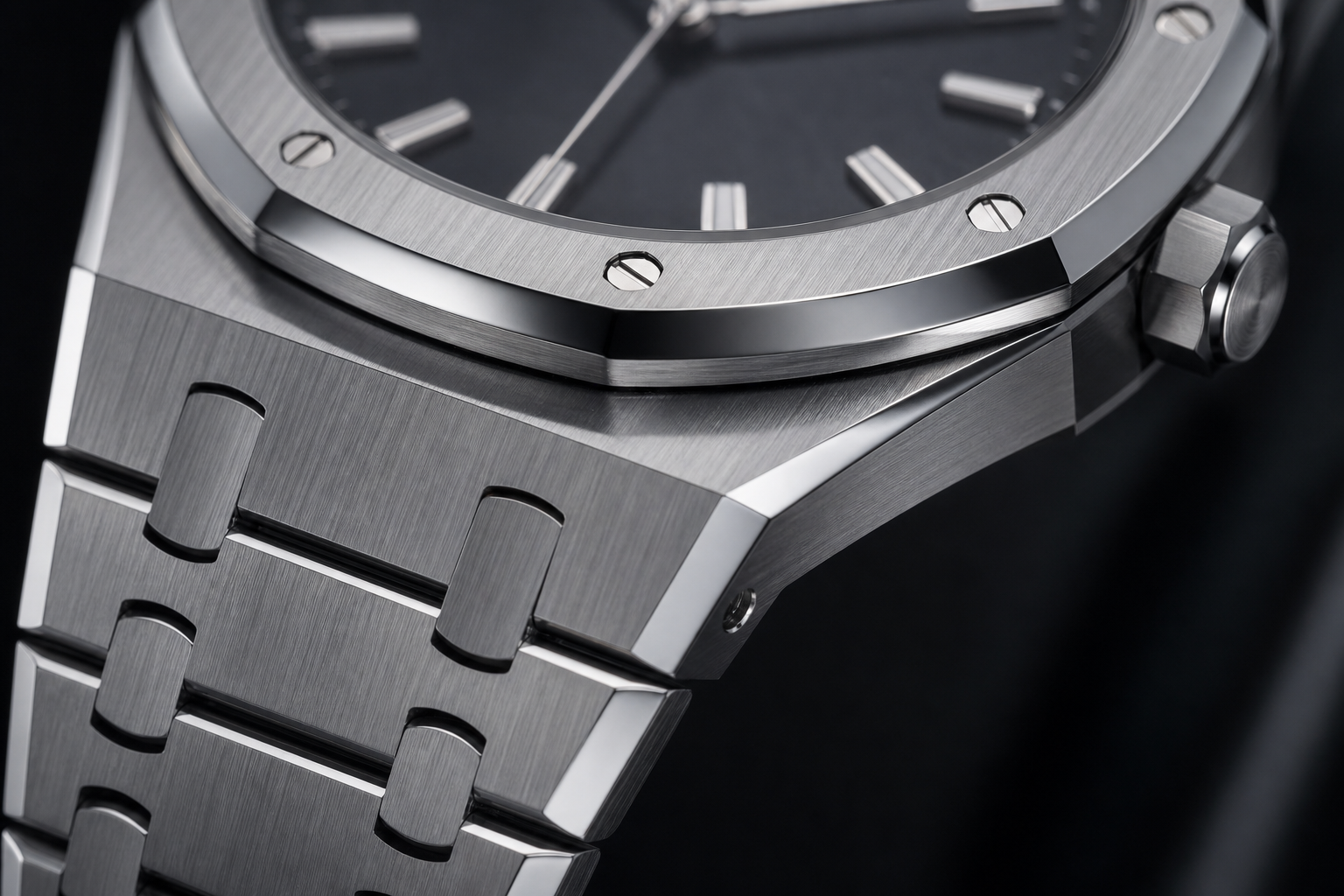
Version Accuracy and Version Number Claims: Useful Signal or Review Hype?
Chinese AP replica reviews use version language heavily because the market changes through small corrections rather than clean model-year updates. A translated review may say “V3 upgraded,” “latest version restored,” or “version accuracy improved,” but those phrases do not mean much until the changed part is named. For a buyer, the useful question is not whether the review says V2, V3, or latest. The useful question is what the version changed and whether that change affects the watch on the wrist.
AP replica version claims can be a real signal. A new version may correct case thickness, adjust the first bracelet link, improve dial texture, change the movement route, refine the date position, or improve brushing and bevel transitions. Those are meaningful because they can be checked. But version language also gets used as sales pressure. “Latest” often sounds safer than “older,” even when the update is minor, undocumented, or relevant only to one dial color or one production batch.
The strongest judgment here is simple: a version number is useful only when it is tied to a specific correction. If a review says “V3” but cannot explain what changed from V2, the label is mostly positioning. If it says “new version with thinner caseback, corrected first-link articulation, and revised dial texture,” the claim becomes easier to evaluate because it points to visible or measurable details.
Version labels should also be separated from seller inventory labels. A seller may use a version name to describe current stock, while another seller may use the same label differently. Without consistent documentation, the safest approach is to verify the actual watch in the QC photos rather than rely on version terminology alone.
When a Version Number Is Actually Helpful
A version number helps when it acts like a shortcut for a known set of changes. In AP super clone version accuracy discussions, this usually means the factory has revised something buyers already complained about: a case that wore too thick, a bracelet that did not drape naturally, a dial texture that looked flat, a date window that sat slightly wrong, or a movement route that forced the case proportions to move away from the genuine reference.
For example, if a Chinese review says a Royal Oak replica has a “new version corrected thickness,” the phrase should push the buyer toward a side-profile question: is the mid-case slimmer, is the caseback flatter, or is the number simply copied from an older description? If the review says “head link upgraded,” the buyer should look for first-link movement and wrist drape, not just accept the phrase as general bracelet praise.
Version language is strongest when the correction affects AP’s core design identity. A small logo-printing adjustment may matter under macro photos, but a case thickness correction or bracelet articulation update can change how the watch wears every day. On a Royal Oak-style watch, the side profile and integrated bracelet flow often matter more than a minor caseback engraving improvement most owners rarely inspect.
A useful version claim should answer three questions: what was wrong before, what was changed now, and how can the buyer check it? If any of those pieces are missing, the version label has less practical value.
When “Latest Version” Is Mostly a Sales Phrase
“Latest version” is one of the most abused phrases in translated AP replica reviews. It creates the feeling that the buyer is looking at the safest or most advanced option, but it may only mean the seller wants to move current stock. Sometimes “latest” refers to a real batch update. Sometimes it refers to a changed rotor engraving, a new clasp stamp, or nothing clearly documented at all.
The warning sign is lack of parts language. If a review says “latest version, fully upgraded, closest version,” but does not mention movement route, case thickness, bracelet structure, dial texture, date placement, bezel screw execution, or finishing changes, the phrase has low buying value. It may still be attached to a decent watch, but the wording itself is not evidence.
Western buyers often overvalue “latest” because in normal consumer electronics or car model language, newer usually means improved. Replica watches do not work that cleanly. A batch can improve one area and introduce another problem. A dial color may look better while the bracelet tolerance feels worse. A new movement presentation may look more convincing through the caseback but create more uncertainty in serviceability. Newer is not automatically safer; it is only better if the actual change matters to the specific reference.
It can also be useful to ask whether the “latest” description is model-specific or copied across several listings. If the same language appears for many unrelated watches, it is probably generic sales copy rather than a precise version explanation.
How Batch Differences Can Confuse Translated Reviews
Batch difference is the hidden reason many translated reviews seem to contradict each other. One review may praise the case finishing of a factory version, while another buyer complains about rough bracelet edges under the same version label. Both can be true if they are looking at different batches, different dial colors, or samples assembled with slightly different parts.
This is especially important with AP replicas because small tolerances change the whole impression. A Royal Oak case can look strong from the front but feel wrong if the first link is too stiff. A dial can photograph well under strong lighting but look flat indoors. A movement decoration update can sound impressive while the actual watch still carries the same rotor noise or winding feel. The version label does not erase unit-to-unit variation.
At CleanVSFactory, we usually treat version language as a starting point, not a conclusion. A factory name plus version number may tell you what the watch is supposed to be, but the actual evaluation still depends on the visible sample: case profile, bracelet fit, dial execution, date position, and whether the claimed update appears in the photos.
Batch uncertainty is one reason a buyer should avoid relying only on old review articles or older comparison photos. Those materials can be useful for learning what to inspect, but they may not represent the exact watch being shipped today. Current QC photos remain essential.
Version Details to Confirm
- Factory name: Useful, but not enough by itself. One factory may be strong on one AP reference and less convincing on another.
- Version label: V2, V3, V4, or “latest” should be connected to named changes, not treated as automatic proof of superiority.
- Batch timing: If available, batch timing helps explain why two watches with the same version label may show different small details.
- Movement route: Confirm whether the claim refers to an integrated clone-style movement, a decorated base movement, or only a visual bridge update.
- Case thickness claim: Look for actual measurements or useful side-profile photos. Front photos can hide thickness problems.
- Bracelet update: Check whether the first link actually articulates and whether the bracelet drapes naturally instead of flaring out.
- Dial update: Ask whether the update concerns texture, color tone, printing, date window placement, or only general “better dial” wording.
- QC photo consistency: The photos should show the claimed version details. If the claim says revised thickness but no side photo appears, the claim remains weak.
When version details cannot be confirmed, it is safer to evaluate the watch as an individual sample rather than as a guaranteed representative of a named version. In replica buying, the specific watch matters more than the label attached to the listing.
Before making a decision, buyers should review real QC photos where available, including dial printing, hand alignment, bezel screw seating, datewheel centering, bracelet fit, clasp engraving, case thickness, side profile, and overall finishing. QC photos can reduce uncertainty, but they do not guarantee perfection. Factory labels, translated review phrases, and stock photos alone are not enough for a reliable judgment.
Factory Name, Price, and Seller Photos: Why They Should Not Be Read Separately
Many Western buyers try to simplify AP replica selection into one question: which factory is best? That shortcut is understandable, but it is often too broad. A factory can be strong on one Royal Oak reference because it has solved the case profile and bracelet articulation, while being less convincing on another reference because the movement route, dial color, or thickness is harder to execute. Factory reputation is a useful filter, not a complete buying decision.
Price should be read the same way. A higher price may reflect a more complex movement, better finishing, lower availability, seller margin, replacement risk, or simply current hype around a version. It does not automatically prove better daily reliability or better visual accuracy. For example, a more expensive integrated movement version may offer a thinner case and stronger caseback layout, but it may also carry higher service risk if parts are less accessible. A cheaper plate-modified route may be less impressive through the caseback but more sensible for a buyer who wants a simple daily wearer and does not care much about display-back accuracy.
Seller photos and QC photos are helpful, but they show only what the camera angle allows. Front dial photos can show marker alignment, date position, hand finish, and general dial tone. They cannot prove bracelet comfort, rotor behavior, crown feel, or caseback thickness. Side photos can reveal thickness, but they may still hide clasp feel or movement stability. A careful buyer should treat each photo as evidence for one category, not as proof of the whole watch.
The most balanced way to compare AP replicas is to connect the factory name, price, and photos to the buyer’s actual use case. If the watch is mainly for occasional photos, dial texture, bezel symmetry, and front-facing accuracy may matter most. If the watch is for daily wear, bracelet articulation, case thickness, winding feel, rotor noise, and serviceability become more important. “Best factory” claims only become useful when narrowed to a specific model, version, and wearing priority.
Factory names in the replica market are not the same as official brand manufacturers, and they should not be treated as verified corporate identities with public technical documentation. They are practical buyer-community labels and seller-side identifiers. That makes them useful for communication, but it also means claims about factory methods, parts, suppliers, or exact movement sourcing should be treated cautiously unless the specific watch provides checkable evidence.
A factory comparison is most useful when it is tied to the specific reference, version, movement configuration, and visible execution details rather than treated as a universal ranking. For AP-style watches, the same factory label may appear on different dial colors, case sizes, movement routes, or batches, and those differences can change the buying decision. The safer question is not “which factory is always better?” but “which factory-version combination solves the problems that matter on this exact model?”
Prices can change by factory label, version, movement, seller channel, availability, finishing quality, and after-sales support, so exact comparisons should be verified at the time of purchase. A price that appears attractive should still be compared against the claimed movement route, the visible QC evidence, the seller’s communication, and any confirmed policies. A low price does not automatically mean poor quality, and a high price does not automatically prove a stronger version.
Factory Name Clarification: Factory names in the replica watch market are buyer-facing market references, not official brand affiliations, audited manufacturer identities, or guarantees of identical quality across every AP-style model, so discussions of high-end Audemars Piguet replica origins should remain secondary to version-level evidence. Buyers should compare the specific version, visible QC details, movement route, bracelet fit, case thickness, and current batch photos before treating any factory label as meaningful evidence.
Which Chinese Review Terms Are Buyer-Useful and Which Are Mostly Marketing?
The easiest way to read AP replica review terminology is to separate terms into three groups: checkable, partially useful, and mostly promotional. This matters because Chinese review writing often places real technical observations next to sales-heavy phrases in the same paragraph. A review can contain good information and exaggerated language at the same time.
Useful terms point to something you can see, measure, feel, or compare. Weak terms depend on confidence, status language, or broad claims of superiority. The buyer’s job is not to reject every enthusiastic phrase, but to downgrade any phrase that does not lead to a concrete watch part.
A good rule for AP replica review terminology is this: the more a term can be checked in photos or tied to ownership behavior, the more weight it deserves. “Articulated first link” has more value than “super restored feel” because the first link can be inspected. “Case thickness corrected” has more value than “ceiling version” because thickness affects wrist presence and can be measured. “Brushing direction improved” has more value than “top quality” because brushing can be judged under side lighting.
This classification also helps buyers avoid emotional overreaction. A review may contain one promotional phrase and still include useful evidence elsewhere. The goal is not to reject the whole review, but to separate the parts that can guide inspection from the parts that mainly create excitement.
Terms That Usually Point to Real Evaluation Areas
Some Chinese review terms are genuinely useful because they identify the parts of an AP replica that determine whether the watch feels convincing in daily wear. These terms do not guarantee quality, but they tell you where to look.
- Case thickness: A high-value term on Royal Oak-style designs because extra height changes the side profile and wrist feel quickly.
- First-link articulation: Useful because the first bracelet link controls whether the integrated bracelet wraps naturally or makes the watch wear larger.
- Dial texture: Meaningful when the review discusses actual surface behavior, such as depth, light play, or micro-texture, rather than only saying the dial is “better.”
- Date alignment: Useful because misalignment is easy to notice in normal viewing, especially on a clean Royal Oak dial layout.
- Brushing direction: Important because AP finishing depends on large flat brushed planes meeting polished bevels cleanly.
- Movement route: Useful when it explains how the movement affects thickness, dial layout, rotor behavior, or service risk.
These are not magic words. A review can mention case thickness and still be vague. But at least these terms point toward real evaluation areas. They give the buyer a path from translated language to inspection.
When a useful term appears, the next step is not to accept the claim but to ask for the matching evidence. Case thickness needs side photos. First-link articulation needs wrist and bracelet-drop views. Dial texture needs varied lighting. Movement route needs movement, caseback, thickness, and service-risk context.
Terms That Need Supporting Evidence
Some terms sit in the middle. They may refer to real improvements, but they are too broad to trust without photos, measurements, or specific explanation. “Integrated clone” is one example. It sounds technical and may indicate a movement route closer to the original architecture, but it does not prove reliability, finishing quality, or perfect case proportions. The practical question is what the movement changes: thickness, hand position, date behavior, power reserve, winding feel, or caseback appearance.
“Latest version” also needs support. It can mean a real batch update, but it can also mean current seller stock. “Fully upgraded” is even weaker unless the review lists what was upgraded. “Same as original” should be treated with special caution because it usually compresses too much into one phrase. A replica can be closer in one area and still limited in another.
For AP watches, supporting evidence usually means specific visual proof: side-profile photos for thickness, wrist-drape photos for bracelet articulation, macro or angled photos for dial texture, straight dial photos for date alignment, and light-angle photos for brushing and bevel transitions. If the phrase cannot be connected to one of these checks, it should not drive the decision.
Evidence does not always have to be formal. In replica buying, practical evidence often means clear QC photos, a short video, a side-view comparison, or a seller willing to answer specific questions. But the evidence should match the claim. A beautiful dial video does not support a movement reliability claim, and a movement photo does not prove bracelet comfort.
Terms That Are Often Too Vague to Trust Alone
Some translated Chinese review terms are mostly atmosphere. Phrases such as “top level,” “perfectly restored,” “ceiling version,” “king version,” “no difference,” or “best version in the market” may appear in otherwise useful reviews, but they should not be treated as technical evidence. They are designed to create confidence, not to describe a specific part.
“Ceiling version” is a common example. It sounds like a final judgment, but it does not tell you whether the case is thin enough, the bracelet drapes correctly, the tapisserie-style texture has convincing depth, or the movement is a safer ownership route. A watch can be called a “ceiling version” and still have a dial color issue, a slightly bulky caseback, or inconsistent clasp feel.
The mistake is not reading these phrases. The mistake is letting them replace evaluation. If a review says “no difference,” the buyer should immediately ask: no difference where? Dial at arm’s length? Case thickness from the side? Movement under the caseback? Bracelet feel on wrist? The phrase collapses too many categories into one claim, which is exactly why it is unreliable without details.
The strongest response to vague praise is a narrow follow-up question. Instead of asking whether the watch is “top level,” ask whether the caseback height has changed, whether the first link now drops, whether the date is centered, or whether the dial texture remains visible under neutral light.
| Term Type | Examples | Buyer Value | How to Treat It |
|---|---|---|---|
| Usually useful | case thickness, first-link articulation, date alignment, brushing direction | High | Check photos, measurements, and model-specific expectations. |
| Needs evidence | integrated clone, latest version, fully upgraded, corrected version | Medium | Ask what part changed and whether the change is visible or practical. |
| Mostly marketing | ceiling version, top level, perfectly restored, no difference | Low by itself | Do not rely on the phrase unless specific corrections are named. |
How to Read a Translated AP Replica Review Without Overreacting
A translated Chinese watch review can feel either too technical or too exaggerated, sometimes in the same sentence. The safest reading method is to slow the phrase down and convert it into a watch part. Do not react to the confidence of the wording. React to the evidence behind it.
Suppose a translated review says an AP Royal Oak replica has “new integrated movement, articulated head link, and restored thickness.” That sounds impressive, but it is not one claim. It is three separate claims: movement, bracelet, and case. Each one needs a different type of evidence. The movement claim needs architecture and ownership context. The bracelet claim needs first-link and wrist-drape evidence. The thickness claim needs side-profile photos or measurements.
This is the core reading discipline: turn every translated claim into a category, then into a checkable detail. If you cannot do that, the phrase is probably too vague to influence the evaluation.
This method also protects buyers from being impressed by density. A paragraph full of technical-sounding words may feel authoritative, but if the words do not lead to a watch part you can inspect, the practical value remains limited.
Step One: Identify the Category of the Claim
Start by deciding what the phrase is actually talking about. Most AP replica review language falls into one of seven categories: movement, bracelet, dial, case, finishing, version, or general marketing language. This classification matters because the same English word can sound more precise than it really is after translation.
“Integrated” may refer to the movement route, but in another paragraph it might describe the bracelet-to-case design. “Restored” may mean corrected thickness, improved dial texture, or simply a general claim of closer appearance. “Upgraded” is not a category at all until the review names the part.
Once the category is clear, the buyer can avoid mixing up different standards. A movement claim should not be judged only by dial photos. A bracelet claim should not be accepted because the bezel looks clean. A version claim should not be trusted because the review tone sounds confident.
If the category remains unclear after reading the sentence twice, downgrade the claim. A review that cannot identify what part changed should not strongly influence a buying decision.
Step Two: Convert the Phrase Into a Checkable Detail
After identifying the category, translate the phrase into a practical inspection question. “Restored thickness” becomes: can the side profile support the claim? “Articulated head link” becomes: does the first bracelet link drop naturally from the case? “Dial texture upgraded” becomes: does the surface show convincing depth and controlled light play, or does it look flat under neutral lighting?
This step is where many Western buyers gain the most clarity. Instead of asking, “Is this review exaggerated?” ask, “What would make this claim true?” A movement claim might require case thickness compatibility, correct date position, acceptable rotor behavior, and realistic service expectations. A finishing claim might require clean brushing direction, consistent bevels, seated bezel screws, and bracelet edges that do not look rough.
Do not demand impossible proof from a short review. The goal is not forensic certainty. The goal is to decide whether the phrase gives you a real evaluation path or only creates a feeling of quality.
A checkable detail should be specific enough that two buyers could look at the same photos and discuss it. “Looks premium” is too broad. “The first link drops below the case line instead of projecting outward” is a useful inspection question.
Step Three: Look for Evidence, Not Confidence
Chinese AP replica reviews often use confident language because that is how factory and dealer descriptions compete. Confidence is not the same as evidence. A review that calmly shows side photos, bracelet angles, dial close-ups, and explains what changed is more useful than a dramatic review that repeats “best version” five times.
Photos also need the right angle. A straight-on dial shot can make almost any Royal Oak replica look better than it wears. Side-profile images reveal thickness. Low-angle bracelet shots reveal first-link stiffness. Oblique lighting reveals brushing quality. Neutral dial photos reveal date alignment and texture behavior more honestly than heavily lit promotional shots.
The final judgment should come from consistency across details. If a review claims a major upgrade but only shows beauty shots, reduce the weight of the claim. If the review names a correction and the photos support that correction from relevant angles, the language becomes more useful even if the wording sounds awkward in translation.
Evidence should also be checked for relevance. A review of one dial color, one case size, or one complication may not transfer cleanly to another version. AP-style replicas can vary significantly by reference, dial, movement route, and batch, so the closest evidence is the evidence attached to the exact watch being considered.
Red Flags in Translated Review Language
- Vague absolutes: Phrases like “no difference,” “perfectly restored,” or “same as genuine” are too broad to trust without narrowed evidence.
- No corrected detail: “Fully upgraded” means little if the review does not say whether the change is movement, case, bracelet, dial, or finishing related.
- Missing side-profile evidence: For AP Royal Oak replicas, thickness claims without side photos are weak.
- Version claims without batch context: A V2 or V3 label is less useful if the review gives no clue what batch or correction it refers to.
- Factory authority used as proof: A factory name can be relevant, but it does not replace inspection of the actual watch details.
- Overloaded sentences: If one sentence claims improved movement, case, dial, bracelet, and finishing without examples, treat it as marketing until supported.
The right response to translated AP replica reviews is not cynicism. It is controlled skepticism. Some terms point to real improvements, and some of the awkward English comes from compressed Chinese industry shorthand rather than bad information. But the buyer should always pull the claim back to the watch itself: which part changed, why does it matter, and can the available evidence show it?
Controlled skepticism also means being honest about limits. A buyer may never receive perfect proof before purchase. The goal is to reduce avoidable risk by focusing on the details most likely to affect wearing experience and satisfaction.
Beginner-Friendly AP Replica Choices: When Simpler Is Safer
Not every AP replica is equally suitable for a first purchase. A simple three-hand Royal Oak-style model is usually easier to judge than a complicated chronograph, perpetual-style display, skeletonized model, or ultra-thin movement claim. The more complicated the watch, the more places there are for the factory, seller description, and translated review language to blur important ownership risks.
For beginners, the safer comparison is often not “which version sounds most advanced?” but “which model has fewer difficult areas to get wrong?” A simpler dial makes printing and marker placement easier to inspect. A less complicated movement may reduce service uncertainty. A case with fewer functions avoids extra pusher alignment, subdial spacing, and chronograph reset risks. This does not mean simple models are automatically better; it means they are usually more forgiving and easier to evaluate from QC photos.
Complicated AP replicas can look impressive in listings because skeleton bridges, openworked dials, chronograph subdials, and decorated casebacks create a high-spec impression. But these same features create more risk for a buyer who cannot verify movement behavior, subdial function, rotor sound, hand clearance, or long-term parts availability. A watch that is excellent for photos may not be the most comfortable or reliable daily-wear choice.
A practical first-buyer approach is to choose the model where the key flaws are visible before purchase. On a Royal Oak, that usually means confirming case thickness, bracelet articulation, dial texture, date placement, and finishing from the right angles. If a watch requires trusting a complicated movement description that cannot be verified through photos or ordinary QC checks, it may be better suited to an experienced buyer who accepts the additional service risk.
Beginners should also be cautious with watches that promise many functions but do not clearly explain which functions actually work. A decorative subdial, a modified calendar display, or a skeletonized movement can look convincing in photos while adding uncertainty in daily use. If the buyer cannot verify the function and does not need it, simpler may be the more practical route.
A replica watch should be evaluated with realistic ownership expectations. Even a strong super clone can have limits in water resistance, long-term movement stability, servicing convenience, and close inspection compared with a genuine reference. Buyers should confirm return, repair, shipping, and after-sales terms before ordering, because those details depend on the seller and should not be assumed from a review phrase or factory label.
Practical Glossary for Common Chinese AP Replica Review Terms
This Chinese AP replica glossary is meant as a quick reference, not a substitute for looking at the watch itself. The safest way to read translated review language is to ask one simple question: does this phrase point to something visible, measurable, or useful in ownership, or is it mainly there to make the version sound important?
AP replica terms explained too literally can mislead buyers. “Restored,” “integrated,” “upgraded,” and “ceiling version” often sound more precise in translation than they are in the original review culture. Treat the terms below as interpretation tools. They help you understand the claim, but they do not prove the claim.
When using the glossary, avoid treating one term as a final verdict. Most terms are useful only when combined with the right evidence. For example, “integrated movement” should be paired with thickness and service questions, while “head link” should be paired with bracelet-drop images.
Movement and Architecture Terms
| Term | Likely Meaning in Chinese Review Language | Buyer Interpretation |
|---|---|---|
| Integrated clone movement | A movement route designed or arranged to resemble the genuine AP movement layout more closely than a simple base movement with decoration. | Useful term, but not a guarantee. Check whether it improves case thickness, balance position, date placement, winding feel, and movement presentation. “Clone” does not mean official AP engineering or equal long-term reliability. |
| Plate-modified movement | A base movement, often dressed with decorative plates, rotor engraving, or bridge covers to look closer through the caseback. | Do not confuse visual dressing with mechanical equivalence. It may be practical and serviceable, but it can affect thickness, rotor noise, and caseback accuracy. |
| Decorated movement plate | A visible plate added to hide or reshape the look of the base movement. | Mostly a visual solution. Ask whether the plate makes the watch thicker or hides a layout that does not match the original architecture. |
| Movement route | The factory’s chosen mechanical solution: integrated clone, modified Miyota-style base, 7750-style chronograph base, or another architecture. | This is one of the more useful translated concepts. It affects ownership more than many cosmetic claims because it can influence thickness, reliability, rotor behavior, and service options. |
The judgment here is straightforward: movement wording matters only when it changes the watch you actually receive. A more impressive movement label is not automatically better if the result is noisy winding, poor date behavior, weak power reserve, or a thicker case.
Movement terms should never be treated as authorization language. They describe imitation routes in the replica market, not official manufacture, official parts compatibility, or genuine movement origin.
Bracelet and Case Fit Terms
| Term | Likely Meaning in Chinese Review Language | Buyer Interpretation |
|---|---|---|
| Head link | The first bracelet link where the Royal Oak bracelet meets the case. Some translations may call it “head grain” or “head particle.” | Important on AP replicas because the Royal Oak is defined by its integrated bracelet. A poor first link can make the whole watch wear stiff, wide, or awkward. |
| Articulated head link | A first link that moves downward more naturally instead of staying rigid beside the case. | One of the more buyer-useful terms. It can be checked in side photos and wrist shots. Better articulation can improve comfort, especially on smaller or flatter wrists. |
| Integrated bracelet fit | The visual and mechanical transition between case, first link, and bracelet. | Look for smooth case-to-bracelet flow, controlled gaps, and natural drape. A good dial cannot fully save an AP Royal Oak replica with a clumsy bracelet transition. |
| Thickness accuracy | A claim that the replica case thickness has been reduced or brought closer to the genuine reference. | Very important, but only if supported by measurement or side-profile photos. AP cases are flat and architectural, so even a small extra thickness can change wrist presence. |
| Case profile | The side-view shape of the bezel, mid-case, caseback, and bracelet drop. | Front-facing photos often hide case problems. For Royal Oak-style designs, the side profile is usually more revealing than a clean dial shot. |
If a translated review praises the “head link upgrade” but shows only front dial photos, the claim is incomplete. Bracelet fit language should be judged from the side, not from the most flattering straight-on angle.
Bracelet and case-fit terms are among the most practical because they affect daily comfort. They are also among the easiest to misrepresent with selective photos, so buyers should request side and wrist angles whenever possible.
Dial and Finishing Terms
| Term | Likely Meaning in Chinese Review Language | Buyer Interpretation |
|---|---|---|
| Radial sunburst | A light pattern that spreads outward from the dial center or subdial area, depending on the model. | Useful for judging light play, but lighting can exaggerate it. Compare photos taken under neutral light, not only dramatic review lighting. |
| CD-pattern micro-texture | Fine circular grooves or reflective micro-lines that resemble the surface of a compact disc. | A visual descriptor, not proof of genuine-style manufacturing. It can improve dial depth, but it should be judged alongside color, printing, marker placement, and date window position. |
| Tapisserie-style texture | The square-pattern dial texture associated with Royal Oak models. Reviews may describe it as more three-dimensional, sharper, deeper, or more “restored.” | Important but often overstated. Replica dials can look convincing in photos while still lacking the smoother depth and light behavior of genuine guilloché work under close inspection. |
| Brushing | Satin-finished surface lines on the case, bezel, bracelet, or clasp. | Check direction and consistency. Cloudy brushing or mismatched grain direction makes an AP replica feel lower-tier quickly because the design exposes large flat metal surfaces. |
| Bevels | Polished chamfered edges between brushed planes, especially on the bezel, case, and bracelet links. | One of the key AP finishing cues. Overly rounded bevels look soft; overly sharp edges can feel rough. The better result is clean, consistent transition, not just shiny polishing. |
| Finishing quality | A broad claim covering brushing, polishing, screw seating, bracelet edge comfort, clasp feel, and surface transitions. | Too vague by itself. Ask which finishing area improved. “Delicate finishing” is less useful than “cleaner brushing direction on bracelet links” or “less sharp clasp edge.” |
The non-obvious point: dial texture and finishing are separate judgments. A replica can have a strong tapisserie pattern but weak bracelet brushing, or good case finishing with a flat-looking dial. Chinese reviews often compress these into one praise paragraph, but buyers should separate them.
Dial and finishing language is also highly lighting-sensitive. A review that uses only dramatic lighting may be useful for showing texture, but it should be balanced with neutral lighting before the buyer makes a final judgment.
Version and Factory Claim Terms
| Term | Likely Meaning in Chinese Review Language | Buyer Interpretation |
|---|---|---|
| Latest version | The seller or reviewer claims this is the newest available batch or update. | Weak unless the changed parts are named. Newer is not automatically better; a batch can improve one detail while creating a new QC issue elsewhere. |
| Version accuracy | A claim that the replica matches the correct generation, dial layout, case proportion, movement appearance, or reference-specific detail. | Useful only when tied to a specific model. Ask what is accurate: thickness, dial print, bracelet link, movement layout, bezel screws, or date position. |
| V2 / V3 / V4 claims | A version number used to position the watch as newer or improved compared with earlier factory output. | Potentially useful, but easy to misuse. The number should correspond to documented changes, not just higher pricing or seller confidence. |
| Batch update | A production change within the same factory or version label. | Often more important than buyers expect. Two watches described as the same “version” may differ in dial tone, bracelet tolerance, movement decoration, or datewheel alignment depending on batch. |
| Corrected details | Specific flaws the factory claims to have improved, such as case thickness, first-link articulation, dial texture, screw position, or printing weight. | This is the version language worth paying attention to. A correction claim should be visible in photos or measurable in specifications. |
| Ceiling version / top level / fully restored | High-praise marketing language suggesting the watch is the strongest available version. | Treat as promotional unless supported by concrete details. These phrases may point to a good watch, but they do not tell you what is actually better. |
For English-speaking buyers, the practical rule is to downgrade any version claim that does not name the changed component. “V3 with improved first-link articulation and reduced case thickness” is far more useful than “latest perfect version.” The first can be checked; the second is mostly confidence language.
Factory and version claims should be understood as market shorthand, not official certification. They may help buyers organize choices, but they do not replace inspection of the individual watch.
A Practical Traceability Checklist Before Trusting an AP Review Claim
A traceable AP replica review should make it possible to follow a claim from wording to visible evidence. If a review says the watch is thinner, the reader should be able to find a side profile or measurement. If it says the bracelet was corrected, the reader should see first-link drop and wrist drape. If it says the movement route changed, the review should explain whether that affects thickness, date behavior, caseback appearance, winding feel, or service risk.
For CleanVSFactory, the goal is to make replica watch comparison easier to understand by connecting factory names, movement claims, visible QC details, and realistic ownership limits. That does not mean treating any factory name, seller phrase, or translated Chinese term as proof. It means asking whether the claim can be traced to the watch sample, the model reference, the current version, and the buyer’s intended use.
- Trace the model: Confirm the exact AP-style reference, case size, dial color, and complication being discussed. A review of one version may not apply to another.
- Trace the factory label: Use the factory name as a market reference, then check whether the visible watch matches the claimed factory-version characteristics.
- Trace the movement: Ask whether the claim describes architecture, decoration, base movement, clone-style layout, or only a seller name for the movement route.
- Trace the photos: Match each claim to the right image type: side profile for thickness, wrist shot for bracelet drop, macro and neutral light for dial texture, and angled metal shots for finishing.
- Trace the ownership risk: Consider how the watch may behave after purchase, including winding feel, rotor noise, bracelet comfort, servicing difficulty, and realistic water-resistance expectations.
This checklist is not meant to make every decision certain. Replica buying always contains uncertainty, especially when factory labels, version names, and movement terms are not documented like official brand specifications. The point is to reduce preventable confusion by asking whether a review phrase leads to a specific watch detail that can be checked before the buyer relies on it.
QC Photos, Water Resistance, and Seller Policy Claims Need Separate Verification
QC photos can reduce uncertainty, but they do not turn a replica watch into a verified authentic watch or guarantee that every invisible detail is correct. A QC set is strongest when each image answers a specific question: dial alignment, marker placement, date centering, bezel screw seating, case thickness, bracelet drop, clasp finishing, movement appearance, and overall surface condition. It is weaker when it relies on beauty shots, extreme lighting, or angles that hide the exact issue being claimed as corrected.
Water resistance should not be assumed from the model name, sport-watch appearance, screw-down crown look, or similarity to a genuine reference. Unless the specific watch has been tested and the seller’s policy is clearly confirmed, buyers should treat replica watches cautiously around water. Even when a seller says a watch has been tested, the buyer should understand what kind of test was performed, whether it applies to that exact unit, and whether any after-sales support is actually available if water damage occurs.
Seller policy language should be checked directly instead of inferred from factory reputation or review tone. Return terms, repair options, movement support, shipping expectations, customs risk, and after-sales communication can vary by seller and should not be assumed. A review that praises a version’s movement, case, or dial does not automatically confirm warranty coverage, replacement terms, delivery outcomes, or service availability.
How to Avoid Misreading Chinese Review Language as Authentication Advice
Some Chinese replica review phrases are meant to say a watch looks closer to the genuine reference in normal viewing, but direct translation can make them sound like authentication claims. Phrases such as “no difference,” “can compare with original,” or “restored to authentic level” should be treated as promotional shorthand, not proof that the watch can pass professional inspection, boutique review, official service, resale screening, or authentication checks.
The purpose of factory and movement information is to help readers understand quality and risk, not to represent a replica watch as genuine. A strong super clone may reduce obvious visual tells in casual use, but close inspection can still reveal differences in finishing, movement architecture, case proportions, bracelet feel, dial details, materials, or service compatibility. Buyers should not use review terminology to conceal replica status, mislead another person, or resell a replica watch as an authentic luxury watch.
A safer way to read these phrases is to convert them into limited visual observations. “Closer to original” may mean the case is thinner than before. “No obvious difference” may mean the dial looks acceptable at arm’s length. “Restored movement layout” may mean the caseback view is more convincing than a plate-decorated alternative. None of those statements should be expanded into authenticity, official approval, or guaranteed inspection passability.
Legal, Authenticity, and Disclosure Boundaries Buyers Should Keep in Mind
Replica watch content can easily become misleading if it sounds as if imitation watches are official products. They are not. A replica or super clone watch should be understood as an unauthorized imitation product, even when it visually follows the design language of a well-known watch model. That distinction matters for expectations, service, resale, disclosure, and legal risk.
Buyers should be cautious with language such as “same as genuine,” “1:1,” “no difference,” or “authentic quality.” These phrases may appear frequently in seller and review content, but they should not be read as factual proof of equivalence. An authentic watch and a replica can differ in movement construction, finishing tolerance, material verification, water resistance, warranty, service access, trademark status, and long-term durability.
Legal and customs rules can vary by jurisdiction, and this article should not be treated as legal advice. A cautious buyer should understand that replica watches may raise trademark, customs, import, resale, and disclosure issues depending on where the buyer lives and how the watch is purchased, transported, or represented to others. The safest wording is to treat replicas as imitation goods and avoid presenting them as authentic, authorized, or brand-approved.
This boundary is also important when reading Chinese review translations. Some phrases may sound like official-level claims after translation, but the review is still discussing the replica market. No translated praise phrase can convert an imitation product into an authorized Audemars Piguet watch.
Final Buyer Filter: Translate the Term, Then Test the Watch
The best way to use Chinese AP replica reviews is to translate the term into a practical buying question. “Integrated movement” should lead to thickness, date, winding, rotor, and service questions. “Head link upgraded” should lead to bracelet drop and wrist-fit questions. “CD texture restored” should lead to dial close-ups under different lighting. “Latest version” should lead to specific corrected-part evidence, not automatic confidence.
This approach also keeps expectations realistic. A replica watch is not genuine, official, authorized, or brand-approved, and review language should not make it sound that way. The useful comparison is not whether a translated review claims “no difference,” but whether the watch’s known strengths and weaknesses fit the buyer’s reason for buying it. A photo-focused buyer, a daily-wear buyer, and a movement-sensitive buyer may make different choices even when looking at the same factory and version.
Use this review translation guide as a filter: movement terms should lead to movement-route questions, bracelet terms should lead to fit and drape checks, dial terms should lead to texture and printing inspection, case terms should lead to side-profile evidence, and version terms should lead to specific corrected details. If a translated Chinese AP replica review does not give you anything to verify, it may still be interesting, but it should not carry much weight in the buying decision.
The final decision should be based on the watch sample, not the strongest phrase in the review. A careful buyer reads translated language as a map, then checks the terrain: the case, the bracelet, the dial, the movement behavior, the finishing, the version evidence, and the ownership risk. That process is slower than accepting “ceiling version” at face value, but it is much more useful for choosing an AP-style replica with realistic expectations.
Disclosure: This article is for general educational and comparison purposes only. Replica watches are not genuine products from the original luxury brands, and brand names are used only to identify reference designs or comparison topics. Factory names, movement descriptions, prices, availability, QC details, seller policies, and version information can change, so readers should verify important details with the seller before making a purchase decision. Replica watches should not be represented, resold, or used as genuine watches.