
Claims of a “perfect 1:1” Audemars Piguet super clone are easy to misunderstand because the Royal Oak looks simple at first glance but exposes small errors quickly, and AP super clone QC photos often reveal how bezel flatness, brushing direction, and bracelet fit hold up under closer inspection. The flat bezel, sharp brushing, integrated bracelet, tapisserie dial, thin case profile, and visible movement details leave little room for sloppy execution. A better replica may look convincing in normal wear, but that does not mean every proportion, finish, dial detail, or movement behavior matches the original standard.
This article helps separate useful buying judgment from marketing language. Instead of relying on factory reputation, “latest version” claims, or dramatic photos, the practical question is whether a specific reference, batch, movement route, and QC set show a clean, stable watch. The goal is to identify acceptable compromises, spot deal-breakers, and choose a Royal Oak version that makes sense for daily use rather than chasing an unrealistic promise.
Brand names are used here to identify the genuine reference design being discussed. Replica watches are not genuine products from Audemars Piguet or any original luxury watch brand, and they should not be represented, resold, or used as authentic watches.
| What to Check | Why It Matters on AP Replicas | Practical Buyer Judgment |
|---|---|---|
| Tapisserie dial | Texture depth, printing, logo position, indices, date alignment, and lume can expose flaws. | Use real QC photos, not only bright seller images. |
| Case and bezel finishing | Royal Oak geometry makes brushing direction, chamfers, bezel screws, and side thickness obvious. | Check front, angled, and side views before accepting. |
| Movement route | Open casebacks may look decorated, but winding feel, rotor noise, date action, and serviceability still vary. | Confirm the actual replica-market movement route, not just the factory name. |
| Reference choice | Thin models like 15202 are less forgiving; 15400/15500 styles are often more practical. | Choose based on wearability and QC tolerance, not hype. |
| Bracelet and clasp | Comfort, edge finishing, articulation, and clasp security affect daily wear more than macro-only details. | Reject rough edges, loose clasp feel, or poor bracelet integration. |
| “Latest version” claims | A version update only matters if the actual improvement is visible and documented. | Ask what changed and verify it through current QC photos. |
Quick Questions Before You Read
Q: Does a perfect 1:1 AP super clone exist?
No. Better examples can be visually strong, but AP case finishing, dial texture, bracelet feel, and movement behavior still involve compromises.
Q: Is factory reputation enough to choose a Royal Oak replica?
No. The exact reference, batch, movement, dial color, and QC photos matter more than a factory slogan.
Q: Which AP replica details should be checked first?
Start with dial alignment, date position, bezel screws, side thickness, bracelet fit, clasp feel, and movement claims.
Q: Are complex AP chronograph replicas a safe beginner choice?
Usually they carry more risk because thickness, subdial layout, pushers, and movement execution are harder to get right.
Editorial Perspective: For AP replicas, the useful question is rarely “which factory is best?” by itself. The better judgment is model-specific: a factory name may be a helpful filter, but it does not prove the dial texture, bezel screw seating, case thickness, bracelet feel, or movement route are the right match for the exact reference you want. At CleanVSFactory, we treat QC photos, version labels, and factory reputation as signals to verify—not as final proof—because a strong-looking listing can still hide thickness issues, weak tapisserie depth, or a movement choice that is less pleasant for daily wear.
Evidence Boundary: This article discusses imitation watches and buyer evaluation logic. It does not claim that any replica is authorized by Audemars Piguet, equivalent to an authentic watch, or technically identical to a genuine Royal Oak. Official brand specifications can help explain what the authentic model is trying to achieve, but they do not prove that a replica has matched those dimensions, materials, finishing standards, movement construction, or water resistance.
Because replica-factory information is often seller-driven and difficult to verify independently, factory names should be treated as market labels rather than formal proof. A claim such as “best AP factory,” “latest version,” or “1:1 movement” should be checked against the actual watch, the current QC photos, the movement route, and the reference-specific weaknesses described below.
Movement and material claims also need restraint. A decorated rotor, a familiar bridge shape, or a seller-provided movement name does not by itself confirm long-term reliability, service compatibility, or genuine-level finishing. Likewise, buyers should not assume water resistance, shock resistance, or sports-use durability unless the individual watch has been properly tested and the seller’s policy is clearly confirmed.
How to Judge an AP Replica Before the Factory Name Influences You
The most reliable way to shop for a Royal Oak replica is to reverse the usual sales order. Start with the watch itself, then the reference, then the movement route, and only after that compare factory names. This helps prevent one common mistake: assuming that a famous factory automatically makes every AP model its strongest product. In practice, factory reputation does not apply equally to every reference, and the right choice often depends on whether the buyer values visual accuracy, comfort, or lower ownership risk more heavily.
For some AP buyers, the best watch is not the one with the most impressive caseback decoration or the loudest “latest batch” description. It is the one with the cleanest geometry, the most believable side profile, and the fewest obvious QC compromises. That may sound less exciting than a premium listing title, but it is a much better way to avoid disappointment after the watch arrives. A well-chosen replica should be evaluated as a complete object: dial, case, bracelet, movement, and expected wear pattern.
The most useful habit is to ask what the watch is trying to do well. A Royal Oak 15500-style piece may be a better daily-wear choice because it balances size, dial openness, and general practicality. A thin 15202-style replica may win on elegance but demand more tolerance for movement and thickness compromises. A chronograph may look more impressive in photos but create more risk in execution. The “best” AP super clone is therefore not a universal ranking; it is the watch that best fits the buyer’s intended use.
A Traceable Decision Path for AP Super Clone Buyers
A more traceable AP buying decision moves from broad claims to specific evidence. First identify the exact genuine reference design being imitated, then confirm the replica-market factory name, version label, dial color, case size, bracelet configuration, and movement route. After that, judge the visible execution through actual watch photos rather than assuming that the factory label or stock images describe the piece accurately.
This sequence matters because two Royal Oak replicas can share the same factory name and still differ in dial tone, datewheel centering, bezel screw finishing, bracelet comfort, and movement behavior. A buyer who records the exact reference, claimed version, movement description, and visible QC findings is less likely to be confused by broad “1:1” language. CleanVSFactory’s editorial approach is to make these decisions more traceable by connecting factory claims to visible details, movement behavior, version differences, and practical QC checks.
Why “Perfect 1:1 AP Super Clone” Is Usually a Marketing Claim, Not a Technical Standard
No Audemars Piguet super clone should be treated as a perfect 1:1 technical match. The phrase sounds precise, but in the replica watch market it is usually sales language. It often means the watch is visually close enough to resemble the original design at normal viewing distance, not that every dimension, bevel, dial texture, screw position, movement decoration, and ownership behavior has been matched to genuine Audemars Piguet standards.
This distinction matters because the Royal Oak is one of the worst watches to judge by a slogan. A strong Royal Oak replica can look convincing on the wrist. It can capture the octagonal bezel, integrated bracelet, tapisserie dial, thin sports-watch profile, and general AP presence well enough for many buyers to enjoy it. But “convincing on wrist” is not the same as “technically identical.” A watch can photograph well from the front and still fall short once you check dial depth, case-edge finishing, bezel screw seating, bracelet articulation, caseback movement decoration, and long-term movement consistency.
The safest way to read a perfect 1:1 AP super clone claim is to treat it as a starting point for questions, not an answer. What reference is being discussed? Which factory version? Which movement route? Is the case thickness correct for that model? Are the dial and bracelet from the latest batch, or only described that way? Has the seller shown real QC photos, or only polished stock images? These questions matter more than the phrase “1:1,” because the phrase itself does not define a measurable standard.
The Difference Between Visual Similarity and True Technical Matching
Visual similarity is what most buyers notice first. The case looks like a Royal Oak, the dial layout is familiar, the bracelet flows from the case, and the watch gives the right general impression. Higher-tier AP replicas can do this surprisingly well, especially compared with older plate-movement versions or low-tier fashion replicas. For many daily wearers, that broad visual match is the main reason the watch is appealing.
True technical matching is a much higher bar. It means the dial texture behaves the same under angled light, the case thickness supports the correct wrist profile, the chamfers have the same crisp but refined transition, the bezel screws sit with the correct size and depth, and the movement not only looks similar through the caseback but also winds, runs, changes date, and holds power in a consistent way. That is where “perfect 1:1” starts to fall apart.
The non-obvious issue is that AP’s design does not hide small misses very well. On some watches, a slightly soft case line or a slightly shallow dial texture gets lost in the overall shape. On a Royal Oak, those details are the design. If the brushing is too coarse, the polished bevel too rounded, the tapisserie too flat, or the bracelet edge too sharp, the watch may still look good in a photo but feel less convincing in hand.
At CleanVSFactory, we usually encourage buyers to separate appearance accuracy from ownership experience. A replica can be visually strong and still be the wrong choice if the movement route is noisy, the bracelet feels rough, or the case profile is wrong for the reference. That is not a reason to dismiss every Audemars Piguet super clone. It is a reason to judge the actual watch instead of trusting the slogan.
Why AP Is Harder to Clone Than It Looks
The Royal Oak looks simple because the design is clean: flat case surfaces, an octagonal bezel, exposed screw heads, a patterned dial, and an integrated bracelet. In reality, that simplicity makes it harder to replicate convincingly. There are fewer decorative distractions and fewer rounded forms to soften mistakes. The eye reads the watch through geometry, alignment, texture, and finishing contrast.
The flat brushed planes need to meet polished chamfers cleanly. The bezel screws need to look evenly seated. The bracelet cannot simply be heavy; it has to articulate with the case in a controlled way. The dial cannot just have squares printed or stamped onto it; it needs depth and light behavior. Even the case thickness matters because the Royal Oak’s appeal depends heavily on its low, architectural wrist presence.
This is why the strongest AP super clone is not the one with the loudest “1:1” description. It is the one where the factory, reference, version, and individual QC sample work together with the fewest visible compromises. A buyer who understands that will make a better decision than someone chasing the most aggressive marketing claim.
How to Read Overconfident Seller Language
When a listing says “perfect,” “no difference,” or “same as genuine,” the buyer should translate that language into concrete checks rather than accept it literally. For a Royal Oak, those checks include whether the tapisserie has believable depth, whether the bezel screws are evenly seated, whether the case thickness suits the reference, whether the bracelet articulates naturally, and whether the movement route is clearly described. The more absolute the claim, the more important it is to ask for evidence tied to the specific watch.
The safest purpose of factory and movement information is to avoid overpaying or misunderstanding quality, not to misrepresent a replica watch as genuine. A strong AP super clone may be enjoyable as an imitation watch, but it should still be understood as an unauthorized replica with different finishing standards, service expectations, and legal boundaries from an authentic Audemars Piguet watch.
Where Top AP Super Clones Can Actually Get Close
A realistic article about AP replicas should not pretend that all of them are poor. The better high-tier examples can be impressive, especially in normal use. The strongest Royal Oak super clone accuracy is usually found in the broad architecture: the recognizable case shape, the octagonal bezel outline, the integrated bracelet profile, the dial layout, and the overall wrist presence. That is why many buyers are drawn to them in the first place.
The key is to define “close” correctly. Close does not mean flawless under macro inspection. It means the watch captures enough of the Royal Oak identity to feel coherent on the wrist. If the case is proportionally right, the bracelet sits correctly, the dial layout is balanced, and the movement route supports a reasonable case thickness, the watch can be satisfying for daily wear even though it remains a replica with limitations.
Execution depends heavily on reference, factory, version, and batch. An AP 15400-style replica, a 15500-style replica, a Jumbo-style replica, and a chronograph-style replica do not all carry the same risk. Even within one factory name, one version may improve the dial while another may still have bracelet or movement-display compromises. A buyer looking for strong AP super clone quality should avoid asking only “which factory is best?” and start asking “which version is strongest for this exact model?”
Case Shape and Wrist Presence
The Royal Oak’s first impression comes from its case architecture. High-tier AP replicas often get the broad silhouette right: the flat middle case, the octagonal bezel, the visible screw layout, and the way the bracelet appears to continue the case rather than attach like a normal strap. From wrist distance, that overall shape can carry most of the visual effect.
This is where better replicas are meaningfully ahead of cheap versions. Low-tier pieces often look too thick, too rounded, or too shiny. The case may resemble the idea of a Royal Oak but not the posture of one. Higher-tier examples tend to have better diameter control, more believable bezel geometry, and a more convincing side profile. For a casual daily wearer, this broad shape may matter more than tiny dial-print differences.
The judgment here is simple: if the case profile is wrong, the rest of the watch has to work too hard. A beautiful dial will not save a Royal Oak replica that sits too tall, has awkward case sides, or loses the flat, sharp attitude of the design. Case shape is one of the areas where “good enough on wrist” can be real, but only if the proportions are not fighting the model.
Bracelet Weight and Link Construction
The integrated bracelet is another area where top AP super clones can get surprisingly close in the first impression. Better examples have substantial weight, screw-style link construction, a bracelet that visually flows from the case, and a clasp that feels more secure than older replica generations. On the wrist, this can make the watch feel like a serious object rather than a loose costume version of the design.
Weight alone is overrated, though. A heavy bracelet is not automatically a good bracelet. What matters more is how the links articulate, whether the edges feel refined, whether the brushing runs cleanly across the surfaces, and whether the clasp closes with confidence. The Royal Oak bracelet should feel solid but fluid. If it feels stiff, scratchy, or uneven between links, the buyer will notice it every time the watch is worn.
This is one of the most practical differences between photo accuracy and daily-wear quality. A bracelet can look fine in seller photos but feel rough after two days of wear. Buyers who care about comfort should pay close attention to link gaps, clasp fit, and edge finishing rather than assuming bracelet quality from the factory name alone.
Dial Layout and Marker Placement
Many high-tier AP replicas can place the major dial elements convincingly enough for normal viewing. The AP logo, hour markers, minute track, hands, date window on applicable models, and general spacing can look balanced from arm’s length. This is especially true when the buyer is not inspecting the watch under harsh light or macro magnification.
That does not mean the dial is perfect. It means the layout can be close before the deeper dial-texture questions begin. Marker placement, hand length, logo position, and date-window balance all help determine whether the dial feels orderly. A slightly imperfect tapisserie texture may be tolerable if the markers are straight and the dial layout is clean. Crooked indices or a visibly off-center date, however, will bother most buyers much sooner than a subtle texture difference.
The practical standard is not whether the dial survives forensic inspection. It is whether the dial looks clean, centered, and calm in normal use. If a Royal Oak replica looks visually busy because the markers, print, or date window are slightly off, the geometric design makes those errors harder to ignore.
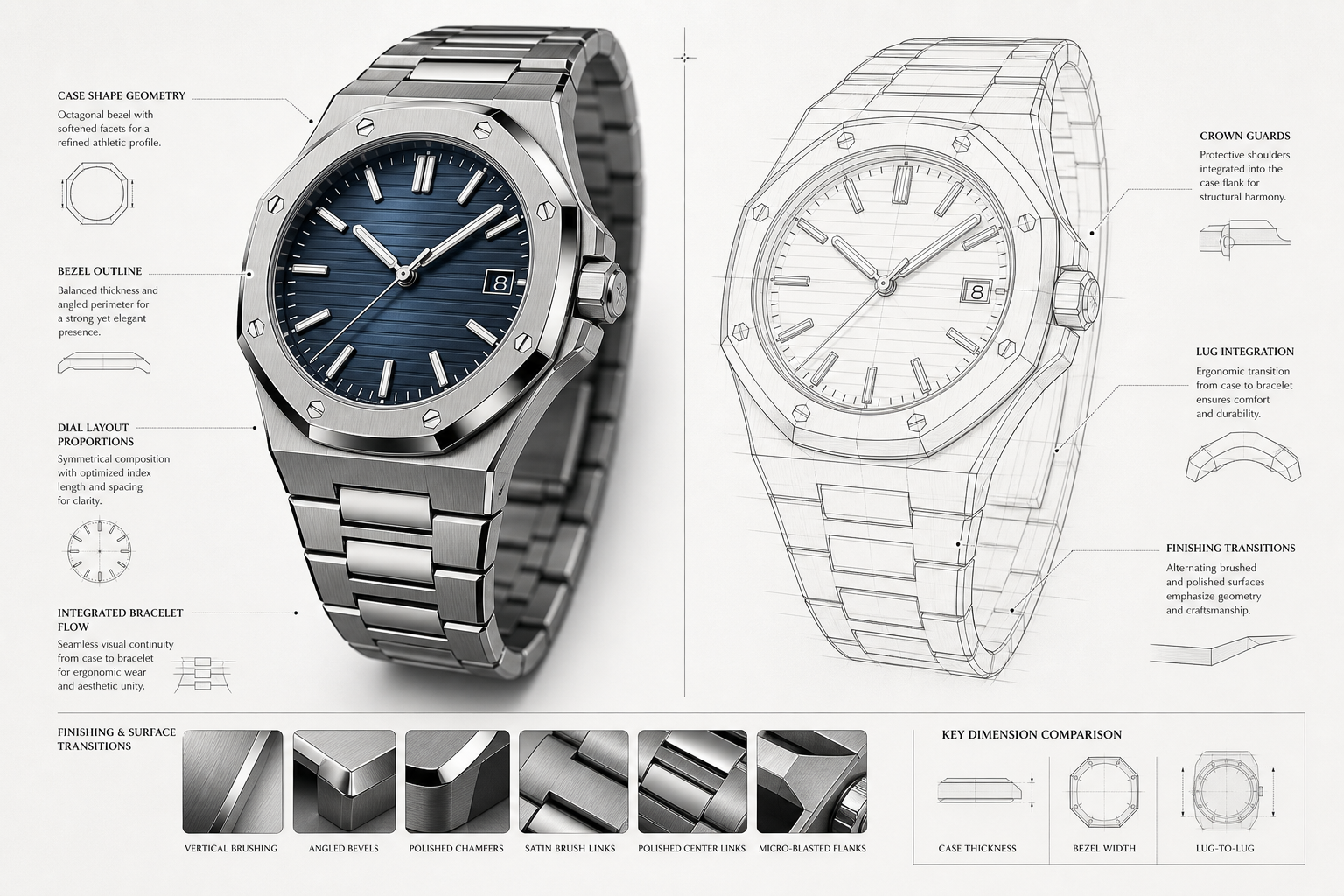
The Tapisserie Dial Is One of the Biggest Reasons Perfection Fails
The tapisserie dial is where the perfect 1:1 claim becomes hardest to defend. It is not just a background pattern. On a Royal Oak, the dial texture is part of the watch’s identity. It controls how the face catches light, how deep the dial appears, and whether the watch feels like a flat imitation or a layered mechanical object.
A strong AP tapisserie dial replica can look very good in a front-facing photo. The square pattern may be even, the color may be attractive, and the markers may sit in the right places. But genuine-style tapisserie is difficult because the issue is not only the number of squares. It is the quality of the surface transitions between the raised blocks and the recessed channels, the way the pattern softens under angled light, and the controlled texture inside each section.
This is why dial photos can mislead buyers. Flat lighting can hide shallow patterning. Harsh lighting can exaggerate texture and make a replica dial look more dramatic than it feels in person. Blue dials can be especially tricky because camera exposure, white balance, and reflective angles can make the same dial look rich, washed out, purple, or too glossy depending on the photo. A buyer asking “how close is the dial?” needs more than one front-on image.
Why Genuine Tapisserie Has a Different Sense of Depth
An authentic-looking Royal Oak dial is not created by the square pattern alone. The convincing effect comes from depth, surface smoothness, and the way each raised block transitions into the surrounding grooves. On better replicas, the tapisserie may be clean and sharply formed, but it can still look either too stamped, too shallow, too crisp, or too flat compared with the smoother dimensional quality buyers associate with genuine AP dials.
The non-obvious problem is that “sharper” is not always better. Some buyers see a highly defined replica dial and assume it is more accurate. In practice, an overly aggressive square pattern can look artificial because the real visual effect is not just sharpness; it is controlled depth. The valleys should not look like harsh cutouts, and the raised squares should not look like a printed grid sitting on top of the dial.
At wrist distance, a small tapisserie difference may not ruin the watch. Under close inspection, it is one of the fastest ways the perfect 1:1 claim loses credibility. For daily wear, the acceptable version is a dial that looks balanced and textured without becoming cartoonishly deep, overly glossy, or visibly flat.
Dial Printing, Logo Placement, and Index Cleanliness
After texture, the next dial checks are printing and applied furniture. The AP logo should not look too heavy, crooked, or poorly seated. The minute track should be sharp enough to look intentional, not thick and fuzzy. Applied indices should sit straight, align with the minute track, and avoid glue marks or uneven height. These are not abstract details; they affect whether the dial looks calm or slightly wrong every time the buyer checks the time.
Logo weight is a common buyer trap. A dial can look attractive in a compressed seller image, but once enlarged, the logo may appear too bold or the lettering too crowded. The same applies to “SWISS MADE” text and minute markers. Slightly heavier printing may not matter to a casual wearer, but sloppy printing does. The line between acceptable and distracting is usually cleanliness, not microscopic perfection.
Lume quality should also be judged realistically. AP Royal Oak lume is not the main reason most buyers choose the watch, but uneven or mismatched lume can make the dial feel cheaper. The more important red flag is inconsistency: hands and markers glowing different colors, one marker much weaker than the others, or lume plots that look messy in close photos. A mild difference in brightness is usually tolerable; uneven application is harder to forgive.
Dial Checks That Matter in QC Photos
For QC review, the best dial request is not one dramatic beauty shot. Buyers should look for a straight-on dial photo to judge centering, an angled-light photo to reveal tapisserie depth, a closer image of the logo and applied indices, and a date-window close-up if the reference has a date. If lume is important to the buyer, a lume shot can show obvious mismatch or weak application, though it will not prove long-term brightness.
The main red flags are simple: crooked markers, visibly uneven logo placement, a date that sits too high or low in the window, a dial that looks unusually flat, or a square pattern that appears harsh and artificial under normal light. Minor texture differences are part of the AP replica compromise. Poor dial assembly is not.
QC photos should help the buyer avoid a bad individual watch, not prove that the watch is perfect; hidden cost of super clone ownership is better judged by a clean dial with acceptable texture, straight indices, balanced print, and no obvious date issue than by chasing a seller’s “perfect 1:1” label.
Bezel Screws, Case Edges, and Chamfers Reveal the Limit of Machine Replication
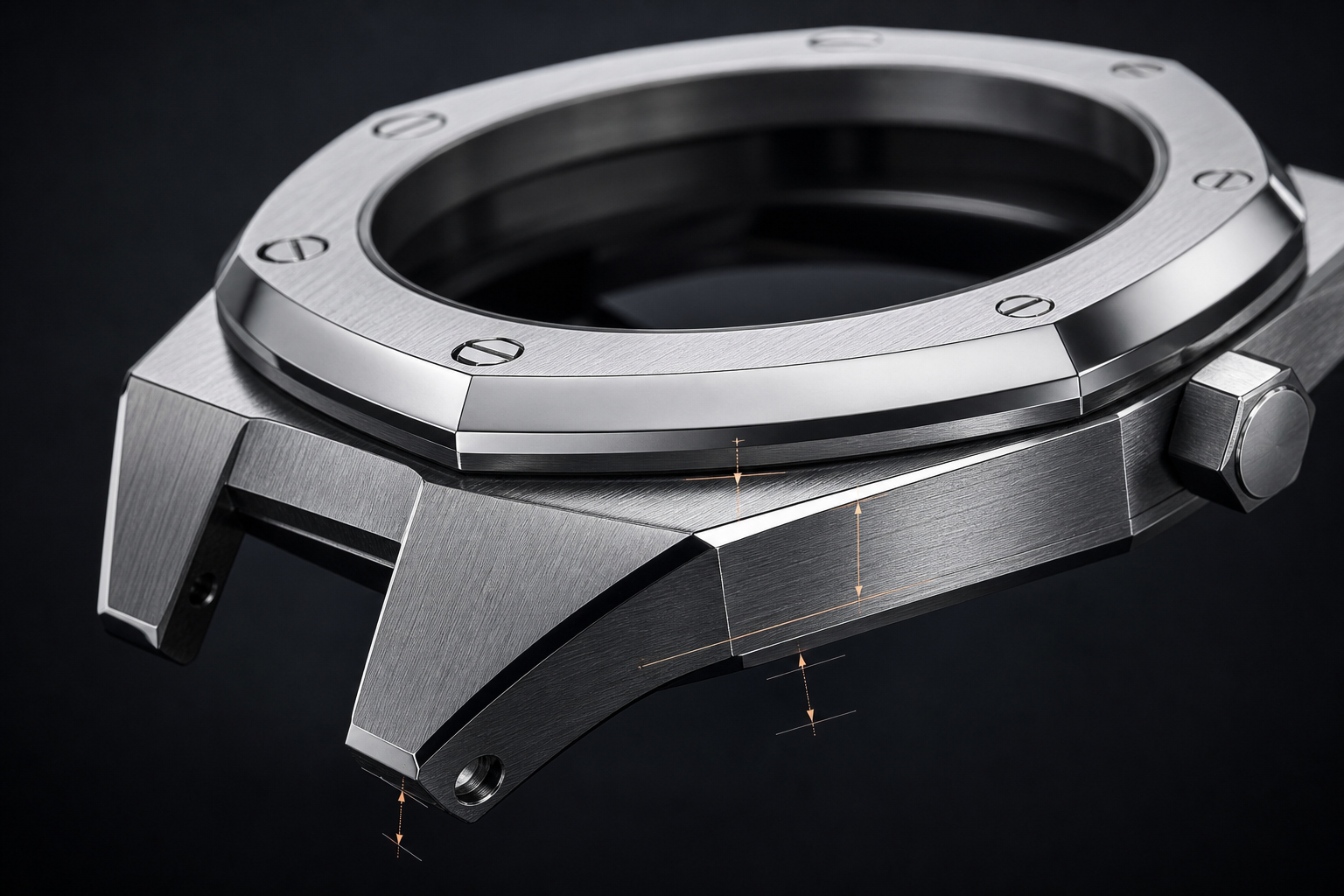
The Royal Oak case is not difficult because it has an octagonal bezel. It is difficult because every visible surface has to meet another surface at the right angle, with the right brushing direction, the right polished bevel width, and the right amount of sharpness. This is where the “perfect 1:1” claim starts to lose credibility. A strong AP bezel screw replica may look convincing in a straight-on seller photo, but angled light often exposes whether the case geometry is truly controlled or simply shaped to look close from the front.
Royal Oak case finishing is a test of transitions. The flat bezel top, the brushed case planes, the polished chamfer edges, and the vertical case wall all create contrast. If one bevel is too wide, one edge is too rounded, or the brushing is slightly uneven, the whole watch can feel less precise. This does not always ruin the watch for daily wear, but it matters for buyers who are paying super clone prices and expecting the case to carry the same crisp architectural impression as the original design.
Bezel Screw Size, Position, and Seating
The bezel screws are one of the fastest ways to judge the quality of a Royal Oak replica case. On a good example, the screw heads should look evenly sized, cleanly cut, and seated flat into the bezel. The slots should not look chewed, overly wide, or shallow. The screw heads should not sit proud of the bezel surface, and they should not appear sunken in a way that creates dark uneven rings around them.
The non-obvious issue is position. Many buyers only check whether the screws are “aligned,” but alignment is not the whole problem. On AP-style cases, the screw head diameter, distance from the crystal, distance from the outer bezel edge, and depth of seating all affect the visual balance of the octagonal bezel. A screw that is technically straight can still look wrong if it is too large or placed too close to the crystal. That type of bezel screw flaw becomes more noticeable because the Royal Oak bezel has so little visual clutter to hide it.
For QC review, avoid judging screw execution only from a bright front-facing photo. Ask for an angled view where light runs across the bezel. That angle shows whether the screw heads are level, whether the slots are clean, and whether any screw reflects differently from the others. One slightly imperfect screw may be acceptable for a daily wearer. Multiple uneven screws, mismatched depths, or a visibly rough slot cut should be treated as a warning sign, especially on a watch sold as a top-tier AP super clone.
Brushing and Polished Bevel Transitions
The better factories can reproduce the general Royal Oak shape, but the harder part is making the brushed finish and polished bevels meet with discipline. Genuine AP finishing is not just shiny edges beside satin surfaces. The contrast is controlled, and the transition lines have a refined sharpness without looking crude. On replicas, the polished chamfers can be too soft, too wide, too bright, or inconsistent from one side of the case to the other.
This is where machine replication reaches its limit. CNC shaping can create the basic geometry, but the final impression depends on edge control and surface treatment. A case edge that looks acceptable in flat photos may look rounded when light hits it from the side. A bevel that is slightly over-polished may create a flashy reflection instead of the narrow, disciplined line that gives the Royal Oak its architectural feel. This is not a tiny forum-only flaw; it can change how expensive the watch feels in the hand.
The brushing direction also matters. On a Royal Oak replica, the satin brushing should look straight, even, and consistent across the bezel and case planes. Uneven brushing makes the watch look refinished or lower grade. Polished bevels should frame the brushed areas rather than overpower them. If the case looks too glossy overall, the watch loses the industrial-luxury character that makes the Royal Oak design work.
Case Thickness and Reference-Specific Proportions
Case thickness is not only a number on a specification sheet. On a Royal Oak, thickness changes the side profile, the bezel-to-case relationship, and the way the integrated design sits on the wrist. A replica can have a good dial and decent bezel screws but still feel off if the mid-case is too tall or the caseback adds too much visual bulk.
This matters more on some references than others. Ultra-thin Royal Oak models leave almost no room for error, while larger 41mm references can tolerate slightly more visual mass before looking obviously wrong. Chronograph models introduce another layer of risk because movement thickness can force the case taller than the original design logic supports. The practical judgment is simple: if the side profile looks heavy in QC photos, do not assume the watch will look better in person. Thickness is one of the flaws that often becomes more obvious after the excitement of the first unboxing fades.
For buyers, the most useful case check is a combination of angles: straight front, 45-degree bezel view, and full side profile. The front photo tells you the design layout. The angled photo reveals brushing, screw seating, and chamfer control. The side photo tells you whether the case proportions still make sense. A clean Royal Oak replica does not need to be perfect, but it should look controlled from all three angles.
Movement Decoration Through the Caseback Is Still a Weak Point
An open caseback can make an AP replica look more impressive in seller photos, but it also gives the watch another place to fail the “perfect 1:1” claim. A Royal Oak replica movement can be positioned, colored, and decorated to resemble the correct architecture, yet still fall short in bridge finishing, rotor engraving, bevel quality, jewel appearance, and long-term consistency. The important distinction is this: looking similar through glass is not the same as being finished like a high-end Audemars Piguet movement.
For many buyers, the movement question is not only visual. The AP clone movement or Royal Oak replica movement route affects winding feel, rotor noise, power reserve behavior, date operation, and future service expectations. A watch can photograph well on day one and still become frustrating if the rotor sounds harsh, the crown feels gritty, the date change is inconsistent, or the movement proves difficult to service. This is why movement decoration should never be evaluated separately from ownership risk.
Movement Evidence Note: A movement specification, when available, can explain the official design of a base caliber, but it does not prove what is inside a particular replica watch. For AP replicas, the buyer should avoid treating terms such as “clone,” “decorated,” “Swiss,” or “custom movement” as self-verifying. The practical evidence is narrower: current movement photos, seller consistency, known service feedback, and whether the case thickness and functions make sense for the claimed route.
This is especially important with open-caseback Royal Oak replicas. The visual layout may be designed to look closer to the intended AP architecture, while the actual mechanical construction, finishing quality, lubrication, regulation, and service path remain different from a genuine Audemars Piguet movement. A good-looking rotor is a visual feature; it is not proof of genuine-level engineering.
Decoration Versus True Finishing
Decorative resemblance is the easiest part to misunderstand. A movement may have a gold-tone rotor, engraved text, Geneva-style stripes, perlage-like texture, or bridge shapes that approximate the genuine layout. Those details can look good in a compressed seller image. Under closer inspection, the difference usually appears in edge quality, engraving depth, surface smoothness, and how cleanly the decoration is executed around screws, jewels, and bridge borders.
True finishing is not just decoration placed on top of a movement. It is the quality of the metalwork itself. On high-end genuine movements, bevels, countersinks, screw slots, engraving, and surface textures are finished with a level of refinement that replicas do not fully match. Some clone movements are far more convincing than older plate-decorated movements, but even the stronger versions should be treated as improved replicas, not as identical watchmaking.
The buyer mistake is assuming that an open caseback automatically makes the watch more premium. Sometimes it does; sometimes it simply exposes more compromises. A closed-back design can hide a practical movement route and make daily ownership easier to judge. An open-back AP super clone asks the movement to perform visually, mechanically, and proportionally. That is a much harder standard.
Why Long-Term Movement Consistency Matters More Than Photos
Movement photos tell you layout and appearance. They do not prove long-term stability. A movement can look clean through the caseback but vary in rotor sound, winding feel, date behavior, and power reserve depending on assembly quality, lubrication, regulation, and the specific batch. This is one reason “clone movement” should not be treated as a magic phrase. It may be the better route for case thickness and visual accuracy, but it still needs realistic expectations.
Rotor noise is one of the most common ownership complaints, especially on movement routes based on thinner automatic calibers or modified architectures. Some noise is normal for many replicas, but a loud scraping, grinding, or loose rotor feel is different from ordinary mechanical sound. Winding feel matters too. A crown that feels sandy, overly tight, or inconsistent can signal poor assembly or dryness, even if the watch looks perfect in photos.
Power reserve claims also deserve caution. Sellers may quote the theoretical specification of a movement, but real-world performance can vary. A buyer should care less about the advertised number and more about whether the movement has a track record in that model family, whether the date changes cleanly, whether the hands set smoothly, and whether the movement can be serviced by a competent independent watch repairer if something goes wrong. At CleanVSFactory, we treat movement choice as part of the ownership decision, not just a feature line in a product description.
Movement Route to Verify
Before buying an open-caseback AP replica, confirm the claimed movement route for the exact reference, not just the factory name. Ask whether it is an integrated clone-style movement, a decorated base movement, or a chronograph movement with additional modification. Each route has different consequences for case thickness, caseback appearance, rotor behavior, and service risk.
Also check whether the caseback photo shows the actual watch being considered. Look for rotor engraving quality, bridge layout, jewel placement appearance, screw cleanliness, and any obvious dust or marks under the caseback. None of this guarantees reliability, but it helps separate a reasonably prepared watch from one that has obvious assembly or finishing issues before it even reaches the buyer.
The safest approach is not to chase the most complicated movement claim. The better question is whether the movement route supports the reference convincingly and whether the buyer is comfortable with the long-term maintenance risk. A simpler, proven route may be more sensible than a dramatic-looking movement that creates thickness, noise, or service problems.
Movement Transparency Note: Movement references in this article describe replica-market movement routes, decoration styles, and configuration claims rather than official Audemars Piguet calibers. Buyers should check the specific watch, caseback photos, movement behavior, and service expectations instead of assuming that a clone-style or decorated movement provides genuine-level construction or reliability.
The biggest mistake in AP replica buying is treating every Royal Oak as the same challenge. The “perfect 1:1” claim breaks in different places depending on the reference. An AP 15202 super clone is judged heavily on thinness and dial balance. A 15400 or 15500 is judged more on case height, tapisserie execution, date placement, movement display, and bracelet integration. An AP chronograph replica adds subdial spacing, pusher feel, hand alignment, and movement thickness to the list.
This is why the better question is not “which AP replica is safest?” in a general sense. The better question is which reference gives the buyer the fewest visible and mechanical traps for their tolerance level. A model can be popular and still be unforgiving. Another model can be less romantic but more practical for regular use.
AP 15202: Thinness and Dial Balance Are Unforgiving
The Royal Oak Jumbo is one of the most elegant AP designs, but that elegance makes the replica harder to excuse. The case is thin, the dial is clean, and the proportions are deliberately restrained. There is no chronograph layout, oversized case, or heavy bezel presence to distract from small dimensional errors. If the case is even slightly too thick, the watch can lose the flat, low-slung character that defines the Jumbo.
The AP 15202 super clone also faces a movement problem. The genuine reference depends on an exceptionally thin automatic movement architecture, and that is not easy to reproduce in a replica. When factories use modified or decorated alternatives, the result may be acceptable visually, but the caseback appearance, movement structure, and overall case profile still carry compromise. This is why the 15202 is not always the safest first AP replica, even though it looks simple in photos.
Dial balance matters just as much. The Petite Tapisserie pattern, no-seconds layout, hand length, date position, and slim markers all work together. If the dial texture is too coarse, the hands are too heavy, or the date sits awkwardly, the watch can feel wrong without one single flaw screaming for attention. For detail-focused buyers, the Jumbo is beautiful but unforgiving.
AP 15400 and 15500: Stronger Daily-Wear Candidates but Still Not Perfect
The 15400 and 15500 are usually more approachable daily-wear choices because their 41mm Royal Oak format gives factories more room to work with. The case has more visual mass than the Jumbo, the dial layout is familiar, and the stronger current replicas can deliver a convincing wrist presence when the case, dial, and bracelet are clean. For many buyers comparing AP 15400 vs 15500 replica options, these references are more practical than chasing the thinnest Royal Oak profile.
The tradeoff is that neither model is flaw-proof. On the 15400, buyers should pay attention to the dial text, applied marker alignment, date window, case thickness, and whether the movement display matches the claimed route. On the 15500, the dial is more open and the date position is part of the visual balance, so weak tapisserie texture or a poorly centered date becomes easier to notice. The 15500 can look modern and strong, but it does not hide dial flatness as well as some buyers expect.
The practical judgment is that a clean 15400 or 15500 is often a more sensible AP replica for daily wear than a more delicate Jumbo or a complicated chronograph. But “more sensible” does not mean perfect. The buyer still needs to check the exact reference, factory version, dial color, case profile, bezel screws, and movement route. A famous factory name cannot correct a bad individual example.
AP Chronographs: More Visual Drama, More Mechanical and Layout Risk
AP chronographs are tempting because they look expensive, busy, and impressive in photos. The problem is that they also multiply the ways a replica can fall short. Subdial spacing, subdial depth, hand alignment, pusher shape, date position, case thickness, and movement architecture all have to work together. If one element is off, the watch may still look dramatic but not necessarily convincing.
Case thickness is the most obvious AP chronograph replica risk. Chronograph movements are thicker and more complex, and older or less refined movement routes can force the case to sit taller than the genuine design logic supports. A few millimeters may not sound dramatic on paper, but on a Royal Oak case, extra height changes the side profile immediately. The watch can start to feel like a thick sports watch wearing Royal Oak styling rather than a properly proportioned Royal Oak chronograph.
Subdial spacing is another trap. If the movement architecture does not support the correct layout, the subdials may sit too close together, too far apart, or slightly off relative to the dial furniture. Chronograph hand reset is also worth watching. A central seconds hand or subdial hand that does not reset cleanly to zero can become annoying quickly, even if the watch looked flawless in the original photos.
For buyers who want daily confidence, a simpler Royal Oak reference is usually the safer path. A chronograph can be the right choice for an experienced buyer who accepts the extra thickness and movement risk, but it is rarely the best place to chase “perfect 1:1.” The more functions and layers the watch adds, the more realistic the buyer needs to be about what can be replicated cleanly and what remains a compromise.
Factory Reputation Helps, But Version and Batch Matter More Than the Slogan
Factory reputation is useful, but it is not a shortcut to a perfect Audemars Piguet super clone. A strong AP super clone factory can be very good on one Royal Oak reference and less convincing on another, especially when the case thickness, movement route, bracelet construction, or dial execution changes. This is where many buyers make the wrong jump: they hear a factory name, assume the whole AP line is safe, and stop asking the questions that actually matter.
The better way to judge a factory claim is narrower: which reference, which version, which movement, which dial color, and which individual watch in the current batch? A factory that is respected for a 15500 may not automatically be the smartest choice for a 15202, a chronograph, or a skeleton model. AP replicas punish generalizations because the Royal Oak is not one problem. It is a group of different problems wearing a similar case shape.
This is also why the phrase best AP replica factory can be misleading if it is used without context. A factory may have better case brushing, while another may have a more convincing movement layout or dial texture on a specific reference. A version update can improve the tapisserie pattern and still leave the bezel screws slightly wrong. Another update can improve the movement display while the bracelet edge finishing remains inconsistent. The slogan never tells you the tradeoff.
At CleanVSFactory, we usually treat factory reputation as the starting point, not the final answer. The factory name helps narrow the field, but the actual buying decision still depends on whether the current version solves the main weakness of that specific AP model.
Factory Name Clarification: Factory names in the replica watch market are buyer-facing labels that can help organize comparisons, but they are not official Audemars Piguet affiliations, audited manufacturer identities, or guarantees of identical quality across every reference. Buyers should judge each AP replica by the specific model, version, movement route, dial color, visible QC details, and current batch evidence.
Why “Latest Version” Needs Specific Proof
“Latest version” is one of the most overused phrases in the AP replica market. It sounds reassuring, but by itself it means almost nothing. A version update may be a real technical revision, a small cosmetic adjustment, a supplier change, or simply a seller using fresh language for old stock. Unless the seller can explain what changed, the phrase should not increase your confidence or justify a higher price.
For an Audemars Piguet Royal Oak replica, a meaningful version update should be tied to a specific part of the watch. Did the dial texture change? Was the case thickness corrected? Are the bezel screws smaller, cleaner, or better seated? Was the bracelet reworked at the first link? Did the date window, logo print, movement decoration, or clasp engraving improve? A vague “V3,” “V4,” or “new batch” label does not answer any of those questions.
The most useful version updates usually address a known flaw. For example, if a prior batch had a flat-looking dial, then a new dial texture is relevant. If the old version used a movement route that forced the case too thick, then a movement update matters. If the complaint was rough bracelet edges, a dial update does not solve the ownership problem. Buyers should ask what the update fixes, not just whether the watch is called the newest one.
A strong seller should be able to describe the difference in plain terms. If the answer is only “best version” or “same as genuine,” that is not technical proof. It is marketing language. The safer response is to compare the claimed update against QC photos and known reference weaknesses.
Factory Claim Check: Factory names in the replica market are useful only when they are connected to a specific watch and a visible result. A buyer should not treat a factory label as proof of steel grade, crystal quality, dial supplier, movement origin, water resistance, or assembly standard unless the seller can provide clear, current, and watch-specific evidence. Even then, the claim should be weighed against what the buyer can actually inspect before shipment.
This matters because two listings with the same factory name can still differ in batch, dial color, movement route, bracelet finishing, and QC quality. The more expensive or more loudly advertised listing is not automatically the cleaner watch. For AP replicas, factory reputation is a filter; the individual QC set is the evidence that affects the final decision.
Why QC Consistency Can Beat Factory Hype
Factory hype can push buyers toward the name on the listing instead of the watch in front of them. That is a mistake with AP replicas because small assembly issues are highly visible. The Royal Oak’s dial markers, octagonal bezel, exposed screws, case edges, and integrated bracelet do not give a bad example many places to hide.
A less hyped factory example with clean dial alignment, even bezel screw seating, a comfortable bracelet, and a stable movement may be a better purchase than a famous-factory watch with visible defects. This is especially true for buyers who plan to wear the watch regularly rather than compare macro photos online. Daily satisfaction often comes from the individual piece being clean, not from owning the most talked-about factory label.
Batch variation matters because replica production is not as uniform as the marketing suggests. One batch may have sharper dial printing, while another may show uneven date alignment. A bracelet may feel better on one piece and rougher on another. Bezel screw finishing can vary even within the same factory version. These are not always huge differences, but on a Royal Oak they can change how refined the watch feels.
The practical judgment is simple: do not pay extra only for the AP super clone factory name if the actual QC photos show problems. A famous factory does not make crooked markers acceptable. It does not make a poor date window disappear. It does not make a rough bracelet comfortable after the first week.
Version Details to Confirm
Before accepting a factory claim, confirm the full specification of the watch being offered. The minimum useful information includes the exact AP reference, factory name, version label, case size, dial color, bracelet or strap type, movement route, and whether the photos show the actual watch for review rather than sample images.
For Royal Oak models, dial color deserves special attention. Blue, grey, black, and silver dials can expose flaws differently. A blue dial may look excellent under one lighting setup and too purple, too flat, or too bright under another. A grey dial may hide some texture issues but reveal printing or marker alignment more clearly. Version quality should be judged on the specific dial color you are buying, not only on general comments about the model.
The movement route should also be stated clearly. A watch with an integrated clone-style movement and a watch with a decorated base movement can look similar from the front but, as a super clone Audemars Piguet guide would emphasize, differ in case thickness, rotor sound, winding feel, service expectations, and caseback appearance. That does not automatically make one choice perfect and the other useless, but it changes what the buyer should expect.
The most important confirmation is whether the QC photos are of the actual watch. Stock images can show the best sample from a factory run. Actual QC photos show the piece you may receive. For AP, that difference matters.
Price, Policy, and Water-Resistance Claims Need Separate Verification
Price language can be as misleading as “perfect 1:1” language. Replica watch prices can vary by factory label, version, movement configuration, finishing quality, seller channel, availability, and after-sales support. A higher price does not automatically prove a cleaner AP replica, and a lower price does not automatically prove a bad one. The useful comparison is like-for-like: the same reference, same claimed factory version, same movement route, same dial color, and comparable QC evidence.
Seller policies should also be confirmed directly before ordering. Return terms, repair options, shipping expectations, payment handling, replacement conditions, and after-sales support can vary by seller and should not be assumed from a factory name, article description, or product title. Buyers should ask clear questions before payment and keep expectations realistic, especially when the listing relies heavily on dramatic claims but provides little watch-specific evidence.
Water resistance should not be assumed from the model name, case style, screw-down crown appearance, or Royal Oak sports-watch identity. Unless the specific watch has been tested and the seller’s policy is clearly confirmed, buyers should treat replica watches more cautiously around water than genuine watches designed and serviced through official channels. Even if a seller says testing was performed, the buyer should understand what was tested, when it was tested, and whether any later case opening could affect the result.
Daily Wear Hides Some Imperfections and Exposes Others
Daily wear is more forgiving than macro photography in some ways and much less forgiving in others. A minor tapisserie texture difference may disappear at wrist distance, especially in normal indoor light. A slightly different print weight may not bother anyone once the watch is moving on the wrist. But rough bracelet edges, a poor clasp snap, loud rotor noise, or a visibly awkward case profile can bother you every time you wear it.
This is the key difference between a watch that looks good in photos and a watch that works as an AP replica daily wear choice. Photos reward drama. Ownership rewards comfort, proportion, sound, and confidence. A Royal Oak super clone that looks impressive in a seller’s front-facing photo can still feel disappointing if the bracelet catches wrist hair, the clasp feels loose, the rotor sounds harsh, or the thickness makes the watch sit too tall.
Buyers should separate three levels of concern: flaws that only matter under close inspection, flaws that affect visual balance at wrist distance, and flaws that affect the physical experience. The last group is usually the most important for daily wear. A tiny dial texture gap is easier to live with than a bracelet that feels sharp every time you move your wrist.
Flaws That Usually Matter Less on the Wrist
Some Royal Oak super clone flaws are real but not always decisive in normal use. Slight differences in tapisserie depth, small variations in dial print weight, or minor limits in movement decoration are often less noticeable once the watch is worn. If the case shape is balanced, the bezel is clean, the markers are straight, and the bracelet sits well, these smaller differences may not dominate the experience.
Subtle finishing gaps can also be acceptable for many buyers. A polished bevel that is not quite as refined as genuine AP finishing may be obvious under angled macro lighting, but less visible at a restaurant table or in an office. The same applies to small differences in lume strength. Many Royal Oak owners rarely rely on lume in real use, so weaker lume is usually less important than bracelet comfort or dial alignment.
This does not mean these flaws are imaginary. It means they should be weighted correctly. A detail-focused enthusiast may care deeply about dial texture and bevel transitions. A casual wearer may care more about whether the watch has the right Royal Oak presence and does not feel cheap on the wrist. Neither buyer is wrong, but they should not use the same accept-or-reject standard.
Flaws That Tend to Become Annoying Over Time
The flaws that age badly are usually tactile, audible, or obvious at a glance. Rough bracelet edges are one of the biggest examples. The Royal Oak bracelet is central to the watch’s identity, so if the links feel sharp, stiff, uneven, or poorly finished, the whole watch feels less convincing. A beautiful dial will not save a bracelet that is uncomfortable after two hours.
Clasp feel is another daily-use issue buyers underestimate. A clasp that closes weakly, sits unevenly, or feels thin can make the watch feel less secure. You may not notice it in photos, but you notice it every time you put the watch on. The same applies to poor bracelet articulation near the case. If the first links do not flow naturally, the watch can wear larger, flatter, or more awkwardly than expected.
Movement behavior can also change the ownership experience quickly. A loud rotor, gritty winding, unstable timekeeping, inconsistent date change, or uncertain chronograph feel is more frustrating than a tiny printing difference. Buyers who are sensitive to sound and mechanical feel should prioritize movement route and QC confidence over the most dramatic-looking model.
Obvious visual defects are harder to forgive. Crooked indices, badly seated bezel screws, misaligned hands, a date window that sits too high or low, or a case profile that looks visibly too thick will keep drawing your eye back to the flaw. These are not “macro-only” problems. They affect daily confidence.
A Practical Buyer Scenario
Consider a buyer choosing between a visually dramatic AP chronograph and a simpler Royal Oak 15400 or 15500-style replica. The chronograph may look more exciting in photos: more subdials, more wrist presence, more mechanical theater through the caseback. For a buyer browsing listings, it can feel like the more impressive watch.
But the chronograph also adds risk. Subdial spacing, pusher feel, case thickness, chronograph hand reset, and movement complexity all create more ways for the watch to disappoint. If the buyer mainly wants a daily-wear Royal Oak that feels clean and reliable, the simpler three-hand model may be the smarter choice. It may look less dramatic in photos, but it often gives fewer ownership surprises.
The right choice depends on tolerance. A casual wearer who wants the Royal Oak look may be happier with a cleaner, simpler reference. A detail-focused enthusiast may accept more risk if the chronograph layout is the main attraction. A movement-sensitive buyer should be the most cautious, because mechanical feel and long-term consistency matter more than first-photo impact.
The strongest daily-wear AP replica is rarely the one with the loudest claim. It is the one where the visible details, bracelet feel, movement behavior, and case proportions all stay within a range the buyer can live with after the novelty wears off.
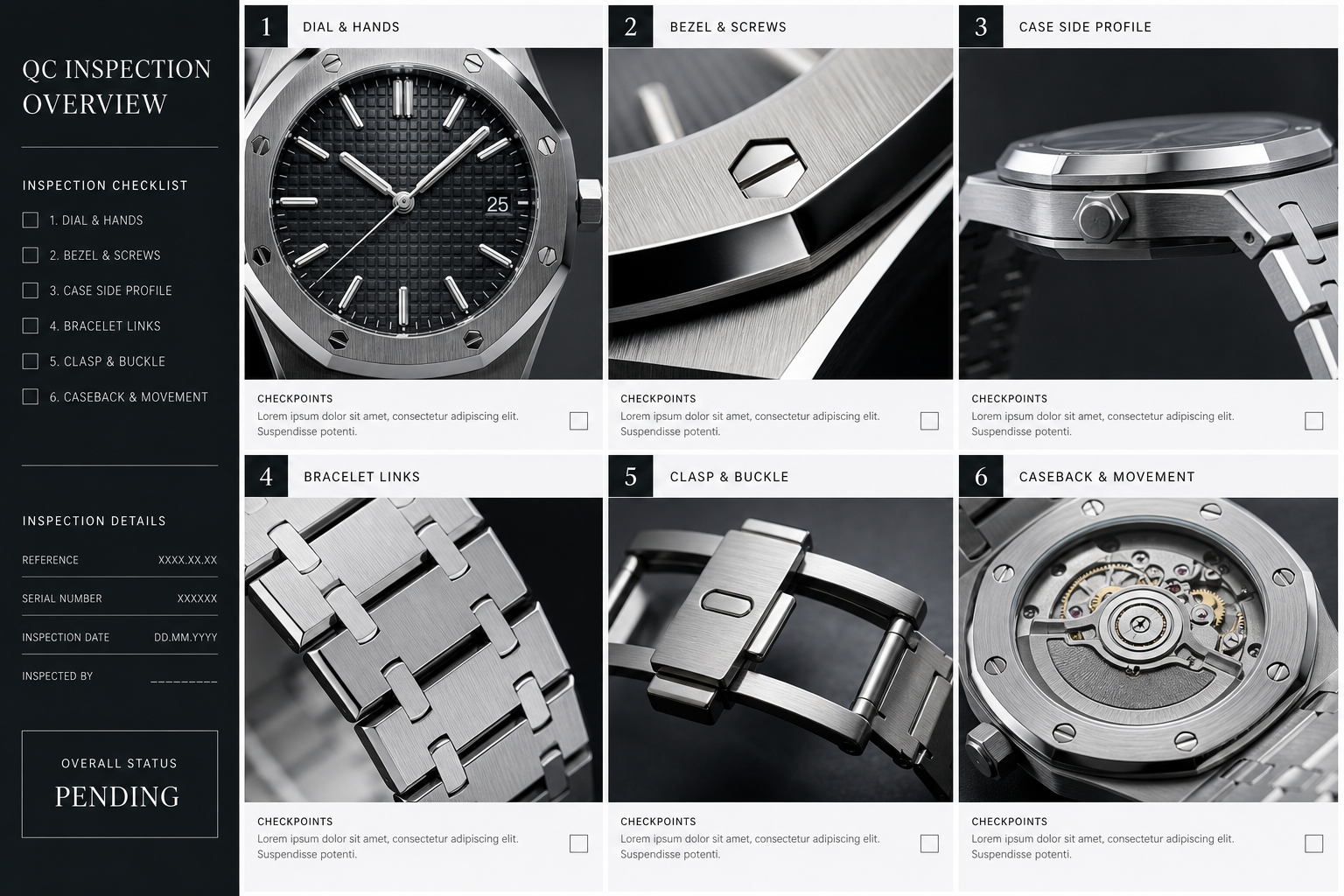
QC Photos Should Be Used to Control Risk, Not Prove Perfection
AP replica QC photos are useful, but they are not proof of perfection. They help you reduce risk before buying by catching obvious assembly, alignment, and finishing problems. They cannot prove waterproofing, guarantee long-term movement reliability, or confirm that the finishing matches genuine Audemars Piguet standards. Treat QC as a filter, not a certificate.
This distinction matters because buyers sometimes expect too much from photos. A straight-on dial image can show whether markers are reasonably aligned, but it cannot tell you how smooth the bracelet feels. A movement photo can show the claimed decoration style and layout, but it cannot tell you whether the rotor will stay quiet after months of wear. An angled case photo can reveal thickness and brushing quality, but lighting can also hide scratches, soften edges, or distort proportions.
A good Royal Oak QC checklist should focus on the problems that are both visible and decision-changing. You are not trying to prove that the watch is a perfect 1:1 AP super clone. You are trying to decide whether this individual piece is clean enough to accept or flawed enough to reject.
Before making a decision, buyers should review real QC photos where available, including dial printing, hand alignment, bezel screw position, datewheel centering, bracelet fit, clasp engraving, case thickness, side profile, and overall finishing. Factory labels and stock photos alone are not enough for a reliable judgment.
Front Dial and Bezel Review
Start with a straight-on front dial photo in neutral lighting. The goal is to check alignment without distortion. Look at whether the dial is centered, whether the applied markers sit straight, and whether the logo and minute track look clean. If the model has a date window, check that the date sits centered and does not appear too high, low, left, or right.
For the tapisserie dial, do not judge only from one bright photo. Strong lighting can make a shallow dial look more dramatic, while poor lighting can make a good dial look flat. If possible, compare a straight-on shot with a slightly angled shot. You are looking for an even pattern, no obvious color blotches, no damaged indices, and no strange gloss that makes the dial look toy-like.
The bezel deserves its own attention. Check whether the octagonal outline looks symmetrical and whether the screws sit evenly. On AP replicas, bezel screw issues are more important than many buyers realize because the screws are part of the Royal Oak’s face. A slightly imperfect screw shape may be tolerable, but uneven depth, damaged slots, or one screw sitting visibly higher than the others should be treated as a serious warning.
Side Profile and Bracelet Review
The side profile photo helps you judge whether the watch has the right wrist presence. AP Royal Oak designs are sensitive to thickness. If the case looks tall, slab-like, or poorly integrated with the bracelet, the watch may wear less convincingly even if the dial photo looks strong. Ask for a side view that shows the bezel, mid-case, caseback, and first bracelet links together.
Bracelet fit is just as important as the case. Look at the transition from the case to the first link. Large gaps, uneven spacing, stiff-looking end links, or poor finishing around the link edges can affect comfort and appearance. The Royal Oak bracelet should visually flow from the case. If it looks like an attachment rather than an integrated design, the watch loses much of its appeal.
Clasp photos are often skipped, but they should not be. A clean clasp does not guarantee perfect feel, but it can reveal rough engraving, poor plating, misaligned closure, or sloppy finishing. For daily wear, clasp quality is more important than many macro dial details because it is part of every wearing experience.
Caseback and Movement Review
A caseback photo can confirm the claimed movement appearance, decoration style, rotor design, and whether anything looks obviously damaged or incorrectly assembled. It can also help you distinguish a movement route that is visually closer to the intended AP layout from a simpler decorated base movement. That matters for thickness, caseback appearance, and buyer expectations.
But a movement photo has limits. It cannot prove power reserve, winding smoothness, long-term stability, or serviceability. A movement can look clean through the caseback and still arrive dry, noisy, or inconsistent. This is why buyers should avoid treating decorated bridges and engraved rotors as proof of mechanical quality.
Use the caseback image to check for obvious red flags: loose screws, damaged rotor finish, strange engraving errors, dirty assembly, or a movement that does not match the seller’s claim. Then keep expectations realistic. QC can reduce the chance of receiving a visibly poor watch, but it cannot turn a replica movement into genuine AP watchmaking.
Red Flags Before Buying
Some flaws are minor tolerances. Others should make a buyer pause or reject the piece. Serious red flags include crooked hour markers, visibly uneven bezel screws, damaged hands, a badly misaligned date, a case profile that looks clearly wrong for the reference, large bracelet gaps, rough-looking bracelet finishing, or a clasp that appears poorly seated.
Seller behavior can also be a red flag. If a seller refuses to provide basic front, side, bracelet, clasp, and caseback angles, the buyer is being asked to accept unnecessary risk. The same applies when the seller relies only on factory sample photos while claiming the watch is the “latest perfect version.” For AP replicas, the actual piece matters too much to buy from slogans alone.
The cleanest approach is to accept small imperfections that do not affect daily wear and reject flaws that will bother you every time you look at or handle the watch. QC photos should help you make that decision calmly. They are not there to prove the watch is flawless; they are there to prevent an avoidable mistake.
A Better Standard: Convincing, Clean, and Wearable Beats “Perfect 1:1”
The right question is not whether a perfect 1:1 AP super clone exists. It does not. The better question is whether a specific watch is convincing enough, clean enough, and stable enough for the way you plan to wear it. That standard is less exciting than the sales phrase, but it is much more useful for avoiding a bad Audemars Piguet replica purchase.
A realistic AP super clone can still make sense for some buyers. The strongest examples capture the Royal Oak shape, bracelet flow, dial layout, and general wrist presence well enough for normal daily use. But the buyer has to accept the category honestly: this is still a replica watch, with visible and mechanical limits. Paying extra only because a seller says “perfect 1:1” is one of the easiest ways to overpay for confidence that the watch itself may not support.
For this model family, the practical target should be simple: a clean dial, aligned bezel screws, reasonable case thickness for the reference, comfortable bracelet articulation, acceptable clasp feel, stable winding behavior, and no obvious QC defects. If those points are strong, small differences in tapisserie depth or movement decoration may not ruin the ownership experience. If those points are weak, no factory slogan can rescue the watch.
Acceptable Imperfections for Most Daily Wearers
Most daily wearers can live with small differences that do not dominate the watch at wrist distance. A slightly less dimensional tapisserie dial, minor variation in dial print weight, softer movement decoration through the caseback, or a bracelet finish that is good but not genuinely AP-level may be acceptable if the watch is otherwise well assembled. These are the kinds of flaws that matter more in macro photos than during normal use.
The key is balance. A Royal Oak replica does not need to win a loupe inspection to be enjoyable, but it does need to look coherent. If the dial color, case profile, bezel, bracelet, and hands all work together, the watch can feel convincing even with known limitations. This is where realistic expectations protect the buyer: you are choosing the best compromise, not buying a flawless technical match.
Small movement decoration gaps are also usually tolerable for buyers who rarely study the caseback. A rotor engraving that lacks depth or bridge finishing that looks simpler under magnification may be disappointing to a movement-focused enthusiast, but it will not necessarily affect daily wear. The more important question is whether the movement winds normally, keeps stable enough time, changes date properly where applicable, and does not make the watch feel fragile or irritating.
Deal-Breakers That Undermine the Whole Watch
Some flaws are not just “replica limitations.” They are reasons to walk away from a specific piece. Crooked hour markers, visibly uneven bezel screws, a badly misaligned date window, damaged hands, rough bracelet edges, a clasp that feels loose or poorly seated, or a case profile that looks obviously too thick can undermine the entire watch. These are not academic differences. They are issues you will notice after the excitement of purchase wears off.
Movement behavior can be an even bigger deal-breaker than a minor visual flaw. A noisy rotor, gritty winding, inconsistent setting feel, sticking date, unstable timekeeping, or vague movement claim should make the buyer cautious. A beautiful AP super clone that becomes annoying to wear is not a better purchase than a slightly less dramatic model with cleaner execution and fewer ownership risks.
Exaggerated seller language is also a warning sign. If the sales pitch depends heavily on “perfect 1:1,” “same as genuine,” or claims that no difference exists, the buyer should slow down. Strong factories and strong versions do not need impossible promises. In Audemars Piguet replica buying advice, the more credible seller usually explains the tradeoff, shows the actual watch clearly, and does not pretend QC photos can prove perfection.
The Final Buyer Rule
Choose the cleanest, most reference-appropriate version you can verify through QC, not the seller who uses the strongest “perfect 1:1” language. That is the safest rule for anyone asking, “Should I buy an AP super clone?” The answer can be yes, but only if the watch is judged as a realistic AP super clone with known compromises, not as a flawless replacement for genuine AP construction.
For most buyers, the best choice is the example with the fewest obvious problems: straight dial furniture, acceptable tapisserie appearance, even screw seating, sensible thickness, smooth bracelet feel, and movement behavior that matches the intended use. A famous factory name, latest-version label, or premium price should support those qualities, not replace them.
At CleanVSFactory, we treat “perfect 1:1” as a claim to be tested, not a standard to believe. The better buying standard is practical and repeatable: verify the watch, understand the reference, accept minor cosmetic limits, reject obvious execution problems, and never pay more simply because the marketing sounds more confident. For AP replicas, convincing, clean, and wearable is not a compromise standard. It is the only honest one.
Legal, Disclosure, and Resale Caution for AP Replica Buyers
Replica watches can raise trademark, customs, import, resale, and disclosure issues depending on jurisdiction. This article is not legal advice, and buyers should not assume that an imitation watch is risk-free to purchase, ship, import, resell, or present as anything other than a replica. The safer assumption is that an AP super clone is an unauthorized imitation product, not an Audemars Piguet watch.
Disclosure matters. A replica should not be represented as authentic, serviced by the brand, covered by an original manufacturer warranty, or equivalent to a genuine Royal Oak. Even if a watch is visually convincing, its legal status, service path, materials, movement construction, finishing, and long-term value are different from an authorized luxury watch.
This is another reason the phrase “perfect 1:1” is unhelpful. It can blur important boundaries for new buyers. A practical buyer guide should keep those boundaries clear: a stronger replica may be more visually satisfying than a weaker one, but it remains a replica with different risks, different support expectations, and no official relationship with the original brand.
Responsible Use of Replica-Market Information
Factory names, movement descriptions, and QC observations should be used to understand quality and risk, not to support misrepresentation. The traceable way to discuss an AP super clone is to describe it as a replica-market version of a genuine reference design, with visible similarities and known limitations. That framing protects buyers from unrealistic expectations and keeps the distinction between an imitation watch and an authorized Audemars Piguet product clear.
Before ordering, buyers should also confirm practical seller terms such as return, repair, shipping, and after-sales conditions directly with the seller, because those details can vary and should not be assumed from a factory name or article description. The watch itself should then be judged model by model: visible execution first, movement route second, ownership expectations third, and marketing language last.
What This Information Should Not Be Used For
Factory comparisons, movement notes, and QC checklists should not be used to help a replica watch pass as genuine, avoid disclosure, or support resale as an authentic Audemars Piguet watch. A strong replica may reduce obvious visual errors in casual wear, but close inspection can still reveal differences in finishing, movement architecture, case proportions, bracelet feel, dial details, and service compatibility.
The responsible use of this information is buyer protection: understanding where a replica-market watch may be strong, where it may be weak, and which claims require verification. It is not a guide to authentication deception, boutique inspection, resale fraud, or hiding a watch’s replica status. Keeping that boundary clear is part of judging the category honestly.
Disclosure: This article is for general educational and comparison purposes only. Replica watches are not genuine products from the original luxury brands, and brand names are used only to identify reference designs or comparison topics. Factory names, movement descriptions, prices, availability, QC details, seller policies, and version information can change, so readers should verify important details with the seller before making a purchase decision. Replica watches should not be represented, resold, or used as genuine watches.