
This guide is written as a terminology and clarification reference for beginners and intermediate buyers who are trying to understand how IWC replica watches are actually classified, discussed, and judged inside the replica watch world. It does not review individual models, and it does not rank products. Its only purpose is to explain the language that determines whether an IWC replica is structurally credible or fundamentally flawed.
What Does “Super Clone” Really Mean in IWC Replica Watches?
In the context of IWC replicas, “Super Clone” is not a marketing adjective. It is a working term used inside the replica supply chain to describe a watch that passes a small number of structural tests that experienced buyers repeatedly rely on. When those tests fail, the watch may still look attractive in photos, but it will not survive ownership, comparison, or long‑term use, and understanding how replica quality may evolve helps separate short‑term aesthetics from future‑proof performance. For insights into where super‑clone construction is headed — including next‑level accuracy, materials, and complications — see this forward‑looking analysis of the future of IWC super clones, which explores how upcoming generations of replicas could address longstanding weaknesses in durability and function.
A true IWC super clone meets three verifiable standards, none of which depend on branding language.
First, case dimensions must match genuine IWC specifications, not approximately, but functionally. This includes diameter, lug-to-lug span, and especially thickness. IWC designs are proportion-sensitive. A Portuguese Chronograph that is 1.5mm too thick or a Big Pilot that sits too high on the wrist immediately breaks visual balance. Many low-tier replicas fail here even before the dial is examined.

Second, the movement architecture must be correct, not merely decorated to resemble the original. A printed bridge plate or cosmetic engraving does not qualify. The layout of subdials, power reserve mechanisms, and gear flow must match how the genuine movement actually works. This is where most fake “high-end” IWC replicas collapse under scrutiny.
Third, all complications must be functional. Frozen subdials, fake power reserve indicators, or disconnected date mechanisms disqualify a watch from being considered a super clone. IWC designs make complications visually central. When they do not move correctly, the watch becomes obviously wrong the moment it is worn or handled.
When these three conditions are met together, the term “super clone” becomes meaningful. When they are not, the label is empty.
Super Clone vs AAA vs 1:1 – What’s the Real Difference?
Terms like AAA and 1:1 are not technical classifications. They are retail-layer language used to justify price variation, not to describe construction quality. There is no industry definition, no shared benchmark, and no internal agreement on what those labels mean.
“Super Clone,” by contrast, emerged as an internal shorthand among builders, dealers, and experienced buyers to separate structurally correct watches from visually convincing but mechanically hollow ones. It is not perfect, and it is not enforced, but it reflects a consensus built through repeated failures, returns, and comparisons.
In practice, a watch labeled AAA can be anything from mid-grade to disposable. A watch labeled 1:1 often simply means “this is the best version we currently have,” regardless of whether that version is structurally sound. The label itself carries no weight. Only the underlying construction does.
Why “Super Clone” Is Especially Important for IWC Replicas
IWC replicas punish errors more harshly than many other brands. This is not about prestige; it is about design language.
IWC pilot watches rely on precise dial spacing, correct hand lengths, and accurate case geometry. Portuguese models depend heavily on power reserve layout, subdial symmetry, and movement depth. When any of these elements are wrong, the watch becomes a “one-look fake,” even to non-experts.
Many failed IWC replicas are not exposed by logos or fonts. They are exposed by movement structure errors or case proportion mistakes that cannot be disguised by polishing or marketing descriptions. This is why the concept of an IWC super clone matters more here than in brands where simpler three-hand layouts dominate.
For buyers trying to understand which IWC replicas are built on solid foundations, the internal category of
IWC Super Clone Watches exists to separate structurally credible builds from everything else.
Understanding IWC Replica Factories (ZF, V7, MKS & More)
In replica terminology, the word “factory” does not describe a physical location in the way most consumers expect. It describes a version system: a specific combination of molds, movement sourcing, assembly standards, and quality control decisions.
Choosing a factory is not choosing who made the watch. It is choosing which design compromises were accepted and which were not.
What Does “Factory” Mean in the Replica Watch World?
A factory represents three things working together:
- Molds, which determine case shape, thickness, lug geometry, and bezel profile
- Quality control standards, which decide acceptable tolerances and rejection rates
- Supply chain choices, including which movement platform is used and how much it is modified
This is why two watches that look similar in photos can wear completely differently on the wrist. Selecting a factory is not about surface appearance alone. It is about committing to a specific construction logic.
Major IWC Replica Factories Explained
Below are the factories that matter for IWC replicas, not because they produce everything well, but because they produce specific categories correctly.
ZF Factory (IWC Specialist)
ZF is widely regarded as the most consistent IWC-focused factory. Its strength is not aggressive pricing but structural discipline.
ZF excels in:
- Portuguese series
- Big Pilot models
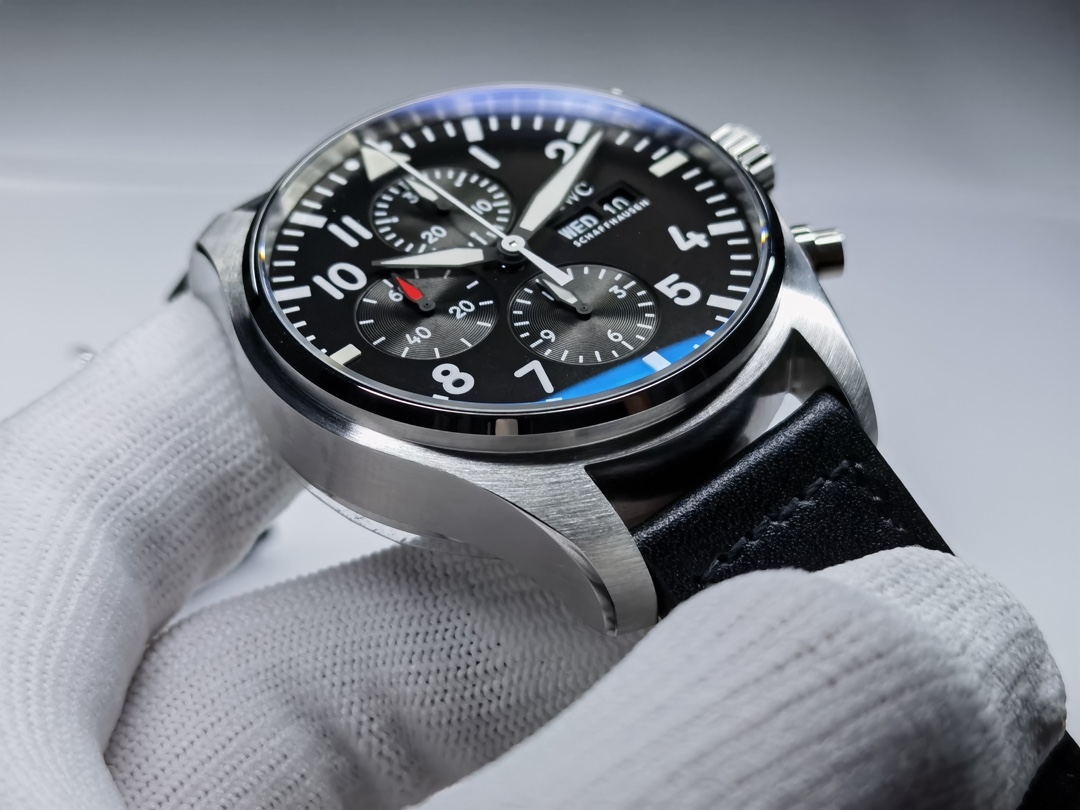
- Pilot Chronograph lines
ZF watches tend to prioritize correct case thickness, authentic movement layouts, and functional complications. They are rarely the cheapest option, but they are often the least compromised. For buyers looking to understand what a fully realized IWC super clone looks like,
ZF Factory IWC Models provide a reliable reference point.
V7 Factory (Ingenieur & Mark Series)
V7 is not a universal IWC solution, and it should not be treated as one. Its relevance comes from narrow specialization.
V7 performs best in:
- Ingenieur Automatic 40
- Mark XVIII and closely related pilot three-hand models
These watches rely heavily on correct case geometry and movement stability rather than complex complications. In those areas, V7’s approach works well. Outside of them, its advantage diminishes.
MKS Factory (Mark & Portofino)
MKS is best understood as a stability-first factory. It does not chase innovation or extreme movement modification.
MKS is well-suited for:
- Mark series entry models
- Portofino three-hand and simple date watches
For beginners, MKS is often a safe choice because it avoids fragile or over-engineered solutions. The trade-off is that its watches may lack deeper architectural fidelity compared to top-tier builds, but they tend to function reliably over time.
Other Factories (APS, YL, GF – When They Matter)
Some factories matter only in very specific contexts.
- APS can be relevant for certain Portuguese variants where dial or case corrections were addressed faster than competitors.
- YL occasionally matters in older Portuguese releases but is largely overshadowed today.
- GF is worth mentioning only when discussing complex calendars or niche complications, where availability is limited and expectations must be adjusted.
Outside of those narrow cases, these factories can generally be ignored when evaluating modern IWC super clones.
Understanding these terms does not make the buying decision for you, but it removes most of the noise that leads buyers into structurally weak IWC replicas, which is often the difference between a watch that feels convincing for years and one that feels wrong the moment it is worn.
What Do V1, V2, V3 Versions Mean in IWC Replicas?
Version numbers in IWC replicas confuse new buyers because they look like quality rankings, but they are not. V1, V2, and V3 do not describe how good a watch is. They describe the order in which a factory released revisions of the same model. A later version may be better, worse, or simply different. The number itself carries no guarantee.
In practice, version numbers exist because replica watches are not finished products in the traditional sense. They are iterative builds, adjusted after release based on feedback, returns, movement failures, or visual discrepancies that become obvious only after real-world wear. Understanding this prevents one of the most common mistakes beginners make: paying more for a higher version number without understanding what actually changed.
Why Factories Release Multiple Versions (V1 → V2 → V3)
Factories typically revise an IWC replica for three reasons, and none of them automatically imply an upgrade.
Dial correction is the most common trigger. This may involve adjusting font weight, marker length, subdial spacing, or date window position. In IWC watches, dial errors stand out quickly, especially in Pilot and Portuguese models where spacing and symmetry define the design. A V2 may exist solely to correct a dial issue that was visually obvious once buyers started comparing the watch side by side with genuine references.
Case thickness adjustment is another frequent reason. Many early IWC replicas fail because the case sits too tall. This is not always noticeable in photos but becomes obvious on the wrist, and understanding these iterative improvements helps explain why some updates matter more than others. For example, you can see how progressive refinements in replica construction — including caseback profile tweaks and movement mounting changes — significantly affect fit and wear in this case study on the evolution of IWC Mark series replica watches. A later version may shave off half a millimeter by changing the caseback profile or movement mounting, and when this happens, a V2 or V3 can be meaningfully better — but only if thickness was the original flaw.
Movement reliability fixes account for the rest. Sometimes a factory realizes that a movement configuration causes excess wear, poor power reserve behavior, or inconsistent chronograph engagement. The revision may involve changing movement suppliers, adjusting gear ratios, or abandoning a decorative plate that interferes with function. These changes are often invisible but can dramatically affect long-term usability.
None of these reasons guarantee that every version step improves the watch. They simply explain why multiple versions exist.
Does a Higher Version Always Mean Better?
No, and assuming so leads to unnecessary spending.
Some V1 releases are already the best version because the original mold was correct, the movement choice was sound, and no structural flaw existed. In those cases, later versions may introduce minor cosmetic tweaks that do not improve wearability or reliability.
Conversely, some V3 versions are little more than surface corrections. A slightly darker dial print, a revised case engraving, or a new clasp stamp may justify a version bump without changing how the watch actually performs. Paying a premium for those changes rarely makes sense unless the buyer values that specific detail.
Experienced buyers evaluate versions based on what changed, not which number is higher. If a V2 fixed a known thickness issue, it matters. If a V3 only changed packaging or lume color, it often does not. Version numbers are useful only when paired with context.
IWC Replica Movement Codes Explained (7750, 2892, 9015 & More)
Movement codes matter more in IWC replicas than in many other brands because IWC designs expose mechanical behavior. Subdial placement, power reserve indication, and chronograph engagement are visually central. When the movement architecture is wrong, the watch fails even if the case and dial look convincing.
Understanding movement codes is less about memorizing names and more about knowing which functions a movement can support without cheating.
Why Movement Choice Matters More Than Case Finish
Many bad IWC replicas look acceptable at first glance because the case and dial were copied competently. They fail later because the movement cannot support the layout it is pretending to drive.
This is especially true for chronograph layouts and power reserve displays. A chronograph with incorrect subdial gearing or a fake power reserve indicator that is disconnected from the mainspring will always betray itself through behavior. Hands jump incorrectly, indicators do not respond to winding, or functions feel inconsistent during use.
A polished case cannot compensate for a movement that was never designed to do what the dial claims it does. In IWC replicas, movement choice determines whether the watch feels mechanically coherent or hollow.
Common IWC Replica Movements Explained
Asian 7750 (Chronograph Models)
The Asian 7750 remains the backbone of most IWC chronograph replicas, including Portuguese Chronograph and Pilot Chronograph models. Its strength lies in being a fully integrated chronograph movement rather than a modular add-on.
When used correctly, the 7750 can support real chronograph functions with proper subdial behavior. Problems arise when it is misused. Incorrect subdial spacing, unnecessary decorative plates, or constant chronograph engagement all shorten its lifespan.
In practice, the 7750 works best when the chronograph is treated as a functional feature, not a permanently running display. Start it when needed, stop it when finished, and avoid treating it as a seconds substitute. Used this way, it can be reliable and consistent. Abused, it becomes fragile.
ETA / Clone 2892 (Three-Hand Models)
For three-hand IWC replicas such as the Mark XVIII and Ingenieur, the 2892 architecture is close to ideal. Its thin profile allows correct case proportions, and its gear layout naturally supports simple time-and-date displays without compromise.
This is why the 2892 platform appears repeatedly in credible Mark and Ingenieur replicas. It does not need heavy modification, and it does not force design shortcuts. Whether Swiss or clone, the architecture itself aligns well with IWC’s original intent for these models.
In practical terms, watches built around 2892-style movements tend to feel balanced, sit correctly on the wrist, and age well with routine maintenance.
Miyota 9015 (Stability-Oriented Choice)
The Miyota 9015 is not historically correct for IWC, but it is often chosen for stability. It is robust, widely serviceable, and tolerant of daily wear. Factories use it when long-term reliability is prioritized over architectural purity.
Its main limitation is structural. The winding direction, rotor behavior, and internal layout do not match IWC’s original movements. For purists, this matters. For users who value low maintenance and predictable performance, it often does not.
In short, the 9015 trades authenticity for durability. Whether that trade is acceptable depends on how the watch will actually be worn. Understanding version numbers and movement codes does not turn a buyer into an expert, but it removes the most common points of confusion that lead to poor decisions, especially in a brand like IWC where mechanical structure matters as much as appearance.
FAQ: Common IWC Replica Terms Beginners Ask About
Is “Super Clone” the Same as “1:1 Replica”?
No, and treating them as interchangeable causes most beginner mistakes.
“1:1 replica” is a marketing claim, not a technical category. It usually means “this is the best version we sell right now,” without specifying why it is good or whether its structure matches the genuine watch in any meaningful way. There is no shared benchmark, no checklist, and no internal agreement behind the term.
“Super Clone,” when used correctly, describes a threshold, not a slogan. It implies that the watch passes basic structural tests: correct case proportions, correct movement architecture, and real, working complications. It does not mean perfect, but it does mean the watch behaves the way an IWC is supposed to behave.
In short, 1:1 tells you how the seller wants you to feel. Super clone tells you whether the watch is mechanically credible.
Are Swiss Movements Necessary for IWC Replicas?
No. They are optional, and often misunderstood.
In IWC replicas, movement architecture matters more than movement origin. A correctly chosen clone movement that matches the layout and function of the original will outperform a poorly integrated Swiss movement every time.
Swiss ETA movements can make sense in simple three-hand watches where the architecture aligns naturally, such as certain Mark or Portofino models. But in chronographs or power-reserve models, installing a Swiss movement does not magically solve layout or reliability problems. In many cases, it introduces new ones.
Experienced buyers judge movements by compatibility, reliability, and behavior, not nationality. Swiss is not a requirement for a good IWC replica, and it is not a shortcut to quality.
Why the Same IWC Replica Has Different Prices?
Because you are rarely looking at the same watch.
Price differences usually reflect changes in factory version, movement choice, case tooling, or quality control, not cosmetic tweaks. A thinner case, a corrected dial mold, or a movement that actually supports the displayed complications all cost more to produce and reject more units during assembly.
Sometimes the difference is justified. Sometimes it is not. Without understanding factory names, version numbers, and movement codes, price looks arbitrary. With that context, pricing usually makes sense, even if you still choose the cheaper option.
What matters is not whether a replica is expensive, but whether its cost reflects a real structural improvement.
Final Thoughts: How Understanding Terminology Helps You Avoid Bad IWC Replicas
Learning the language of IWC replicas does not guarantee a perfect choice, but it removes most of the traps that cause regret, because once you understand how factories, versions, and movements actually work, you stop buying labels and start judging structure—if you want the full framework behind these decisions, start with IWC Replica Watches Guide: Best Factories, Movements & Models Explained and decide for yourself where your priorities sit.
Related IWC Articles: If you found this helpful, you might also enjoy IWC Replica Watch Movement Problems & Repair Advice: Common Faults, Causes, and Maintenance (Beginner Guide), and Is the MKS Portofino Worth Buying? A Dress-Watch–Focused Review Based on Wear, Not Marketing. Another related article is IWC Replica Watches Guide: Best Factories, Movements & Models Explained.