
Super Clone IWC Watches are no longer defined by how convincing they look in photos. They are increasingly judged by how they behave under use, how they age on the wrist, and how closely their mechanical and material decisions mirror the logic of the genuine watches they reference. This shift matters because visual deception has largely plateaued; what now separates a serious super clone from a decorative copy is whether its engineering choices survive time, wear, and scrutiny beyond arm’s length.
Why IWC Super Clone Accuracy Is Entering a New Era
The most important change in IWC super clone accuracy is not cosmetic. It is structural. Over the past few years, the best replicas have moved away from surface mimicry and toward architecture-aware replication. That change did not come from ambition alone; it came from repeated failure. Dial printing reached a ceiling early. Case proportions stabilized. What remained exposed were movements that behaved incorrectly, power reserves that lied, rotors that sounded wrong, and cases that wore unlike their genuine counterparts.
Modern high-end IWC replicas now accept an uncomfortable truth: accuracy is no longer additive. You cannot stack better fonts, cleaner brushing, and louder claims to reach the next level. Accuracy is systemic. Movement layout, case mass distribution, and material response to wear all interact, and when one is wrong, the illusion collapses quickly in real use.
This is where the current generation separates itself from earlier attempts. Power reserve layouts increasingly follow genuine geometry rather than decorative overlays. Rotor mass is tuned not just for winding efficiency but for sound profile. Case thickness is negotiated against movement height instead of hidden under domed crystals. These decisions are uneven across factories, but the direction is consistent.
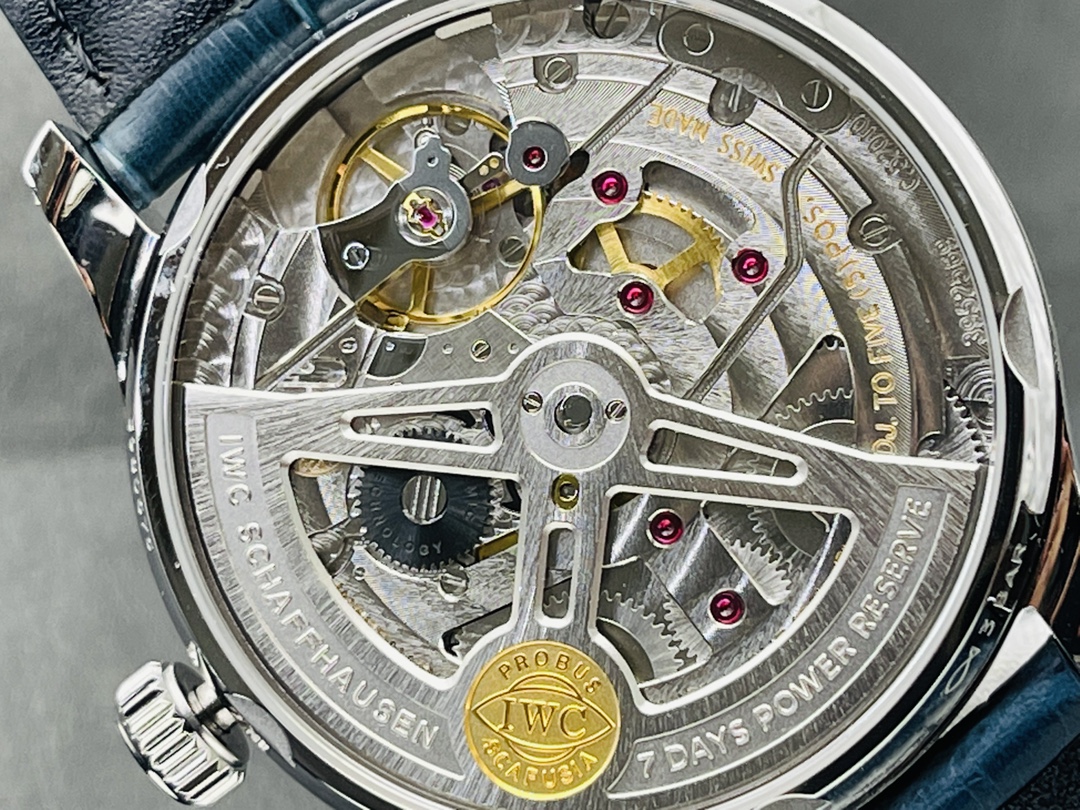
The remaining limits are well known. Movement architecture still relies too heavily on modified ETA and 7750 families. Case materials, especially ceramics and advanced composites, lag far behind IWC’s proprietary processes. Factory specialization prevents full-stack perfection. These constraints are explored in depth in the complete IWC replica watches guide, but they also define why the next phase will look different from the last. The ceiling is no longer visual; it is material and mechanical.
Advanced Case Materials: The Next Bottleneck in IWC Super Clones
Dial accuracy used to dominate discussion because it was the easiest thing to improve and the easiest way to impress. That phase is over. Today, case material accuracy is the primary bottleneck holding IWC super clones back from the next tier of realism.
This is especially true for IWC, a brand whose identity increasingly rests on how its cases feel rather than how its dials read. Ceramic, titanium, Ceratanium®, and carefully controlled surface treatments define modern IWC more than typography ever did. A replica that gets the dial right but misses the tactile response of the case still fails the moment it is worn daily.
Material accuracy is difficult because it is unforgiving. Poor brushing reveals itself under light. Incorrect ceramic density changes how a watch feels the moment it is lifted. Coatings that look fine out of the box betray themselves after months of friction. These are not marketing problems; they are manufacturing problems.
Ceramic & Ceratanium®: Can Replicas Match IWC’s Hardest Materials?
Ceramic is often described as difficult to replicate, but that description undersells the problem. The challenge is not simply producing ceramic; it is producing ceramic that behaves like IWC’s ceramic after years of wear. Sintering temperature, particle size, pigment stability, and post-sinter finishing all influence color depth, surface texture, and edge integrity. Most replicas fail at more than one of these stages.
Current ceramic IWC replicas tend to fall into two categories. The first looks visually correct but feels too light and too smooth, lacking the subtle grain and edge resistance of genuine cases. The second improves density but sacrifices color accuracy, producing blacks that read either chalky or overly glossy under real lighting. Neither truly replicates how an IWC ceramic case absorbs light or resists micro-chipping at sharp transitions.
Ceratanium® is even further out of reach. Its appeal lies in combining titanium’s lightness with ceramic’s hardness through a controlled transformation process. Replicas currently simulate the color, not the material behavior. They can approximate the look, but they do not replicate the way Ceratanium resists wear while maintaining a metallic warmth under handling.
True ceramic super clones will become realistic only when replica manufacturers stop treating ceramic as a coating alternative and begin treating it as a material system. That shift requires supplier-level maturation, not just factory ambition. Until then, ceramic replicas will remain visually impressive but experientially incomplete. For a deeper breakdown of how genuine materials behave, see IWC case materials explained.
Gold, Titanium, and Surface Treatment Improvements
Gold replicas are no longer judged by whether they are solid gold. They are judged by whether the color survives time. Modern PVD and electroplated treatments can look convincing on day one, but tone drift, edge thinning, and contrast loss at contact points expose weak surface engineering quickly. The better replicas now focus less on thickness claims and more on adhesion quality and color stability under abrasion.
Titanium presents a different problem. Weight accuracy is easy to measure and frequently achieved. What is harder is replicating the brushing behavior of genuine IWC titanium, which has a muted, almost dry texture that reflects light unevenly. Many replicas polish too aggressively or brush too uniformly, resulting in cases that look correct but feel sterile.
This is why surface finishing will matter more than metal purity in the next phase of IWC super clones. A well-finished steel case with accurate brushing and edge transitions will feel more authentic than a poorly finished titanium or gold-tone case. As collectors spend more time wearing replicas rather than photographing them, these differences stop being academic. They become decisive.
The future of high-end IWC replicas will not be decided by louder specifications. It will be decided by quieter details: how a case ages, how it resists wear, and whether it continues to feel right long after the novelty fades.
Complex Complications: How Far Can IWC Replicas Go?
Complications are the final boss of IWC super clone accuracy, not because they are visually complex, but because they expose whether a replica understands cause and effect inside a movement. Many replicas look convincing when static. Complications punish them once time starts passing. Calendar logic, energy distribution, tolerance stacking, and long-term stability reveal shortcuts that decoration can hide for only so long.
The honest ceiling today is clear. Replicas can imitate the appearance of complex complications reliably. They can imitate portions of their behavior inconsistently. Fully autonomous logic, especially logic that remains correct across years without intervention, remains rare. Marketing often blurs this distinction, but daily use does not. Anyone who has lived with a complicated replica learns quickly which functions are ornamental and which are trustworthy.
That does not mean progress has stalled. It means the path forward is narrower and more technical than many expect.
Perpetual Calendar Replicas: The Realistic Path Forward
Genuine IWC perpetual calendars work because the movement understands time, not because the dial displays it. Month length, leap years, and century exceptions are encoded mechanically through stacked cams and long-cycle gears. Once set correctly, the watch does the thinking on its own for decades.
Most IWC perpetual calendar replicas do not replicate this logic. They simulate the outcome. Date, month, and year indications often advance through simplified modules that assume uniform month lengths or require manual correction multiple times per year. From the outside, they can look convincing. From the crown, they reveal their limits.
True perpetual logic remains rare in replicas for a simple reason: tolerance and error propagation. A genuine perpetual calendar can absorb minor wear and still remain correct. Replica modules, often added atop base movements never designed for that load, accumulate error quickly. One skipped tooth or mistimed jump cascades into multiple incorrect displays.

The realistic path forward is not full perpetual replication. It is modular semi-perpetual systems. These systems accept that February and leap years will require user intervention but automate everything else with greater reliability. They reduce mechanical strain, simplify servicing, and deliver a more honest user experience. Instead of pretending to be eternal, they aim to be consistent.
This direction aligns with what already works in high-end replicas: fewer fragile promises, more dependable behavior. The underlying movement strategies behind this approach are discussed in IWC replica movement technology, where architecture matters more than feature count.
Tourbillons, Silicon Parts, and High-End Escapements
Tourbillon replicas deserve blunt treatment. Visually, many are impressive. Mechanically, most are compromises. A rotating cage that completes a revolution is easy to showcase. A cage that improves rate stability, resists shock, and remains serviceable over time is not.
Most IWC tourbillon replicas function as animated balances rather than precision regulators. They add visual complexity but often reduce reliability. Increased friction, higher power consumption, and sensitivity to shock offset any theoretical gains. For collectors who understand this trade-off, tourbillon replicas are aesthetic objects, not performance upgrades.
Silicon components are a quieter but more meaningful frontier. Silicon balance springs resist magnetism, improve isochronism, and stabilize performance across temperature changes. They matter because they address everyday problems, not showcase complications. Replicating silicon parts is difficult due to manufacturing requirements, but incremental adoption is already visible in adjacent segments of the industry.
Progress here will be gradual. There will be no sudden leap where replicas match genuine high-end escapements across the board. Instead, expect selective improvements: better balance assemblies, cleaner impulse geometry, and reduced reliance on brute-force regulation. These changes rarely photograph well, but they change how a watch behaves months after purchase.
The Future of IWC Super Clone Movements
The future of IWC super clone movements will not be decided by how closely they resemble ETA calibers with added decoration. That phase is already showing its limits. What matters next is whether movements replicate architecture rather than appearance.
A movement’s layout dictates everything: power reserve behavior, crown feel, rotor sound, case thickness, and long-term wear patterns. When replicas copy only the surface, they inherit none of these behaviors. When they copy geometry, even imperfectly, the watch begins to feel coherent.
From Modified ETA to Architecture-Level Replication
Modified ETA and 7750-based movements succeeded because they were available, robust, and adaptable. They are also the reason many replicas still feel wrong in subtle but persistent ways. Power reserve indicators sweep incorrectly. Subdial spacing forces compromises. Rotor noise exposes imbalance. Case thickness creeps upward to hide structural mismatches. To understand how different movement codes and factory variations impact these issues, check out this detailed guide on IWC super clones.
Architecture-level replication addresses these issues at their source. Instead of forcing functions onto unsuitable bases, movement geometry is redesigned to place gears, barrels, and bridges where they belong. Power reserve layouts become honest rather than theatrical. Energy flow matches dial indications. Case proportions stabilize because the movement no longer fights the shell.
Power reserve accuracy is a useful diagnostic here. When the layout is wrong, the indicator lies even if it moves. When the layout is right, the indicator becomes predictable and trustworthy. This is not a cosmetic upgrade. It is a behavioral one.
Modular Movements & Long-Term Serviceability
As movements grow more specialized, serviceability becomes a defining metric of super clone quality. A watch that cannot be maintained realistically over time is not a serious replica, no matter how accurate it looks initially.
Modular movement systems offer a practical solution. By separating base timekeeping from complication modules, replicas can improve reliability without overloading a single architecture. Failed modules can be replaced. Wear can be isolated. Regulation remains manageable.
This approach mirrors industrial logic rather than boutique ambition. It accepts that replicas live in a real world of wear, shock, and maintenance. Over time, collectors will judge super clones not by how complex they are, but by how calmly they survive ownership cycles.
The future of IWC super clone movements is not about chasing perfection. It is about choosing which imperfections are tolerable and engineering everything else to behave consistently.
Chinese Factories and the Next Super Clone Arms Race
The next phase of IWC super clone development will not be won by a single factory making louder claims. It will be shaped by how effectively Chinese manufacturing functions as a system. What looks like competition on the surface is often coordination underneath: shared suppliers, parallel machining capabilities, and incremental learning distributed across dozens of workshops rather than centralized in one place.
This matters because the limits facing super clones today are no longer about intent. They are about process maturity. When accuracy depended on dial printing or case silhouette, a single factory could leap ahead. Now that accuracy depends on tolerances measured in microns, surface behavior under wear, and long-cycle mechanical stability, progress becomes collective. One shop refines CNC programs. Another improves micro-gear cutting. A third learns how to finish ceramic without introducing stress fractures. The result is uneven but directional improvement.
Thinking in terms of “the best factory” obscures this reality. China’s advantage is not dominance by one name. It is the density of competence across an ecosystem that iterates faster than any isolated operation could.
Precision Manufacturing & Supply Chain Evolution
CNC machining has already reached a level where case geometry accuracy is rarely the limiting factor. The frontier has moved inward. Tolerance control on internal components, especially gear teeth, pinions, and bearing surfaces, now defines reliability. Small deviations that were once irrelevant become critical when movements run closer to their design limits.
Micro-gear production is a quiet constraint. Cutting small, hardened gears consistently without introducing burrs or uneven tooth profiles requires tooling and inspection discipline that few shops had a decade ago. That capability is improving, but unevenly. When a replica movement wears prematurely, the cause is often not design but execution at this scale.
Ceramic and silicon components expose the supply chain even more. These materials cannot be improvised in back rooms. They require upstream suppliers with stable processes and predictable output. As those suppliers mature, replicas gain access not just to materials, but to repeatability. That repeatability, more than any single breakthrough, enables meaningful progress in high-end replicas.
What looks like an arms race is often just convergence. As suppliers improve, everyone gains access to slightly better inputs. The watches improve not because one factory outpaces the others, but because the floor rises for all.
Why “One Perfect Factory” Still Doesn’t Exist
The idea of a single factory mastering every aspect of IWC super clone production is appealing but unrealistic. Modern replicas demand conflicting competencies. Case finishing, movement architecture, ceramic processing, and module assembly each favor different skills, machines, and cultures of work.
Specialization solves this. One group focuses on cases, another on movements, another on finishing. Integration happens through cooperation, not ownership. This model produces better results than forcing everything under one roof, but it also fragments credit. No single factory can legitimately claim total superiority without outsourcing critical stages.
This is why factory hype persists. Marketing favors simplicity. Reality does not. A strong case producer paired with a mediocre movement partner yields a watch that looks excellent and wears poorly. The reverse produces a watch that behaves well but feels visually unfinished. Balanced success requires alignment across specialists, and that alignment is fragile.
Collectors benefit from understanding this structure. Instead of chasing factory names, they learn to evaluate outcomes: how a watch wears, how it sounds, how it ages. The myth of the perfect factory fades once ownership replaces anticipation.
What Hardcore Collectors Should Expect Next
Hardcore collectors already know that specifications stopped being persuasive a long time ago. What matters now is coherence. A super clone either feels internally consistent, or it does not. The next stage of high-end IWC replica collecting will be defined less by feature lists and more by how convincingly a watch settles into daily ownership.
True realism is no longer about fooling someone across a table. It is about whether the watch stops reminding its owner that it is a replica. That threshold is crossed through accumulated small behaviors, not a single dramatic improvement.
From Visual Accuracy to Wear Experience
Weight balance is the first tell. Many replicas match total weight but distribute it incorrectly. Genuine IWC watches feel anchored at the case, not top-heavy or rotor-driven. As movement architecture improves, mass distribution will follow, and watches will stop shifting unnaturally on the wrist during motion.
Crown resistance is another overlooked signal. The way a crown engages threads, compresses gaskets, and transmits torque during winding creates an immediate impression of quality. Replicas often over-tighten or feel gritty because tolerances stack poorly. Incremental improvements here have an outsized impact on perceived authenticity.
Rotor sound realism may be the most honest metric of all. A rotor that spins silently when it should murmur, or chatters when it should glide, breaks immersion instantly. Recent replicas have begun tuning rotor mass and bearing resistance deliberately, not just for efficiency but for acoustic behavior. Collectors notice this shift immediately, even if they cannot articulate why the watch feels calmer.
These changes do not photograph well. They are experienced over weeks, not minutes. That is why they matter.
Customization & Micro-Batch Super Clones
The most significant shift ahead is scale. Large production runs favor consistency, not excellence. As demand fragments among informed collectors, small-batch replicas will become more viable. These watches will not chase universal appeal. They will chase narrow correctness.
Micro-batch super clones can afford tighter tolerances, selective materials, and slower finishing processes. They can accept higher rejection rates. They can prioritize wear experience over cosmetic perfection. The trade-off is obvious: cost rises, availability shrinks, and resale becomes uncertain.
For serious collectors, this is not a deterrent. It is the point. Custom IWC replicas, tuned for a specific reference or use pattern, will blur the line between replica and independent homage in everything but branding. They will not be for everyone, and they should not be.
Final Thoughts: How Close Can Super Clone IWC Watches Really Get?
Super Clone IWC Watches will continue moving closer to genuine behavior through materials, movement architecture, and manufacturing discipline, but they will never eliminate the need for judgment, which is why informed collectors should treat each new advance as a refinement rather than a finish line, and anchor their decisions in long-term use rather than promise, as outlined in the IWC replica watches buying guide.
Related IWC Articles: If you found this helpful, you might also enjoy Guangzhou IWC Watch Market Explained: How IWC Replicas Actually Move From Factory to Buyer, and IWC Portuguese 7 Days IW5007 Replica Deep Dive (ZF vs V9 + Real Power Reserve Reality). Another related article is IWC Replica vs Genuine: How to Spot the Differences (Big Pilot & Portuguese 7 Days), which shows how to spot differences between IWC replica and genuine Big Pilot & Portuguese models.