
Opening Thesis: Aquatimer Is a Replica Trap (In a Good Way)
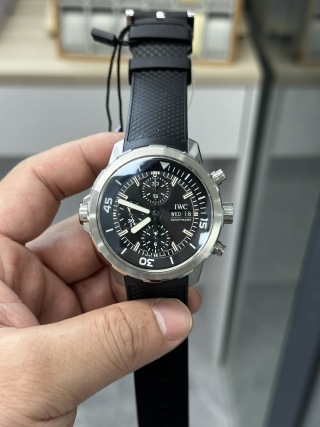
The design is not “hard”; the mechanism is hard
Most people approach an Aquatimer replica the wrong way. They start with bezel color, dial print, or whether the font weight feels right under a loupe. That mindset misses the point entirely, because Aquatimer lives or dies by how the bezel system behaves under real hand force. You can tolerate small cosmetic imperfections on a tool watch, but you cannot tolerate a timing system that slips, jumps, or feels vague when you actually try to use it.
This is also why Aquatimer stays cold compared to Pilot or Portuguese models. There are fewer hype references, less online noise, and far fewer casual buyers chasing it for status alone. That lower demand means fewer factories are willing to invest in the hard part, which is engineering the bezel transmission instead of just printing another dial. The result is a strange situation where Aquatimer replicas look “easy” on photos, yet quietly punish shortcuts the moment you interact with them.
In practice, Aquatimer filters buyers. If you judge replicas mainly by surface appearance, this series will frustrate you. If you judge them by mechanical behavior, Aquatimer becomes one of the most honest lines in IWC’s replica ecosystem.
Define what “worth it” means for Aquatimer buyers
Aquatimer only makes sense for certain types of owners, and pretending otherwise leads to disappointment. The first group is the tool-watch wearer who actually values daily durability, crown feel, and bezel feedback more than dial drama. These people tend to notice case integrity, strap security, and rotational resistance long before they care about microscopic print alignment.
The second group is the odd-IWC collector. Aquatimer attracts buyers who enjoy references like Cousteau or Expedition variants precisely because they sit outside mainstream Pilot and Portuguese narratives. For them, rarity and mechanical character matter more than instant recognition.
The third group is the value hunter who wants IWC’s diver identity without chasing the same models everyone else owns. Aquatimer offers that, but only if the buyer accepts that this line demands stricter mechanical scrutiny than most.
What Aquatimer is not, however, is a safe first replica. If you do not understand bezel coupling risk, inner ring behavior, and basic tool-watch tolerances, this series will teach you the hard way. Aquatimer rewards informed ownership and punishes casual buying.
The Aquatimer Mechanism: Why This Series Is Genuinely Hard to Replicate
Internal/External bezel transmission (the real engineering problem)
At its core, Aquatimer uses a two-layer timing system where the outer bezel does not measure time directly but mechanically drives an inner timing ring through a coupling mechanism hidden inside the case, and this functional linkage — similar to the SafeDive system that links an external bezel to an internal unidirectional timing ring via a sealed internal gear train — defines how elapsed minutes are tracked and resists accidental counter-rotation, a detail that the IWC replica watches by series: Portuguese, Pilot, Ingenieur & Portofino structural and functional comparison highlights as challenging for replicas to reproduce with authentic bezel-to-inner-ring engagement.
That coupling is where replicas fail.
On a genuine Aquatimer, rotating the external bezel transfers motion smoothly and predictably to the internal ring. Resistance feels deliberate, and position changes remain stable after release. In replicas, this system often degrades into vague engagement, delayed response, or partial slippage, especially once tolerances loosen after wear.
This is not a cosmetic challenge. It is a mechanical one. You can copy hands and indices with enough tooling, but reproducing controlled torque transfer inside a sealed diver case requires proper machining, alignment, and materials. Most factories compromise here because it is expensive and difficult to tune at scale.
SafeDive logic: why the directionality matters
Aquatimer’s bezel logic is not decorative. It exists to prevent accidental extension of dive time.
The inner timing ring is designed to move only in the direction that shortens remaining dive duration. That counterclockwise behavior is a safety rule, not marketing language. If the bezel gets bumped, the worst outcome should be a shorter indicated dive window, not a longer one.
Replica failure modes are remarkably consistent once you know what to feel for. Sometimes the outer bezel rotates while the inner ring hesitates or jumps in steps. Sometimes the inner ring rotates freely in both directions, defeating the entire safety concept. In weaker executions, the inner ring drifts after setting, slowly walking away from its position during normal wrist movement.
Any of these behaviors disqualify the watch as a serious Aquatimer replica. When the directionality logic breaks down, you are no longer wearing a diver instrument. You are wearing a dial inside a diver-shaped case.
Quick-change strap system: small feature, big QC exposure
On newer Aquatimer references, IWC integrates a quick-change strap system that allows tool-free removal. On paper this looks minor. In practice it exposes manufacturing discipline immediately.
Replica issues here tend to cluster around tolerances. Loose springbars or soft retaining parts create audible rattling at the lugs. Poorly machined interfaces leave micro-gaps between strap and case, which destroys the solid, sealed feeling a tool watch should project.
These problems rarely show up in seller photos. They appear on wrist, during movement, and while putting real load through the strap. A proper Aquatimer should feel like a single assembled unit. If the strap behaves like an accessory instead of an integrated component, that is a structural failure, not a cosmetic one.
A Catalog That Makes Sense: Aquatimer by Era and Core Architecture
Era A: The “Aquatimer 2000” heavy-tool generation
The Aquatimer 2000 family, often anchored by references like IW3568, represents the heavy-tool phase of this line. These watches emphasize depth rating, mass, and legibility over elegance. They wear large, feel dense, and communicate purpose immediately.
Replicas favor this era for practical reasons. Dial layouts are simpler, and the tool-watch aesthetic tolerates minor print imperfections better than dress models ever could. Thick markers, bold hands, and matte surfaces hide small inconsistencies that would stand out on polished Portuguese dials.
At the same time, this generation exposes a different weakness. Even when dimensions look correct on paper, replicas often feel blocky on wrist. Caseback profiles tend to bulge, mid-case walls grow too vertical, and overall balance shifts upward. You end up with a watch that measures right but wears wrong, especially under cuffs or jackets.
Era B: SafeDive + inner bezel modern Aquatimer (core identity era)
This is the true Aquatimer identity. Inner timing ring. External control. SafeDive behavior. Everything else is secondary.
If the bezel feel is wrong here, the watch is Aquatimer cosplay.
Modern Aquatimers depend on controlled resistance, predictable engagement, and positional stability. When executed properly, setting the inner ring feels deliberate and confidence-inspiring. When executed poorly, it feels like plastic gears inside a steel shell.
This era separates decorative replicas from functional ones. You can forgive slight dial tone differences. You cannot forgive an inner ring that creeps or disengages. For most buyers, this is the point where Aquatimer either earns its place in a collection or gets sold within weeks.
Era C: Chronograph era (the most common replica target)
Chronograph Aquatimers, commonly represented by IW3767xx and IW3768xx families, dominate replica availability. Factories gravitate toward them because proven 7750-family architecture simplifies movement sourcing and assembly. They already know how to build chronographs. Adding a diver shell feels incremental.
That convenience comes with consequences. Thickness creep becomes hard to avoid once you stack a chronograph on top of a bezel transmission system. Case profiles grow taller, center of gravity rises, and wrist stability suffers. At the same time, the bezel system now shares space with additional gearing, increasing tolerance demands across the entire assembly.
Chrono Aquatimers can be satisfying watches, but they amplify every weakness in the platform. When they are good, they feel impressive. When they are average, they feel compromised in ways that simpler Aquatimers never do.
Factory Landscape for Aquatimer Replicas (What Actually Exists)
The “headline factories” vs the “tool-watch specialists”
In the broader IWC replica world, production naturally splits by flagship lines. ZF dominates Portuguese and many Pilot references because those models reward dial work, case finishing, and visual symmetry. Aquatimer does not reward those strengths in the same way. It rewards mechanical discipline, tolerance control, and assembly consistency, which is why its best versions often come from quieter factories that specialize in tool-watch architecture rather than headline dress models.

Looking at Aquatimer through popularity alone leads nowhere. The useful way to understand this series is by capability.
Factories that perform better on bezel mechanics tend to be the ones already experienced with internal-rotating diver systems and multi-layer case assemblies. These workshops focus on torque transfer, spring tension, and ring alignment, not just cosmetic rotation. When their Aquatimers are good, the bezel feels deliberate, the inner ring tracks smoothly, and the system holds position under light shock.
Case finishing and strap integration usually come from a different skill set. Some factories excel at mid-case shaping, lug geometry, and strap-seat tolerances even if their bezel systems are only average. Their watches wear better on wrist, sit flatter, and feel more coherent as objects, even when the inner ring action lacks refinement.
Rare dial variants like Cousteau or Expedition editions tend to attract smaller, more experimental producers, and as the finish-and-variant fidelity section of the MKS IWC Portofino Moonphase replica review vs YLF dress-watch comparison explains, these factories chase uniqueness rather than volume; sometimes they deliver surprisingly faithful special editions, and sometimes they sacrifice mechanical consistency to hit a visual theme quickly, a trade-off that with models like Aquatimer shows up immediately in bezel feel and crown behavior during functional engagement.
This is why Aquatimer cannot be reduced to a single factory narrative. One workshop might give you excellent bezel coupling but mediocre case ergonomics. Another might produce beautiful shells with loose inner rings. The strongest Aquatimers usually emerge when those two disciplines intersect, and that intersection is inconsistent across batches.
“ZF Aquatimer / Cousteau” reality-check framing
Many Aquatimer listings circulate under major factory labels, especially for Cousteau and chronograph variants. That labeling is often more commercial than technical. What matters in real ownership is not the badge attached to the listing but the behavior of the unit in your hand.
Judge the watch by how the bezel couples to the inner ring. Judge it by crown threading feel and whether the date snaps cleanly at midnight. Look at how the strap seats against the case and whether the lugs transmit movement or remain silent. These are mechanical truths that survive any factory story.
Factory attribution in Aquatimer is messy because multiple workshops share parts, outsource case components, and assemble in parallel. Two watches sold under the same name can behave very differently. Once you accept that, Aquatimer becomes easier to evaluate. You stop chasing labels and start judging outcomes.
The Model Library (The “大全” Section Readers Actually Want)
Template block for each Aquatimer variant
Every Aquatimer variant deserves to be judged using the same lens, regardless of price or edition status.
Start with identity. Note the reference family and any commonly used nickname, such as Cousteau or Expedition. This tells you which generation of case architecture and bezel system you are dealing with.
Move to the core mechanism. Identify whether it uses the classic SafeDive inner ring, a simpler external bezel, or a chronograph-integrated system. Pay attention to how that mechanism should feel during rotation, not just how it looks.
Then consider wear behavior. Aquatimers vary widely in perceived thickness. Some sit low and centered. Others feel top-heavy due to caseback bulge or tall mid-case walls. Cuff clearance matters more here than on many divers because IWC still carries dress-watch proportions even in its tool lines.
Next come the replica tells. Three fast tells usually surface quickly: bezel response under light torque, crown threading smoothness, and date alignment within the window. Two microscope tells follow for those who care: lume edge cleanliness around indices and hand stack alignment under angled light.
Finally, decide who the watch is for. Each Aquatimer variant fits a specific ownership style. Some suit daily tool use. Some exist mainly for collectors who enjoy obscure references. Some only make sense for buyers willing to tolerate quirks.
Must-cover Aquatimer model buckets
The Aquatimer 2000 and other 200 bar-plus tool models, anchored by the IW3568 family, represent the heavy-duty side of this line. These watches emphasize depth rating and mass, and replicas often perform well cosmetically here while struggling with blocky case profiles.
The Aquatimer Chronograph lineup, centered around IW3767xx and IW3768xx references, dominates replica availability. These models combine internal bezels with 7750-based chronograph stacks, creating the most complex tolerance environment in the series.
Special editions such as Cousteau and Expedition variants attract collectors who value visual identity and rarity. Replica quality here varies wildly by batch, making unit-level inspection essential.
Newer 42mm Aquatimer Automatic models offer a more wearable size for modern wrists. When executed well, they balance tool-watch presence with everyday comfort. When executed poorly, they reveal mid-case thickness and strap-fit issues immediately.
Engineering Comparison: What Makes a “Good Aquatimer Rep” Different
Bezel action grading (the core scoring system)
Aquatimer quality begins with bezel behavior. Over time, five practical grades emerge.
At the bottom is cosmetic rotation only, where the outer bezel moves but fails to drive the inner ring reliably. Slightly above that is inner ring movement with frequent slipping, followed by movement with mild drift after setting. These watches feel unstable and never inspire confidence.
Next comes stable but gritty, where the system holds position but transmits motion with uneven resistance. This level is usable but fatiguing in daily interaction.
At the top is stable, smooth, and predictable. Here the inner ring tracks instantly, holds alignment, and resists accidental movement. This is where Aquatimer finally feels like a functional instrument rather than a themed accessory.
Case architecture: mid-case height vs perceived thickness
Measured thickness tells only part of the story. Felt thickness comes from how that height distributes across the case.
Aquatimer tolerates thickness better than Portofino because it is a diver. You expect substance. But it still carries IWC’s design language, which favors balance over brute mass. When replicas push too much height into the mid-case or rely on a domed caseback to hide movement stacks, the watch starts wearing tall and awkward.
A good Aquatimer keeps mass centered. The caseback sits flush, the mid-case tapers gently, and the watch hugs the wrist despite its specifications. Poor executions feel like towers strapped to your arm.
Lume and dial legibility: the tool-watch truth test
Tool watches earn their credibility in low light. Aquatimer replicas often reveal themselves here.
Uneven lume fill edges around indices are common. Mismatched color temperature between hands and markers appears frequently. Under dim conditions, these inconsistencies break the visual coherence that makes a diver readable at a glance.
You do not need laboratory darkness to see this. A hallway at night or a shaded room is enough to tell whether the watch behaves like a tool or like a display piece.
Movement Reality (Practical, Not Hype)
Why most Aquatimer chronograph reps lean on 7750-family architecture
Aquatimer chronograph replicas overwhelmingly rely on 7750-family movements because they are serviceable, widely supported, and structurally familiar to factories. This is not laziness. It is an engineering tradeoff.
Using a proven chronograph base allows parts availability and repair pathways that proprietary clone movements rarely offer. In exchange, you accept thicker cases and less authentic movement layout. For most owners, that trade favors longevity over visual perfection.
Marketing claims about cloned calibers matter far less than whether your local watchmaker can source a balance wheel or reset a chronograph hand two years from now.
Home tests that matter for Aquatimer owners
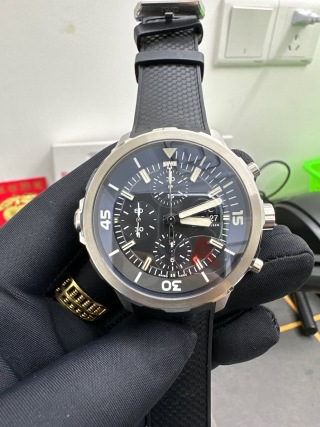
Start with bezel stability. Set the inner ring, then apply light torque to the outer bezel. Watch for drift or delayed engagement. A healthy system holds position.
Next, assess crown threading feel. Tool-watch crowns expose poor machining immediately. Gritty threads or uneven engagement predict future sealing problems.
For chronograph models, perform a reset-to-zero test. Start the chronograph, let it run briefly, then stop and reset. All hands should snap cleanly back to twelve without hesitation. Anything else signals tolerance or spring issues that will only worsen with time.
“Should You Buy It?” Decision Framework (Cold-Series Logic)
Buy Aquatimer if…
Aquatimer makes sense when you want a daily tool watch that does not announce itself as a Rolex alternative. It carries IWC’s restrained design language, and when executed properly it feels purposeful rather than performative. On wrist, a good Aquatimer projects competence, not trend awareness.
It also fits buyers who care more about mechanism feel and case integrity than dial flex. If your satisfaction comes from how the bezel engages, how the crown threads, and how the case sits under movement, Aquatimer rewards that attention. This is a line where tactile feedback matters more than mirror polish, and where ownership value comes from interaction, not validation.
Most importantly, Aquatimer suits people who are comfortable evaluating watches as systems. You are buying torque transfer, sealing discipline, and structural balance as much as you are buying design. If that framing feels natural, Aquatimer can be quietly satisfying in a way few replicas manage.
Skip Aquatimer if…
Aquatimer is a poor match if you obsess over ultra-thin wear — even the best executions carry real case height, and as the case mass versus wrist dynamics analysis in the how good are IWC Top Gun Pilots’ Chronograph replicas with respect to real-world thickness and wear feedback illustrates, no amount of specification reading will change how that mass feels once it is on your wrist; if you expect dress-watch proportions from a diver platform, this series will disappoint.
You should also skip Aquatimer if you are unwilling to gamble on bezel coupling quality. This line exposes mechanical shortcuts faster than almost any other IWC family. Some units feel excellent. Others reveal compromises within minutes. If that variability stresses you, choose something simpler.
Finally, Aquatimer is not for buyers chasing instant recognition. It does not dominate social feeds, and it does not signal status across a room. If your enjoyment depends on external affirmation more than personal satisfaction, Aquatimer will feel invisible.
The “one-watch rule” for Aquatimer
If this is your only IWC replica, choose the simplest Aquatimer architecture you can live with. Fewer complications mean fewer tolerance stacks, and fewer tolerance stacks mean a higher chance of long-term mechanical stability.
If this is your second or third IWC, special editions become rational. At that point you already accept quirks, understand maintenance realities, and can appreciate unusual references like Cousteau for what they are. Aquatimer becomes a character piece instead of a reliability gamble.
QC Checklist (Aquatimer-Specific, Not Generic)
Bezel system checks (non-negotiable)
Rotate the outer bezel through its full range and feel for consistency. Resistance should remain even, without sudden light spots or binding. Any change in torque usually signals uneven coupling or poor internal alignment.
Set the inner ring, then release. It should not jump forward, slide backward, or slowly drift out of position. Stability after setting is more important than how smooth the rotation feels in isolation.
Pay attention to directionality. The system should behave like a safety mechanism. Even if it does not perfectly mimic genuine counterclockwise logic, it should never rotate freely both ways without resistance.
Case/strap checks (tool-watch discipline)
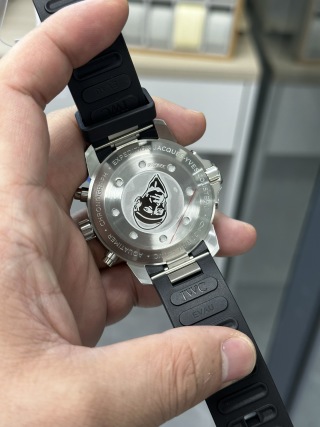
Test strap integration at the lugs. There should be no wobble, clicking, or visible micro-gap when you flex the strap. A tool watch should feel like a single assembled structure, not a case with accessories attached.
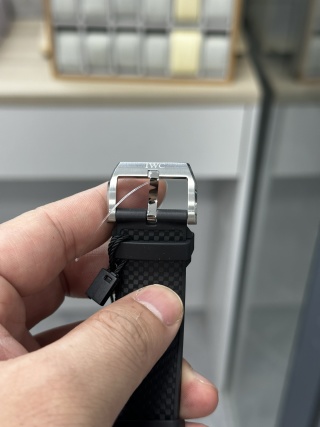
Engage the clasp repeatedly and confirm lock certainty. Half-click closures and ambiguous engagement predict future failures. A diver clasp should close with intention and stay closed under movement.
Run your finger along the underside of the lugs. Sharp edges here ruin long-term comfort and reveal rushed finishing. Good Aquatimers feel rounded where they contact skin, even if the exterior lines remain crisp.
Chronograph checks (only for chrono models)
Start and stop the chronograph several times. Button action should feel smooth and deliberate, not spongy or abrupt. Inconsistent resistance usually means uneven lever engagement inside the movement.
Reset the chronograph and watch the hands. They must snap cleanly back to twelve. Hesitation or partial alignment indicates spring or tolerance issues that tend to worsen with use.
Observe the minute counter during operation. Any stutter or delayed jump suggests poor coupling in the chronograph train and foreshadows reliability problems.
Engineering Summary: The Verdict Sentence
A real Aquatimer is defined by how it behaves, not how it photographs, and if the bezel does not act like a mechanism, the watch is not an Aquatimer at all—just a dial inside a diver case, and whether that difference matters is a decision only you can make.
Related IWC Articles: If you found this helpful, you might also enjoy IWC Replica Watch Price Breakdown: Why the Same Model Can Cost $300 or $1,000 — A Practical Buyer’s Guide, which breaks down why the same IWC replica model can cost $300 or $1000 (a practical buyer’s guide), and V7 Factory IWC Replica Watches: How Close Are They to ZF — and Where Do They Still Fall Short?. Another related article is Beyond the Big Three: APS, YL, and Other Niche IWC Replica Factories Explained.