
Why This Comparison Exists (And Why Most Comparisons Are Useless)
“Which factory is better?” is the wrong question
Factories don’t win globally. They win by model architecture.
That distinction matters more than most people realize. V7 and ZF aren’t competing on a single, unified battlefield. They’re solving different problems, at different speeds, with different priorities. The reason buyers end up cross-shopping V7 versus ZF usually has nothing to do with brand loyalty and everything to do with timing and structure.
V7 tends to surface first on new-release IWC steel sports models. When a fresh case-and-bracelet system drops, especially something modern and integrated, V7 is often the first factory willing to commit tooling resources and ship real inventory.
ZF, on the other hand, dominates mature staples. Once a reference has lived through multiple production cycles, once tolerances have been corrected and small geometry mistakes have been burned out through iteration, ZF usually owns that territory.
So this article doesn’t compare slogans or reputations. It compares systems.
The rule is simple: judge how each factory handles case geometry, bracelet behavior, dial discipline, and movement ownership over time. Marketing claims don’t survive wrist time. Systems do.
Define what “gap” means in wear, not in photos
The real gap between factories doesn’t live in studio photos. It shows up after days and weeks of use.
In practice, that gap is a combination of four things working together.
First is geometry: how the case sits on the wrist, how end links meet the lugs, and whether the bracelet flows naturally or collapses awkwardly at the first joint.
Second is dial discipline. On simple IWCs especially, printing precision and alignment become unforgiving. A slightly drifting minute track or a date window that favors one side turns into a daily annoyance once you start noticing it.
Third is movement behavior. This isn’t about timegrapher screenshots. It’s about winding feel, crown smoothness, chronograph reset confidence, and whether the watch feels mechanically calm or slightly anxious every time you interact with it.
Last is ownership reality. That includes service risk, tolerance drift, and how small imperfections evolve after weeks of opening and closing clasps, setting time, or starting chronographs.
Sample variation is real — two watches from the same factory can behave differently — and as discussed in the analysis of high-end IWC replica production variance and assembly consistency, what matters here is factory tendency, not a single lucky or unlucky unit.
V7 Factory Snapshot: What They’re Optimizing For
V7’s core advantage: speed-to-market on modern IWCs
V7’s defining strength is speed.
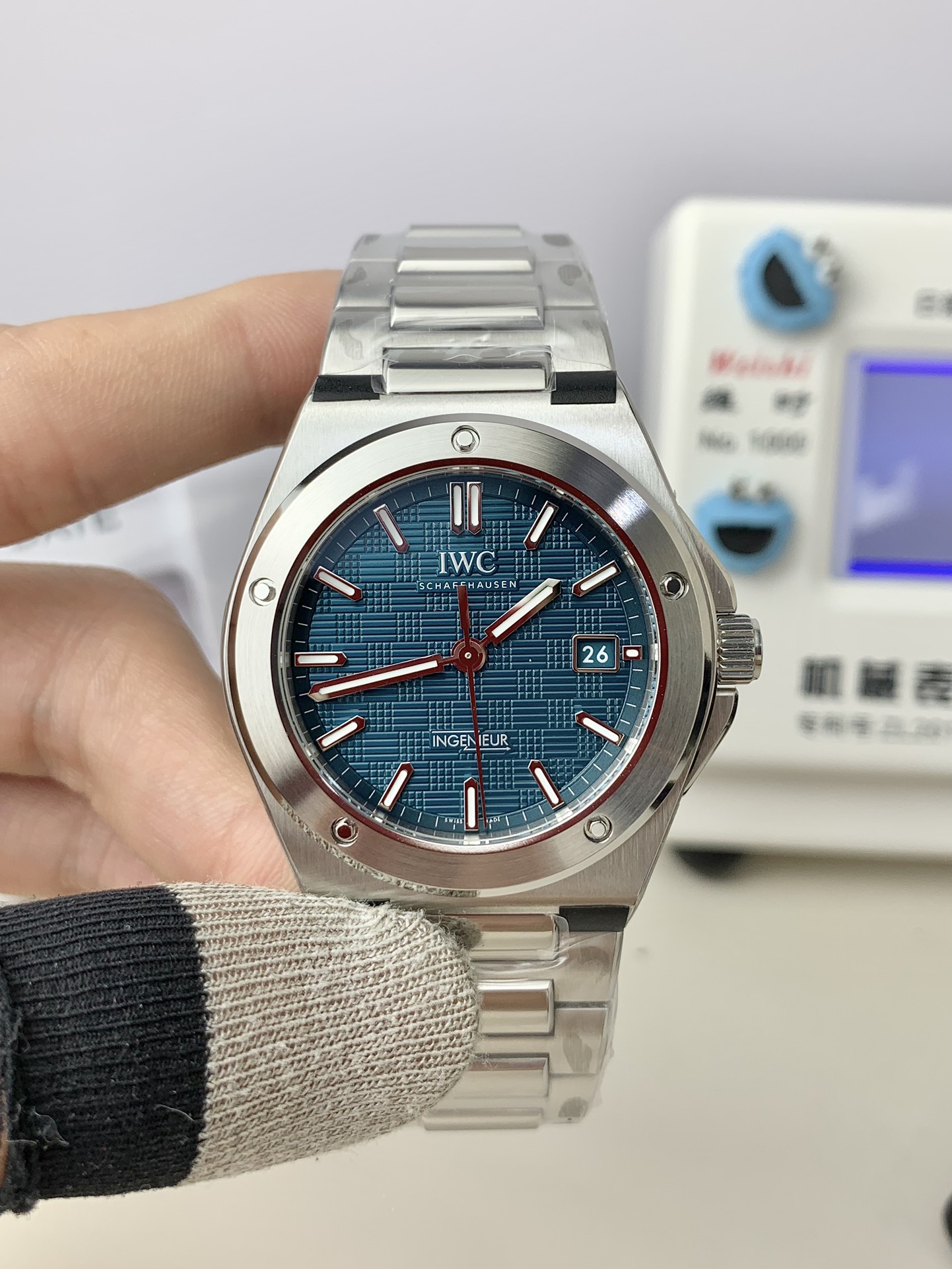
When IWC releases a new steel sports reference, especially one built around a fresh bracelet and case architecture, V7 usually reacts faster than anyone else. Their tooling turnaround for new midcases, integrated bracelets, and clasp systems is aggressive, and that’s why their versions of modern models often appear months before competitors catch up.
You can see this in how quickly they commit to new silhouettes. The factory is willing to take early risks on machining and assembly, even when some tolerances haven’t fully settled yet.
That speed comes with a cost. Early batches sometimes ship before every micro-adjustment has been debugged. You’ll occasionally see minor inconsistencies in bezel seating, bracelet articulation, or dial alignment that later batches quietly improve. V7 plays the early-access game. They accept that first production runs may require tighter QC from the buyer side.
If you chase the newest IWC steel release, V7 is usually your first real option. Just understand what that implies.
V7 builds from the outside in.
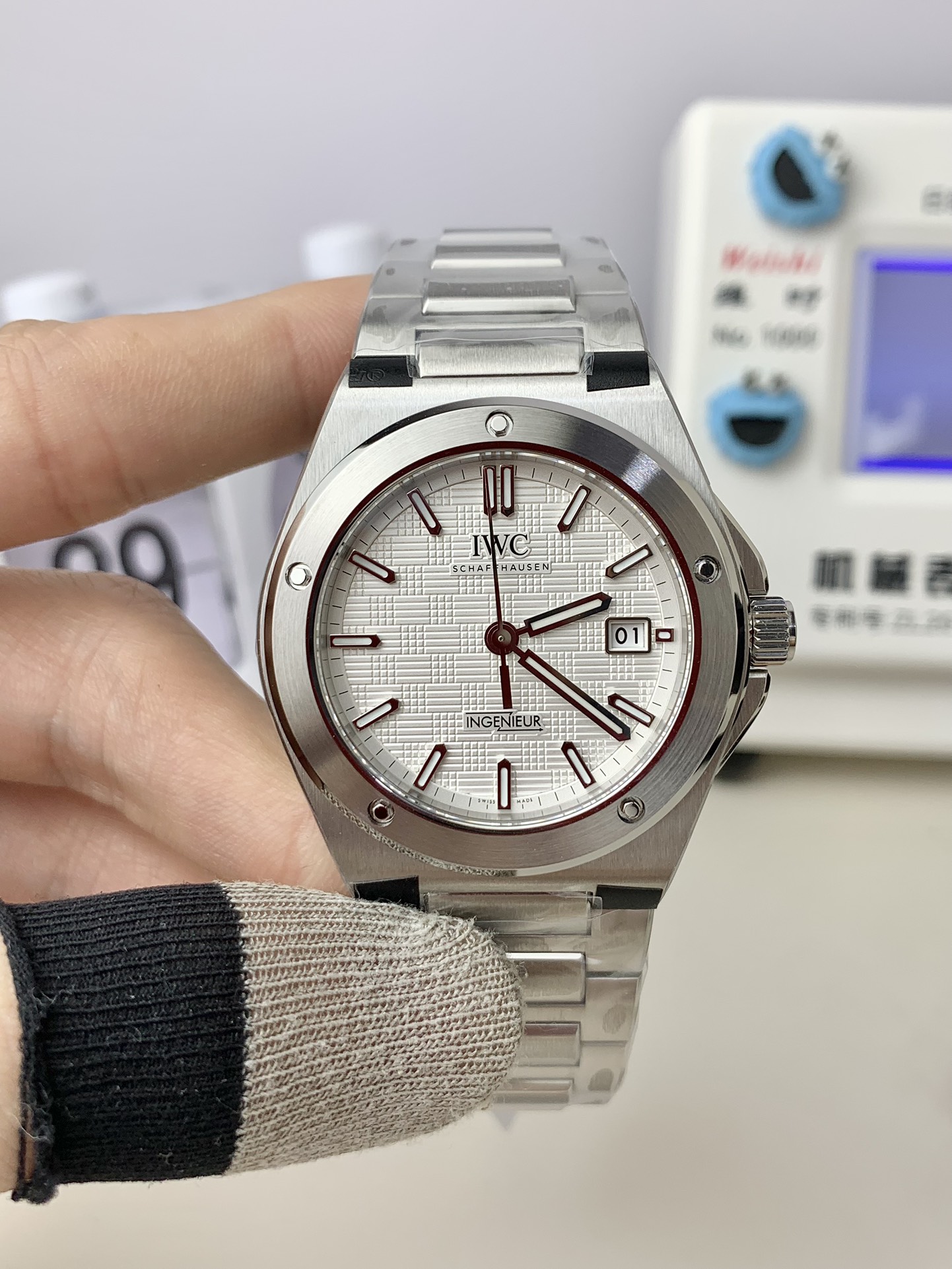
Their priority is how the watch reads on the wrist. Bracelet feel, silhouette accuracy, and overall presence come first. The goal is immediate visual and tactile credibility. When you strap it on, it should feel like the right object.
That approach works beautifully on models where the case-and-bracelet system is the product. Integrated steel watches reward this philosophy because comfort and articulation dominate the experience.
The trade shows up on simpler designs.
On minimal dial layouts, there’s nowhere to hide. If printing is slightly soft, if a minute hand doesn’t land cleanly on markers, or if a date window sits a fraction off-center, those issues become more obvious because everything else is quiet. Outside-in construction delivers strong wrist impact, but it puts enormous pressure on dial execution when the design is restrained.
V7 can absolutely nail these details. They just don’t always lead with them.
Where V7 usually does not focus (so you don’t get surprised)
V7 isn’t trying to own every legacy IWC dress staple.
They’re not built around long, slow refinement cycles on traditional three-handers or established chronographs. That’s not their game. Their strength lives in modern steel, integrated bracelets, and contemporary silhouettes where geometry carries most of the experience.
If you’re shopping classic dress IWCs, expecting V7 to outperform factories that have been iterating the same references for years sets you up for disappointment.
V7 is strongest where the case and bracelet are the watch.
Everything else should be evaluated with that reality in mind.
The Benchmark: What ZF Represents in IWC (So We Compare Fairly)
Why ZF is hard to beat on mature references
ZF’s advantage is not flash. It’s iteration.
On models that sell steadily, ZF keeps refining long after other factories move on. That refinement shows up in small, cumulative ways that only become obvious after you’ve handled multiple batches over time. Dial printing becomes more consistent from run to run. Date windows stop drifting. Hand stack clearance tightens. Crystal behavior under angled light becomes predictable instead of lottery-based.
This is what iteration advantage looks like in real ownership.
You start seeing fewer “tiny tells.” The bevel around the date window stays sharp instead of softening. Minute hands clear applied markers without grazing. Reflections off the crystal behave the same across different units instead of changing batch to batch. None of these details sell watches in photos, but together they determine whether a piece feels settled or improvised.
ZF earns its reputation by staying with a reference long enough to remove these friction points. When a model has lived through several production cycles, ZF’s output usually feels calmer. Less nervous. More repeatable.
That matters if you care about consistency more than novelty.
Where ZF can be less relevant than people assume
ZF is not automatically the best choice on the newest steel sports releases.
Their process favors refinement over speed. That means ZF often arrives later to modern integrated designs, and when they do, it’s usually after they’ve observed how the market reacts to early versions from other factories.
This creates a predictable pattern.
ZF tends to be late but refined.
V7 tends to be early but raw.
Neither approach is universally superior. If you want the latest silhouette immediately, ZF often isn’t your first option. If you want something that has already survived multiple tooling corrections, ZF becomes much harder to beat.
Understanding that difference prevents most buyer regret.
Ingenieur 40 (IW3289): V7’s Flagship Test
Why Ingenieur 40 is a different kind of hard
This is not a dial watch. It’s a bracelet geometry watch.
Most bad Ingenieur replicas fail long before you look at printing. They fail at the first link.
The earliest tell is first-link droop asymmetry. One side collapses more than the other, which exposes incorrect lug curvature and poor tolerances at the end link interface. Once you notice it, you can’t unsee it.
Next comes end-link flushness. Any visible gap between case and bracelet usually means the arc radius is wrong. That gap doesn’t just look off. It changes how the watch wears because pressure concentrates on the wrong part of the wrist.
Then there are bezel screws. On weak builds, screw heads sit at inconsistent depths, slots don’t line up, or recess edges look rough. These aren’t cosmetic issues. They signal sloppy machining upstream.
Finally, brushing quality gives everything away. If the grain direction isn’t consistent across bezel, midcase, and bracelet, the watch starts to look toy-like under natural light. Integrated steel designs are ruthless about this.
You can fake a dial. You can’t fake geometry.
Where V7 genuinely impresses (what to look for)
On Ingenieur 40, V7 gets the hard parts surprisingly right.
Bracelet articulation is the first thing to evaluate. Good V7 samples move smoothly without grit, and the underside edges stay rounded enough that they don’t create pressure hot spots during long wear. If the bracelet feels stiff or scratchy out of the box, that unit is not representative of V7 at its best.
Bezel screws are another strong point when QC is done properly. On solid pieces, slot orientation is consistent, seating depth matches across all five screws, and the recess walls look clean rather than chewed up.
Dial texture also holds up better than expected, and as noted in the comparative IWC replica factory build-quality and dial surface alignment criteria, under angled light the surface stays even and the minute track usually lines up cleanly with applied indices, an alignment that matters more than lume color or logo sharpness on this model.
Clasp behavior is the final check. A proper V7 clasp closes with a decisive click and stays that way. Half-engagement or mushy locking predicts future annoyance.
When these elements come together, the watch reads correctly on wrist in a way that photos rarely capture.
Where ZF would still matter (even if V7 leads the model)
If ZF releases a later Ingenieur batch, the comparison shifts.
ZF tends to excel at finishing continuity. Look at how brushing flows from bezel into midcase and then into the bracelet. On refined ZF builds, that transition feels intentional instead of segmented.
Micro edges matter here too. Subtle chamfers along bracelet links and case shoulders create that quiet “expensive steel” look that integrated watches depend on. V7 often gets close, but ZF usually tightens these edges with more consistency once they commit to a reference.
Here’s the practical rule.
If you’re buying Ingenieur as a daily wearer, choose the version with better bracelet comfort, not the one with better marketing. Wrist feel will dominate your experience long after you stop caring about factory labels.
Ingenieur 40 acceptance checklist (strict, wearable)
Start with end-link flush on both sides. Don’t rely on one flattering angle. Look straight down at the lugs and confirm symmetry.
Then test first-link droop. Hold the watch level and let the bracelet hang. Both sides should sag evenly. Any imbalance signals geometry problems.
Inspect bezel screws for consistency. Depth, slot alignment, and seating should match across all five.
Check dial index alignment against the minute track under magnification or phone zoom. Misalignment here is permanent.
Finally, cycle the clasp at least twenty times. It should feel the same on the twentieth close as it did on the first. Any degradation during this test predicts accelerated wear later.
Pass these steps, and you’re evaluating a real contender rather than a lucky photo sample.
Mark Series (Mark XVIII / Mark XX): Simple Watches Expose Truth
The “simple dial penalty”: why basic models are ruthless
Minimal designs leave no place for mistakes to hide.
On Mark models, everything collapses into alignment. You don’t get visual distractions from complications or textured bezels. What’s left is geometry, printing, and hand placement. That’s why these watches are brutal on factories.
Three tells surface immediately once you start wearing them.
First is minute-hand accuracy. The tip must land cleanly on the markers. Not close. Not most of the time. Every minute, every rotation. If it floats between indices, the watch will feel wrong every time you glance down.
Second is date window centering, and this can’t be judged on a single date. Run through three or four consecutive days. Some builds look fine on “15” and drift on “28.” That pattern predicts tolerance issues in the date ring and will never correct itself.
Third is dial print edge quality. Use phone zoom under angled light. Clean edges look crisp and contained. Weak prints show fuzz, uneven ink density, or tiny breaks in numerals. Once you see it, you’ll see it forever.
These aren’t collector nitpicks. They’re daily-visibility problems.
Where V7 can win (especially on newer references)
When V7 handles the latest Mark reference, their strengths show up in physical presence.
Start with case thickness and under-cuff behavior. V7 tends to prioritize silhouette accuracy, and on newer Marks this often translates into a watch that slips under sleeves naturally instead of catching fabric at the bezel edge.
Crystal clarity is the next test. Good V7 samples control reflections well, keeping the dial readable at shallow angles instead of turning into a mirror. This matters more in real light than any lume comparison.
Then evaluate crown thread feel. Set the time a few times. Wind lightly. If the threads feel gritty or uneven, that predicts future wear. Smooth engagement suggests proper tube alignment and cleaner machining.
On fresh references, V7 often gets these tactile elements right before anyone else.
Where ZF often holds the advantage
ZF usually wins on dial discipline once a Mark model becomes a staple.
Their batch stability tends to be stronger. Typography spacing stays consistent. Date windows land more predictably. Minute tracks line up with applied indices more often across multiple units.
If you’re sensitive to micro alignment and font behavior, this matters. ZF’s slower iteration cycle pays off here. They quietly remove small inconsistencies over time, and the result is a calmer-looking watch that doesn’t draw attention to itself.
V7 may deliver the newest version first. ZF often delivers the most settled one later.
Mark acceptance checklist (pass/fail style)
Start at 12:00. The minute hand must point exactly at the marker.
Move to the date. Check bevel sharpness, font weight, and centering across at least three dates.
Inspect dial printing under zoom, and as outlined in the IWC replica factory identification and defect symptom taxonomy, no bleed, no uneven spacing, no soft edges.
Finish with the crown. Threads should engage smoothly with no grinding. Anything else signals future irritation.
Pass all four, and you’re looking at a wearable Mark. Miss any, and the simplicity of the design will magnify the flaw every day.
Classic Portugieser / Big Pilot: Why V7 vs ZF Isn’t Always the Right Fight
The trap: comparing a “legacy staple factory” to a “new model factory”
These families reward patience, not speed.
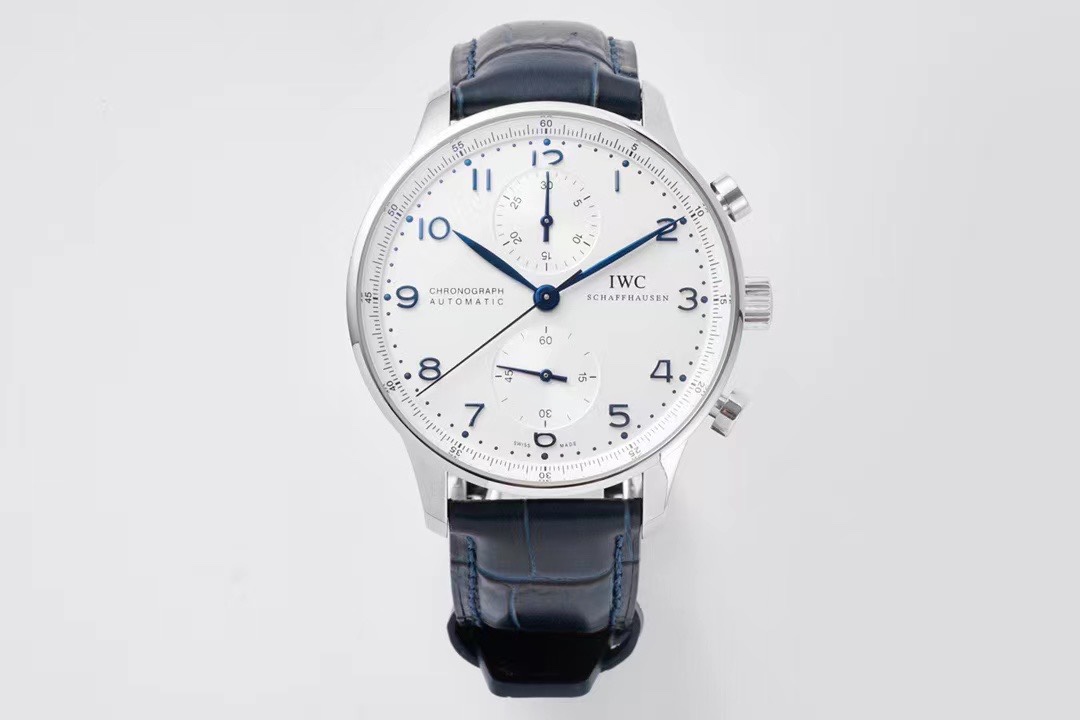
Portugieser and Big Pilot references live or die by long iteration cycles. Case thickness management, power-reserve stability, and chronograph reset behavior don’t improve overnight. They improve after repeated production runs and accumulated corrections.
If V7 offers these models, the comparison shouldn’t revolve around factory reputation. It should focus on system behavior.
Look at thickness first. Does the case sit correctly, or does it feel top-heavy?
If it’s a long-reserve model, observe power behavior over several days. Stable output matters more than advertised duration.
If it’s a chronograph, reset alignment becomes non-negotiable. Hands must snap back to zero cleanly and stay there.
These watches expose mechanical discipline more than design ambition.
How to compare without brand bias
Use system-level scoring instead of factory loyalty.
Weight dial discipline at forty percent. That includes printing, hand alignment, and date execution.
Give thirty percent to case geometry and finishing. This is where comfort, visual proportion, and brushing continuity live.
Reserve the final thirty percent for movement behavior. Winding feel, reset confidence, and setting smoothness decide whether ownership stays enjoyable.
Then judge the actual sample in front of you.
If V7 delivers the better piece that day, take it. If ZF does, don’t hesitate. Factory labels don’t guarantee outcomes. Wrist-level execution does.
The Real-World Gap: What You Notice After 30 Days (Not Day 1)
Bracelet comfort drift (Ingenieur-style watches)
Day one tells you almost nothing. Day thirty tells you everything.
Better builds keep their articulation smooth as the bracelet breaks in. Weaker builds start to reveal themselves through small, accumulating annoyances. Clasps develop micro looseness. Individual links begin to squeak when your wrist flexes. Sharp edges that felt tolerable at first slowly turn into pressure points.
This is where integrated steel watches separate themselves.
A properly finished bracelet will move quietly and evenly, distributing weight across the wrist. A weaker one concentrates load on one or two contact points. You don’t notice that in the mirror. You notice it after a full workday.
There’s a simple test that exposes this quickly. Wear the watch for eight continuous hours, then run a finger along your wrist bone and the underside of the bracelet. If you feel localized soreness or heat spots, that geometry problem will not improve with time.
Comfort drift is not cosmetic. It’s structural.
Crown and setting feel (daily interaction tells)
Crown behavior predicts long-term ownership more accurately than most people expect.
Proper crown tube alignment produces smooth, consistent threads. You feel a clean engagement every time you screw down or set the time. That sensation usually stays stable for years.
Gritty threads tell a different story. They point to imperfect tube alignment or rough internal machining. At first it’s just tactile noise. Months later it becomes resistance. Eventually it becomes wear.
If the crown doesn’t feel right on day one, it will feel worse on day ninety.
This applies equally to V7 and ZF. Factory reputation doesn’t override mechanical reality.
Chronograph ownership reality (if your V7 reference is a chrono)
Chronographs age faster than simple three-hand watches.
What drift looks like in real life is subtle at first. Reset hands stop landing perfectly at zero. Pushers lose their original firmness and start to feel inconsistent from press to press. You begin compensating subconsciously, pressing harder on one side than the other.
These are not failures. They’re normal outcomes of complexity.
Here’s the practical rule: if you won’t service the watch, avoid high-complexity chronographs and, as detailed in the comparative IWC replica factory architecture and maintainability guidance, choose simpler architectures where daily interaction doesn’t slowly erode precision.
Chronos reward attention. If you won’t give it, they punish neglect.
Value Logic: When V7 Is the Smarter Buy Even If ZF Is “Better”
Buy V7 if…
You’re chasing the newest steel sports release, especially integrated-bracelet designs.
You care more about bracelet comfort and silhouette accuracy than microscopic printing perfection.
You accept early-batch risk and are willing to screen QC more carefully.
V7 makes sense when immediacy and physical presence matter more than long-term iteration polish. If you’re comfortable acting as your own quality gate, V7 often delivers the most compelling modern wrist experience first.
Buy ZF if…
You want a mature staple with a proven iteration history.
You’re sensitive to dial printing consistency and date window execution.
You want a lower probability of one small tell undermining the illusion after weeks of wear.
ZF shines when you prefer stability over novelty. Their strength is not excitement. It’s repeatability.
The “one-watch rule”
If this is your only IWC replica, choose the lowest-complexity architecture with the strongest batch stability.
That usually means simple three-hand or well-established models from whichever factory has spent the longest refining that reference.
It’s not glamorous. It’s durable.
V7 vs ZF: The IWC Truth Table (Model Family → Winner → Risk → Who It Fits)
| Model family | What the watch demands | V7 advantage | ZF advantage | Most common QC failures | Best buyer profile |
|---|---|---|---|---|---|
| Ingenieur 40 | Bracelet geometry, case integration | Faster access to new releases, strong articulation feel | Later batches refine brushing continuity and micro edges | End-link gaps, bezel screw depth, clasp inconsistency | Daily-wear steel sports buyers who prioritize comfort |
| Mark Series | Dial discipline, hand alignment | Early access to newest references, good case thickness control | More consistent typography and date alignment on staples | Minute hand misalignment, date drift across numerals | Minimalist wearers who notice small visual errors |
| Portugieser | Thickness control, movement stability | Occasionally faster to market on updates | Long-term iteration on classics, calmer dials | Power reserve inconsistency, hand clearance | Dress-watch buyers who value refinement over novelty |
| Big Pilot | Case proportion, long-reserve behavior | Rarely the lead | Deep experience with legacy builds | Crown feel, PR linkage looseness | Tool-watch fans who accept size and complexity |
Use this table as orientation, not instruction. Individual samples still matter more than factory averages.
FAQ
Is V7 actually “top tier” for IWC, or just hype?
V7 is top tier where modern case-and-bracelet systems define the watch. On newer steel sports models, their execution often leads. On legacy references, they are competitive but not dominant.
On Ingenieur 40, what are the 3 easiest tells?
First-link droop symmetry, end-link flushness against the case, and bezel screw seating depth. If any of these fail, the watch will never feel settled.
For Mark models, why does date centering matter more than lume?
Because you see the date every day in daylight. Lume matters for minutes at night. Date alignment shapes your daily visual experience.
If I already trust ZF, when should I still consider V7?
When you want the newest steel release immediately and you’re willing to QC aggressively. V7 often delivers modern references months earlier.
What QC photos should I demand for V7 Ingenieur?
Straight-on end-link shots from both sides, bezel screw close-ups, dial alignment under angled light, and clasp engagement photos after repeated open-close cycles.
Does price difference reflect real build differences?
Sometimes. Often it reflects timing, demand, and risk tolerance more than objective quality. Pay attention to structure, not just cost.
A good V7 can outperform an average ZF, and a refined ZF can feel more complete than an early V7—but as captured in the comparative IWC replica factory performance and wear-quality synthesis, the watch that earns daily trust is the one whose geometry, dial discipline, and movement behavior align with how you actually wear it.
Related IWC Articles: If you found this helpful, you might also enjoy IWC Replica Watch Buying Guide : A Beginner’s Guide to Super Clone IWC, which is a beginner’s guide to purchasing a high-quality IWC super clone watch, and 2026 IWC Replica Factory Ranking: ZF, V7, and MKS — A System-Based Evaluation, Not a Popularity Contest. Another related article is Top 5 Best IWC Replica Watches: Super Clone Models Ranked & Explained, which ranks the top 5 best IWC replica watches available.