
Why “Swiss Version” Sounds Convincing to New Buyers
The psychological shortcut: Switzerland = quality
Most first-time buyers arrive with a simple mental chain: Swiss origin means luxury, luxury implies craftsmanship, and craftsmanship suggests legitimacy. That association did not come from the replica world. It comes from decades of exposure to genuine manufacturers like IWC Schaffhausen, whose real products are designed, engineered, regulated, and priced inside Switzerland’s formal watchmaking system.
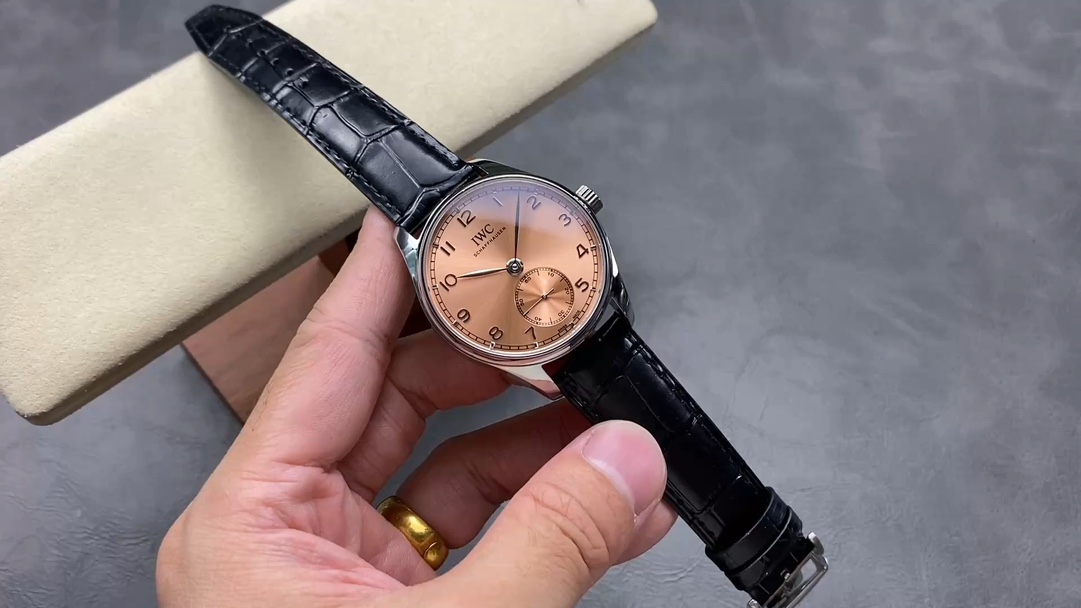
The problem begins when that reputation gets borrowed.
Once you already believe that “Swiss” equals quality, it feels natural to assume that a “Swiss version” replica must sit on a higher tier than everything else. New buyers often don’t stop to ask what part is Swiss, who built it, or how that claim could exist inside the realities of counterfeit production. They accept the label as shorthand for excellence, even though no such manufacturing category exists in replicas.
That shortcut is understandable. It’s also exactly what makes the term effective.
How sellers weaponize that association
In practice, “Swiss version” almost always appears alongside the same set of behaviors.
Prices suddenly double compared to visually identical watches. Descriptions lean on vague phrases like “Swiss assembly” or “Swiss components” without naming any factory or process. Movement photos appear, often blurry or generic, presented as proof of origin even though movements and complete watches are two entirely different things.
None of this represents a recognized production class. It’s marketing language, not manufacturing classification.
What’s being sold here is borrowed prestige. The word “Swiss” carries emotional authority, so it becomes a convenient justification for inflated pricing. The watch itself usually remains unchanged. Same case supplier. Same dial printer. Same assembly line. Only the story shifts.
Once you start asking for concrete identifiers—factory lineage, batch references, repeatability data—the “Swiss version” narrative tends to collapse quickly.
The Physical Reality: Where IWC Replicas Are Actually Produced
Replica watches follow industrial clustering, not brand heritage
Replica watches are built inside manufacturing ecosystems, not national legends.
They depend on tight geographic clustering of very specific resources: CNC case machining, bezel finishing, dial printing, handset stamping, lume application, bracelet fabrication, and low-cost assembly labor. These processes require rapid iteration. Tolerances get adjusted across batches. Parts are swapped, re-cut, or re-plated when something doesn’t align. That only works when suppliers sit within short transport distance of one another and when labor can flex without formal certification barriers.
That ecosystem does not exist in Switzerland.
Instead, replica production operates inside southern China’s watch supply network, with cities like Guangzhou serving as consolidation hubs. Guangzhou itself is not “a factory.” It functions as a logistics center where components converge, assemblies are coordinated, and finished watches move through distribution channels. Cases may come from one workshop, dials from another, bracelets from a third, and final assembly from yet another. What matters is proximity and speed, not heritage.
Replica manufacturing is industrial and iterative, and as explained in the IWC replica factory identification and production-model comparison, it looks more like electronics supply chains than traditional Swiss horology.
Why Switzerland cannot be a replica production base (practically or legally)
Even before legality enters the picture, the economics alone make the idea impossible.
Swiss watchmaking wages exceed the retail price of most replicas. A single trained technician in Switzerland costs more per day than an entire replica watch sells for. That gap cannot be bridged with efficiency or volume.
Tooling is the second barrier. Replica molds, CNC programs, and tolerance-tuned case sets live inside Chinese supplier networks. They are revised constantly based on feedback from assembly lines. Those assets are not mirrored in Switzerland, and recreating them there would require rebuilding the entire supply ecosystem from scratch at many times the cost.
Then there is legal exposure. Producing counterfeit branded watches inside Switzerland would trigger immediate enforcement. Switzerland actively protects its domestic watch industry. There is no gray zone here. A “Swiss replica factory” would not survive long enough to ship its first batch.
Put plainly: the labor costs don’t work, the tooling isn’t there, and the legal environment would shut it down instantly. Even if someone wanted to try, the numbers fail before the first case is cut.
That is why every serious replica originates inside the same manufacturing regions, regardless of how it is marketed afterward.
Switzerland supplies reputation. China supplies production. Confusing the two is how the “Swiss version” myth keeps circulating.
What Sellers Usually Mean When They Say “Swiss Version”
This is where most confusion lives, because the phrase sounds technical while hiding a very small set of repeatable behaviors. In practice, “Swiss version” almost never describes a production method. It describes a pricing strategy.
Scenario 1: Swiss movement + Chinese assembly
The most charitable interpretation of “Swiss version” is that a standard Swiss automatic movement—typically from ETA SA or Sellita Watch Co.—has been installed into an otherwise unchanged replica.
That does not make the watch Swiss-made.
The case is still cut in the same CNC shops. The dial still comes from the same printers. The hands, crystal, bezel, crown, bracelet, and clasp all originate from the same component suppliers. Final assembly still happens on the same benches, by the same technicians, using the same tolerances. Only the movement changes.
What you actually gain is a more expensive caliber with familiar Swiss finishing and, in many cases, slightly smoother winding feel. What you do not gain is any improvement in case geometry, dial printing, marker alignment, bezel execution, or bracelet articulation. Those elements define how a watch looks and wears. They remain exactly where they were before.
The tradeoff is simple. You pay more for the movement, and nothing else moves forward.
For some owners, that makes sense. They value known Swiss calibers for service familiarity or personal peace of mind. But it is critical to understand what you are buying. You are not upgrading the watch. You are swapping the engine while leaving the chassis untouched.
Scenario 2: “Swiss-grade” parts (a meaningless phrase)
“Swiss-grade” sounds official. It is not.
There is no regulated category called Swiss-grade in replicas. No standards body defines it. No factory certifies it. No supplier issues documentation for it. The phrase survives entirely because it feels technical while remaining unverifiable.
When pressed, sellers usually point to one of three things.
Sometimes it means slightly brighter lume, often from the same supplier that already provides lume to higher-tier batches. Sometimes it means a marginally nicer strap, usually still produced in the same leather workshops. Sometimes it means nothing at all.
What it never means is that parts suddenly originate from Switzerland.
Cases are not Swiss-grade. Dials are not Swiss-grade. Hands are not Swiss-grade. These components are produced inside the same regional supply chains regardless of how they are labeled afterward. The term exists to create separation between identical watches so one can be priced higher.
If you cannot trace a concrete change in manufacturing—new case tooling, revised dial plates, different bracelet construction—then “Swiss-grade” is just a story attached to the same object.
Scenario 3: Pure fiction
The final category is the most common.
Some listings simply invent “Swiss version” to justify charging two or three times more for a watch that already exists in standard form. There is no factory name. No batch reference. No production documentation. No verifiable trail from component to assembly.
Instead, you get emotional language, urgency cues, and selective photos that show only what cannot be checked.
This is not ambiguity. It is fabrication.
Once you ask for repeatable identifiers—factory lineage, revision history, QC patterns across multiple units—the narrative usually evaporates. What remains is a regular replica being sold under borrowed prestige.
Why a Real “Swiss Replica Factory” Cannot Exist
Tooling and iteration reality
Replica development lives on iteration.
Cases go through multiple mold revisions before lug curvature feels right. Bezels get recut when tolerances drift. Dial printing plates are adjusted when numerals bleed. Test batches surface problems that only appear after assembly. Then the cycle repeats.
That process requires cheap CNC access, flexible labor, and suppliers close enough that parts can be modified and returned within days, not weeks. It also requires tolerance for failed runs and discarded components, because refinement costs material.
This is why replica production clusters geographically. Everything depends on proximity and speed.
Switzerland offers none of those conditions.
CNC time is expensive, labor is highly regulated, and as explained in the comparative IWC replica factory economic-model and tooling-supply analysis, supplier density for replica-specific components does not exist; the economic structure is built for certified luxury manufacturing, not rapid, disposable iteration, and even ignoring legality the operating model collapses under its own cost.
Replica watches are refined through repetition. Switzerland is optimized for permanence.
Movement integration vs full manufacturing
Even when a Swiss movement appears inside a replica, integration happens elsewhere.
This distinction matters.
Movement origin describes where the caliber was produced. Watch origin describes where the case was machined, the dial printed, the hands mounted, the crystal fitted, the bracelet sized, and the final assembly completed. Those processes define the physical object on your wrist.
In replicas, that work does not occur in Switzerland.
A Swiss movement can arrive as a component, just like a sapphire crystal or a gasket. Once it enters the replica supply chain, it becomes one part among many. The watch itself still comes together inside the same manufacturing ecosystem as every other high-end replica.
Understanding that difference—movement origin versus watch origin—eliminates most “Swiss version” claims on the spot. You can change an engine without changing a factory. That is exactly what happens here.
How the “Swiss Version” Scam Is Usually Structured
Step-by-step pattern
Once you’ve seen a few of these transactions up close, the structure becomes predictable.
It starts with artificial tiering. A seller presents a “standard version,” then introduces a “Swiss version” as a premium upgrade, even when both watches come from the same assembly batch. The visual differences are usually nonexistent, but the price jump is immediate.
Next comes a movement photo. Sometimes it’s real. Often it’s a stock image pulled from elsewhere. Either way, it’s framed as proof of origin rather than what it actually is: a picture of one component removed from its manufacturing context.
Then scarcity enters the conversation. You’re told supply is limited, that only a few pieces remain, or that this configuration is hard to source. None of this is tied to production records. It exists to shorten your decision window.
Finally, pressure pricing appears. The seller anchors the higher price as “normal” for Swiss, implying that hesitation risks missing out on something rare or superior.
None of these steps establish provenance.
There is no factory trail. No batch identifier. No revision history. No documentation that traces how the watch was built. The entire structure operates on narrative momentum, not manufacturing evidence.
Once you recognize this pattern, it becomes difficult to unsee.
Common red flags in listings
The warning signs tend to cluster.
You won’t see a factory name, because attaching one would allow comparison with known batches. You won’t see a batch reference, because that would invite cross-checking with other buyers. You won’t see any description of QC procedures, because there usually aren’t any beyond basic function checks.
What you do see is emotional language doing the heavy lifting.
Phrases like “top Swiss,” “ultimate edition,” and “1:1 Swiss” replace concrete identifiers. Superlatives stand in for process. Vague prestige replaces traceable production.
When a listing relies entirely on feeling rather than structure, you’re not being shown a better watch. You’re being guided toward a higher price.
What Actually Determines Replica Quality (Instead of Origin Claims)
Once you strip away geography myths, replica quality becomes much easier to evaluate. It lives in execution, not storytelling.
Architecture fit
The first thing that reveals long-term build quality is architecture.
Case geometry determines whether lugs sit naturally on the wrist or flare awkwardly. Bracelet articulation tells you whether links flow with movement or fight it. Thickness control decides whether a watch disappears under a cuff or constantly reminds you it’s there.
These are structural choices made during case machining and bracelet design. They come from tooling accuracy and tolerance discipline. No movement swap changes them. No “Swiss version” label improves them.
If the case profile is wrong, it stays wrong regardless of what beats inside.
Dial discipline
Dial work exposes shortcuts faster than almost any other area.
Sharp printing matters because soft edges turn markers into fuzzy shapes under angled light. Marker alignment matters because even half a millimeter of drift breaks symmetry once you start noticing it. Date window execution matters because sloppy apertures or off-center numerals are visible every single day.
These details come from dial plate machining, print registration, and assembly care. They require consistent supplier output and patient rejection of flawed parts. They do not improve when someone installs a more expensive movement.
You wear the dial. You don’t wear the balance wheel.
Movement behavior
Movement quality does matter, but not in the way “Swiss version” implies.
What shows up in daily ownership is not the country stamped on a caliber. It’s how the watch behaves.
Does winding feel smooth or gritty? Does the chronograph reset cleanly to zero every time, or does it creep off center? Does power reserve decay predictably, or does accuracy collapse on day two?
These behaviors emerge from regulation, lubrication, and assembly care. A Swiss movement can still be poorly integrated. A non-Swiss movement can run beautifully when handled properly. Origin alone tells you very little about how the watch will live on your wrist.
Batch stability
The most overlooked indicator of quality is repeatability.
One good sample proves nothing. Consistency across units tells you everything.
Serious factories show stable results from batch to batch. Dial alignment doesn’t wander. Case finishing stays uniform. Bracelet tolerances don’t fluctuate wildly. QC documentation exists because internal revisions happen, and problems get corrected over time.
This is where experienced buyers focus their attention. Not on flags or country names, but on whether a factory demonstrates learning across production cycles.
A watch that looks great once is luck. A watch that looks great every time reflects process.
When you evaluate replicas through these lenses—architecture, dial discipline, movement behavior, and batch stability—the “Swiss version” label fades into irrelevance. These are the elements that determine ownership satisfaction. They decide whether a watch feels coherent after six months or starts revealing shortcuts after six weeks.
Everything else is just vocabulary.
Why “Swiss Version” Usually Delivers Worse Value
Price inflation without proportional improvement
In real transactions, “Swiss version” almost always means paying significantly more for the same external watch.
The premium typically lands somewhere between fifty and one hundred fifty percent, while the case geometry, dial printing, handset quality, bracelet construction, and overall finishing remain unchanged. Nothing structural improves. Nothing visible advances. The watch on your wrist behaves exactly like the standard batch.
That extra money does not flow back into machining tolerances or dial tooling. It rarely funds tighter QC. In most cases, it stops at the reseller level.
This is why experienced buyers tend to avoid the label altogether. They have already learned that replica pricing only correlates with quality when it reflects concrete manufacturing upgrades. When the justification is geographic language instead of build changes, the value equation collapses.
False confidence replaces real QC
The second cost is subtler.
Once a watch is framed as “Swiss,” buyers often relax. They stop inspecting details they would normally scrutinize. They accept minor misalignment. They overlook uneven printing. They ignore crown feel or date centering because the label implies safety.
That misplaced confidence increases acceptance of flawed watches.
Quality control only works when someone is willing to reject imperfect units. “Swiss version” short-circuits that process by encouraging emotional trust instead of mechanical verification. Over time, this is how mediocre batches get normalized.
A Practical Audit Framework for Buyers
Ask for factory identity, not country
Real suppliers talk about factories.
They can tell you where the case set comes from, which dial batch is being used, and how this revision differs from the previous one, and as outlined in the IWC replica factory identification and lineage-based revision analysis, they reference lineage because production history matters.
Scammers hide behind geography.
If the answer to every question is “Swiss,” but no one can name the factory or explain how this batch evolved, you are not dealing with manufacturing transparency. You are dealing with branding language.
Demand QC evidence, not origin stories
A serious seller can show how the actual watch behaves.
Clear dial photos under angled light reveal print sharpness and marker alignment. Date tests across multiple numbers expose window centering. Chronograph reset videos show whether hands return cleanly to zero. Crown operation clips reveal winding smoothness and thread feel.
These are functional proofs. They reflect assembly quality and regulation effort.
Stories about origin do none of that.
Compare behavior, not branding
At the end of the process, the only thing that matters is how the watch performs in real use.
Judge the object itself. Ignore the labels attached to it.
A well-built replica feels coherent when you wind it, set it, wear it, and live with it. A poorly built one announces its shortcuts within weeks. Marketing language never changes that outcome.
Common Buyer Mistakes That Enable the Scam
Assuming higher price equals higher authenticity
Price does not automatically reflect build quality in replicas.
Sometimes it does, when new tooling or revised architecture genuinely increases production cost. Often it does not. When pricing rises without visible structural change, you are usually paying for narrative, not engineering.
Learning to separate those two saves both money and frustration.
Treating movement origin as total quality
Movements matter, but they are only one system inside a much larger assembly.
Focusing exclusively on where the caliber comes from blinds buyers to case tolerances, dial discipline, and bracelet execution. A familiar movement inside a poorly finished watch still produces a disappointing ownership experience.
Total quality emerges from integration, not from any single component.
Skipping independent verification
Relying solely on seller claims is how most people get trapped.
Independent photos, repeat buyer feedback, and cross-checking batch behavior across multiple examples reveal patterns that single listings hide. Skipping that step leaves you exposed to whatever story happens to be told most convincingly.
FAQ
Are any IWC replicas actually made in Switzerland?
No. Complete replica watches are not manufactured in Switzerland. Even when a Swiss movement is present, the case, dial, hands, bracelet, and final assembly are produced elsewhere.
Does a Swiss movement make a replica “Swiss”?
It does not. A movement is a component. Watch origin is defined by where the full assembly happens. Installing a Swiss caliber changes the engine, not the factory.
Why do sellers insist on the term “Swiss version”?
Because it allows higher pricing without requiring measurable manufacturing upgrades. The word carries inherited prestige, which makes it effective as a sales lever.
Is paying extra for “Swiss” ever worth it?
Only when you specifically want a Swiss movement for service familiarity or personal preference, and you understand that nothing else about the watch improves. If you expect better cases or dials, the premium usually disappoints.
What should I focus on instead?
Focus on case architecture, dial execution, movement behavior, and batch consistency. Those determine how the watch actually wears and ages.
Reframing the Decision: From Country Myths to Build Reality
Learn to evaluate systems, not slogans
Replica quality lives in systems.
It shows up in how the case fits the wrist, how the dial holds alignment under light, how the movement winds and resets, and how consistent results remain across multiple units. These elements form a complete build picture. They tell you far more than any geographic claim ever could.
Once you train your eye on these systems, marketing language loses its grip.
Treat geography as irrelevant in replicas
Country labels do not assemble watches. Processes do.
When you focus on execution instead of mythology, decisions become clearer, expectations become realistic, and ownership becomes more satisfying because, as the Guangzhou IWC replica market structure and engineering-discipline perspective explains, replica quality ultimately comes from engineering discipline and quality control rather than borrowed national prestige.
Related IWC Articles: If you found this helpful, you might also enjoy IWC Replica vs Genuine: How to Spot the Differences (Big Pilot & Portuguese 7 Days), which shows how to spot differences between IWC replica and genuine Big Pilot & Portuguese models, and 7750 vs 2892 Movements: The Real Differences Inside IWC Replica Watches (2026 Guide). Another related article is IWC Super Clone Terminology Explained: Factories, Versions & Movement Codes, which explains IWC super clone jargon (factory versions, movement codes, etc.).