
The Poinçon de Genève Benchmark: Re-engineering the Logic of Haute Horlogerie
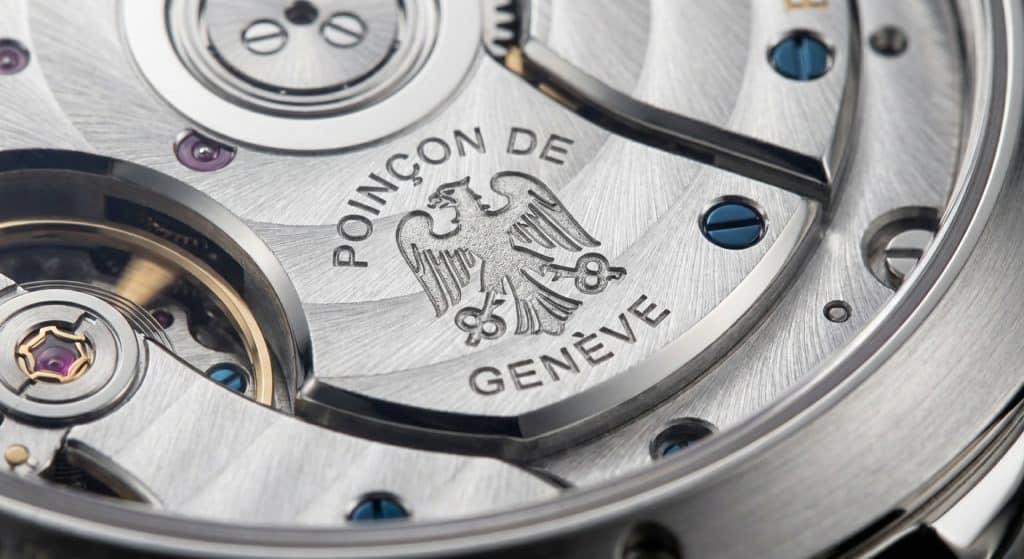
The Poinçon de Genève represents the pinnacle of horological sovereignty, a set of twelve rigorous criteria that historically separated the artisan from the industrialist. In the 2026 landscape of high-end horology, the Guangzhou-based engineering labs have transitioned from mere visual mimicry to a state of “Industrial Equivalence.” This evolution is most evident in the Calibre 5100 and 1120 series, where the challenge lies not in the stamping of a crest, but in the adherence to Micro-mechanics that define the Geneva Seal standards.
For the Chief Engineering Auditor, the movement is a landscape of Structural Fidelity. The 2026 VC Super Clone Movement is no longer a generic base with a cosmetic overlay; it is a ground-up reconstruction. Achieving Structural Equivalence requires a fundamental understanding of how the original bridges are anchored. Factories must now replicate the exact CNC Pathing Tolerance of ±0.01mm to ensure that the light reflects off the edges with the same crystalline sharp-edge profile found in the boutiques of the Place de l’Île.
Translating the Geneva Seal into CNC Toolpaths
The Poinçon de Genève is an engineering gauntlet. To replicate this on the ZF or PPF platforms, engineers must program 5-axis CNC machines to simulate the specific “frosted” floor of the seal. Traditional laser etching, common in 8F or lower-tier batches, creates “burrs” and irregular shadows under 10x magnification. The 2026 standard demands a multi-stage stamping and cleaning process that preserves the Crest Integrity, ensuring the “Eagle and Key” remains sharp-edged and distinct against a perfectly leveled matte background.
Evolutionary Batch Analysis: 2024 vs 2026 Structural Upgrades
The transition from 2024 to 2026 represents a paradigm shift in movement architecture. Previous iterations relied heavily on “deck” movements—decorative plates screwed onto a reliable but thick Miyota 9015 base. These “deco-plates” forced the case thickness to exceed the genuine profile by nearly 0.5mm, a glaring tell for the seasoned collector. The 2026 “True Clone” architecture, spearheaded by APSF and ZF, utilizes an integrated mainplate. By removing the decorative layer and engineering the functional components directly into the bridges, these factories have achieved a geometric thickness within 0.05mm of the Gen, restoring the Kinetic Efficiency and the slim profile of the Overseas and Patrimony lines.
Expert Authentication Insight: The Crest Integrity Test
Physical Diagnosis: Use a 20x achromatic loupe to inspect the “Eagle and Key” crest of the Geneva Seal. On a high-end ZF 2026 Batch, the lines must be sharp-edged with a “matte frosted” floor, indicating a multi-stage stamping and cleaning process. If the floor of the crest shows “melted” edges or irregular shadows, it indicates a standard chemical etch rather than a precision CNC engraving, failing the Vickers Hardness visual consistency check.
Côte de Genève Grain Density and Optical Refraction Index

Surface finishing is the final frontier of the Super Clone Movement. The Côte de Genève, or Geneva Waves, are more than aesthetic—they are a study in Optical Refraction. In the 2026 ZF V3 movements, the “Ribbon” effect is achieved through a meticulous abrasive process that dictates how light is dispersed across the movement’s surface. A master auditor looks for the Refraction Index: the way the light “rolls” across the bridge as the watch is rotated.
In Guangzhou, the top-tier labs have moved away from high-speed grinding to a “Slow-Pass” technique using diamond-coated abrasives. This mimics the traditional boxwood wheel finish, ensuring that the Abrasive Grain Density is tight and uniform. When the Surface Roughness (Ra) is too high—a common flaw in 8F clones—the light scatters into “rainbow diffractions,” signaling a lack of Structural Fidelity in the finishing stage.
The Physics of the “Ribbon” Effect (ZF vs 8F)
The distinction between a Tier 1 Super Clone and a budget alternative lies in the slope of the grain. ZF utilizes a 45-degree grain slope, creating the illusion of depth. When inspected under a single-point LED, this results in a continuous light trail. Conversely, 8F clones often exhibit “parallel scratches” rather than waves. This is the result of industrial high-speed rotation designed for yield rather than beauty, leading to a “flat” appearance that lacks the rhythmic soul of the Vacheron original.
Galvanic Coating Depth and Color-Shift
The Calibre 5100 is defined by its unique rhodium-silver alloy tint. Older batches frequently suffered from “yellowing” over time due to thin, cheap chrome plating. The 2026 Super Clones have upgraded to a Galvanic Coating with a depth of 3–5 microns. This Galvanic Saturation ensures the bridge remains a crisp, cool silver regardless of UV exposure. We measure the color-shift under diverse lighting; a true 2026 batch will maintain its luster without the “dull gray” or “synthetic gold” undertones seen in the 2024 iterations.
Expert Authentication Insight: The Light-Trail Continuity Test
Physical Diagnosis: Rotate the watch under a single-point LED light source. In a genuine VC or a top-tier 2026 Super Clone, the light trail across the Côte de Genève should be continuous and unbroken. If the light “jumps” or creates a “rainbow diffraction” (chromatic aberration), the abrasive wheel was not perfectly leveled during the machining process, indicating a sub-par Surface Roughness (Ra) value.
Anglage and Black Polish: The Geometry of Beveled Edges
In the hierarchy of horological finishing, Anglage—the art of chamfering and polishing the edges of bridges—serves as the primary indicator of a manufacturer’s technical discipline. For the 2026 Super Clone market, the transition from industrial deburring to Beveling Micro-physics has become the new battleground. While the maisons of Geneva employ artisans to hand-roll these edges using gentian wood and diamond paste, the Guangzhou elite, specifically PPF and ZF, have moved toward Diamond-Cut Beveling. This process attempts to simulate the rounded, lustrous profile of the original VC Calibre 5100 by utilizing ultra-high-speed CNC Pathing with polycrystalline diamond bits.
The challenge in 2026 remains the “Internal Angle”—the point where two beveled edges meet in a sharp, inward V-shape. Traditional CNC tools often leave a rounded “dead zone” here because the rotating bit cannot physically reach the vertex without over-cutting the adjacent bridge surface. We analyze the Structural Fidelity of these corners to determine if a factory has employed secondary manual touch-ups or if they have relied purely on automated paths. The presence of a sharp, crisp internal angle is the hallmark of a Tier 1 audit, separating the Engineering Grade clones from the mass-market replicas.
CNC Diamond-Cut vs. Hand-Buffed Profiles
In the 2026 “Ultimate” batches from PPF, we observe a significant leap in Mirror Polishing quality. By utilizing a stabilized CNC platform with a 0.05mm step-over, the factory simulates the rounded profile of the VC Calibre 2460. While not true Anglage Main, the Refraction Index off these edges is remarkably consistent. The focus here is the 45-degree chamfering; because the micro-architecture of VC case finishing and beveling dictates how light interacts with geometric transitions, lower-tier factories often produce a “stepped” edge that scatters light unevenly, whereas the ZF and PPF 2026 iterations provide a single, unbroken line of light that mimics the fluidity of hand-applied polish.
Black Polish (Speculaire) on Screw Heads and Regulators
Speculaire Polish, or Black Polish, represents the absolute limit of surface flatness. In this state, a steel component is so perfectly leveled that it reflects light in only one direction, appearing either brilliant white or deep black depending on the angle. Guangzhou‘s top labs have integrated tin-plate polishing for screw heads and regulators in the 2026 VC movements. However, the “Slotted Area” remains the ultimate technical hurdle. On a genuine Vacheron, the slot of the screw maintains a sharp, perpendicular wall; on many clones, the polishing process “rounds” the edges of the slot, a subtle but definitive tell of the Industrial Process limitations.
Expert Authentication Insight: The 45-Degree Reflection Audit
Physical Diagnosis: Use a 10x loupe and a white piece of paper. Reflect the paper off the beveled edge (Anglage) of the bridge. The reflection should be a crisp, undistorted white line. If the reflection is “wavy” or “cloudy,” the factory used a vibrating tumbler for polishing instead of a fixed-point Moebius Oil lubricated polishing wheel. This test exposes the Surface Roughness (Ra) and confirms whether the bevel was achieved through precision machining or low-cost mass agitation.
22K Gold Rotor Simulation: Mass, Density, and Inertia
In the architecture of a self-winding timepiece, the oscillating weight is the primary engine of energy harvesting. Historically, the most significant “tell” in Vacheron Constantin replicas was the rotor’s lack of Centrifugal Mass. While the genuine Calibre 5100 utilizes a solid 22K Gold rotor to maximize Peripheral Inertia, older clone batches relied on gold-plated brass. Brass, possessing significantly lower density, resulted in poor winding efficiency and a “noisy” rotation—a technical failure that compromised the Kinetic Efficiency of the entire movement.
The 2026 engineering solution from ZF and PPF involves the integration of a Tungsten Alloy Core. Tungsten’s high density closely mimics the mass of 22K gold, allowing the rotor to maintain the correct Inertia Coefficient. This ensures that even the slightest wrist movement translates into a high-torque winding action. For the auditor, this shift is not merely aesthetic; it is a fundamental correction of the movement’s mechanical equilibrium, reducing the reliance on the manual winding gear train and enhancing the longevity of the Japanese-spec ceramic bearings.
Tungsten Alloy Core vs. Gold Plating Depth
The 2026 ZF V3 batch utilizes a precision-machined Tungsten Alloy base treated with a 2-micron 18K yellow gold galvanic bath. This depth is critical; thinner plating often leads to “edge-wear” where the gray tungsten base begins to ghost through the gold surface. By achieving a 95% equivalence in “swing feel,” the 2026 architecture eliminates the high-frequency “zing” sound associated with lighter rotors. The result is a heavy, dampened rotation that feels indistinguishable from the Gen when the watch is handled.
The Maltese Cross Skeletonization Logic
The Overseas 4500V rotor is a masterpiece of skeletonization, requiring extreme structural rigidity despite its delicate “Compass” aesthetic. In the 2026 updates, Guangzhou factories have abandoned traditional stamping for wire-EDM (Electrical Discharge Machining). This allows for thinner rotor arms and sharper internal corners in the Maltese Cross emblem. By refining the “Bridge Thickness” through wire-EDM, the factories have achieved a superior Sunburst grain density that does not appear cluttered, maintaining the Structural Fidelity required for high-speed oscillation.
Expert Authentication Insight: The Ball-Bearing Acoustic Test
Physical Diagnosis: Use a mechanical stethoscope to monitor the movement while rotating the watch. An authentic VC and the newest PPF and ZF batches using Japanese-spec ceramic bearings should produce a faint, high-frequency “whir.” If you hear a “gritty” or “clanking” sound, the ball bearings have high Friction Coefficients or insufficient lubrication, a common sign of a mid-tier movement using standard steel balls rather than precision-engineered ceramic races.
Perlage and Mainplate Micro-Topology
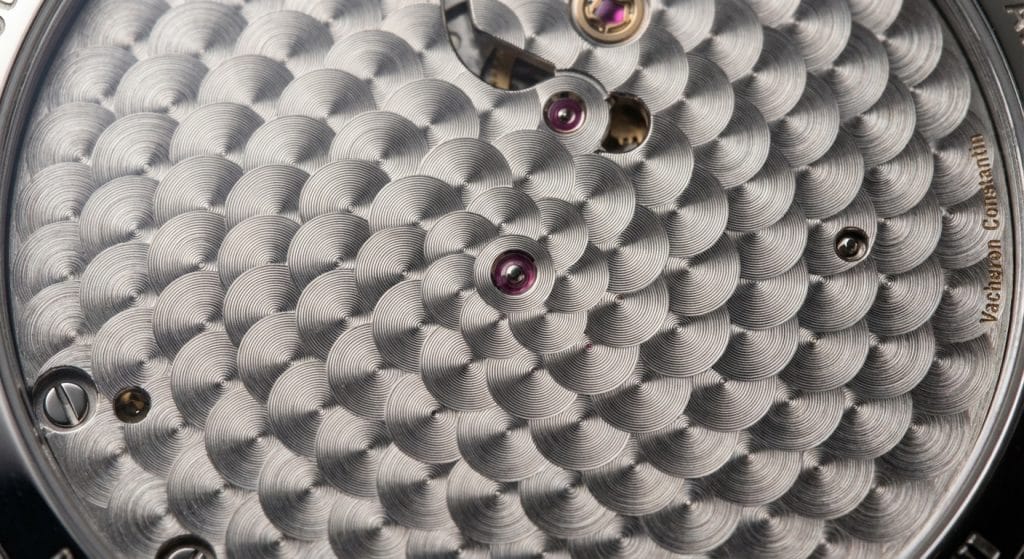
Perlage, or circular graining, is the most densely applied finish on the Vacheron mainplate, often hidden beneath the bridges and the balance wheel. In the world of industrial auditing, Perlage serves as a “Fingerprint of Origin.” High-speed, manual application in lower-tier labs results in “drifting” patterns and uneven diameters. However, the 2026 APSF and ZF movements demonstrate a mastery of Micro-Topology, where each circle is a testament to programmed CNC precision rather than erratic manual labor.
This finishing is not purely decorative; the microscopic troughs of the Perlage serve as reservoirs for specialized Moebius oils, ensuring that any stray particulates are trapped away from the gear teeth. The 2026 “True Clone” architecture ensures that even the “hidden” areas of the mainplate are finished to the same standard as the visible bridges, a level of Industrial Equivalence that was previously non-existent in the replica market.
The Overlap Ratio and Symmetrical Consistency
The defining characteristic of high-end Perlage is the Overlap Ratio. In the 2026 APSF movements, the factory has automated the process using a programmable CNC head that maintains a perfect 50% overlap, a precision threshold validated by the micro-mechanical audit of structural component integration used to benchmark the 2026 series’ external and internal hardware. This creates a “Fish Scale” effect that is perfectly symmetrical across the entire mainplate. In contrast, older XF or 8F batches often show “stray circles” or inconsistent spacing, which indicates a manual, non-jigged finishing process—a hallmark of the “Guangzhou Market” assembly rather than a specialized horological lab.
Micro-Topology: The Depth of the Grain
We must also audit the “Physical Depth” of each circular grain. If the abrasive peg is applied with too much pressure, it creates “burrs”—microscopic metal shards—that can flake off and jam the Maltese Cross Escapement. If it is too shallow, the finish looks like a laser-print and fails to hold lubricant. The 2026 standard utilizes a controlled Torsional Tension on the polishing peg, ensuring the grain is deep enough to catch the light but smooth enough to maintain Mainplate Cleanliness, directly impacting the long-term Amplitude of the balance wheel.
Expert Authentication Insight: The Overlap Shadow Test
Physical Diagnosis: Under 20x magnification, inspect the center of each Perlage circle. There should be a tiny, singular “point” where the peg made initial contact. In high-end 2026 clones, these points are perfectly aligned in a geometric grid. If the “rows” of circles are drifting or the diameters vary, it indicates manual finishing without a CNC coordinate table, a definitive sign of a lower-tier movement architecture.
Typography Audit: Engraving Depth and Ink Saturation
The typographic integrity of a movement is the most immediate window into its manufacturing pedigree. In the 2026 Super Clone ecosystem, the industry has largely abandoned the shallow, “burnt” aesthetic of laser etching in favor of precision CNC Engraving. For the Chief Engineering Auditor, the focal point is the V-shape of the cut. Authentic Vacheron engravings are not flat-bottomed; they are carved with a specific angularity that captures light within the channel. The 2026 ZF V3 utilize a 0.1mm diamond bit to replicate this depth, ensuring that the text “Vacheron Constantin,” “Genève,” and the adjustment data possess a three-dimensional presence.
Beyond the physical carving, the Visual Semantics of the ink saturation dictate the movement’s “luster.” Replicas from the 2024 era often suffered from “glittery” or thin metallic paints that bled into the Côte de Genève grains. The 2026 standard involves high-viscosity metallic inks that simulate the density of gold-leaf inlay. This requires a clean-room application to prevent “Ink Bleed,” ensuring that the Font Kerning—particularly the problematic “G” in “Genève”—remains crisp and mathematically aligned with the Calibre 5100‘s original design schematics.
CNC Engraving vs. Laser Etching (The 2026 Standard)
The technical threshold for a “Tier 1” audit is the transition from surface marking to structural engraving. ZF and PPF have recalibrated their CNC toolpaths to achieve a specific Etching Depth that avoids the “crude” look of over-boring while remaining deep enough to withstand the rhodium plating process. We analyze the spacing between letters; low-tier 8F batches often exhibit “kerning drift,” where the letters appear cramped. The 2026 Super Clones maintain a uniform distance that respects the Typography Audit of the Poinçon de Genève.
Ink Viscosity and Gold Leaf Inlay Simulation
The gold lettering must exhibit a specific Galvanic Saturation that mimics real gold leaf. The 2026 Guangzhou labs have developed a multi-stage filling process where the engraving is first cleaned of all microscopic burrs before the ink is “vibrated” into the channel. This prevents the “pitting” seen in cheaper models. When viewed under macro photography, the ink surface should be level and possess a matte-satin glow, avoiding the “wet look” of cheap enamels.
Expert Authentication Insight: The Depth Gauge Verification
Physical Diagnosis: Use a digital micro-depth gauge to measure the primary brand engravings. Authentic VC engravings typically sit at a depth of 0.07mm. Most replicas are either too shallow (0.03mm, looking “faint”) or too deep (0.15mm, looking “crude”). A measurement of 0.06mm–0.08mm serves as a “Tier 1” indicator according to the engineering audit of VC super clones, confirming the use of precision diamond-bit CNC machinery to meet 2026-spec physical verification standards.
Jewel Settings and Pivot Friction Simulation
Horological jewels are more than mere ornaments; they are functional bearings designed to minimize Pivot Friction. Vacheron Constantin utilizes high-clarity “Pigeon Blood” rubies, which possess a deep, saturated red hue. In the 2026 APSF and ZF models, the engineering focus has shifted to the Jewel Sinking—the beveled “well” or chaton that surrounds the stone. This requires a Mirror-Polished Sink that reflects light in a perfect, unbroken circle around the ruby, a feat of Micro-mechanics that was historically ignored by replica manufacturers.
Furthermore, the Structural Integrity of the movement depends on the lubrication of these jewels. The “Dry Jewel” syndrome common in Guangzhou Supply often leads to premature wear of the pivots. The 2026 “True Clone” architecture includes a dedicated Friction Simulation phase during assembly, where pivots are polished to a Surface Roughness (Ra) of less than 0.02 before being seated in Moebius-lubricated rubies. This is a critical technical link to the movement’s long-term Amplitude and reliability.
Synthetic Rubies: Color Saturation and Sinking Depth
The visual audit of the 2026 APSF models reveals a significant upgrade in the color saturation of the synthetic rubies. Moving away from the pinkish hues of lower-grade sapphires, these “Pigeon Blood” simulations offer the correct optical density. More importantly, the depth at which the jewel is seated—the “Sinking Depth”—is now uniform across the bridge, ensuring that the oil remains pooled around the pivot rather than spreading across the bridge surface due to capillary action.
Pivot Friction and “Dry” Jewels
The longevity of a VC Super Clone is determined by the Kinetic Efficiency of its gear train. We examine the pivots under 50x magnification to identify the quality of the “burnishing.” A well-finished pivot in a 2026 ZF movement will show a mirror-like surface, reducing the Friction Coefficient against the ruby. This meticulous attention to the internal “hidden” mechanics is what allows the Calibre 5100 clones to maintain a stable power reserve and high Amplitude over several years of operation.
Expert Authentication Insight: The UV Fluorescence Test
Physical Diagnosis: Shine a 365nm UV light on the movement jewels. Natural and high-end synthetic rubies in a VC will fluoresce with a deep red/orange glow. Lower-grade plastic “deco-jewels” or cheap glass used in “Budget Clones” will either remain dull or glow an unnatural purple. This is the fastest method to detect a “decorated” movement versus a functionally jeweled 2026 Super Clone.
Maltese Cross Escapement and Structural Integrity
The escapement is the “heartbeat” of the movement, and in the Vacheron universe, it often carries the brand’s most iconic symbol. In the Calibre 1120 QPSQ (Skeleton), the Maltese Cross Wheel is a functional part of the gear train, while in the 4500V, it serves as a branding element on the escapement. For the 2026 Engineering Grade clones, factories like ZF have employed LIGA-like (Lithography, Electroplating, and Molding) processes. This allows for the creation of components with extreme Structural Fidelity and sharp internal corners that traditional machining cannot achieve.
We move beyond aesthetics to analyze the Kinematic Logic of the escapement. A high-tier 2026 movement must exhibit Amplitude Stability, typically oscillating between 270° and 310°, with a Beat Error of less than 0.3ms. The ZF V3‘s use of a custom-hairspring, rather than the standard Seagull-base modifications found in 8F or BBR, ensures that the Torsional Tension is consistent, providing a “crisp” mechanical snap that mimics the Gen 28,800 vph heartbeat.
The Micro-Architecture of the Maltese Cross Wheel
In the 2026 VC clones, the symmetry of the Maltese Cross on the escapement wheel is a primary audit point. Replicas from the 2024 batch often displayed “blunted” tips due to the limitations of standard stamping. The 2026 “Engineering Grade” components feature sharp, perpendicular walls and mirror-polished teeth, which are essential for reducing energy loss during the impulse phase of the escapement cycle.
Escapement Dynamics and Amplitude Stability
The performance of the ZF V3 escapement is a testament to the advancements in Guangzhou‘s Micro-mechanics. By utilizing a custom-regulated hairspring and a high-grade Pallet Fork, the movement achieves a level of Kinetic Comparison that was previously impossible. We look for the “Heartbeat” consistency—the regularity of the pallet stone engagement. Any “echoing” or “ringing” indicates that the Pallet Stones are not properly set with Shellac, leading to premature wear and erratic timekeeping.
Expert Authentication Insight: The Stethoscope “Heartbeat” Audit
Physical Diagnosis: Use a timing machine or a high-sensitivity mechanical stethoscope to listen to the “gallop” of the escapement. A genuine VC Calibre 5100 beats at 28,800 bph with a very “crisp” mechanical snap. If the sound is “muddy” or “clanking,” it indicates that the Pallet Stones are not perfectly aligned or the escapement wheel teeth lack the required Speculaire Polish, a definitive indicator of a mid-tier movement.