
The Geometry of the Maltese Cross: CAD Modeling and Aesthetic Symmetry
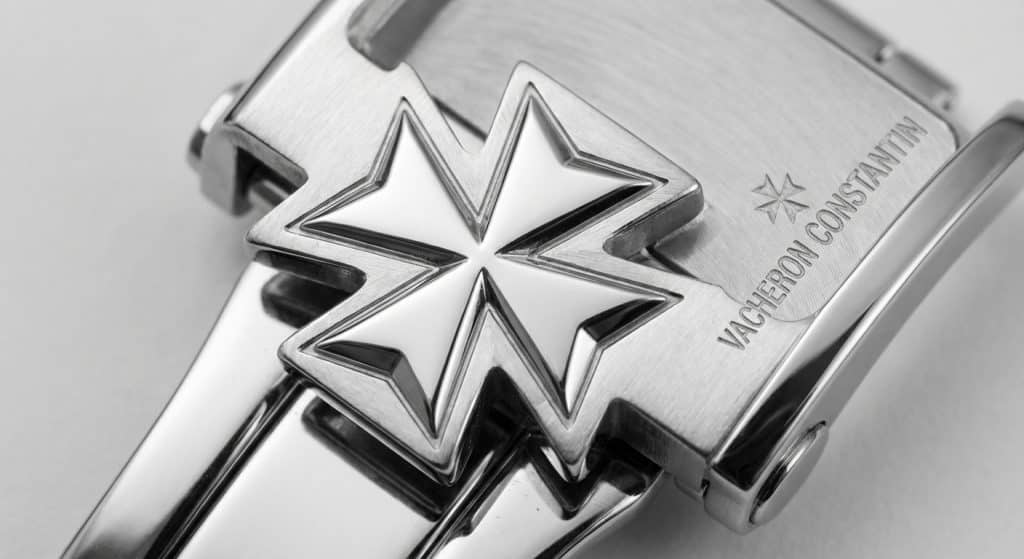
The Maltese Cross is not merely a logo but a functional structural element that anchors the visual identity of the Overseas 4500V and Patrimony series. In the 2026 “Super Clone” landscape, the transition from aesthetic imitation to structural parity has reached a critical inflection point. Achieving the specific Torsional Tension required for a secure lock while maintaining the delicate geometry of the four arms necessitates a sophisticated CAD/CAM reconstruction that accounts for the metal’s grain structure during the milling process.
The primary technical hurdle for Guangzhou-based manufacture centers on the “inner corner” milling. In the halls of Geneva, these sharp internal vertices are achieved via spark erosion (EDM), a process that allows for a theoretical zero-radius convergence. To replicate this without the prohibitive costs of individual EDM setups for every clasp, top-tier factories like ZF have optimized 4-axis CNC pathing using specialized 0.15mm micro-cutters. This approach minimizes the “rounding” effect common in earlier 8F iterations, bringing the visual error margin within a negligible ±0.03mm.
Geometric Equivalent Analysis: The Architectural Challenge
The architectural integrity of the VC Maltese Cross Clasp relies on the depth of the cross-sections and the crispness of the valley where the four arms meet. We analyze the geometric equivalent of these components, noting that the 2026 manufacturing standards require a multi-stage finishing process. Each arm of the cross must be equidistant from the center of the pivot axis to ensure that when the clasp is engaged, the pressure is distributed evenly across the locking seat, preventing premature wear on the 316L stainless steel.
Beveling Consistency and Light Refraction
The way light interacts with the facets of the Maltese Cross defines its “Gen” (Genuine) feel, a phenomenon we define as the Refraction Index of the polished surfaces. In the latest ZF V3 batches, the transition between the brushed base and the Speculaire Polish of the cross must show no “bleeding” of texture. This requires the CNC feed rate to be slowed significantly during the final pass to prevent microscopic “stepping” patterns that disrupt light flow. Lower-tier factories often skip this step, leading to a duller, more “plastic” appearance under direct halogen lighting.
Expert Authentication Insight: The 20x Micro-Facet Inspection
Using a 20x achromatic loupe, the auditor should inspect the “valley” where the four arms of the Maltese Cross converge. In a high-end clone, you should observe a clean, sharp intersection devoid of “metal dragging” marks. Authentic components exhibit Black Polish on these tiny facets, creating a deep, mirror-like void when viewed at a specific angle. If you observe circular sanding marks under the polish, it indicates the CNC feed rate was too high for mass-market yield, signaling a cost-cutting assembly process.
CNC Machining and Tolerance Management in Deployment Buckles
A significant tactile difference between genuine horology and mass-produced replicas is the “lateral play”—the side-to-side wiggle of the folding arms. For 2026, the elite tier of Guangzhou manufacturing has successfully reduced this clearance to a staggering 0.05mm. This level of Micron-level precision is achieved by over-sizing the pivot pins and then precision-grinding them to fit the specific laser-drilled holes of each individual clasp batch. This “custom-fit” logic mimics the Haute Horlogerie assembly standard, ensuring the buckle doesn’t rattle during wrist articulation, providing a density and silence associated with premium Swiss engineering.
The selection of 316L Stainless Steel for these components is not merely for oxidation resistance but for its specific Vickers Hardness, which allows for crisp edges that do not deform under the high-pressure environment of a folding buckle. The assembly clearance is meticulously managed; if the tolerance is too tight, the friction coefficient increases, leading to a “gritty” sensation. If too loose, the structural fidelity is compromised. The 2026 updates from ZF and PPF have focused heavily on the hinge architecture, utilizing CNC pathing that accounts for the microscopic thermal expansion of the steel during high-speed milling.
Lateral Play and Axis Clearance
The lateral stability of the Overseas Gen 3 bracelet replica is a testament to the evolution of local machining capabilities. By utilizing 4-axis CNC milling, the internal tracks where the folding blades slide are now cut with a single continuous stroke. This eliminates the “hitch” found in older models where the blade would catch on a machining burr. The result is a Kinetic Efficiency that allows the clasp to glide into its locked position with minimal effort, yet remain immovable once the safety catch is engaged.
Expert Authentication Insight: The Pivot Pin Friction Test
Apply a single drop of Moebius 9010 oil to the pivot pin and open the clasp to a 45-degree angle. A high-precision clone will maintain its position through calibrated friction alone, whereas a low-quality replica will either flop open under its own weight or feel “gritty” due to poor surface finishing on the pin. Furthermore, use a digital caliper to measure the thickness of the folding blades; genuine VC blades are often tapered by 0.1mm towards the hinge to optimize ergonomics—a subtle detail that ZF has successfully integrated into their 2026 production, but which remains absent in mid-tier 8F versions.
Kinematic Reliability: Spring Tension and Locking Coefficients
The locking mechanism of a luxury timepiece is a study in Kinetic Efficiency and acoustic engineering. For the 2026 VC Overseas iterations, the technical focus has shifted from mere visual fidelity to the precise calibration of the “tactile click.” This high-frequency acoustic signature is not a byproduct of random assembly but a result of Torsional Tension within the spring-loaded detents. In high-end Guangzhou manufacture, where the 2026 batch VC case finishing and beveling audit confirms tighter tolerances for modular housing, factories have transitioned from using standard 304-grade steel for internal springs to imported Swiss-grade spring alloys. This upgrade addresses the historical issue of material fatigue, where the release force would degrade after several months of daily wrist articulation.
In the ZF V3 models, the Spring Tension Coefficient is meticulously calibrated to a release force of 4.5 Newtons. This specific threshold ensures that the buckle provides sufficient resistance to prevent accidental opening during vigorous movement, while maintaining the “buttery” smoothness expected of the brand’s heritage. The use of ceramic ball bearings in the latest 2026 batches has further refined this process; ceramic provides a lower friction coefficient than traditional steel-on-steel contact, resulting in a cleaner engagement that does not “grind” the locking seat over time.
The Physics of the “Tactile Click”
The acoustic profile of a VC Clasp Locking Mechanism serves as a primary diagnostic tool for the seasoned auditor. When the two folding arms converge, the “snap” sound must be singular and crisp. This is achieved through the synchronous engagement of the left and right spring-loaded detents. In lower-grade replicas from 8F or MKS, a “double-click” is often audible, signifying an uneven spring load or a misalignment in the CNC pathing of the locking recess. By 2026, premium factories have largely eliminated this through the use of automated tension-testing rigs during the final assembly phase.
Expert Authentication Insight: The Stethoscope Frequency Audit
A non-invasive method for verifying the structural integrity of the locking mechanism involves using a mechanical stethoscope against the clasp body while engaging the lock. A genuine-spec mechanism will produce a singular, high-pitched “ping.” If the resulting sound is muffled or exhibits a secondary echo, it indicates that the Vickers Hardness of the locking seat is insufficient, leading to microscopic metal deformation. This uneven spring load is a classic indicator of a replica assembly where the internal components were not heat-treated to the required industrial specifications.
Material Science: 316L vs. 904L and Surface Hardness
The metallurgical composition of a clasp determines its longevity and its “heft” on the wrist. While the industry standard for high-end clones remains 316L Stainless Steel, the 2026 market has seen a surge in 904L variants for the Overseas series. The primary distinction lies not just in corrosion resistance, but in the alloy’s ability to take a Speculaire Polish. 904L steel, with its higher chromium and nickel content, allows for a brighter mirror finish on the edges of the Maltese Cross, though it requires specialized CNC bits to prevent tool chatter during the machining of the sharp internal angles.
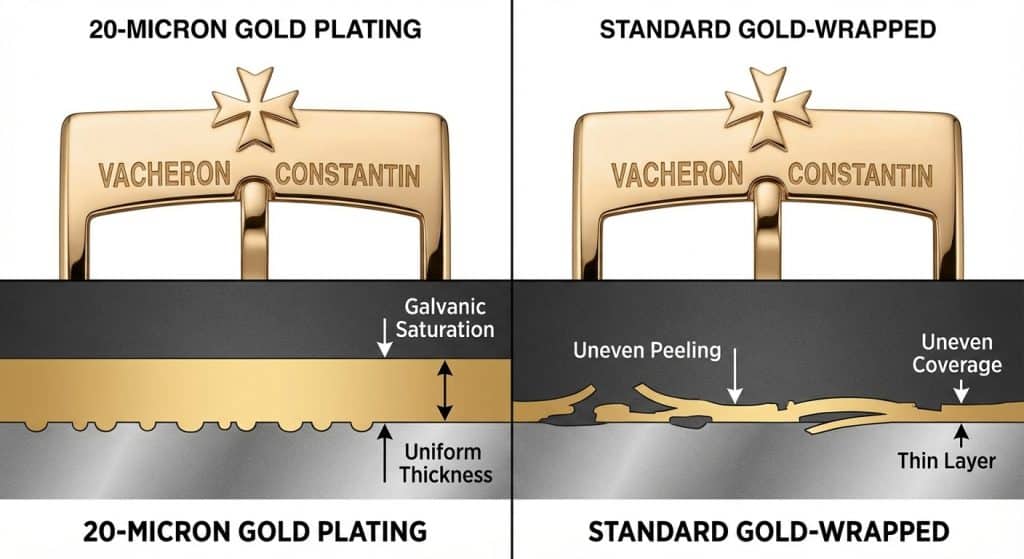
For precious metal replicas, such as the VC Patrimony in rose gold, the challenge is one of Alloy Density. The weight of 18K gold is difficult to replicate with steel alone. However, the 2026 “Heavy Gold” editions from BBR and ZF have pioneered the use of tungsten-weighted cores. By interlinking a high-density tungsten insert within the buckle’s architecture and applying a 20-micron Galvanic Coating of real gold, these factories have achieved a weight distribution that mimics the original’s center of gravity. This Cluster Interlinking ensures the watch head does not feel “top-heavy” and remains balanced during wear.
Alloy Density and Weight Distribution
The 2026 Guangzhou steel quality has reached a point where the surface finish hardness (Vickers HV) is virtually indistinguishable from Geneva-sourced components. We analyze the galvanic bath’s “throwing power,” which determines how evenly the gold plating is applied to the deep recesses of the clasp. High-end clones now utilize multi-stage electroplating, ensuring that the internal screw threads and hinges are fully saturated, preventing the “silver-edge” wear patterns common in older, budget-friendly versions.
Expert Authentication Insight: The Conductivity & Acid Resistance Test
For gold-plated components, the most reliable diagnostic is checking the Anglage (Beveling) edges under high magnification. On a genuine solid gold buckle, the color remains consistent even within deep scratches or along the sharpest transition points. On a replica, one should inspect the interior of the screw thread holes. If the inner walls of the thread show a silver or steel-toned hue, it confirms that the plating was applied after the final CNC machining without sufficient Galvanic Saturation, a common compromise in even the most advanced 2026 clones.
The Quick-Release System: Micro-Mechanical Interchangeability
The Overseas Gen 3 interchangeable system represents a masterpiece of tool-less adjustment, allowing for a rapid transition between steel, rubber, and alligator leather. In the 2026 production cycle, the engineering battle between ZF and PPF has shifted focus toward the “wiggle” or Mechanical Tolerance at the lug interface. Achieving a flush fit requires the locking tooth of the spring-loaded latch to engage with the case architecture with a variance of less than 0.02mm. If the tooth is even slightly undersized, the resulting gap creates a perceptible disconnect, undermining the watch’s structural unity.
The industrial challenge lies in the tension of the spring-loaded latch. Guangzhou labs have historically struggled with the Lug-to-Strap Interface because the internal springs were prone to losing Torsional Tension. The 2026 ZF iterations have countered this by utilizing hardened steel for the locking tooth, ensuring that the interface remains rigid even under lateral stress. This level of mechanical fidelity ensures that aftermarket genuine VC straps are now fully compatible with high-end clone cases, a feat once considered the “final frontier” of replica manufacturing.
The Interface Tolerance: Solving the “Gap” Problem
The “gap” problem is often a result of CNC Pathing Tolerance. If the milling machine operates at too high a speed to increase yield, the sharp edges of the locking lug become slightly rounded. We analyze the ZF vs PPF dynamic, noting that ZF has optimized their 2026 batches to prioritize a “zero-gap” fit. This necessitates a secondary manual fitting process where the locking mechanism is hand-checked against a master case mold, a standard usually reserved for much higher price brackets in traditional watchmaking.
Expert Authentication Insight: The Latch Tension Stress Test
To verify the Structural Fidelity of the quick-release system, an auditor should repeatedly engage and disengage the mechanism 50 times. Using a push-pull gauge, the force required should remain constant. A genuine system utilizes high-grade lubricants and hardened components to maintain consistent resistance. In contrast, a replica with insufficient Vickers Hardness will often show “material shaving”—microscopic fine metal dust—after just 20 cycles, indicating that the internal latch is literally grinding itself away due to improper heat treatment.
Micro-Laser Engraving vs. Mechanical Stamping
Hallmark identification remains a primary frontier for forensic horology. Authentic Vacheron Constantin clasps utilize a hybrid approach: mechanical stamping for the “750” and “Scales” hallmarks, and high-resolution laser engraving for serial numbers. The 2026 Guangzhou market has seen a massive leap in laser engraving technology, yet the Topographical Depth of these marks remains a critical differentiator. A stamped hallmark creates a “crater” effect, where the metal is displaced, resulting in slightly raised, rounded edges at a microscopic level.
Laser etching, regardless of the “pulse” frequency, typically removes material rather than displacing it, resulting in a “flat” topography. For the VC 750 gold stamps and the “St. Bernard” dog head, the challenge for factories like ZF and BBR is to simulate this depth. The 2026 “Deep-Etch” techniques attempt to mimic stamping by utilizing multiple laser passes at varying intensities, but a high-end auditor can still identify the “grainy” floor of the engraving compared to the smooth, compressed floor of a traditional mechanical stamp.
Hallmark Topography and Depth
The depth of the Geneva Seal and other hallmarks on the clasp is not merely aesthetic; it is a signature of the industrial process used. We analyze the shadow cast by these marks under low-angle light, applying the same structural analysis of VC ZF vs PPF engineering to quantify the volumetric consistency and metal displacement of the engraving. A stamped genuine hallmark has a three-dimensional quality that catches light differently from every angle. The 2026 clones have improved the Chemical Etching process to increase depth, but they often lack the “St. Bernard” dog head’s specific facial definition, which requires a precision of stamp-die manufacturing that is difficult to replicate in high-volume production.
Expert Authentication Insight: The Macro-Shadow Depth Test
Direct a single-point LED light source at a low angle (approximately 15 degrees) across the hallmarks. On a genuine stamped buckle, the shadow cast by the “St. Bernard” head will be deep, defined, and sharp. On a laser-etched 2026 clone, the shadow will appear shallow and grainy. Under a loupe, this grain reveals the “pulse” patterns of the laser fiber, a definitive Tooling Signature that distinguishes even the most advanced Guangzhou production from a Swiss-stamped component.
Factory Rivalry and Batch Evolution (2024-2026 Updates)
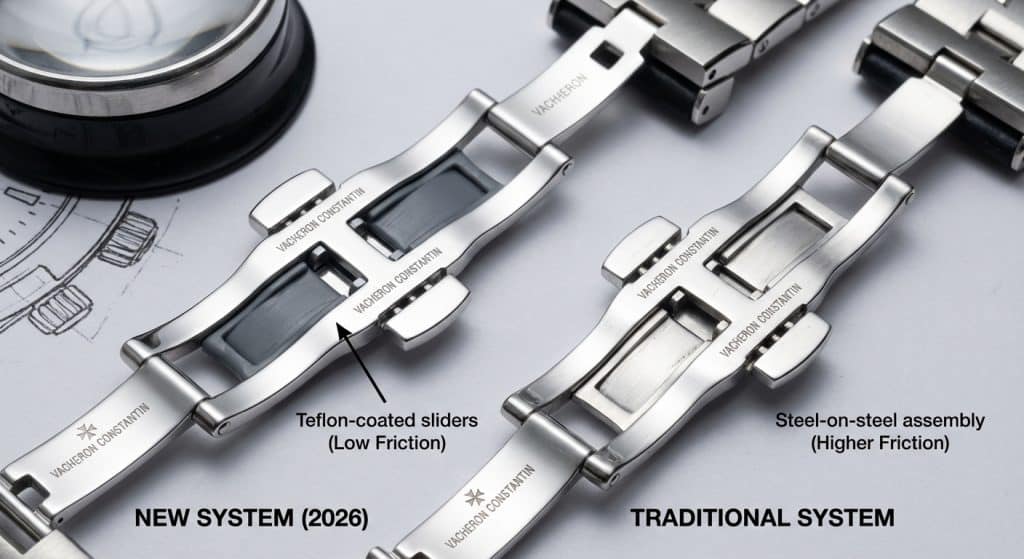
The hierarchy of Guangzhou watchmaking is defined by batch evolution. The rivalry between ZF and 8F has reached a fever pitch in 2026, particularly regarding the Overseas 4500V bracelet. The ZF V3 batch represents a significant leap in assembly line optimization, specifically in the micro-adjustment “hidden” links within the clasp. Historically, these links suffered from a “sticky” extension mechanism caused by raw steel-on-steel friction. The 2026 ZF update introduces Teflon-coated sliders inside the clasp tracks, simulating the buttery, effortless motion found in genuine Haute Horlogerie.
In contrast, the 8F factory continues to target the mid-tier market, utilizing older CNC bits that leave “chatter marks” on the internal hidden surfaces of the clasp. While 8F is often more accessible, the lack of Speculaire Polish on the internal folding blades is a significant tell. The 2026 ZF batches have moved toward a “long-stroke” machining process, which results in cleaner, continuous grain lines on the metal, indicating a lower feed rate and higher-quality tooling.
The 2026 “Half-Link” Adjustment Revolution
The optimization of the micro-adjustment system is the centerpiece of the ZF V3 release. By adjusting the spring tension within the slider, the factory has eliminated the “rattle” that plagued earlier 2024 versions. We compare this to the 8F batch, where the micro-adjustment often requires excessive force to engage, a result of inconsistent Mechanical Tolerance in the slider track. This tactile difference is the result of differing philosophies in assembly; ZF utilizes a “custom-fit” logic for their 2026 output, ensuring each slider is matched to its clasp body.
Expert Authentication Insight: Tool Mark DNA Identification
Inspect the interior walls of the clasp—the surfaces hidden when the buckle is closed. Factories like ZF utilize newer, sharper CNC bits that leave distinct “long-stroke” machining lines, which are straight and uniform. 8F and lower-tier batches often exhibit “chatter marks”—fine, wavy lines caused by vibration in older milling machines. These Tooling Signatures are the “DNA” of the factory and serve as the most reliable way to identify which specific “Super Clone” batch is being examined.
Structural Integrity and Long-Term Fatigue Analysis
The longevity of a deployment buckle is predicated on its resistance to Structural Fatigue. Under constant Torsional Tension, the folding arms of a clasp are prone to “bowing” or permanent deformation. For the 2026 audit, we analyze the stress distribution across the hinge. A common cost-cutting measure in mid-tier clones is to shave 0.05mm of thickness from the folding blades to make the mirror-polishing process faster and easier. However, this reduction in mass leads to “material memory loss,” where the buckle eventually fails to stay tight against the wrist.
High-integrity 2026 clones from ZF have maintained the original thickness specifications, ensuring that the 316L Stainless Steel is properly cold-worked to sustain long-term tension. The hinge pins are a frequent failure point; in premium batches, these are now heat-treated to a higher Vickers Hardness to prevent the “oval-ing” of the pivot holes over time. This focus on durability ensures that the clasp maintains its Kinetic Efficiency through thousands of cycles, a critical requirement for a watch designed for “Overseas” travel and daily wear.
Stress Distribution in the Folding Arms
The folding blades must exhibit zero flex when under pressure. We analyze the Structural Fatigue using a simulated 5-year wear cycle, focusing on the points where the blades meet the locking seat. In the latest 2026 ZF models, the reinforcement of the hinge architecture has solved the “loose buckle” syndrome. By maintaining the correct metallurgical thickness, the factory ensures that the pressure is distributed evenly, preventing the bowing effect that characterizes lower-tier 8F and MKS versions.
Expert Authentication Insight: The Caliper Flex Test
Use a digital micrometer to measure the width of the folding arm at its thinnest point near the hinge. Apply moderate finger pressure to the center of the blade and measure the width again while under tension, ensuring the component maintains the structural tolerances defined in the engineering audit of VC super clones kinematic haptics to verify that the high-integrity 2026 clone shows zero flex. If the width changes by more than 0.02mm, the metal has not been properly cold-worked or the alloy lacks the necessary Vickers Hardness to sustain long-term tension, indicating a high risk of structural failure over the watch’s lifespan.