
A right-handed watch enthusiast, accustomed to the familiar bite of a crown digging into their wrist, might eye a Luminor Destro with a specific curiosity. Could this “left-handed” configuration truly be the ergonomic revelation they’ve been seeking? The initial relief of a crown-free 3 o’clock might be palpable, but as with any unconventional design, new, unexpected quirks can quickly emerge. This tension—between promised ergonomic salvation and the reality of daily wear—forms the core of understanding Panerai’s Destro models. Is it a genuine functional improvement for a niche wearer, or primarily a distinctive aesthetic choice that appeals to collectors, influencing the Panerai limited edition value?
The Destro Philosophy: Unpacking Panerai’s Left-Handed Legacy
The Luminor Destro configuration, with its crown and iconic crown guard positioned at 9 o’clock, is more than just a stylistic inversion. It represents a deliberate design choice rooted in historical context and specific ergonomic considerations. Moving beyond the simple “left-handed” label, understanding its origins reveals a pragmatic approach to addressing real-world operational challenges.
Historical Roots: Combat Diver Origins and Practicality
Panerai’s early military contracts for the Italian Navy’s frogmen unit demanded watches that could withstand extreme conditions and integrate seamlessly with specialized combat gear. The Destro crown placement directly addressed issues such as the crown interfering with other equipment worn on the wrist or forearm, or impeding the natural movement of a combat diver’s hand during critical operations. This design provided an unimpeded range of motion for the primary hand, preventing accidental crown manipulation or discomfort while wearing heavy gloves or diving suits. It was a functional adaptation born from necessity, not mere aesthetic preference.
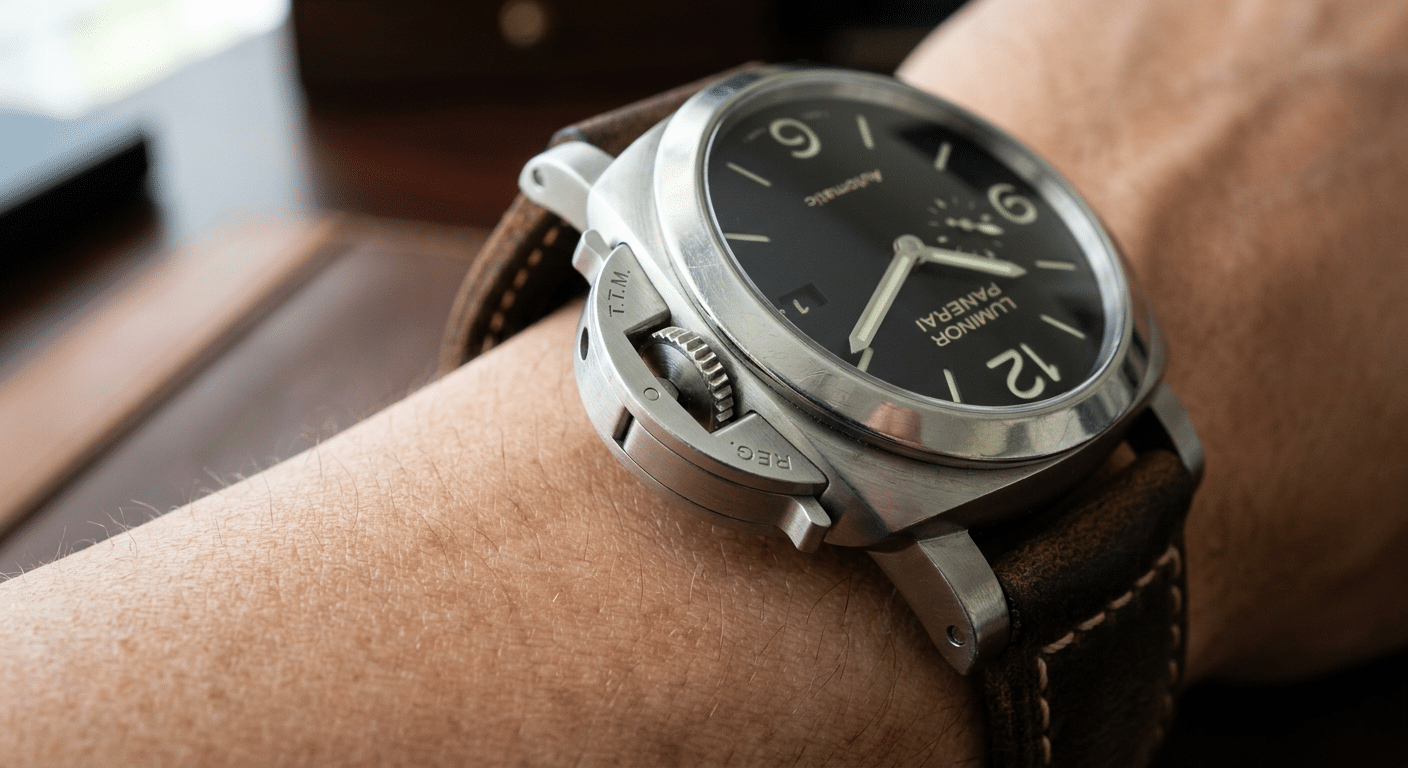
Crown Guard Ergonomics: Right-Wrist Freedom vs. Left-Handed Access
The Luminor’s distinctive crown guard, while offering superior protection against impacts and water ingress, can create pressure points on the wrist, particularly for those wearing the watch on their right arm. By repositioning this entire assembly to the left side of the case (the 9 o’clock position), the Destro design aims to alleviate this common discomfort. However, this shift inherently alters the winding and setting experience; what feels natural for a right-handed person manipulating a crown at 3 o’clock with their left hand becomes a different, less intuitive motion when the crown is at 9 o’clock for the same dominant hand. It’s a trade-off, solving one specific ergonomic problem while introducing a new interaction dynamic.
Brand Identity and Niche Appeal: The Collector’s Lure
Beyond its functional origins, the Destro configuration has evolved into a significant pillar of Panerai’s brand identity, cultivating a distinct niche appeal among collectors. Models like the PAM219 or later PAM1157, often produced in smaller batches or as special editions, carry an inherent sense of exclusivity. This rarity and the unconventional aesthetic attract collectors who value unique configurations and historical nods, sometimes prioritizing these aspects over the watch’s practical ergonomic benefits. The Destro becomes a statement piece, a conversation starter, and a testament to Panerai’s willingness to deviate from watchmaking norms, further cementing its status as a collector’s item.
Expert Authentication Insight
Verifying the authenticity and specific edition of a Destro model often begins with a meticulous examination of its caseback engravings. A genuine Panerai will feature crisp, deeply etched details including the specific OP reference number, the production year, and the precise model number—for instance, “PAM00219” for the specific Destro reference. These details should precisely match known Panerai production records for Destro models. Any discrepancies in font, depth, or numbering could indicate a counterfeit or a modified watch, making this physical diagnostic an essential first step for any serious acquisition.
Wearability in Practice: Right-Wrist Comfort & Crown Interference
The theoretical benefits of the Luminor Destro’s design are often highlighted, but its real-world wearability, particularly for those who choose to wear it on their right wrist, presents a more nuanced picture. Critically evaluating its tangible ergonomic advantages and potential drawbacks in daily activities is crucial for an informed decision.
Mitigating “Crown Dig”: The Primary Ergonomic Advantage
The most direct and celebrated ergonomic advantage of the Destro configuration is its ability to mitigate “crown dig” for right-wrist wearers. By relocating the crown assembly from the conventional 3 o’clock position to 9 o’clock, Panerai directly addresses the discomfort caused by the crown pressing into the back of the hand during wrist flexion. This is particularly beneficial for individuals with larger wrists, those who wear their watches snugly, or those whose daily activities involve frequent wrist articulation. For this specific user group, the Destro offers a genuine and noticeable improvement in comfort, eliminating a common source of irritation.
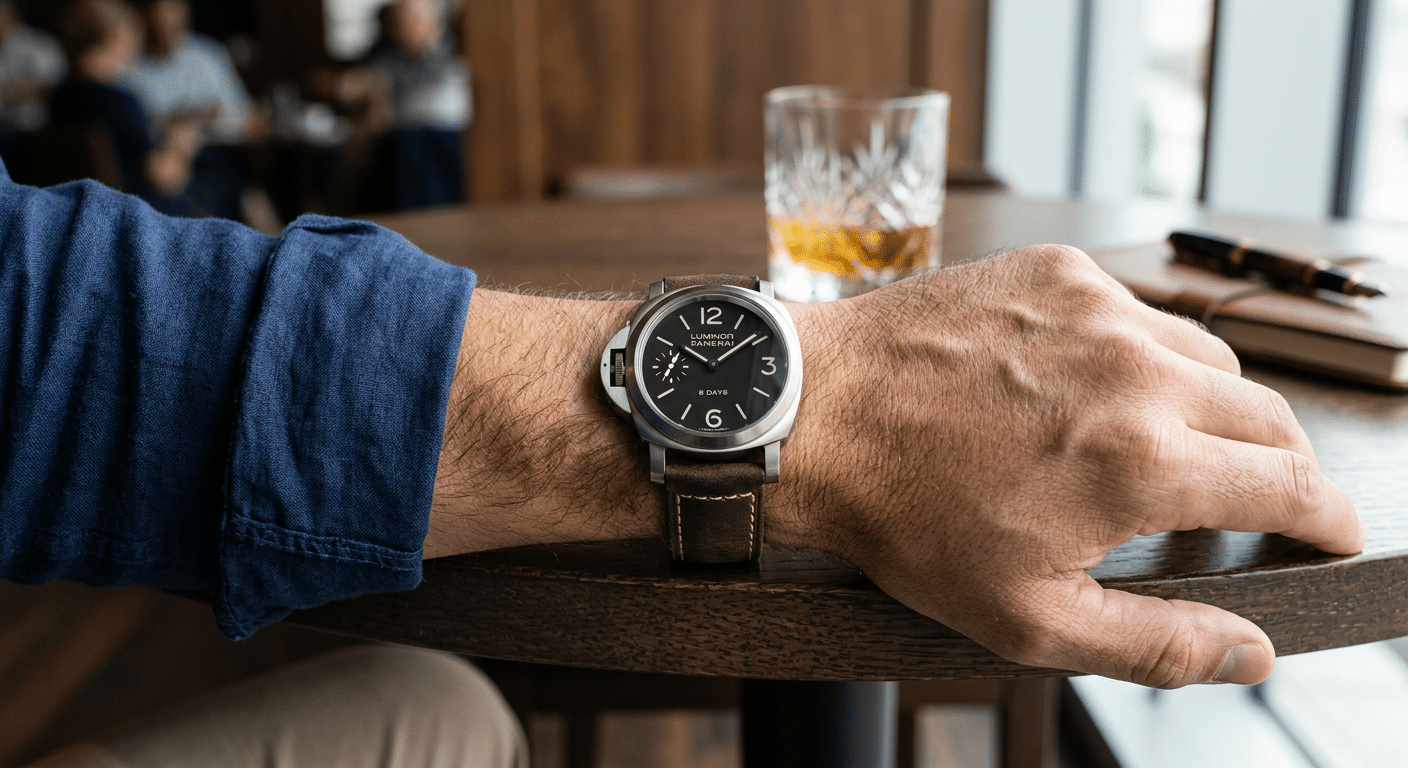
Desk Diving and Daily Use: New Friction Points?
While solving the “crown dig” problem, the repositioned crown guard at 9 o’clock can introduce new, albeit different, points of contact and potential friction. For individuals who spend significant time “desk diving” (working at a desk), the prominent crown guard might now rub against sleeves, desk surfaces, or even the back of the hand during specific movements like typing or writing. The exact impact depends heavily on individual wrist anatomy, wrist size, and specific daily activities. What feels like relief for one wearer might translate into a new, albeit less severe, form of irritation for another, underscoring that ergonomic solutions are rarely universal.
Strap Dynamics and Balance: Weight Distribution Implications
The asymmetrical case design of the Destro, with its crown assembly shifted to one side, subtly alters the weight distribution on the wrist. While the overall weight of the watch remains the same, the perceived balance can change. This shift can influence how the watch sits on the wrist, potentially leading to a slight lean or a feeling of imbalance for some wearers. The effect is often more pronounced with certain strap materials and thicknesses; a heavy, stiff leather strap might accentuate the asymmetry, whereas a more pliable rubber or textile strap could help distribute the weight more evenly. This minor detail contributes to the overall wear experience, impacting long-term comfort for discerning users.
Expert Authentication Insight
A tactile examination of the crown guard lever action and its spring tension provides a reliable indicator of authenticity and manufacturing quality. A genuine Panerai crown guard mechanism should exhibit a firm, precise snap when opened and closed, accompanied by consistent spring tension throughout its movement. This is distinctly different from the looser, spongy, or inconsistent action often found in aftermarket components or lower-quality replicas. The precision of this mechanical feel is a direct reflection of Panerai chronograph engineering standards and serves as a valuable physical diagnostic for authenticity.
The True Left-Handed Perspective: Beyond Novelty
The term “Destro” literally means “right” in Italian, referring to the watch being worn on the right wrist, making it suitable for left-handed individuals. This section explores whether the Luminor Destro genuinely serves its intended left-handed audience, or if its appeal has largely shifted towards collector novelty.
Winding and Setting: Left-Handed Dexterity
For a truly left-handed individual who wears their watch on their right wrist, the left-side crown is theoretically ideal for manipulation. It allows them to wind and set the watch using their dominant left hand while the watch remains on the wrist, avoiding the awkward contortions often required for right-handed crowns. This configuration significantly enhances convenience and dexterity for its intended user base. This direct functional benefit for left-handed individuals is a core justification for the Destro design, providing a genuine ergonomic advantage over standard crown placements.
Operational Flow: Chronograph Pushers and Other Complications
For Destro models equipped with complications, such as chronographs, GMT functions, or power reserve indicators, the left-side crown placement can introduce complexities into the overall operational logic. If chronograph pushers or other complication adjusters remain on the right side of the case (3 o’clock), it creates an asymmetrical control layout. While the crown is conveniently placed for a left-handed wearer, operating these additional pushers might still require an awkward reach or a two-handed approach. This can reduce the intuitive operational flow, making the “left-handed” design a partial solution rather than a fully integrated ergonomic system for more complex watches.
Market Perception vs. Real-World Utility for Lefties
While marketed as a “left-handed” watch, the actual adoption rate by true left-handed individuals for its functional benefit versus collectors seeking its uniqueness remains a point of considerable debate. Many right-handed collectors purchase Destro models for their distinctive aesthetic or rarity, wearing them on their left wrist despite the reversed crown. This blurs the line between genuine utility and collector appeal. While the functional benefit for a left-handed individual is clear, the broader market perception and purchasing patterns suggest that the Destro’s “novelty” factor often outweighs its specific ergonomic purpose for a significant portion of its buyers.
Expert Authentication Insight
Inspecting the crown and stem for any signs of excessive wear, irregular machining marks, or improper fitting is critical for authentication. Authentic Panerai crowns exhibit specific knurling patterns, precise logo engravings (if applicable), and a consistent finish that is difficult for aftermarket or counterfeit parts to replicate perfectly. Any deviation from these expected characteristics—such as a different knurling texture, a poorly defined logo, or tool marks around the stem where it meets the crown—can indicate that the component is not original or is of poor quality, potentially signaling a fake or a poorly serviced watch.
Under the Hood: Movement Considerations in Destro Models
The internal mechanics of a Luminor Destro model reveal more than just timekeeping; they showcase Panerai’s engineering approach to an unconventional design. This section delves into the specific movements found in key Destro references like the PAM219 and PAM1157, exploring the adaptations required for their left-sided crowns and the implications for ownership.
PAM219: The OP XI (ETA 6497-2) and Crown Reversal
The Panerai PAM219, a highly sought-after Destro model, houses the OP XI caliber. This movement is based on the robust Unitas 6497-2, a historically significant manual-wind pocket watch movement. Its large diameter and simple construction make it an ideal candidate for modification. Adapting the 6497-2 for a Destro configuration primarily involves a crucial reversal of the winding stem and, consequently, the dial-side indication. For a standard watch, the crown at 3 o’clock connects directly to the movement’s winding and setting mechanism. To move the crown to 9 o’clock, the entire movement is essentially rotated 180 degrees within the case. This necessitates a special winding stem that can reach the crown at its new position. While the base movement remains the same, the specific Destro-configured components are distinct, meaning a standard 6497-2 cannot simply be dropped into a Destro case without these specialized parts.
PAM1157: The P.6000 and Integrated Destro Design
In contrast to the adapted external movement of the PAM219, the PAM1157 features Panerai’s in-house P.6000 manual-wind caliber. This movement represents a more integrated approach to the Destro design. Developed from the ground up by Panerai, the P.6000 can be designed with the left-sided crown in mind from its inception. This means the gearing and stem architecture are purpose-built for the 9 o’clock position, rather than being an adaptation of an existing movement. This integrated design often results in a more seamless and potentially more reliable winding and setting experience, as the mechanism is optimized for its intended configuration. The P.6000, with its three-day power reserve, also reflects a modern Panerai standard, offering enhanced performance over older adapted calibers.
Serviceability and Parts Availability for Destro-Specific Components
While the core components of movements like the Unitas 6497-2 (in PAM219) are widely available and easily serviced by most watchmakers, the Destro-specific parts present a different challenge. The specialized winding stems, crown assemblies, and any unique gearing required for the left-handed setup are not standard off-the-shelf items. For the PAM219, obtaining a replacement Destro-specific winding stem might require sourcing from Panerai directly or specialized parts suppliers, potentially leading to longer service times and higher costs compared to a standard Luminor. Similarly, for the in-house P.6000 in the PAM1157, while the movement itself is designed for the configuration, any unique components would still be proprietary to Panerai. This means that while routine maintenance is generally straightforward, significant repairs involving these specific parts could impact long-term serviceability and parts availability, a consideration for any potential owner.
Expert Authentication Insight
When authenticating a Destro model, especially concerning its movement, a critical step is to observe the movement’s finishing and engravings. For the PAM219’s OP XI, look for classic Unitas characteristics like the large balance wheel, but also specific Panerai branding (e.g., “PANERAI” engraved on bridges, “OP XI” caliber designation, and serial numbers). The finishing should be consistent, typically with Côtes de Genève (Geneva stripes) and blued screws, though the level of hand-finishing is modest compared to haute horlogerie. For the PAM1157’s P.6000, inspect the distinctive bridge layout and the “P.6000” engraving. Authentic Panerai movements will exhibit precise, clean engravings and consistent finishing patterns that align with known examples. Discrepancies in font, depth, or the presence of rough machining marks can indicate a non-authentic or modified movement. Comparing these details against high-resolution images of verified genuine movements is crucial.
Collecting & Value: Destro as a Niche Investment
Beyond their practical utility, Luminor Destro models occupy a distinct segment within the collector market. Their unique configuration and often limited production runs imbue them with a different kind of appeal, making them more than just a watch—they become a niche investment, as explored in a replica Panerai models guide, or a prized piece within a specialized collection.
Rarity vs. Demand: Understanding Market Premiums
Models like the PAM219, produced in relatively smaller quantities (e.g., 1,000 units in 2007), often command higher prices on the secondary market due to their scarcity. This rarity creates a premium that is less about universal functional demand and more about collector desirability for unique or limited editions. While a standard Luminor might be chosen for its everyday wearability, a Destro is often acquired precisely because it’s not* standard. For instance, a PAM219 might fetch upwards of $8,500 – $10,500 on the secondary market, a notable premium over comparable standard Luminor models from the same era, despite sharing similar base movements. This premium reflects the collector’s pursuit of exclusivity, not necessarily a superior ergonomic experience for every wearer.
The “Cool Factor”: Aesthetics and Distinctive Appeal
The inverted crown guard is arguably the most visually striking feature of a Destro, providing an instantly recognizable and distinctive profile. This aesthetic deviation from the conventional 3 o’clock crown placement is a significant part of its “cool factor.” For many collectors, the appeal lies in owning a Panerai that subtly yet distinctly stands out from the brand’s more ubiquitous offerings. This visual asymmetry can be polarizing, but for those who appreciate it, it represents a bold design choice that reinforces Panerai’s heritage of unconventional utility. The Destro’s appearance signals a knowing appreciation for Panerai’s military roots and design evolution, attracting enthusiasts who value uniqueness and historical context in their timepieces.
Future Value Projection: Stable Niche or Volatile Trend?
The long-term collectibility of Destro models is influenced by their continued appeal within the broader Panerai market. Historically, Panerai’s limited editions and models with unique historical connections have performed well in terms of value retention, and even appreciation. Destro models, particularly those with a clear narrative (like the PAM219’s connection to the Unitas movement and earlier Destro tradition), tend to fall into this category. Their value is likely to remain stable within their niche, driven by dedicated Paneristi and collectors who appreciate unconventional configurations. However, they may not experience the same broad market surges as more universally popular models, making them a “stable niche” rather than a “volatile trend.” Their value is tied to specific collector preferences rather than general market speculation, offering a more predictable, albeit less explosive, investment outlook.
Expert Authentication Insight
Authenticating a Destro model for its collector value requires meticulous examination of the original accompanying materials. The original box, papers, and warranty card are critical, as they provide verifiable provenance. Ensure that the serial numbers on the watch (caseback and/or movement) precisely match those printed on the warranty card and any other documentation. Pay close attention to the font, print quality, and specific details on these accessories. For instance, authentic Panerai warranty cards have specific holographic elements, precise printing, and often include a stamp from the authorized dealer. Counterfeiters often overlook these nuances, producing documents with incorrect fonts, fuzzy printing, or missing critical security features. The presence of a full set of correctly matched and authentic documentation significantly enhances a Destro’s collector value and confirms its authenticity.
The Verdict: Who Should Buy and Who Should Skip a Destro?
The Luminor Destro is not a one-size-fits-all timepiece. Its unique configuration, while rooted in historical practicality, carries distinct implications for modern wearers. This final section distills the insights into actionable recommendations, helping potential buyers determine if a Destro aligns with their needs, preferences, and wrist habits.
The Ideal Destro Owner: Right-Wrist Comfort Seekers & True Lefties
The Destro configuration offers genuine, tangible benefits for two specific wearer profiles. First, individuals who consistently wear their watch on their right wrist and frequently experience discomfort from the crown “digging” into their hand or wrist during flexion will find the Destro to be an ergonomic revelation. By shifting the crown to the 9 o’clock position, the pressure point is eliminated, significantly improving comfort for right-wrist wearers. Second, true left-handed individuals who prefer to wear their watch on their right wrist and manipulate the crown with their dominant left hand will find the Destro’s layout intuitively superior. This allows for natural winding and setting without awkward wrist contortions. For these specific users, the Destro is not merely a novelty but a functional improvement, genuinely enhancing the wearing experience.
The Collector’s Choice: Unique Aesthetics and Rarity Appreciation
Beyond pure ergonomics, the Destro appeals strongly to a different segment of the market: the discerning collector. These individuals prioritize distinctive Panerai designs, appreciate the brand’s historical quirks, and value the exclusivity of limited editions. For them, the Destro’s inverted crown guard and less common configuration are primary draws. They might already own several standard Luminors and seek a piece that offers a different aesthetic or narrative. The “cool factor” and the sense of owning a specialized piece of Panerai history outweigh any perceived functional advantages or disadvantages. For these collectors, a Destro is a compelling addition to a diverse collection, regardless of whether it’s worn on the right or left wrist, or if they are left-handed.
Who Should Think Twice: Standard Wearers & Budget-Conscious Buyers
For the majority of right-handed individuals who wear their watch on their left wrist, a Destro offers no inherent ergonomic advantage and may even introduce new minor quirks, such as the crown guard catching on sleeves or resting against the back of the hand during certain movements. If you haven’t experienced significant crown discomfort with standard watches, the Destro’s primary benefit is largely moot. Furthermore, for budget-conscious buyers or those seeking maximum versatility and value, a standard Luminor model often presents a more practical and cost-effective entry point into the brand. These models are typically more widely available, often at lower price points, and offer the classic Panerai experience without the premium associated with Destro’s niche appeal. For these individuals, the Destro is an aesthetic choice rather than a functional necessity, and the added cost might not be justified.
Expert Authentication Insight
A crucial authentication step for any Panerai, including Destro models, is to perform a “time setting test.” This involves pulling the crown out to its various positions (winding, quick-set date if applicable, and time setting) and observing its action. A genuine Panerai crown should pull out smoothly with distinct, precise clicks into each position. When setting the time, the hands should adjust smoothly and without any noticeable backlash or slippage. The crown should re-engage firmly when pushed back in. Any grittiness, excessive play, vague clicks, or erratic hand movement can be indicative of a poorly maintained, damaged, or non-authentic movement. This tactile examination provides immediate insight into the movement’s health and the quality of the crown mechanism, which is especially vital for Destro models where the crown’s functionality is a key design element.
Choosing a Luminor Destro ultimately comes down to a highly personal assessment of needs and desires. If you consistently wear watches on your right wrist and experience discomfort from a conventional crown, then a Destro is worth exploring for its genuine ergonomic relief. If you are a true left-handed individual who prefers to manipulate the crown with your dominant hand, the Destro offers an intuitive and natural interface. However, if you are a right-handed wearer new to Panerai and value versatility, ease of ownership, and a more conventional aesthetic, then a standard Luminor is likely your better entry point. If your primary motivation is to acquire a distinctive, historically significant piece for a collection, then the Destro’s unique appeal makes it a compelling choice, irrespective of its ergonomic implications. The “best” Luminor is not universally superior; it is the one that best fits your individual wrist, habits, and collecting philosophy, rooted in specific functional needs rather than market hype or collector FOMO.