
Introduction: Why the 7750 Still Dominates IWC Replica Chronographs
The “factory split” reality: different factories solve different problems
Top-tier IWC replicas are not built by a single source chasing a single ideal. They are divided across multiple factories, each optimizing a different compromise: case thickness, subdial geometry, chronograph feel, or long-term stability. Some lean into aggressive re-engineering to achieve thinner profiles. Others accept thickness in exchange for calmer mechanics. A few focus on tactile quality—pusher resistance, crown feedback, rotor behavior—because those are what owners actually touch every day.
This is why you can handle two Portuguese chronograph replicas that look similar on the wrist and feel completely different in use. One may prioritize dial symmetry at the cost of added gearing and stack height. Another may keep the movement closer to its native layout, resulting in a thicker case but fewer stress points. ZF has become a reference point for certain Portuguese chronograph builds precisely because they chose to solve the thickness problem with deeper movement work rather than cosmetic shortcuts. That choice carries consequences—both positive and negative—that show up over time.
This article is not about selling watches. It is about ownership engineering. It is about what the 7750 can do consistently, what it resists doing, and how those realities shape daily use. If you approach a chronograph as a system rather than a feature, most buying mistakes disappear on their own.
Define what “Asian 7750” actually means (without mythology)
“Asian 7750” is not a single movement. It is a family label covering multiple factories, multiple finishing standards, and wide tolerance ranges. Some batches arrive well-regulated, cleanly lubricated, and properly adjusted. Others leave the line with dry pivots, burrs on coupling parts, or calendar components set too tightly. The name tells you almost nothing about how a specific example will behave.
Reliability is shaped far more by assembly discipline than by geography. Lubrication quality, endshake adjustment, chronograph engagement alignment, and final regulation matter more than where the plates were machined. Two movements from different batches can live very different lives on the wrist.
Set expectations accordingly. A chronograph is a load-heavy system, and while the 7750 movement can be robust and surprisingly tolerant when assembled correctly and used with care, it also punishes bad habits. Continuous chronograph use, careless crown handling, and rough pusher operation all contribute to predictable wear patterns. This is not a fragile caliber—it’s a mechanical workhorse that remembers how it has been treated.
To better understand how to manage the 7750’s unique requirements and identify how different replicas handle such a movement, you can refer to this guide on identifying what movement your IWC replica uses, which provides insights into recognizing and understanding the nuances of various IWC replica movements.
Reader promise: what you’ll know by the end
By the end of this guide, you will understand why thickness happens, how the typical failure chain unfolds, which IWC chronograph styles are most forgiving on the 7750, and how to own one without slowly dismantling it through daily habits.
7750 Architecture in Plain English: Where the Stress Lives
Power flow and why chronographs amplify wear
Every automatic watch has an energy budget. The mainspring stores power. The escapement meters it. The gear train delivers it to the hands. When you activate a chronograph, you add a second job to that same system. A clutch engages. Additional wheels come into play. Reset hammers and heart cams wait in tension for the next command.
In practical terms, running the chronograph means asking the movement to do more with the same reserve. Amplitude drops. Friction increases. Tolerances that felt generous in three-hand mode suddenly feel tight. This is why timekeeping often shifts after prolonged chronograph use and why some watches feel lively until you start the timer.
None of this is mysterious. You are splitting torque between timekeeping and timing. The 7750 handles this by design, but how gracefully it does so depends on how cleanly the engagement system was adjusted and how well the movement was lubricated.
Key components that drive real-world reliability
At a high level, the parts that determine whether a 7750 feels dependable or temperamental are straightforward:
- Mainspring barrel: sets the baseline for power delivery. Weak or uneven output magnifies every downstream problem.
- Escapement: translates power into time. Poor lubrication here shows up as erratic rates, especially under load.
- Automatic winding module: convenient, but also a common source of noise and wear if tolerances are loose.
- Chronograph coupling and engagement system: the heart of the matter. Smooth engagement equals lower shock to the gear train. Abrupt engagement shortens service life.
- Reset hammers and heart cams: determine how cleanly the chronograph returns to zero. Misalignment here becomes visible on the dial.
- Calendar work: day-date mechanisms add layers of parts and crown resistance. They also introduce a timing window where careless adjustment causes damage.
Most failures are not dramatic breaks. They are cumulative wear. A little extra friction at engagement. Slight debris from poorly finished edges. Marginal lubrication that dries faster than expected. Over months of use, these small compromises compound, and the difference in underlying movement quality becomes obvious — the sort of variation you can actually see when comparing long-term tests of different replica calibers and how they hold power reserve and amplitude over time, such as in the IWC replica power reserve stability rankings for 2026, where movements that start with robust tolerances and proper finishing consistently outperform those that don’t and require less frequent adjustment or service.
Why some 7750s feel “gritty” and others feel “Swiss-smooth”
That difference lives in finishing and adjustment, not in decoration. A smooth-feeling chronograph usually has clean pivots, correctly set endshake, and engagement parts that meet without scraping. A gritty one often carries microscopic burrs, uneven lubrication, or coupling components that were never truly centered.
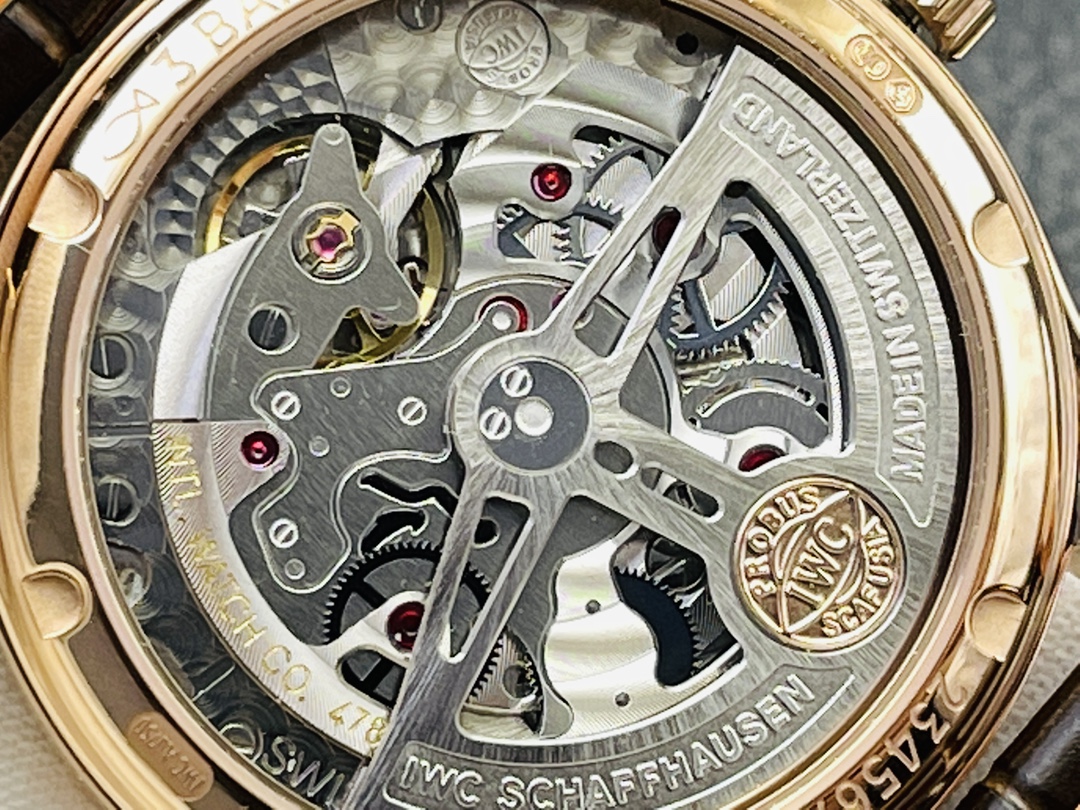
You can feel this through the pushers. You can hear it in the rotor. You can sense it in the crown when setting the time. None of it correlates reliably with how attractive the movement looks through a display back. Decorative plates and stripes do not tell you whether the chronograph clutch was adjusted with care.
The practical takeaway is simple: judge the movement by behavior. Start, stop, and reset should be decisive. Crown action should be smooth and aligned. Timekeeping should remain sane after chronograph use. These are the signals that matter. The rest is theater.
How the 7750 Is Used in IWC Replica Chronographs (Model-by-Model Logic)
Portuguese Chronograph (IW3714 / IW3716) and the “layout problem”
The Portuguese chronograph looks deceptively simple on the wrist. Two clean subdials. Wide negative space. A sense of symmetry that feels architectural rather than technical. That visual calm hides a mechanical constraint: the dial wants balance, but the native 7750 does not naturally place its registers where the Portuguese design expects them.
This is where most compromises begin.
To achieve the familiar Portuguese layouts—either a vertical 12–6 balance or a more classical 6–9–12 symmetry—replica builders often resort to relocated subdials. On paper that sounds cosmetic. In reality it means extra gears, altered bridges, and a taller movement stack. You are no longer dealing with a straightforward 7750. You are dealing with a 7750 plus an adaptation layer.
Subdial spacing is not just about where the hands land on the dial. Mechanically, every relocation introduces additional transmission points. Each point adds friction. Each added bridge increases stack height. Stack height pushes the hands closer to the crystal, the dial closer to the keyless works, and the entire case architecture into tighter tolerances. This is why Portuguese chronograph replicas have historically struggled with thickness and why the better builds required deeper re-engineering rather than surface-level case tricks.
When a Portuguese chronograph wears slim, something structural had to change. Either the movement plates were redesigned, or the gear stack was compressed, or both. If neither happened, the thickness came from hiding volume elsewhere, usually in the caseback or under the dial, and the stress still exists.
Pilot Chronograph (3777-style / 3881-style aesthetics) and the “thickness tolerance”
Pilot chronographs live in a different visual world.
They are tool watches. Broad bezels. Strong lugs. Busy dials. A sense of mechanical density that welcomes mass rather than disguising it. Because of this, pilot chronos can wear thicker without looking wrong. A millimeter here or there does not disrupt the design language. In some cases, it reinforces it.
That visual tolerance matters mechanically.
A pilot chronograph allows the 7750 to remain closer to its native architecture. There is less pressure to chase perfect symmetry through aggressive subdial relocation. Case designs can accommodate the movement’s natural height. Hands have more clearance. Crown feel tends to be calmer. Chronograph engagement can be tuned for reliability rather than elegance.
This is why pilot chronographs are generally a safer place for 7750 ownership than ultra-dress chronographs. They give the movement room to breathe. They accept thickness instead of forcing it to disappear. Over time, that space translates into fewer stacked compromises and more predictable behavior on the wrist.
If you want a daily-wear chronograph on a 7750, pilot styles forgive more mistakes—both in manufacturing and in ownership.
“Slim case” claims vs movement reality
The 7750 is inherently thicker than most three-hand calibres. That is not a defect. It is a consequence of having an integrated chronograph with automatic winding.
So when you see a chronograph advertised as “ultra-thin” on a 7750 base, the right question is not whether it is thin. The right question is how it became thin.
There are only a few honest answers:
- Custom main plates or bridges that reduce stack height.
- A reworked gear train that shortens the vertical transmission path.
- Case architecture that distributes volume differently, such as deeper mid-cases or domed crystals.
If none of those are present, the thinness usually comes from hiding height somewhere less visible, which means tighter tolerances elsewhere.
A simple checklist helps:
If the case thickness is close to genuine, ask what structural change made it possible.
If the subdials sit where the design demands, ask how they got there.
If both are true at once, expect deeper movement work—not just cosmetic adjustment.
When those questions have no clear answers, you are likely looking at a build that shifted stress rather than removing it.
Which IWC chrono styles are most forgiving on 7750
Not all chronographs ask the same things from the movement.
Over years of handling different builds, a clear hierarchy emerges.
The most forgiving are tool-oriented pilot chronographs with simple day-date layouts and stable, native-feeling subdial positions. They accept thickness. They avoid extreme relocation. They let the 7750 operate closer to its original geometry.
More fragile are dress-leaning chronographs that chase perfect symmetry through heavy modification. Every extra wheel added to satisfy dial aesthetics raises stack height, increases friction, and narrows tolerance windows. These watches can look spectacular out of the box and age faster on the wrist.
This does not mean dress chronographs are unusable. It means they demand better assembly and more disciplined ownership. If you prefer elegance, you inherit tighter margins.
Common Failure Patterns in 7750-Driven Replicas (What Breaks First and Why)
Symptom-based diagnosis (what you notice on the wrist)
Most problems announce themselves quietly before they become serious.
When chronograph seconds begin to stutter or jump, it usually points to coupling friction, falling amplitude, or lubrication that is no longer doing its job.
When reset no longer snaps cleanly to zero, suspect hammer alignment issues, cam wear, or debris interfering with the return action.
When timekeeping drifts noticeably after chronograph use, you are seeing amplitude collapse from added load.
When rotor noise suddenly increases, the automatic winding module is often telling you that tolerances have opened up or parts have begun to loosen.
None of these are mysteries. They are predictable outcomes of a movement being asked to work harder than its current condition allows.
The thickness and “stack height” chain reaction
Stack height is not an abstract measurement. It creates a chain reaction across the watch.
Added wheels and bridges to reposition subdials raise the movement profile. That height compresses clearances. The keyless works begin to feel heavier. Hands sit closer to each other and to the crystal. Dial-side friction increases. Chronograph engagement becomes more sensitive to alignment.
On the wrist, this shows up as a harder crown feel, occasional hand rubbing, or inconsistent pusher response. These are not isolated annoyances. They are signals that the system is operating near its tolerance limits.
Gear wear and the “metal dust” reality
Poor finishing combined with poor lubrication creates microscopic wear debris. You do not see it, but the movement does.
That fine material migrates. It contaminates oil. It accelerates wear in neighboring components. Over time, a small finishing shortcut in one place becomes amplified across the gear train.
This is why two outwardly identical 7750s can age so differently. One stays smooth for years. The other becomes noisy and erratic within months. The difference is almost always hidden in surface quality and lubrication discipline.
Calendar complications as secondary failure multipliers
Day-date mechanisms add parts, resistance, and timing sensitivity.
There is a danger window around the natural date change, when the calendar works are partially engaged. Forcing the crown during this period stresses teeth, levers, and springs that were never meant to be moved under load.
Beyond that, every added calendar function increases crown resistance and compounds wear on the keyless works. It does not make the watch unreliable by default, but it raises the cost of careless handling.
Chronographs already carry a heavy mechanical workload. Layering day-date on top makes ownership habits matter even more.
Stability: What Actually Determines a “Good” 7750 in a Replica
Assembly quality beats origin mythology
Where a 7750 was made matters far less than how it was finished.
Regulation, lubrication, endshake, and chronograph adjustment decide whether a movement feels calm or chaotic. A well-regulated 7750 with clean lubrication and properly set tolerances will outperform a poorly assembled example every time, regardless of what label someone attaches to it. This is why blanket statements about “good” or “bad” 7750s rarely hold up in real ownership.
Variation is part of the landscape. The best batches are genuinely excellent—stable amplitude, smooth engagement, predictable timekeeping. The worst batches are frustrating from day one, with gritty pushers, noisy rotors, and drifting rates. Most sit somewhere in between. The movement family itself is capable. What separates a keeper from a problem child is the discipline applied at assembly.
If you remember only one thing, make it this: consistency comes from process, not origin.
Chronograph engagement design differences (why some feel safer)
Not all chronograph engagements behave the same way.
Some builds bring the chronograph online gradually. The coupling meets gently, power transfer ramps up smoothly, and the gear train absorbs the added load without shock. Others engage abruptly, effectively slamming parts together every time you press the pusher.
You can feel this through your fingers. A smooth engagement feels decisive but calm. A harsh one feels sharp, sometimes accompanied by a visible jump of the seconds hand. That difference is not cosmetic. Each hard engagement sends a small impact through the gear train. Over hundreds or thousands of cycles, those impacts become wear.
This is why two watches with the same base movement can age very differently. One treats engagement as a transition. The other treats it as an event. The former tends to survive longer.
The “decorated plate” trap
A beautifully striped bridge does not guarantee a well-adjusted chronograph.
Decorated plates can hide generic bases. They can distract from misaligned coupling parts or rushed lubrication. A movement that looks impressive through a display back can still suffer from poor geometry underneath.
A healthier buyer mindset focuses on behavior, not appearance. Ask for evidence of function: clean start and stop, precise reset, stable timekeeping before and after chronograph use. These tell you far more about long-term reliability than any amount of visual embellishment.
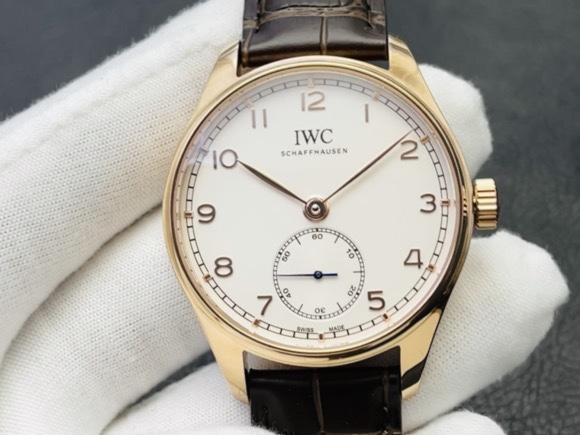
Pretty metal does not equal correct mechanics.
Ownership Rules: Daily Use Habits That Extend 7750 Life
When to run the chronograph (and when not to)
Treat the chronograph like a function you use, not a status light you leave on.
Running the chronograph continuously keeps the movement under constant extra load. Amplitude stays lower. Friction stays higher. Lubricants work harder. Over time, this accelerates wear in predictable places. There is nothing wrong with using the chronograph regularly, but there is little benefit in letting it run all day for no reason.
Use it when you need it. Let it rest when you do not.
Crown handling: the fastest way to create damage
Most user-induced problems start at the crown.
Operate it gently, keep it aligned with the stem, and move slowly. Avoid side pressure. If something feels resistant, stop and reset your grip rather than forcing it.
For watches with day-date, stay away from calendar adjustment during the natural date-change period. A simple rule works well in practice: make calendar changes during the middle of the day, not late at night or early morning. This avoids loading parts that are already in motion.
Patience at the crown saves expensive headaches later.
Winding and rotor habits
Manual winding should be calm and controlled. Slow turns. No forcing. The goal is to build power, not to race the barrel.
Avoid shaking or spinning the watch to “wake it up.” That kind of behavior stresses the winding module and does nothing positive for lubrication. Consistent daily wear is far kinder to the automatic system than bursts of aggressive motion.
Let the rotor do its job over time.
Water resistance realism (especially for chronographs)
Chronographs have more case penetrations than three-hand watches. Every pusher is another potential entry point.
Even when seals are new, tolerances vary. Treat water resistance claims with caution. If water exposure matters to you, pressure testing is the only responsible approach. Without it, assume splash resistance at best.
This is not about pessimism. It is about acknowledging mechanical complexity.
Service interval mindset (not DIY)
If you wear a 7750 chronograph frequently, periodic inspection and regulation by a competent watchmaker is preventative care, not a sign of failure.
Fresh lubrication, minor adjustments, and early detection of wear extend service life dramatically. Waiting until something feels wrong usually means more parts are already involved.
Think in intervals, not emergencies. A small check at the right time costs less than a full repair later.
Evaluating a 7750 IWC Replica Chronograph Before You Commit
Visual and tactile checks that correlate with movement health
Before you look at specifications or photos, use your hands.
Crown feel should be smooth and linear, not crunchy or uneven. Resistance is normal, grinding is not. A crown that fights you usually points to stressed keyless works or poor alignment.
Chronograph start, stop, and reset should feel decisive. You want a clear click at engagement, a confident stop, and a reset that snaps back to zero without hesitation. Mushy pushers or lazy resets often signal weak hammer alignment or friction in the coupling system.
Hand alignment tells quiet truths. Chronograph seconds must return exactly to twelve. Subdials should advance logically and evenly. If a register hesitates or drifts, something underneath is already unhappy.
Finally, check timekeeping sanity. Observe the watch for a period with the chronograph off, then repeat after running the chronograph. Large shifts in rate or behavior suggest amplitude collapse under load. A healthy 7750 stays composed in both states.
These are not cosmetic preferences. They are functional indicators.
What “QC proof” should show
Good pre-delivery documentation focuses on behavior, not glamour.
Ask to see the chronograph engaging and disengaging in real time. Watch how the seconds hand comes alive. Observe whether reset is crisp or vague.
Request a date change demonstration, performed outside the natural change window, to confirm calendar health. If available, an amplitude or basic accuracy snapshot adds context, especially when paired with chronograph-on and chronograph-off readings.
The goal is not to interrogate anyone. It is to confirm that the movement behaves like a system in balance rather than a collection of parts in tension.
FAQ
Is the Asian 7750 reliable enough for daily wear?
It can be, when assembly quality is good and chronograph use is disciplined.
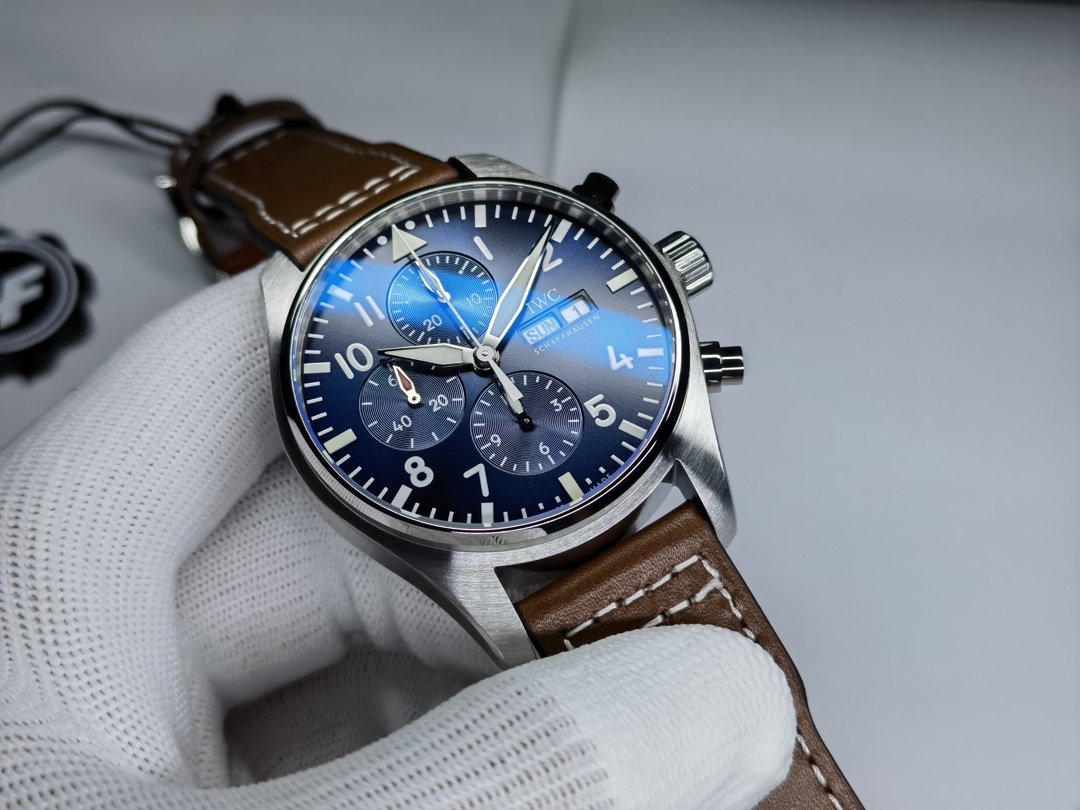
There is real variation from batch to batch, and some IWC chronograph styles are more forgiving than others. Pilot chronographs and simpler layouts tend to tolerate daily wear better than heavily modified dress chronos. Treat the movement with respect, avoid constant chronograph running, and accept periodic inspection as part of ownership, and the risk profile becomes manageable.
Ignore those factors and even a decent build will age quickly.
Why do some IWC replica chronographs feel too thick?
Because they are carrying more than just a chronograph.
The 7750 starts thicker than most three-hand movements. Add extra gearing to relocate subdials, then wrap everything in a case designed for visual symmetry, and height accumulates. Some builds absorb that volume gracefully. Others hide it in ways that tighten tolerances elsewhere.
Thickness is not merely aesthetic. It reflects how much engineering happened under the dial.
Is a “Swiss” labeled 7750 always real?
No.
Labels are easy. Evidence is harder. What matters is how the movement behaves and whether documentation supports the claim. Smooth engagement, stable timekeeping, and consistent reset tell you more than engraving ever will.
Trust function first. Treat branding as secondary.
Which is safer for long-term use: a 7750 chronograph or a 2892 three-hand?
They serve different lives.
The 2892 family is simpler, thinner, and often more consistent over long stretches. The 7750 gives you chronograph capability at the cost of higher mechanical load and more variables. If you rarely use the chronograph, the 7750’s risk profile improves. If you value simplicity and predictability, a three-hand movement usually asks less of both the watch and the owner.
Match the movement to your habits, not the other way around.
Can I keep the chronograph running all day?
You can, but it is not kind to the movement.
Continuous chronograph operation increases wear and often reduces amplitude. Occasional extended timing is fine. Permanent engagement turns every hour into a stress test. For longevity, treat the chronograph as a tool you activate when needed, not a feature that stays on.
Conclusion: The Honest Trade-off
A 7750 chronograph offers real capability, but it carries greater stack height and wider variance risk than simpler movements, and the difference between acceptable reliability and predictable degradation comes down to assembly quality and daily habits, because a well-built example paired with disciplined use can live a stable life, while a rushed build combined with constant chronograph running will age fast, so we can explain how it’s built and how it tends to behave, but how you balance function, thickness, and risk is a decision only you can make. For a deeper dive into the inner workings of IWC replica movements, including the 7750, 2892, and 7-day power reserve, check out the IWC replica movements explained article.
Related IWC Articles: If you found this helpful, you might also enjoy Best IWC Replica Factories Compared (ZF vs V7 vs MKS & Others), and IWC Pilot’s Replica Watch Comparison: Mark vs Big Pilot vs Chronograph (Pilot Series Explained). You may also like MKS IWC Portofino Moonphase Replica Review (vs YLF): The Dress-Watch Comparison, and Why the IWC Big Pilot Is One of the Hardest Watches to Replica.