
In the IWC replica market, ZF, APS, VS, and others compete by series. But the real difference is usually under the dial—movement architecture, not the label. If you learn to read architecture through what you can see and what the watch does, you stop being dependent on marketing names, seller scripts, or engraved rotors.
Why “Movement Names” in Listings Are Often Misleading
A listing can be technically true and still mislead you. That is not always fraud. It is usually how this niche communicates: broad labels, selective details, and a heavy reliance on cosmetic cues. If you want to identify the movement in your IWC replica, you have to treat names as hints, not answers.
The 3 common ways sellers describe the same thing
Most movement descriptions you’ll see are layered. The problem is that different sellers emphasize different layers, so two listings can describe the same watch in completely different language.
Base caliber family is the only layer that reliably predicts how the watch will behave over months of wear. A “7750” tends to feel and wear like a 7750. A 2892/SW300-type tends to wear flatter, wind smoother, and tolerate daily use differently. An ETA 2824-type usually feels robust but can read slightly thicker in a dress watch. A 9015-type often shows up where factories want stable value and easy sourcing, even if they decorate it to resemble something else.
Modification type is where most of the confusion lives. A watch can be “7750” and still not look like a 7750 on the dial, because factories relocate subdials, re-gear displays, or add a module to match an IWC layout. Portuguese Chronograph-style two-register dials are the classic example: the dial layout can look “IWC-correct,” while the movement underneath is still a 7750 family base with conversion work. The same logic applies to “power reserve” hands and calendar complications. The modification changes what you see, but it rarely changes the base architecture.This same principle becomes even clearer in simpler three-hand models. Entry IWC replicas such as Portofino and Mark series are often marketed under different labels, but in reality they usually trace back to just a few core movement families. If you want a practical breakdown of how ETA 2824 and ETA 2892 are typically used — and why these “simpler” architectures often deliver better daily stability — this guide on ETA 2824 vs ETA 2892 in entry-level IWC replica models explains how base movements matter far more than surface modifications.
Decoration layer is what sellers love because it photographs well. Plates, engravings, rotor text, and perlage can make a movement look “in-house.” They can also hide very ordinary bases. If you take one lesson from this article, make it this: a decorated rotor proves nothing. Behavior beats engraving.
“Clone,” “in-house,” and “1:1” language: what it usually means in practice
“Clone” is often used as a cosmetic claim, not an engineering claim. In practice, it usually means the dial layout, case proportions, and visible cues resemble the genuine watch—sometimes extremely well—while the gear train and architecture remain rooted in a common base. That is why two replicas can look equally convincing on the wrist, yet one winds smoother, holds amplitude longer, or survives daily use with fewer surprises.
“In-house” language is even more slippery. In the replica world, “in-house” often means “customized,” “private batch,” or “factory-specific build.” Occasionally it means a genuinely reworked long-reserve architecture, like the higher-tier Portuguese 7-day efforts that attempt a true-ish multi-day behavior rather than a purely decorative indicator. But the default assumption should be simple: true architecture copying is rare; IWC-like appearance is common.
“1:1” is usually a statement about external likeness and overall feel, not a promise that the movement shares IWC’s underlying engineering philosophy. If you judge “1:1” by how the watch behaves across a year of ownership—winding feel, reset alignment, date-change consistency, and tolerance to daily knocks—most claims fail quickly. That is why identification should start with what the watch does, not what it is called.
Step-by-Step Identification Workflow (Use This Like a Checklist)
The fastest path to a correct movement call is a short workflow you repeat every time. You are not trying to be a watchmaker. You are trying to be difficult to fool.
Step 1: Identify the watch category by complications
Your complication set narrows the movement family more than any listing description.
If your watch is three-hand with date only, it most commonly sits on the 2824 / 2892 / SW300 / 9015 family spectrum. This is where you’ll see many Mark series and Portofino-style replicas. The difference matters because daily-wear comfort and long-term stability tend to track the family: 2892/SW300-type builds often wear thinner and feel more refined; 2824-type builds often feel sturdy but can push thickness; 9015-type builds often aim for reliable value and can be dressed up cosmetically.
If your watch is a chronograph, assume a 7750-family base until you have hard evidence otherwise. This is not cynicism. It is what holds in repeated ownership cycles: when an IWC replica has working pushers, running seconds, and a functional reset, the 7750 family is the default backbone—sometimes modified heavily to match IWC dial layouts.
If your watch has a power reserve indicator, you are in the danger zone. The hand can be driven by a real long-reserve architecture, or it can be a display linked to winding activity or a simplified proxy. The presence of the indicator alone does not prove anything. In the IWC world, Portuguese 7-day-style replicas split into two camps: “true-ish” multi-day behavior attempts versus “display reserve” builds that look correct and disappoint fast.
If your watch has an annual or perpetual calendar, assume a base movement plus calendar module rather than a faithful replication of IWC’s genuine caliber. That does not automatically mean “bad.” It means your identification should focus on how the module behaves—date jumps, month change behavior, and setting sensitivity—because that is where ownership risk concentrates.
Step 2: Determine if the caseback is open or closed—and what you can still verify
An open caseback makes identification easier, but a closed caseback does not trap you. It just changes what you measure.
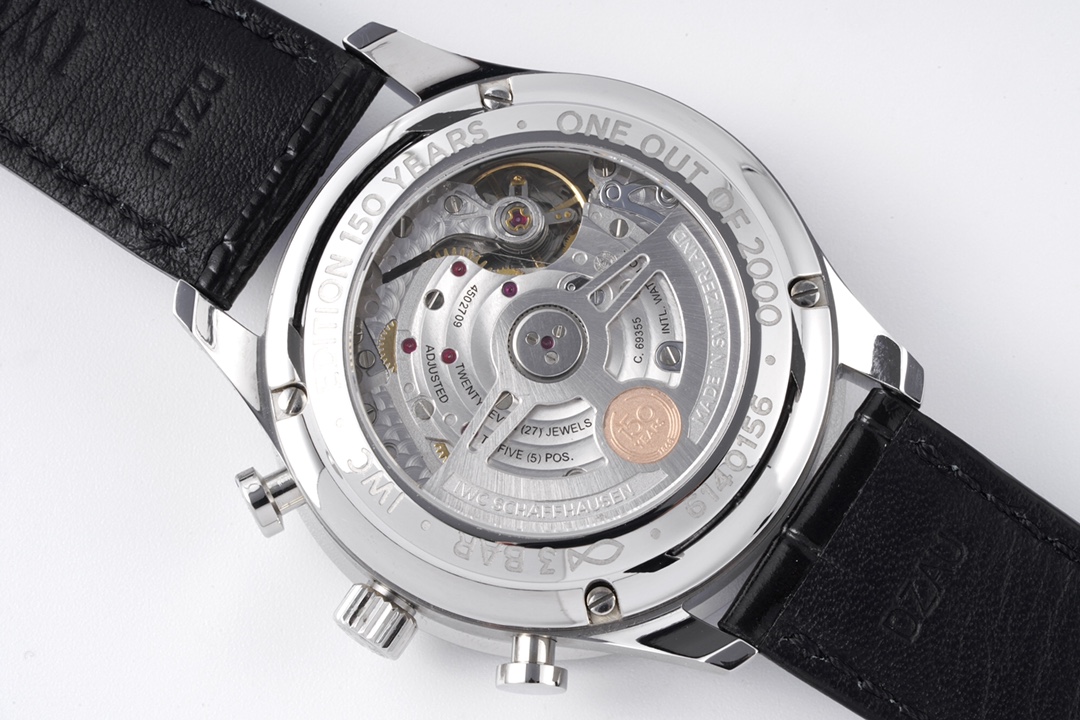
With an open caseback, you are looking for architectural cues, not pretty engraving. Balance wheel position gives a rough map. The overall “crowded” look of a chronograph layer often points toward a 7750 family. Cleaner, broader bridge layouts tend to suggest 2892/SW300-type bases. You may also see telltale plates that exist mainly to imitate IWC styling. Treat those as decoration until other evidence supports them.
With a closed caseback, stop wishing you had a display back and start using what you can still test: dial behavior, thickness on the wrist, crown feel, and pusher feel. Over time, these cues are more honest than a rotor engraving anyway. A closed-back Portuguese Chronograph that wears unusually tall and has mushy pushers is telling you something, even if you cannot photograph the movement.
Step 3: Run 3 behavior tests before you guess the movement
Before you label anything, run three tests that expose architecture. They do not require special tools. They require patience and attention.
Date change timing is the first tell. Some builds begin a slow “creep” of the date change hours before midnight. Others snap closer to midnight. The exact window varies, but consistency matters. If the date behaves erratically—sometimes early, sometimes late—that often points to lower assembly discipline or keyless works issues, regardless of what the movement is called. Over months, inconsistent date behavior tends to correlate with the kind of build that also develops crown feel problems.
Chronograph engagement is the second tell. Start, stop, and reset should feel decisive. A crisp reset with clean alignment is often a sign of better 7750 finishing and adjustment, even if the base remains the same family. A mushy start, hesitant return, or repeated misalignment is not “normal replica behavior.” It is a warning that your watch will be more sensitive to daily use, shock, and long-term wear.
Power reserve reality check is the third and most valuable test, especially for Portuguese 7-day-style replicas. Ignore what the hand claims. Fully wind the watch, note the time, and check whether it can reliably exceed two days. If a “7-day” watch dies around 40–50 hours, you are not dealing with a true long-reserve architecture in any meaningful sense. You are dealing with a display story, not stored energy.
The Fastest Visual Clue: Subdial Layout Maps (IWC-Specific)
If you only remember one shortcut, make it this: IWC dial layouts often look bespoke, but most replica chronographs still start from a familiar base. Subdial geometry is the quickest way to tell which family you are dealing with, long before you worry about rotor text or factory names.
IWC chronographs: the “layout fingerprints” that usually reveal 7750-based builds
The classic 7750 architecture has a native logic. In its most common form, you will see three subdials arranged at roughly 6-9-12, with running seconds typically at 9, the 12-hour counter at 6, and the 30-minute counter at 12. That pattern is not random. It comes directly from how the gear train and chronograph layer are stacked.
IWC, however, prefers cleaner symmetry on many models. Portuguese Chronographs want two registers at 12 and 6. Pilot Chronographs often emphasize legibility with balanced layouts and combined day/date windows. To make that happen, factories do not abandon the 7750. They adapt it.
What usually happens is re-gearing or module-driven relocation. The base remains 7750-family, but the output of certain wheels gets redirected so the visible subdials land where IWC expects them. This is why a watch can present a very “IWC-correct” dial while still behaving like a 7750 underneath. Once you understand that, the mystery disappears. You stop asking whether it is “7750 or clone” and start asking how heavily the 7750 has been modified.
Portuguese Chronograph (IW3714 / IW3716 style): what the dial tells you
A two-subdial Portuguese Chronograph almost always points to a 7750-family base with modification. There are exceptions on paper, but in real ownership cycles this assumption holds.
The visual cue is the simplicity itself: 30-minute counter at 12, running seconds at 6, no third register. That elegance does not come naturally to a stock 7750. It is achieved through conversion.
Here the “thickness reality lens” matters. Portuguese Chronographs are dress chronographs. On the wrist, they should feel relatively composed and not top-heavy. If your example wears noticeably thick for its diameter, that usually means you are feeling the extra stack height from a 7750 plus conversion work. Thinner executions exist, but they require more aggressive re-engineering. When a Portuguese Chrono feels tall and slightly nose-heavy, the odds strongly favor a modified 7750 underneath.
Pilot Chronograph (3777 / 3881 style): how to spot a standard 7750 vs a cleaner conversion
Pilot Chronographs give you more behavioral clues because they add day/date and invite frequent chronograph use.
Start with the day/date window. On many 7750-based builds, you will notice either a gradual creep well before midnight or inconsistency in when the discs begin to move. Cleaner conversions tend to show more predictable timing. It is not about hitting midnight perfectly. It is about repeating the same behavior night after night.
Then move to pusher feel. A mushy or hesitant start often correlates with rougher finishing or weaker adjustment on the chronograph layer. Better-executed 7750 builds feel decisive. The pushers engage with intent, not apology.
Finally, watch the reset. When the chronograph seconds hand snaps back cleanly to zero and lands exactly where it should, that usually reflects better alignment and regulation. Chronic misalignment is rarely just cosmetic. Over time, it often travels with amplitude loss and increased sensitivity to shock.
These three cues together tell you far more about the underlying movement quality than any engraving ever will.
Caseback Identification (Open Back): What to Look For Without Becoming a Watchmaker
An exhibition caseback can help, but only if you ignore the parts designed to impress you and focus on the parts that betray architecture.
Rotor and bridges: what matters vs what is decoration
Do not overtrust rotor text. “IWC,” “Probus Scafusia,” or elaborate striping can be added to almost anything.
Instead, orient yourself using structure.
Look at the balance wheel location. Its approximate position relative to the caseback screws gives you an immediate sense of the base layout.
Study the bridges. A 2892/SW300 family tends to look cleaner and more open, with broader, simpler bridges. A 7750-family chronograph usually appears more crowded, with visible layers and additional components stacked on top of each other.
On many open-back chronographs, you can also spot parts of the chronograph mechanism itself—levers, cams, or intermediate wheels peeking through. That visual density is a strong hint you are dealing with a 7750-based architecture, regardless of how refined the decoration appears.
2892 / SW300 family: the typical visual profile in IWC replicas
This family shows up most often in Portofino three-hand models, Mark series pilots, and thinner sport/dress hybrids.
Visually, these movements tend to look calmer. The layout feels less congested. Bridges are broader. The overall presentation is flatter.
On the wrist, watches powered by this family usually sit closer to the arm. They rotate less, slide under cuffs more easily, and feel more composed during daily wear. That physical experience is often more reliable than anything you see through the glass.
2824 family: why it’s still common and how it shows up
The 2824 family refuses to disappear because it is forgiving. It tolerates less-than-perfect assembly better than many alternatives, and parts availability is widespread.
In IWC replicas, it typically appears in entry-level three-hand builds. If you encounter a simple Mark or Portofino-style watch that wears a touch thicker than expected but feels mechanically sturdy, an 2824-type base is a reasonable assumption.
Owners often describe these as “solid” rather than “refined.” That matches long-term behavior. They keep running, but they do not always deliver the slim, elegant feel associated with higher-grade architectures.
9015 family: how it gets used and why it confuses buyers
The 9015 family appears frequently because it balances cost, reliability, and thinness. It is a practical choice for factories aiming to offer “thin + stable” at a lower tier.
The confusion comes from how easily it can be dressed. Plates, rotors, and cosmetic elements can make a 9015 resemble other calibers at a glance. But underneath, it remains a simpler base.
In IWC replicas, you will often find 9015 in three-hand models where sellers want a flatter case profile without stepping up to more expensive architectures. It can be a perfectly reasonable movement in daily use. The key is not to mistake decoration for complexity. When a watch feels thin and stable but lacks the visual or behavioral signatures of a 2892/SW300, 9015 is frequently the quiet answer.
Understanding these visual and tactile patterns changes how you evaluate replicas. You stop chasing names and start reading structure. And once you do that, identifying your IWC replica’s movement becomes less about guessing and more about observing how the watch is built—and how it behaves when you actually live with it.
The “Fake Power Reserve” Trap: Portuguese 7-Day as the Key Case Study
If there is one area where buyers get misled most often, it is the Portuguese “7-day” category. The dial looks authoritative. The power reserve hand moves. The rotor is engraved. And yet, in everyday ownership, many of these watches behave like ordinary two-day automatics.
The difference is not marketing. It is architecture. And architecture always shows itself in runtime.
What a true long-reserve build looks like in behavior terms
A real long-reserve build announces itself through endurance, not cosmetics.
The simplest test requires no tools. Fully wind the watch until resistance increases and the crown no longer spins freely. Note the time. Then leave the watch untouched on a flat surface.
Check it at 48 hours. Then again at 72. Then at 96.
You do not need laboratory precision. You are looking for consistency across cycles. A genuine multi-day architecture will still be running strongly at two days and usually beyond three. Even the better replica long-reserve builds rarely deliver a full seven days in practice, but they should comfortably exceed normal automatic territory. For a deeper comparison of how different movement platforms influence reserve performance and reliability—such as the structural contrasts between a modified ETA 2892-based movement and a heavily configured 7750 chronograph base—you can refer to this detailed breakdown on the real differences inside IWC replica watches and how those designs affect long-reserve execution: 7750 vs 2892 Movements – The Real Differences Inside IWC Replica Watches (2026 Guide).
If your “7-day” Portuguese struggles to make it past two days, the discussion ends there. The indicator may be moving, but the energy storage is not.
Over repeated ownership cycles, this runtime test has proven far more reliable than any visual inspection. It cuts through decoration, language, and factory claims in one weekend.
How a 9015-based “Portuguese 7-day” usually cheats the indicator
Most fake-reserve builds follow the same playbook.
The watch uses a standard automatic base—often from the 9015 family—and adds a mechanism that drives the power reserve hand from winding activity or a simplified gearing proxy. In other words, the indicator reflects motion, not stored energy.
Wear the watch for an hour and the hand climbs optimistically. Set it down overnight and it drops. The display responds to rotor activity, not to the actual state of the mainspring.
The behavioral clue is always the same. The indicator looks lively, but the watch stops far earlier than the dial suggests. Owners often notice that the reserve hand rises quickly during wrist movement, creating the impression of abundance, while the real runtime barely clears forty hours.
This is not subtle once you know what to look for. The indicator feels hopeful. The movement feels ordinary.
Quick decision rule: real reserve vs display reserve
You do not need to overthink this.
If the watch cannot consistently exceed roughly forty to fifty hours, it is not a true long-reserve architecture.
If the power reserve hand changes rapidly with wrist movement while total runtime remains short, treat it as a display-only feature.
There are higher-tier Portuguese 7-day replicas that attempt a genuine multi-day behavior using more elaborate constructions. Even those rarely deliver a full week. But they do behave differently from decorated automatics. They wind differently, discharge differently, and most importantly, they keep running when cheaper builds have already gone silent.
That difference shows up on your desk, not on the rotor.
Thickness, Crown Feel, and Pusher Feel: Mechanical Clues You Can Sense
Not every identification step requires opening the caseback. Some of the most honest clues come from how the watch sits on your wrist and how it responds to your hands.
Thickness benchmarks by complication type (IWC context)
A three-hand IWC-style dress watch should sit relatively flat. If it feels unexpectedly tall, you are likely dealing with either a thicker base movement or additional plates added for cosmetic reasons.
Chronographs are naturally thicker. That is normal. What matters is excess thickness. When a Portuguese or Pilot Chronograph feels bulky for its diameter, that usually reflects a 7750 base combined with conversion layers. You are feeling the stack height.
This does not automatically mean the watch is bad. It means you are experiencing the architectural compromise required to achieve that dial layout.
Once you start paying attention, thickness becomes one of the quickest ways to separate refined builds from utilitarian ones.
Crown feel (winding and setting): what to notice
The crown tells the truth about assembly.
Smooth, even winding usually indicates decent lubrication and acceptable alignment in the keyless works. The resistance builds gradually. There is no scraping sensation. The action feels deliberate.
Crunchy or gritty winding is a warning sign. It often points to debris inside the movement, dry lubrication, or misaligned components. These issues appear across all movement families. They are not exclusive to any one caliber. But they show up more often in lower QA batches.
Setting the time should also feel controlled. If the hands jump erratically or the crown feels loose in certain positions, you are seeing the downstream effects of rushed assembly.
These sensations matter because they tend to predict future service needs better than model names.
Chronograph pushers: what correlates with 7750 health
On 7750-based builds, pusher feel is a direct window into movement condition.
A healthy example starts cleanly, stops decisively, and resets with confidence. The chronograph seconds hand returns to zero without hesitation. That behavior usually reflects better finishing and adjustment on the chronograph layer.
Mushy pushers, vague engagement, or inconsistent reset alignment often accompany rougher builds. Over time, these watches are more prone to amplitude loss and sensitivity to shock.
One practical habit helps longevity: avoid leaving the chronograph running continuously on many 7750-based replicas. Constant engagement increases wear and can accelerate performance degradation. Use the chronograph when you need it, then let the movement return to its simpler state.
These tactile cues do not replace visual inspection. They complement it. Together, they form a pattern. And once you learn to read that pattern, identifying what movement your IWC replica uses becomes far less abstract—and far more grounded in how the watch actually lives with you.
Model-by-Model “Movement Probability” Guide (IWC Series Map)
Once you understand the patterns, most IWC replicas stop being mysterious. Each series tends to cluster around the same movement families, with differences showing up more in finishing quality than in core architecture. This is not a rulebook. It is a probability map built from repeated ownership and teardown exposure.
Mark series (XVII / XVIII / XX): most common movement families
The Mark line is structurally simple, which is why it attracts a wide range of builds.
Across tiers, you will most often encounter 2892/SW300, 2824, and 9015 families.
Higher-tier versions favor 2892 or SW300-type bases for their thinner profile and calmer wear. Mid-tier and value builds frequently lean on 9015 for cost control and reliable performance. Entry-level executions often use 2824-type movements because they tolerate rougher assembly and remain easy to service.
Identification here is straightforward. Pay attention to thickness first. A Mark that sits flat and disappears under a cuff usually points toward 2892/SW300 or 9015. A Mark that feels slightly chunky for its diameter often signals 2824.
If the caseback is open, bridge shape confirms the story. Broader, cleaner bridges suggest 2892/SW300. More utilitarian layouts tend to belong to 2824. Cosmetic plates can obscure this, but the underlying proportions still show through.
Portofino (three-hand and chronograph): what usually powers them
Portofino three-hand models live in the same ecosystem as the Mark series, but buyer priorities differ. Portofino owners usually care about thin dress comfort, and the movement choice becomes obvious on the wrist.
Three-hand Portofinos most commonly run on 2892 or 9015 families, with occasional 2824 in lower tiers. If the watch feels elegant and flat, it is likely in the 2892/9015 camp. If it feels solid but a touch taller than expected, 2824 is a reasonable guess.
Portofino chronographs almost always sit on a 7750-family base. The visual language may be refined, but the underlying architecture follows the same rules as other IWC chronographs. Here again, thickness and pusher feel tell you more than any engraving ever will.
Portuguese Chronograph: what you should assume unless proven otherwise
Start from the assumption that you are dealing with a modified 7750-family movement.
Portuguese Chronographs achieve their clean two-register layout through conversion, not through an entirely new base. That is simply how this category is built in the replica world.
Confirmation comes from four places: overall thickness, pusher feel, reset alignment, and caseback cues if the watch is open. A thicker-than-expected dress chronograph combined with decisive but slightly heavy pushers usually points straight back to 7750 with modification.
Some executions are far cleaner than others. Higher tiers refine finishing, alignment, and feel. They do not usually abandon the architecture.
Portuguese 7-day: two camps (true-ish long reserve vs display PR)
Portuguese 7-day replicas split cleanly into two behavioral camps.
One group attempts a genuine multi-day architecture. These watches can usually exceed standard automatic runtimes and feel different when winding and discharging; even here, a full seven days is uncommon in practice, but three to five days is achievable on better builds. A clear way to understand how different replica movement designs behave—especially when comparing long-power-reserve architectures to more common bases like the 7750 or 2892—is to review in-depth movement breakdowns such as those at “IWC Replica Movements Explained: 7750, 2892, 7-Day Power Reserve”, which shows why some multi-day builds outperform others.
The other group uses a display power reserve driven by motion or simplified gearing. These watches look convincing on paper, but runtime rarely escapes normal automatic territory. Do not accept claims; require runtime proof. Fully wind, set aside, and measure. If it cannot consistently push beyond forty to fifty hours, it belongs in the display-reserve camp regardless of how impressive the dial looks.
Pilot Chronographs / Top Gun: tier differences and what changes
Most Pilot Chronographs, including Top Gun variants, remain 7750-based at heart.
What changes with tier is not the architecture. It is the execution.
Higher tiers improve finishing, alignment, lubrication discipline, and overall feel. Pushers become more decisive. Reset becomes more accurate. Day/date behavior becomes more predictable. Lower tiers often feel rougher and show greater variance from unit to unit.
If you are evaluating a Pilot Chronograph, judge it by behavior first. Architecture tells you what it is. Finishing tells you how livable it will be.
QC Proof Requests (Ethical, Non-Evasive)
You do not need to interrogate anyone or ask for invasive proof. A small set of basic demonstrations reveals more than long spec sheets ever could.
The 3 videos that reveal the most
Ask for a short chronograph start/stop/reset clip if the watch has a chrono. Watch how decisively it engages and how cleanly it returns to zero.
Request a date change demonstration outside the danger window. You are looking for consistency, not perfection.
If available, a brief timegrapher snapshot can help establish baseline health, but treat it as supporting context, not a guarantee of long-term behavior.
The 3 photos that reveal the most
A straight-on dial photo shows alignment and printing quality.
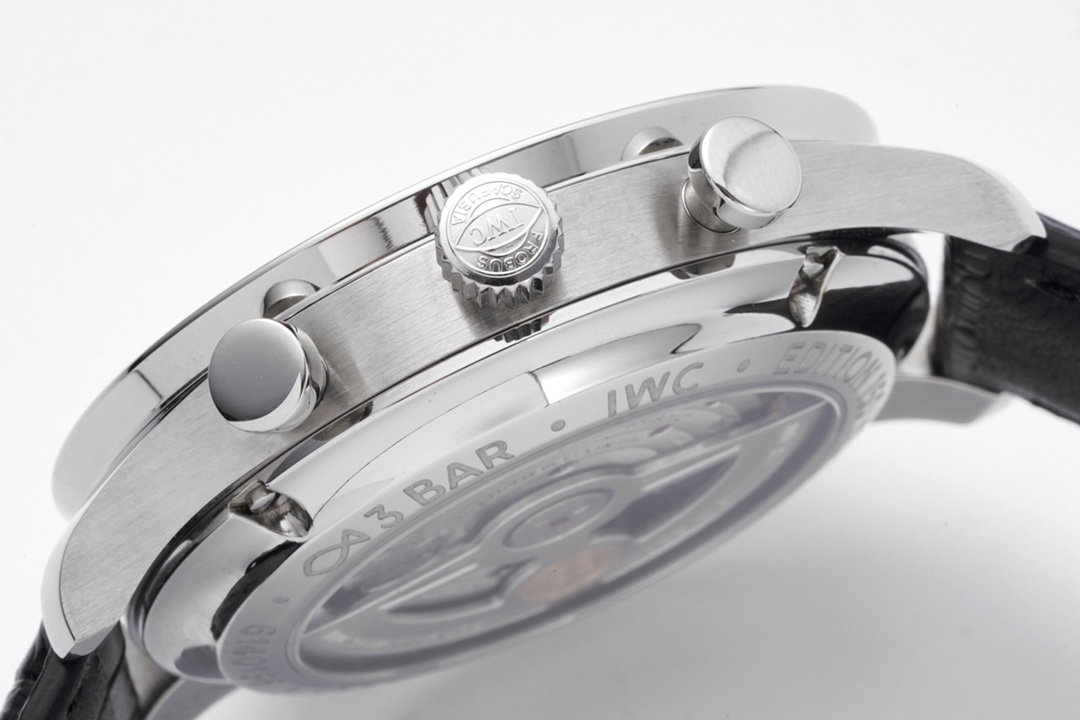
A side profile reveals thickness and crystal shape, which often expose hidden conversion layers.
If the caseback is open, a movement photo gives you architectural context. Focus on layout and density, not on rotor text.
FAQ
“How can I tell if my IWC replica uses a 7750?”
Combine layout, thickness, pusher feel, and reset alignment.
On open-back models, look for the visual density of the chronograph layer and the characteristic crowded architecture. On closed-back watches, rely on how the chronograph feels and how thick the case wears for its style.
“Is 2892 always better than 9015?”
Not always. Stability depends on assembly quality and load.
2892/SW300-type builds often win on thinness and refined feel, especially in dress watches. 9015 can be a strong value option when executed well, particularly for three-hand models where reliability matters more than cosmetic fidelity.
Judge the individual watch, not the family name.
“Can a replica really have a true 7-day reserve?”
Some can deliver multi-day performance. Fewer are consistent at a full week.
The only reliable method is runtime testing. Ignore the indicator. Fully wind the watch and measure how long it actually runs.
“Closed caseback—am I stuck?”
No.
Use behavior tests, thickness on the wrist, crown feel, and complication logic. These cues, taken together, usually narrow the movement family with surprising accuracy.
Conclusion: The Practical Truth in One Paragraph
Identifying what movement your IWC replica uses is not about trusting labels or chasing engravings; it is about reading architecture through layout, thickness, crown and pusher feel, and—above all—how the watch behaves over time, and while we can explain how it’s built and how it tends to behave, how you balance appearance, function, and long-term risk is a decision only you can make.
Related IWC Articles: If you found this helpful, you might also enjoy ZF IWC Portofino Chronograph Review: Where the Elegance Holds—and Where the 7750 Shows, and IWC Replica Movements Explained (7750, 2892 & 7-Day Power Reserve). You may also like IWC Replica Power Reserve & Stability Rankings (2026): Which Movement Is Best for Daily Wear?, and 2023 IWC Ingenieur 40mm Replica Review (V7 Factory).