
Why ZF Matters in IWC Replicas (Context, Not Hype)
The “top factory” label is meaningless unless you define systems
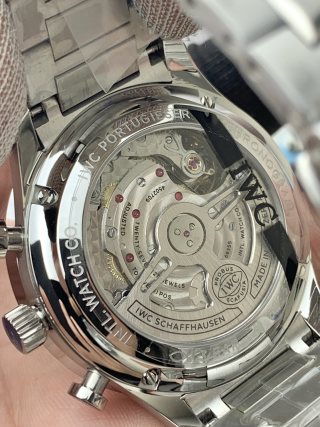
Tips
If you approach IWC replicas through glamour shots and macro finishing photos, you will miss what actually determines quality. These watches live or die by architecture. Case geometry has to carry the design. Dial discipline has to survive close inspection. Movement behavior has to remain stable once the watch is worn, wound, and allowed to run under real load. None of that shows up in a single polished product image.
For the purposes of this article, “quality” means five things that can be tested in hand: alignment tolerance across hands and indices, dial printing clarity under magnification, date window correctness, chronograph reset geometry, and long-reserve stability after the first day of running. Everything else is secondary. A mirror polish does not save a drifting minute track. Decorative rotor engraving does not compensate for a chronograph hand that refuses to land at zero.
ZF matters because they tend to build watches that survive those tests more often than most, and as discussed in the MKS Portofino movement behavior and reliability evaluation, that does not mean ZF is universally best across every IWC subfamily — it means their strongest models show fewer system-level failures once the watch leaves the bench and enters daily rotation, and in practical terms they produce fewer pieces that look convincing in photos but fall apart in behavior.
Where ZF historically wins in IWC
Tips
ZF’s reputation is not built on obscure references or experimental releases. It comes from Portugieser dress lines and the core pilot icons. Those families reward restraint, geometry, and printing accuracy, which happen to align with ZF’s strengths.
More importantly, ZF tends to deliver consistency. Their advantage is not the occasional perfect sample. It is the repeatability of acceptable QC across batches. When you handle enough pieces over time, you start to value factories that produce fewer surprises. ZF usually fits that profile. You still need to inspect every watch, but the baseline tends to be higher, especially on their staple models.
That consistency also shapes ownership experience. Watches that arrive properly aligned, with stable hands and disciplined dials, stay that way longer. You spend less time chasing small corrections and more time actually wearing the watch.
ZF Factory Profile: What They Actually Build Well
Product philosophy: “visible surfaces first”
Tips
ZF generally prioritizes the parts of an IWC that betray authenticity fastest. Dial printing comes first because IWC designs are unforgiving. Case polishing discipline follows because sloppy transitions between brushed and polished planes instantly cheapen the watch. Crystal behavior matters because poor anti-reflective coating turns a clean dial into a cloudy mirror.
This focus is pragmatic. IWC replicas do not usually fail because of exotic internal tolerances. They fail because the dial looks soft, the case edges blur together, or the crystal throws a muddy purple haze instead of a controlled flash. ZF tends to invest where the eye lands first, and that choice shows up in day-to-day wear more than any marketing claim.
The movement reality: what ZF tends to use by category
Tips
Across their IWC lineup, ZF relies on three broad movement strategies, each with its own behavior profile.
Simple three-hand models usually run on dependable base automatics. These are serviceable, predictable, and low drama. When properly assembled, they keep time well and tolerate daily winding without complaint. They are not exotic, but they rarely create ownership headaches.
Chronographs built on the 7750 family live or die by execution. Reset alignment, hand stack clearance, and thickness management matter more than the movement name. A well-assembled 7750 chronograph feels solid. A sloppy one announces itself immediately through inconsistent pusher feel, drifting hands, or excessive case height.
Long power-reserve models change the equation entirely. Here, stability depends on the day-2 torque curve, not the advertised “seven days.” A watch that looks impressive on paper but loses amplitude after the first full day will never feel trustworthy on the wrist. With these models, ZF’s success comes from keeping the power delivery smooth once the novelty of full wind wears off.
The buyer implication is simple. The more display features you add—power reserve indicators, dual subdials, extended autonomy—the more aggressively you need to test behavior under load. Complication increases exposure. ZF handles that exposure better than many, but no factory makes complexity free.
Pricing banding (broad, no platform talk)
Tips
ZF pricing generally falls into three practical tiers.
Three-hand dress and pilot models sit in an entry-high range. They cost more than generic builds because dial tooling and case finishing are not cheap, but they remain accessible.
Chronographs move into the upper mid to high range. The added cost reflects movement modification, thicker case machining, and the labor required to align multiple hands and subdials correctly.
Long-reserve models occupy the high tier. Custom dial layouts, reinforced winding systems, and deeper movement work all add expense. You are paying for architecture, not just parts.
Those bands exist for a reason. Custom dial tooling, disciplined case finishing, and movement modification depth are where real money goes. When pricing drops too far below these ranges, something structural has usually been removed.
How to Judge a ZF IWC Replica Like a Watchmaker (The Test Protocol)
Dial discipline (IWC is unforgiving here)
Tips
Start with the dial because IWC gives you nowhere to hide. Under phone zoom, printed text should show crisp edges with no ink spread. Minute track spacing must remain consistent around the entire circumference. Applied indices need to sit level, without tilt or uneven seating.
IWC designs are clean by intent. That means a single error becomes the whole watch. A soft logo, a wandering track, or a leaning marker immediately dominates your perception. ZF usually performs well here, but you still need to verify every piece.
Date window: the fastest honesty test
Tips
The date window exposes shortcuts faster than almost anything else. Use the bevel, font, and centering triad.
The bevel edge should be sharp and well defined, not rounded or fuzzy. The date font must match IWC’s thin, upright style. Pay attention to the shapes of “2,” “4,” and “7.” These numerals reveal font mismatches quickly. Finally, centering must remain stable across three or four date changes. A window that looks fine on one date but drifts on another usually indicates mixed components.
This happens because date parts are frequently swapped across batches. Treat the date as a moving target, not a single snapshot.
Crystal + AR: controlled flash vs cheap haze
Tips
Good anti-reflective coating produces a controlled blue flash at angles. Poor coating shows up as patchy purple haze that floats across the dial.
This is not just cosmetic. Uneven AR makes the watch harder to read and amplifies dial flaws. In practice, AR can vary by batch even within the same factory. Treat it as a QC checkpoint, not a fixed specification. If the reflections look inconsistent, assume older stock or mixed components.
Case geometry + finishing: where ZF can look “real” or “toy”
Tips
Use a straight-line reflection test. Hold the watch near a window frame or any hard edge and watch how the line bends across the case. Distortion reveals sloppy polishing immediately.
Then study edge transitions. IWC cases rely on clean breaks between brushed and polished planes. Those transitions should feel intentional, not melted together. When the geometry is right, the watch carries weight and presence. When it is wrong, even perfect dials start to feel toy-like.
ZF often gets these transitions right on their core models. When they miss, it shows quickly in reflections and in how the watch sits on the wrist. That is why case geometry deserves as much attention as any movement spec.
Deep Dives by Series (ZF’s Headliners)
ZF Portugieser 7-Day (IW5007 / IW5009 Family): Where Marketing Claims Get Punished
What the genuine watch demands
Long-reserve architecture is not about headline numbers. It is a systems problem. Winding efficiency has to feed a torque curve that stays usable after the first day, and the power-reserve linkage has to translate that energy honestly onto the dial without stutter or lag. When any one of those elements drifts, the whole concept collapses.
Real-world success does not mean squeezing out seven theoretical days on a bench. It means stable amplitude and predictable timekeeping on day two and day three, when the mainspring is no longer riding its strongest segment. That is the phase where replicas reveal themselves. Watches that feel impressive right after a full wind often lose composure once they settle into normal wear.
ZF strengths in Portugieser 7-Day builds
ZF tends to get the visible architecture right. Subdial symmetry usually reads balanced, the power-reserve scale remains legible across its full sweep, and the case profile avoids the swollen midcase look that ruins so many long-reserve replicas.
On wrist, a good ZF example still reads as a dress watch. The lugs fall naturally, the head does not dominate the strap, and the watch does not pitch forward. That matters more than any internal claim. If a seven-day replica looks thick and top-heavy from arm’s length, it has already failed its purpose, regardless of how impressive the movement sounds on paper.
Dial execution is another consistent strength; as outlined in the IWC replica quality-control layout and print discipline criteria, printing tends to stay crisp, applied elements usually sit level, and the overall layout preserves the calm symmetry that defines this model family, so when ZF is on a strong batch the watch feels composed rather than engineered.
Known risk points (what usually fails first)
Failures here are rarely dramatic. They arrive quietly.
Winding modules develop noise or resistance as tolerances loosen. Power-reserve hands begin to stutter or move in uneven steps instead of tracing a smooth arc. Date changes drift toward inconsistency near midnight, especially on pieces that have seen repeated manual setting.
None of this makes the watch unusable, but it changes ownership. The rule is simple: long-reserve replicas are serviceable, not ignore-and-forget. If you treat them like sealed appliances, they will disappoint you. If you approach them as mechanical systems that benefit from occasional attention, they remain enjoyable.
Acceptance tests before you approve QC
Start with the crown. Wind from low to mid reserve and pay attention to feel. Any grinding, uneven resistance, or sudden changes in tension suggest assembly issues upstream.
Track timekeeping over a full 24 hours rather than a quick desk check. You are looking for stability, not perfection. Observe the power-reserve hand during that period. It should travel smoothly, without pauses or jumps.
Finally, verify date behavior. Confirm alignment at the window and watch the changeover window around midnight. Whether your reference places the date at six or three, the logic is the same: centering must remain consistent, and the transition should complete cleanly rather than dragging on into the early hours.
ZF Portugieser Chronograph (IW3714 / IW3716 Family): The Thinness and Reset Alignment Trap
Why this model exposes factories
This is a clean-dial chronograph. There is nowhere to hide. Any reset misalignment jumps out immediately, and any excess thickness destroys the dress-chronograph character.
More than most chronos, this watch has to pass an under-cuff test. If it snags on a shirt sleeve or sits tall on the wrist, it stops behaving like a Portugieser and starts behaving like a tool watch. That single failure overrides every other detail.
ZF strengths (what to check if it’s truly a good batch)
Strong ZF batches show disciplined dial printing and properly concentric subdial rings. Those rings should sit perfectly centered, without oval distortion or uneven spacing. Hand stack clearance matters just as much. The central seconds and subdial hands must pass cleanly over each other and over printed markers, with no scraping or hesitation.
Pusher feel is another tell. Start, stop, and reset should each have their own character. Start and stop should feel similar to each other, while reset should snap decisively. When all three actions blur together, assembly quality is usually the culprit.
The chrono truth: what matters more than “movement name”
Behavior matters more than branding.
Run five start–stop cycles in a row. The action should feel consistent each time, not progressively softer or harsher. After each reset, the chronograph seconds and subdials must land exactly at zero. Near-zero is not good enough on a watch with this much empty dial space.
A soft reset is the red flag to remember. When the hands drift back instead of snapping home, you are seeing weak heart-cam tension or careless assembly. That issue does not improve with wear. It gets worse.
QC Checklist (strict, Portugieser Chrono-specific)
Begin with the dial. Printing should remain crisp under magnification, subdial rings must be perfectly concentric, and the date should sit centered in its window.
Move to the chronograph. Verify reset alignment on all hands. Run the watch for ten to fifteen minutes and watch for stutter. Test pusher resistance for consistency across cycles.
Finish with the case. Use a straight-line reflection to check polish distortion, and inspect bezel edges for sharp, intentional transitions. A Portugieser Chronograph only works when thinness, alignment, and surface discipline come together. Miss any one of those, and the watch never fully convinces.
ZF Big Pilot (IW5009 / IW5007 / IW5010 Family): Presence Is Easy, Behavior Is Hard
What makes Big Pilot replicas fail even when they look good
Big watches amplify small errors. A crown tube that sits half a millimeter off axis suddenly becomes obvious. Hands that barely clear printed numerals start to scrape once the case flexes on wrist. Strap fit and lug geometry reveal themselves through tiny gaps that would go unnoticed on a 40 mm case but look careless on a 46 mm pilot.
The underlying problem is wear physics. A Big Pilot carries a heavy head on a wide strap. That mass creates leverage. Hardware works harder. Spring bars take more load. Leather fatigues faster. Any weakness in alignment or finishing accelerates once the watch enters daily rotation. Many replicas look impressive in photos and fail six months later because the system was never balanced for real use.
This is why Big Pilot ownership exposes factories. You are not just judging a dial and case. You are judging how the whole assembly behaves under weight.
ZF strengths that create the “icon read”
When ZF gets a Big Pilot right, the watch reads as an icon from across the room. Dial typography stays disciplined, with numerals that feel deliberate rather than stamped. Matte dial texture avoids chalkiness and holds light evenly. The oversized crown carries the correct bulbous shape and finishing, which matters more than most people realize because it defines the tactile identity of the watch.
Case lines and lug length proportions are another quiet strength. On good ZF batches, the lugs fall naturally and the midcase does not balloon. That keeps the watch planted on wrist instead of perching on top of it. These are not flashy victories. They are proportional ones. But they are what separate a wearable Big Pilot from a novelty object.
Big Pilot–specific acceptance tests
Start with winding feel. From roughly zero to about 80 percent reserve, the crown should turn smoothly, without dry spots or sudden resistance. Any grinding sensation usually points to winding train issues that will only worsen with time.
Watch the power-reserve hand through that process. It should move in a continuous, predictable arc. Stutter or uneven travel signals linkage problems that tend to appear early on long-reserve builds.
Check date alignment carefully, especially on references that place the date at six. Centering needs to hold across multiple changes, not just on a single day. Then move to the strap hardware. Spring bars must seat securely. Buckles should close square, without twist. Lugs should meet the strap flush, without daylight showing through the joint.
A Big Pilot that passes these tests will age reasonably. One that does not will slowly come apart at the edges.
Why Mark models punish lazy assembly
Mark watches look simple. That simplicity is exactly what makes them brutal.
With a clean three-hand layout, every tolerance becomes visible, and as highlighted in the comparative IWC replica factory fitment and dial precision criteria, the minute hand must land precisely on its markers, date fonts have nowhere to hide, dial printing sharpness becomes the entire story—there are no subdials to distract the eye and no complications to soften mistakes, so a Mark that is off by a fraction of a degree looks wrong immediately.
This is why many factories struggle here. The model does not reward shortcuts.
What ZF gets right (and where other factories sometimes edge it)
ZF can be excellent on Mark builds, especially in dial clarity and overall case feel. Their better batches show strong printing discipline and solid crown action, which goes a long way toward making the watch feel legitimate in daily wear.
That said, this is also a category where other factories sometimes edge ZF depending on the year and reference. Some runs from competitors have matched or surpassed ZF in hand alignment or date execution. The honest approach is to judge the individual sample, not the logo on the box. Mark models demand that level of scrutiny.
Brand mythology does not wear on your wrist. Assembly quality does.
Mark acceptance checklist
Set the hands to exactly 12:00 and confirm that the minute hand points dead-on to its marker. Even a slight offset will haunt you every time you glance down.
Pay attention to crown threads. Smooth engagement matters. Gritty threads are not just annoying. They predict future wear at the tube.
Observe date change timing and centering. The transition should occur within a reasonable window around midnight and land square in the aperture. Finally, inspect dial print under angled light. Any fuzziness or bleed becomes obvious once reflections move across the surface.
If a Mark passes these checks, it will likely remain satisfying. If it fails them, nothing else about the watch will compensate.
ZF vs Other Top Factories in IWC: Where the Gap Is Real
ZF vs VS: movement ambition vs dial discipline
This comparison usually comes down to trade-offs.
VS often pushes movement architecture harder, experimenting with deeper mechanical implementations on certain models. ZF, on the other hand, commonly wins in visual consistency and finishing continuity, especially on core references. Depending on the watch, one approach may matter more than the other.
Avoid absolutes here. VS tends to lead in specific movement projects. ZF often leads in how complete the watch feels once assembled. The difference shows up in daily wear, not spec sheets.
ZF vs APS: engineering projects vs mature staples
APS sometimes aims at ambitious engineering exercises, particularly on complex or unusual references. When those projects land, they can be impressive. ZF’s advantage usually lies in repeatability on established models. Their staple pieces arrive more consistently aligned and ready to wear.
If you enjoy experimental builds, APS can be interesting. If you want predictable behavior on proven designs, ZF usually feels safer.
ZF vs V7 (when it applies): new model speed vs legacy coverage
V7 is often faster to market on newly released designs, which makes them relevant for certain Mark or Ingenieur discussions. ZF carries deeper legacy coverage across Portugieser and Big Pilot families.
Both approaches have merit. Just do not let comparisons in one niche derail your evaluation of ZF’s core strengths.
Durability, Service, and What Fails Over Time (Realistic, Not Fear-Based)
Water resistance: conservative rules
Replica IWC watches should be treated as splash-resistant unless you have personally pressure tested the case. Factory claims mean very little once shipping, handling, and reassembly enter the picture. Gaskets may be present, but consistency is not guaranteed.
Crown feel tells you more than any rating. A crown that feels gritty, uneven, or slightly misaligned usually points to tube issues. That same misalignment often becomes a slow leak path over time. If the crown does not seat smoothly and squarely, assume moisture risk and behave accordingly. Hand washing and rain are usually fine. Swimming and showering are not.
Straps, clasps, and daily wear
Straps fail before movements. This is especially true on Big Pilot models, where mass and leverage accelerate wear. A heavy case on a wide strap creates constant torque at the spring bars and buckle. Leather fatigues faster. Holes elongate. Hardware loosens.
Good hardware feels boring. There are no sharp edges on the underside. Clasps close with consistent resistance and lock without flex. Spring bars seat firmly and do not creak when the watch shifts on wrist. When these details are right, you forget about them. When they are wrong, you feel them every day.
Expect Big Pilot straps to age quickly. That is not a defect. It is physics. Plan for replacement as part of ownership rather than treating it as an unexpected failure.
When to service (behavior triggers)
Service decisions should follow behavior, not calendar promises.
A change in rotor noise usually comes first. What starts as a faint rasp can turn into vibration you feel through the caseback. Power-reserve drop-off is next. When a long-reserve model stops holding stable time on day two, lubrication is already past its comfort zone.
On chronographs, reset drift is the warning sign. Hands that no longer snap cleanly to zero are telling you something about cam tension and assembly wear. None of these issues require panic. They simply mean the watch has moved from “new” to “used” and would benefit from attention.
Mechanical replicas reward owners who listen to these signals early.
The ZF IWC “Truth Table”: Model Type vs Risk vs Best Use
| Model Family | Strengths (What Feels Right) | Most Common QC Fails | Ownership Risk Level | Who It’s For |
|---|---|---|---|---|
| Portugieser 7-Day | Balanced dial layout, convincing case profile, strong dress-watch presence | PR hand stutter, winding module noise, date change inconsistency | Medium–High | Owners comfortable with servicing long-reserve systems who want classic dress impact |
| Portugieser Chronograph | Clean dial execution, good thinness on strong batches, satisfying pusher feel | Soft reset, subdial misalignment, case polish distortion | Medium | Wearers who want a refined chrono and will test reset behavior before accepting |
| Big Pilot | Iconic dial typography, crown shape, proper lug proportions | Crown tube alignment, hand clearance, strap hardware fatigue | Medium | Those who value wrist presence and accept higher strap and hardware wear |
| Mark Series | Sharp printing, simple reliability when assembled well | Minute hand misalignment, date font errors, crown thread roughness | Low–Medium | Daily wear users who prefer simplicity and will inspect alignment carefully |
This table is not about ranking factories. It is about matching behavior profiles to model types. Each family carries its own compromises. Understanding them upfront saves far more time than chasing perfection later.
Should You Buy a ZF IWC Replica? Decision Rules That Don’t Lie
Buy if…
You care about dial discipline and case finishing continuity more than exotic movement claims.
You gravitate toward staple references where ZF has multiple stable iterations rather than one-off experiments.
You are willing to inspect alignment, reset behavior, and crown feel before committing.
Skip if…
You expect long-reserve models to behave like modern genuine watches without ever needing service.
You cannot tolerate even a small chance of chronograph reset quirks.
You prefer novelty over consistency.
The “one-watch rule”
If this will be your only IWC replica, choose the lowest system complexity that delivers the strongest visual payoff. Simple three-hand or clean chronograph models age more gracefully than long-reserve pieces when ownership conditions are imperfect.
FAQ
Is ZF the best factory for all IWC replicas?
No. ZF tends to excel on Portugieser dress lines and Big Pilot staples, but other factories can outperform them on specific models or production years. Judge the individual watch, not the reputation.
Which ZF Portugieser model is the safest buy?
The Portugieser Chronograph is generally the lowest-risk entry point. It balances visual impact with manageable mechanical complexity, provided reset alignment is confirmed.
Do ZF 7-day models really last 7 days?
They can approach it under ideal conditions, but real success is stable timekeeping on day two and day three. That matters far more than squeezing out a theoretical maximum.
What’s the most common tell on ZF IWC watches?
Date window execution. Bevel sharpness, font shape, and centering across multiple dates reveal more than almost any other detail.
How do I test chrono reset alignment at home?
Run several start–stop cycles, then reset. All hands must snap cleanly to zero every time. Any hesitation or near-zero landing is a warning sign.
Why does AR coating vary between batches?
Crystals are often sourced in waves. Coating quality can shift between production runs, so treat AR as a QC checkpoint rather than a fixed specification.
What should I check in QC photos before shipping?
Dial printing sharpness, date centering, hand alignment at 12:00, crown seating, and overall case symmetry. If any of these look questionable in photos, they will look worse in person.
Are ZF IWC straps and buckles “good enough,” or should I upgrade?
They are usually serviceable, but not exceptional. If comfort or longevity matters to you, upgrading straps is one of the easiest ways to improve daily wear.
A ZF IWC replica makes sense when you choose the right model for your tolerance of complexity and accept that mechanical consistency matters more than factory labels.
Related IWC Articles: If you found this helpful, you might also enjoy IWC Replica QC Guide: How to Inspect Your Watch on Arrival (A Practical Acceptance Protocol), and How Good Are IWC TOP GUN Pilot’s Chronograph Replicas?. Another related article is IWC Complication Replicas: Perpetual Calendar vs Tourbillon vs Repeater (Which Is Worth Playing With?).