
Opening: Why Ingenieur 40 Is a Replica Stress Test
Integrated-bracelet watches don’t forgive shortcuts. You can fake a dial. You can polish a case. But when the bracelet is structurally part of the watch, geometry becomes visible the moment it hits your wrist.
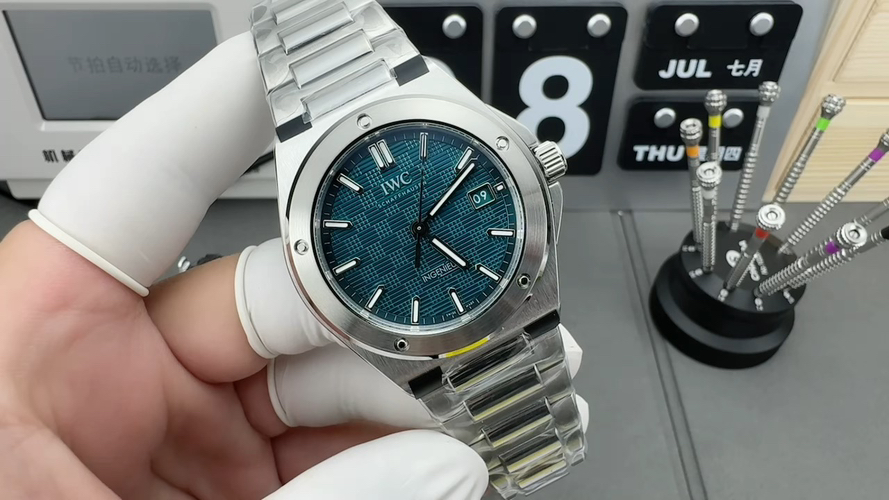
That is why the 2023 Ingenieur 40 is a stress test for any factory that claims precision. The first link angle, the way the bezel line continues into the bracelet, and how the end-links sit against the case all expose tooling quality within seconds. This review is not about whether the watch “looks similar” in photos. It is about how it wears, how it flexes under movement, and how light travels across steel surfaces when tolerances are right—or wrong.
If an integrated watch fails, it fails in motion.
The “integrated bracelet” problem (where most reps fail)
Most replica integrated bracelets behave like folded sheet metal. They hinge instead of drape. The first link drops too steeply, or not at all. End-links either sit proud of the case or leave hairline gaps that catch light at the wrong angle.
On the Ingenieur, these mistakes compound. The bezel has five exposed screws and a continuous brushed plane that visually flows into the bracelet. If the end-link height is off by half a millimeter, that flow breaks. If the first link articulation is stiff, the watch sits like a block instead of wrapping the wrist.
A correct Ingenieur does not perch. It settles.
Tips
Pay attention to three things immediately after putting it on. Check whether the first link angles naturally downward instead of forming a hard hinge. Look at both end-links from the side to confirm they sit flush with the case, not floating or biting inward. Run a finger along the underside of the first two links. Any sharp edge there means comfort will degrade fast during daily wear.
Where V7 sits in the IWC replica hierarchy
IWC replicas tend to divide by specialization rather than overall dominance. ZF built its reputation on Portuguese and pilot icons. Other factories focus on chronographs or ceramic cases. V7’s strength has been new-generation IWC execution: modern case geometry, integrated bracelets, and tighter finishing continuity across multiple surfaces.
That context matters: this is not about declaring a universal winner but about whether V7 understands this specific watch well enough to reproduce its behavior, not just its outline, as the nuances of case dynamics and stack interaction discussed in the IWC Big Pilot replica vertical clearance and performance review demonstrate.
On the Ingenieur 40, V7 is attempting something different from traditional IWC replicas. This model depends less on dial theatrics and more on how steel components interact. That plays directly into V7’s recent development focus.
Model Identity: What We’re Reviewing (So Specs Don’t Get Fuzzy)
Reference family and design cues
This is the Ingenieur Automatic 40 introduced in 2023. It carries the modern integrated-bracelet format with a five-screw bezel, textured dial, and compact sports proportions. Case diameter sits in the 40mm class, but the defining trait is thinness relative to footprint. This watch only feels right when thickness stays restrained and the bracelet becomes an extension of the mid-case.
Design-wise, everything revolves around continuity. The bezel brushing must align with the case flank. The first bracelet link must pick up that same direction. The dial texture must react to light without turning cartoonish. Any single element done in isolation breaks the illusion.
Tips
Treat this as a 40mm integrated sports watch, not a conventional three-hand piece. Thinness matters more than diameter here. If the case feels tall, the entire design language collapses.
Version naming (V7 “batch” reality)
V7 does not announce every revision. Dial texture depth, date wheel color, and bracelet finishing often change quietly between production runs. There is no consistent public versioning. What circulates as “latest batch” is usually just the most recent shipment.
That means judgment should always land on the individual unit, not on rumors about upgrades.
Tips
Build a simple rule for yourself. Always verify three batch tells in person or via detailed photos: dial color tone under angled light, date wheel background color against the dial, and bracelet surface finishing on the first two links. If any of these look inconsistent with known good examples, assume you are seeing an older or transitional batch.
First-Wear Reality: Does It Actually Feel Like an Ingenieur?
Wrist stance and balance (the first-link test)
The first ten seconds on the wrist tell you almost everything.
A correct Ingenieur stance feels planted but not stiff. The bracelet should begin its curve immediately after leaving the case, allowing the watch head to settle into the top of the wrist rather than hovering above it. The first link must articulate smoothly, creating a natural arc instead of a mechanical bend.
On the V7, when geometry is right, the case distributes weight evenly across the first three links. You do not feel the watch fighting gravity. You feel it finding its place.
When geometry is wrong, the head feels top-heavy, and the bracelet behaves like a rigid appendage.
Tips
Look for a shallow, controlled first-link angle rather than a dramatic drop. Check both sides for end-link symmetry. Turn your wrist palm-up and feel the underside. Any sharp transition at the case-to-bracelet junction predicts long-term discomfort.
Bracelet comfort and noise (micro-behavior)
Comfort on integrated watches lives in micro-behavior. It shows up as squeaks when the bracelet twists, faint rattles inside the clasp, or a gritty sensation when links articulate under load.
A well-executed bracelet moves continuously. There should be resistance, but no stepping. When you lightly twist the bracelet between two fingers, it should glide through its range rather than jumping from position to position.
On a good V7 example, articulation feels damped. There is movement, but it is controlled. Clasp closure sounds muted, not hollow. During daily wear, the bracelet stays quiet even when typing or reaching.
Poor examples announce themselves acoustically.
Tips
Perform a simple twist test. Hold the watch head in one hand and gently rotate the bracelet with the other. You are looking for smooth travel. If you feel discrete clicks or hear metal-on-metal chatter, tolerances are not where they should be. Then close the clasp near your ear. A solid clasp gives a low, contained sound. A cheap one rings.
Case & Bezel Engineering: The 5-Screw Bezel Is the Lie Detector
On the Ingenieur, nothing exposes manufacturing discipline faster than the bezel. Five screws, evenly spaced, sitting inside a brushed ring that must flow directly into the bracelet. There is nowhere to hide. Any shortcut shows up as asymmetry, glare, or uneven transitions.
A good V7 example reads calm from arm’s length. The bezel feels like a single engineered surface, not a collection of parts. Poor ones feel busy, even when you can’t immediately explain why.
Bezel screws: alignment, depth, and tool cut
The screws are not decorative. They act as visual anchors. When they are right, the watch looks composed. When they are wrong, everything feels off.
On a properly finished bezel, all five screws sit at the same depth. The slots show consistent orientation. The recess around each screw carries the same brushing as the rest of the bezel, without halos or burnished rings.
What breaks the illusion is inconsistency. One screw slightly proud. Another sunk too deep. Slots cut too aggressively so the edges look sharp instead of controlled. These “overcut” slots catch light differently and make the bezel feel cheap.
On strong V7 units, the screws look like they were installed by a jig, not by hand. On weaker ones, they look individually negotiated.
Tips
Inspect screw depth from a shallow angle, not straight on. Look for random slot orientation and overly sharp slot edges. Pay attention to the finishing inside each screw recess. If it doesn’t match the surrounding brushing, you are seeing compromised tooling.
Case brushing and edge definition
Integrated sports watches live or die by line discipline.
The brushing direction must stay coherent as it moves from bezel to mid-case to first bracelet link. Transitions should feel intentional. Edges should be crisp where the design calls for crispness, and softened only where comfort demands it.
The most common replica failure here is rounding. Factories over-polish edges to speed finishing, and the watch loses its architectural sharpness. On the Ingenieur, that turns a confident industrial profile into something vaguely melted.
A good V7 case shows controlled contrast. Flat surfaces remain flat. Brushed planes stay straight. The edge where bezel meets case reads as a line, not a blur.
Tips
Trace the brushing with your eyes from the bezel into the bracelet. Any change in direction or texture breaks continuity. Feel the top edges of the case. If they feel overly soft, the watch will age poorly and lose definition fast.
Crystal and anti-reflection (AR) behavior
AR quality is not about blue tint. It is about how the dial behaves under moving light.
On a proper crystal, reflections fall away at angles, allowing the dial texture to remain legible. On inferior coatings, the dial turns milky or washed out when light hits from the side.
With the V7 Ingenieur, good examples preserve contrast even under strong indoor lighting. You still see the dial pattern. You still read the indices clearly. Weak examples bloom with haze, especially near the edges.
This matters because the Ingenieur relies on subtle dial texture. If the crystal kills that, half the watch disappears.
Tips
Tilt the watch slowly under a ceiling light. Watch how reflections slide off the surface. If the dial loses clarity or looks foggy at moderate angles, the coating is doing more harm than good.
Dial Deep Dive: Texture, Printing, and “Light Behavior”
The Ingenieur dial does not shout. It whispers through texture and proportion. That makes it unforgiving.
A replica can get the color right and still fail completely if the texture behaves incorrectly in light.
Dial texture pattern (grid/waffle behavior under angled light)
You evaluate this dial by motion, not by still photos.
Rotate your wrist slowly and observe how the grid pattern wakes up and goes quiet: on a convincing dial the texture appears and disappears in bands as light moves across it, and the layered surface behavior described in the IWC Portuguese 7 Days IW5007 replica surface finish and dial texture review makes it feel layered, not stamped. Common replica errors fall into two extremes — too shallow, and the dial looks flat and lifeless; too deep, and it turns cartoonish, with shadows that feel exaggerated and fake — whereas the better V7 dials sit in the middle, with texture that has presence but does not dominate, supporting the design rather than performing for attention.
Tips
Judge the dial while walking past a window or light source. You want to see controlled shifts, not sudden flashes. If the texture looks the same from every angle, it is too shallow. If it throws harsh shadows, it is too deep.
Logo, text weight, and spacing
This is where many replicas quietly betray themselves.

If the text is too bold, the watch reads cheap from thirty centimeters away. If spacing is off, the whole dial feels crowded even when you can’t immediately articulate why.
On the Ingenieur, pay close attention to the “Ingenieur” script and its relationship to the minute track. The lettering should feel balanced within the available space, not pushed upward or squeezed.
V7 generally gets the macro proportions right. The failures tend to appear in minor batches where print weight drifts thicker than it should.
Tips
Step back and look at the dial as a whole. If your eye keeps getting pulled to the logo instead of the texture and indices, something is wrong. Then zoom in and check spacing between the text and the minute markers.
Indices and lume application
Brightness does not equal quality. Edge discipline does.
Clean lume application shows sharp borders and even fill inside each index. Sloppy lume bleeds, pools, or leaves uneven edges that catch light unpredictably.
Hands and markers should also agree in color. When the lume tone differs between them, the watch looks assembled rather than designed.
Good V7 examples show tidy lume work. Weak ones reveal themselves through fuzzy borders or mismatched hues.
Tips
Inspect lume in daylight first, not in the dark. Look at the edges of each index. Any waviness or overflow will become more obvious over time as dirt and moisture collect.
Hands & Date: Small Parts That Break the Illusion
Hands and date components are tiny, but they govern how the watch feels in use. This is where mechanical sloppiness becomes visible.
Hand shape, polish, and pinion fit
Start with the seconds hand. It should track cleanly without lateral wobble. Any visible oscillation usually means poor pinion fit or uneven hand mounting.
Then check the hour and minute hands. They should clear the indices comfortably and pass over each other without grazing. Tight tolerances matter here. Poor clearance leads to intermittent contact that shows up as timekeeping irregularities later.
Polish quality also counts. On the Ingenieur, hands should reflect light smoothly, not in broken patches.
Tips
Watch the seconds hand closely for a full minute. Look for side-to-side movement. Then set the time and rotate the hands past each other, paying attention to clearance near the indices.
Date window and date wheel font
Date alignment is the silent killer.
Many replicas look acceptable until you notice the date sitting slightly high or low in the window. Once you see it, you cannot unsee it.
Font weight matters just as much. The Ingenieur dial carries a restrained, technical tone. Thick or clumsy date numerals destroy that balance and make the watch feel loud.
V7 generally keeps centering under control, but this is still a unit-by-unit check.
Tips
Scroll through multiple dates, not just one. Some wheels center well on certain numbers and drift on others. Evaluate the font at arm’s length. If it feels heavy, the calm industrial look is already compromised.
Movement Reality: What’s Inside V7 Ingenieur 40, and What That Means
This watch lives or dies on case thickness and stability. That reality shapes the movement choice more than marketing narratives ever will.
Claimed movement type vs typical architecture in the market
Most Ingenieur 40 replicas rely on a dependable automatic base rather than chasing visual clones. That is not a weakness. It is a practical decision.
Thin integrated watches leave no room for fantasy bridges or decorative plates that compromise dimensions. A stable, serviceable caliber that fits the case correctly will always outperform a cosmetically ambitious one that forces the watch to grow thicker.
The sensible rule here is simple. Prioritize reliability, ease of service, and correct profile over engraved promises.
A watch that feels right on the wrist will outlive one that merely looks impressive through a display back.
Tips
Ignore rotor engraving and marketing language. Ask whether the case thickness matches expectations and whether parts are commonly available. Those two factors matter more over years of ownership than any decorative flourish.
Functional testing you can do at home (no tools)
Start with winding. The crown should turn smoothly, without grinding or sudden resistance.
Move to time-setting. The crown should feel secure in each position. The minute hand should advance predictably, not jump backward when you release pressure.
Test the date. Quickset should engage cleanly, and the midnight change should occur decisively rather than dragging across an hour.
These behaviors tell you far more about assembly quality than any spec sheet.
Tips
Perform these checks slowly. Mechanical problems often hide at speed. Pay attention to tactile feedback through the crown. It is your direct connection to the movement.
Timekeeping expectations (realistic, not fantasy)
Expect consistency, not perfection.
A well-regulated example should hold steady within a reasonable daily window. More important than absolute numbers is whether it behaves the same day after day.
Thin integrated watches also reveal rotor noise and winding efficiency quickly. You will hear and feel the movement during normal activity. That feedback is part of ownership. Excessive rattle or lazy winding usually shows up within the first week.
Tips
Wear the watch continuously for several days and note both time drift and rotor behavior. Sudden changes are more concerning than modest offsets. Consistency is the real benchmark.
Comparison Block: V7 vs Other Factories (How to Judge Without Fanboying)
This model attracts brand loyalty fast, but the Ingenieur 40 rewards system-level thinking, not factory slogans. You don’t compare these watches by logo placement or spec sheets. You compare them by how their parts behave together.
V7 vs TW (the common cross-shop)
Most people end up choosing between V7 and TW. Both produce convincing Ingenieur 40s. The difference shows up in how consistently each system is executed.
Bracelet articulation is where V7 usually pulls ahead. On good V7 examples, the first three links move as a unit, creating a smooth drape that lets the case settle naturally. TW bracelets tend to feel slightly more segmented. They still wear fine, but the transition from case to bracelet feels more mechanical.
Bezel screw execution favors V7. Slot depth and recess finishing tend to look more uniform, which gives the bezel a calmer, more engineered appearance. TW screws sometimes show minor depth variation that only becomes obvious under angled light.
Dial texture depth is closer than many expect. TW occasionally produces dials with slightly deeper stamping, which some people prefer visually. V7 tends to stay closer to the restrained industrial look of the original. This is not a universal win for either side. It comes down to whether you value subtlety or contrast.
Clasp feel is another separator. V7 clasps usually close with a more muted, solid response. TW clasps can feel lighter and sometimes sound hollow, even when they lock securely.
None of this makes TW “bad.” It simply defines where each factory spends its tolerance budget.
Tips
Compare by systems, not by marketing. Evaluate bracelet articulation, bezel screw consistency, dial texture depth, and clasp feedback separately. Let each category stand on its own. Avoid declaring a blanket winner when the differences are clearly distributed.
V7 vs older Ingenieur-style reps (why 2023 is different)
Earlier Ingenieur-inspired replicas struggled with integrated geometry. End-links floated. First links hinged. Bezel planes failed to align with bracelet brushing. Those watches looked acceptable in isolation but collapsed in motion.
The 2023 format exposes all of that.
Modern V7 and TW examples benefit from tighter machining tolerances, more disciplined surface finishing, and better continuity between components. You see fewer toy-like reflections. Edges carry intent. Brushing flows instead of stopping abruptly at component boundaries.
This is not incremental improvement. It is a structural shift. Integrated sports watches punish sloppy tooling, and recent factories have finally adapted to that reality.
Tips
If you are comparing against older Ingenieur-style pieces, focus on how the bezel transitions into the bracelet and how the first link behaves under gravity. Those two areas alone explain why current-generation replicas feel fundamentally different.
QC Checklist Before You Accept (Ingenieur-Specific, Strict)
Integrated watches leave less room for forgiveness. Small flaws compound quickly in daily wear. These checks are not optional if you care about long-term satisfaction.
Case/bracelet acceptance checks
Both end-links must sit flush against the case, with no visible gaps on either side. The first link should droop symmetrically when the watch is held horizontally. Any imbalance there will translate into uneven wrist stance.
Run a finger along the underside of the bracelet near the case. Sharp edges predict discomfort and accelerated wear.
Close the clasp repeatedly and it should lock with the same authority every time; any half-click behavior usually gets worse, not better, as explained in the functional wear and hardware engagement section of the IWC replica watches series comparison for Portuguese, Pilot, Ingenieur, and Portofino clasp reliability analysis, because inconsistent engagement often indicates tolerance drift in the locking mechanism.
Tips
Perform these checks before sizing the bracelet. Once links are removed, people tend to rationalize problems instead of addressing them.
Dial/hands acceptance checks
Rotate the watch under light and confirm that dial texture appears even across the surface. Look for indices that drift relative to the minute track.
Observe the seconds hand closely. Any wobble indicates poor hand seating. Then cycle the hour and minute hands past each other to confirm clearance near the indices.
Tips
Use angled light, not straight-on inspection. Many alignment issues only appear when shadows move.
Movement/function acceptance checks
Cycle through all crown positions. Each should feel defined, without lateral wobble or gritty threading.
Scroll through multiple dates, not just one, and confirm centering across the wheel. Then perform a gentle rotor noise test by lightly shaking the watch. A soft presence is normal. Excessive rattle is not.
Tips
Trust tactile feedback. Your fingers often detect assembly issues before your eyes do.
Ownership Reality: Water Resistance, Durability, and Service
Water resistance: what to assume
The conservative rule is simple. Treat the watch as splash-resistant unless it has been professionally pressure tested.
Integrated bracelet watches tend to be worn daily. Sweat, humidity, and hand washing matter more than swimming. Over time, moisture exposure through the crown and caseback has a greater impact on reliability than any single water event.
Tips
Dry the watch after heavy wear days. If you plan regular water exposure, proper testing is not optional.
Long-term wear points
Bracelet screws gradually loosen. Clasps pick up play. Bezel screws lose cosmetic sharpness from contact and cleaning.
Inside the case, rotor noise and winding efficiency are the first mechanical changes most owners notice. These shifts usually arrive slowly, then suddenly feel obvious.
None of this is dramatic. It is the normal aging pattern of thin automatic sports watches.
Tips
Check bracelet screws periodically and listen to the movement during quiet moments. Small maintenance habits extend usable life more than any initial specification.
“Tell” Section: What Still Gives a Good Rep Away
Even strong replicas leave traces. The key is knowing which ones matter in real life.
The three fastest tells in real life
Bracelet drape and clasp sound come first. People notice how the watch settles and how it closes, even if they don’t know why.
Next is bezel screw finishing. Inconsistent depth or harsh slot cuts catch light in ways that feel wrong.
Finally, dial texture light shift. When the texture behaves unnaturally under movement, the illusion collapses.
These three signals surface within minutes of handling the watch.
Tips
Pay attention to motion and sound, not static appearance. Integrated watches reveal themselves through behavior.
The microscope tells (only for collectors)
Under magnification, printing edges show their limits. Date fonts reveal subtle weight differences. Brushing transitions expose whether surfaces were finished together or separately.
These details matter to collectors, but they rarely affect daily enjoyment.
Tips
Use macro inspection for curiosity, not for deciding whether a watch feels right on your wrist.
Engineering Summary: The Decision Rule (Judgment-Forward Close)
A clean verdict framework
If you want the Ingenieur feeling, prioritize bracelet geometry before anything else. If you chase a pretty dial photo, you will overlook the real tells and regret it later.
We can show how it’s built and how it behaves—but how it fits into your life is a decision only you can make.
Related IWC Articles: If you found this helpful, you might also enjoy Beyond the Big Three: APS, YL, and Other Niche IWC Replica Factories Explained, and ZF IWC Portofino Chronograph Review: Where the Elegance Holds—and Where the 7750 Shows. You may also like IWC Replica Chronograph Movement Guide: Asian 7750 Reliability, Weak Points, and Care, and Best IWC Replica Factories Compared (ZF vs V7 vs MKS & Others).