
The Real Context: Why “ZF vs V7” Is a Legit Question in IWC Replicas
IWC replicas don’t have one “best factory”
Tips
There is no single factory that “wins” IWC across the board, and anyone telling you otherwise is flattening a much more practical reality.
IWC replicas present two very different problem types. The first is dress and precision work: dial printing sharpness, overall thinness, date-window behavior, and how quietly the watch wears under a cuff. These models expose micro-errors fast. A slightly off-center date, uneven ink on numerals, or a case that carries half a millimeter too much height will bother you every single day.
The second is architecture: chronograph layout, long power-reserve systems, and modern integrated bracelet geometry. These watches punish shortcuts in different ways. Here the issues show up in pusher feel, reset accuracy, bracelet articulation, or how the case transitions from brushed to polished surfaces.
ZF and V7 specialize on opposite sides of that divide.
ZF built its reputation on mature references and complication-heavy dress pieces. Portuguese Chronograph, 7-Day power reserve, Big Pilot lineage—these are watches where ZF has years of iteration behind them. Their strength comes from accumulated version history: dial layouts refined across releases, case dimensions corrected over time, and movement integrations that improve incrementally rather than radically.
V7 took a different path. Instead of building a wide legacy catalog, they concentrated on newer-generation IWC releases and modern sports cases. Their focus shows up in surface finishing, alignment consistency, and how clean everything looks straight out of the box. Where ZF evolves slowly across generations, V7 tends to arrive sharper on day one.
The only stance that survives real ownership is this: factory strength is model-dependent, and what matters is where your specific reference punishes shortcuts.
If the watch lives or dies by dial discipline and date behavior, ZF usually brings deeper historical refinement. If the watch is a modern daily where case geometry and finishing quality define the experience, V7 often looks cleaner before you’ve even set the time.
What this comparison covers (and what it does not)
Tips
This comparison rests on three pillars only: external execution, movement behavior, and stability over time.
External execution means geometry, printing, alignments, reflections, and tactile feel. Movement behavior means winding resistance, setting friction, chronograph engagement, and how the date changes in real use. Stability and risk means QC variance, common failure points, serviceability, and how forgiving the watch is after months of wear.
What it does not include is forum reputation, reseller narratives, or popularity cycles. Those change faster than the watches themselves.
Every judgment here comes from measurable checks you can perform at home and from repeated ownership patterns, not from brand loyalty or factory mythology. Purchase platforms are intentionally excluded because where you buy does not change how a crown thread feels or whether a date disc sits straight.
Factory Profiles: How ZF and V7 “Think” Differently
ZF Factory: mature IWC portfolio, dress tolerances, complication ambition
Tips
ZF behaves like a factory that plays long games.
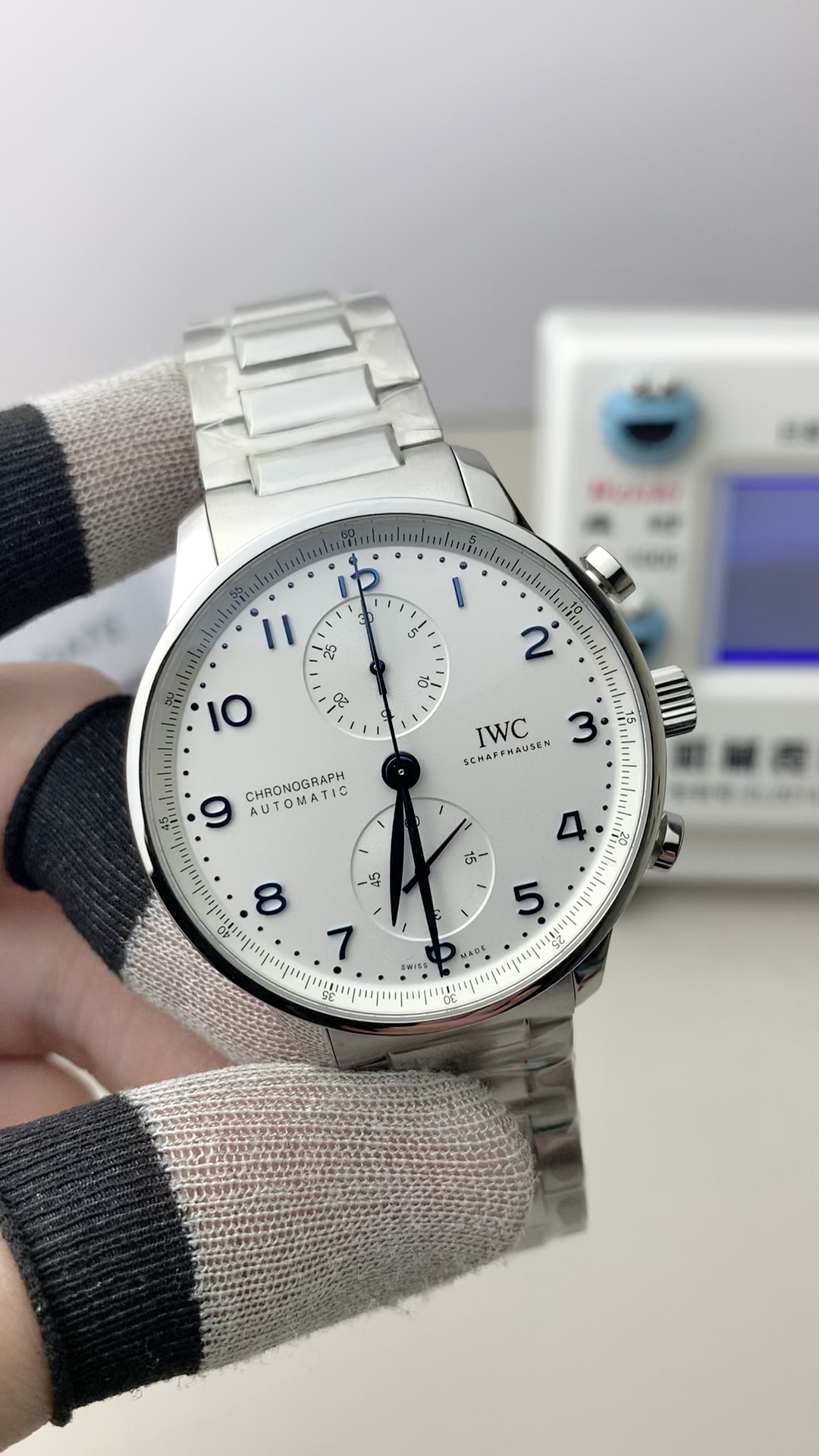
Their strongest territory sits around established references: Portuguese Chronograph, Portuguese 7-Day, Big Pilot, and select dial-forward dress pieces. These are watches that require patience rather than flash. ZF typically releases early, absorbs feedback, then revises quietly across versions. Case thickness gets corrected. Subdial spacing improves. Dial printing tightens. Nothing dramatic happens in a single update, but after a few cycles the watch feels settled.
The ZF signature shows up most clearly in dial discipline and case correctness on known models. Their numerals tend to carry sharper edges. Date windows are more consistently centered across multiple dates. Subdial rings usually sit concentrically instead of drifting microscopically off-axis. These are slow refinements that only appear after a factory has lived with a reference for years.
ZF is also more willing to tackle complicated architectures — from long power-reserve systems to classic chronographs and higher-attention dress layouts — and, as detailed in the V7 Factory vs ZF architectural ambition and complexity handling evaluation, that ambition comes with trade-offs but explains why their catalog feels deeper on traditional IWC families.
V7 Factory: modern releases, tighter cosmetics, fewer but sharper bets
Tips
V7 behaves like a factory optimized for first impressions and contemporary design.
They concentrate on newer IWC releases and modern case structures, where alignment, surface finishing, and bracelet behavior dominate the experience. Rather than spreading across decades of references, V7 places fewer bets and executes them with cosmetic precision.
The V7 signature is clean surface finishing and alignment consistency. Brushed planes tend to run uninterrupted across lugs. Polished chamfers usually reflect straight lines instead of wavering. On bracelet-equipped models, articulation feels controlled, and clasp engagement is more decisive. You notice this immediately when you handle the watch, even before you start inspecting dial details.
V7’s strength lies in how cohesive everything feels out of the box. Their watches often arrive looking finished rather than evolving.
The key implication for buyers
Tips
If your model is a dress watch that lives or dies by dial quality and date behavior, ZF usually brings more accumulated refinement.
If your model is a modern release where fit, finishing, and alignment define ownership, V7 often feels cleaner from day one.
Neither approach is universally superior. They simply answer different problems.
Methodology: How We Compare Without Fanboying
The three-pillar test
Tips
Every comparison here runs through the same three filters.
External execution covers geometry, printing, alignment, reflections, and tactile feel. This is what you see and touch every day.
Movement behavior focuses on winding smoothness, crown position definition, chronograph engagement consistency, setting friction, and how the date changes. You don’t need to open the case to feel whether a movement is behaving correctly.
Stability and risk looks at QC variance, known failure points, serviceability, and parts availability. This pillar matters after the honeymoon phase, when small issues either stay small or grow expensive.
No single pillar decides the outcome. A watch can look beautiful and still frustrate you after three months if the crown threads feel gritty or the date hesitates.
The “home test kit” (no lab needed)
Tips
You don’t need specialized equipment to evaluate most of this.
A phone camera with 2× or 3× zoom reveals dial print edges and index placement. A single bright desk lamp exposes AR behavior and reflection distortion. A simple timing app gives relative stability checks without chasing unrealistic accuracy claims. A basic ruler or caliper helps confirm case proportions if something feels off. A plain paper card pressed against polished surfaces quickly shows whether reflections stay straight or bend unexpectedly.
These tools won’t tell you everything, but they will surface the differences that actually affect ownership.
Scoring rubric: category wins, not a single total
Tips
Avoid collapsing everything into one number.
Use category wins instead. Let external execution, movement behavior, and stability each stand on their own. This allows you to choose based on what you care about most, rather than accepting someone else’s weighted average.
One watch may win on finishing while losing on movement feel. Another may do the opposite. The goal is not to crown a universal champion, but to match factory strengths to your priorities.
Head-to-Head Model Case Studies (Where the Comparison Is Real)
Case Study A: Pilot Mark Series (daily wear accuracy test)
What to compare (high-signal checks)
The Mark series is deceptively simple, which is exactly why it makes a ruthless daily test platform. There is nowhere for mistakes to hide. Start with the date window. Check three or four consecutive dates, not just one. You are looking for consistent centering, upright numerals, and even font weight. On weaker executions, the date will drift slightly high or low depending on the disc position, or the “2” and “7” will reveal uneven stroke thickness under angled light. This is usually the first shortcut to surface.
Move to dial print sharpness. Under a single point light at about a 30–45° angle, clean builds show crisp edges on numerals and indices. Softer builds blur at the edges, especially around the minute track. That blur looks minor on day one, but over months of ownership it becomes the thing your eye keeps returning to.
Hand stack and clearance matter more than most people expect, and as highlighted in the comparative IWC replica factory build-quality and hand-fitment criteria, if you set the time so the minute hand lands exactly at 12 and watch it settle, it should point cleanly and stay there — not hover or wobble — because any vertical play in the stack shows up later as inconsistent alignment during normal wear.
Crystal AR behavior tells you how modern the components really are. A controlled blue flash at an angle usually signals newer coatings. Patchy purple haze tends to come from older stock crystals or mixed batches. You don’t need instruments to see this—just rotate the watch under a desk lamp and let the reflections move.
Case finishing is where wearing comfort is decided. Brushing should run in one continuous direction across the lugs without breaking. Polished chamfers should carry straight reflections instead of bending unpredictably. If those transitions feel sloppy, the watch will feel sloppy on the wrist.
Finally, evaluate crown feel. Thread engagement should be smooth and progressive, setting friction should feel controlled, and there should be no gritty feedback. A crown that feels rough on day one almost never improves with time.
Likely outcome framing
On Mark references, ZF more often wins on date discipline and dial printing consistency. That usually makes ZF the “daily winner,” because those are the elements you interact with every single morning.
V7 tends to win on case finishing and alignment. Their brushing transitions and chamfer continuity often look cleaner straight out of the box, which makes V7 the “wearing winner” if surface quality dominates your priorities.
The rule that holds in repeated ownership is simple: on Mark models, the date window exposes shortcuts faster than almost anything else. Start there, and most decisions clarify themselves.
Case Study B: Portuguese Chronograph (architecture vs thinness reality)
What matters most on Portuguese Chronograph
This model is not about cosmetics first. It is about architecture.
Begin with case thickness behavior. Do a real under-cuff test using both a shirt cuff and a jacket cuff. A Portuguese Chronograph that sits even half a millimeter too tall will catch fabric and rotate on the wrist. That annoyance compounds over time.
Next, step back to arm’s length and judge subdial spacing and symmetry. The two registers must “read right” visually before you ever zoom in. If they feel cramped or slightly off balance, no amount of dial printing quality will save the watch.
Pusher feel is your next filter. Start and stop resistance should remain consistent across multiple cycles. Reset should snap decisively, not drift home slowly. Mushy pushers usually signal compromises in the chronograph coupling that show up later as reset errors.
Reset accuracy itself matters more than marketing claims. Run the chronograph, reset it, then repeat that process three times in a row. The seconds hand must return dead to 12 every time. Anything less is not a cosmetic issue—it is a functional one.
Finish with dial printing discipline. The minute track must align cleanly with the applied markers, and ink density should stay even across the entire dial. On this reference, uneven printing becomes obvious because the layout is so open.
How to write the comparison without pretending V7 competes here
This is one of the few places where honesty matters more than symmetry.
V7 does not field a true flagship competitor in the Portuguese Chronograph category. As a result, this stops being a factory-versus-factory contest and becomes a buyer decision.
Choose ZF for Portuguese Chronograph because this watch punishes shortcuts in thickness and layout. ZF’s long iteration history on this reference shows up in case proportions, subdial placement, and movement integration.
V7 becomes relevant again when the buyer shifts away from this architecture-heavy chronograph and back toward modern Pilot dailies, where finishing discipline carries more weight than movement packaging.
Case Study C: Portofino (dress watch honesty test)
What matters on Portofino-type dress execution
Portofino models are quiet watches, and quiet watches are unforgiving.
Start with bezel edge geometry. The edge should feel sharp and defined, not rounded or fuzzy. Soft edges make the entire watch read cheaper, even if everything else looks acceptable.
Inspect the dial surface carefully. Lacquer should appear clean and uniform, with no dust trapped beneath. On sunburst variants, the radial pattern must stay even without darker bands or cloudy patches.
Index placement reveals assembly discipline. Under light magnification, look for symmetry and any trace of adhesive around applied markers. Glue marks are small, but once you see them, you cannot unsee them.
Time setting feel matters more on dress watches because you interact with the crown more often. Setting should feel smooth with controlled resistance, and there should be no backlash when reversing direction.
Finish with strap and buckle execution. Stitching should run straight, edge paint should be clean, and buckle engraving should have real depth rather than shallow stamping. These are tactile signals of overall build quality.
Interpreting the results
Dress watches don’t shout, which means small errors surface faster.
Across Portofino references, ZF usually shows stronger dial cleanliness and printing consistency, while V7’s advantage—when present—leans toward surface finishing on the case. If one factory’s dials look cleaner across multiple examples, that becomes the decisive win, because on a Portofino the dial is the watch.
When everything else is restrained, the details carry the verdict.
Movement Reality: What You Can Infer Without Opening the Case
The winding and setting behavior test
Tips
You can learn more from two minutes on the crown than from any spec sheet.
Start by winding the watch slowly. Resistance should feel smooth and progressive, not gritty and not hollow. A healthy movement gives you consistent feedback through the crown. If it feels empty in one direction and tight in another, that usually points to uneven lubrication or gear mesh that will only worsen with wear.
Pull the crown through its positions. Each click should feel defined. There should be no vague half-states where you’re unsure whether you’re in time-setting or date-setting. Mushy transitions often indicate loose keyless works, and those tend to become real problems after a few months of daily use.
On models with a date, test the quickset deliberately. Turn forward, then reverse slightly, then forward again. You are looking for binding, hesitation, or backlash. A clean system advances decisively and stops cleanly. If the date creeps or fights you, that behavior almost never fixes itself over time.
These checks don’t tell you everything about the movement, but as explained in the high-end IWC replica assembly quality and tolerance exposure rationale, they reliably expose poor assembly and marginal tolerances.
Chronograph behavior tests (if applicable)
Tips
Chronographs reveal their quality through repetition.
Start and stop the chronograph five times in a row. The pusher resistance should stay consistent across all cycles. If the first press feels firm and the third feels soft, that inconsistency usually traces back to weak coupling or uneven spring tension.
Reset three times consecutively. The chronograph seconds hand must return exactly to 12 every time. “Almost centered” is not good enough here. Reset drift is one of the most common long-term complaints, and it announces itself early if you bother to test.
Let the chronograph run for 10 to 15 minutes. Watch for stutter in the seconds hand or creeping misalignment in the minute counter. Both signal friction problems that tend to accelerate with use.
If a chronograph passes these three steps, it is usually mechanically sound enough for regular wear.
Power reserve indicator honesty (if applicable)
Tips
Ignore headline claims about multi-day power reserves and focus on day-two behavior.
Wind the watch fully, wear it normally, then check stability on the second day. A well-integrated long-reserve system should still feel lively, with no sudden drop in amplitude or erratic hand motion.
Watch the power reserve hand itself. Travel should be smooth and continuous. Stutter, dead zones, or uneven jumps usually point to linkage issues that become more obvious as lubrication ages.
The goal isn’t to prove a seven-day claim. The goal is to confirm that the system behaves predictably once the novelty wears off.
External Execution: The High-Signal Tells That Separate ZF and V7
Dial printing and alignment
Tips
Dial work is where factories quietly declare their priorities.
Look closely at numeral edges, especially on “2,” “4,” and “7.” Clean executions show crisp boundaries with no feathering. Softer builds blur at the edges under angled light. Minute track spacing should remain even all the way around the dial, without tight clusters or stretched gaps near the date window.
Check concentricity on subdial models. The rings must sit perfectly centered within their cutouts. Even a fraction of a millimeter off becomes obvious once you know to look for it.
ZF tends to win here on established dress references through accumulated refinement. V7 often matches closely on newer releases, but dial discipline remains ZF’s long-standing advantage.
Crystal and AR coating behavior
Tips
Anti-reflective coating is not a spec. It’s a behavior.
Hold the watch under a single point light at roughly 30–45 degrees and rotate it slowly. Modern coatings show a controlled blue flash that moves cleanly across the surface. Older or mixed components produce patchy haze, often with purple tones that linger unevenly.
This test takes seconds and tells you immediately whether the crystal belongs to the current generation or to leftover stock.
Case geometry and finishing continuity
Tips
Run your eye along the case instead of staring at one spot.
Brushing should flow in one uninterrupted direction across lugs and midcase. When it breaks abruptly, you’re seeing rushed finishing. Polished surfaces should reflect straight lines cleanly. Use a paper card or window frame as a reference—if the reflection bends, the surface isn’t flat.
V7 usually shows strength here on modern sports cases, where alignment and surface transitions dominate first impressions. ZF catches up on models that have gone through multiple revision cycles.
Strap and bracelet realism
Tips
Straps and bracelets tell you how much attention went into the final assembly.
On straps, check edge paint and stitching. Clean edges and straight seams signal careful finishing. On bracelets, look at first-link droop symmetry and clasp engagement. Both sides should articulate evenly, and the clasp should lock with certainty, not hesitation.
These details don’t just affect aesthetics. They determine whether the watch feels cohesive on the wrist.
QC Variance, After-Sales Risk, and What Usually Fails First
QC variance (why two “same factory” watches can differ)
Tips
Factory name does not guarantee identical results.
Variance comes from mixed production batches, ongoing parts iteration, and simple assembly tolerance. One dial batch prints sharper than the next. One set of crowns threads more smoothly. These differences explain why two watches from the same factory can feel surprisingly far apart.
The practical lesson is to judge the watch in your hand, not the logo on the box. Every piece deserves its own inspection.
Common failure points by watch type
Tips
Patterns emerge once you’ve handled enough examples.
On dress three-hand watches, crown tubes, date mechanisms, and dial dust are the usual suspects. Chronographs most often stumble on reset alignment, pusher feel, and coupling consistency. Long-reserve models tend to develop wear in winding modules, looseness in power-reserve linkages, and sensitivity to aging lubrication.
None of these are catastrophic, but all of them shape ownership more than surface scratches ever will.
Serviceability and realistic ownership expectations
Tips
These watches are serviceable, but they are not ignore-and-forget.
Avoid hard impacts, especially on chronographs and long-reserve pieces. Keep water expectations conservative unless you’ve personally verified sealing. Treat the crown gently, and don’t force quickset mechanisms around midnight.
Handled with basic respect, both ZF and V7 builds can provide years of reliable use. Treated carelessly, even the best-finished example will remind you that precision objects have limits.
Decision Framework: Which Factory Should You Pick (By Buyer Profile)
Choose ZF if…
Tips
ZF makes the most sense when you’re buying into a reference that already has history behind it.
Portuguese flagships, long-running Pilot variants, and dress-forward models benefit from ZF’s habit of revising the same watch across multiple generations. Dial layouts get corrected. Case thickness gets trimmed. Date behavior stabilizes. These improvements don’t arrive in one dramatic leap, but they accumulate quietly. If you care more about model correctness than being first to the newest release, ZF usually feels more settled in hand.
ZF also suits buyers who notice dial discipline. If uneven printing, soft numeral edges, or drifting date windows bother you more than slightly less aggressive case finishing, ZF aligns better with that preference. Their strength shows up in watches that reward patience: pieces where you live with the dial every day and expect it to stay visually calm over time.
In short, ZF fits owners who value maturity over novelty.
Choose V7 if…
Tips
V7 shines when the watch is defined by surface quality and modern execution.
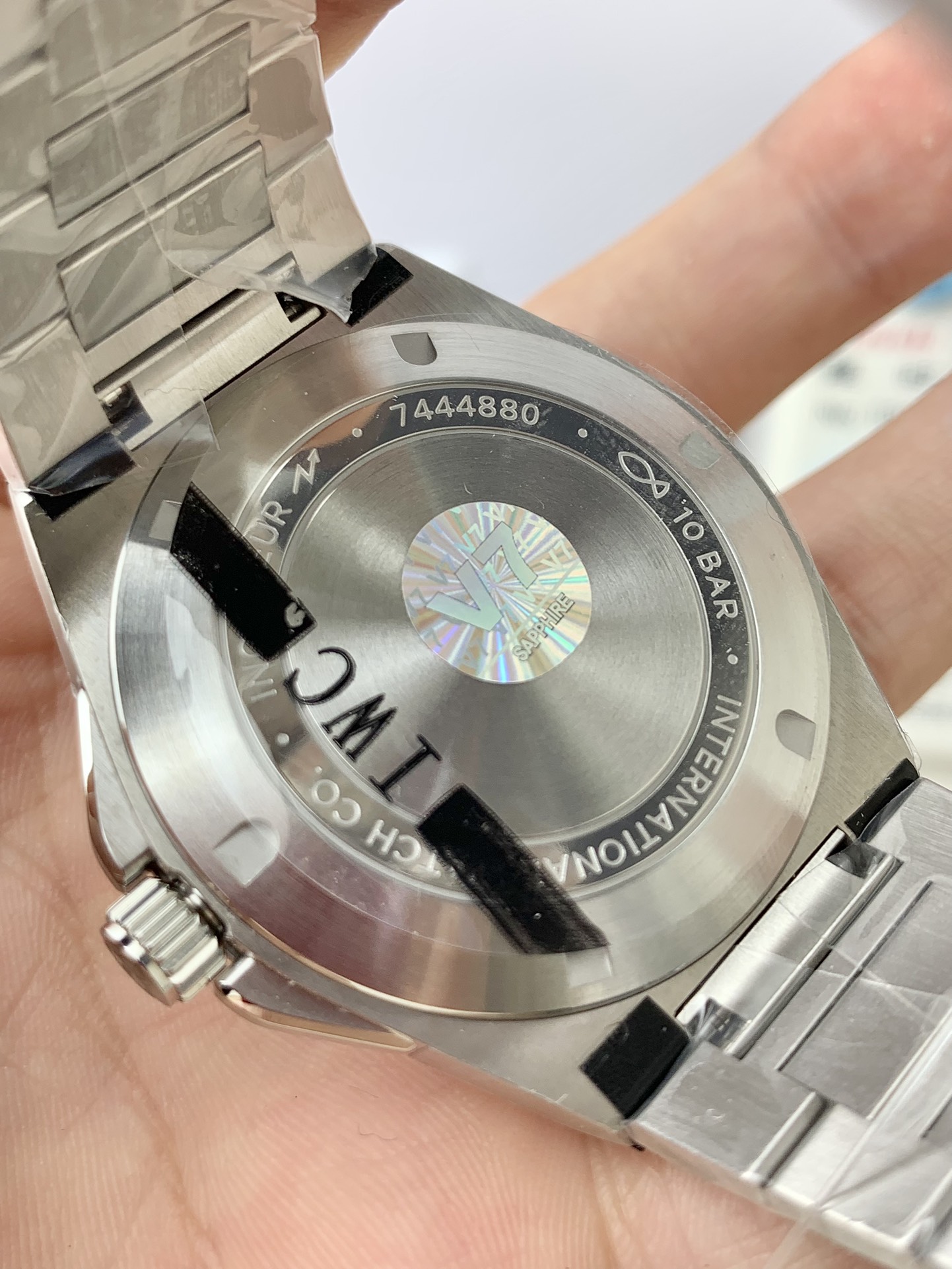
If you prioritize clean finishing, tight alignment, and the feeling that everything was assembled with today’s tolerances in mind, V7 often looks sharper right out of the box. This matters most on contemporary Pilot dailies and newer sports-case designs, where brushing continuity, polished chamfers, and bracelet articulation dominate the wearing experience.
V7 also suits buyers who care about how a watch feels on the wrist more than how deep its version history runs. Their strengths show up immediately: cohesive case geometry, confident clasp engagement, and consistent alignment across visible components.
If your goal is a modern daily that feels precise from day one, V7 usually delivers that impression more reliably.
The one-watch rule
Tips
If this is your only IWC replica, pick the model category with the lowest architecture risk.
That usually means a clean Pilot daily: simple three-hand layout, straightforward movement behavior, and minimal complication stacking. These watches tolerate small variances better and demand less long-term attention.
If this is your second or third piece, you can rationally step into chronographs or long power-reserve models. At that point you’re accepting upkeep as part of ownership, and you can choose based on character rather than simplicity.
Your collection stage matters as much as factory choice.
Acceptance Checklist Before You Say Yes (Model-Specific, Not Generic)
Mark-type checklist
Pass/fail tips
Check the date across several positions, not just today’s number. It should stay centered vertically and horizontally, with consistent font weight from one date to the next.
Zoom in on the dial print. Numerals and indices should have crisp edges, not fuzzy outlines. Set the minute hand to 12 and confirm it lands cleanly without hovering or drifting.
Unscrew and re-seat the crown. Threads should engage smoothly, and setting positions should feel defined rather than vague. Rotate the watch under a single light source and confirm the AR coating behaves in a controlled way, without patchy haze.
If any of these fail, keep looking.
Portuguese Chronograph checklist
Pass/fail tips
Reset the chronograph multiple times. The seconds hand must return dead to 12 every time, not almost every time.
Cycle the pushers repeatedly. Resistance should stay consistent, and reset should snap decisively. Step back to arm’s length and confirm subdials feel visually balanced.
Do a real under-cuff test with both shirt and jacket. If it catches fabric or rotates on the wrist, thickness is already working against you.
Finish by inspecting dial printing for uneven ink or soft track alignment. This reference exposes shortcuts fast.
Portofino-type checklist
Pass/fail tips
Run a fingertip along the bezel edge. It should feel sharp and defined, not rounded over.
Inspect indices under light magnification. They should sit cleanly with no visible adhesive. Hands must be centered and clear each other without scraping.
Look at the strap closely. Stitching should run straight, edge paint should be tidy, and buckle engraving should have real depth. On a quiet dress watch, these small details carry disproportionate weight.
FAQ
Is ZF always better than V7 for IWC?
No. ZF tends to dominate mature dress and complication-heavy references, while V7 often leads on modern releases where finishing and alignment define the experience. The better choice depends on the model.
Which is safer for daily wear: ZF or V7?
On simple Pilot dailies, both are safe. V7 usually feels cleaner out of the box, while ZF often brings stronger dial discipline. Daily safety comes more from model choice than factory name.
What is the easiest tell on a Mark-series IWC replica?
The date window. Check centering across multiple dates and inspect numeral edges under angled light. Shortcuts show up there first.
Does Portuguese Chronograph thickness matter in real wearing?
Yes. Even small excess height changes how the watch sits under a cuff and how often it rotates on the wrist. Comfort and balance suffer long before aesthetics do.
How do I test QC at home without tools?
Use a phone camera with zoom, a single desk lamp, and your hands. Check dial edges, AR behavior, crown feel, and chronograph reset. These reveal more than any spec sheet.
Which factory has more stable alignment and printing?
ZF usually shows stronger consistency on established references. V7 often matches or exceeds on newer models, especially in case alignment and surface finishing.
Should I prioritize movement claims or external execution?
External execution first. You interact with the dial, case, and crown every day. Movement architecture matters, but cosmetic and tactile quality shape ownership more consistently.
Final Judgment: The Only Honest Conclusion
ZF wins when the reference demands mature engineering history, while V7 wins when modern finishing and alignment consistency define the watch.
Related IWC Articles: If you found this helpful, you might also enjoy IWC Replica vs Genuine: How to Spot the Differences (Big Pilot & Portuguese 7 Days), which shows how to spot differences between IWC replica and genuine Big Pilot & Portuguese models, and IWC Tourbillon Replica Movement Explained: Gimmick, Decoration, or Real Engineering?. Another related article is IWC Replica Chronograph Movement Guide: Asian 7750 Reliability, Weak Points, and Care.