
Opening Thesis: In IWC, Complications Are “Systems,” Not Features
Why IWC is a special case for complications
IWC does not treat complications as decorative add-ons. Across its modern history, especially in the Portugieser and Big Pilot lines, complications are designed as integrated systems: large, legible displays driven by coordinated mechanical logic. The perpetual calendar isn’t just a moonphase with extra windows. It’s a calendar computer distributed across the dial, engineered to remain readable at a glance and coherent over time.
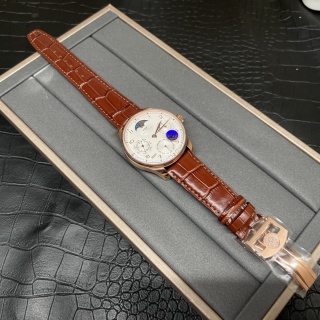
That matters in replicas, because the moment you approach these watches as a collection of individual functions, you misunderstand the problem. You are not buying “a moonphase.” You are buying a setting ecosystem. You are buying interlinked gears that must advance together, reset together, and tolerate daily wear without drifting apart.
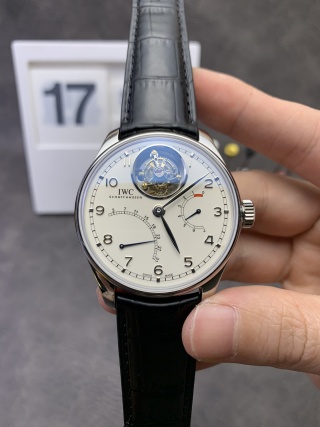
Most disappointment in IWC complication replicas comes from framing the purchase incorrectly.
Define what “worth it” means in complications
In practice, complication value collapses into three behaviors.
First is functional authenticity. Does the watch do what it claims, repeatedly, across normal wear cycles, not just on day one.
Second is setting safety. Can a normal owner adjust it without inducing silent damage or long-term desynchronization.
Third is wear legitimacy. When it’s on the wrist, does it still feel like an IWC, or does the added complexity destroy proportions, balance, and usability.
If a piece fails any one of these, it stops being a complication watch and becomes a display object.
The Genuine Reference Spine (So We Stop Mixing Models)
Perpetual Calendar anchors (Portugieser / Big Pilot)
There are two real mental models for IWC perpetual calendars.
The first is the Portugieser Perpetual Calendar family, anchored by references like the IW5037 series. This is the dress execution: large round case, multi-window calendar layout, moonphase integrated into a symmetrical dial. These watches typically sit around 44–45 mm with thickness in the mid-14 mm range, paired with long power reserves to stabilize calendar torque.
The second is the Big Pilot’s Watch Perpetual Calendar, such as IW5036 and IW503605. This is the instrument approach. The dial spreads the calendar across pilot-scale real estate so it remains readable despite density. Case sizes push past 46 mm, thickness climbs further, and the movement architecture prioritizes torque stability over elegance.
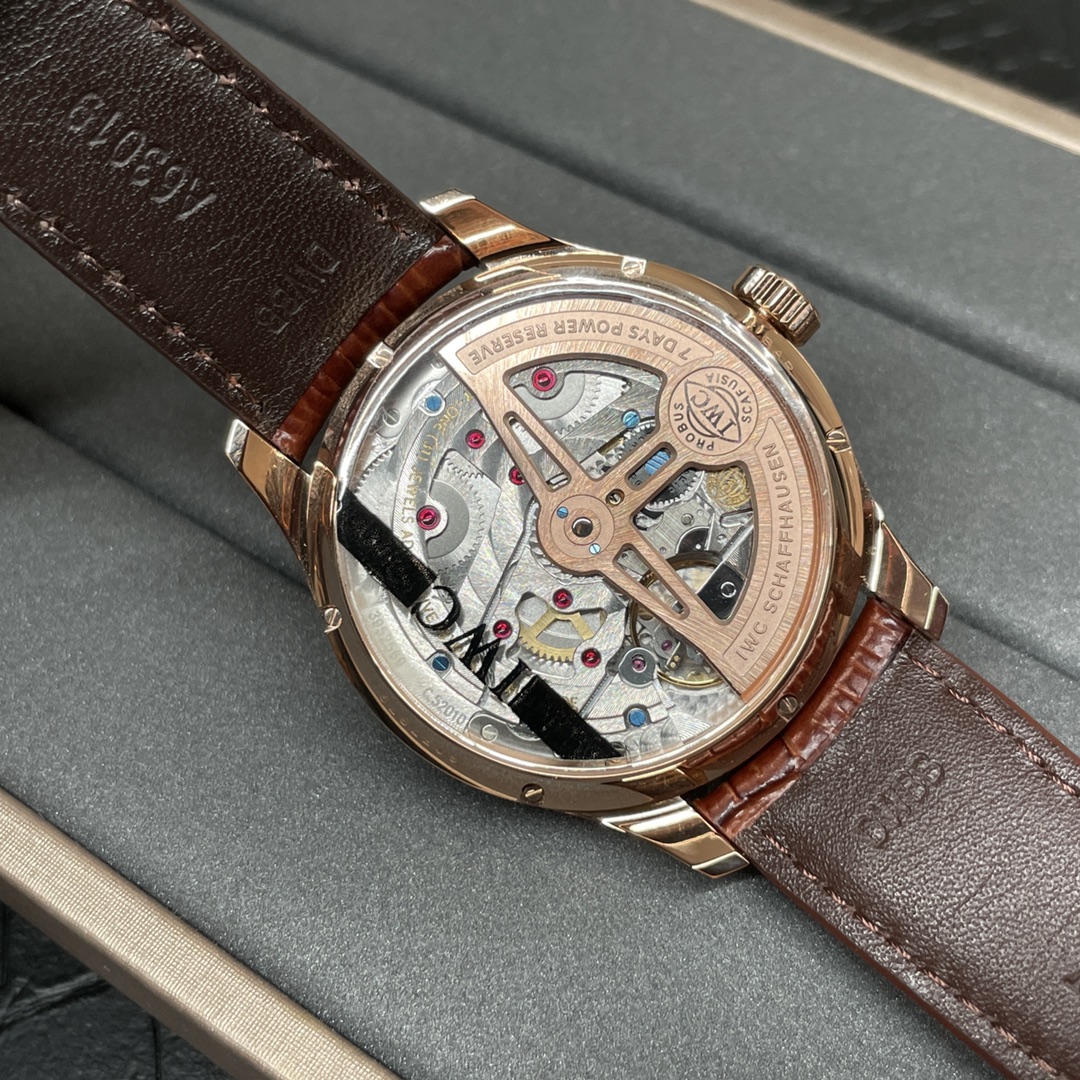
These specifications matter because replicas inherit the same volume problems. Calendar modules stack on top of base movements. Crystal height increases. Case backs bulge. If a replica claims to mirror these references but collapses thickness by magic, something else has been sacrificed.
Minute Repeater anchor (Portugieser Minute Repeater IW5449)
A minute repeater is not a button that makes noise.
In genuine form, such as the Portugieser Minute Repeater IW5449, it is a mechanical acoustic system: racks, snails, hammers, and gongs working in sequence to translate time into sound. Case geometry becomes part of the instrument. Gong shaping, hammer tension, and resonance volume all affect clarity.
It exists in IWC as a serious horological category, not a novelty feature. That distinction becomes critical once replicas enter the conversation.
Tourbillon anchor (Portugieser Tourbillon Hand-Wound IW5463 / IW546301)
The tourbillon, as seen in references like IW5463 and IW546301, is a rotating regulating organ. In IWC’s execution it sits inside a high-finishing narrative: hand-wound architecture, exposed cage, carefully managed power delivery, and visual balance.
This establishes the baseline. When tourbillons appear in replicas, they should be judged against this standard of mechanical intent, not merely by whether something spins at six o’clock.
Replica Reality Map (New Framework)
The 4 “Levels of Truth” in complication replicas
After handling enough complication replicas, patterns emerge. They fall into four practical categories.
Level A — Fully functional complication logic.
These operate as systems. Perpetual calendars recognize month lengths and leap cycles. Displays advance together. Under normal wear, coherence holds.
Level B — Functional, but simplified logic.
Displays move, but logic is partial. Month or leap behavior may require manual correction. Usable, but supervised.
Level C — Decorative complication.
Elements appear active, but linkage is cosmetic or loosely coupled. It looks convincing until you live with it.
Level D — Demo-only complication.
It performs briefly or in limited modes. Under real ownership, reliability collapses.
Once you adopt this framework, most marketing language becomes irrelevant. You stop asking who made it. You start asking what level it lives on.
Why IWC complication replicas fail (failure modes, not insults)
The first failure is stack height.
Complication modules add vertical mass, and as documented in IWC replica movement stack height and power-reserve architecture analysis, once this cumulative thickness pushes the case beyond what the original mid-case geometry tolerates, manufacturers are forced to compensate with taller crystals or deeper case backs; you feel it immediately on the wrist, balance shifts, and the watch stops wearing like an IWC.
The second failure is setting risk.
Every added display introduces gears. Every gear introduces tolerance stacking. Date, day, month, moonphase, sometimes power reserve, all want synchronized advancement. In lower-quality builds, one weak transfer wheel is enough to desync the whole system.
The third failure is energy budget.
Calendars and moonphases draw torque. Add a power-reserve indicator and demand rises again. Genuine IWC designs solve this with long barrels and careful distribution. Cheap replicas don’t. The first symptom is not stopping. It’s calendar misbehavior when power drops.
These are not theoretical issues. They show up after a few nights on the wrist.
If a complication replica cannot maintain coherence through low-power states and routine setting, it doesn’t belong in Level A or B. It belongs in the display case.
And that distinction determines whether it is actually worth playing with.
Perpetual Calendar Replicas (The Only Complication That Can Be “Playable”)
Representative models people actually target
There are only two layouts that matter if you want a perpetual calendar replica to behave like an IWC.
The first follows the Portugieser Perpetual Calendar lineage, anchored by the IW5037 family. This is the dress configuration: round case, multiple calendar windows distributed across the dial, moonphase integrated into the lower half. Everything lives close together. The aesthetic depends on balance, and the mechanics depend on tight tolerances because the displays stack densely.
The second mirrors the Big Pilot Perpetual Calendar, such as IW5036 and IW503605. This is the instrument approach. The case grows past 46 mm, the calendar spreads outward, and legibility becomes part of the engineering. IWC designed this layout because perpetual calendars get visually chaotic fast. The Big Pilot format gives every display room to breathe.
Those two categories define almost every serious replica attempt. If a piece doesn’t clearly belong to one of them, it usually isn’t trying to be a system watch.
Factory landscape (market labels versus reality)
You will see these watches commonly marketed under names like “ZF Portugieser perpetual” or “VS/APS perpetual,” depending on model and production run.
Treat those labels as shorthand, not guarantees.
Complication replicas are batch-defined, not brand-defined, and as highlighted in the detailed hardware and tolerance breakdown of the ZF IWC Portofino chronograph construction and timing behavior review, one batch can behave coherently for months while the next, even carrying the same factory tag, may arrive with different calendar tolerances or crown feel, because unlike three-hand watches the complication logic lives in small tolerances and finishing choices that shift quietly between runs.
If you approach perpetual calendars as factory identities, you will be disappointed. If you approach them as individual mechanical systems that must prove themselves, your success rate improves dramatically.
Functional authenticity checklist (the only tests that matter)
Perpetual calendars do not reveal their quality in five minutes. They reveal it over days.
I use a simple seven-day validation cycle, no tools, no special procedures.
Let the watch run through seven consecutive nights and observe whether the date advances consistently every time. Not once. Every time.
Check day and month coherence each morning. A single mismatch tells you the transfer logic is marginal.
Watch the moonphase disc. It should advance smoothly and remain stable in its aperture. Jumpy behavior or visible wobble usually means loose gearing.
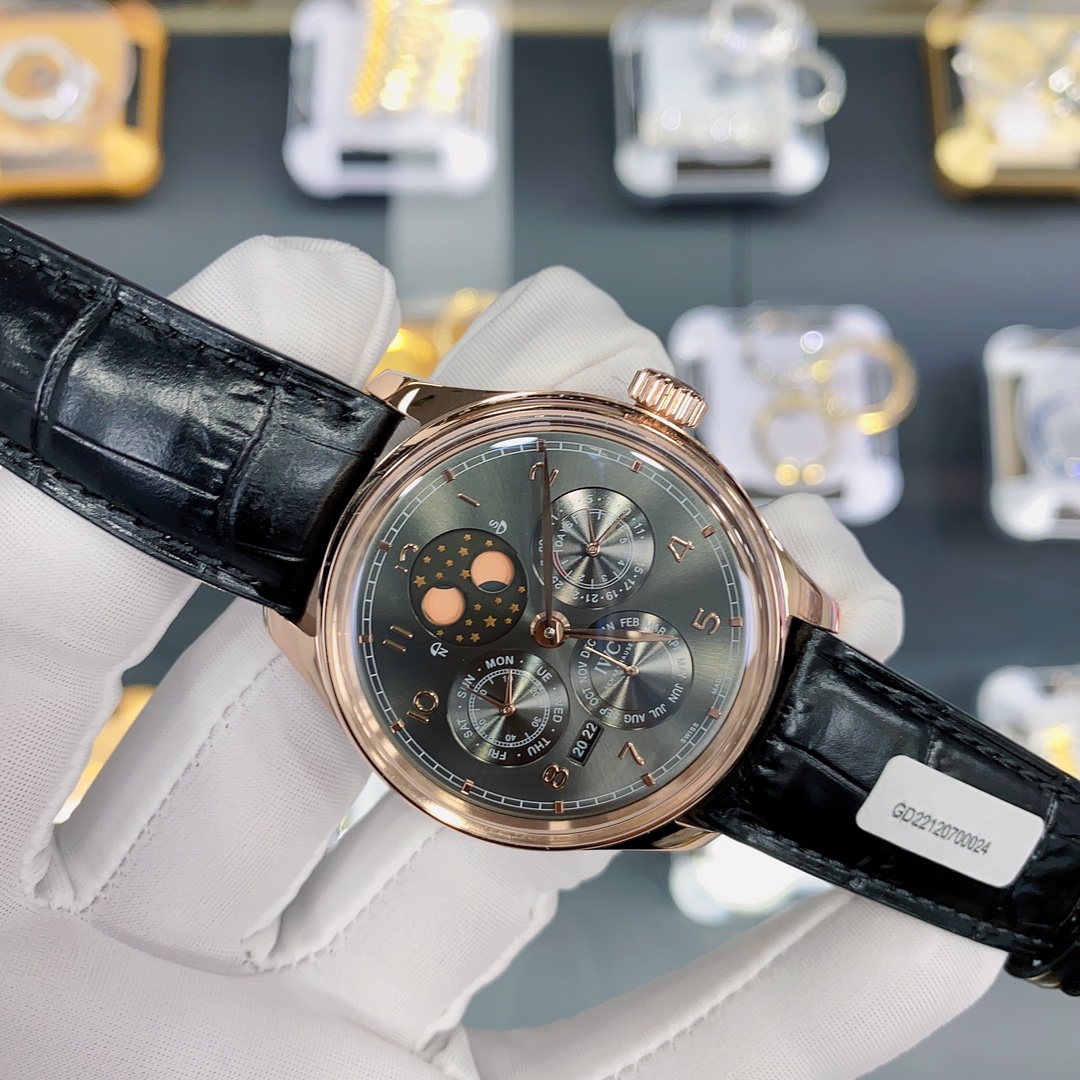
If leap-year indication exists, test whether it progresses logically or sits frozen as decoration.
Pay attention to crown feel. Setting should feel progressive, with resistance changing in predictable stages. Gritty or uneven feedback usually signals rough calendar gearing.
Watch for desynchronization. When one display starts lagging, does the whole system drift together, or do elements separate? Separation is fatal long term.
Finally, let the power reserve run low once during the week. Many replicas behave acceptably at full wind and collapse near depletion. If the calendar misbehaves under low torque, it is not a system watch.
These behaviors matter more than any claimed specification.
Wear experience: why some still feel like IWC, and others don’t
A working calendar is only half the story. The watch still has to wear like an IWC.
Dial density must remain readable. The genuine Big Pilot Perpetual exists because IWC understood that complications destroy clarity unless space is engineered around them. Replicas that compress Big Pilot layouts into smaller cases usually fail here. The result is visual congestion and poor balance.
Dress-case perpetuals face a different problem: thickness. The real IW5037 lives in the mid-14 mm range. That is already substantial for a dress watch. Replica builds that climb well beyond this through stacked modules and tall crystals stop feeling elegant. You notice it when the watch tips forward on the wrist or refuses to slide under a cuff.
When perpetual calendar replicas succeed, it’s because both of these problems are controlled. The dial remains legible, and the case still feels intentional.
When they fail, it’s almost always because one of those two gives way.
Practical verdict rule for perpetual calendar replicas
If the calendar stays coherent through seven consecutive daily wear cycles, it’s playable.
If it desynchronizes when power drops, it’s a display toy, not a system watch.
Tourbillon Replicas (The Visual Complication With the Most Misleading “Value”)
“Real tourbillon” versus open-heart cosplay
This distinction should be non-negotiable.
A true tourbillon places the escapement and balance inside a rotating cage. The entire regulating organ turns.
An open-heart is simply a dial cutout exposing the balance wheel. Nothing rotates as a system.
Many watches marketed as “tourbillon” in the replica space drift dangerously close to open-heart cosplay. Even when a genuine rotating cage exists, finishing quality and mechanical integration often fall far short of what IWC represents in references like the Portugieser Tourbillon Hand-Wound IW5463 and IW546301.
Movement alone does not make it equivalent.
What to evaluate when it is a true tourbillon
If the cage really rotates, the next questions are mechanical, not cosmetic.
Look at alignment. A healthy cage runs centered, without visible lateral wobble.
Observe beat stability. Tourbillons consume torque. If amplitude collapses quickly after winding, long-term consistency will be poor.
Watch power reserve sensitivity. These systems expose weak energy delivery faster than standard movements.
Listen closely. Any scraping, ticking asymmetry, or dry friction noise is a hard stop. A tourbillon should sound smooth and restrained, not stressed.
These signs tell you more than decorative bridges or engraved plates ever will.
Wearability reality
Tourbillons are thick. Even in genuine IWC form, they carry presence. Replicas exaggerate this because cages, bridges, and modules stack vertically.
This is where the Portugieser Tourbillon identity becomes your reference. It should feel substantial but balanced, dramatic but controlled. Many replicas overshoot into top-heavy territory, where the watch constantly reminds you of its weight.
And then there is daily practicality.
Tourbillons in this segment offer visual engagement, not carefree ownership. They demand attention, careful winding habits, and acceptance of higher mechanical stress. They are not forget-and-go watches.
Practical verdict rule for tourbillon IWC replicas
A tourbillon is worth playing with only if you accept it as a visual engine with higher care needs.
If you want one watch you can wear without thinking, a tourbillon is the wrong complication.
Minute Repeater Replicas (Usually the Least Worthwhile)
Why repeaters are fundamentally hard to replicate
Minute repeaters sit in a different engineering universe from calendars and tourbillons.
They are not “a sound feature.” They are mechanical acoustics. Time is translated into motion, motion into impact, impact into vibration, and vibration into audible tone through precisely shaped gongs and carefully tensioned hammers, all inside a case whose geometry directly affects resonance.
In genuine IWC form—think Portugieser Minute Repeater territory—this is a high-discipline system. Gong metallurgy matters. Hammer mass matters. Case volume matters. Even crystal thickness changes timbre. Nothing here is decorative.
That is why repeaters expose shortcuts instantly. You cannot fake acoustics with cosmetic finishing. Either the mechanical chain is real, tuned, and stable, or it isn’t.
The replica reality (what exists versus what’s claimed)
Across the replica market, not just in IWC, most so-called repeater watches fall into two camps.
Some rely on decorative sound modules. A slider triggers a basic chime unit that bears little relationship to actual time. Others attempt mechanical approximation but collapse under real ownership: weak strikes, inconsistent cadence, stuck hammers, or rapid degradation after light use.
This is where marketing claims most aggressively outrun mechanical reality.
You may hear sound. That does not mean you own a repeater.
In practice, stable mechanical repeater systems are vanishingly rare at this level, and when they appear, they demand care, tuning, and acceptance of fragility that most owners do not want to live with.
Verdict rule for repeater replicas
If it isn’t a proven mechanical system with stable behavior, it isn’t a complication—it’s a novelty.
The Complication Truth Table
Complication vs play value vs risk
| Complication Type | Typical Replica Truth Level | Wear Practicality (1–5) | Setting Risk (1–5) | Servicing Friendliness | Best For |
|---|---|---|---|---|---|
| Perpetual Calendar | A–B (batch dependent) | 4 | 3 | Medium | Owners who want real functional interaction and are willing to observe behavior |
| Tourbillon | B–C | 2 | 2 | Low | Collectors who value visual mechanics and accept higher care needs |
| Minute Repeater | C–D | 1 | 4 | Very Low | Curiosity-driven collectors who understand novelty risk |
These scores are not theoretical. They reflect how these watches behave after weeks of wear, not how they present on day one.
Why perpetual calendar wins most of the time
Only the perpetual calendar consistently offers meaningful functional ownership when executed well.
A good calendar replica can run coherently across days, tolerate routine setting, and still feel like an IWC on the wrist. It gives feedback. You interact with it. You learn its rhythm.
Tourbillons, by contrast, are visual-first. Their value lives in motion, not in daily usability. They reward observation, not forget-and-go wear.
Repeaters sit at the far end of the spectrum. They promise engineering theater but usually deliver fragile novelty.
If you care about living with a complication rather than just seeing one, the hierarchy becomes obvious once you consider how the 2023 IWC Ingenieur 40 mm replica construction and dynamic wear review highlights real-world interplay between module height, torque delivery and field performance over a normal duty cycle.
QC & Acceptance Checklist (Complication-Specific)
Perpetual calendar QC
Observe overnight display coherence and confirm date, day, and month remain synchronized each morning; as the multi-function synchronization benchmarks in the IWC replica watches series comparison for Portuguese, Pilot, Ingenieur, and Portofino calendar and display stability analysis outline, watch the moonphase for wobble or abrupt jumps and evaluate crown feel during setting, where progression should be smooth and staged — because any drift between displays signals future instability.
Tourbillon QC
Check cage alignment and visual stability.
Listen for scraping or dry friction.
Confirm stable running over a full 24-hour cycle.
Tourbillons reveal weakness quickly. Trust what you see and hear.
Repeater QC (if you include it)
Activation must be consistent.
Hammers must not stick.
Cadence should feel even, not hesitant.
Anything less indicates decorative behavior.
Engineering Summary: The Final Decision Rule
A complication that behaves as a coherent system for a full week is worth playing with, and anything that only performs on day one is not a complication at all—it is a display whose meaning ends when you take it off.
Related IWC Articles: If you found this helpful, you might also enjoy IWC Big Pilot Replica Review (IW5009): ZF Version, Real Wear Behavior, and What Actually Matters, and IWC Portuguese 7 Days IW5007 Replica Deep Dive (ZF vs V9 + Real Power Reserve Reality). You may also like How Good Are IWC TOP GUN Pilot’s Chronograph Replicas?, and Seagull/Dandong vs Swiss ETA in IWC Replicas: What You Really Get (And What You Don’t).