







1 — Product Identity & First-Wear Experience
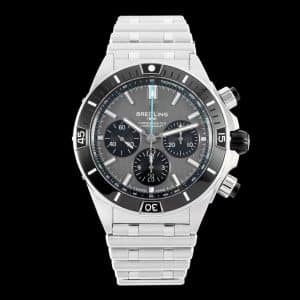
On first contact, the watch feels solid. The pilot bracelet flexes in a smooth, almost fluid motion that contrasts with the firmness of the 42 mm case. That combination of flexibility and mass defines the wear experience. The slate-grey dial doesn’t try to charm you immediately the way an ice-blue or champagne dial does. Instead, it waits for movement and light to reveal its grain. Indoors the dial appears matte; outside it becomes more metallic, with subtle vertical brushing that you only catch at certain angles.
The black subdials provide strong visual contrast, grounding the chronograph layout so it remains clear in low light. When the watch finds its resting point on your wrist, it feels like a tool — polished enough to be modern, but still rooted in mechanical logic.
2 — Background Story & Original Chronomat Logic
The Chronomat line has always been about tactile interaction: rider tabs for grip, strong case geometry, clear indexes, oversized pushers. Nothing here was originally designed for fashion; it came from timing instruments built for pilots who needed feedback they could feel through gloves and turbulence.
The pilot bracelet follows similar logic. The cylindrical links roll rather than bend, allowing the bracelet to sit securely while still adapting to wrist motion. With a slate dial version like this, the Chronomat’s history becomes more apparent. It looks like a piece of equipment rather than an accessory.
Guangzhou’s replica ecosystem understands this design language well. BLS factory, in particular, handles steel machining and bracelet articulation with enough consistency to preserve that Chronomat feel. Their approach tends to prioritize steel geometry and pusher tension over ultra-fine dial micro-texture, and for this model, that prioritization works.
3 — Dial, Bezel & Visibility in Real Light
This slate-grey dial behaves like brushed metal on some days and like muted charcoal on others. In morning light, the brushing becomes more visible, cutting the dial into faint vertical streaks. In afternoon sunlight, the dial brightens and the black subdials deepen, making the chronograph layout unusually legible. When shadows move across the dial, the applied markers catch light in quick flashes, giving the watch brief moments of brightness despite its overall muted tone.
The outer tachymeter ring shifts from dark blue to near-black depending on angle. When walking outdoors, you’ll notice how the ring occasionally picks up reflections that outline the numbers more clearly.
The rider-tab bezel on this BLS factory Chronomat clicks with decisiveness. Each click feels firm but not heavy, and the grip points respond well when your fingers are slightly sweaty or when you rotate it during a casual moment of fidgeting. This bezel behavior is one of the details that makes the watch feel like a Chronomat rather than simply look like one.
4 — Case, Steel Structure & Wrist Behavior
The stainless-steel case has a balanced stance. The lugs angle downward just enough to secure the watch without forcing it flat against the wrist. When you move your hand — turning a steering wheel, pulling a drawer, or lifting a laptop — the watch stays where it should, with very little sliding.
The steel picks up light in controlled ways. The brushed areas soften the reflection; the polished bezel ring sharpens it. The result is a watch that shifts personality depending on environment but never feels flashy. If you wear it with business casual clothing, the watch blends in. If you wear it with a T-shirt, it takes on a more assertive tone.
Temperature also plays a role. On cold mornings, the steel feels sharp for the first few minutes. As your wrist warms the case, the edges soften and the watch becomes more comfortable, settling in naturally for the rest of the day.
5 — Movement & Functional Behavior (Feel, Not Theory)
This Chronomat replica keeps the focus on tactile feedback.
Winding
The crown turns with measured resistance. You feel the mainspring tension build in a way that gives you confidence without asking you to overthink it.
Setting the time
The minute hand responds cleanly, with no sudden jumps. When aligning the hands in dim light, the large polished markers help guide placement.
Pusher behavior
Chronomat fans judge pushers carefully, and this BLS version performs well:
-
Start: crisp, slightly firm
-
Stop: lighter, but still controlled
-
Reset: a decisive snap back to zero
Nothing feels overly light or overly tight. The pushers behave consistently whether the watch is cool from rest or warm from a long day on the wrist.
6 — Bracelet & Long-Term Comfort
The pilot bracelet remains one of the most distinctive parts of the Chronomat identity. Its cylindrical links offer a sensation you don’t find on flat bracelets: the movement is smoother, the rotation more natural, and the weight distribution more even.
BLS factory has refined the articulation enough that there are no rough edges or stiff hinge points. During long sessions at a desk, the bracelet stays quiet. When walking, the bracelet shifts slightly, adapting to small wrist movements without creating pressure points.
On warm days, the gaps between the links allow more airflow than you expect from a steel bracelet. Sweat dissipates quickly, and sunscreen wipes off easily without clinging to the brushed surfaces. On cold days, the bracelet begins cool but warms quickly as the steel absorbs body heat.
7 — Factory Execution Logic
BLS factory typically prioritizes:
-
Steel machining accuracy
-
Smooth and aligned pilot bracelet
-
Strong bezel clicks
-
Clean marker finishing
-
Reliable pusher feedback
Their slight compromise is usually in ultra-microscopic dial texturing, but on a slate dial with vertical brushing, this limitation becomes irrelevant — the dial itself is designed to rely on natural texture rather than hyper-fine details.
This particular grey version benefits from BLS’s strengths more than many other colors. The muted tones make the steel execution stand out. The black subdials hide imperfections well. And the overall alignment of markers, bezel, and printing builds a cohesive impression.
8 — Real-Life Usage Scenarios
Scenario 1 — 8:45 AM, Walking Into Work
The slate dial looks darker in early morning light. The bracelet is still cool, but you feel it warming as you settle into your routine. When you glance at the time before entering the building, the contrast between the grey dial and black subdials makes reading quick and easy.
Scenario 2 — 6:10 PM, Leaving the Office
Indoor lighting softens the dial into a warm grey, and the polished bezel edge catches reflections from overhead lamps. You start the chronograph out of habit before timing your walk to the car. The pusher’s tactile feedback remains consistent despite the temperature changes throughout the day.
9 — Who This Chronomat Is Actually For
This version suits someone who prefers subtle strength over bright colors. Someone who wants a chronograph with real mechanical presence but doesn’t need the watch to announce itself. It fits people who appreciate steel as a material, who like a dial that changes depending on the environment, and who want a bracelet that feels engineered rather than decorative.
It’s not for someone who wants a disappearing dress watch. It’s for someone who wants a daily steel chronograph that behaves predictably and confidently.
10 — Neutral Difference vs Original
Compared with the genuine model, this BLS factory Chronomat feels slightly lighter in bracelet mass and slightly softer in pusher tension. The slate dial reflects light in a very similar way, especially in sunlight. The rider-tab bezel behaves nearly identically in terms of rotation and tactile grip. The most noticeable difference isn’t visual — it’s micro-finishing, something that doesn’t affect daily interaction.
The important point is that the watch behaves like a Chronomat: steady, structured, and ready to be used rather than admired from a distance.
Final Attitude
I see this slate-grey Chronomat as a grounded, confident steel chronograph — one that gains character through light, temperature, and motion rather than through loud design choices. But that’s only my view — the decision is yours.
Watch Specifications
- Factory version
- BLS Factory
- Movement
- Not specified on this product page
- Case size
- 42 mm
- Thickness
- Not specified on this product page
- Bracelet / strap
- Stainless steel pilot bracelet
- Crystal
- Not specified on this product page
- Dial details
- Slate grey dial with black subdials and chronograph-style layout
- Bezel
- Rider-tab bezel with described firm click feel
- Caseback
- Not specified on this product page
- Model / reference family
- Breitling Chronomat 42 replica watch
- Colorway
- Slate grey dial, black subdials, stainless steel case and bracelet
- QC focus
- Check bezel 12 o’clock alignment, rider-tab symmetry, black subdial placement, chronograph hand reset, marker alignment, dial printing clarity, and bracelet finishing in photos
Product Visuals
Dial and Front View
The front images should help buyers inspect the slate grey Chronomat 42 dial, black subdial contrast, applied marker alignment, dial printing clarity, and chronograph hand reset position. Pay close attention to whether the grey dial reads evenly across the surface and whether the subdials sit cleanly within the layout.
Bezel and Rider-Tab Detail
Use the bezel views to check the 12 o’clock marker alignment, rider-tab symmetry, engraved or printed bezel markings, and the consistency between brushed and polished steel surfaces. The rider-tab bezel is a key Chronomat visual cue, so centering and clean edge finishing matter in QC photos.
Case and Side Profile
Side or angled photos are useful for judging the stainless steel case shape, crown and pusher positioning, polished edge transitions, and the overall thickness impression on the 42 mm case. Buyers should also check that the chronograph pushers appear even and sit cleanly against the case flank.
Stainless Steel Pilot Bracelet
Bracelet images should show the articulated pilot bracelet links, link spacing, brushing consistency, and how smoothly the bracelet curves from the case. Look for clean link finishing and even connection at the lugs, since the bracelet is one of the main reasons to choose this steel-forward BLS Factory Chronomat configuration.
Clasp, Caseback, and QC Angles
If clasp or rear-angle photos are included, use them to inspect clasp finishing, bracelet end-link fit, caseback alignment, and any visible transitions between brushed and polished steel. Image checks can confirm visible finishing and alignment, but they cannot verify movement details, water resistance, or long-term durability.
Known Flaws
- Inspect the slate grey dial printing and fine surface texture under direct and angled light. This matters because grey dials can hide small print softness or uneven brushing in straight-on photos; for most buyers it is a low-to-moderate concern unless the logo, minute track, or text looks visibly blurred.
- Check the black subdial placement, spacing, and chronograph hand reset position. The black subdials are a major part of this Chronomat 42 layout, so off-center registers or a hand that does not return cleanly to zero will stand out; seriousness is moderate for buyers who use or visually judge the chronograph often.
- Review the applied markers, date window if visible, and bezel 12 o’clock alignment together. These details affect the front-view symmetry of the watch, especially against the restrained slate dial; minor variance is usually acceptable, but obvious tilt or mis-centering should be treated as a meaningful QC issue.
- Look closely at the rider tabs, bezel marker centering, and polished-versus-brushed edge transitions. The bezel is one of the tactile and visual anchors of the Chronomat design, so uneven tabs or rough finishing can weaken the steel-forward impression; this is moderate in seriousness because it remains visible in daily wear.
- Inspect the stainless steel pilot bracelet articulation, end-link fit, and clasp finishing if shown. The bracelet is a main reason to choose this version, and tight links, uneven brushing, or poor SEL fit can affect comfort and perceived build quality; seriousness is moderate to high if the bracelet does not curve smoothly from the case.
- Use photos and any available video only to judge visible movement behavior, such as pusher action and reset alignment. Images cannot confirm movement specification, water resistance, or long-term durability, so treat those as unverified rather than assumed flaws; for most buyers this is a standard limitation of photo-based QC.
Best For / Not Ideal For
Best For
- Buyers who want a restrained Chronomat 42 with a serious slate grey dial instead of a brighter blue, champagne, or more decorative colorway.
- Buyers who like a steel-forward chronograph with noticeable wrist presence, black subdial contrast, and a 42 mm case that feels more substantial than a slim dress watch.
- Buyers who see the stainless steel pilot bracelet as a major part of the appeal, especially for its articulated look, bracelet identity, and daily-wear character.
- Buyers who are comfortable using QC photos to check bezel alignment, rider-tab symmetry, subdial placement, marker alignment, bracelet finishing, and chronograph reset position before ordering.
Not Ideal For
- Buyers who prefer a light, thin, or low-profile watch, since a 42 mm stainless steel Chronomat-style chronograph is intended to have clear wrist presence.
- Buyers who want a brighter or warmer dial that stands out immediately; this slate grey version is more muted, technical, and understated.
- Buyers with smaller wrists who are sensitive to case size, steel bracelet weight, or the assertive feel of a full bracelet chronograph.
- Buyers who need fully verified movement specifications, water-resistance claims, exact thickness, or long-term durability confirmation from the product data alone.
- Buyers who are not willing to review QC photos carefully, especially for fine dial texture, subdial alignment, bezel marker centering, bracelet link finishing, and pusher reset alignment.
Chronomat models are often chosen by collectors who want a Breitling that feels versatile rather than extreme. Instead of leaning fully into a tool-watch aesthetic, the Chronomat line focuses on balance — how the case proportions sit on the wrist, how the bracelet articulates during daily wear, and how the dial layout reads in different lighting conditions.
If you are comparing Chronomat options and trying to understand which versions tend to offer the most consistent experience across different factories, this Breitling super clone buying guide provides a broader breakdown of factory choices, common configuration differences, and what actually matters once the watch is worn regularly.