






Presence & Behavior on the Wrist
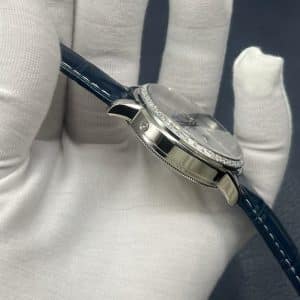
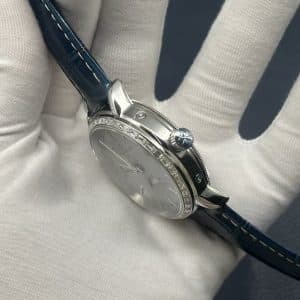
The 41 mm stepped round case carries a cool, metallic sharpness when lifted from the surface and then softens once it settles onto the wrist. Light touches the bezel in a thin, continuous ring, never flashing or scattering. The polished lugs behave differently—they take light in vertical strokes, emphasizing length rather than width, which stabilizes the visual balance of the large calendar layout. KM Factory’s machining keeps these transitions crisp enough that the case reads as a layered object, not a single mass of steel.
The watch wears thinner than its 12.9 mm thickness suggests. The center case visually sinks between the bezel and the stepped caseback, letting the calendar complexity remain visually centered and not top-heavy. This is where the Traditionnelle silhouette shows its advantage: formal, upright, but never rigid.
The Dial: A Controlled Map of Functions
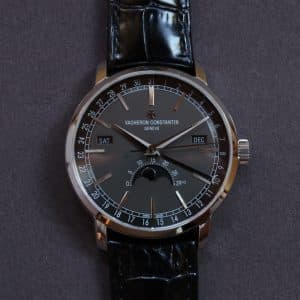
The dial of the 4010T complete calendar is a carefully aligned environment.
• Railway minute track gives the perimeter a framework, stabilizing the multiple calendar indications.
• Dauphine hands cut through the dial in two polished planes, catching light sharply at one angle and fading into silhouette at another.
• Day and month apertures, positioned at 9 and 3, create a lateral axis that divides the dial into two clean hemispheres.
• Peripheral date scale remains legible because the typography is thin, evenly spaced, and never competes with the hands.
• The black crescent date pointer introduces the only curve on the entire dial, adding a gentle piece of movement to a composition dominated by straight lines.
• Moon phase at 6 o’clock deepens the lower half of the dial, anchoring the visual weight and preventing the upper calendar windows from dominating.
KM Factory replicates all of these relationships in proportion—not only copying printing, but preserving spacing, alignment, and depth. Under angled light, the date numerals never appear crowded, and the moon-phase disc sinks just enough to create dimensionality without shadowing the surrounding surface.
Light, Texture, and the Quiet Behavior of a Formal VC Calendar
The 4010T generation behaves differently from the Patrimony or Overseas families. Traditionnelle is about structured order.
From a top view, the dial behaves like a technical instrument. But as the wrist moves, reflections soften the geometry and give the watch a warmer, more ceremonial presence. The silver dial does not glow; it diffuses. The polished hands and markers act as controlled reflectors, generating sharp but narrow highlights that remain readable even in low angles of light.
This controlled, almost academic approach to light is what gives the Traditionnelle its particular emotional register: calm, precise, learned, slightly formal, but never cold.
Movement Representation — The KM Factory 2460 Architecture
KM Factory uses its upgraded 2460-style automatic movement to reproduce the correct spatial layout associated with Vacheron Constantin’s in-house 2460 QCL. The bridges, gear locations, and rotor profile follow the geometry and behavior of the original architecture, giving the caseback the correct “VC mechanical density” rather than the open, flat appearance typical of lower-grade clones.
Winding feels smooth, without the abrupt mechanical jumps or resistance variations often found in non-Vacheron-based clones. The watch carries a clean central seconds behavior, stable date-index positioning, and consistent calendar engagement when transitioning near midnight.
This is one of KM’s strongest technical executions for the Traditionnelle category.
Wrist Personality & Dress Adaptation
On the wrist, the 4010T Complete Calendar behaves like a formal instrument rather than a decorative watch. The calendar functions create a sense of quiet capability—something designed to be used, not merely admired.
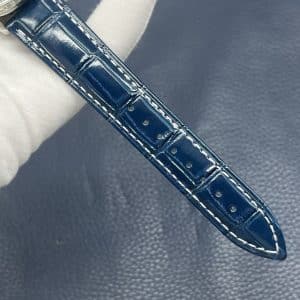
With darker leather, the look becomes archival and traditional. With blue alligator (as shown), the watch gains a subtle modernity without losing formality. The calendar display always remains the emotional center of the piece: calm—never urgent, never busy.
Why This Model Works Well as a Super Clone
Because the original 4010T relies on:
• exact spacing
• exact geometry
• exact step transitions
• exact calendar symmetry
…factory execution matters more than dial printing or lume tone. KM Factory’s strength is consistency of machining and alignment, making this particular model significantly closer to the genuine layout than many other VC complications.
Technical Data (KM Factory Specification)
Design Background
The Traditionnelle Complete Calendar 4010T in KM Factory form is a formal, stepped round calendar watch built around restraint rather than visual drama. The silver dial, day aperture at 9 o’clock, month aperture at 3 o’clock, peripheral date scale, and moon phase at 6 o’clock create a balanced complete-calendar layout that suits buyers who want the complication to read as organized, not busy. The blue alligator strap shown in the source adds contrast without changing the watch’s disciplined dress profile.
The stated 41 mm case size and 12.9 mm thickness place it firmly in dress-watch territory, with enough presence to carry the calendar display while still keeping the silhouette controlled. The stepped case architecture is part of the appeal here: it gives the watch structure and visual depth, which matters more on this model than flash or surface decoration. Exact case material is not specified in the source, so that point should be confirmed from the final product details or QC images.
KM Factory positions this version around dial symmetry, calendar spacing, and movement presentation. The 2460-style automatic architecture is referenced for layout and presentation rather than as a confirmed caliber match, so the key buyer question is consistency of alignment and finishing, not simply whether the watch has the complication. This is the right type of piece for formal wear, office rotation, and model comparison work where proportion matters more than spectacle.
Crystal type is not specified in the provided material. For this model, buyers should verify the dial print, calendar aperture alignment, hand finish, and strap presentation in photos, since those details decide whether the watch reads cleanly as a complete-calendar dress piece.
Watch Evaluation Highlights
KM Factory Positioning
This version is identified as a KM Factory build of the Traditionnelle Complete Calendar 4010T. The buyer value here is not a new layout, but the factory execution of the same formal calendar architecture: a disciplined complete-calendar display with emphasis on spacing, symmetry, and presentation consistency.
Case Geometry
The 41 mm stepped round case is the main design cue. Its layered structure is meant to keep the watch visually ordered rather than heavy, and the thickness is listed at 12.9 mm. Exact case material is not specified, so the surface finish and step transitions should be confirmed from photos rather than assumed.
Dial Layout and Readability
The complete calendar arrangement is set with day at 9 o’clock, month at 3 o’clock, a peripheral date scale with pointer hand, and moon phase at 6 o’clock. This is the part of the watch that needs the closest QC attention: window spacing, date track alignment, print clarity, and moon-phase centering all affect whether the dial reads as balanced.
Movement Presentation
The movement is described as a 2460-style automatic architecture, which should be treated as a presentation reference unless the exact caliber is separately confirmed. The practical buyer check is whether the movement view and calendar behavior match the stated layout without awkward spacing, loose visual alignment, or inconsistent finishing.
Wear Profile and Strap Context
The silver dial and blue alligator strap shown in the source give the watch a restrained formal profile with a slight color contrast. This is best for office wear, event wear, and dress rotation. It is not a casual sport watch, and the polished surfaces may show handling marks more readily than brushed cases.
QC Focus and Known Cautions
Check day and month windows, the date pointer track, moon-phase centering, hand finish, and the step transitions across the case. Calendar complications are alignment-sensitive, so small offsets matter more here than on simpler dress watches. Batch finishing can vary, and the blue strap appearance may differ by photo set.
QC Checklist
- Day window at 9 o’clock: Check that the day text sits centered in the aperture, with even left and right margins and no cropping at the frame.
- Month window at 3 o’clock: Verify the month display is level in the opening and matches the height and spacing of the day window on the opposite side.
- Peripheral date pointer: Confirm the pointer tip tracks the outer scale cleanly, lands directly on the intended numeral, and does not sit too far inboard or outboard.
- Moon phase at 6 o’clock: Look for a centered disc with balanced clearance inside the subdial and no visual tilt or off-center placement.
- Dial print spacing: Inspect the minute track and calendar text for even spacing, crisp edges, and any crowding around the apertures or lower dial.
- Hand stack and finish: Check that the hands are aligned at the hub, sit at clean heights without touching, and show even polished finishing on both surfaces.
- Case step transitions: Look for sharp, regular edges where the stepped case changes level, with smooth polishing and no wavy or softened transitions.
- Blue strap presentation: Confirm the strap sits straight at the lugs, the color reads consistently across photos, and the attachment points do not gap unevenly.
- Movement or setting video, if provided: Watch for smooth calendar engagement and stable hand motion, with no hesitation during date, day, or month changes.
Known Flaws
- Calendar aperture alignment: Inspect the day window at 9 o’clock and month window at 3 o’clock for level text, even margins, and no cropping inside the frames. This matters because the 4010T layout depends on left-right symmetry, and even a small offset can make the dial look less disciplined. Seriousness is moderate for most buyers and high for buyers focused on close-up QC accuracy.
- Date pointer and outer scale: Check that the pointer hand lands cleanly on the peripheral date numerals and follows the track without sitting too far inward or outward. The date scale is visually exposed around the dial edge, so misalignment is easy to notice in photos. Seriousness is moderate, especially if the pointer regularly falls between numerals.
- Moon phase centering: Confirm that the moon-phase display at 6 o’clock sits centered in its opening, with balanced clearance and no visible tilt. This lower dial element anchors the complete-calendar layout, so poor centering can disturb the whole vertical balance. Seriousness is moderate for most buyers, but it becomes high if the disc is visibly off-center.
- Dial print and marker spacing: Review the railway minute track, calendar text, and applied marker alignment for crisp edges and consistent spacing. The silver dial gives little visual cover for uneven printing, and this model relies more on order than decoration. Seriousness is low to moderate unless the print is blurred, tilted, or crowded near the calendar windows.
- Case thickness impression and stepped finishing: Compare side-view photos for clean step transitions, regular polishing, and a controlled 12.9 mm profile. The stepped case is a key part of the Traditionnelle look, so softened edges or uneven reflections can make the watch feel less structured. Seriousness is moderate, mainly affecting buyers who care about dress-case architecture.
- Strap fit and polished-surface marks: Check that the blue alligator strap sits straight at the lugs and that polished case surfaces do not show obvious handling marks in QC photos. Strap presentation affects the formal character of the watch, while polished areas can reveal marks more readily than brushed sports cases. Seriousness is usually low to moderate unless the strap gaps or visible marks are pronounced.
Best For / Not Ideal For
Best For
- Buyers who want a formal complete-calendar layout with day at 9 o’clock, month at 3 o’clock, a pointer date scale, and moon phase at 6 o’clock arranged in a balanced dial structure.
- Buyers comfortable with a 41 mm dress-case presence and a stated 12.9 mm thickness, especially if they prefer a structured case profile over an ultra-thin minimalist watch.
- Buyers drawn to a restrained silver dial with blue alligator strap context, where color contrast stays formal rather than sporty.
- Buyers comparing KM Factory Traditionnelle versions and willing to judge the watch through QC photos for aperture alignment, date pointer accuracy, moon-phase centering, and case-step finishing.
- Buyers who understand the movement is described as a 2460-style automatic architecture and want to evaluate presentation and setting behavior without assuming an exact caliber match.
Not Ideal For
- Buyers seeking a casual sports watch, rough daily-use piece, or low-maintenance design with minimal surfaces to inspect.
- Buyers who prefer smaller, thinner dress watches, since the 41 mm case and calendar dial give this model more visual presence than simpler Traditionnelle variants.
- Buyers who want instant dial simplicity; the complete-calendar display requires comfort with multiple indications and close spacing around the date track.
- Buyers who are highly sensitive to small alignment differences, because day and month windows, the date pointer, and moon-phase centering are all QC-critical on this layout.
- Buyers who do not want to review batch-specific finishing, strap fit, polished-surface marks, or movement-presentation details before deciding.
The Traditionnelle line represents Vacheron Constantin’s interpretation of classical watchmaking: thin cases, refined lugs, railroad minute tracks, and symmetrical dial layouts. In high-quality replicas, the most telling indicators of faithful execution are rarely found in broad specifications but in refined details—how crisply the applied indices sit against the dial surface, whether the hands maintain proportional balance, and how clean the edge finishing is between polished and brushed surfaces.
For buyers comparing super clones within the Traditionnelle collection, focus on concrete points that affect real-world presence: the quality of the dial texture under changing light, the precision of the minute track printing around the outer flange, and how smoothly the crown winds without resistance or wobble. These aspects often differentiate well-executed replicas from average pieces. For a structured approach to evaluating features that matter across Vacheron Constantin models, this Vacheron Constantin replica watches buying guide provides practical insight into identifying core quality traits before purchase.