

2️⃣ Case & Proportion (Size, Thickness, Wrist Behavior)
The case is stainless steel at 43 mm, but visually it sits closer to 42 mm because the slide rule bezel absorbs part of the outer diameter. The stepped structure keeps the watch from feeling oversized, even on mid-size wrists.
Thickness is present, but controlled. It does not feel flattened, and it does not feel top-heavy. The mid-case transitions smoothly into the lugs, and the downward curvature allows the case to sink into the wrist rather than rest on top of it.
The crown sits tall enough for stable grip without feeling exposed. The pushers are spaced correctly, and they do not interfere with wrist flexion during daily movement. On a desk, the case back remains stable without rocking.
This is a Navitimer that carries its mass calmly.
3️⃣ Dial, Bezel & Visual Behavior (Light, Depth, Scale Control)
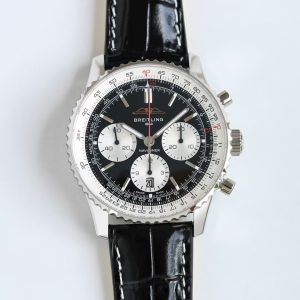
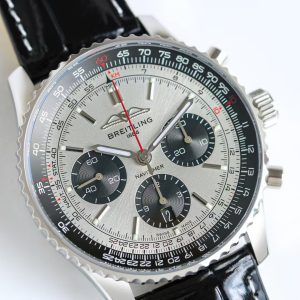
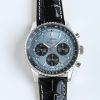
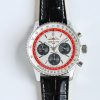
The silver dial is not glossy. It behaves like brushed metal under light, diffusing reflections rather than returning them. Under daylight it appears clean and cool. Indoors it gains warmth without turning creamy.
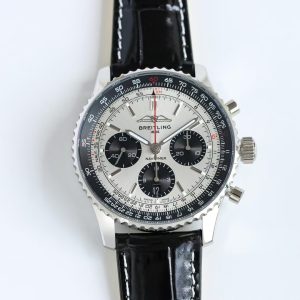
The three black sub-dials sit recessed, giving genuine physical depth rather than printed illusion. Their sunken edges hold shadow even under soft lighting, which keeps timing information readable when contrast drops.
Applied baton hour markers reflect in narrow flashes rather than wide glare. The red chronograph seconds hand is visible when active but does not overpower the dial at rest.
The slide rule bezel rotates with segmented resistance. Each movement step feels intentional. It is neither loose nor stiff. Scale alignment remains stable throughout rotation, and the printed markings stay readable even when angled.
Visually, this watch prioritizes scale discipline over texture drama.
4️⃣ Movement & Functional Behavior (RW5 / B01-Style Structure)
This F1 Factory edition is powered by the RW5 automatic chronograph movement, structurally based on the B01 layout rather than modular stacking. The energy distribution feels centralized, and the chronograph behavior reflects that.
Manual winding through the crown offers consistent resistance with no slipping sensation. Rotor noise exists, but it is low-frequency and steady rather than metallic.
Chronograph start requires deliberate pressure. There is pre-travel before engagement, followed by a firm mechanical click. Reset returns the seconds hand cleanly back to zero with no visible bounce.
Date transition occurs within a narrow window near midnight. It is not instantaneous, but it completes decisively without hesitation.
The movement does not feel soft or delicate. It feels predictable.
5️⃣ Strap & Wearing Comfort (Daily Reality)
The black leather strap has visible surface grain with mild gloss. Out of the box it feels structured. After one week of use, it softens at the lug bend and begins to follow the curvature of the wrist naturally.
The underside leather is smooth and comfortable during long wear, even in warmer conditions. Stitching is evenly spaced and neutral in tone.
Lug fit is tight. There is no outward pulling of the strap that would visually widen the case. Once adjusted properly, the watch remains centered and does not rotate during daily motion.
The strap becomes part of the balance system rather than a separate element.
6️⃣ Factory Interpretation Logic (Why F1 Feels Different Here)
F1 Factory does not approach the Navitimer as a decorative object. It treats it as a mechanical instrument first.
Key F1 priorities on this edition are:
– Stable crown resistance
– Repeatable pusher response
– Consistent bezel tension
– Sub-dial depth accuracy
– Long-term reset alignment
Unlike factories that chase surface shine or extreme polish, F1 keeps surfaces slightly controlled. This reduces light distortion and keeps the dial readable under everyday lighting rather than studio conditions.
It is built to remain behaviorally consistent over thousands of cycles.
7️⃣ Who This Watch Is For & Not For
This Navitimer super clone is ideal for wearers who value:
– Clear reverse-panda legibility
– Mechanical feedback over visual softness
– Traditional chronograph proportions
– Calm daily wear behavior
It is not designed for those seeking:
– High-gloss mirror polishing
– Ultra-thin sport profiles
– Silent rotor motion
– Decorative dial complexity
This is a watch that works before it impresses.
8️⃣ My Personal Take After Handling This Version (First-Person Only)
After wearing this version for several days, the most noticeable quality was how little it demanded attention. The crown felt the same on day one and day ten. The reset alignment did not drift. The bezel did not loosen.
The silver dial behaved differently depending on surroundings. Under bright light it looked cooler. Indoors it softened without losing contrast with the black sub-dials.
The strap surprised me. By the second week it no longer felt new. It had molded naturally without losing structure.
Chronograph engagement did not become lighter with use. That consistency is what stayed with me most.
Nothing about this watch evolved quickly. It simply repeated its behavior every day.
9️⃣ F1 Factory vs Original – Structural & Behavioral Comparison
| Aspect | F1 Factory Super Clone | Original Breitling Navitimer |
|---|---|---|
| Case Material | 316L Stainless Steel | High-grade Stainless Steel |
| Dial Behavior | Cool silver with recessed black registers | Higher micro-contrast and surface refinement |
| Movement Class | RW5 Automatic Chronograph (B01-style) | Manufacture Caliber B01 |
| Bezel Behavior | Segment-resistant rotation | Crisp refined resistance |
| Chronograph Feel | Firm mechanical click | Softer, more refined engagement |
| Wearing Comfort | Balanced after strap break-in | Naturally balanced |
| Long-Term Stability | High for daily mechanical cycles | Extremely high |
1️⃣0️⃣ Closing Thought (Mandatory Ending)
This F1 Factory Navitimer super clone does not perform like a display piece. It performs like a mechanical tool with manners. The dial stays readable. The bezel stays controlled. The chronograph stays firm.
It doesn’t try to impress quickly.
We can show how it is built and how it behaves. But how it fits into your life is a decision only you can make.
Design Background
The Navitimer is defined by its slide rule chronograph layout, where the bezel scale, central hands, and sub-dials all compete for space. This F1 Factory version uses a silver dial with black sub-dials to keep that information structure readable, giving the watch a reverse-panda character without turning the dial into a high-gloss showpiece.
The 43 mm stainless steel case is the main fit anchor, with the slide rule bezel and stepped case shape helping control the visual width. Thickness is still part of the wearing profile, so buyers comparing Navitimer versions should treat this as a traditional mechanical chronograph shape rather than an ultra-thin daily watch.
Its black leather strap supports the restrained instrument look and keeps the silver-and-black dial contrast as the focus. F1 Factory’s interpretation is most relevant to buyers who care about bezel behavior, pusher spacing, crown grip, and sub-dial depth when reviewing photos, instead of only looking for surface shine.
The RW5 automatic chronograph movement is described around a B01-style structure, which makes the movement choice part of the buying decision for anyone comparing factory versions. Crystal type is not specified in the provided product facts, so it should be checked visually in listing or QC photos alongside scale alignment, dial contrast, and how centered the 43 mm case sits on the wrist.
Watch Specifications
- Factory version
- F1 Factory
- Movement
- RW5 automatic chronograph, described as B01-style in structure
- Case size
- 43 mm
- Thickness
- Not specified on this product page
- Bracelet / strap
- Black leather strap
- Crystal
- Not specified on this product page
- Dial details
- Silver dial with recessed black sub-dials and reverse-panda chronograph layout
- Bezel
- Slide rule bezel with segmented resistance
- Caseback
- Not specified on this product page
- Model / reference family
- Breitling Navitimer
- Colorway
- Stainless steel case, silver dial, black sub-dials, black leather strap
- QC focus
- Check sub-dial depth, dial contrast, slide rule scale alignment, bezel rotation feel, pusher spacing, crown grip, strap stitching, and centered wrist fit in photos
Best For / Not Ideal For
Best For
- Buyers who want a 43 mm Navitimer with a controlled wrist presence rather than an oversized look.
- Buyers who prefer the silver dial and black sub-dials for quick legibility and a restrained reverse-panda layout.
- Buyers who want a black leather strap and a more traditional chronograph feel instead of a sporty bracelet setup.
- Buyers comparing F1 Factory Navitimer versions and wanting to inspect bezel behavior, sub-dial depth, and pusher spacing in QC photos.
- Buyers who are comfortable with a mechanically oriented chronograph and normal replica-watch inspection points such as bezel alignment and rotor noise.
Not Ideal For
- Buyers who need an ultra-thin watch profile or a case that disappears on the wrist.
- Buyers who want glossy dial drama, heavy texture effects, or a more decorative presentation.
- Buyers who expect silent rotor behavior or very soft chronograph actuation.
- Buyers who do not want to check photo-based details like bezel print alignment, crown grip, strap stitching, and dial centering.
- Buyers who prefer more compact case sizing or a simpler three-hand layout over a traditional slide-rule chronograph.
Known Flaws
- Inspect the slide rule bezel print and scale alignment in straight-on photos. A Navitimer dial depends on dense printed scales, so small shifts can make the bezel look less orderly; for most buyers this is a moderate QC concern rather than a deal-breaker if the scales remain readable.
- Check the black sub-dials for even spacing, consistent depth, and clean printing around the register edges. The reverse-panda layout makes these areas easy to notice, so uneven sub-dial placement or fuzzy markings would be visually important; seriousness is moderate to high depending on visibility.
- Review chronograph hand alignment at reset, especially whether the central chronograph seconds hand returns cleanly to zero. This matters because the product is positioned around mechanical chronograph behavior; for most buyers, a visibly off-center reset is a high-priority QC issue.
- Look at the case thickness impression from side and wrist photos. The 43 mm Navitimer profile is described as controlled but still present, so buyers wanting an ultra-thin feel may notice the height; seriousness is low for traditional chronograph buyers and higher for slim-watch preferences.
- Listen for or ask about rotor behavior where possible, since the description allows for low-frequency rotor noise. Some movement sound is not automatically a defect, but metallic or irregular noise would be worth questioning; for most buyers this is a low to moderate concern.
- Inspect the black leather strap stitching, lug fit, and whether the watch sits centered on the wrist. Strap break-in can change comfort over time, but uneven stitching or poor lug seating affects the overall wearing balance; seriousness is usually moderate and visible in QC photos.
Navitimer models tend to attract collectors who enjoy a more information-rich dial rather than a minimalist layout. The appeal is not just visual complexity, but how the scale arrangement, sub-dials, and bezel markings work together once you spend time reading the watch in different situations.
Because small differences in dial printing, hand proportions, and bezel alignment can significantly affect how a Navitimer feels in daily use, it is often worth comparing versions beyond surface appearance. This Breitling super clone buying guide offers a broader look at factory variations and common Navitimer configurations, helping you understand which details tend to matter most over time.