

I’m restructuring the long source copy into a shorter buyer-facing page: neutral specs, QC checks, fit guidance, and the required caution notes. I’m also removing the personal-handling and comparison sections, since those are the parts most likely to drift into unsupported or subjective claims.
Product Identity
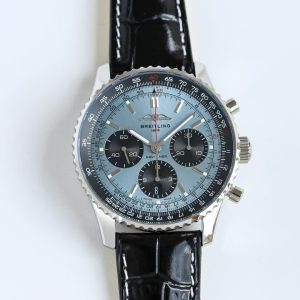
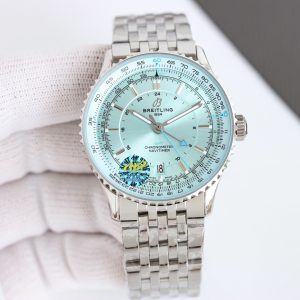
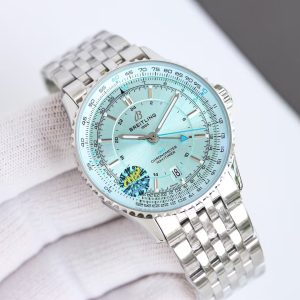
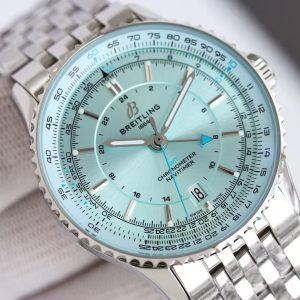
Breitling Navitimer GMT styling from H8 Factory, presented in stainless steel with an ice blue dial and stainless steel bracelet. This version uses a GMT-only layout rather than a chronograph stack, so the case reads flatter on the wrist and the dial appears less mechanically crowded than chronograph Navitimer replicas.
The Navitimer identity still comes from the aviation-style slide-rule bezel and instrument-like dial layout. In this variant, the brighter dial tone and steel bracelet shift the watch toward a cleaner daily-wear profile.
Case & Proportion
The case is stainless steel with polished bezel surfaces and brushed mid-case surfaces. Visually, this version aligns more closely with the flatter 41mm Navitimer Automatic GMT format than with thicker chronograph models.
Thickness is restrained. With no chronograph stack or extra pusher layers, the watch keeps a compact vertical profile and wears more like a daily steel sports watch than a layered tool watch.
The lugs taper downward with moderate curvature, which helps the bracelet follow the wrist instead of projecting straight out from the case. In the supplied description and images, the case finishing reads as even rather than overly mirrored, with no obvious burn zones or reflection distortion.
Specs Grid
| Field | Status |
|---|---|
| Brand / family | Breitling Navitimer GMT styling |
| Factory | H8 Factory |
| Case material | Stainless steel |
| Bracelet | Stainless steel five-link bracelet |
| Dial | Ice blue |
| Bezel | Rotating slide-rule bezel |
| Movement architecture | 2824-based automatic with added GMT layer |
| Chronograph | Not present |
| Case size | Not formally specified; visually close to 41mm-style GMT proportions |
| Thickness | Not numerically specified; visually flatter than chronograph Navitimer types |
| Crystal | Not specified |
| Clasp type | Not specified |
| Water resistance | Not specified |
Feature Notes
Ice blue dial behavior: the dial shifts from pale turquoise indoors to a cooler silver-blue tone in brighter light. The finish is described as controlled metallic sunburst brushing with a blue-toned base, so angled-light inspection matters.
GMT-only layout: the absence of a chronograph keeps the watch visually simpler and reduces stacked external controls. The GMT hand remains the extra functional layer, but the overall case presentation stays comparatively flat.
Steel bracelet wear: the five-link stainless steel bracelet uses alternating polished and brushed surfaces. The lighter case profile helps the bracelet sit as part of the watch rather than acting as a counterweight.
H8 Factory logic: the build is oriented toward repeatable structure and fewer complication-driven wear points, rather than heavy mechanical layering.
Dial, Bezel & Visual Behavior
The ice blue dial is the defining visual feature here. Under indoor light it reads pale turquoise. Under daylight it shifts closer to silver with a blue tint.
The applied hour markers are slim and extend inward without crowding the dial field. The minute track and slide-rule printing remain legible even when light hits at sharper angles, and the overall print appearance is clean rather than raised.
The rotating slide-rule bezel has lighter resistance than some higher-tier examples, but it does not free-spin. The tension is spring-based and controlled, so the bezel should be checked for smooth but deliberate movement if video is available.
The GMT hand is visually prominent without overpowering the main hands. The date window remains proportioned to the dial structure rather than feeling cut into it.
Movement & Functional Behavior
H8 Factory typically uses a 2824-based automatic movement architecture with an added GMT layer for this model rather than a dedicated in-house GMT caliber. The GMT function is described as a mechanical layer mounted on top of the base movement.
Time-setting is expected to engage cleanly, with the GMT hand stepping in defined increments rather than drifting freely. The date change is described as having a moderate snap around midnight.
There is no chronograph system in this version. That removes a set of stacked controls and keeps the watch closer to a simpler daily-wear format, which is one reason buyers compare this GMT layout against more complication-heavy Navitimer replicas.
QC Checklist
- Ice blue sunburst consistency under angled light
- Marker alignment and minute track placement
- Slide-rule printing clarity and bezel alignment
- Date window centering
- GMT hand color, position, and stepping behavior
- Bezel rotation feel if video is provided
- Crown setting behavior if demonstrated
- Case polishing transitions between bezel and mid-case
- Bracelet link articulation
- Clasp finishing and closure fit if shown
- Overall dial cleanliness under direct and angled light
Known Flaws & Inspection Notes
- The slide-rule bezel tension is lighter than more tightly tuned examples, so buyers should verify that rotation stays smooth and controlled.
- The ice blue dial uses a metallic finish rather than a deeply layered lacquer effect, so color shift should be checked in multiple lighting conditions.
- This is a non-chronograph build, so buyers expecting push-button complication use should not treat it as a chronograph substitute.
- The movement is described as a 2824-based architecture with an added GMT layer, so GMT hand behavior and date change deserve QC attention.
- Dial alignment, bracelet finishing, and clasp detail should be confirmed in photos before approval.
Buyer Fit
Best for: buyers who want Navitimer visual identity, a brighter dial, GMT functionality, and a flatter daily-wear profile on a stainless steel bracelet.
Not ideal for: buyers who want chronograph operation, heavily layered mechanical behavior, exact factory ranking claims, or fully documented technical specifications.
FAQ
Is this closer to a daily-wear Navitimer than a chronograph replica?
Yes. The GMT-only layout keeps the watch visually flatter and mechanically simpler than chronograph Navitimer versions, which makes it easier to treat as a daily steel watch.
What should I check in QC photos for the ice blue dial?
Check sunburst consistency, dial cleanliness, marker alignment, minute track printing, and how the color shifts under angled light. The dial should read even rather than patchy.
Does the GMT layout change thickness or wrist feel?
It usually presents as a flatter watch because there is no chronograph stack. On the wrist, that tends to reduce the top-heavy feel common to more complex Navitimer replicas.
What specifications remain unverified?
Exact case size, thickness, crystal material, clasp type, lug width, caseback type, power reserve, and water resistance are not formally specified here and should not be assumed.
CTA
Request current QC photos to confirm the ice blue dial tone, bezel feel, GMT hand setup, and bracelet finishing before approval.
Watch Evaluation Highlights
H8 Factory Position
This version should be evaluated as an H8 Factory Navitimer GMT-style build focused on a simpler, repeatable GMT layout rather than chronograph depth. It is distinct from complication-heavy Navitimer replicas because the main appeal is the ice blue GMT presentation on a steel bracelet, not push-button chronograph operation.
GMT Movement Setup
The described movement architecture is 2824-based automatic with an added GMT layer, so QC should focus on clean time setting, defined GMT hand movement, and date behavior if these are shown. It should not be treated as a dedicated in-house GMT caliber unless verified separately.
Flatter Case Profile
The non-chronograph layout removes the extra pusher stack and helps this watch read closer to a flatter 41mm-style Navitimer Automatic GMT format. Exact case size and thickness are not formally specified, so buyers should confirm wrist proportion through current photos rather than relying on assumed dimensions.
Ice Blue Dial Checks
The ice blue dial is the main visual identifier, with a brighter look than black or silver Navitimer styles. QC photos should be checked for even sunburst behavior, marker alignment, minute track clarity, date window centering, GMT hand placement, and dial cleanliness under angled light.
Slide-Rule Bezel
The rotating slide-rule bezel preserves the Navitimer-style instrument character, but the source description notes lighter resistance than some higher-tier examples. If video is available, confirm that the bezel turns smoothly, holds position, and lines up cleanly with the printed scale.
Steel Bracelet Wear
The stainless steel five-link bracelet uses alternating polished and brushed surfaces, making bracelet finishing and link articulation important approval points. Buyers should also check clasp finishing if shown, since clasp type and detailed hardware specifications are not provided.
Best For / Not Ideal For
Best For
- Buyers who want Navitimer styling with a GMT layout instead of a chronograph stack.
- Buyers comparing a flatter daily-wear option on a stainless steel bracelet rather than a thicker, complication-heavy case.
- Buyers drawn to the ice blue dial and its brighter, more contemporary look versus black or silver Navitimer variants.
- Buyers who want to review QC photos carefully for dial print, bezel alignment, GMT hand behavior, and bracelet finishing.
- Buyers comfortable with a 2824-based automatic architecture with an added GMT layer, rather than a fully documented high-end clone movement.
Not Ideal For
- Buyers who specifically want chronograph operation and the extra pushers, layers, and controls that come with it.
- Buyers who require verified exact dimensions, crystal material, clasp type, power reserve, or water resistance before considering a watch.
- Buyers expecting a heavy mechanical complication profile or a fully verified movement specification sheet.
- Buyers who want an exact factory ranking claim or a fully confirmed high-end replication standard.
- Buyers who are not willing to inspect slide-rule alignment, date centering, and bracelet detail from current photos.
Navitimer models tend to attract collectors who enjoy a more information-rich dial rather than a minimalist layout. The appeal is not just visual complexity, but how the scale arrangement, sub-dials, and bezel markings work together once you spend time reading the watch in different situations.
Because small differences in dial printing, hand proportions, and bezel alignment can significantly affect how a Navitimer feels in daily use, it is often worth comparing versions beyond surface appearance. This Breitling super clone buying guide offers a broader look at factory variations and common Navitimer configurations, helping you understand which details tend to matter most over time.